Market updates and conversation from TheStreet Pro team. Follow the latest and join the conversation below.
Stock Market Today: November 4, 2026
Newest first · All times Eastern · 5 updates
DATE:
By Neil Sethi
Updates From Q4 GDP Trackers
After today’s data the two Q4 GDP trackers that updated are telling different stories, which is not unusual at this point in a quarter.
After this morning’s trade report, Goldman Sachs raised its Q4 GDP tracking estimate by 0.1 percentage point to 1.9%, citing a trade deficit that “narrowed by $0.7bn to $105.0bn in September, below expectations.”
Goldman doesn’t provide a component breakdown of their GDP tracker.
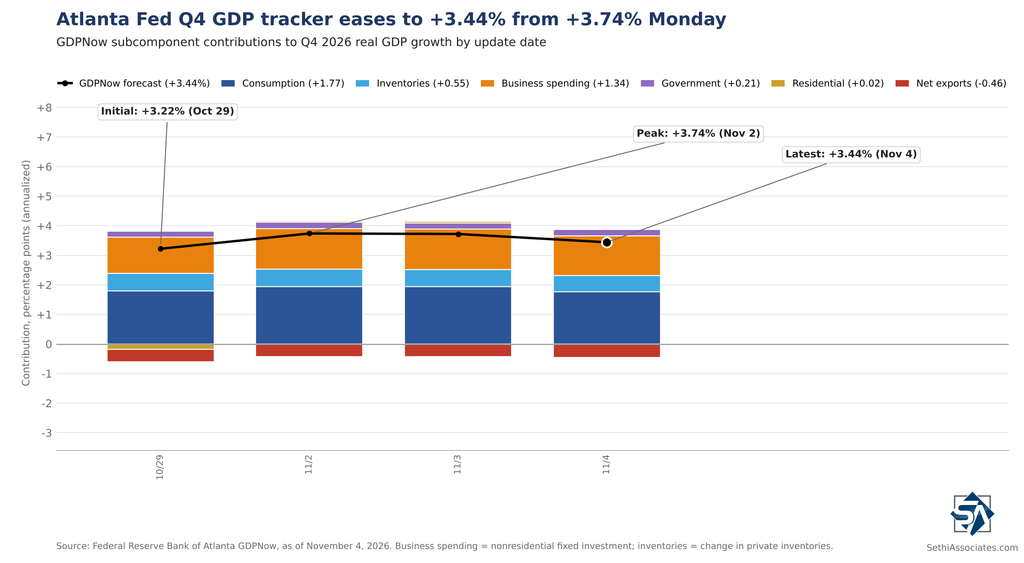
The Atlanta Fed’s GDPNow, meanwhile, eased to 3.44% as of November 4, down from 3.74% on November 2 but still above its 3.22% initiation on October 29. It was driven mostly by a 0.17 percentage point pullback in the contribution from consumption (to 1.77 points from 1.94), with smaller declines in inventories (−0.05 point), net exports (−0.04) and residential investment (−0.03).
That leaves Goldman just below the Blue Chip consensus* of roughly 2.1% and GDPNow well above it, a gap of about 1.5 percentage points between the two.
History suggests the gap is more likely to close from the Atlanta Fed’s side. Its tracker started very strong in each of Q1, Q2 and Q3 before falling sharply as we approached the actual GDP reads: Q1 went from 3.13% to 1.99%, Q2 from 3.70% to 1.50%, and Q3 from 4.95% to 3.37% (more here: GDPNow Tracking Slowdown in Q4). Its first reading for a quarter has come in above the actual print in 34 of the last 57 quarters (excluding 2020). Goldman, for its part, was at 3.30% for Q3 the week before the release, within a tenth of the actual 3.37%, although its tracker has started the last two quarters below where it ended up.
Here’s GDPNow’s breakdown of the components as of November 4 and changes from my last update November 2:
Investor ‘Fear’ Is Dropping the Most Since April 2025
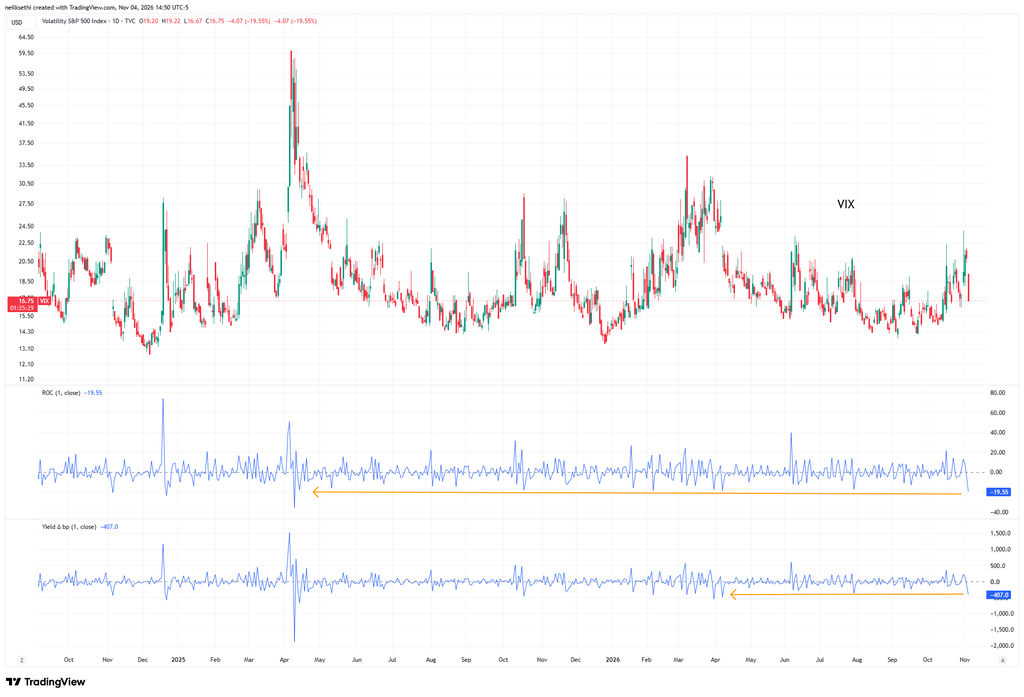
The Cboe Volatility Index (VIX), often called Wall Street’s “fear gauge,” is down about 20% this afternoon to around 16.75. If that holds into the close, it would be the biggest one-day percentage drop since April 2025. The roughly 4-point decline is also the largest since this past April.
The VIX tracks how much volatility options traders expect in the S&P 500 over the next 30 days. A drop this sharp usually means investors are taking hedges off after a known risk has passed, not that the market has become safe. It puts the VIX back below its long-run average of about 19, which leaves room for it to rise if stocks lose ground again.
Blue Wave Puts Data Centers in the Crosshairs, but Wall Street Sees Delays, Not a Halt
Ahead of the election, there was much concern about the impact of a “Blue Wave” Democratic sweep on equities, particularly those related to the AI trade given the expressed desire from many Democratic candidates to slow the growth of data centers.
Predictably, as early returns showing just such a result came in Tech stocks fell with Nasdaq-100 futures down about 1.5% at midnight, but as of this morning, traders were rethinking things with those futures now higher and the S&P 500 indicated to open up around 1.2%. Meta Platforms (META), Amazon (AMZN), Nvidia (NVDA) and Alphabet (GOOGL) all trading higher before the open Bloomberg reported.
That may be because the first read from most analysts is that the Democratic sweep slows the AI data center buildout rather than stops it.
A Bigger Sweep Than Expected
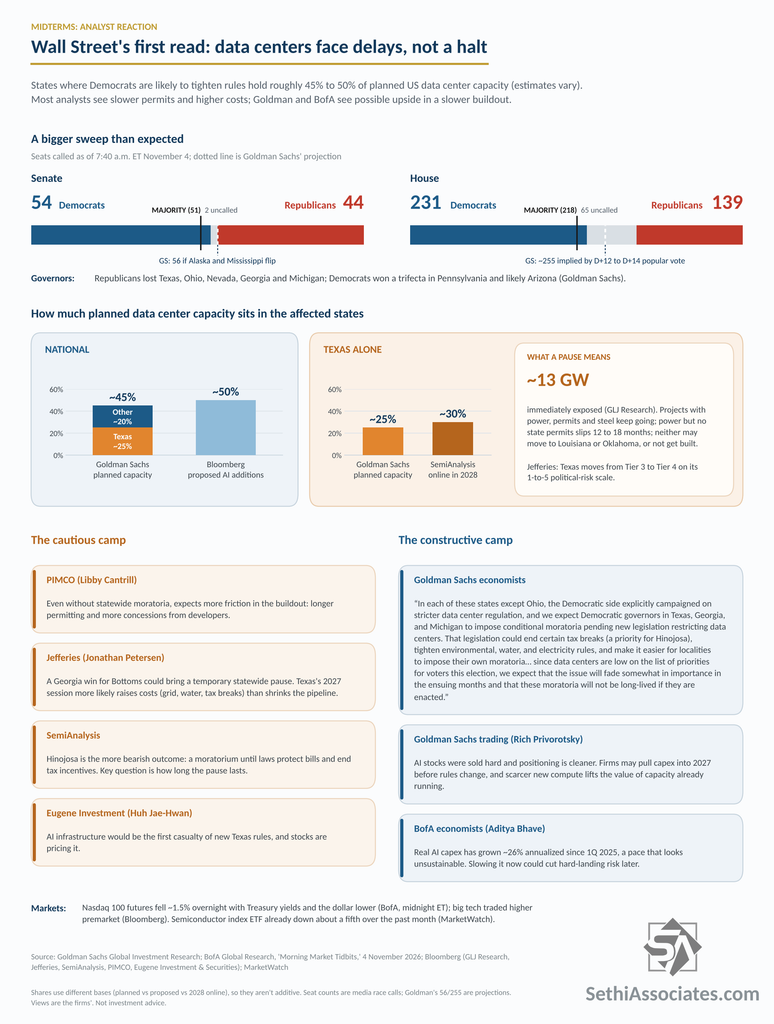
Bloomberg reports that 54 Senate seats (a majority) are now in the hands of the Democrats with Alaska likely to follow (according to Goldman) and Mississippi a coin toss. In the House, Goldman sees a popular-vote margin of roughly 12 to 14 points, consistent with a majority of around 255 seats (Bloomberg has that currently at 232 Democrats). Its economists don’t think the Senate flip changes the federal outlook much, since the House was already expected to turn.
The bigger change perhaps is in the statehouses. Republicans lost governor’s races in Texas, Ohio, Nevada, Georgia and Michigan, and Democrats won full control in Pennsylvania and likely Arizona.
How Much of the Buildout Is Exposed
Goldman estimates the states likely to tighten data center rules hold about 45% of planned U.S. capacity, with Texas alone about 25%. It expects Democratic governors in Texas, Georgia and Michigan to impose conditional moratoriums until new laws pass, which could end tax breaks and tighten water, power and environmental rules.
Texas is currently a key state for the buildout. Bloomberg cites SemiAnalysis putting Texas at nearly 30% of the U.S. capacity due online in 2028, and GLJ Research estimating about 13 gigawatts there is immediately exposed. GLJ expects fully permitted projects with power to keep going, while those with power but no state permits slip 12 to 18 months. Jefferies thinks new Texas rules are more likely to raise development costs than to materially shrink the pipeline, and PIMCO’s Libby Cantrill expects “a lot more sand in the gears” even without statewide moratoriums.
Similarly Goldman says Ohio was one state where Democrats didn’t run explicitly on tighter data center rules, but Bloomberg notes Governor-elect Amy Acton has called for a conditional moratorium, which matters for the cluster of projects around Columbus.
Jefferies: new Texas rules are more likely to raise development costs than to materially shrink the pipeline.
PIMCO’s Libby Cantrill expects “a lot more sand in the gears” even without statewide moratoriums.
Goldman: “In each of these states except Ohio, the Democratic side explicitly campaigned on stricter data center regulation, and we expect Democratic governors in Texas, Georgia, and Michigan to impose conditional moratoria pending new legislation restricting data centers. That legislation could end certain tax breaks (a priority for Hinojosa), tighten environmental, water, and electricity rules, and make it easier for localities to impose their own moratoria….since data centers are low on the list of priorities for voters this election, we expect that the issue will fade somewhat in importance in the ensuing months and that these moratoria will not be long-lived if they are enacted.”
So the thinking so far: slower permits and higher costs, not a shutdown.
The Positive Angle
Not everyone reads this as bad news. BofA economist Aditya Bhave notes real AI-related capital spending has grown at about a 26% annualized pace since the first quarter of 2025, a front-loaded wave he calls “symptomatic of over-investment.” Slowing it now, he argues, could lower the risk of a harder landing later.
Goldman’s head of European equities trading, Rich Privorotsky, told clients AI stocks had been “sold to death” into the vote, according to MarketWatch. He thinks companies may pull spending into 2027 to lock in today’s permitting, and that limits on new supply make capacity already running more valuable, which favors Amazon, Microsoft (MSFT) and Alphabet. For neocloud providers such as CoreWeave (CRWV) and Nebius (NBIS), he says it depends on how much of their compute is contracted versus already built. Privorotsky also expects volatility to fall quickly now that the election is over.
Beyond Data Centers
On fiscal policy, Goldman expects Democrats to reverse last year’s spending cuts, adding about 0.25% of gross domestic product to 2027 spending, per MarketWatch. The first test is December 11, when government funding runs out; Goldman sees a short-term extension to February or March as most likely. Corporate America is also bracing for a wave of congressional investigations once Democrats gain subpoena power, the Financial Times reports.
Treasury’s Quarterly Refunding announcement is out, setting auction sizes for the coming quarter. The sizes came in as expected, but the long end jumped on the release before settling back with several factors to blame for disappointment from bond bulls.
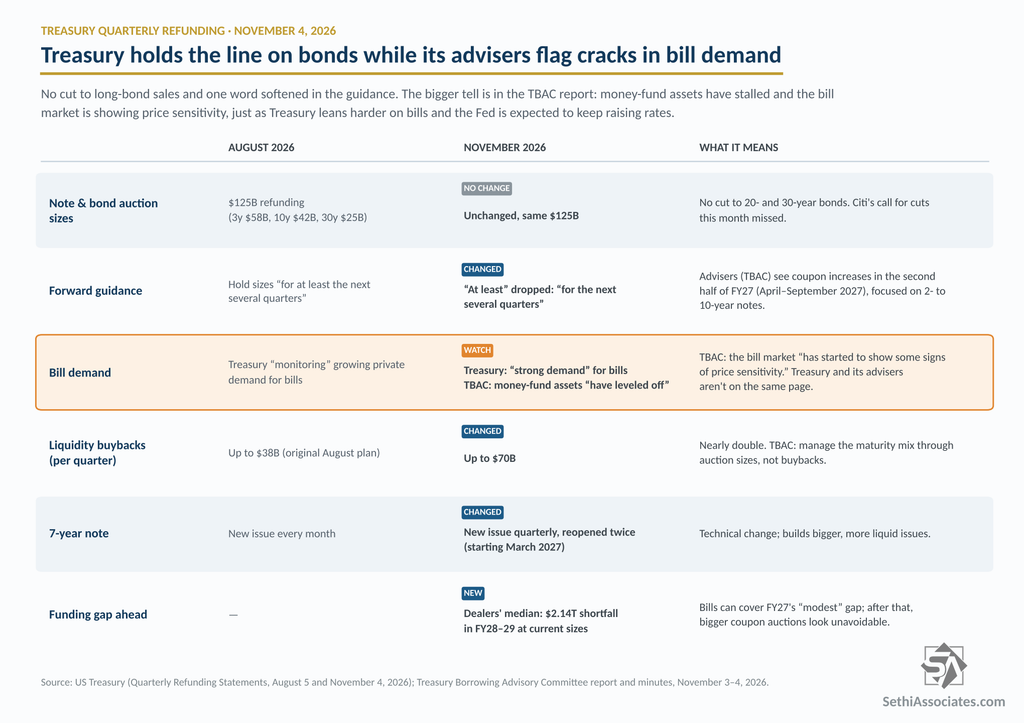
First, Treasury kept note and bond auction sizes unchanged at $125 billion for next week’s refunding auctions of 3-, 10- and 30-year securities. That means no cut to 20- and 30-year bonds, which some, including Citi, had expected this month. Treasury also repeated that it continues to see “strong demand” for bills.
Treasury also softened its guidance to holding auction sizes “for the next several quarters,” dropping “at least.” Starting in March 2027, the 7-year note will move to a new issue each quarter with two reopenings.
Second, the Treasury Borrowing Advisory Committee (TBAC), a panel of Wall Street bank and investor executives that advises Treasury on its debt sales, sounded less sure about that. In its report, the committee said money market fund assets “have leveled off” and that the bill market “has started to show some signs of price sensitivity.”
The committee also recommended larger coupon auctions in the second half of fiscal 2027 (April through September 2027), focused on 2- to 10-year notes, with “meaningful discussion” about future 20- and 30-year sizes. According to the meeting minutes, dealers see a $2.14 trillion funding shortfall in fiscal 2028 and 2029 at current auction sizes. Bills can cover fiscal 2027’s “modest” gap, but not that much.
The committee further advised that the mix of maturities should be managed through auction sizes, not buybacks. That came even as Treasury nearly doubled its planned liquidity buybacks this quarter, to as much as $70 billion from $38 billion in August’s plan.
As I noted in Monday’s post, bills could reach close to 24% of marketable debt by March, the highest since late 2020. The Fed has already hiked once, and markets price over two more increases over the coming year, according to the committee. If bill buyers also start demanding higher yields, it would be a double whammy for Treasury’s interest costs.
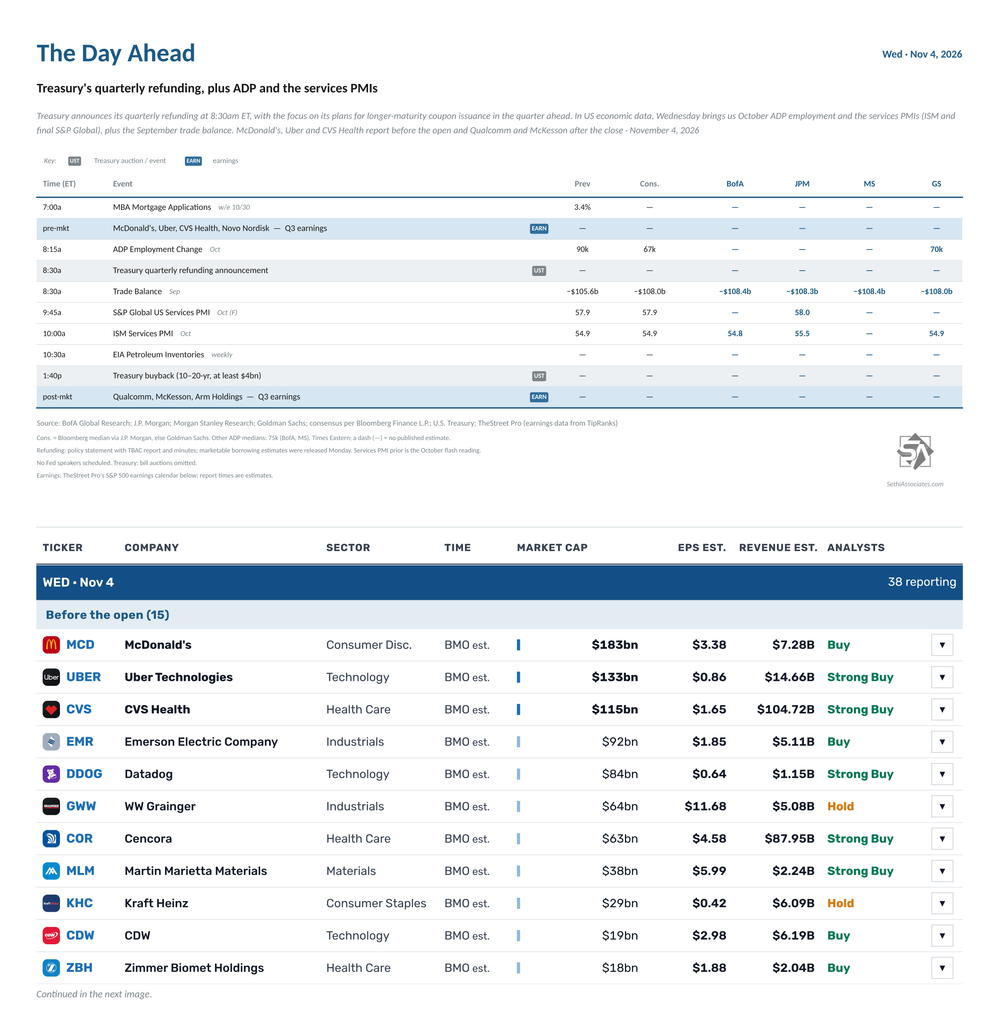
The Day Ahead: Election Results, Refunding, ADP and Services PMIs
In US economic data, Wednesday brings us October ADP private employment growth and the services PMIs (ISM and final S&P Global), plus the September trade balance. We’ll also get weekly MBA mortgage applications and EIA petroleum inventories.
There are no Fed speakers scheduled.
There are no non-Bill (>1yr in maturity) US Treasury auctions, but Treasury announces its quarterly refunding at 8:30am ET, with the focus on its plans for longer-maturity coupon issuance in the quarter ahead. It also holds a buyback of 10- to 20-year securities in the afternoon.
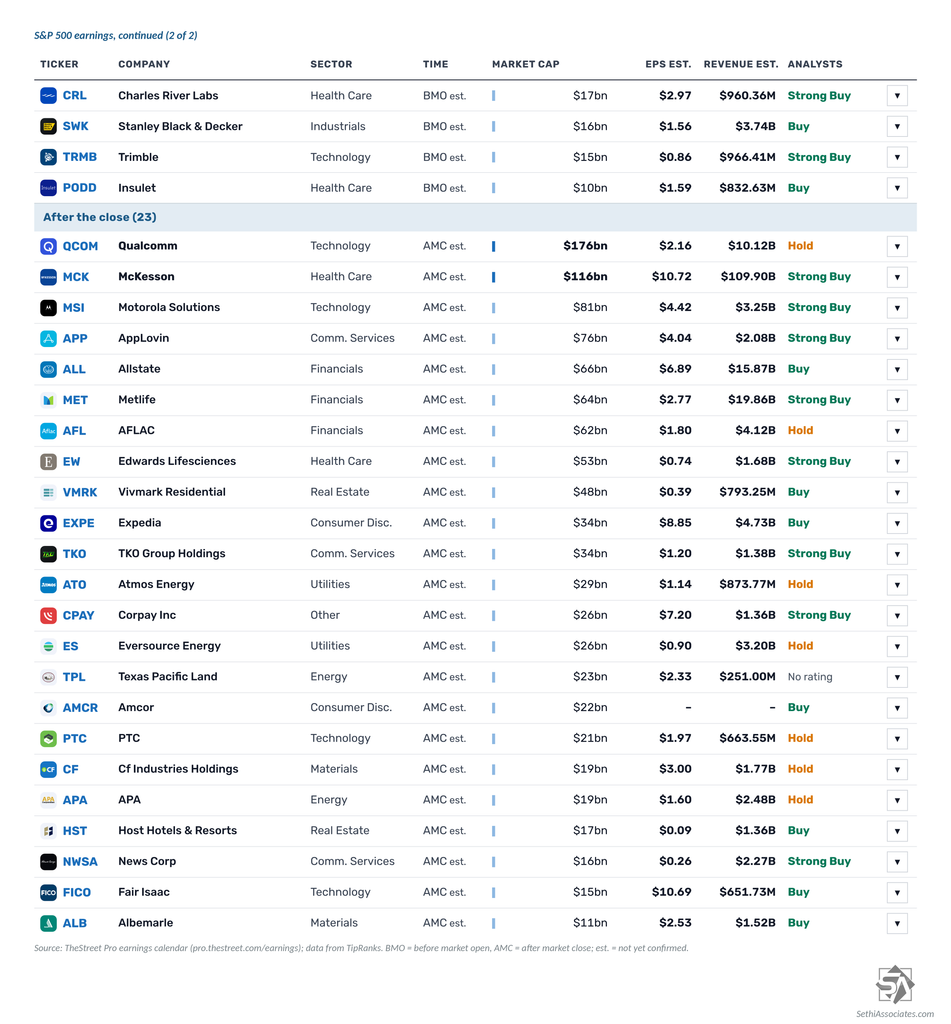
38 S&P 500 components report, five of them with market caps over $100B:
Before the open: McDonald’s (MCD), Uber (UBER), CVS Health (CVS), Emerson Electric (EMR), Datadog (DDOG), W.W. Grainger (GWW), Cencora (COR), Martin Marietta Materials (MLM), Kraft Heinz (KHC), CDW (CDW), Zimmer Biomet (ZBH), Charles River Laboratories (CRL), Stanley Black & Decker (SWK), Trimble (TRMB) and Insulet (PODD)
After the close: Qualcomm (QCOM), McKesson (MCK), Motorola Solutions (MSI), AppLovin (APP), Allstate (ALL), MetLife (MET), Aflac (AFL), Edwards Lifesciences (EW), Vivmark Residential (VMRK), Expedia (EXPE), TKO Group (TKO), Atmos Energy (ATO), Corpay (CPAY), Eversource Energy (ES), Texas Pacific Land (TPL), Amcor (AMCR), PTC (PTC), CF Industries (CF), APA (APA), Host Hotels & Resorts (HST), News Corp (NWSA), Fair Isaac (FICO) and Albemarle (ALB)
Outside the S&P 500, Novo Nordisk (NVO) reports before the open and Arm Holdings (ARM) and MercadoLibre (MELI) after the close.
Also, opening arguments are scheduled in a Los Angeles trial over claims that Meta (META) and Snap (SNAP) designed their platforms to be addictive and harmful to young users, per Bloomberg.
Ex-US highlights include the final October services PMIs (including China’s RatingDog services PMI), Eurozone October CPI, Spain’s October unemployment rate, UK October official reserves changes and Canada’s September trade balance. There are rate decisions from Sweden’s Riksbank, Poland and Brazil, the ECB releases its wage tracker, ECB Chief Economist Lane and Bank of France Governor Moulin speak, and the Bank of Japan releases the minutes of its September meeting.

Conversation 0 Comments
One ongoing discussion across all days. Everyone can read; sign in to take part.
Your voice matters. Discussions are moderated for civility. Read our guidelines .
Log in to join the conversation