Tech Leads S&P And Nasdaq to Best Days since Early August
Tech’s continued rebound along with falling oil prices and Treasury yields drove a powerful rally to start the week.
You've reached your free article limit
You've read 0 of 1 free Pro articles.
A quick note before we get to today’s summary.
Starting tomorrow, I will be retiring the morning update.
TheStreet Pro already offers extensive coverage from Pro columnists (something that obviously wasn’t available for Neil’s Newsletter), so I’d rather put that time toward finding great investment ideas for TheStreet Pro’s members.
Each day I’ll take one stock — a name that’s in the news, or better yet, one a reader has asked me to look at — and run it through the same checks I use when I’m deciding where to put my own money.
Have a name you want examined? Email me at [email protected]. Reader requests go to the front of the line. The only caveat is that it has to be one with sufficient analyst coverage that I can get a clean read on Wall Street expectations and fundamentals.
Quick Summary
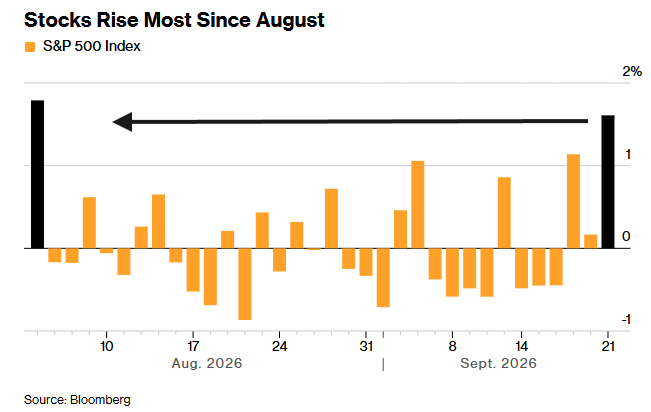
- A continued rebound in Tech (see the Week Ahead – Can Tech Lead the Market Higher?), along with a fourth day of falling oil prices, and joined Monday by softening bond yields, drove a rally to open the week, the best for the S&P 500 and Nasdaq since early August.
- Growth stocks drove the Nasdaq to a 2.3% gain and its first record close since June. Tech was already riding momentum from last week and was boosted by NVIDIA (NVDA) CEO Jensen Huang pushing back against AI safety concerns in a weekend interview, saying there is a “0% chance” AI ends the world by 2030 and arguing in favor of continued development. President Trump similarly reiterated his support for continued AI development, while preliminary U.S.-China discussions ahead of this week’s meeting between President Trump and Chinese President Xi Jinping were characterized as establishing a formal dialogue around AI, with Reuters reporting that the two sides are expected to meet again in two months to discuss AI safety. The absence of an agreement to slow development provided a supportive element for today’s rally.
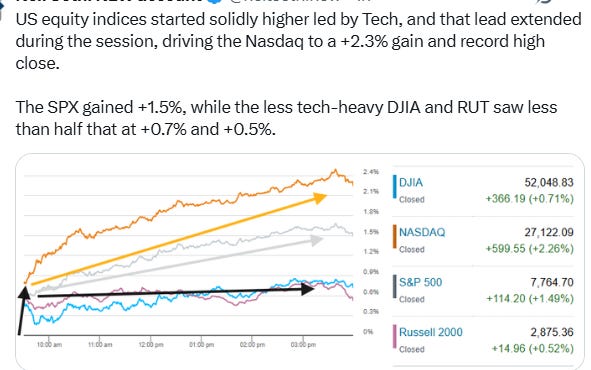
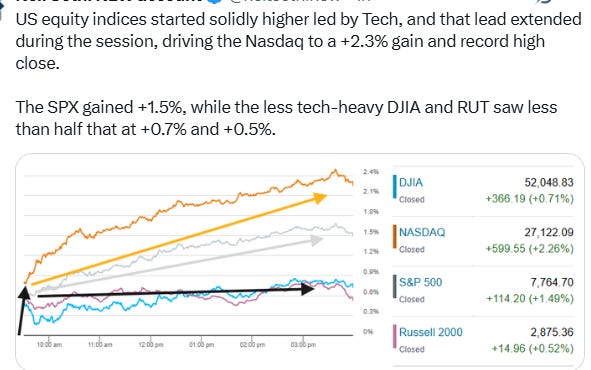
- The S&P 500 would gain 1.5%, while the less tech-heavy Dow Jones Industrial Average and Russell 2000 saw less than half that at 0.7% and 0.5% respectively.
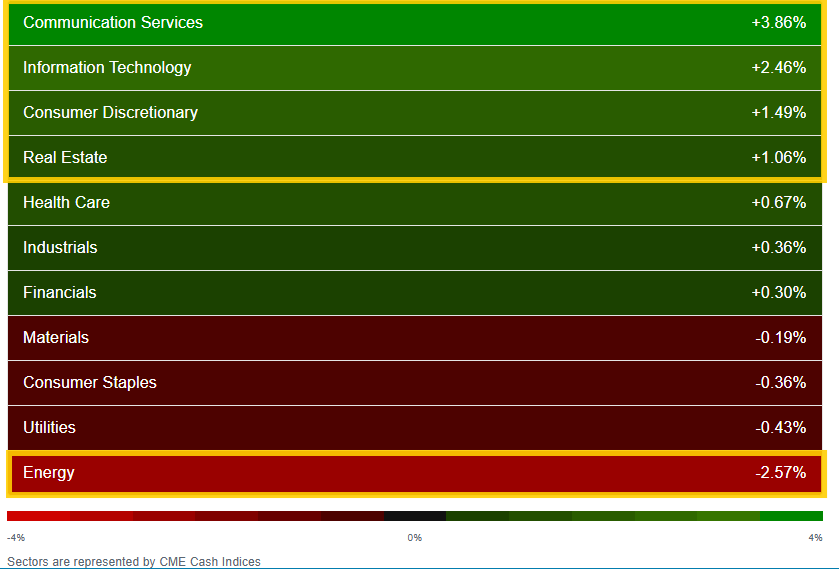
- Breadth strengthened with 7 of 11 sectors higher, but it was the megacap-growth sectors (Communications, Tech, and Consumer Discretionary) which took the top three spots, the first two up over 2% and doing much of the heavy lifting.
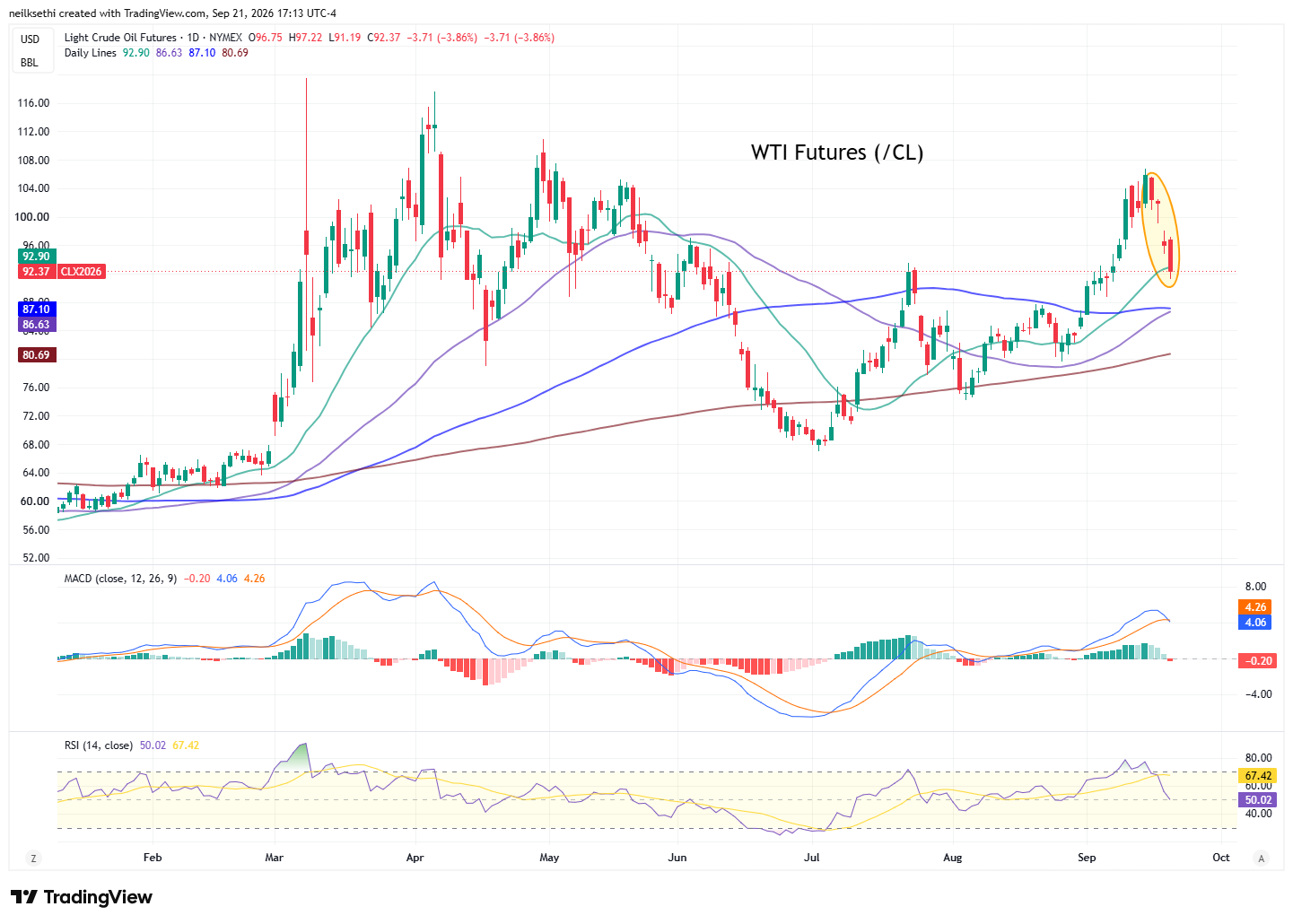
- WTI dropped 4.5% to ~$96 during the cash session and Brent slid below $101, as the 10-year yield shed more than 4 basis points to 4.95%.
Market Commentary
Equities:
- The “feedback from the talks between China and the US is feeding a positive narrative as the week begins,” said Alexandre Baradez, chief market analyst at IG in Paris. “That said, for me oil prices remain the key driver.”
- “Sentiment has started the week on a strong footing, with the bias for that to continue as trade negotiations culminate in Thursday’s Trump-Xi summit. Major central bank meetings are in the rearview mirror, Brent is falling for a fourth straight day and Bessent struck a constructive tone on US-China talks. Both sides have strong incentives to keep the momentum going.” — Skylar Montgomery Koning, BBG macro strategist.
- “As long as the growth keeps up to more than offset the rate hikes, you can still see equities continue to rally,” said David Miller, chief investment officer at Catalyst Funds.
- “The equity market and growth is going to be so resilient that 50 basis points or maybe even 75 is not going to derail the rally,” Ulrike Hoffmann-Burchardi, chief investment officer of global equities for UBS Global Wealth Management, said in an interview on Bloomberg TV.
- “Tech needs to get back in that pole position for us to see those new all-time highs,” Joe Mazzola, head trading strategist at Charles Schwab said.
- The S&P 500 has been generally unchanged over the past few months, despite strong overall corporate earnings, which is “ultimately going to provide a good valuation base for the market to melt higher,” Jeff Schulze, head investment strategist at the Franklin Templeton Institute said. “It’s a pretty positive setup for risk assets, especially if we can continue to get some drop of long bond yields,” he said.
- “Given that so far stocks are down only a few percentage points from record highs, we argued last week that equities will be able to absorb higher bond yields, and we continue to believe that October will see markets realigning with the fundamental backdrop more closely, and here we see the supportive setup persisting,” strategists at JPMorgan, led by Mislav Matejka wrote in a note published Monday.
- A 5% level on the benchmark 10-year Treasury yield and $100 a barrel for oil posed “psychological lines in the sand,” said Art Hogan, chief market strategist at B. Riley Wealth. Below those levels “lets market participants breathe a brief sigh of relief and get more involved,” Hogan said. When they have been rising above those levels, “what’s happened over the course of the last four or five weeks, the market just finds those headwinds to be insurmountable,” he said.
- “The Fed did not say the quiet part out loud,” Greg Daco of EY Parthenon said. ”The reality is, the Fed is raising monetary policy to destroy demand to bring underlying inflation under control.”
Fed:
- “Higher-for-longer energy prices add to the case for further tightening,” wrote Ed Yardeni, president of Yardeni Research, in a Monday note. He also pointed out that the risks to supply are “not going away,” saying that the Middle East conflict “continues to threaten oil production and shipping, while Ukrainian strikes on Russian refineries and sanctions on Russia are further constraining global fuel supplies.”“The longer this energy shock persists, the greater the risk of second-round inflation effects,” he continued.
- “The same geopolitical conflict inflating energy prices is also what’s keeping the [Federal Reserve] hawkish and what’s squeezing Chinese refiners,” wrote Jeffrey Roach, chief economist at LPL Financial. Fed Chairman Kevin Warsh’s committee “has conditioned its inflation outlook on oil markets settling down, and Beijing’s fiscal calculus runs through the same variable.”
Stock and Sector Breakdown:
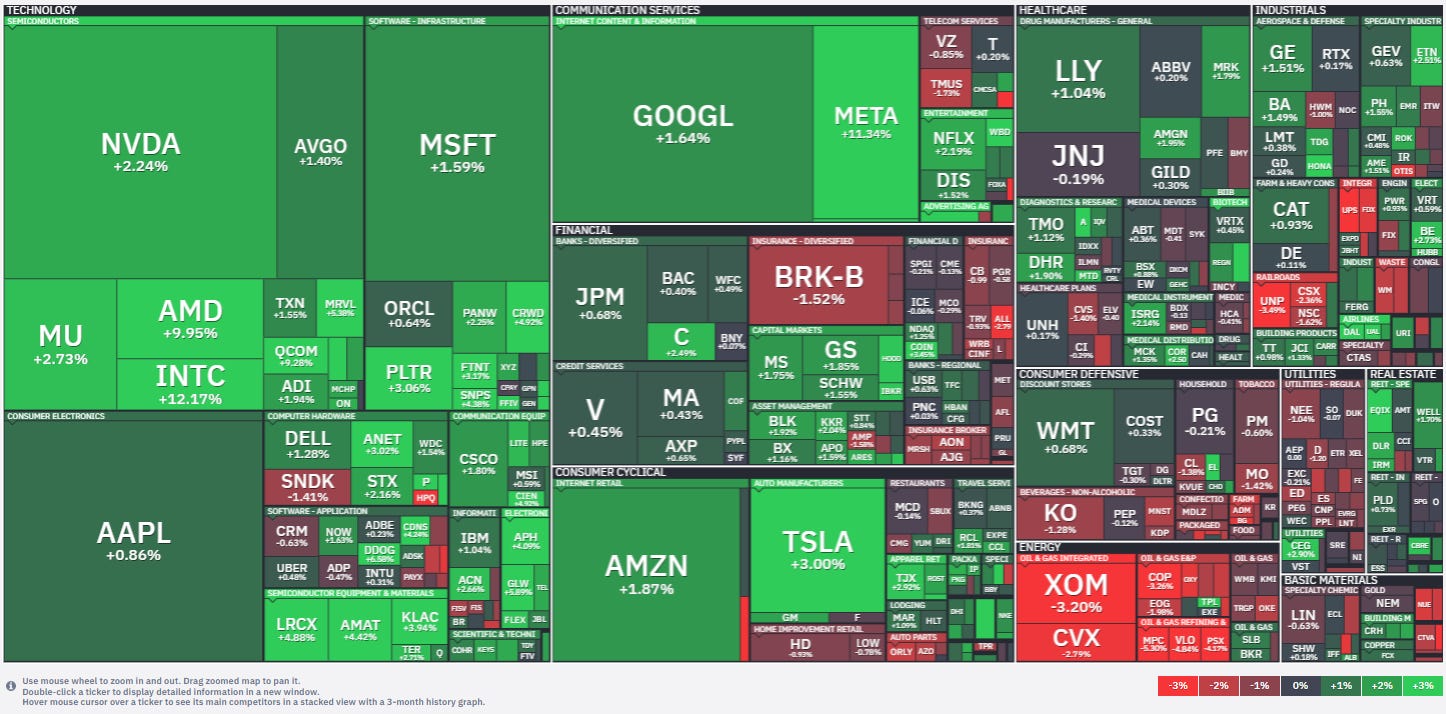
As you might expect, sector breadth strengthened considerably with 7 of 11 sectors higher and four of those up over 1% led by the megacap growth sectors Communications, Tech, and Consumer Discretionary (along with Real Estate) the first two of which were up over 2% lifting the headline. Just one sector down more than -0.5% in Energy (-2.6%).
Technology was led by semiconductors (which now make up nearly 20% of SPX market capitalization). The PHLX Semiconductor Index (SOX) surged 4.3%. Advanced Micro Devices (AMD) +10.0% reached a new all-time high and crossed $600 per share for the first time, lifting its market capitalization above $1 trillion. Intel (INTC) was another top S&P 500 component despite the absence of company-specific catalysts, reflecting renewed momentum across the semiconductor space. The top S&P gainer was Akamai Technologies (AKAM) which announced an expanded technology collaboration with MuleSoft.
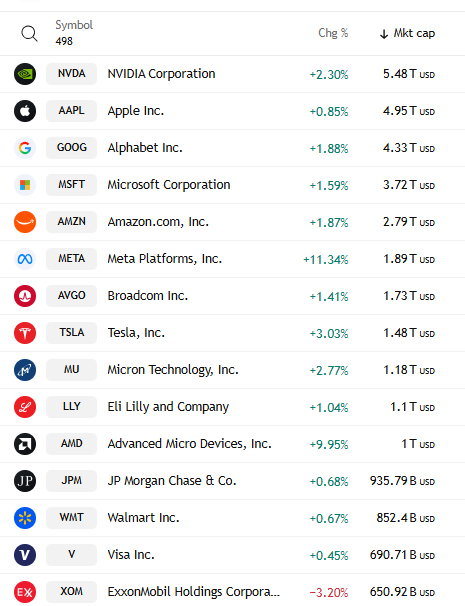
Mega-cap strength also gave the market cap indices a lift with the top 14 stocks in the S&P by market cap higher on the day led by Meta Platforms (META) +11.3%, its best session since April 2025 and extending its September gain to over 30%. Enthusiasm surrounding the company’s AI efforts remained a major driver, particularly after its Muse AI agent climbed to the top spot among free downloads on Apple’s App Store.
While defensive sectors were weak the health care sector bucked that trend, supported by a surge in Moderna (MRNA) +12.3%), the second best performer on the S&P 500, to multi-year highs.
Warner Bros. Discovery (WBD) +10.8% jumped after Bloomberg reported that Paramount Skydance (PSKY) -2.9% reached a settlement with California and other states that had sought to block its acquisition of Warner Bros. Discovery, removing a legal obstacle to the transaction.
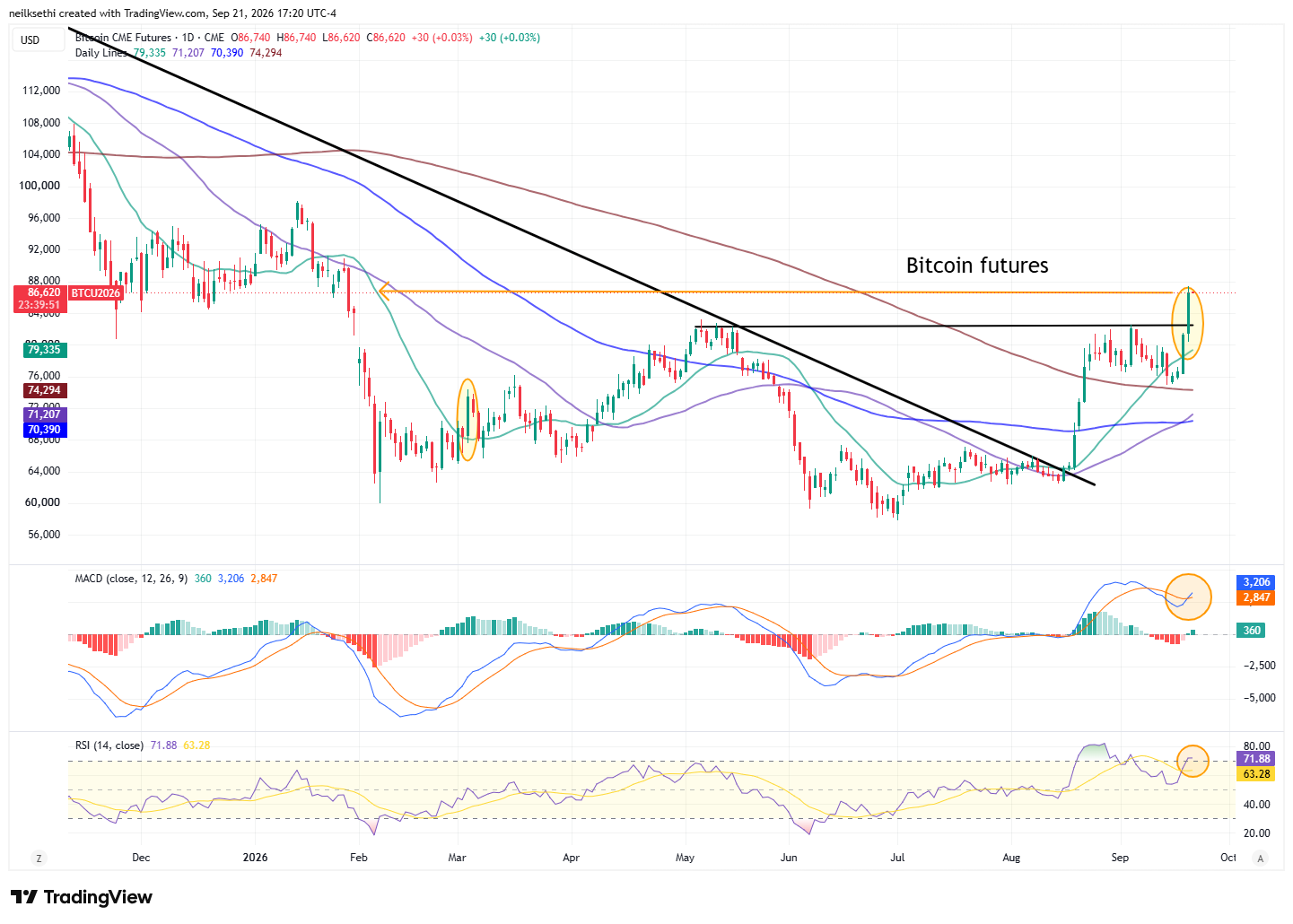
Crypto-related stocks also rallied as Bitcoin climbed above $86,000 to its highest level since January, boosting Coinbase Global (COIN) +3.50%, Robinhood Markets (HOOD) +2.9%, and Strategy Inc (MSTR) +9.5%.
Accenture Plc (ACN) shares climbed +2.7% after striking an agreement to safety test Anthropic’s AI models.
In other news from BBG:
- The Qatar Investment Authority is targeting a $20 billion partnership with JPMorgan Chase & Co., people familiar with the matter said.
- Health and fitness ring-maker Oura Inc. and some of its backers are seeking to raise as much as $2.2 billion in an initial public offering.
- SoftBank Group Corp. is seeking the equivalent of more than $11 billion in what would be one of the biggest junk bond deals ever, people familiar with the matter said.
[Note: chart uses futures prices.]
The number of large SPX winners (up over 3%) still not that impressive at just ~55 although up from ~20 Friday and ~35 Thursday, while the number of large losers (down over 3%) fell to 11 from ~30 Friday.
Top 14 SPX stocks by market cap higher on the day.
Some stock-specific commentary from TheStreet Pro today:
- Chris Versace – Who’s In and Who’s Out of the New iPhone Models? & 4 Holdings to Watch Closely in Pursuit of Opportunity
- Stephen Guilfoyle – We’ve Got Our Eye on the ‘Sky’ as a New Position & Sticking With This Microsoft Price Target After AI Chief Sends Safety Warning
- James “Rev Shark” DePorre – One of My Top Small-Cap Biotech Picks Made a Move. Here’s How I Trade It & Magnificent Seven Hits All-Time High but it’s Not What it Seems
- Bob Lang – Chart of the Day: Apple’s Bullishness Can’t Be Ignored
A Look At The Charts
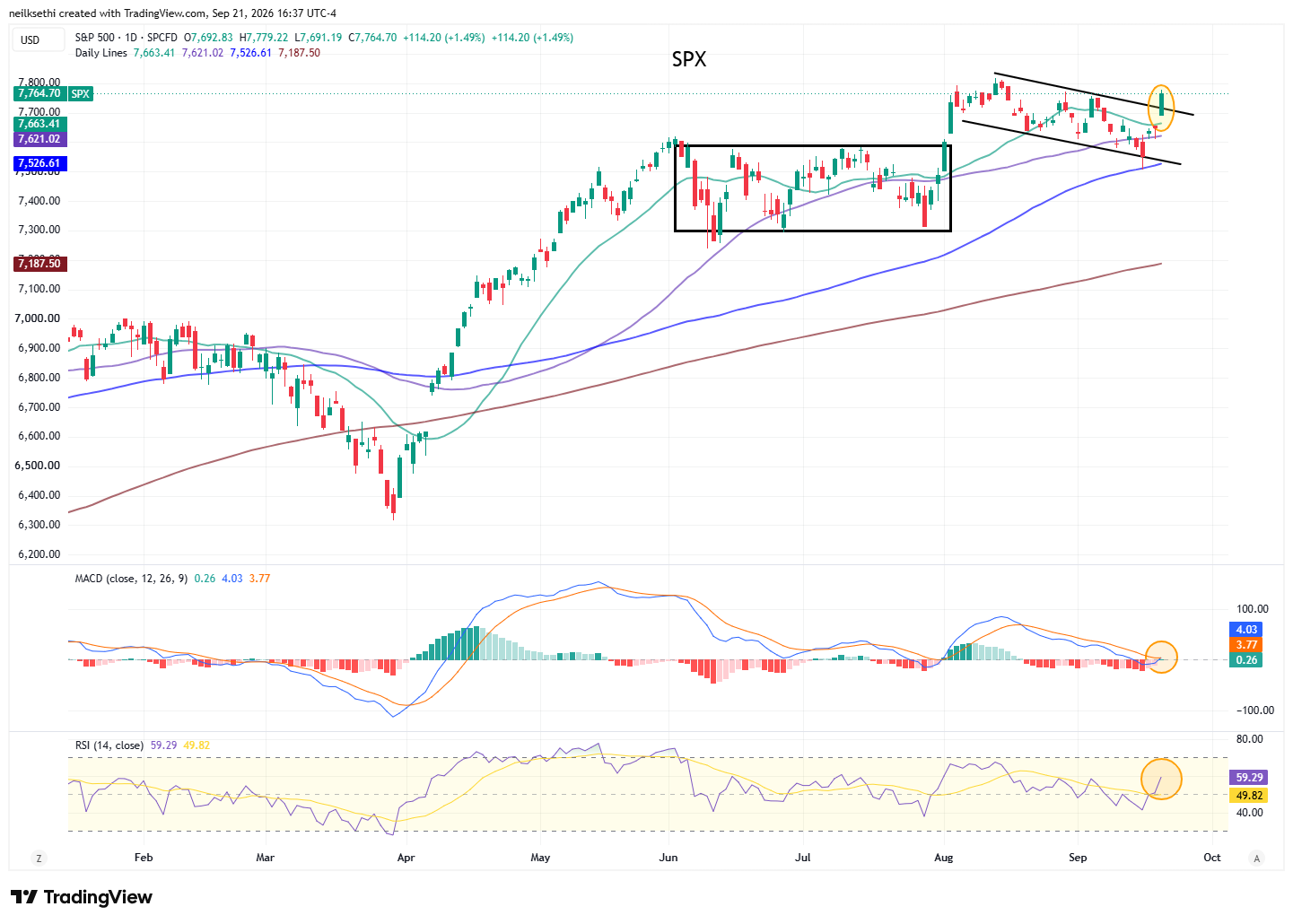
Note on all charts the colored lines are moving averages (the average price over the lookback period — days on the daily charts, weeks on the weekly charts):
20 = green
50 = purple
100 = blue
200 = brownException is monthly charts where blue is 10-month moving average and brown is 20-month moving average.
MACD = Moving average convergence/divergence line, a measure of momentum that compares longer term and shorter term momentum to gauge if a move is strengthening or weakening. This is probably my favorite individual indicator (it’s also the favorite of Katie Stockton, a very fine technician).
RSI = Relative Strength Index (basically what it sounds like) = measures the strength of the move comparing gains to losses over the given lookback window (I use the standard 14 periods).
SPX rocketed out of its channel to the highest close since the record high in August. The gains flipped the daily MACD to “go long” positioning, and the RSI to near 60. Per my note Friday, I added on the break above the channel.
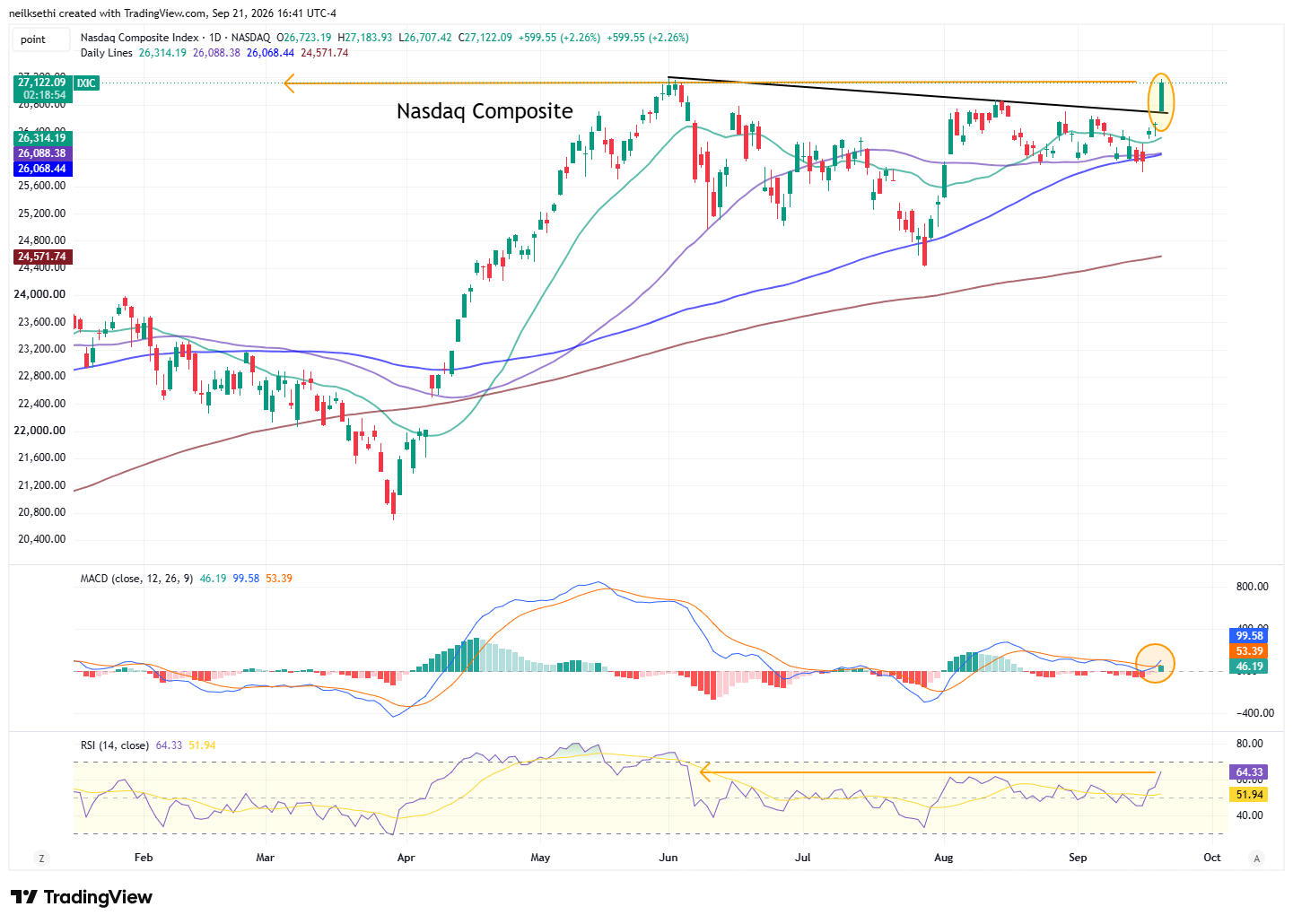
Nasdaq Composite also shot higher to a fresh record. Also got a positive MACD crossover and the RSI is the highest since June.
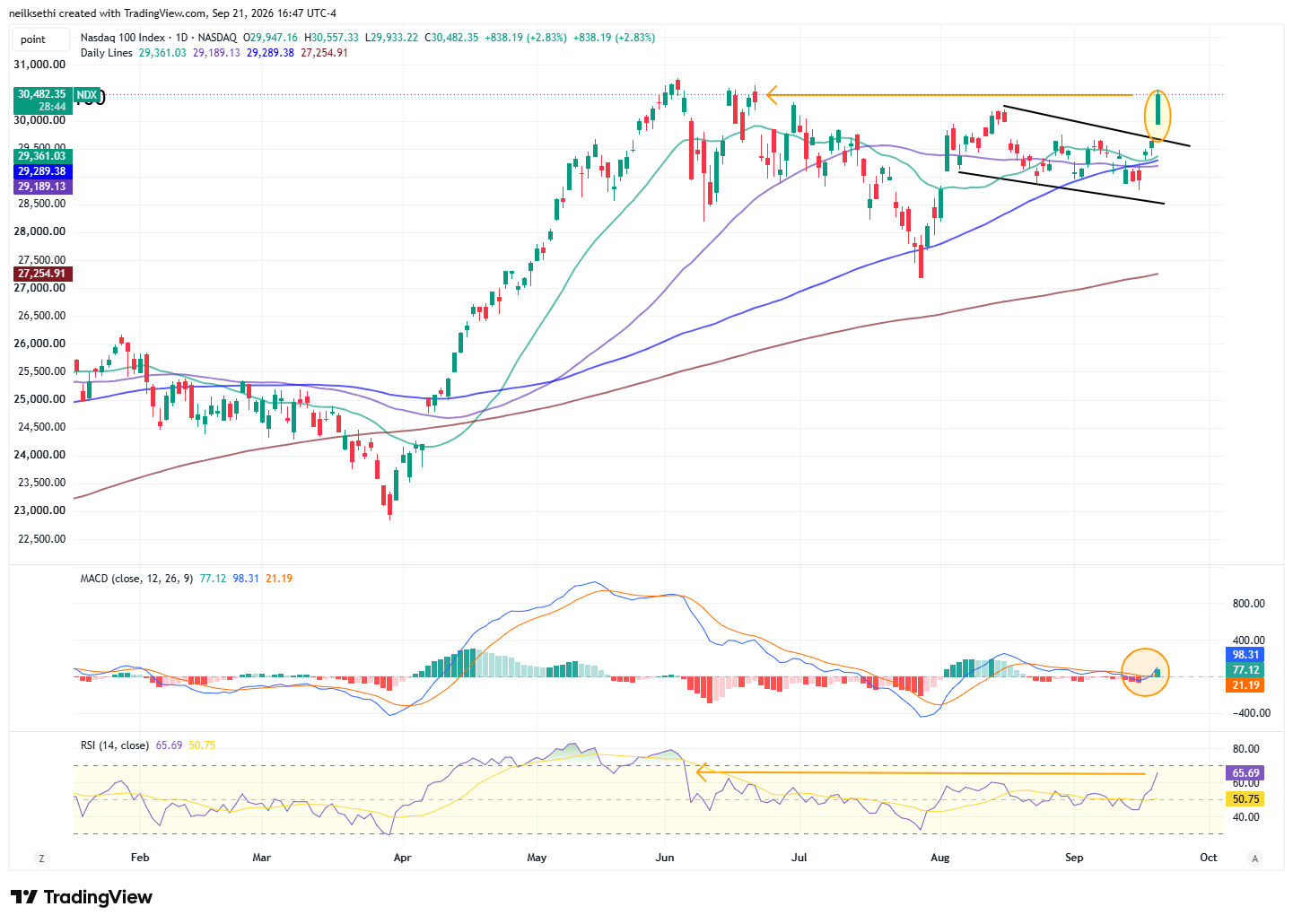
In terms of the Nasdaq-100 (QQQ) I said Friday I “would add again on a break above 29,700,” and I did just that as it blew through that level also breaking out of its channel. Daily MACD had already flipped more positive last week, and the RSI like the Nasdaq is the highest since June. Just under record highs.
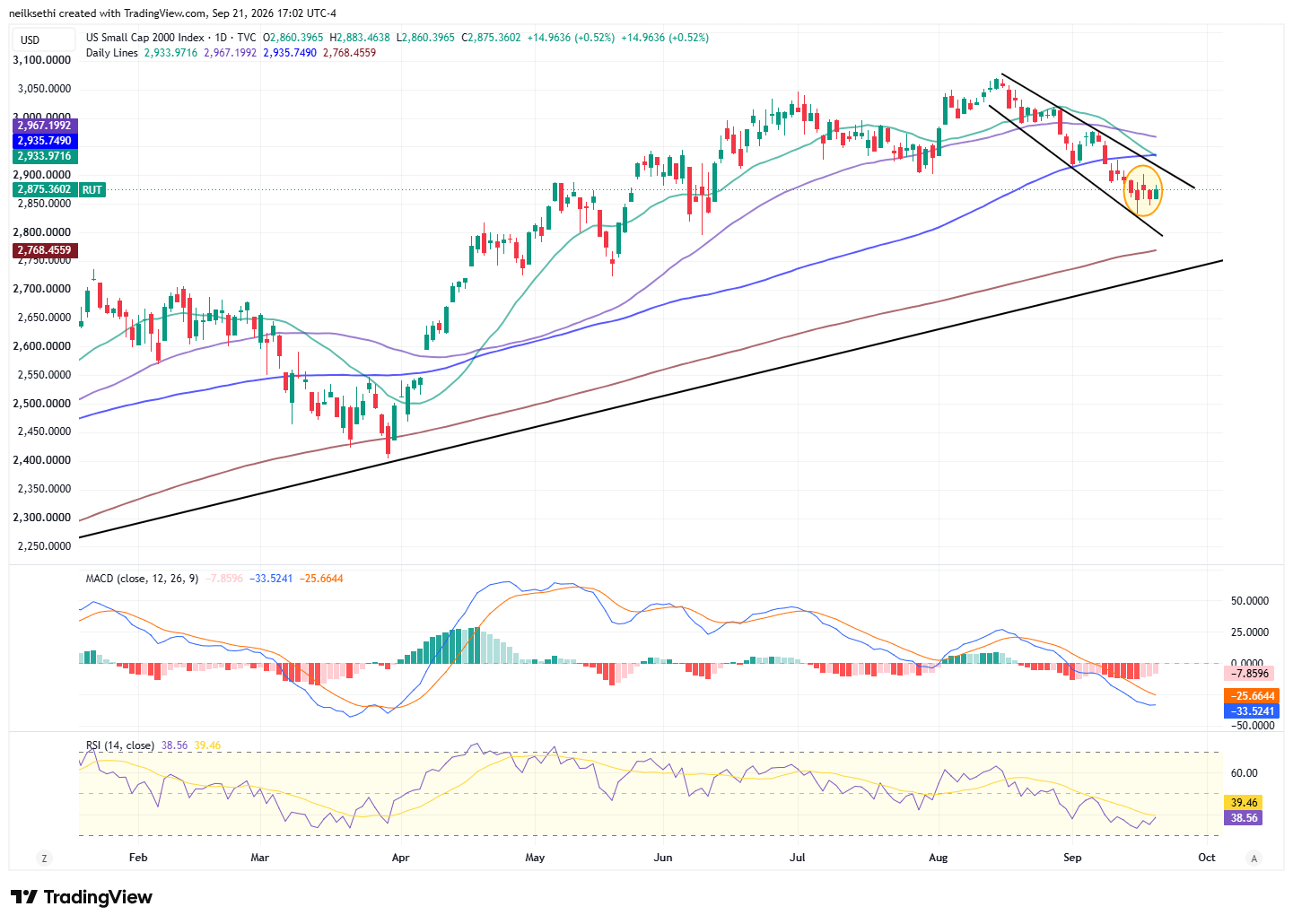
The Russell 2000 (RUT) I said two weeks ago was “much more problematic,” and that remains the case although as mentioned Friday “at least has not broken Wednesday’s low.” But its daily MACD remains in “go short” positioning, and the RSI below 40. As I said then “I am not long this index, but … I’d be out until it at least recovered the 100-DMA.” I also noted last week “200-DMA is a fair bit away, but that might provide an interesting risk/reward as it served as a floor in March.”
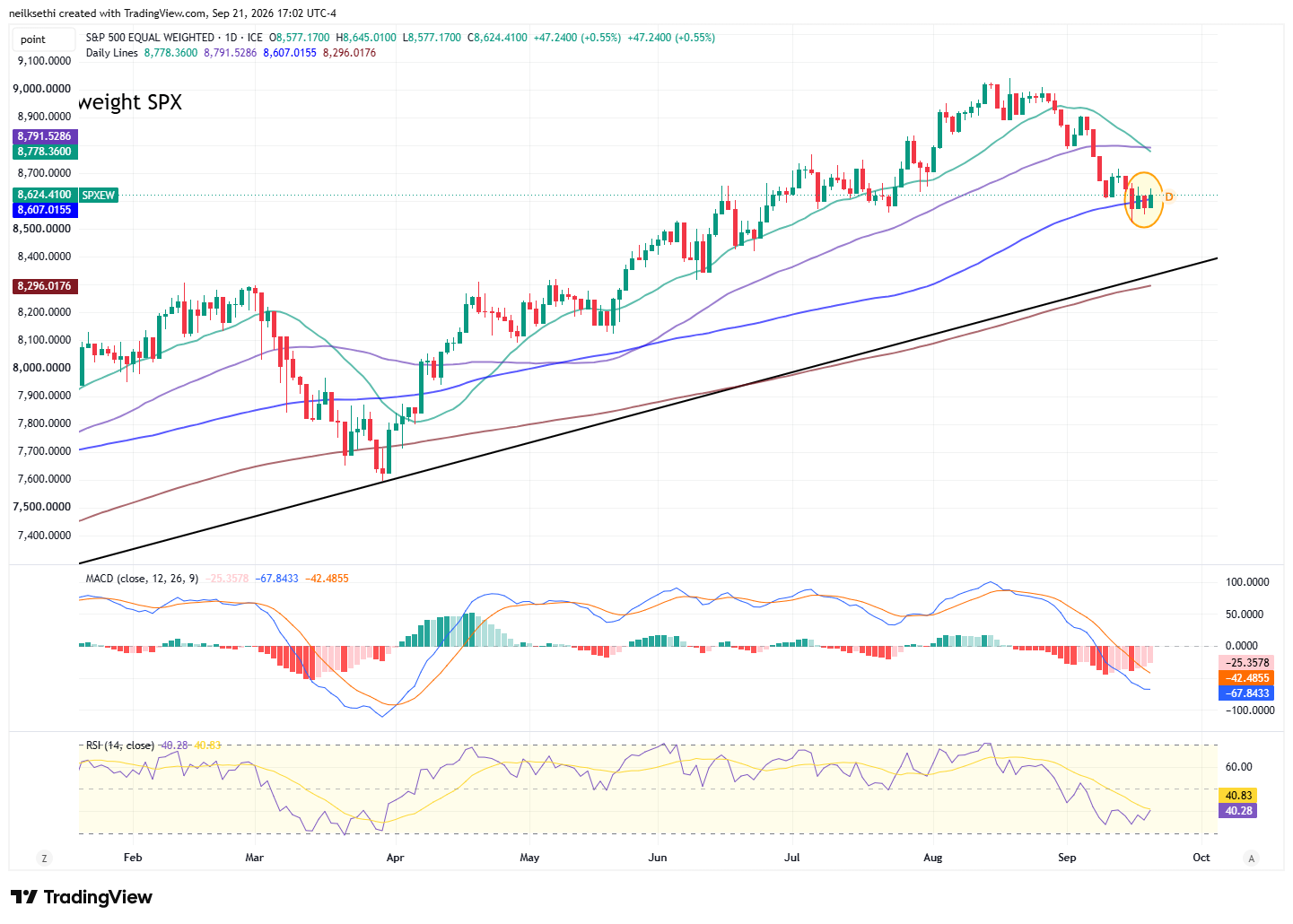
The equal-weighted SPX I said Wednesday is “back to concerning.” I mentioned early last week “I did take off most of my holdings in (RSP) for now. I’ll be looking for a tradeable bottom to form.” Like the RUT it has held Wednesday’s low, but daily MACD and RSI are still weak.
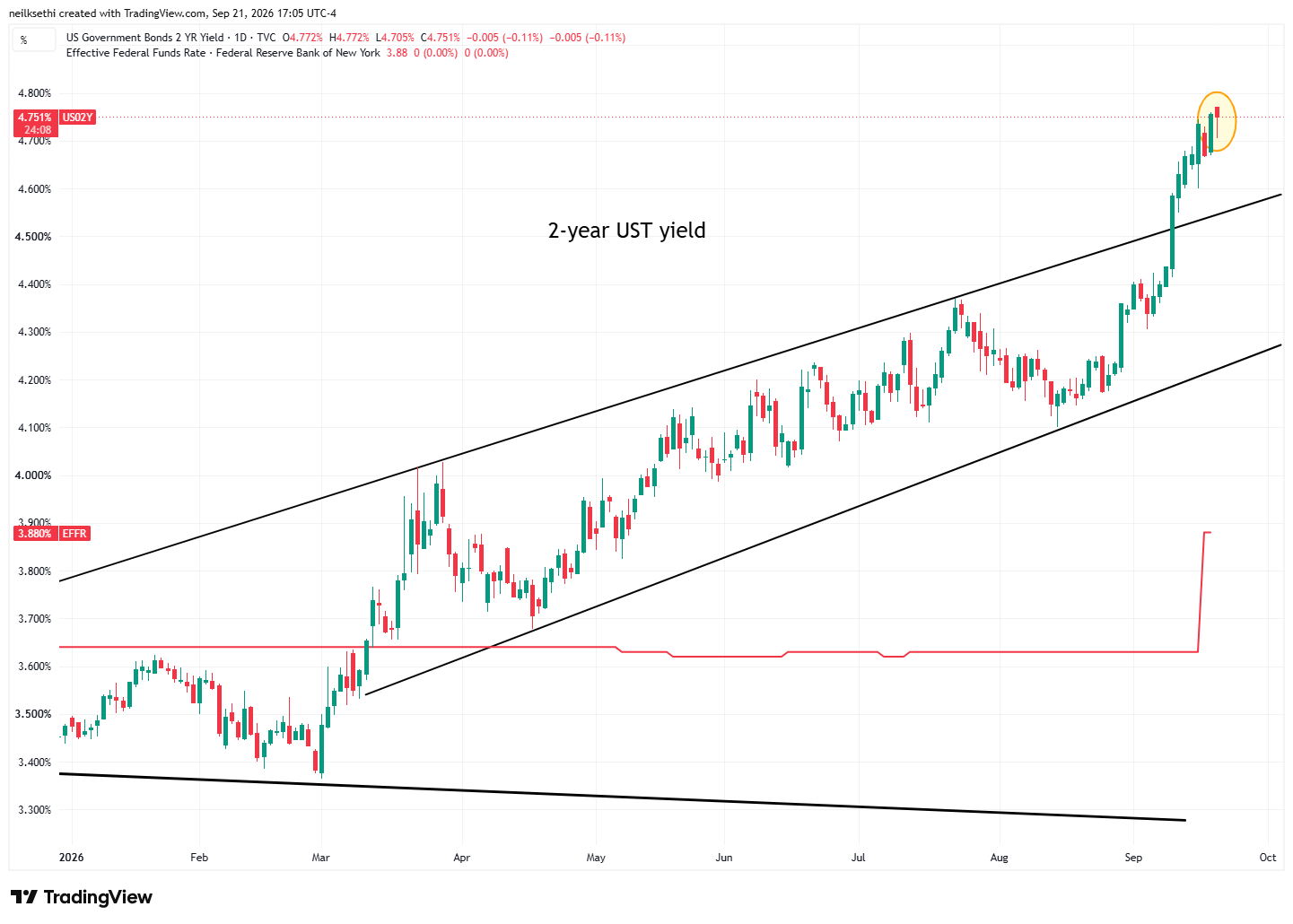
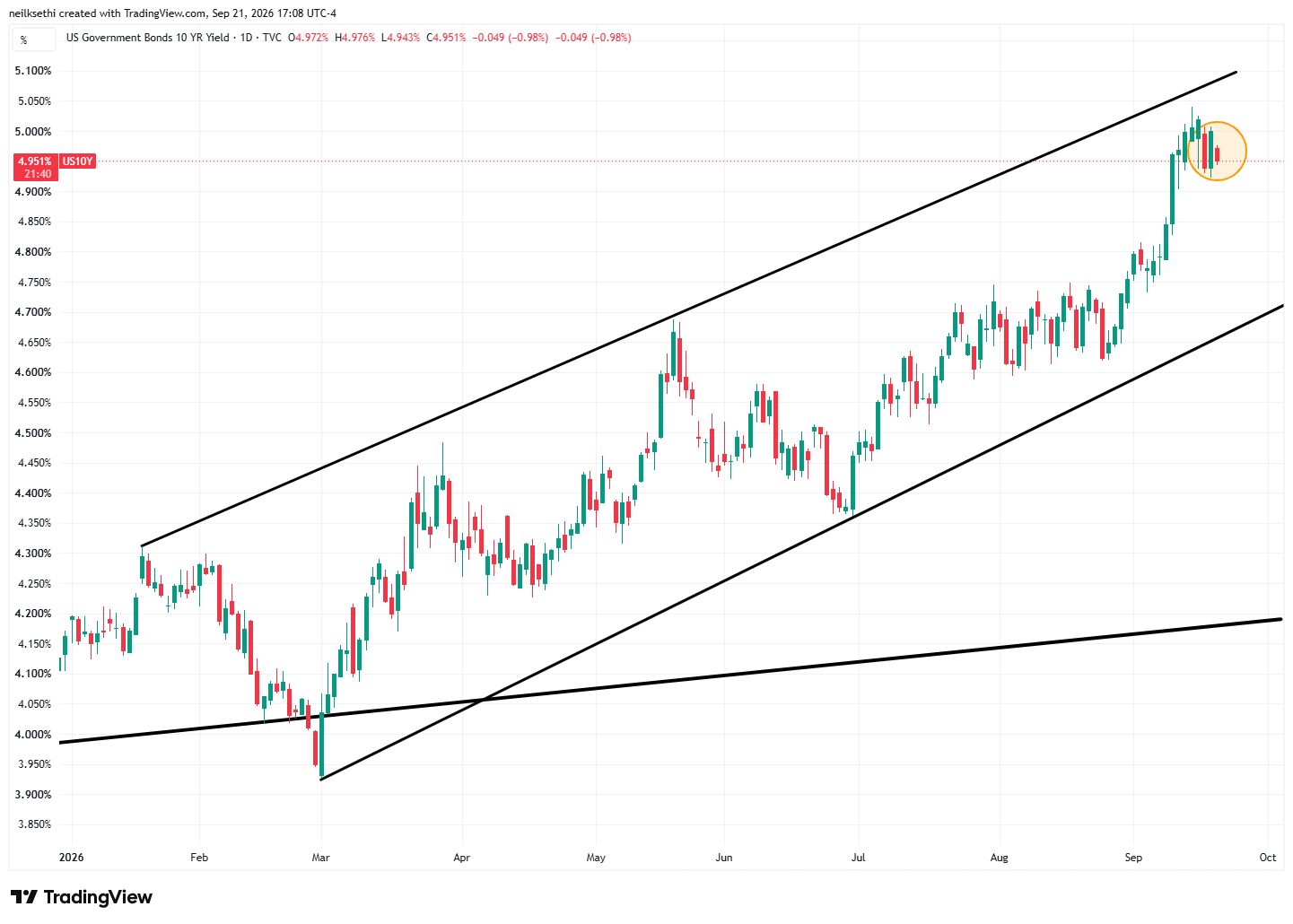
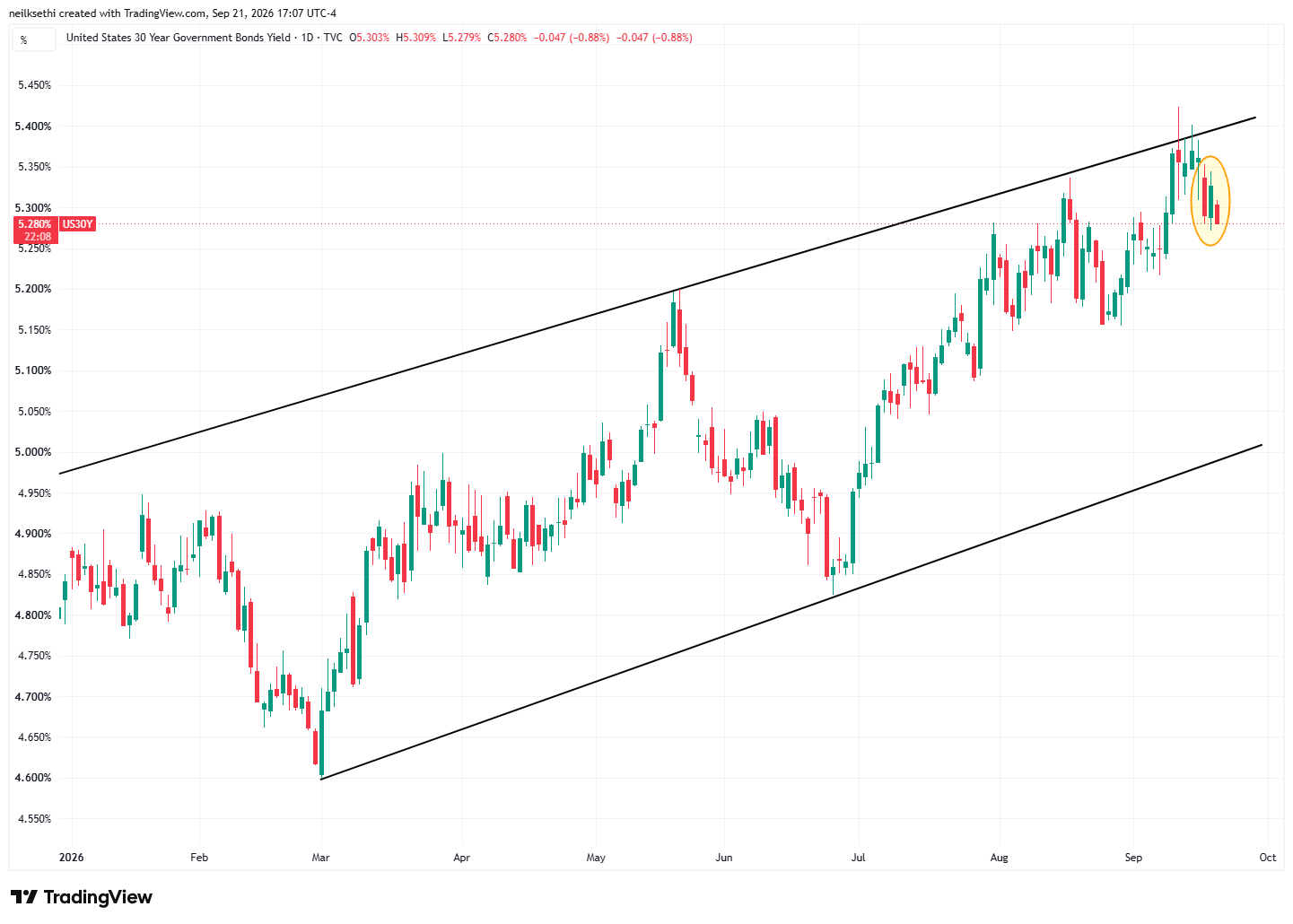
Treasury yields fell across the curve in a bull flattening (shorter yields falling less than longer):
The 2-year Treasury just eased off one basis point from the highest close since July 2024.
It is now ~95 basis points above the Effective Fed Funds rate (red line), so still screaming for more rate hikes. That got some support from the first of the flurry of Fed speakers this week (see below).
10-year yields fell back five basis points to end the after-hours session at 4.95%.
30-year yields also down five basis points ending at 5.28%, a nearly two-week low, now nine basis points from Tuesday’s close (the highest since 2007).
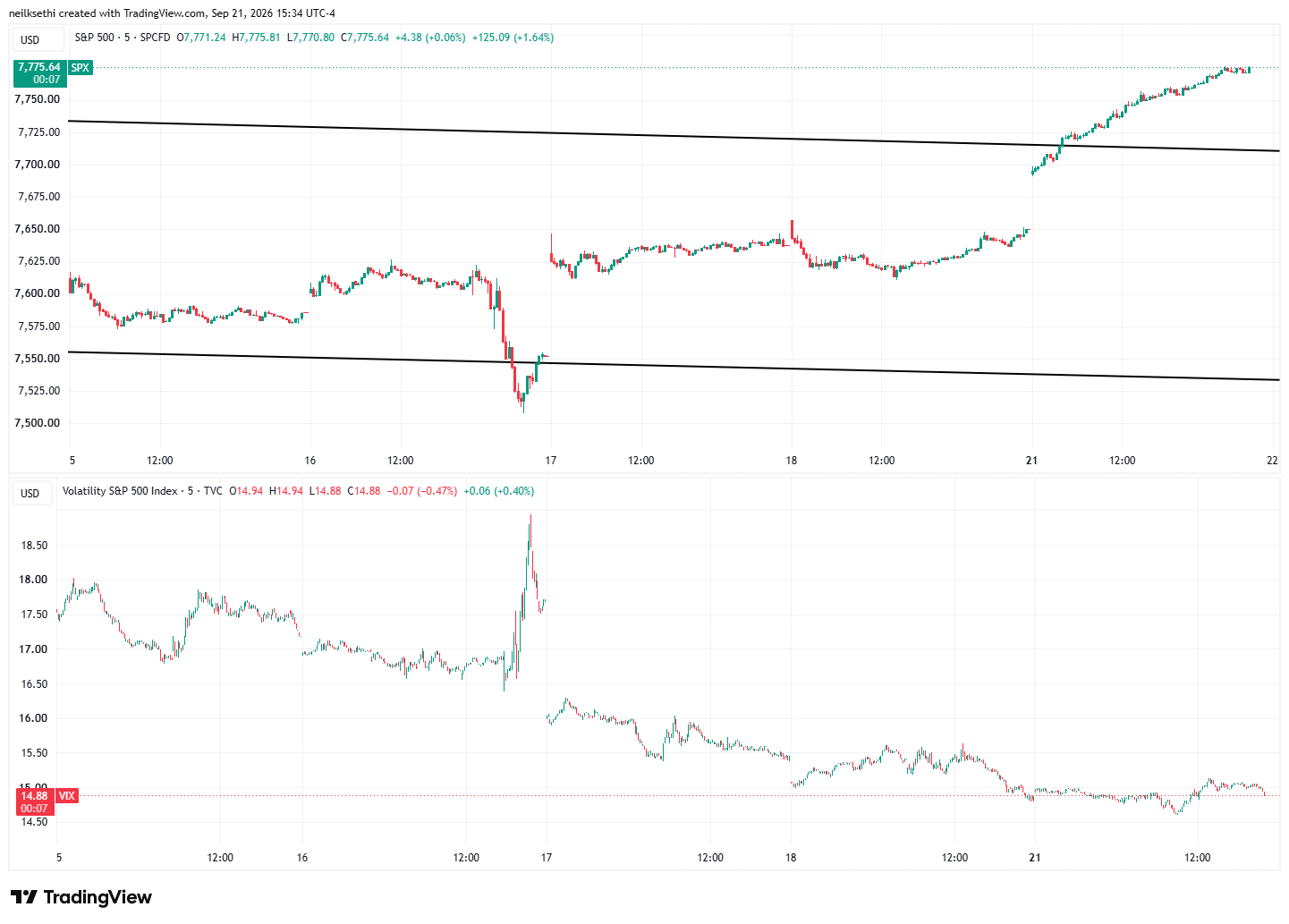
Despite the equity rally VIX actually edged slightly higher to 14.9, still not far from the lows of the year. That’s consistent with ~0.93% average daily moves in the SPX over the next 30 days.
The “spot up, vol up” is unusual but not rare as Tier1Alpha has noted previously, but according to MarketWatch a higher VIX paired with a 1% SPX gain has only happened two other times this year, on Aug. 4 and May 6, according to FactSet data.
Before that, the last time it happened was July 10, 2024.
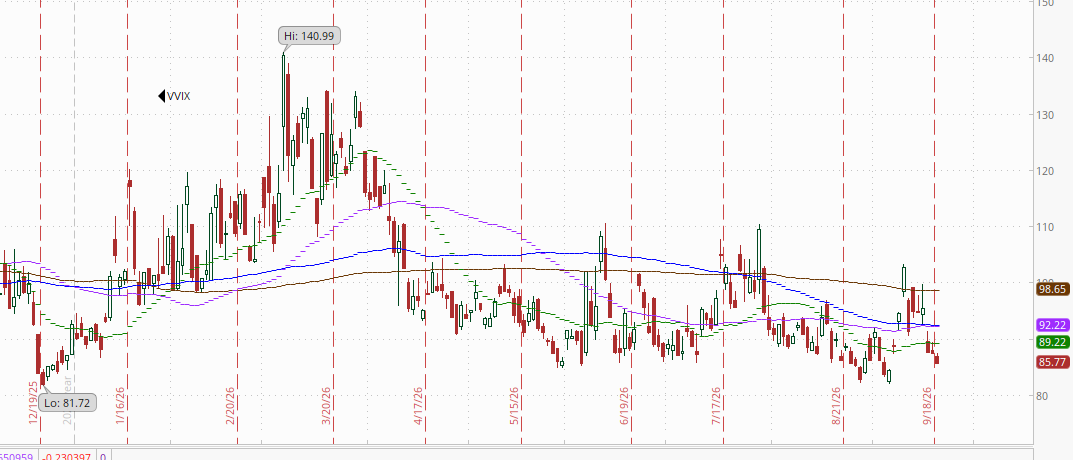
The VVIX (VIX of the VIX) though eased back to 85.8, not that far from the lows of the year.
The current level is consistent with “moderate” daily moves in the VIX over the next 30 days (historically, normal is 80-100). Above 100 is the level flagged by Charlie McElligott as indicating higher stress.
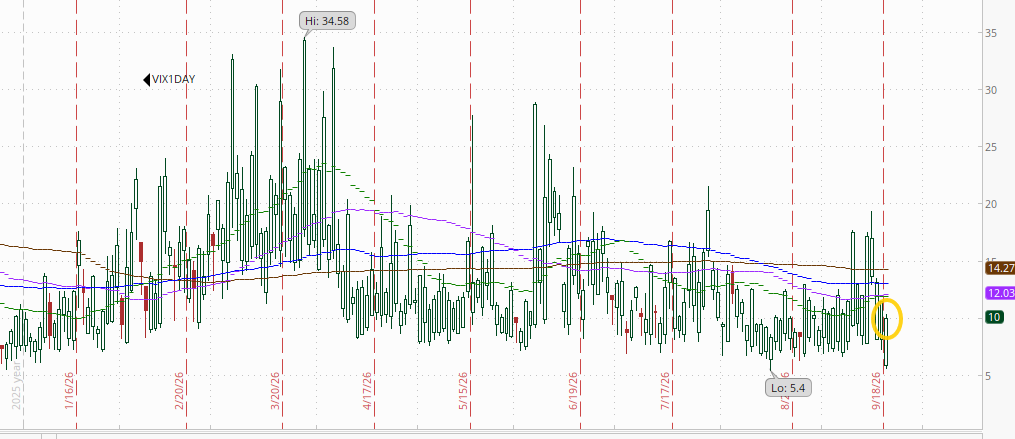
The 1-day VIX also eased to 10.0. The current reading isconsistent with a move of 0.64% in the SPX next session.
WTI futures (/CL) fell another -3.9% (including the after-hours session) to the lowest close since September 4th.
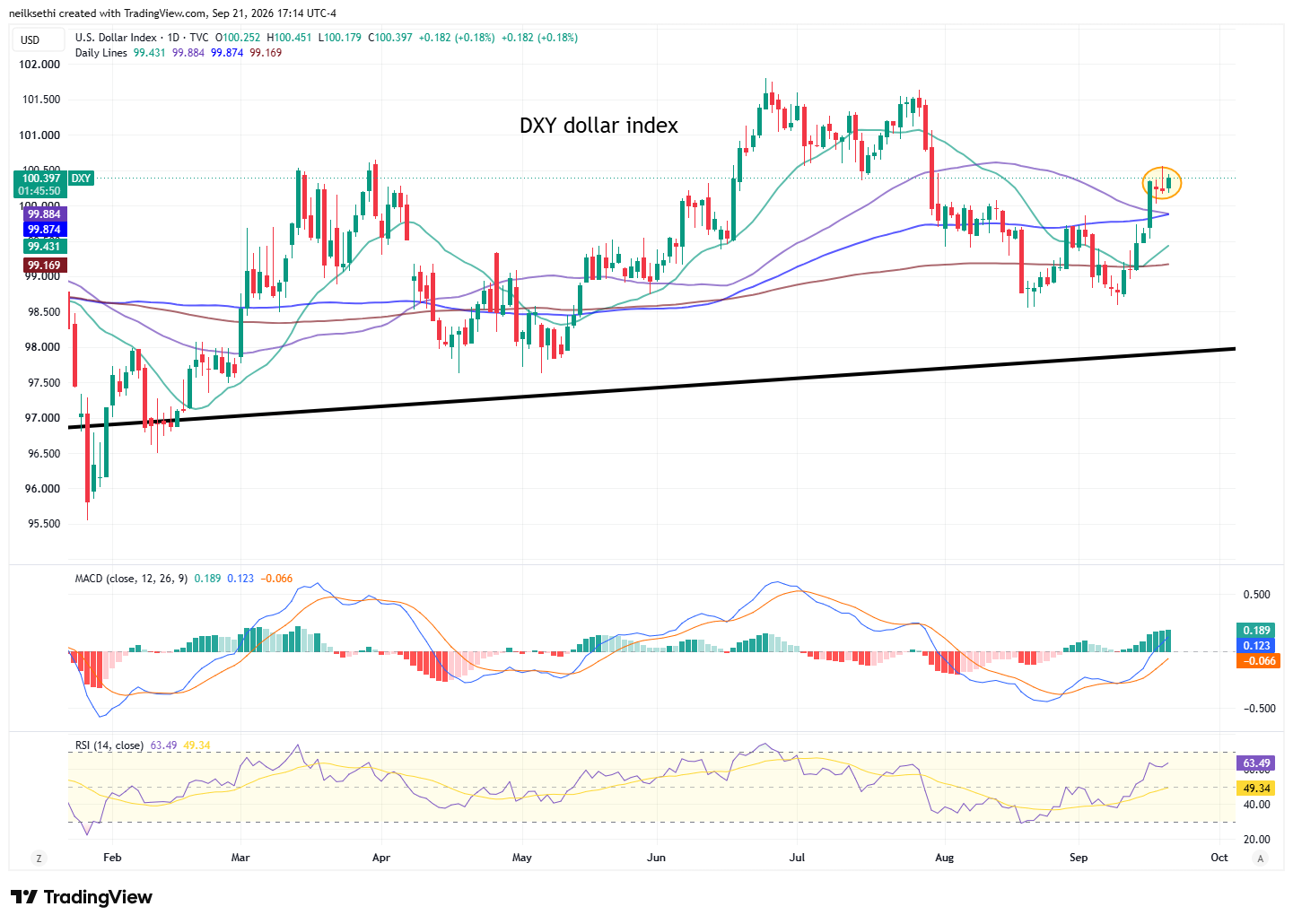
The DXY dollar index (which is fixed weighted with a heavy (57%) weighting vs the euro), pushed to the highest close since July.
While the move Wednesday “opens up a run back up to the highs of the year,” as I said Thursday it “seems to have stalled out here. The daily MACD remains positive and the RSI is above 60 so continues to have strong technical support.”
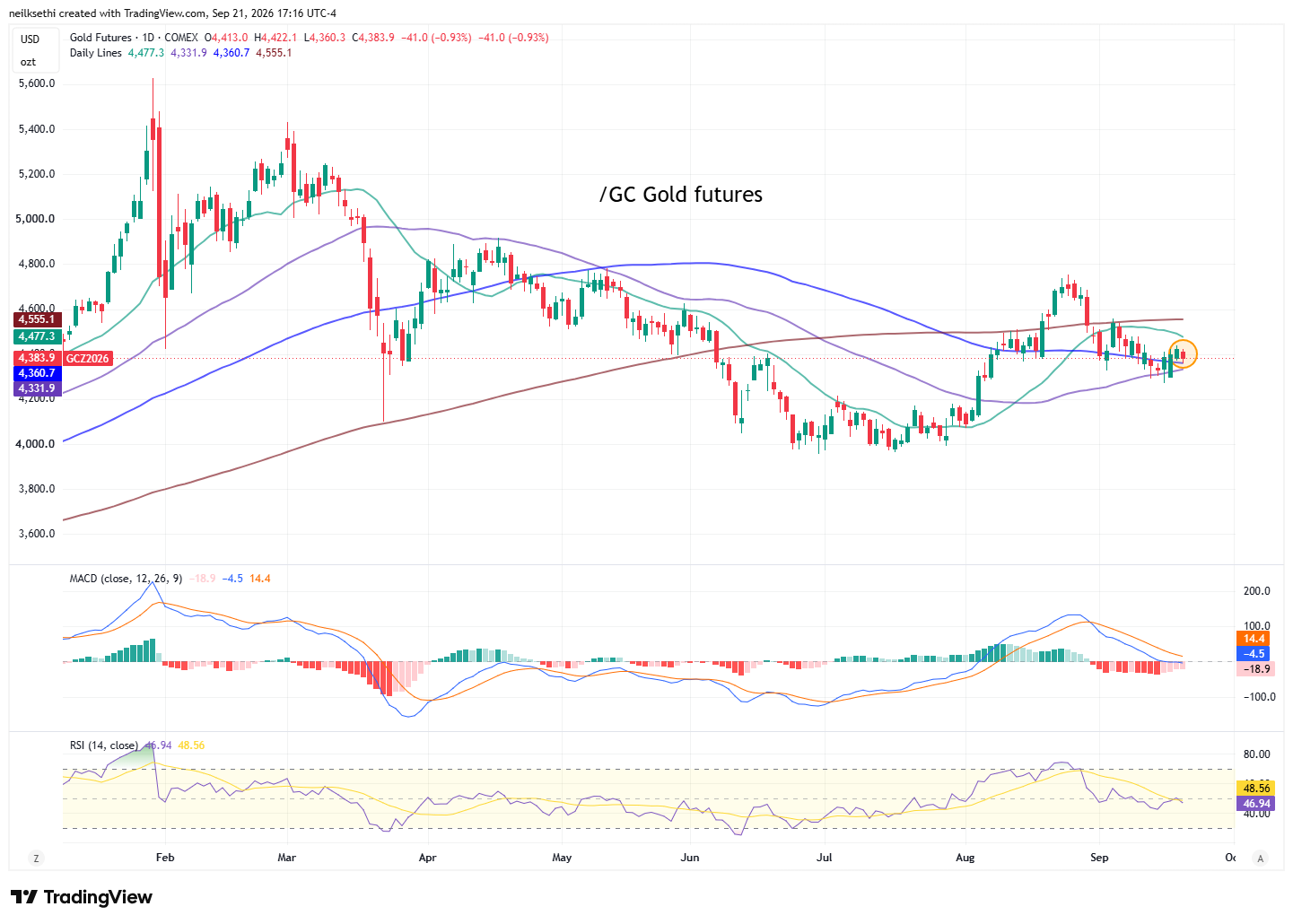
Gold futures (/GC) though eased back nearly 1%. The daily MACD remains negative and the RSI is under 50, so I’m still holding off for now. As I said Tuesday though “if it can continue to hold here and the technicals firm up, I may take a shot.”
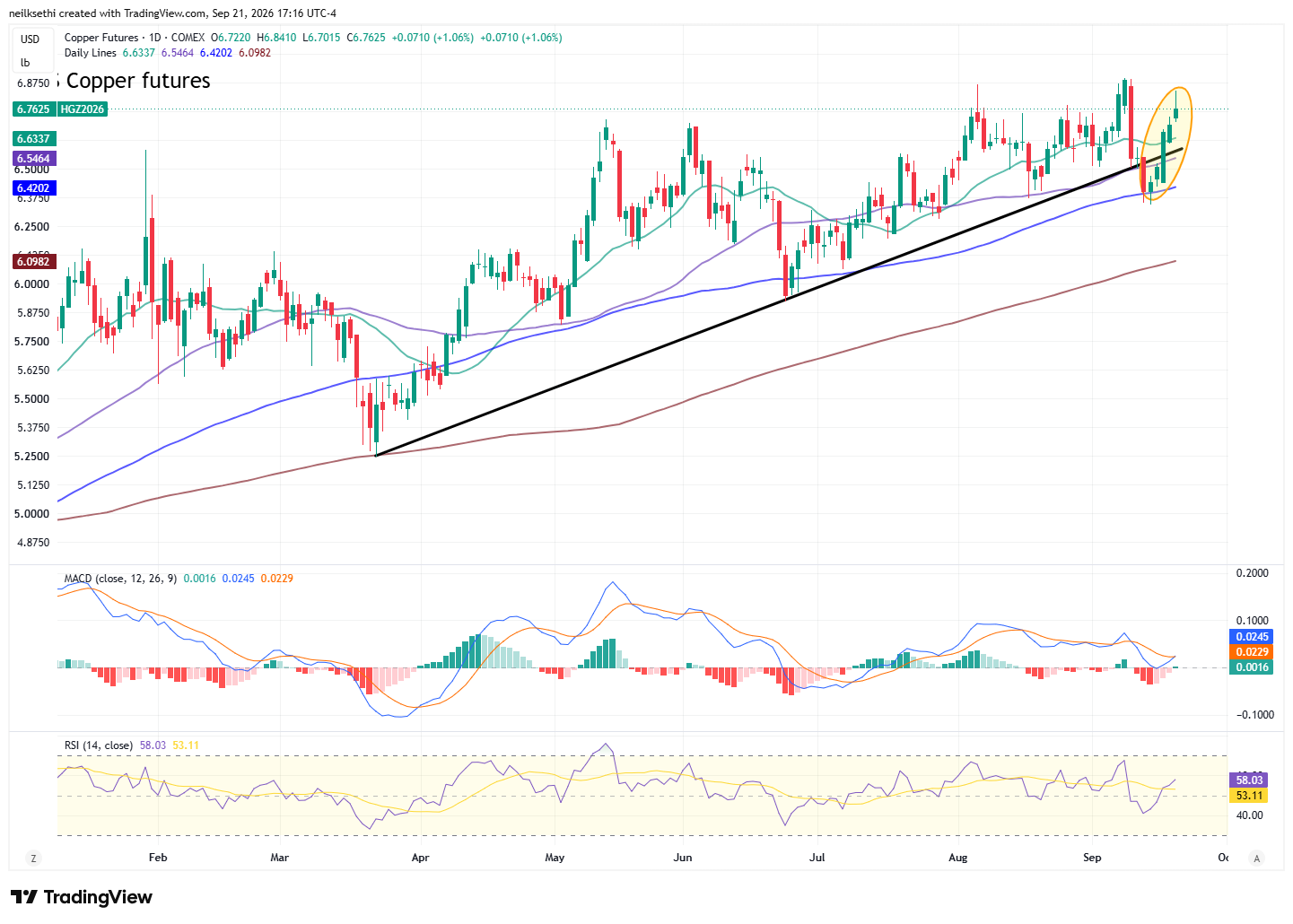
US copper futures (/HG) up for a fifth session although finished well off the highs. Daily technicals are starting to firm up though with the MACD crossing positively and the RSI near 60.
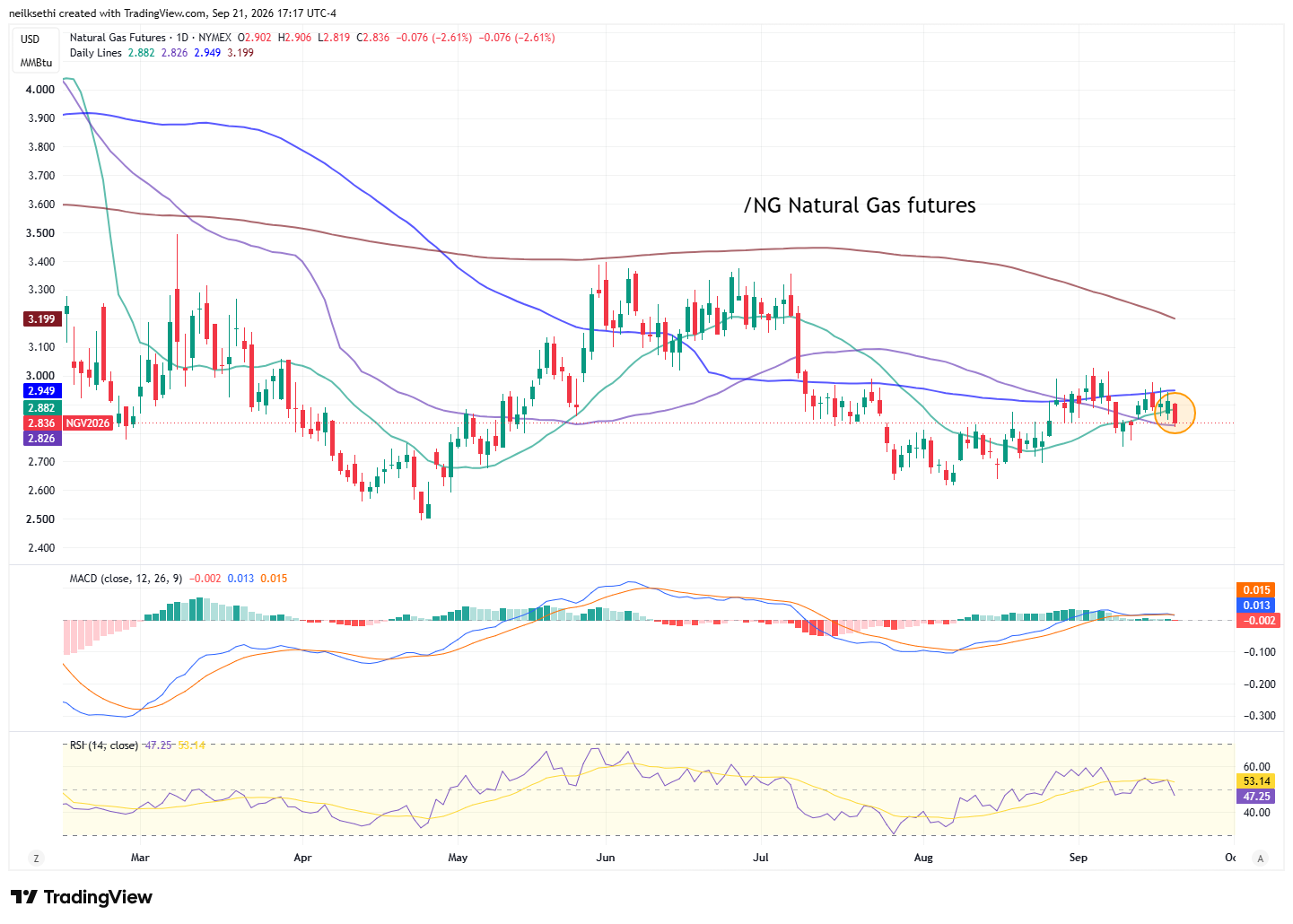
US natural gas futures (/NG) continue trading in their range since the start of July.
Bitcoin futures jumped +6.5% (up nearly 13% the last two sessions) as they broke above the important $82,500 level which I mentioned Friday “represents the highs of the year and also capped the spring rally. Clearing that would be notable.” I don’t like to buy extended moves but I did add a little today. Daily MACD has also crossed positively while the RSI is over 70.
More From TheStreet Pro:
- Doug Kass – Sit Down, It’s Time to Have ‘That’ Talk (About Valuation Models)
- Chris Versace – VIDEO: Energy Overhang, Diplomacy Catalysts Set Stage for Earnings Season &
- Peter Tchir – Geopolitics Takes Focus as Energy Prices Drive Economy
- Bret Jensen – A Crack Is Forming Across the Markets
And From Me If You Missed It:
- High Mortgage Rates Keep Existing Home Contract Signings Near Record Lows
- Chicago Fed’s Monthly GDP Proxy Remains Around Trend Growth
Miscellaneous:
Wrap-Up – The Market Again Bends but Doesn’t Break
I said Sunday:
So for the first time this month it is starting to feel like the balance of risks has at least stopped deteriorating, if not improved. You can add to that an improving technical situation in the Nasdaq-100 as mentioned on Friday (and which as noted above also has a more favorable systematic set-up).
And investors have been buying Tech as discussed in the Flows section, as it’s led the market the past three sessions. I asked Friday “Is the Tech trade back?”, and it seems to have the best set-up for the week. Maybe continued buying there can bring the rest of the market along with it.
But while I was expecting Tech to continue to lead, I’m not sure I was expecting a 2+% day for the group. But I’ll certainly take it. With the trade gaining further momentum, the technical picture even more improved, and no particular near term negative catalysts on the horizon (there can always be something unexpected of course), it feels like it probably has further to go.
And positively today it brought some of the non-Tech areas of the market with it, although it remains to be seen how much that depends on falling oil prices and bond yields.
So far so good, let’s see if we can keep it going Tuesday.
The Day Ahead – Here Come The Fed Speakers
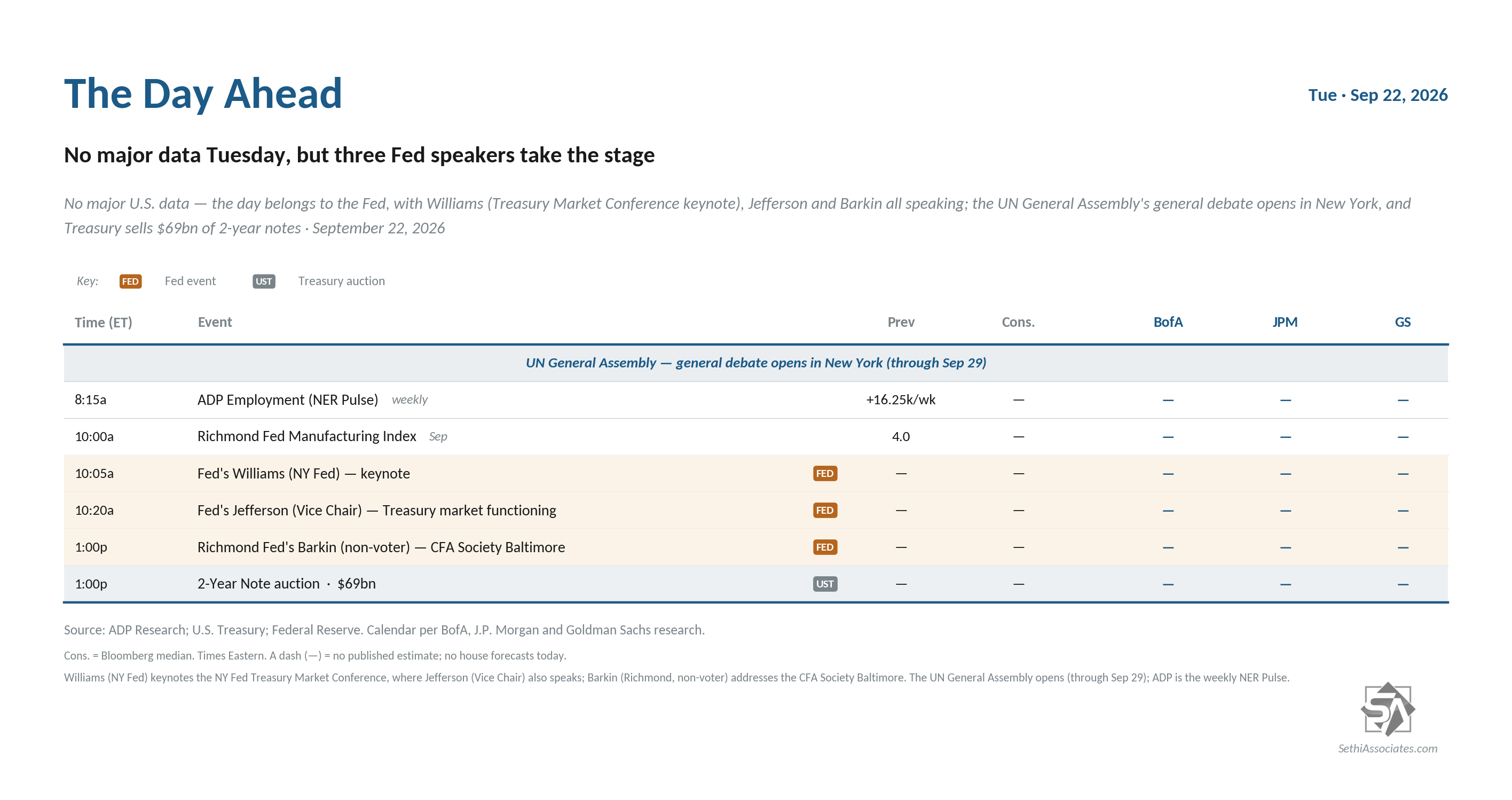
US economic data remains light Tuesday with just the weekly ADP report and a regional Fed PMI.
But the Fed speakers continue apace headlined by a couple of core centrists I want to hear from. Both Vice-Chair Jefferson and NY Fed President Williams (both permanent voters) indicated ahead of the September FOMC meeting that they thought holding rates steady was the proper move. Hopefully they provide some insight on what changed their mind (although they might not as they’re speaking at the Treasury Market Conference). We also get Richmond Fed President Barkin, a voter next year, and, like today, we’ll likely have more speakers via media interviews.
Non-Bill (>1yr in maturity) US Treasury auctions also pick back up with 2-year notes.
As noted in the Week Ahead we are now in the weird middle ground between Q2 and Q3 earnings. Tuesday we’ll get one SPX component reporting in AutoZone (AZO).
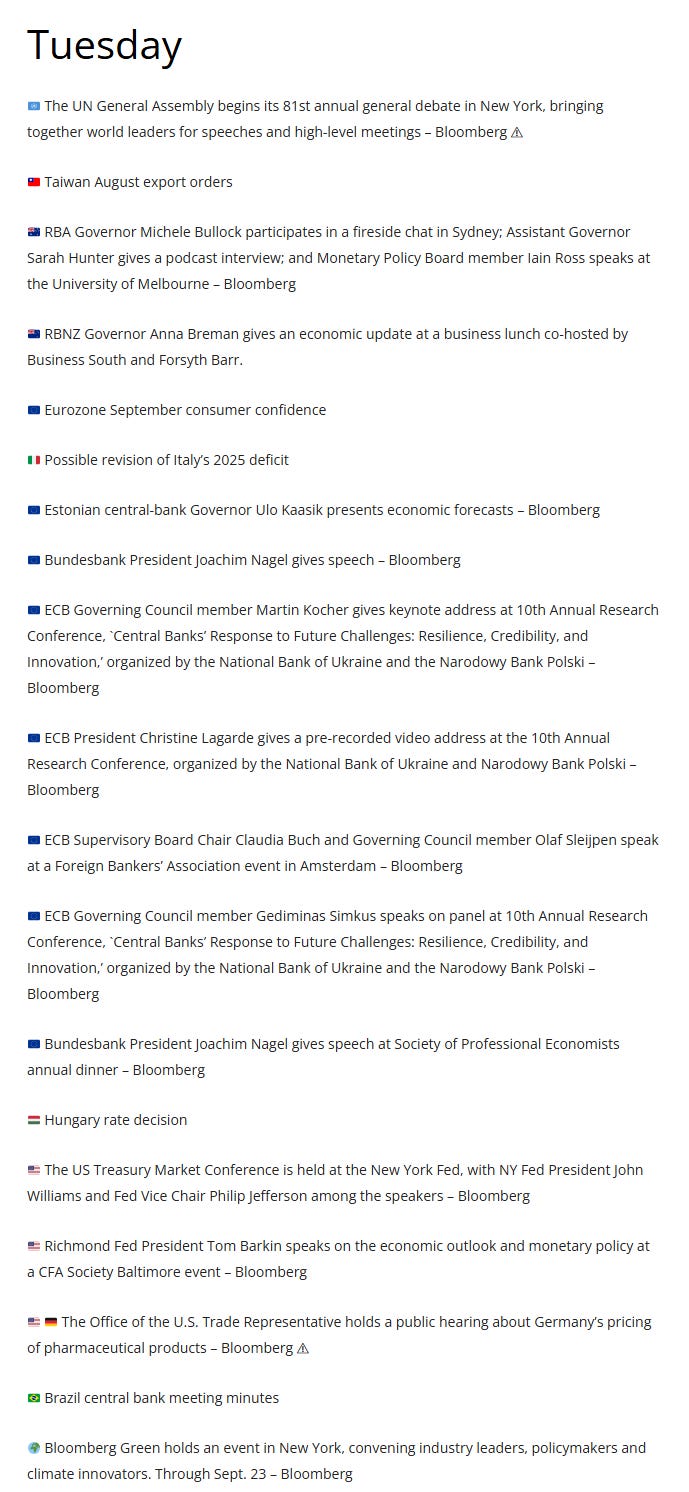
Ex-US highlights are UK August public finances and Eurozone September consumer confidence.
We’ll also get the start of general debate of the UN’s General Assembly in New York (runs until September 28th).
From Christophe Barraud’s international Week Ahead rundown:
As a reminder, if you do put a comment in for me on a post please be sure to put @NeilSethi in front. Comments are encouraged!