Sticking With This Microsoft Price Target After AI Chief Sends Safety Warning
A bevy of analysts have updated their outlook on Microsoft shares today.
You've reached your free article limit
You've read 0 of 1 free Pro articles.
Interesting. Apparently, Microsoft (MSFT) AI chief Mustafa Suleyman appeared on Fareed Zakaria GPS on CNN over the weekend. (I read about it in Bloomberg). Suleyman feels that concerns related to parallel or uneven progress made by Chinese AI models should not be used as a reason against putting guardrails around the technology here. Suleyman said, “I don’t think we should use China as the bogeyman for not making progress on our own (safety) efforts.”
This came after, on Friday, The Wall Street Journal reported that, according to a legal filing unsealed in a copyright infringement case, staff at OpenAI and Microsoft knew using news websites to train their AI models may damage or destroy those publications but did it anyway. According to this filing, in an internal document, Brent Hecht, Microsoft’s director of applied science, wrote, “Our AI content strategy has started a ‘doom loop’ that will hurt the performance of our models and the entire web at the same time.”
Supposedly, an OpenAI executive also called it an “existential threat” to publishers. Hmm, that’s not very flattering.
This Morning
A bevy of sell side analysts opined on the shares of Microsoft on Monday morning. First, the bullish news. Analyst Thomas Blakely of Cantor Fitzgerald reiterated an “overweight” (buy-equivalent) rating on MSFT while increasing his target price from $522 to $608. Blakely is rated at five stars out of five by TipRanks. Over the past two years, he has compiled a 58% success rate while generating an average return of 22.9%.
Now, for the pretty good news. Analyst Brent Thill of Jefferies (four stars out of five) reiterated his “buy” rating on MSFT as well as his $575 target price. Over the past two years, Thill has compiled a success rate of 51% while generating an average return of 4.2%. Lastly, the bearish news. Analyst Alexander Haissl (also four stars) of Rothschild Redburn initiated a “neutral” (hold-equivalent) rating on MSFT after being assigned coverage of the stock by his firm. The semi-positive takeaway would be that Haissl increased his firm’s target price from $400 to $440. Over the past two years, he has compiled a success rate of 55% and an impressive average return of 36.2%.
The one commonality seems to be that several analysts, of late, when speaking or writing on Microsoft, see continued multiple expansion across the enterprise software space as a short to medium-term driver.
Earnings
We’re still about five weeks away from Microsoft’s fiscal Q1 earnings release. At the moment, Wall Street is looking for a GAAP EPS of $4.72 on revenue of roughly $90.7 billion. This would compare to the year-ago comp of $4.13 on annual revenue growth of 16.75%. Interestingly, of the 25 sell-side analysts that I know to cover this name, 19 have revised their earnings outlooks to the upside since the quarter started, while five have revised their numbers lower. Only one has remained asleep at the switch.
The Chart
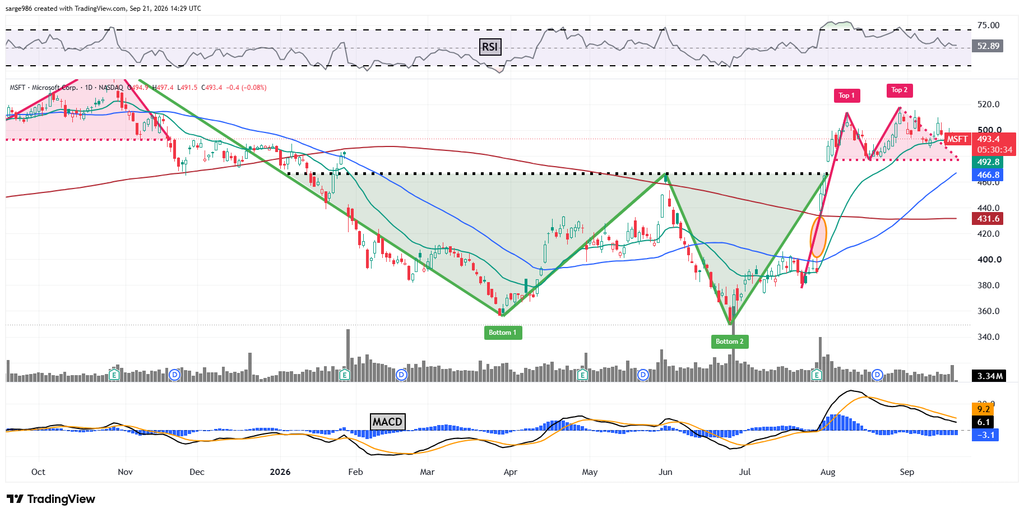
Readers will see the obvious double-bottom pattern of bullish reversal with a $466 pivot that produced the August rally in this stock. The shares broke out of that pattern, then faltered onto the latter part of that month. This formed a small double top of bearish reversal that did produce a sell-off that failed to reach pivot. It looks to this trader like swing traders supported the stock at its 21-day EMA around the same time that the shares enjoyed the algorithmic benefit provided by a golden crossover of the 20-day SMA by the 50-day SMA.
Relative strength is fine, but not especially revealing. The daily MACD, however, is sending bearish signals. What do I think? In August, I increased my target price from $532 to $582 for you. With a recent high of $518, I am still OK with that target. That said, I am watching that 50-day line, currently at $467. I won’t panic until that line cracks. MSFT loses that line, though, and it will lose me, at least on a partial.
At the time of publication, Guilfoyle was long MSFT equity.