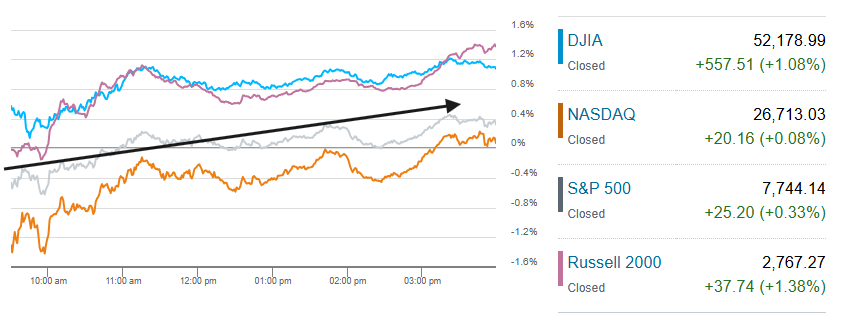
Stocks rebounded from early losses as Tech turned around and Treasury yields tumbled, sparking an intraday rally despite another hot inflation report. The S&P 500 snapped a three-day losing streak, and Tech finished down but well off its lows while small caps soared.
Indices opened mixed as Tech selling again weighed on the Nasdaq and S&P 500, but their bounce off the lows lifted the former to just into the green, after having been down as much as 1.4% early in the session, and the latter to a 0.3% gain. The Russell 2000 though led with a 1.4% gain, and the Dow Jones Industrial Average rose 1.1%, helped by a 5.2% jump in Nike (NKE).
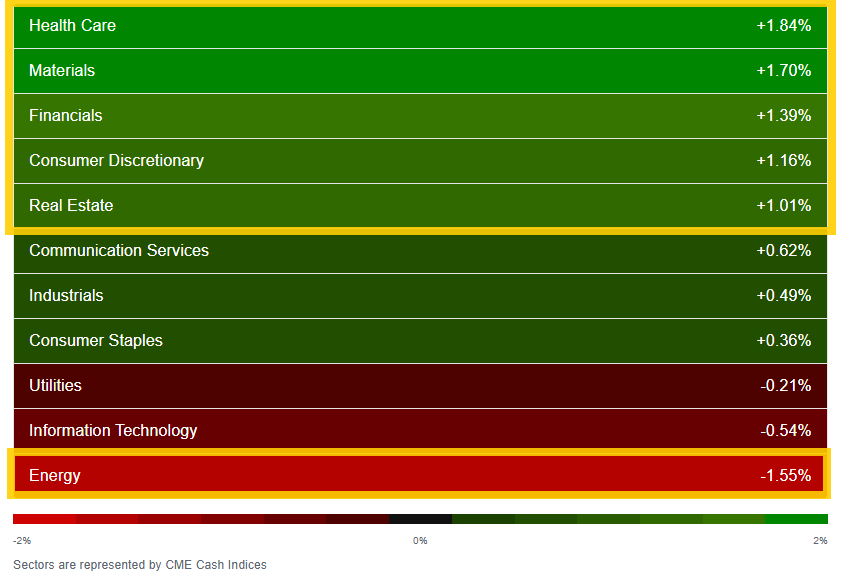
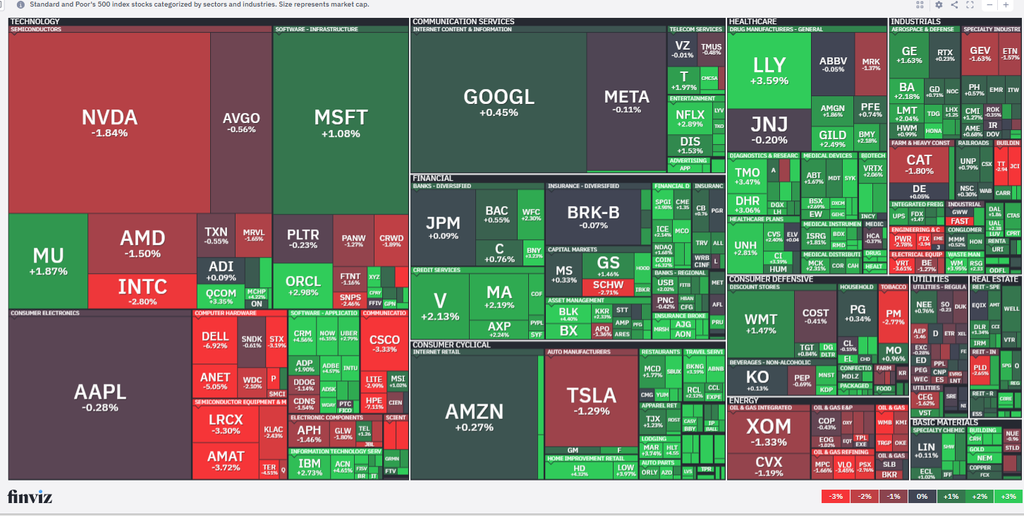
Breadth was solid, with 8 of 11 sectors higher and the equal-weight S&P 500 up 1.4%, its best day since early August. Health Care led for a second session (+1.8%, up 4.3% over two days), and Materials, Financials, Consumer Discretionary and Real Estate also rose more than 1%. Energy was the only sector down more than 1% despite a 3% jump in oil (the sixth day of gains). Tech’s 0.5% dip was a big improvement on Wednesday’s worst session since June.
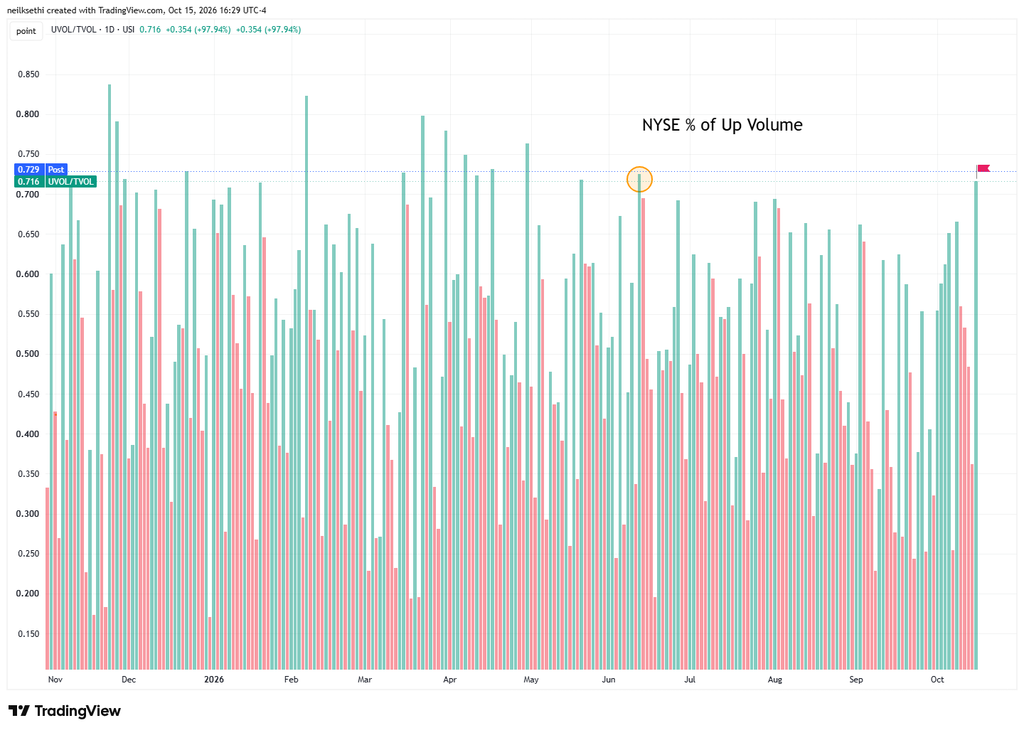
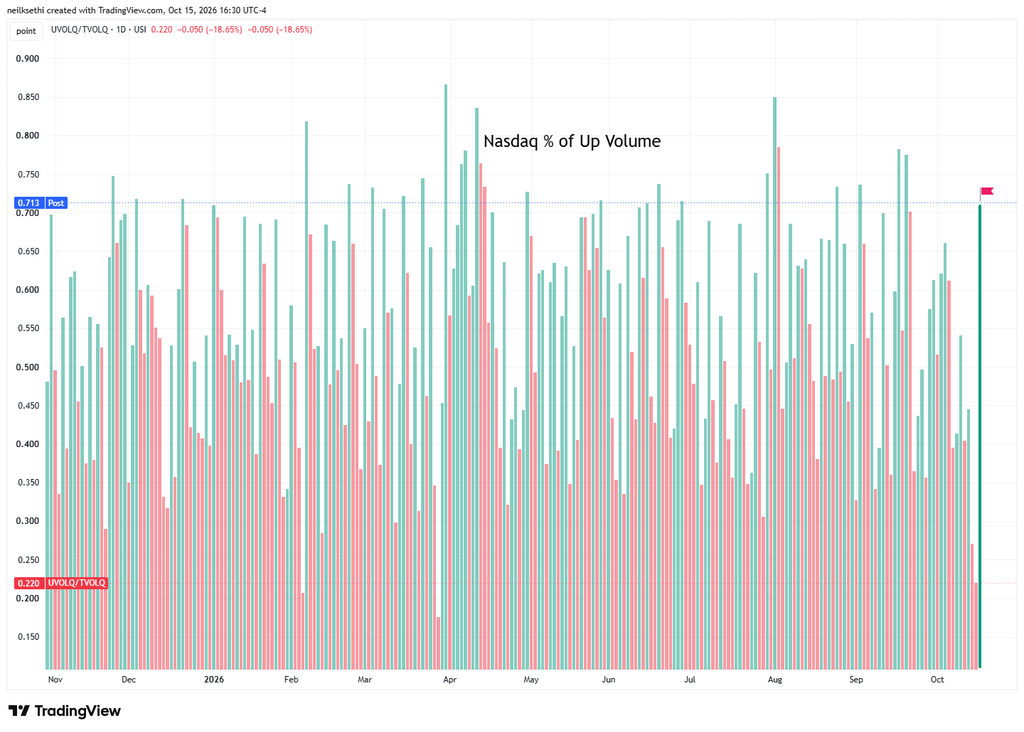
Thursday also saw the most stocks gaining 3% or more in two months, while positive volume (buying pressure in stocks higher on the day) was very strong.
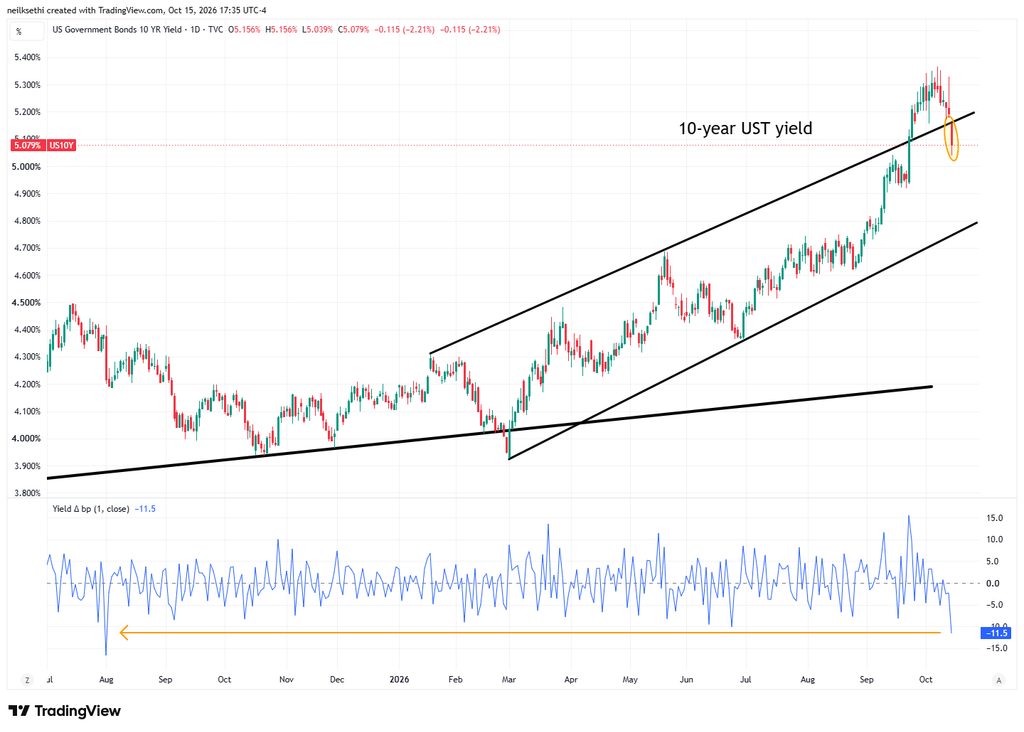
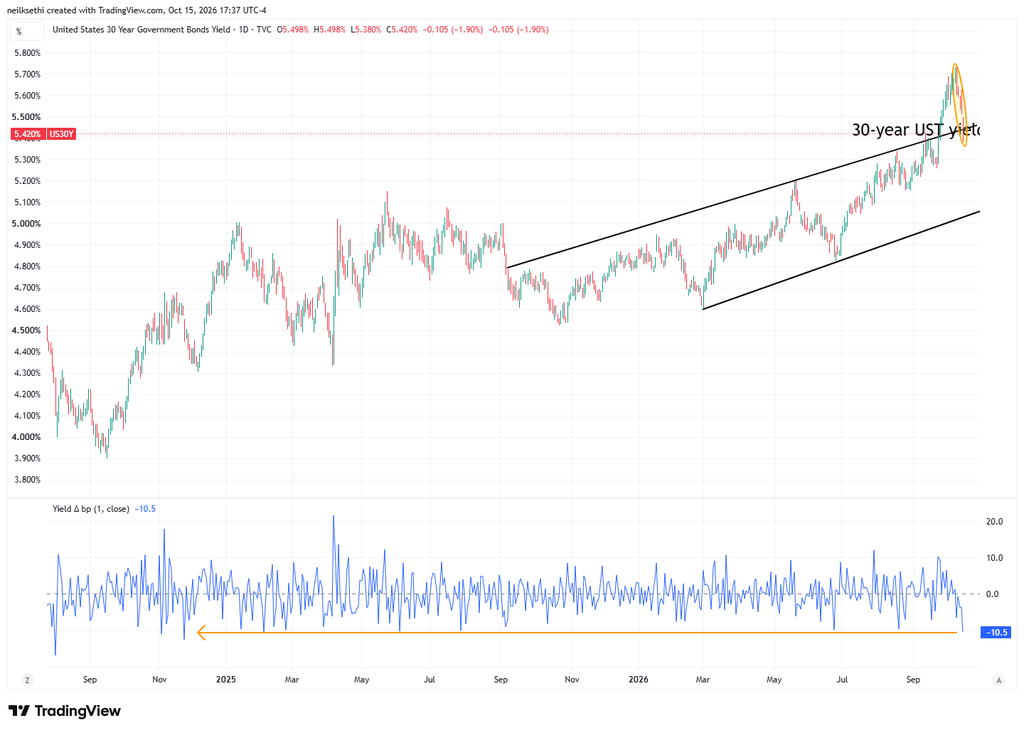
Treasuries rallied: the 10-year fell 10bp to 5.09% in the cash session, its biggest drop since August 2025 while the 30-year fell a similar amount, but in its case the largest drop since November 2024. That was despite September PPI adding to inflation worries, rising 1.3% for the month, over double expectations, and 6.3% from a year earlier, both the biggest gains since 2022, on broad based price pressures led by a record jump in energy prices. Retail sales rose 0.8% versus a 0.3% estimate, but gas stations were over 70% of that while the GDP-linked control group missed.
Fed Chair Warsh’s fireside chat in Bangkok comes late Thursday night, while Friday brings September import prices and industrial production, plus earnings from a handful of regional banks.
Schwab
Market Commentary
Equities:
“Some of the more extended stocks, such as the chipmakers and AI-infrastructure stocks, are having some of the wind taken out of their sails,” said Chris Zaccarelli, chief investment officer at Northlight Asset Management, adding that the inflation numbers fueled concern about more interest-rate increases by the Federal Reserve. “The market was hoping September would be a one and done and [Wednesday] morning’s data makes that scenario much less likely.”
“Days we were worried about the credit issues, the tech stocks were doing fine, and the days we were worried about the tech stocks, we’re getting relief from the credit issues,” said Matt Maley, chief market strategist at Miller Tabak + Co. “Today they’re both hitting at the same time.”
MarketWatch: Jeffrey DeGraff, CEO and chief market strategist at the New York–based Renaissance Macro Research, recommends shooting certain semiconductor stocks “in the back” by taking short positions. “When you’re in a bubble environment — we identified the semiconductors, and Korea and Taiwan as bubbles back at the end of April … you’ve got to shoot them in the back,” he told the “On the Tape with Danny Moses” podcast in an episode released Wednesday. “Let them crack, let them rally back and then roll over, which a lot of them are doing right now, and now it’s time to shoot them in the back,” DeGraff said, referring to SK Hynix, Samsung Electronics, Western Digital and Applied Materials as four stocks that have had a “parabolic rise” and now need to get “rinsed out.”
“For much of the rally, accelerating AI investment was enough to lift almost everything exposed to the theme,” said Charu Chanana, Saxo’s chief investment strategist. “Now markets are becoming more demanding about profitability, financing and capital discipline.”
“When Treasurys are yielding 5% and that’s the highest since the early 2000s, investors are going to start weighing that versus taking a huge bet on on AI,” said Alex Shahidi, co-CIO of MAI Capital Management’s Evoke. “It’s not are you in or out of AI; it’s how concentrated you want to be.”
“Two questions matter. Is demand for AI real? Yes,” said Manish Singh at Crossbridge Capital. “Are we going back to working and using software as we did before AI? No. The structural opportunity is real, but that does not mean every company building the infrastructure will generate attractive returns for investors.”
“If this market is one thing it is resilient, and we believe that resilience will last through the end of the year, but we need to get through the uncertainty of the rapidly approaching mid-term elections, and the volatility that this creates, before the market can finish the year stronger,” Chris Zaccarelli at Northlight Asset Management said.
CPI/PPI:
Olu Sonola, Head of US Economics at Fitch Ratings: This inflation report is flashing red for the Fed. Energy pushed the headline number higher, as expected, but the real problem is that core inflation remains stuck above 3%. Higher energy costs are beginning to seep into broader services prices, increasing the risk that this inflation burst will persist. A rate hike at the end of the month is now firmly on the table, but December remains the more likely move.”
Seema Shah at Principal Asset Management says CPI locked in a December hike: “More than half the CPI basket is still running at an annualised pace above 3%, highlighting the breadth of price pressures across the economy. Combined with continued economic resilience, this suggests the Fed’s job is not yet done. We continue to expect further hikes in December and early 2027 before the Fed can be confident that inflation is on a sustained path back to target.”
Fed:
“Warsh will speak tonight but may remain true to his desire to not offer guidance,” said Citi economists led by Andrew Hollenhorst. “Simply emphasizing that inflation is above target and the Fed will respond accordingly would sound hawkish in the wake of [Wednesday’s] upside inflation surprise. But he may choose to moderate his remarks by noting that financial conditions have already been tightened.”
“On balance, we think Warsh will talk in a way that does not suggest an October hike,” Krishna Guha at Evercore said. “Warsh will be mindful of the global wobble in tech stocks and signs financing conditions are tightening for more exposed AI names, on top of the prior move up in longer-term yields.”
Stock and Sector Breakdown:
Sector breadth was solid with 8 of 11 sectors higher with Health Care leading for a second session +1.8% (up +4.3% the past two sessions). Materials, Financials, Consumer Discretionary, and Real Estate would also finish above 1%. Just one sector (Energy) down over 1%. Tech finished in the red, but well off the lows and the -0.5% performance was a big improvement over Wednesday’s 2% drop, the worst session since June.
[chart uses futures prices]
Schwab
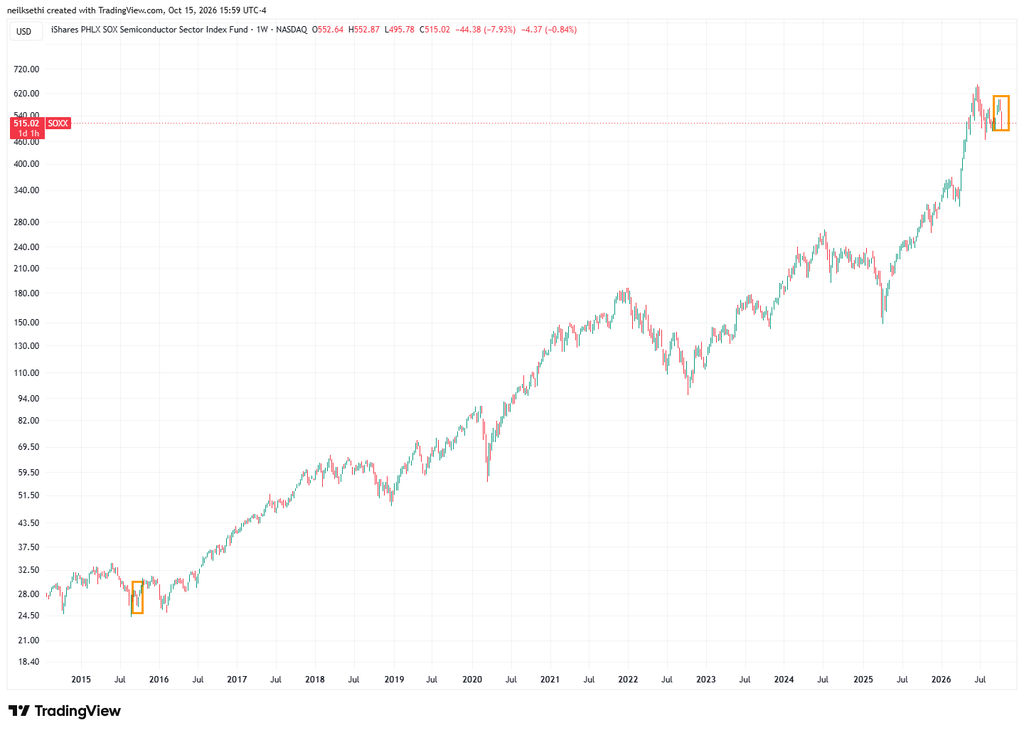
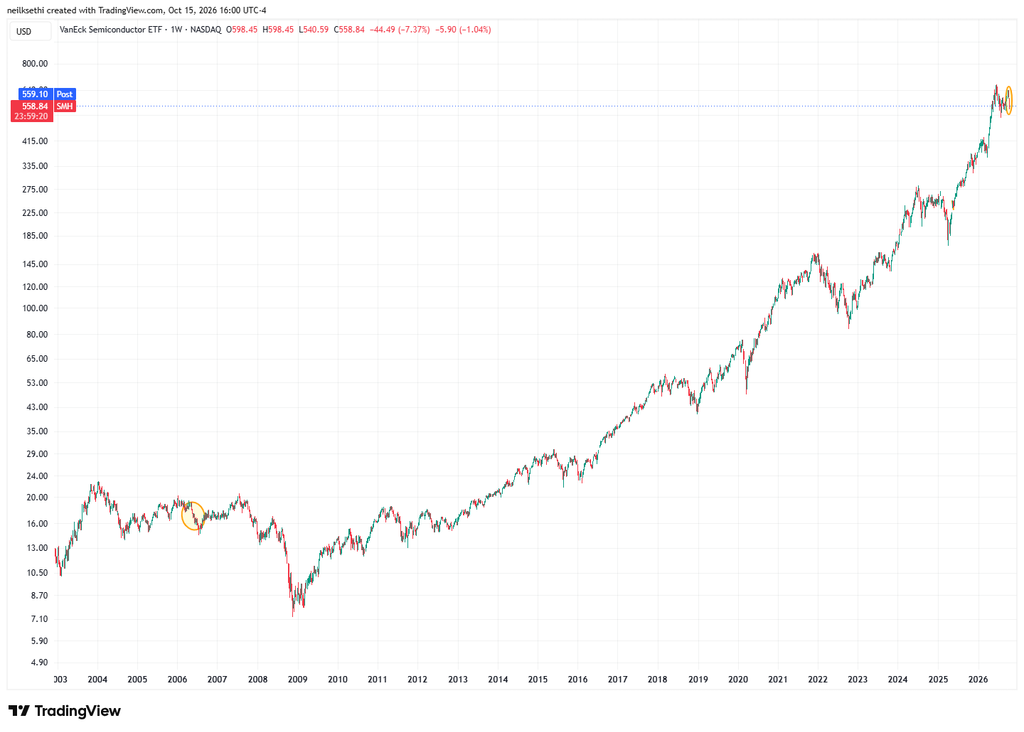
AI beneficiaries continued to pressure Tech. The iShares Semiconductor ETF (SOXX) -0.9% was lower for an eighth straight trading day, its first eight-day slide since September 2015 (for a nine-day slide you have to go back to May 2006). [weekly log chart below] But that 1% decline was well off the over 4% drop at the lows.
The VanEck Semiconductor ETF (SMH) was also down an eighth straight day, making it the longest slide since May 2006 when it fell for nine straight sessions.
CoreWeave (CRWV) saw an even more striking turnaround. After plunging 15% yesterday and falling another 7% this morning amid concerns about debt financing for the AI infrastructure buildout which saw its bonds trade further into distressed territory (see post), both its bonds and shares reversed course with shares ending nearly 6% higher with shares ending nearly 6% higher after Nvidia (NVDA) CEO Jensen Huang said at a Bloomberg event that CoreWeave’s ‘strength is improving every day.
Shares of Hewlett Packard Enterprise (HPE) -7.1% and Dell (DELL) -6.8% though continued their selloff started Wednesday when Barclays analyst Tim Longdowngraded Dell from Overweight to Equal Weight and cut his price target to $574 from $603 and HPE to $77 from $83. He explained the downgrade by stating he sees “less upside as memory prices normalize.” Those were the two worst performers in the S&P 500.
Charles Schwab (SCHW) -2.7% dropped despite reporting results that beat expectations posting a 23% jump in profits powered by a rush of new accounts and customer dollars moving onto the platform. Clients are also borrowing more: bank loan balances were up 35% year-over-year. Pledged asset line balances, which allow customers to borrow against their investments, surged 59% from the same period last year per the Wall Street Journal.
Shares in Rocket Lab (RKLB) meanwhile tumbled over 6%, after having lost about 8% on Wednesday, after it announced it was postponing the maiden launch of its Neutron rocket again.
Equifax (EFX) +7.25% would lead all S&P 500 components just edging out Reddit (RDDT) +7.24%.
The number of large SPX winners (up over 3%) jumped to ~120, the most we’ve seen since the start of August from 20 Wednesday, 13 Tuesday, 10 Monday.
The number of large losers (down over 3%) fell to 18 from ~85 Wednesday, ~20 Tuesday.
As mentioned previously, both of these metrics have been very (extremely?) subdued since the start of August, rarely getting above 50 and only once above 100 previously. So while the large loser count Wednesday was a relatively high reading compared to what we’ve been seeing the past couple of months, the large winners Thursday was even more so.
And positive volume (intensity in buying stocks up on the session) was very strong on both the NYSE and Nasdaq at 71.6% and 71.3% respectively. The latter was particularly outstanding coming on an index gain of just 0.08%. Compare that to Friday when it was just 53.1% on a gain of 0.64%
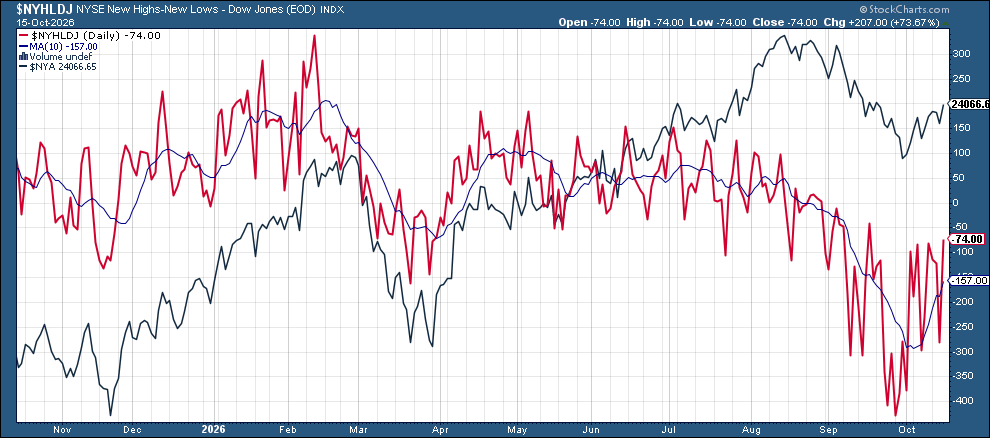
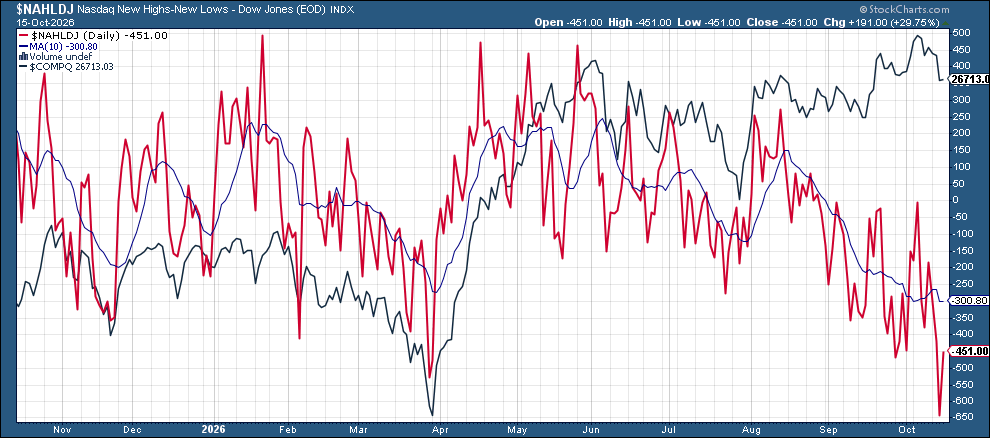
And NYSE new 52-week highs minus lows improved to -74 from -282, but it was still negative, as was the Nasdaq with 457 fewer new 52-week highs than lows, but less than 652 on Wednesday, the most negative since April 2025.
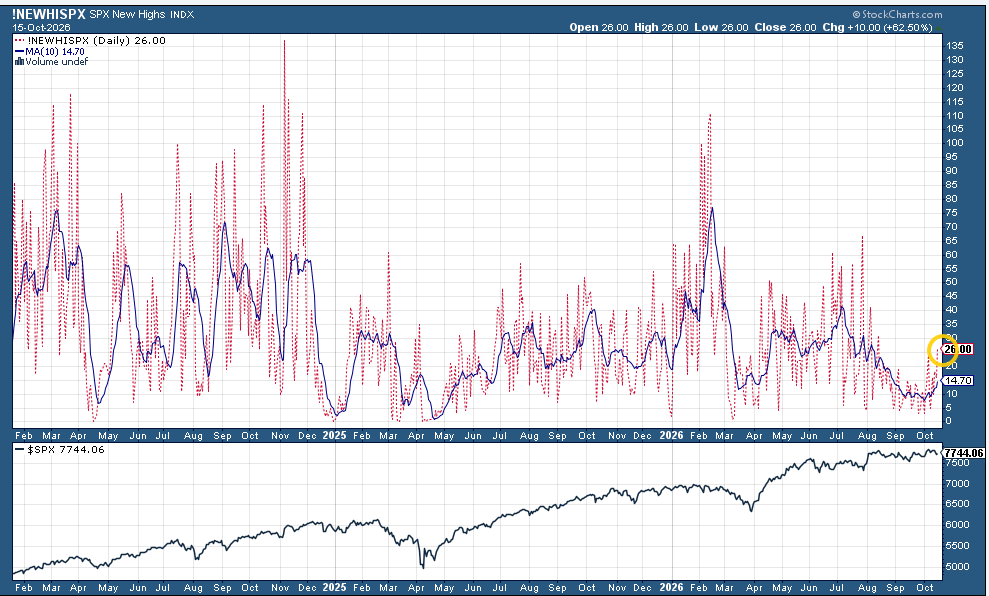
And the most S&P 500 new highs since August (although just 26).
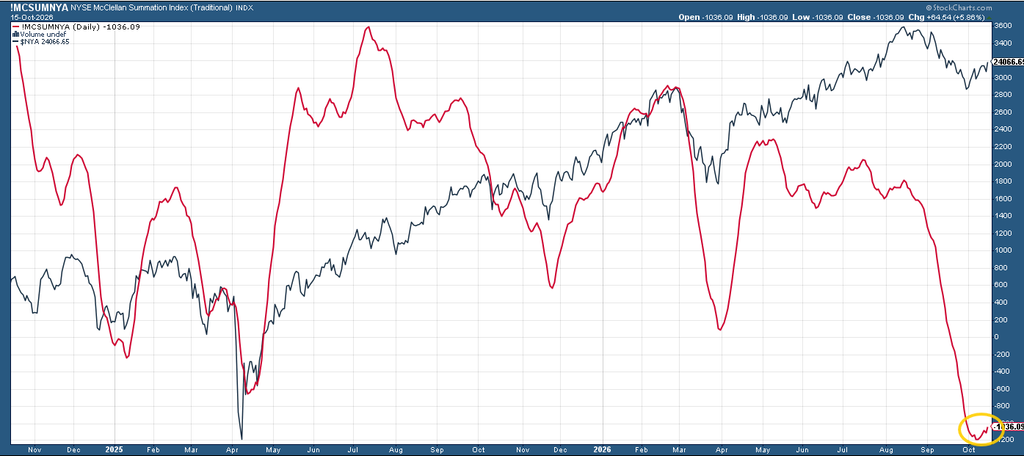
And the McClellan Summation Index (red line, broadly whether the typical stock is doing relatively better or worse than the index) continues to turn up.
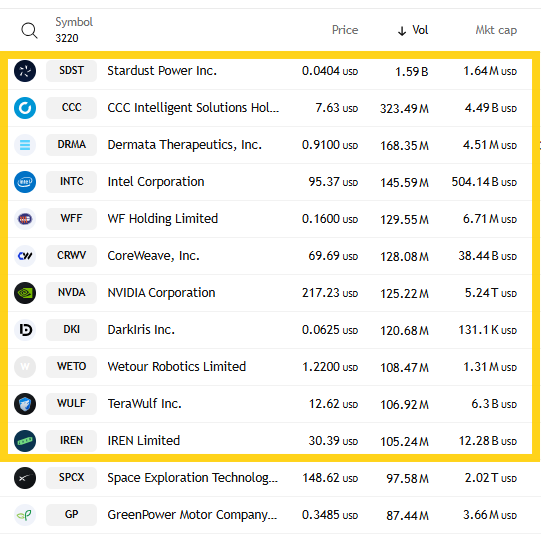
And we’re starting to see speculation creep back into the Nasdaq. Penny stock traders took to Stardust Power (SDST) which traded nearly 1.6 billion shares, the most we’ve seen in weeks, and there were 10 other stocks trading over 100 million shares (four of them sub-$2).
TradingView
Some other stock-specific commentary from TheStreet Pro:
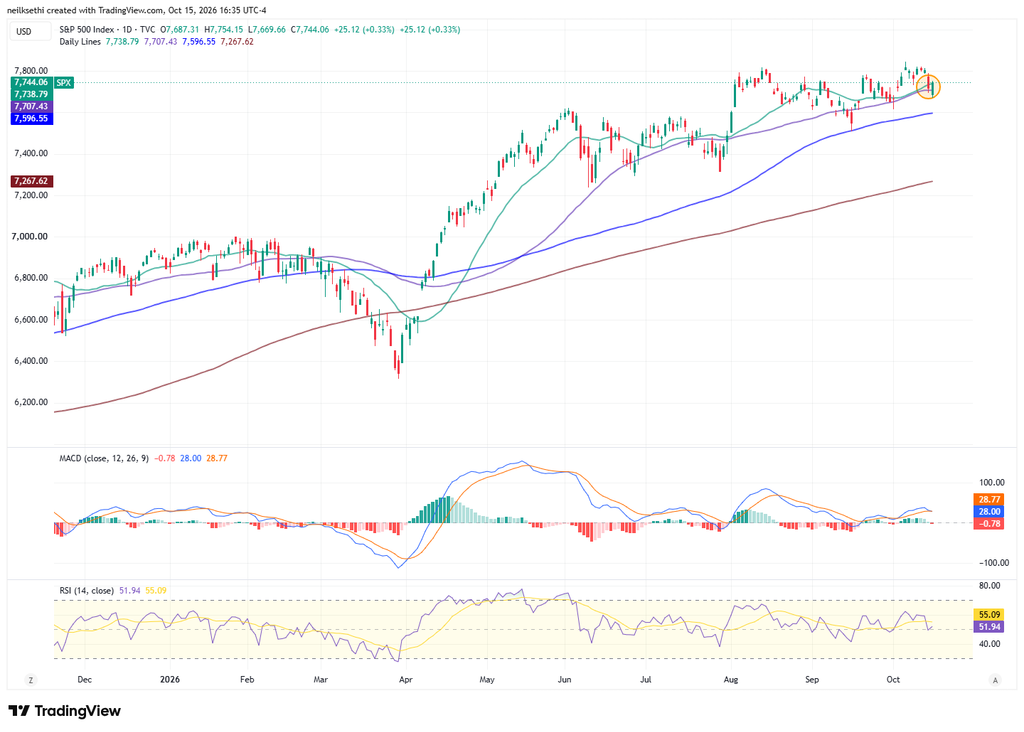
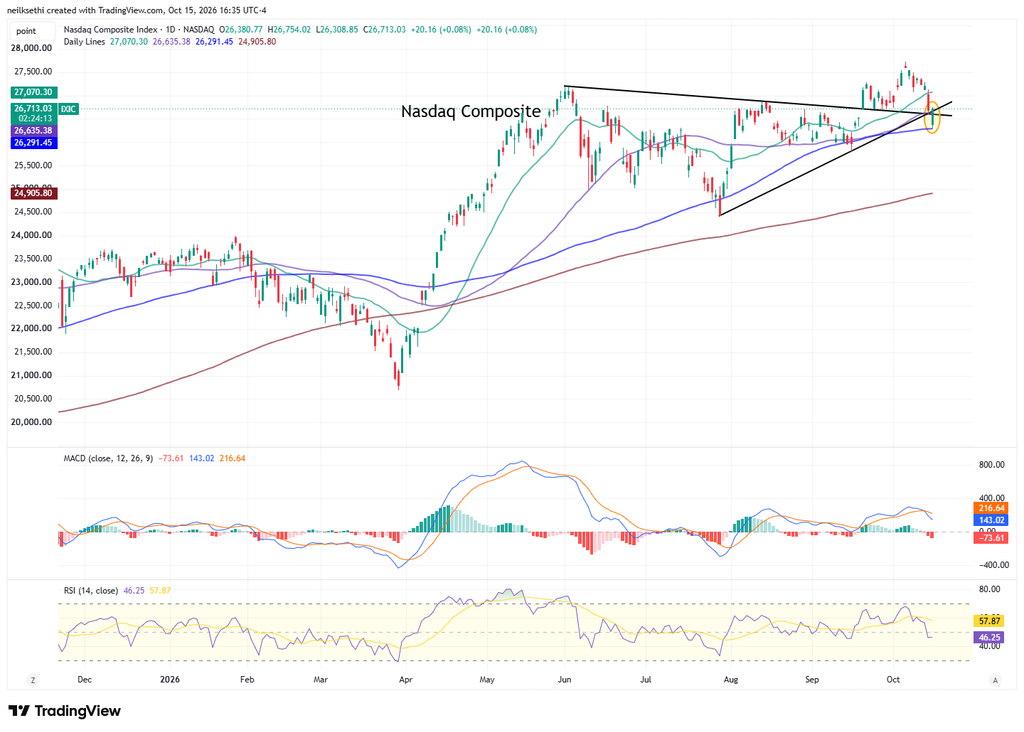
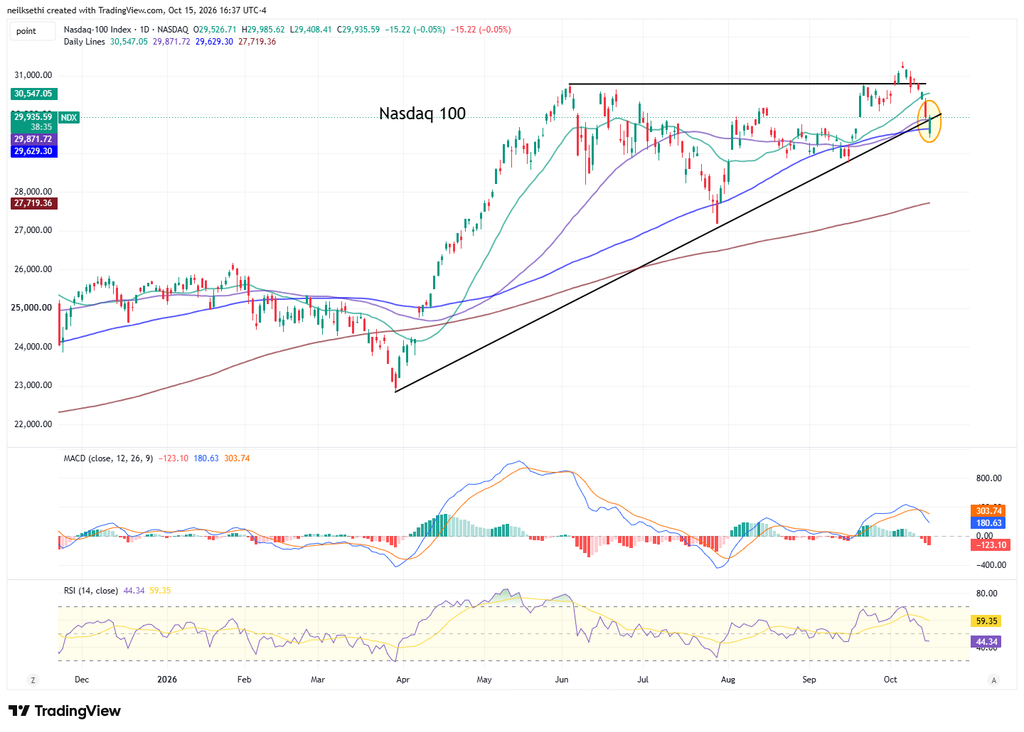
Note on all charts the colored lines are moving averages (the average price over the lookback period — days on the daily charts, weeks on the weekly charts): 20 = green 50 = purple 100 = blue 200 = brown
Exception is monthly charts where blue is 10-month moving average and brown is 20-month moving average.
MACD = Moving average convergence/divergence line, a measure of momentum that compares longer term and shorter term momentum to gauge if a move is strengthening or weakening. This is probably my favorite individual indicator.
RSI = Relative Strength Index (basically what it sounds like) = measures the strength of the move comparing gains to losses over the given lookback window (I use the standard 14 periods).
SPX fell under its 50-DMA but was able to recover it ending on the 20-DMA. The daily MACD and RSI remain neutral.
NasdaqComposite fell to its 100-DMA where it turned around recovering all of its losses. Still, as I noted Tuesday, it has a MACD sell signal and the RSI has fallen under 50. It’s also right on the trendline from the August low.
And theNasdaq-100 (QQQ) similar to the Nasdaq. I sold half my QQQ position when it broke the 50-DMA then bought it back when it got back over, so no net change in that position. We’ll see which way it goes tomorrow.
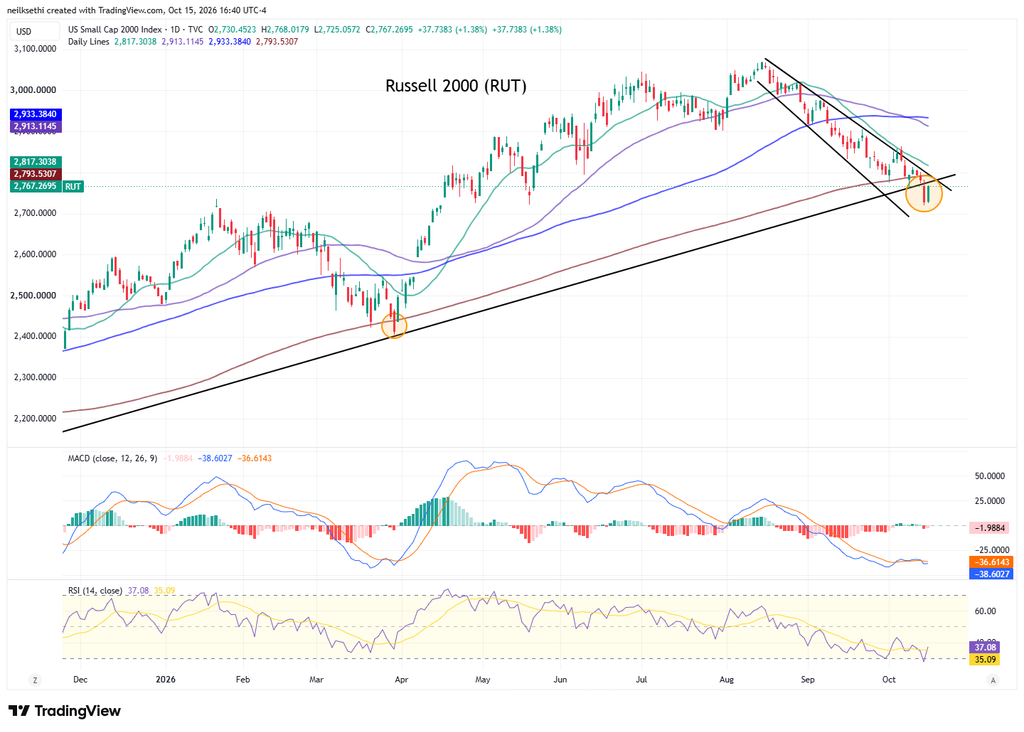
The Russell 2000 (RUT) able to bounce but remains under the uptrend line from the April 2025 lows (as well as all moving averages I track). The MACD remains “go short” although very mildly and the RSI has bounced back over 30 after Wednesday’s first sub-30 reading since April 2025.. If it could get back over the 200-DMA I’ll most likely get back in.
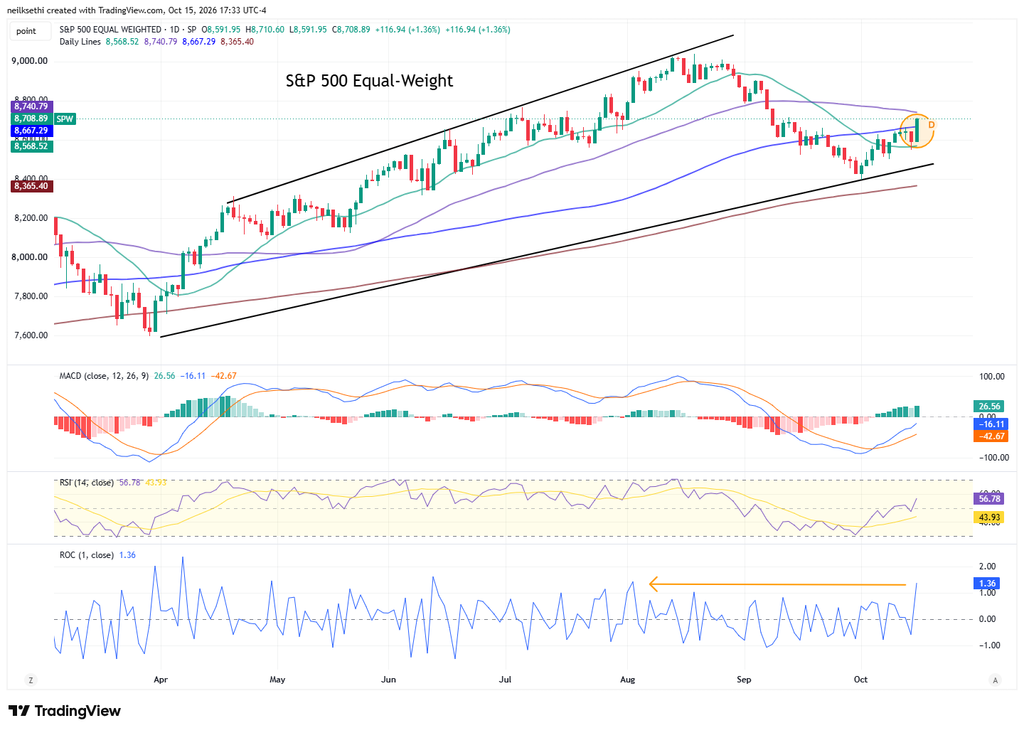
The equal-weighted SPX which I have noted has been “able to hold up better but also capped by the 100-DMA,” busted through that taking it up to just under a downsloping 50-DMA. It was the best day since August 4th. If it can make it over that, I’ll be adding. It has a positive MACD, and the RSI is over 50.
Treasury yields very surprisingly completely ignored the hot PPI report and fell across the curve led by the long end (bull flattening).
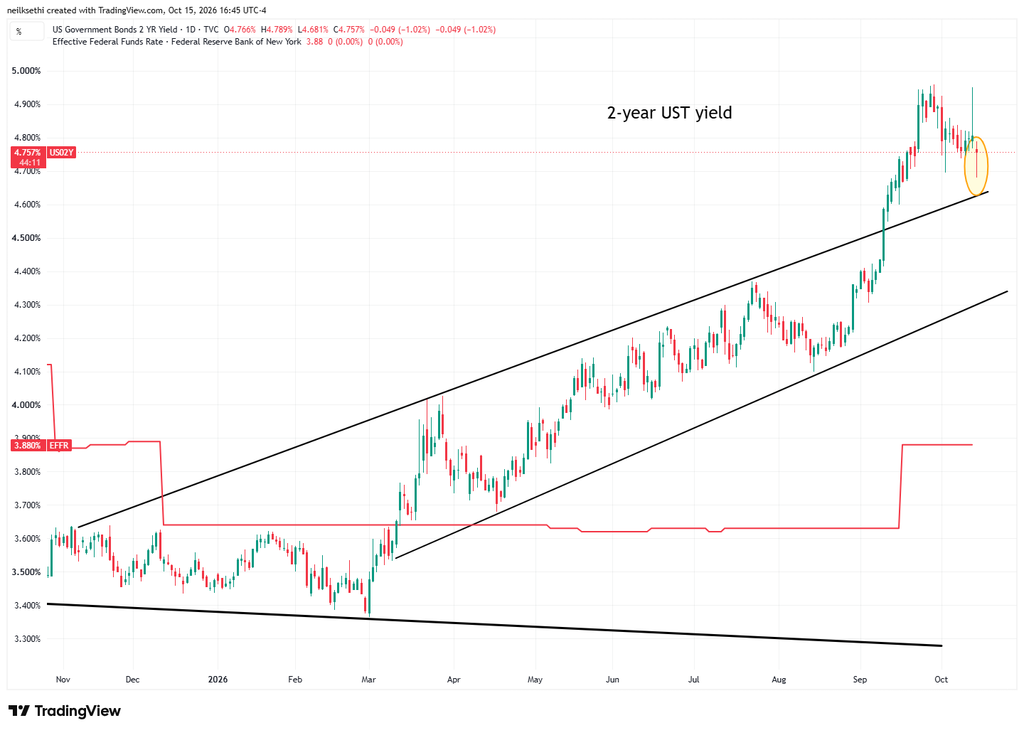
The 2-year Treasury fell five basis points (including the after-hours) after Wednesday’s big reversal lower now at 4.75%. It was though down as much as 12 basis points earlier in the session.
It is ~88 basis points above the Effective Fed Funds rate, so still calling for rate hikes.
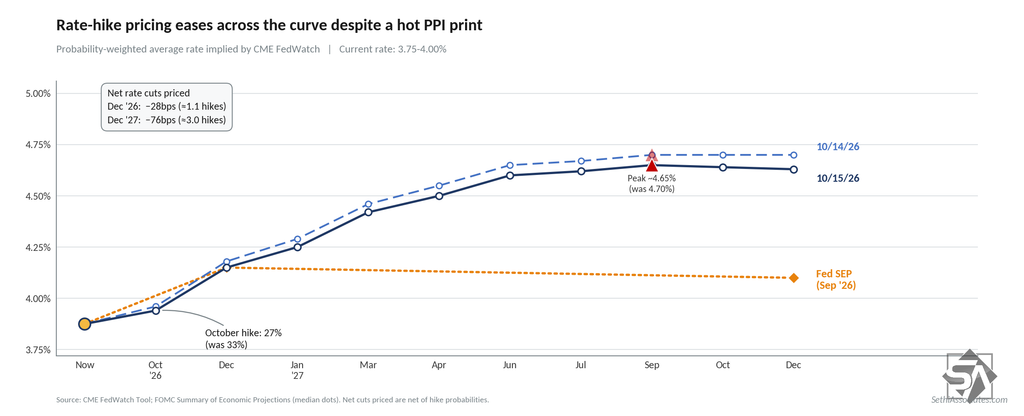
Fed rate hike bets from the CME Fedwatch tool also confusingly softened. There’s now a 27% chance of an October hike (from 33% Wednesday) and ~76 basis points of hikes through 2027 (compared with 83 Wednesday). Chance of two hikes this year is 23%.
10-year yields dropped 12 basis points to 5.08% (including after-hours), the largest drop since August 2025 and now back into their channel from the start of the year (I told you we’d get back in there this year). And there could definitely be more to go, especially now that we’re clearly into a short-covering rally in bonds.
30-year yields fell for a fifth straight session 10.5 basis points to 5.42% (including after-hours), the largest drop since November 2024 and also back into the top of their channel from the start of this year.
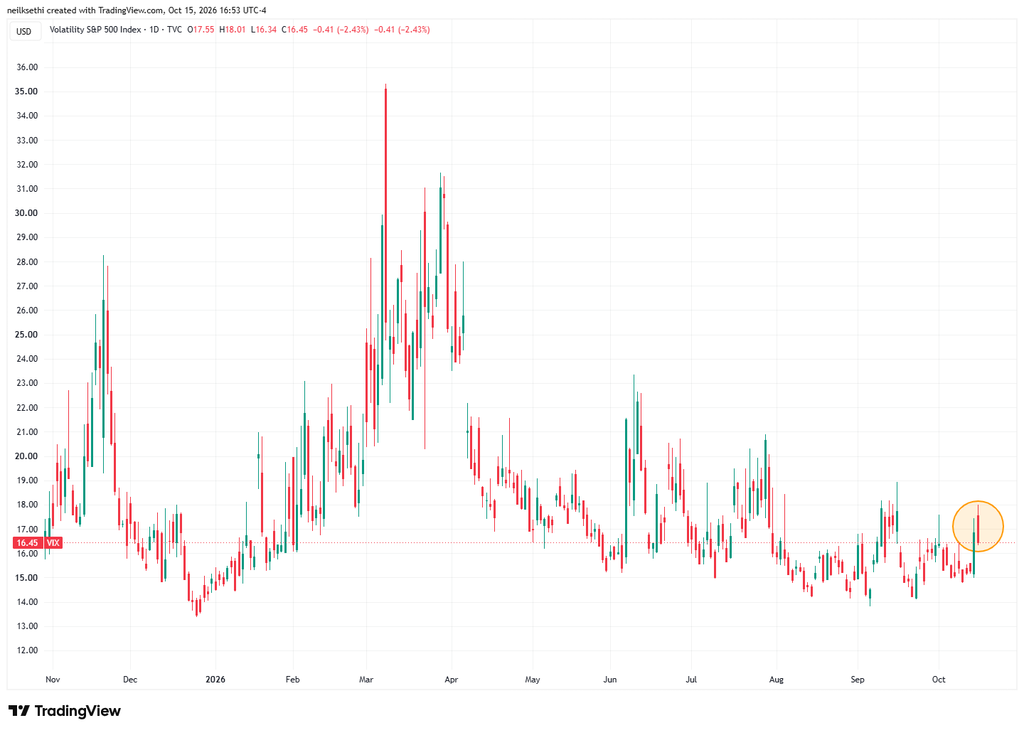
VIX hit 18 before falling back to close at 16.5. That level is consistent with ~1.04% average daily moves in the SPX over the next 30 days.
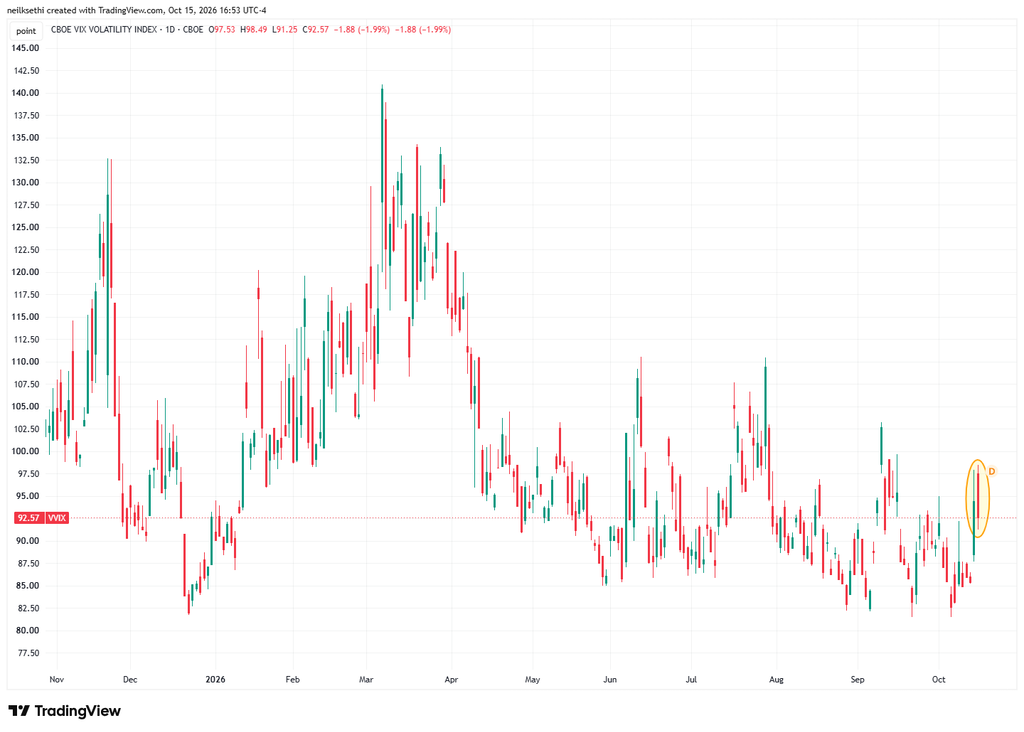
The VVIX (VIX of the VIX) similarly fell back to 92.6. The current level is still consistent with “moderate” daily moves in the VIX over the next 30 days (historically, normal is 80-100, although we haven’t been below 80 since July 2024). Above 100 is the level flagged by Charlie McElligott as indicating higher stress.
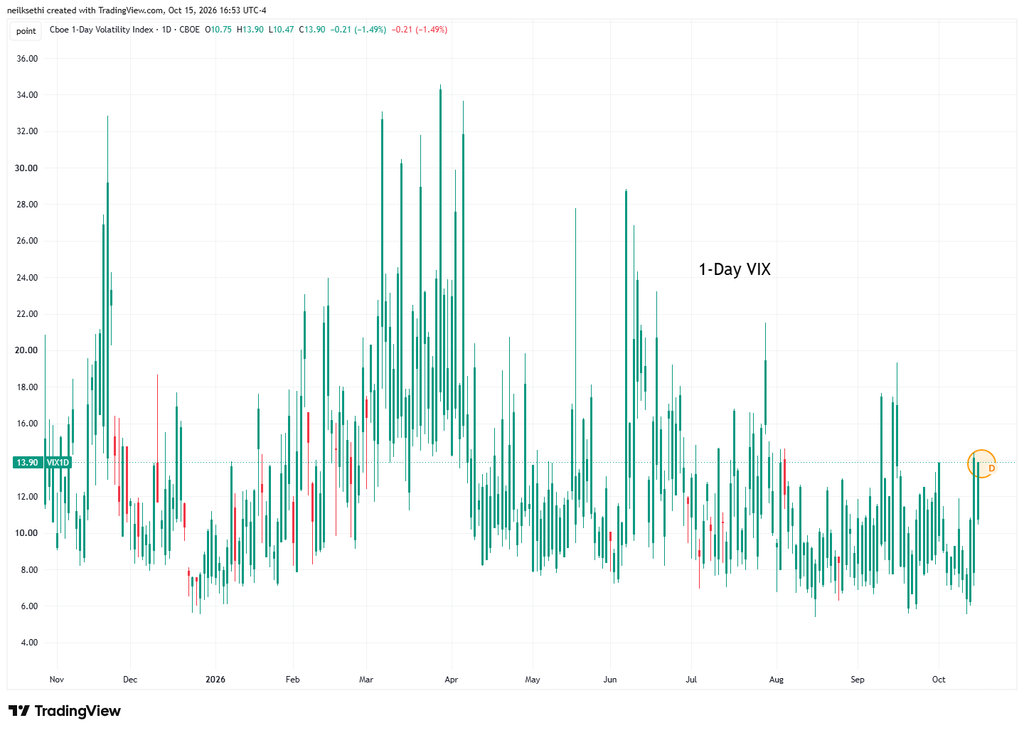
1-day VIX though didn’t soften much ending at 13.9. The current reading is consistent with a move of 0.88% in the SPX next session.
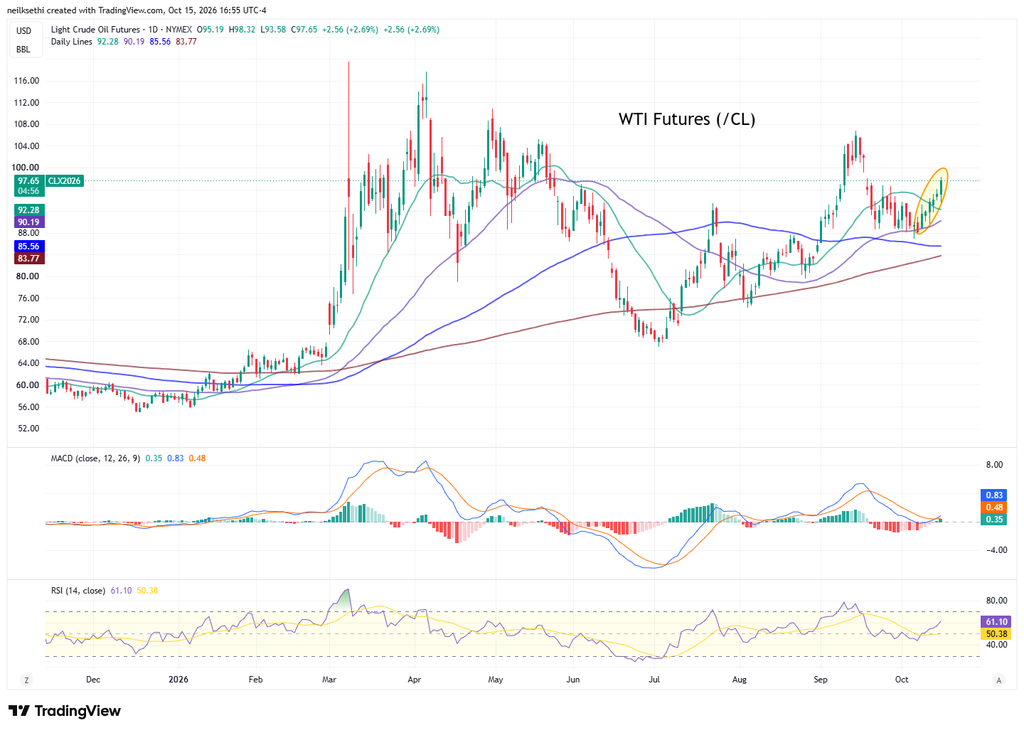
WTI futures (/CL) up for a sixth session to the highest close in nearly a month (including after-hours).
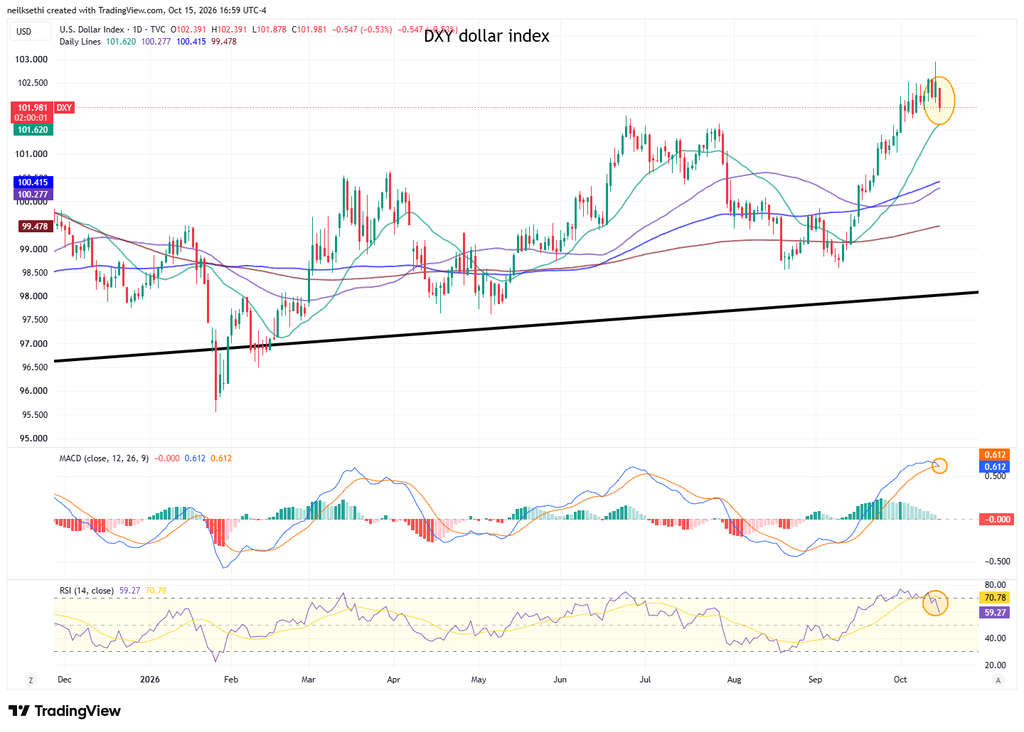
Falling yields pressured the DXY dollar index (which is fixed weighted with a heavy 57% weighting vs the euro) which fell back from the highest levels since April 2025.
Also the daily MACD is about to flip to a “sell longs” positioning while the RSI has fallen from over 70 to under, both of which would argue for a consolidation.
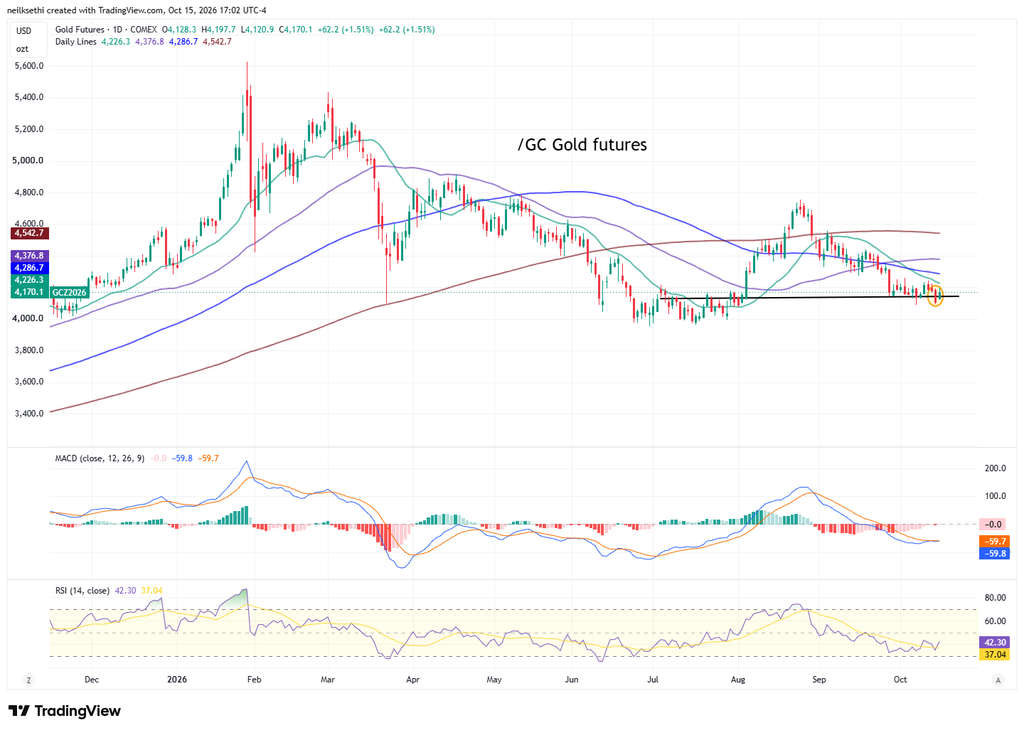
Gold futures (/GC) refuse to break down getting back over support. The daily MACD is now neutral but the RSI is around 40. It’s worked itself into a position for a rally if it wants to take advantage.
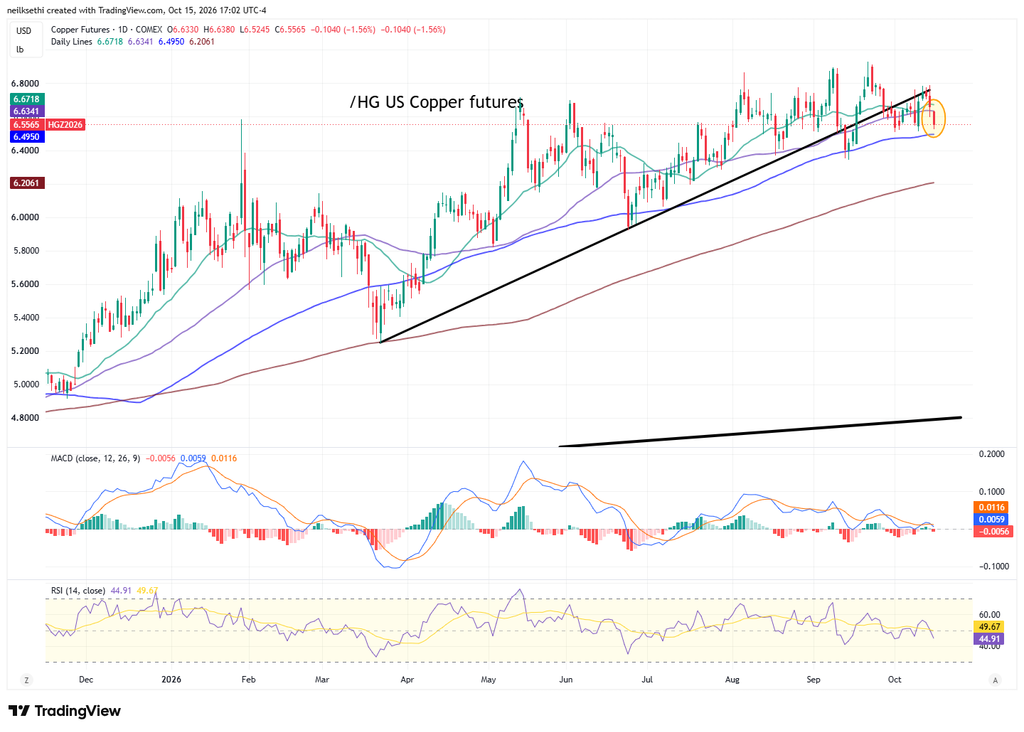
US copper futures (/HG) fell back again. Overall still remains range bound. Daily MACD and RSI to slightly negative from slightly positive.
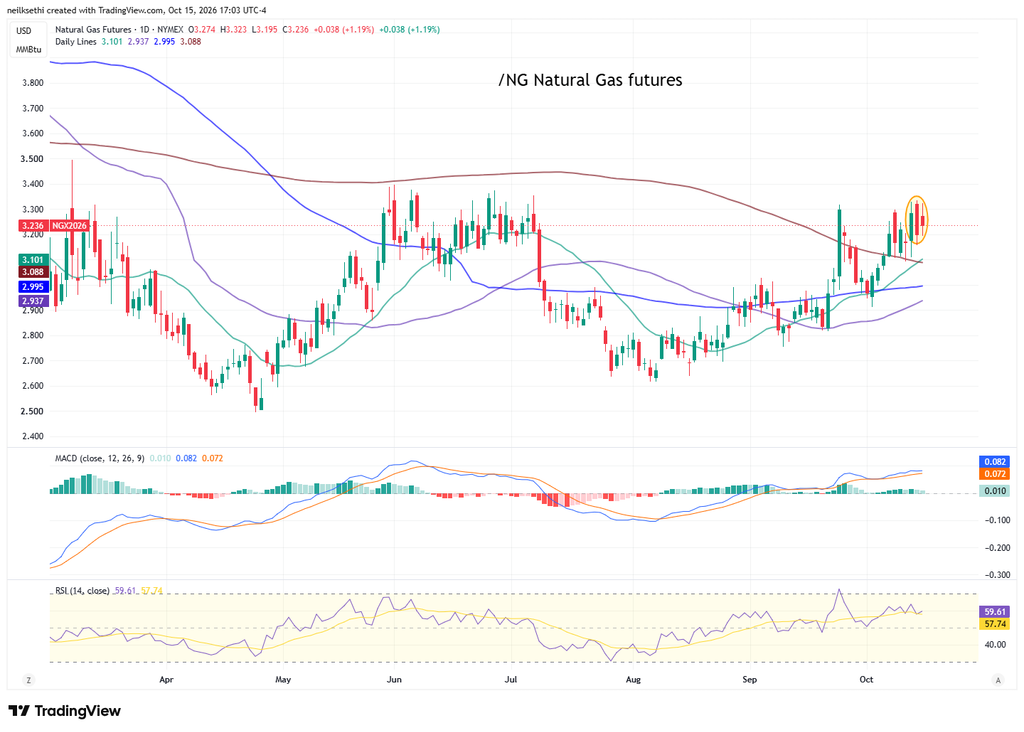
US natural gas futures (/NG) an “inside day” (range inside the range of the previous day). They remain towards the top of their range since March. As mentioned Tuesday, “They do have positive technicals, so if they get over the $3.40 area they could run.”
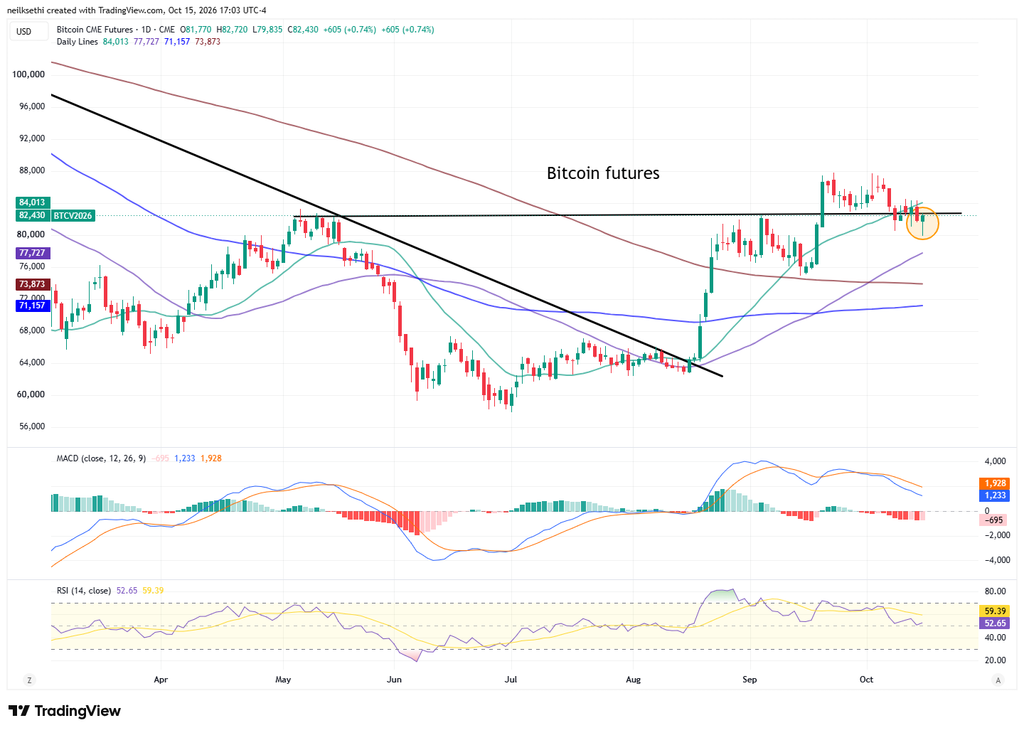
Bitcoin futures, unlike gold, remain under support. I did sell out of my iShares Bitcoin Trust ETF (IBIT). I’ll wait for a better entry. Daily MACD still negative, although the RSI still holds just above 50.
I noted yesterday on the drop in bond yields “I don’t have a great explanation, but it does bolster my case that we are past or near a short-term peak for yields,” and today we got more of that, which appears to be catalyzed by fears about the Tech trade according to BofA’s derivatives team:
They looked at the action on October 8th (the day of the OpenAI revenue headline from the FT) and said “that event provides one of the cleanest case studies of how the equity market might react in a more prolonged and consequential AI slowdown event.”
Specifically they noted that “despite the broader equity lower, yields higher regime that the market has experienced for many months, risks of an AI slowdown elicited lower yields along with lower equities on 8-Oct nearly immediately, with the move holding until the end of the day (Exhibit 16). Such a reaction to AI-specific worries is similar to the DeepSeek event in Jan-25, which also saw a sharp Nasdaq decline with rates falling.”
We also saw this in the unwinding of the dot-com bubble in 2000 they note, as “an AI slowdown would hit both growth and inflation (less capex, less power and resource consumption), which pushes yields lower still. In other words, the bond market would finally start behaving like a hedge again, right when it’s needed.” (ZeroHedge quote)
Separate from that, as I’ve harped on for weeks, there is a huge short position in bonds that it appears is starting to unwind. I noted Tuesday Blackrock had closed their underweight on long duration, and other banks are starting to do the same. I’m not sure if we’re into CTA short-covering, but I would think that we’re seeing at least some of that. We’ll see what BofA, DB, Goldman, etc., say this weekend. If so, this could have much further to run.
But for now the falling yields are boosting a wide swath of stocks as discussed earlier. If/when yields stabilize, it will be interesting to see if the equal-weight can keep pushing higher.
Which brings me to Tech. We got a bounce, but as Jeff DeGraff of Renaissance Macro, a strategist I have a lot of respect for, said in the commentary section this downtrend has further to go, and while we may see a bounce, it will be just that (he advised “shooting them in the back” by taking advantage of the price rise to short).
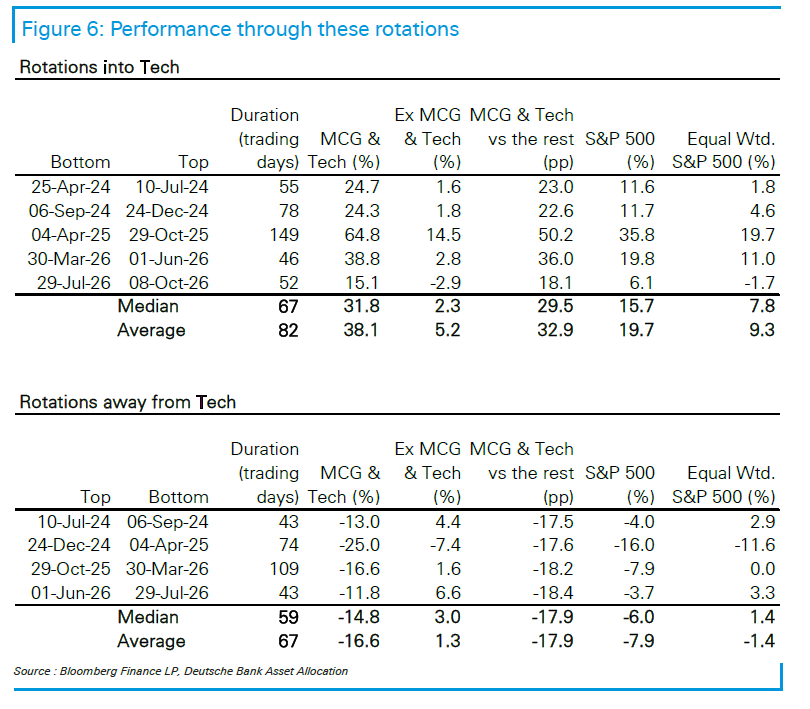
That dovetails in once again with one of my core themes for the week which is Deutsche Bank’s analysis that we’re still early on in what they expect to be a several week pivot away from Tech:
I went through on Sunday my concerns about the Tech trade. It was lengthy, so I won’t revisit that all here, but it was in part based on the analysis of Deutsche Bank’s equity team, who as I mentioned has “called the past year as good as anyone”.
My takeaway was: “I remain hopeful that Tech can get it back into gear, but it does seem we’re due for a rotation out of Tech, and those have lasted over a month since mid-2024. So if they’re right, the answer is no, Tech and non-Tech will not rise together.”
We have one more big event in Warsh tonight. Expectations are relatively low given his avowed avoidance of forward guidance (leaving that it appears to his lieutenants), but if he’s uncomfortable with an ~27% pricing of a hike and wants it to be more “two-sided” (i.e., closer to 50-50) some choice words about how inflation is moving in the wrong direction based on this week’s prints, the Fed still has a lot of work to do, etc. would almost certainly do the trick.
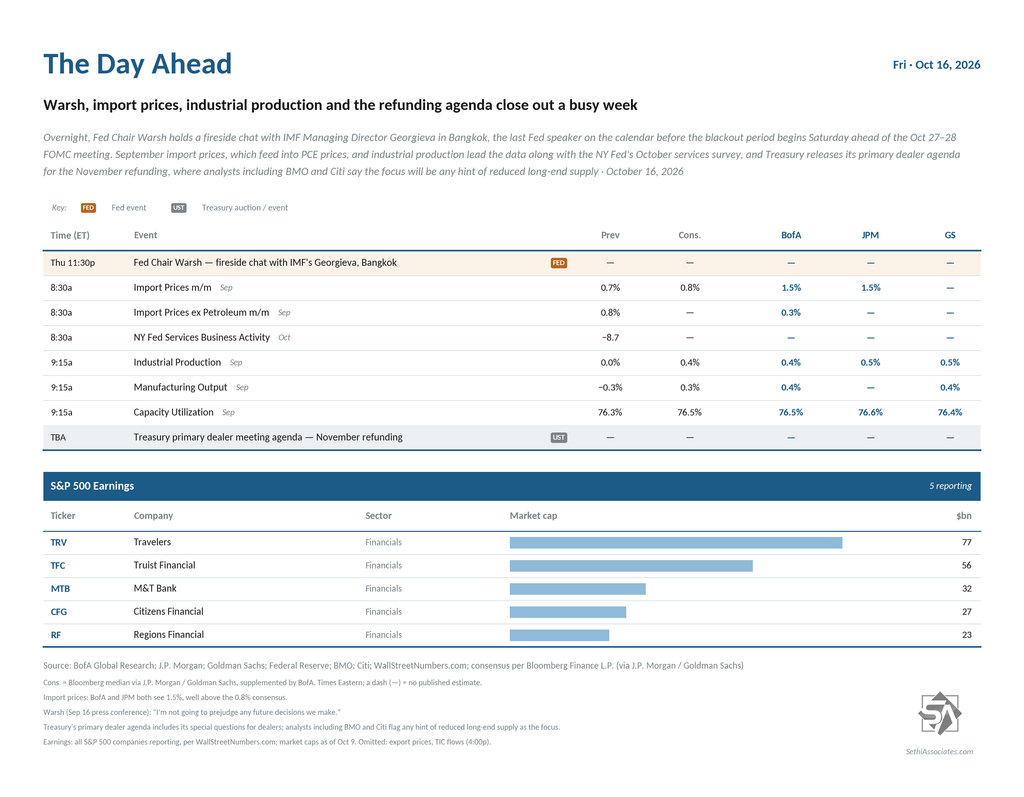
The Day Ahead – Warsh and More Data Close Out the Week
US economic data closes out the week with September import prices (which have some feed-through into PCE prices, but less than CPI or PPI) and industrial production (our most complete look at the manufacturing sector), along with the NY Fed’s October services survey.
Fed Chair Warsh holds a fireside chat with IMF Managing Director Kristalina Georgieva Thursday night (Friday morning in Bangkok, where the IMF/World Bank Annual Meetings are being held). He’s the last Fed speaker on the calendar before the blackout period begins Saturday ahead of the October 27–28 FOMC meeting, so if he wants to move market expectations for the October meeting this is his chance.
No non-Bill (>1yr in maturity) US Treasury auctions this week, although Treasury releases its primary dealer meeting agenda for the November refunding, which analysts including BMO and Citigroup flag for any hint of reduced long-end supply.
Q3 earnings season continues with five S&P 500 components: Travelers (TRV), Truist Financial (TFC), M&T Bank (MTB), Citizens Financial (CFG) and Regions Financial (RF).
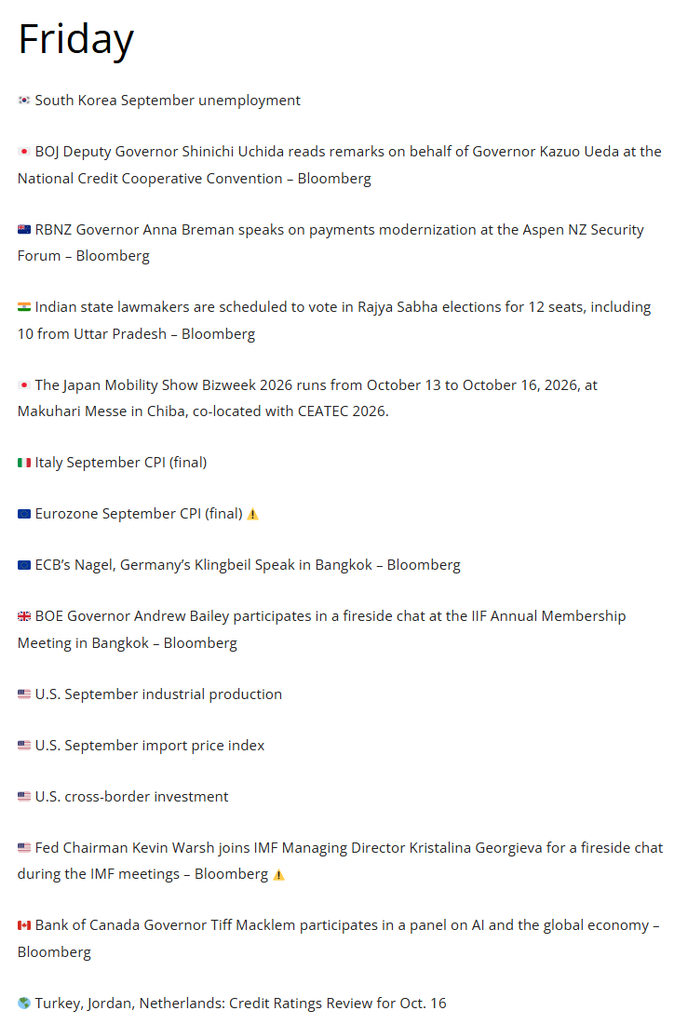
Ex-US highlights mostly central bank speakers per Christophe Barraud’s rundown below.
At the time of publication, in terms of equities mentioned, Sethi was long NKE, NVDA, TSM, QQQ, SPY, RSP, CPER, and numerous equities in the energy sector.
As a reminder comments are encouraged. If they are directed at me, please put @NeilSethi in front.
While China's domestic demand remains moribund, it is relying an increasing amount of exports to keep the economy afloat. So far, so good, as exports in September jumped the most since March, soaring 36% y/y with high-tech products up almost 64%, which Bloomberg EconomicsShow more
$CRWV "The cost of protecting CoreWeave’s debt against default for five years rose by as much as 74.5 basis points to 1194.5 basis points, according to ICE Data Services. That’s the highest intraday level on record with swaps pricing in a more than 60% chance of default withinShow more
The hot CPI print isn't all bad.... at least for Social Security beneficiaries.
The annual cost-of-living adjustment will be 3.6% in 2027, up from 2.8% in 2026 and the largest since 2023’s 8.7%.
The adjustment is based on the change in the CPI for wage earners (CPI-W) in theShow more
South Korea's Kospi fell 8% Thursday, triggering another circuit breaker, its seventh straight decline and taking it to its lowest close since April 7th. The index is now down nearly 40% from its June 22nd closing high, taking its valuation to a record low at less than 5 timesShow more
@business
CoreWeave’s credit risk climbed to an all-time high Thursday as its high-yield bonds extended declines, rattled by the AI cloud-computing company’s plans to ramp up borrowing bloomberg.com/news/articles/…
Neil Sethi NEW account
@neilsethinew
Hot CPI Puts October Rate Hike Back in Play
Core rises 0.33% from August, a second hot monthly print, as gains spread well beyond energy. October rate-hike odds more than double.
pro.thestreet.com/market-comment…
I mentioned that the Fed’s Beige Book, an anecdotal read on conditions across the 12 Fed districts that’s prepared for the upcoming FOMC meeting, was important "given how much regional Fed presidents rely on such anecdotes," and we got another example from Chicago Fed presidentShow more
Fed’s Beige Book Sees Inflation Pressures Rise But Growth Moderates
The October edition bolsters the case for the hawks even as growth moderates
pro.thestreet.com/market-comment…