Gasoline Fuels the Retail Sales Beat in September
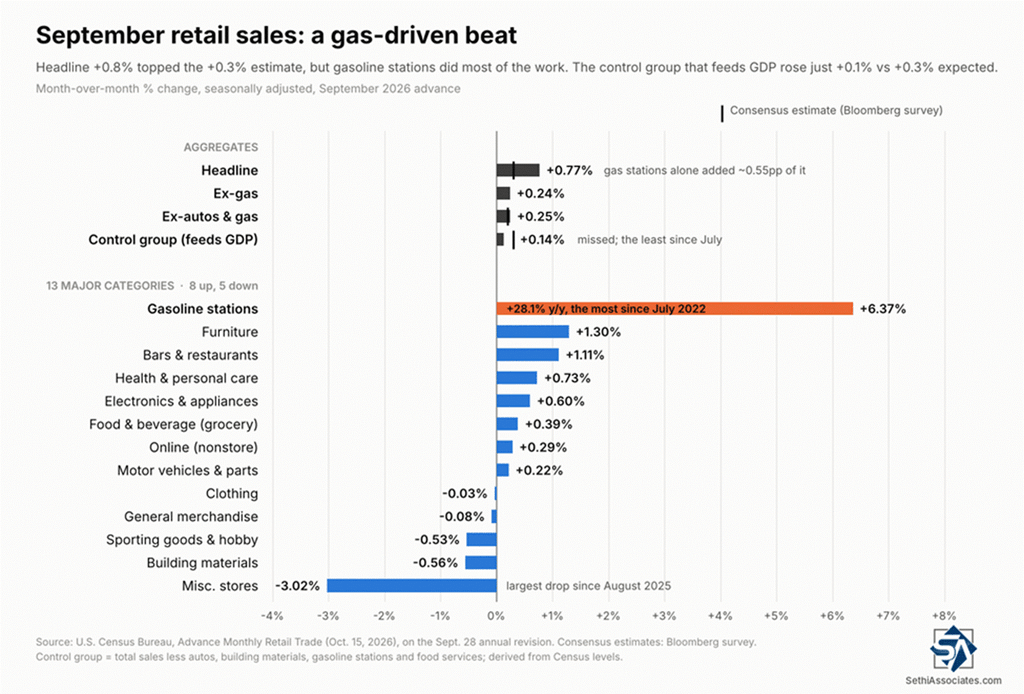
Retail sales rose 0.8% versus a 0.3% estimate, but gas stations were over 70% of that while the GDP-linked control group missed and Census’s annual revision cut sales levels by about 4.5%.
You've reached your free article limit
You've read 0 of 1 free Pro articles.

U.S. Retail Sales Advance (M/M): Sep: 0.8% (est 0.3%; prev 1.2%; prev R 1.3%)
– Retail Sales Ex-Auto (M/M): 0.9% (prev 1.4%)
– Retail Sales Ex-Auto and Gas: 0.2% (est 0.2%; prev 1.2%; prev R 1.1%)
– Retail Sales Control Group (M/M): 0.1% (est 0.3%; prev 1.4%; prev R 1.2%)
Note: All changes month-over-month unless otherwise noted. Usual caveats — First, these are not adjusted for prices so that also should be taken into account. Second, this report is more of a goods report with only one main services category (bars and restaurants) so it is not a complete picture of consumer spending, representing only around 35% of the total. Data on inflation-adjusted personal spending and overall services spending will be out later this month, offering a fuller picture of consumer outlays in the month. Finally this report is seasonally adjusted which can always cause distortions, particularly for retail sales which are very lumpy throughout the year.
Executive Summary
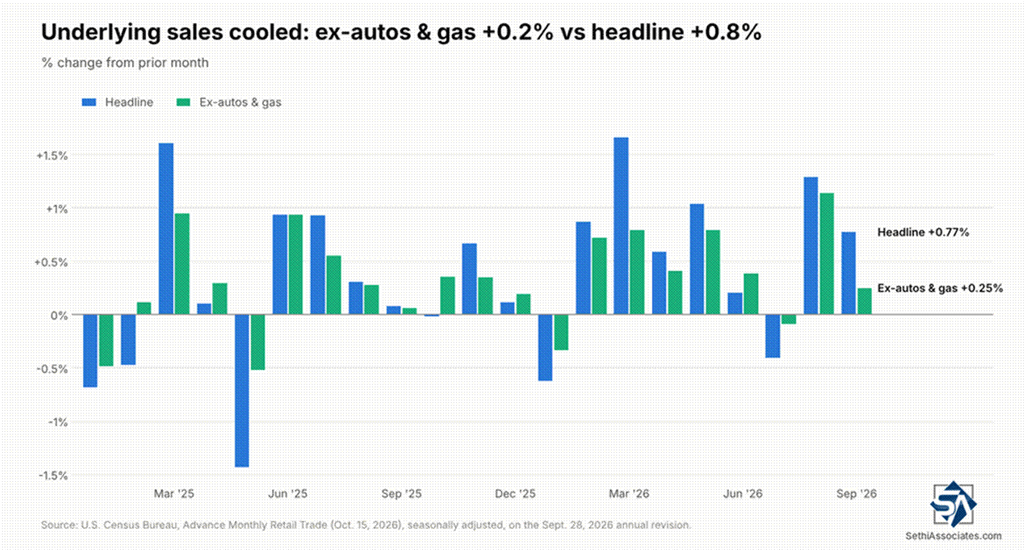
- September retail sales rose 0.77% from August, over double the 0.3% estimate, and August was revised up to +1.29%.
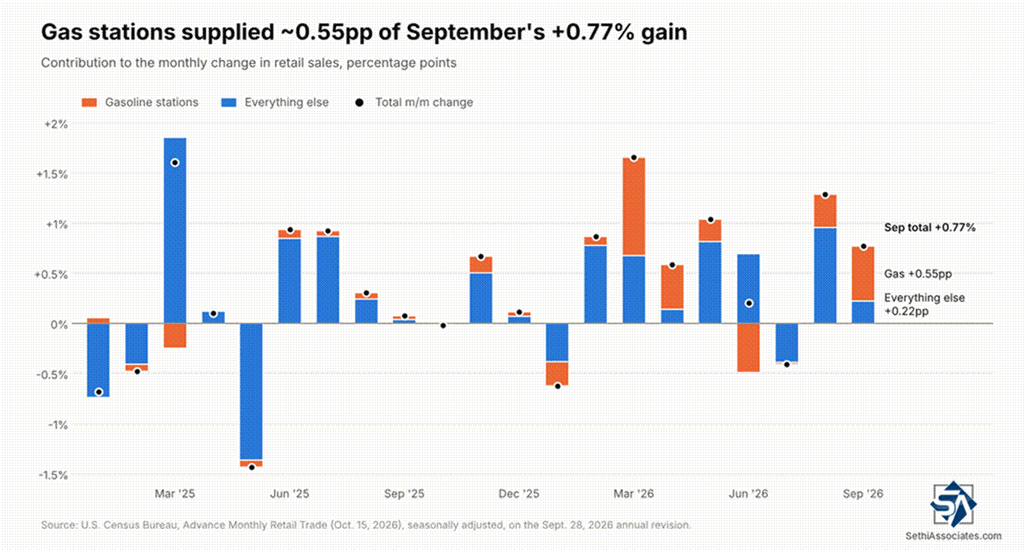
- Gasoline stations, though, were over 70% of the rise, up 6.37% and adding about 0.55 percentage points of the gain, while sales excluding autos and gasoline rose just 0.246%, rounding down to the 0.2% expected.
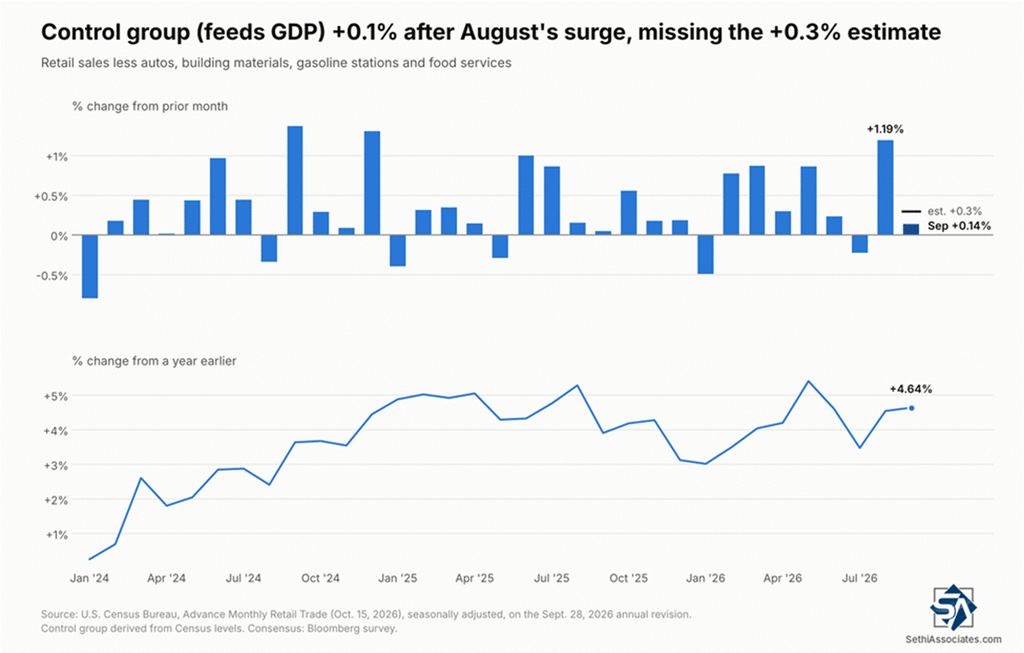
- The control group, which feeds into GDP, rose only 0.14%, the least since July, versus the 0.3% estimate.
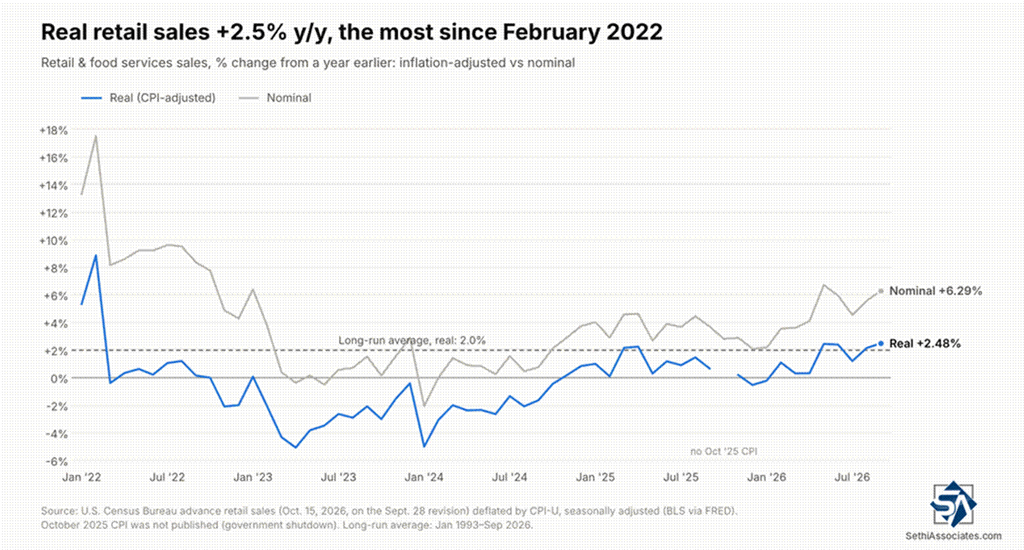
- From a year earlier, though, headline sales rose 6.29%, and real (inflation-adjusted) sales rose 2.48%, the most since February 2022.
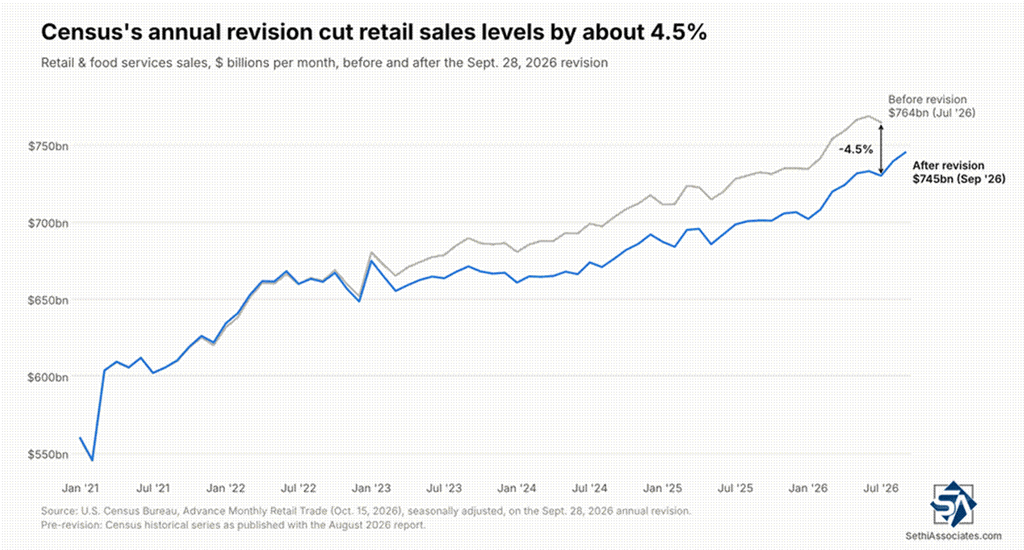
- Census’s annual revision lowered sales levels by about 4.5% and cut 2023 growth to 1.39% from 3.53%.
A Headline Beat, Mostly From Gasoline
September retail sales rose 0.77% from August, over double the 0.3% median estimate in a Bloomberg survey of economists, and August was revised up to +1.29% (from +1.24% initially). That puts sales at a record high in dollar terms, though adjusted for inflation they remain 3.36% below their April 2022 peak. Eight of the 13 major categories rose (more details below).
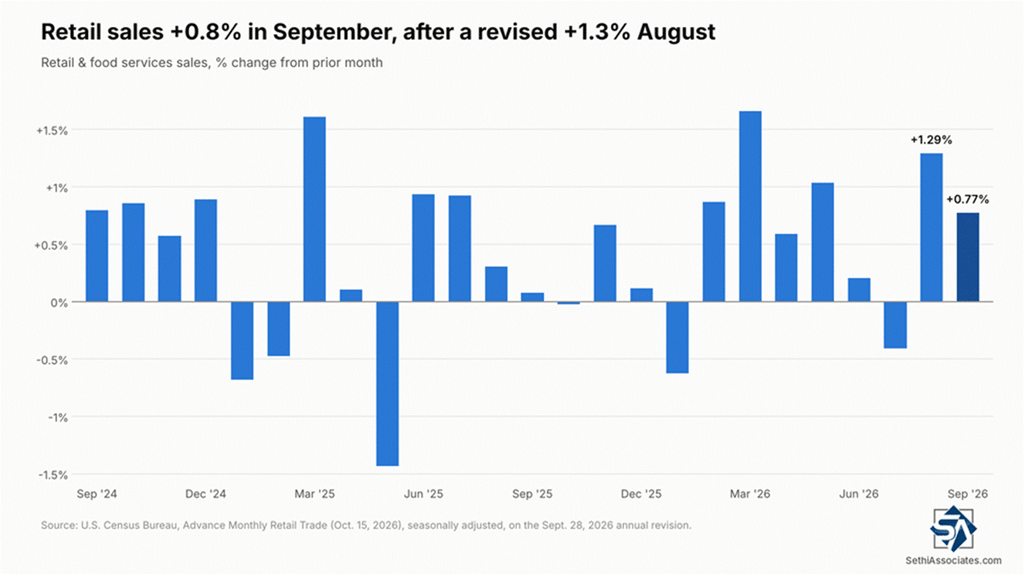
Bloomberg summed it up as a month in which “spending at gasoline stations masked mixed spending at other retailers.” Gasoline stations alone added about 0.55 percentage points of the 0.77% gain, leaving just 0.22 points from everything else.
Gasoline and Autos
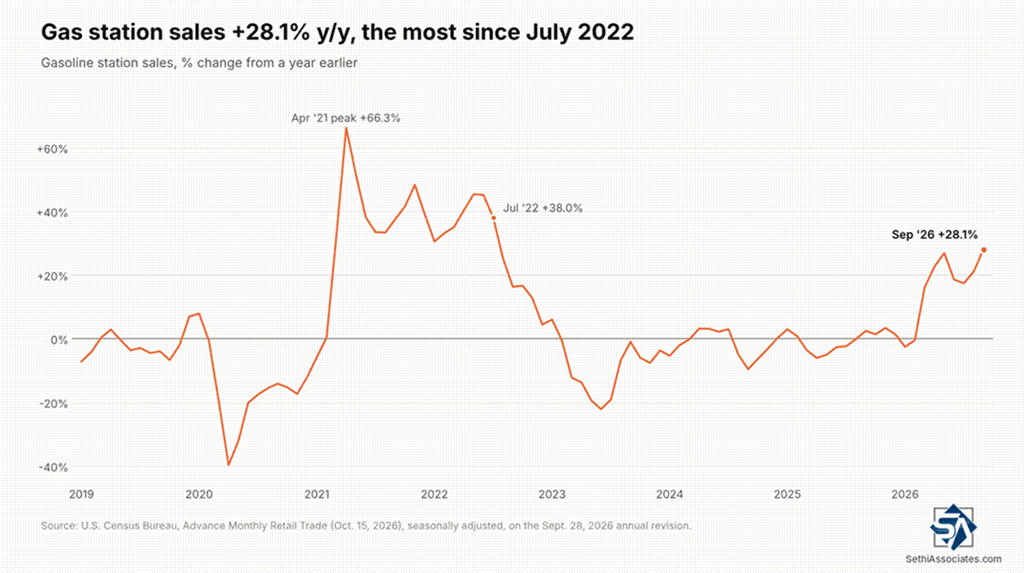
Sales at gasoline stations rose 6.37%, the most since March (after +3.97% in August, revised from +3.06%), and are up 28.05% year-over-year, the most since July 2022. Bloomberg noted that “the cost of a gallon of gasoline surged in September to nearly $4.50 on average, according to American Automobile Association data.”
Motor vehicles rose 0.22% (after +0.68% in August, revised from +0.58%) and are up 2.55% year-over-year. Stripping both out, sales excluding autos and gasoline rose just 0.246%, rounding down to the 0.2% estimate, after +1.14% in August (revised from +1.21%).
GDP Readthrough
Control group sales (headline sales minus food services, auto dealers, building materials and gasoline stations), which feed into GDP as the goods consumption component, rose just 0.14%, the least since July, versus the 0.3% estimate. That follows a 1.19% gain in August on the revised data (initially reported as +1.4%). Still, the control group is up 4.64% year-over-year, from +4.54% in August, and has risen in 14 of the past 17 months.
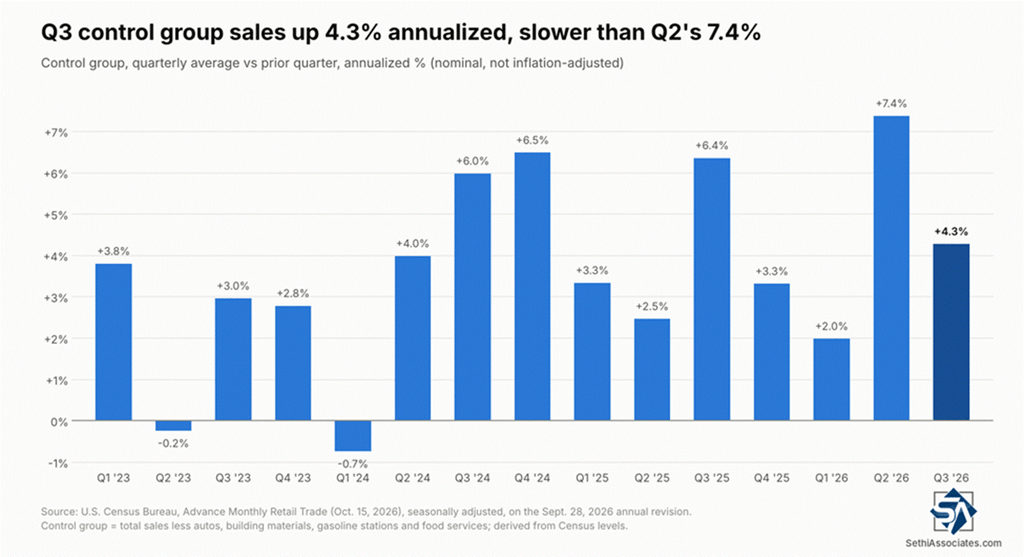
For the quarter as a whole, control group sales rose at a 4.27% annualized pace in the third quarter versus 7.37% in the second quarter (nominal, not adjusted for inflation), so slowing but remaining very supportive.
Category Detail
Eight of the 13 main categories were higher, down from all 13 in August on the revised data (initially reported as 12) and up from six in July. Outside of gasoline, furniture rose the most on a percentage basis at 1.30% (after +0.20% in August) and is up 4.85% year-over-year, the most since July 2025, its first positive annual reading since May. Health and personal care rose 0.73% but is down 1.18% year-over-year, negative for a ninth straight month. Electronics rose 0.60% (up 9.39% year-over-year), food and beverage (groceries) 0.39% (up 0.90% year-over-year, the weakest of any category after health and personal care), online (nonstore) retailers 0.29% (up 8.19% year-over-year) and autos 0.22%.
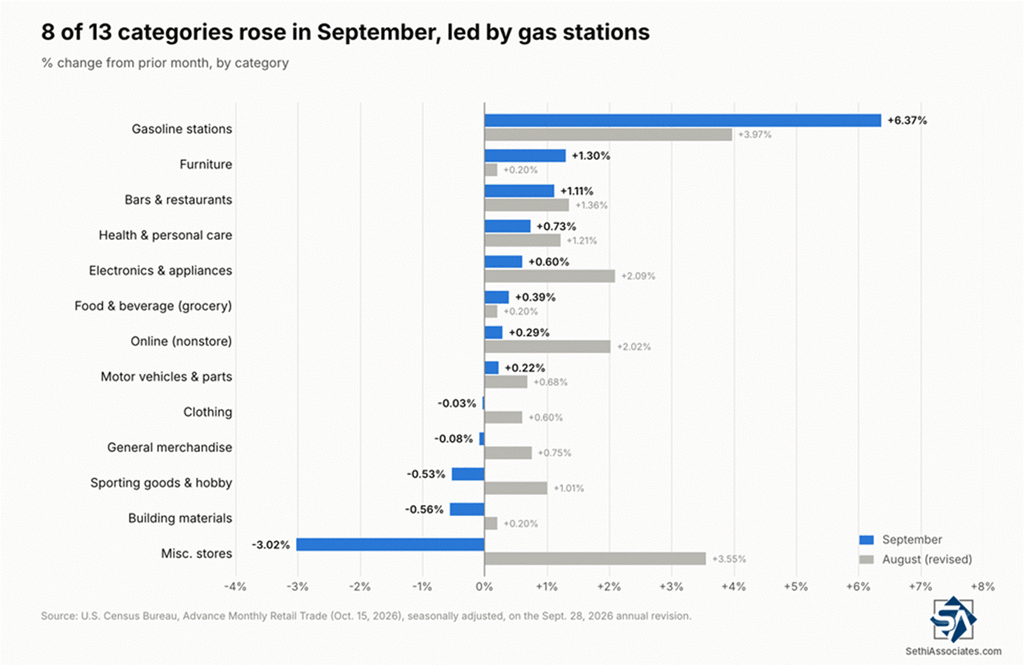
The five decliners were led by miscellaneous stores, down 3.02%, the largest drop since August 2025, though still up 10.94% year-over-year. Building materials fell 0.56% (up 4.50% year-over-year) and sporting goods and hobby stores 0.53% (up 9.57% year-over-year), while general merchandise (-0.08%) and clothing (-0.03%) were essentially flat.
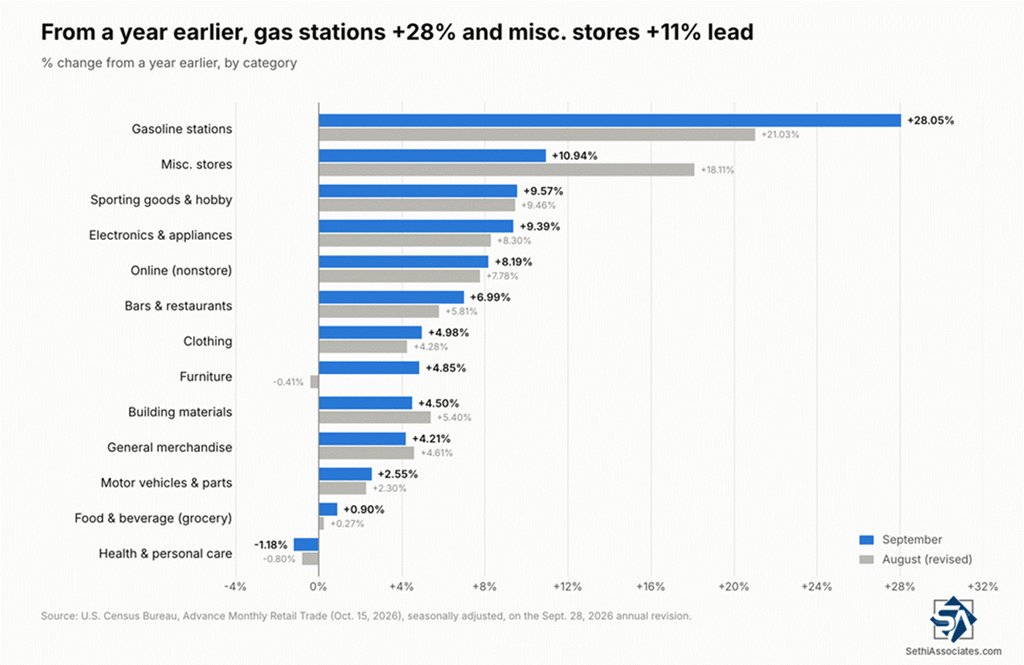
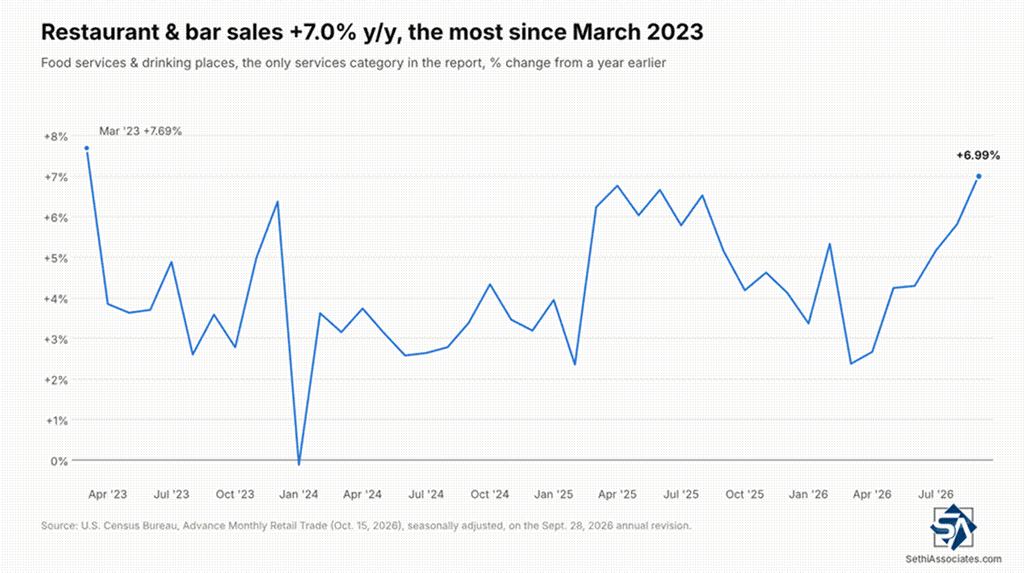
Bars and restaurants, the only services category in the report, rose 1.11% (after +1.36% in August) and are up 6.99% year-over-year, the most since March 2023.
Year-Over-Year
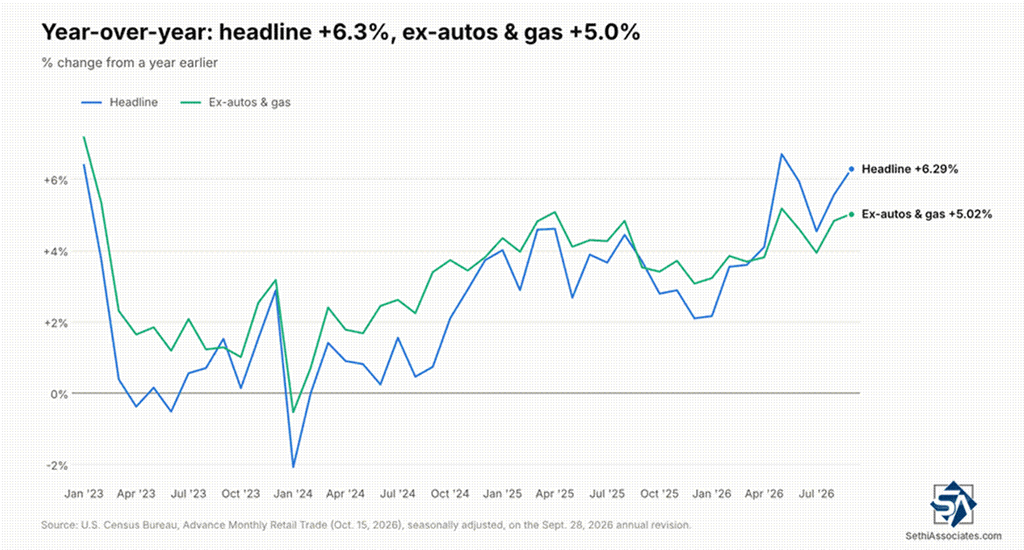
Headline retail sales rose 6.29% year-over-year, the most since May, from +5.56% in August (revised from +6.01%). Core sales excluding autos and gasoline rose 5.02%, also the most since May, from +4.83% (revised from +5.59%).
Taking Out Inflation
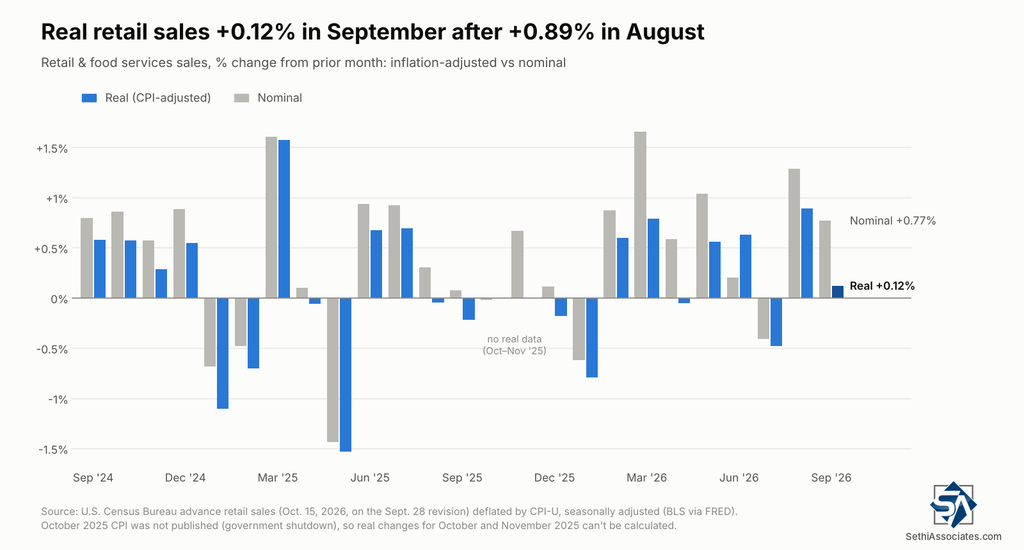
Stripping out inflation, real retail sales rose 2.48% year-over-year, the most since February 2022, from +2.13% in August (revised from +2.58%), and remain above the long-run average of about 2%. Month-over-month, real sales rose 0.12% after +0.89% in August. With consumer prices up 3.72% over the past year, inflation accounted for more than half of the 6.29% nominal gain. Real sales here are Census retail sales deflated by the consumer price index from the Bureau of Labor Statistics via FRED.
The Annual Revision
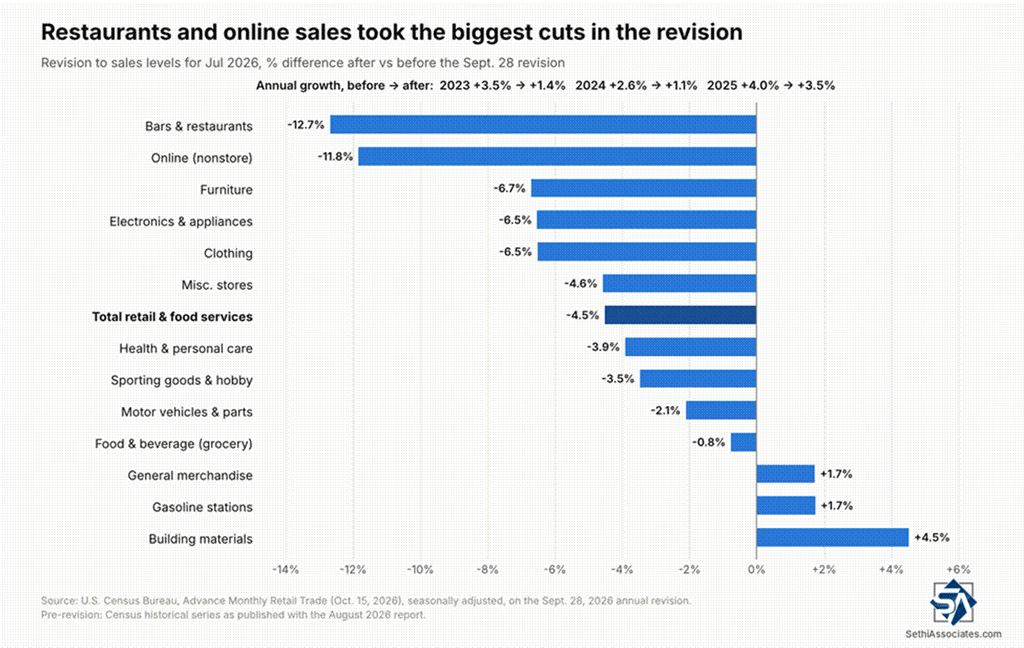
The Census Bureau said its monthly estimates “were revised on September 28, 2026 based on historical corrections” and its 2023 and 2024 Annual Integrated Economic Survey. The revisions were notable, lowering retail sales levels by about 4.5% as of July and cutting annual growth to 1.39% from 3.53% in 2023 and to 1.05% from 2.62% in 2024. Growth in 2025 was trimmed to 3.51% from 3.95%, and year-over-year growth for each month this year through July was lowered by between 0.50 and 1.11 percentage points.
The biggest cuts were to bars and restaurants (-12.69%) and online retailers (-11.83%), while building materials (+4.53%), gasoline stations (+1.74%) and general merchandise (+1.73%) were revised higher.
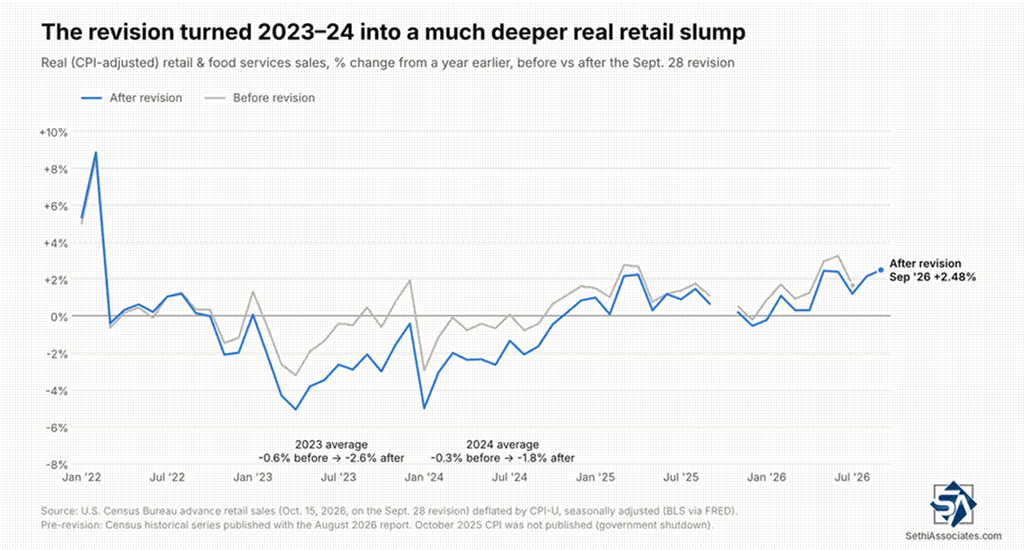
In real terms, the revision turned 2023 and 2024 into a much deeper slump. Real retail sales now averaged -2.62% year-over-year in 2023 (from -0.57%) and -1.84% in 2024 (from -0.33%), and were negative for 21 straight months, from February 2023 through October 2024.
Analyst Reaction
- “The details point to a consumer that remained willing to spend but lost momentum after showing strong spending appetite in August,” EY-Parthenon economists Gregory Daco and Lydia Boussour said in a note cited by Bloomberg. “The broader picture remains one of consumer resilience, but the inflation squeeze is becoming more visible.”
- Bloomberg Economics’ Eliza Winger wrote that “the gain in headline retail sales overstates the strength of consumer demand in September, with higher gasoline prices accounting for most of the increase. The nearly flat reading on control-group sales looks more like a normalization after August’s strong gain than a sharp pullback in consumption.”
- Bloomberg said “the figures indicate consumers took a breather as the third quarter drew to a close and price pressures mounted,” adding that “faster inflation is taking a bigger toll on Americans’ paychecks and squeezing their budgets.” It noted that producer prices rose in September by the most in more than four years, and that executives at Domino’s Pizza (DPZ) and Albertsons (ACI) have acknowledged many consumers remain in a challenging economic environment, even as Wells Fargo (WFC), JPMorgan Chase (JPM) and Citigroup (C) have signaled the consumer remains resilient.