Tech Trade Turns Ugly
Hot inflation data burns up AI, tech and small-cap stocks as CoreWeave unravels and ‘neocloud’ names in ‘crash mode’; also the chart looks precarious.
You've reached your free article limit
You've read 0 of 1 free Pro articles.

That was ugly. The pressure on tech or AI-related stocks has continued overnight and has interestingly forced managers fleeing that trade into U.S. Treasuries. As the Nasdaq Composite and Nasdaq 100 gave up 1.88% and 2.02% respectively for the regular trading session on Wednesday, bond yields have reacted somewhat counterintuitively to a hotter than expected CPI report for September.
On Wednesday morning, the Bureau of Labor Statistics released its data for consumer-level inflation for September. At the headline growth landed at +0.6% month over month and +3.7% year over year. Both were up from August’s pace, and both were hotter than expected. Even the core consumer price index hit the tape at unwelcome levels implying that higher energy prices caused by the war in Iran were bleeding into other parts of the U.S. economy.
Tech stocks and small caps reacted poorly to the news. The Philadelphia Semiconductor Index has hit especially hard, at -4.3% for the day. The tech sector S&P SPDR ETF (XLK) lost 2.98%. The Russell 2000 gave up 1.93%. Oddly, despite increased probabilities for late 2026 rate hikes expressed through futures markets trading in Chicago, the yield paid by the U.S. Ten-Year Note dropped two basis points on Wednesday to 5.19%. The yield on the U.S. Two-Year Note dropped one basis point to 4.8%.
As Nasdaq futures have moved even lower overnight, those two yields have dropped aggressively, to 5.09% and 4.74% respectively. It was not odd at all back in the day for managers to move back and forth between stocks and bonds as the two asset classes more or less robbed one another of the flow of capital. We have not seen a lot of this in the modern era, but as unnatural as it feels, we who manage money are grateful for a place to hide when we need one.
CoreWeave Unravels, ‘Neocloud’ in Crash Mode
At first, I thought, after leaving for the hospital, and having taken my eye off of the ball for a half hour or so, that maybe a hedge fund had blown up. Then I saw the news. The share price of CoreWeave (CRWV), which is an AI-focused cloud infrastructure provider, dropped close to 15.5% on Wednesday after a report emerged that the company was seeking insurance-industry capital to finance the purchase of additional AI infrastructure. In fact, all Neocloud stocks went into “crash mode” on Wednesday after a report by Gartner predicted that 80% of neoclouds will cease independent operations by 2030 if AI infrastructure spending continues at the current pace.
Making matters worse, I see that the cost of insuring against U.S. tech defaults has moved into record territory, implying increased credit stress across the AI trade. Investors are obviously questioning whether these massive investments will ever generate the returns required quickly to service this mountain of growing debt.
According to a report at Reuters that I’ve seen this (Thursday) morning, five-year credit default swap spreads for Oracle (ORCL) widened by 26 basis points overnight to a record 288 bps and five-year spreads for SoftBank (SFTBY) rose 24 bps to 424 bps. Spreads for data-center operator CoreWeave have surged above 1,000 bps, according to data provided by LSEG. It is key to note that Oracle is burdened with one of the most debt-laden and in my opinion, sloppiest balance sheets for a large US tech firm that I have ever seen.
While not quite what I would consider to be at alarming levels, according to data provided by LSEG and S&P Global Market Intelligence, credit default swap spreads for such bellwether tech names as Amazon (AMZN), Alphabet (GOOGL), Meta Platforms (META), and Nvidia (NVDA) also reached record wide levels overnight. That tells us exactly where trader / investor sentiment is right now.
Ukraine Upset
In an interview published at The Financial Times overnight, Ukrainian Pres. Volodymyr Zelenskyy has said that his country will resume military strikes on Russia’s oil refineries as he expressed anger over the withdrawal of U.S. intelligence and a simultaneous weakening of Starlink satellite internet service at a time of increased Russian attacks.
Following these comments, where Zelenskyy was quite critical of U.S. Pres. Donald Trump, Pavel Malkov, who is the governor of the Russian province of Ryazan, said that Ukrainian drones had caused a fire at a refinery owned by state oil company Rosneft. Rosneft did not immediately respond to a request for comment. Despite an overnight pop, crude prices are well off the highs of the week and appear to be trading off as the wee hours have progressed.
Technical Warning
The charts no longer appear to be on the side of the bulls. I hope that I am misreading the charts. I really do. Check this out:
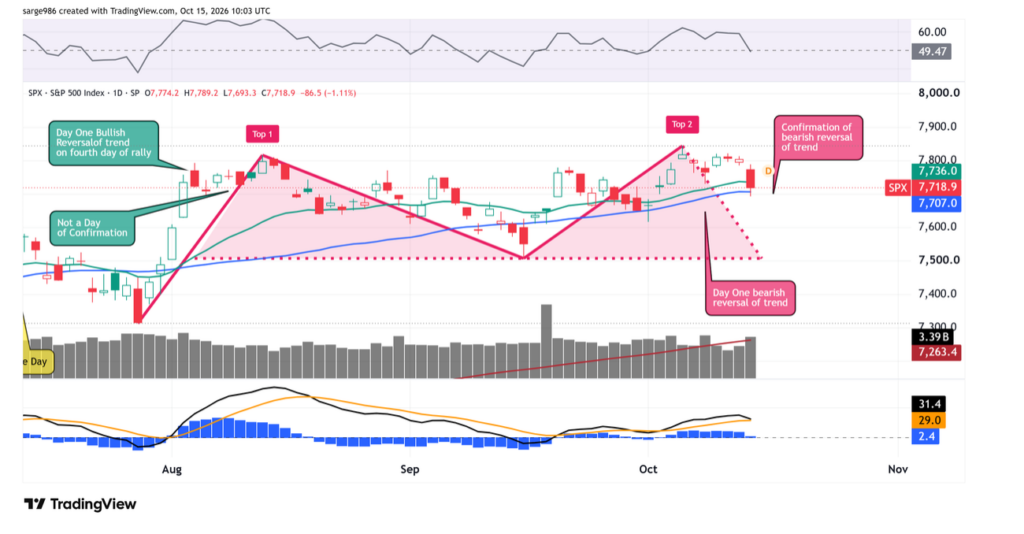
The S&P 500 has developed a “double top” pattern of bearish reversal with a downward pivot of 7,508. In doing so, Relative Strength has dropped to the neutral line, while within the daily moving average convergence divergence, the 12-day exponential moving average has reached the point of potentially crossing below the 26-day exponential moving average. At the same time, the histogram of the 9-day EMA is approaching the zero-bound as the last sale flirts with crossing below the 50-day simple moving average.
I will tell you this. Should the 12-day line cross below the 26-day line as the S&P 500 loses the 50-day SMA and 9-day EMA moves below zero all while the Relative Strength Index moves below neutral, there will be an algorithmic tornado. That won’t be pretty at all.
We also see on this chart, a “Day One” reversal of trend last Thursday, followed by the necessary pause. This development was then followed by a “Day of Confirmation” yesterday (Wednesday). My friends, perhaps, I’ll sing a new song tomorrow. I hope I do, but there is almost nothing constructive about this chart at the moment, other than the fact that many of these levels haven’t actually broken just yet. They are merely “under pressure.
Kevin Warsh
Speaks late tonight from Bangkok.
Economics (All Times Eastern)
08:30 – Initial Jobless Claims (Weekly): Expecting 200K, Last 197K.
08:30 – Continuing Claims (Weekly): Last 1.716M.
08:30 – PPI (Sept): Expecting 0.5% m/m, Last 0.4% m/m.
08:30 – Core PPI (Sept): Expecting 0.3% m/m, Last 0.2% m/m.
08:30 – PPI (Sept): Expecting 5.3% y/y, Last 5.4% y/y.
08:30 – Core PPI (Sept): Expecting 4.5% y/y, Last 4.6% y/y.
08:30 – Retail Sales (Sept): Expecting 0.3% m/m, Last 1.2% m/m.
08:30 – Core Retail Sales (Sept): Expecting 0.1% m/m, Last 0.8% m/m.
08:30 – Empire State Manufacturing Index (Oct): Expecting 10.7, Last 7.6.
08:30 – Philadelphia Fed Manufacturing Index (Oct): Expecting 29.7, Last 37.8.
10:00 – Business Inventories (Aug): Expecting 0.4% m/m, Last 0.8% m/m.
10:30 – Natural Gas Inventories (Weekly): Last +85B cf.
noon – Oil Inventories (Weekly): Last -3.186.
noon – Gasoline Stocks (Weekly): Last +382K.
The Fed (All Times Eastern)
4:30 p.m. – Speaker: Cleveland Fed Pres. Beth Hammack.
11:30 – Speaker: Federal Reserve Chair Kevin Warsh.
Today’s Earnings Highlights (Consensus EPS Expectations)
Before the Open: BNY, SCHW, ERIC, PNC, TSM, USB
After the Close: JBHT
At the time of publication, Guilfoyle was long TSM, NVDA, AMZN equity.