AAII Bears Stay Above Average for 42nd Straight Week, 4th-Longest Run Since 1987
The S&P 500 fell as much as 3.2% Wednesday before stocks erased most of it (see A Holiday Comeback – Stocks Erase Most of a 3% Plunge Heading Into Thanksgiving). That was the last day of voting in a mixed week for the American Association of Individual Investors’ (AAII) retail-focused weekly investor survey, as both Bulls and Bears gained at the expense of the Neutral camp.
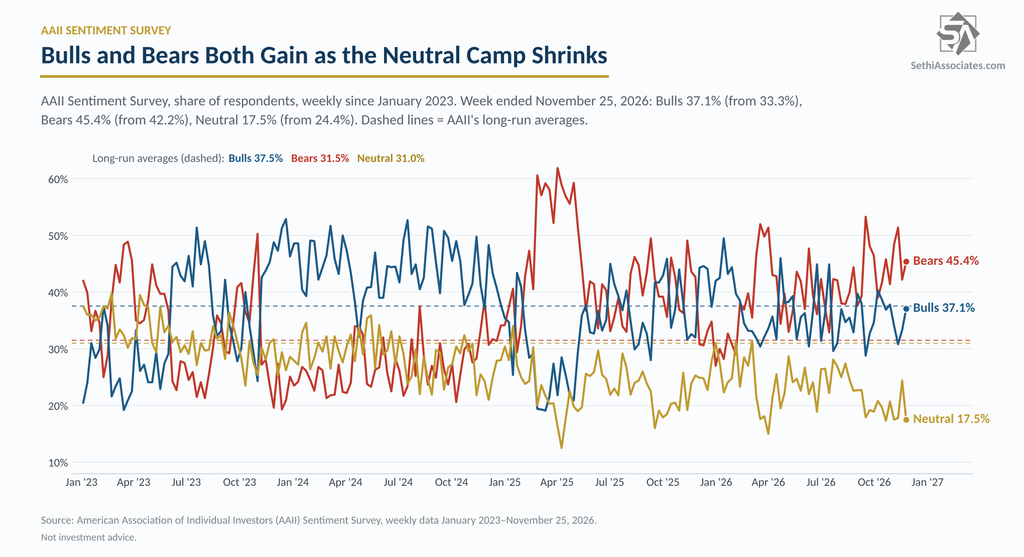
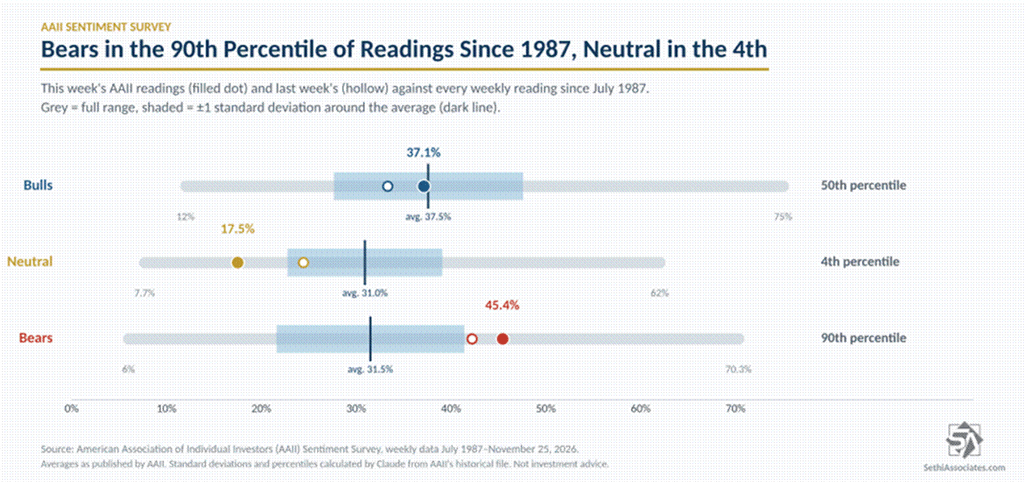
AAII Bulls (those who see higher stock prices in six months) rose to 37.1%, the most in four weeks, from 33.3% the prior week (and well above the 28.8% ten weeks ago, which was the least since September 2025). They remained just below the long-term historical average of 37.5% for a fourth straight week, right at the 50th percentile of all readings since 1987.
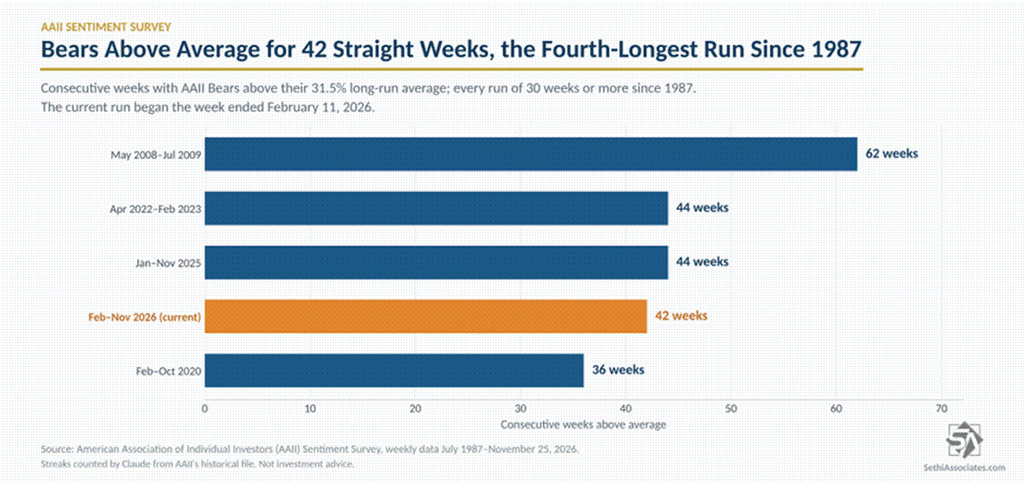
Bulls also remained below the level of the Bears (who see lower stock prices in six months), as the Bears rose to 45.4%, the most in two weeks, from 42.2% the prior week (still below the 51.4% two weeks ago and the 53.3% ten weeks ago, the highest since May 2025). That puts Bears in the 90th percentile of all readings since the survey began in 1987. Bears have now been above the long-term average of 31.5% for 42 straight weeks. That’s the fourth-longest run on record, behind 62 weeks in 2008-09 and 44 weeks each in 2022-23 and 2025 (and they’ve only been below it nine weeks since December 12, 2024).
The Neutral camp dropped to 17.5% from 24.4%, matching the 17.5% three weeks ago (and just above the 17.3% five weeks ago, which was the least since early April). That’s in just the 4th percentile historically. It remains under the long-run average of 31.0% and has been over that only four times since August 2024.
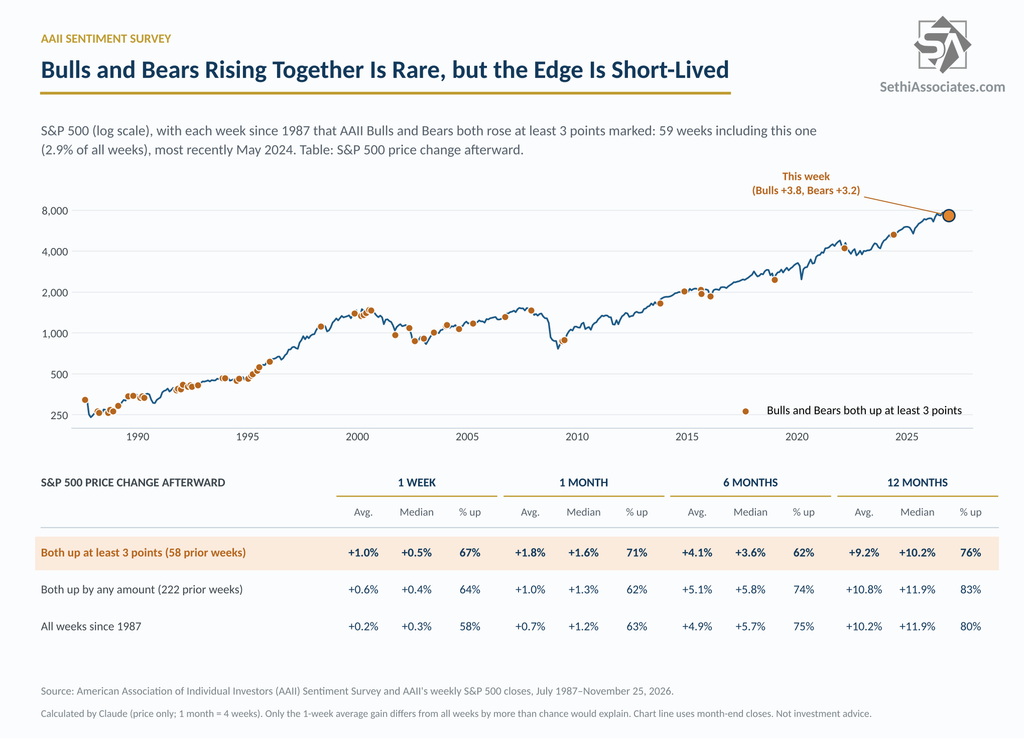
The increase in both Bulls and Bears made this an unusual week for the survey. By our calculations, Bulls and Bears have both risen in only about one in nine weeks since 1987, and both rising by at least 3 points, as they did this week (Bulls +3.8, Bears +3.2), has happened in just 59 weeks, or 2.9% of the time. It has also become rarer: just nine times since 2010, including this week, compared with 23 in the 1990s alone.
To the extent it has mattered for stocks, it’s been short-lived. The S&P 500 rose an average of 1.0% the following week, versus 0.2% for all weeks, a gap that’s very unlikely to be chance, and 1.8% over the next month (vs. 0.7%). But by six and 12 months, returns have been a bit below average (+4.1% and +9.2%, vs. +4.9% and +10.2% for all weeks), well within what you’d expect by chance, and stocks were higher six months later less often (62% vs. 75%).
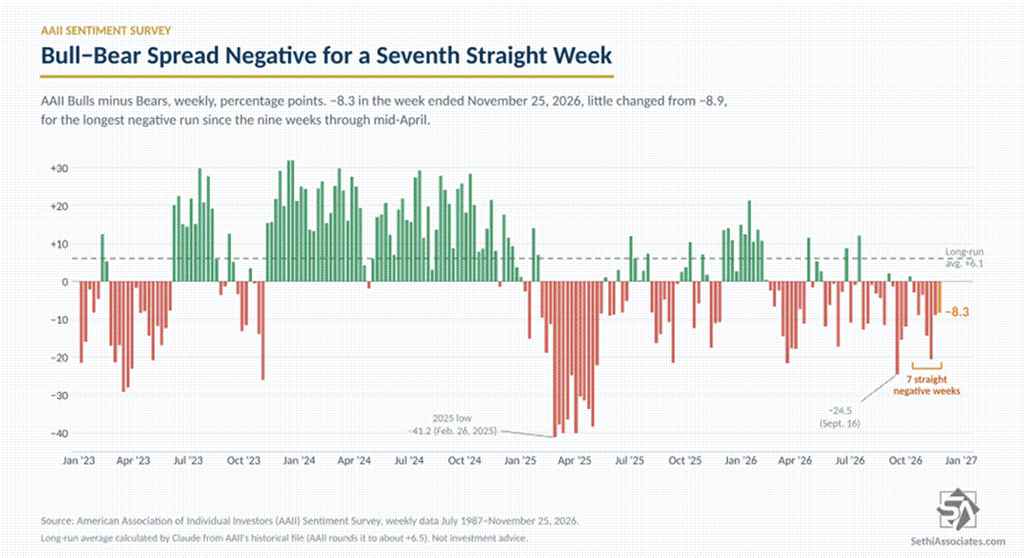
The week’s readings also left the bull-bear spread at −8.3 points, little changed from −8.9 the prior week. It’s the seventh straight negative week, the longest run since the nine weeks through mid-April. The spread is in the 22nd percentile of all weekly readings since 1987, against a long-run average of +6.1, and Bulls have been above Bears just twice in the last 19 weeks.
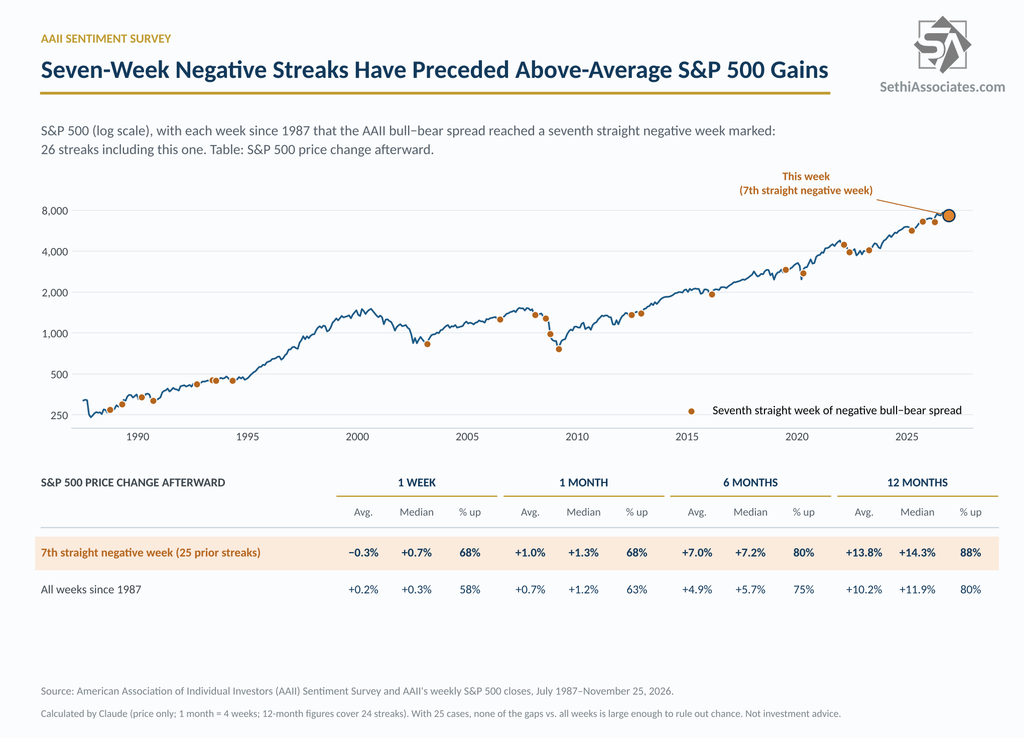
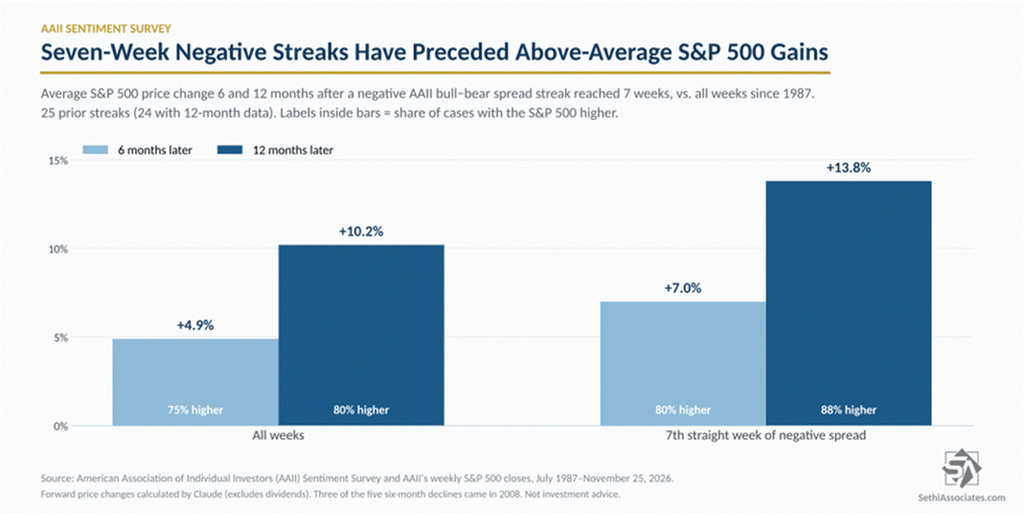
By our calculations from AAII’s data, the S&P 500 has risen an average of 7.0% in the six months after the 25 prior times since 1987 that a negative-spread streak reached seven weeks, and 13.8% over the next 12, compared with 4.9% and 10.2% for all weeks. Unlike the readings at or below −20 we looked at two weeks ago, the odds have been better too: the S&P 500 was higher six months later 80% of the time (vs. 75% for all weeks) and 88% of the time at 12 months (vs. 80%). The exceptions were concentrated in 2008, which accounted for three of the five six-month declines, including a 34.5% drop after the streak that reached seven weeks in July 2008. With only 25 cases, though, none of those gaps is large enough to rule out chance, and the following week and month have been roughly in line with normal (an average of −0.3% and +1.0%, vs. +0.2% and +0.7% for all weeks).
Conversation 0 Comments
One ongoing discussion across all days. Everyone can read; sign in to take part.
Your voice matters. Discussions are moderated for civility. Read our guidelines .
Log in to join the conversation