A Holiday Comeback – Stocks Erase Most of a 3% Plunge Heading Into Thanksgiving
Tariff headlines, AI credit worries and hot inflation data sent the S&P 500 down as much as 3.2%, but stocks recovered nearly all of it, with the DJIA, Russell 2000 and equal-weighted S&P 500 finishing higher. Programming note: With markets closed Thursday for Thanksgiving and Friday a half session (stocks close at 1pm ET), there …
You've reached your free article limit
You've read 0 of 1 free Pro articles.
Tariff headlines, AI credit worries and hot inflation data sent the S&P 500 down as much as 3.2%, but stocks recovered nearly all of it, with the DJIA, Russell 2000 and equal-weighted S&P 500 finishing higher.
Programming note: With markets closed Thursday for Thanksgiving and Friday a half session (stocks close at 1pm ET), there won’t be an evening update until Monday, November 30. The Week Ahead will be Sunday as usual. Happy Thanksgiving!
Executive Summary
Yesterday I said calling for a bounce was the easy part and the harder part was figuring out where things go from here. Wednesday showed why: the AI selloff resumed at the open, before stocks staged a furious comeback to finish little changed.
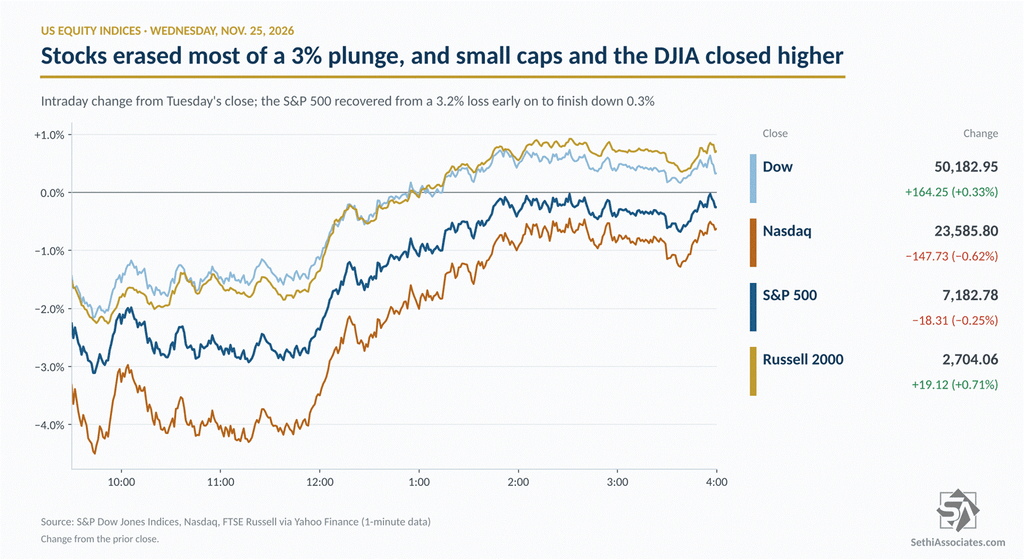
The S&P 500 opened down 2.6% and fell as much as 3.2% in the first 15 minutes, while the Nasdaq was down as much as 4.6%, and the Nasdaq-100 dropped back to test Friday’s low. Stocks hugged those levels through late morning, then turned around at about noon and recovered nearly all of the losses over the next two hours. The S&P 500 finished down 0.3% to 7,183 and the Nasdaq 0.6% to 23,586. The DJIA, which had been down more than 1,100 points, ended up by 164 points (0.3%) to 50,183 , while the Russell 2000 rose 0.7% and the equal-weighted S&P 500 0.8% each for a third straight gain.
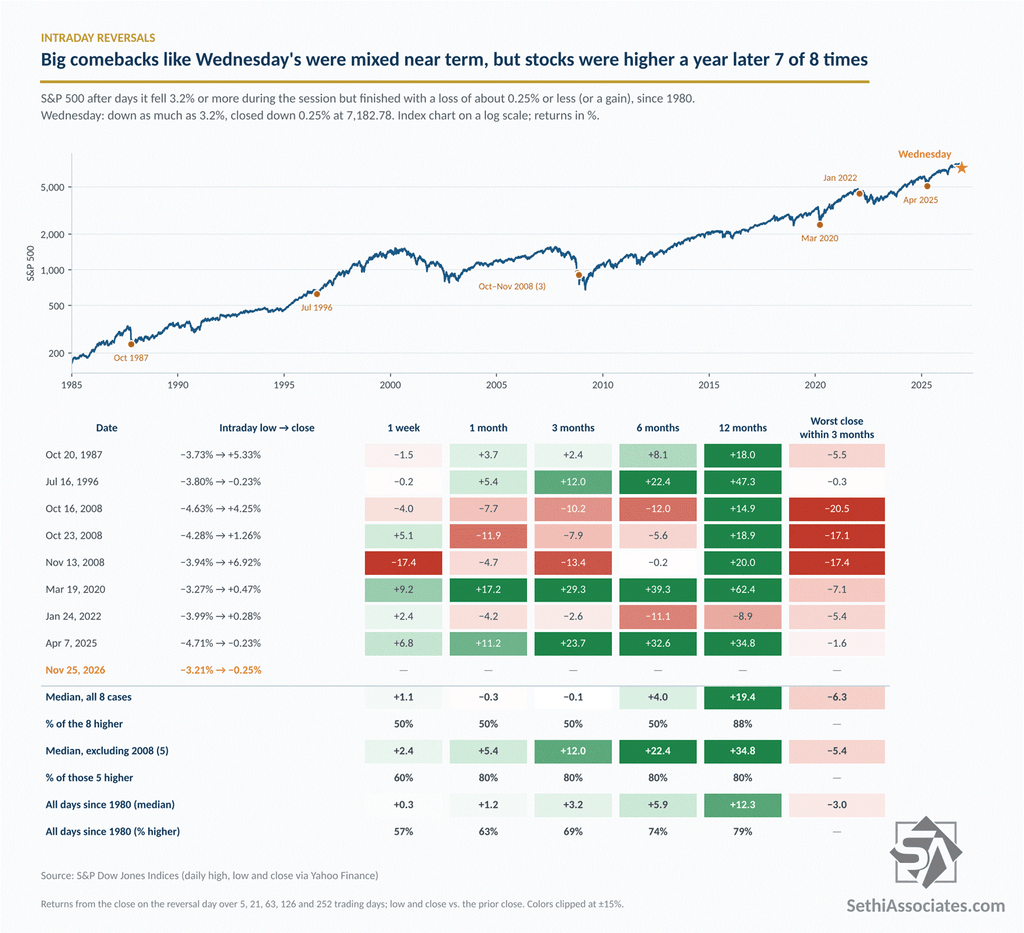
It was only the ninth time since 1980 that the S&P 500 has been down at least 3.2% during the session and finished with a loss of 0.25% or less, and the first since April 7, 2025, near the low of that year’s tariff selloff (more in the Wrap-Up).
The early selloff came as the White House unveiled new tariffs on more than a dozen trading partners, including China (where the rate could rise to 40% if talks collapse) and the EU, while worries about the debt funding the AI buildout lingered and Nvidia faced another round of Huang-related headlines. A relatively hot PCE prices report didn’t help. There was no clear catalyst for the rebound, which traders partly credited to light holiday trading and a Substack post from Michael Burry saying he’s now almost entirely long (see Market Commentary).
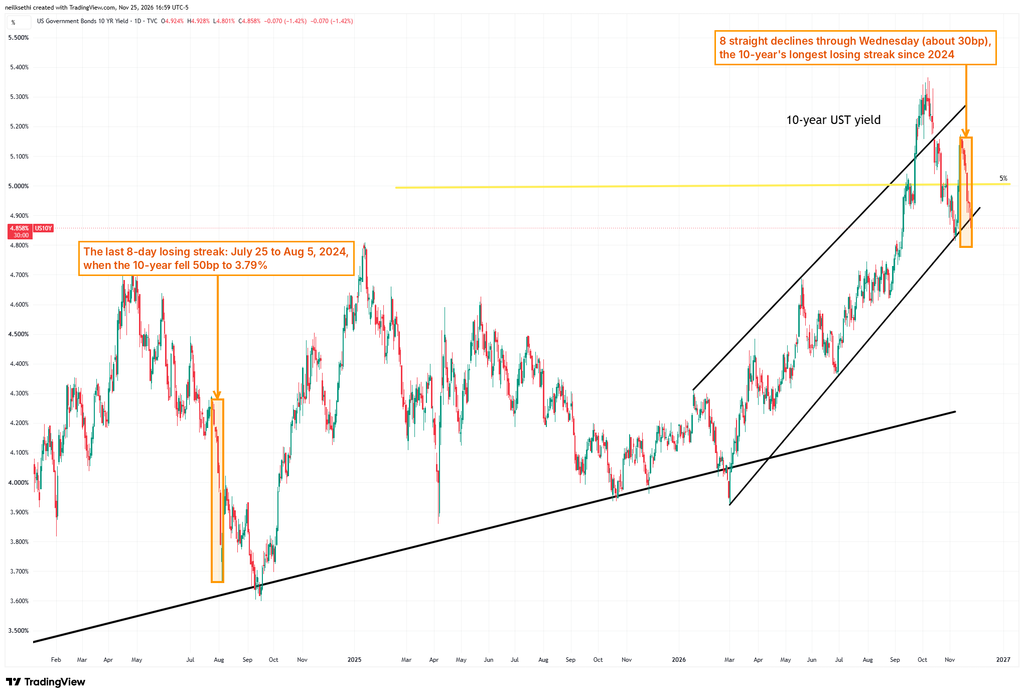
Treasuries rallied, although they finished off their highs. The 10-year yield fell 6 basis points to 4.86% after touching 4.80%, its lowest since early September, falling for an eighth straight day, its longest losing streak since 2024, per Bloomberg. The 2-year yield fell 3.5 basis points to 4.65%. The gains in Treasuries came even as the $44 billion 7-year auction tailed by the most since May 2024. The VIX rose 7.2% (1.9 points) to 28.3 after nearly hitting 35 earlier in the session. The dollar slipped 0.1%, WTI crude rose 2.5% to $84.13, gold rose 0.3%, copper 0.4% and bitcoin futures 1.0% (all including post-market).
It was a busy day for data ahead of the holiday. Core PCE inflation rose to 3.3% year over year, the highest since November 2023 (more in my article: Core PCE Inflation Climbs to Highest Since 2023 as Real Spending Slips), and real spending turned negative. But the rest of the data was strong: incomes rose above expectations, Q3 GDP was revised up to 4.3% from 3.4%, initial jobless claims fell to 189,000, matching the lowest since 1969, core capital goods orders hit a record and new home sales jumped to the fastest pace since December 2025 (I’ll have full reports on GDP, durable goods and new home sales Thursday and Friday). The Beige Book showed growth narrowing for a third straight report (more in my article: Fed’s Beige Book Is a Mixed Bag, but Gives Doves Little Ammunition).
US markets are closed Thursday for Thanksgiving, and Friday is a half session, with stocks closing at 1pm ET and bonds at 2pm ET.
My look at today’s charts follows in a separate post later this evening.
Market Commentary
Equities:
- In a Wednesday morning note, Deutsche Bank’s Jim Reid said a “risk-off tone” had returned to the market over the last 24 hours, adding: “It’s pretty wild out there.” “If you’re looking for good news, we’re back to the rotation trade rather than the indiscriminate sell-off we saw towards the end of last week,” he said, pointing to rallies in defensive sectors like health care and consumer staples. “Clearly the latest declines have revived questions as to whether this selloff has further to run. But so far at least, the current moves don’t have any of the characteristics that accompanied the outright bear markets of recent decades.”
- “The Jensen Huang return was a sideshow to the real issue undermining confidence,” MUFG analyst Derek Halpenny wrote in a research note Wednesday.
- “Let’s remember that the sell-off in the AI ecosystem predated the news about Huang and Nvidia,” Liz Ann Sonders, chief investment strategist at Schwab Center for Financial Research, said in an interview Tuesday. “The concerns about capex, the data center build-out, the spread between the cost of capital and return on invested capital, the bifurcation that’s happening in the market now between sort of profitable segments of the market and unprofitable. I think that is the bigger, more aggregate story.”
- “Recent well-publicized developments have raised questions about the effectiveness of NVIDIA Corp.’s management and governance framework, including board independence and ‘key man’ risk,” S&P Global Ratings said Wednesday. “News regarding the CEO and questions regarding potential export control violations have exposed vulnerabilities in NVIDIA’s management and governance framework, especially in regard to its board structure, composition, and effectiveness.”
- “Everyone focuses on excitement in equity markets. But it’s bonds and credit that are telling you the bigger story,” said Chris Beauchamp, chief market analyst at IG Group. “It’s like a game of Jenga. You’re pulling all these threads of the AI trade one by one and, at some point, you just risk the whole thing keeling over.”
- “This market is very bifurcated” between AI and non-AI stocks, said David Wagner, head of equities at Aptus Capital Advisors. “The market is pulling back obviously due to a pullback in tech, pullback in semis, pullback in the AI narrative, but right now, I don’t see that being a growth scare. I see it being a sentiment-based scare,” based on factors such as the composition of Congress in the new year, he added. Still, there’s a “big worry” among investors that AI worries could move from a sentiment-based scare to a growth-based scare “if the market starts pricing in too much Fed activity of hiking rates,” Wagner said.
- “The fundamental support for a year-end rally simply isn’t there. The AI-inspired rally continues to run out of steam, and without evidence that massive capex spending will deliver the profit and revenue goals the market expects, there is little incentive for a rebound,” said Chris Brigati, chief investment officer at SWBC.
- “Looking forward, the question is shifting from how much companies will spend on AI to what they’ll earn from it. Investors will want evidence that spending holds up and produces returns, particularly if rates remain elevated. The AI trade still has growth behind it, but the burden of proof is getting heavier,” said Bret Kenwell, U.S. investment analyst at eToro.
- “There is still no end in sight for the heightened volatility as investors continue to unwind leveraged risky positions, and move into bonds and other haven assets,” said Fawad Razaqzada at StoneX Trading and Forex.com.
- Michael Burry said in his Substack newsletter Wednesday that he’s now “almost entirely long” stocks. “Globally, my portfolio is more long, and less short, than it has been in some time,” he wrote. “In fact, when I say less short, right now apart from Palantir puts and MetLife puts, I am temporarily almost entirely long. Temporarily, because I am continuing to assess short opportunities.”
Bonds/Fed:
- “We are asking markets to finance one of the largest capital expenditure cycles in modern economic history, while simultaneously contemplating a monetary policy shock that makes that investment more expensive. There is an obvious contradiction,” said Manish Singh at Crossbridge Capital. “All eyes on the Fed and when they walk back hawkish talk.”
Stock and Sector Breakdown
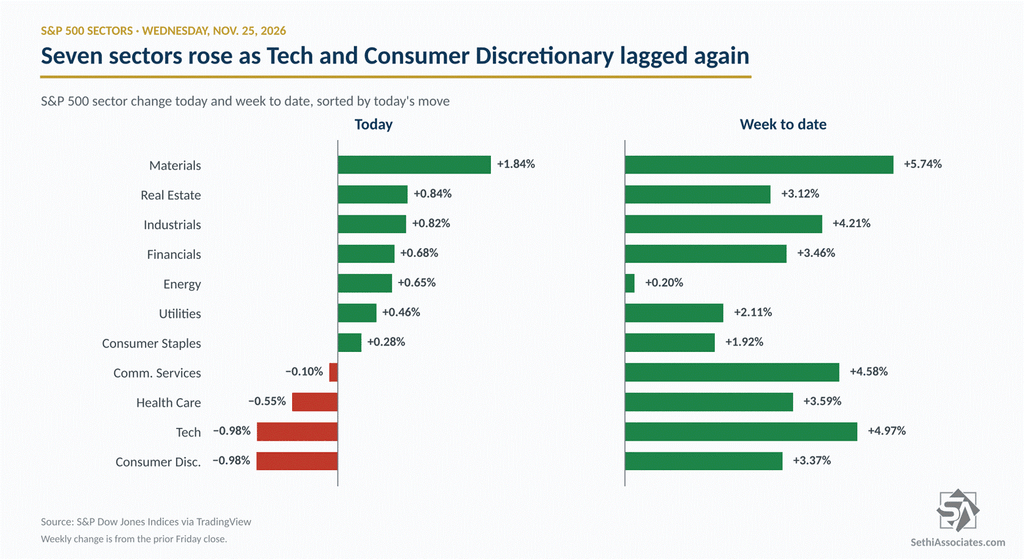
Seven of 11 S&P 500 sectors rose, led by Materials (+1.8%), Real Estate (+0.8%) and Industrials (+0.8%), while Tech and Consumer Discretionary (both -1.0%) and Health Care (-0.5%) lagged. Even after two down days for the index, every sector is up for the week, with Tech still up 5.0%, second only to Materials (+5.7%), and all but Energy (+0.2%) up at least 1.9%.
369 S&P 500 stocks rose and 126 fell. Large winners (more than 3%) fell to 35 from 58 Tuesday, but large losers fell even more, to 14 from 55.
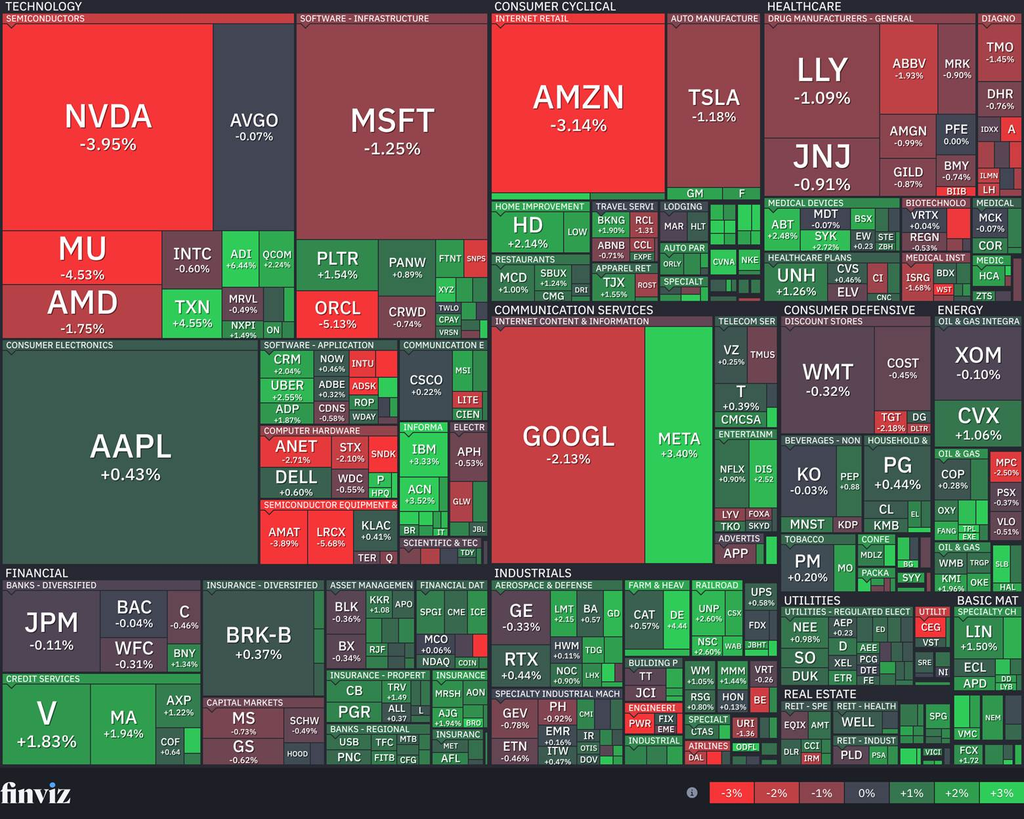
HP Inc. (HPQ) led the S&P 500, up 11.5%, after fiscal fourth-quarter adjusted EPS (83 cents) and revenue ($16 billion) beat estimates, with strength in commercial PCs, a fiscal 2027 profit forecast above estimates and a reaffirmed margin recovery timeline easing worries about rising memory costs. Lam Research (LRCX) was the S&P 500’s worst performer, down 5.7% after being down as much as 12.6%, as chip-equipment and memory names lagged the rebound.
In that regard, the AI trade took the brunt of the selling again. Sandisk (SNDK) fell 5.6% (after -14% at its low), Micron Technology (MU) 4.5% and Applied Materials (AMAT) 3.9%, Oracle (ORCL) dropped 5.1% as its five-year credit default swaps hit their widest in 20 years, and AI power names Quanta Services (PWR) (-4.1%) and Constellation Energy (CEG) (-3.9%) slid. Nvidia (NVDA) fell 3.9% to $149.30, after being down more than 9%, as S&P placed its AA credit ratings on CreditWatch negative, citing management and governance risk, even as Reuters reported the Justice Department did not open an investigation into Huang before his reinstatement and Vice President JD Vance said he’d been assured Huang isn’t under investigation. Nvidia has now given back about 40% of Monday’s 31.5% jump.
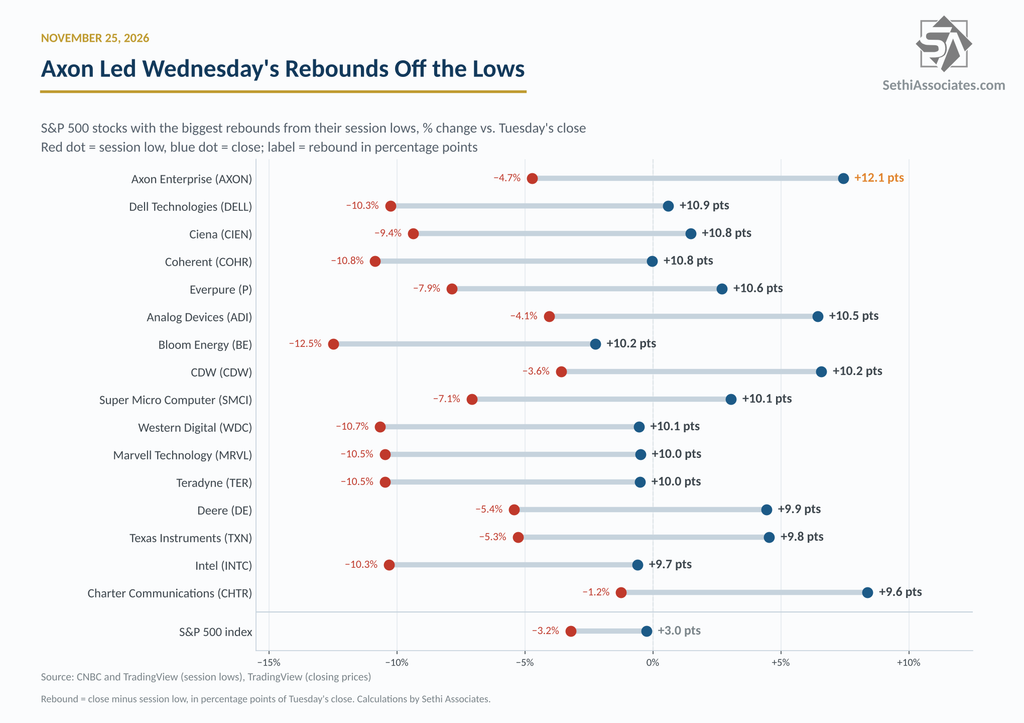
Outside of AI names, the rebound was broad. 75 S&P 500 stocks were down 5% or more at their lows, and 29 rallied at least 8 percentage points off them. Axon Enterprise (AXON) (+7.4%), CDW (CDW) (+6.6%), Analog Devices (ADI) (+6.4%), Texas Instruments (TXN) (+4.6%) and Deere (DE) (+4.4%) all climbed 10 to 12 points off their lows. Deere rose despite a disappointing earnings forecast, amid expectations the farm economy will begin to rebound, while Autodesk (ADSK) (-3.5%) didn’t get the same treatment after a solid report. Homebuilders also rallied with yields lower, with the iShares U.S. Home Construction ETF up 2.9%, and Materials got a lift from International Paper (IP) (+4.8%) and Smurfit Westrock (SW) (+4.3%). Dell Technologies (DELL) was an AI winner, swinging from a 10% loss to a 0.6% gain after its record quarter and raised outlook.
Among the megacaps, Meta Platforms (META) (+3.4%) and Apple (AAPL) (+0.4%) rose, while Amazon (AMZN) (-3.1%), Alphabet (GOOGL) (-2.1%), Microsoft (MSFT) (-1.3%) and Tesla (TSLA) (-1.2%) fell. Anthropic (ANT) rose 1.1% to $82.79 but is still just below its $83 IPO price.
On the AI selloff, Rev Shark said the comparisons to the 2000 bust miss a big difference: the speculation this time was in megacaps and chips, driven by institutions, not in small, weak companies. Stephen “Sarge” Guilfoyle thinks the Huang saga has gotten a little too hands-on, noting CoreWeave’s notes hit record lows Tuesday, and Bret Jensen isn’t chasing Tuesday’s biotech surge, noting SpaceX and Anthropic closed under their IPO prices and warning 2027 could bring the kind of “rug pulls” that followed the IPO booms of 1999 and 2021. Bob Lang said a market in distribution is dangerous for bulls.
Doug Kass bought the dip, buying SPY and QQQ with S&P futures down 135 points before the open and adding with the S&P 500 down 200 points, then took off part of his longs with the index down only about 80 points heading into the long weekend. He also took quick profits in Dell Technologies (bought at $273.85, sold at $294.78) and Goldman Sachs (GS) (bought at $775.84, sold at $802.93).
FedWatch
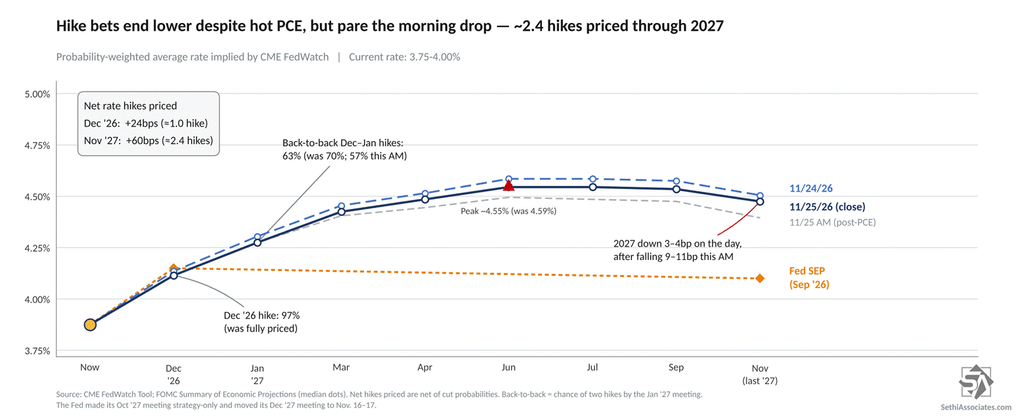
Fed rate hike expectations ended lower despite the hot PCE report, though they pared much of the morning’s drop as stocks recovered. A December hike slipped to a 97% chance from fully priced Tuesday, back-to-back hikes in December and January are 63% priced (from 70% Tuesday), and 60 basis points of hikes are priced through the Fed’s final 2027 meeting in November, nearly two and a half hikes, down from 63 basis points, per CME FedWatch.
More From TheStreet Pro
Jason Meshnick — Thankful
Helene Meisler — Follow the Indicators, Not Your Gut
Bob Lang — VIX Elevated
Doug Kass’s Diary:
- Early Morning Index Trades
- Jenron
- Adding to Index Trading Rentals
- Oracle CDs Now and Then
- More SPY, QQQ
- Boockvar Dives Into the Data Dump
- Boockvar on Why the Market Doesn’t Believe Dell
- A Real Pattern
- Long Weekend Prep
- Trump Lays Blame for Sharp Decline
- Nvidia on Watch
- Sticky Inflation
- For Whom the Dell Tolls
Note: Doug posted 31 Diary entries today; these are the market ones.
And From Me If You Missed It
- Machines Behind Monday’s Rally
- Core PCE Inflation Climbs to Highest Since 2023 as Real Spending Slips
- Fed’s Beige Book Is a Mixed Bag, but Gives Doves Little Ammunition
Miscellaneous
Deutsche Bank’s Street-high 9,000
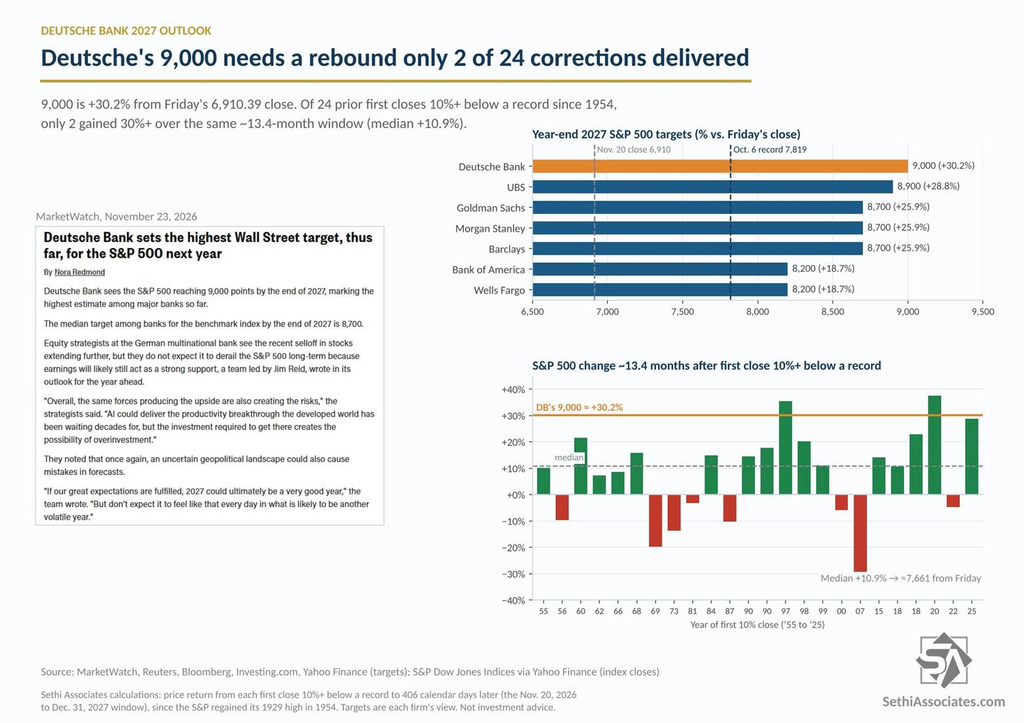
I’ll give Deutsche Bank credit for being aggressive. While some strategists were trimming their targets during the selloff, Deutsche set its 2027 S&P 500 target at a Street-high 9,000 last weekend (MarketWatch), compared with the current median target of 8,700. The team, led by Jim Reid, said AI “could deliver the productivity breakthrough,” but also warned that the investment needed to get there creates “the possibility of overinvestment.”
The math on 9,000: it’s 30.2% above Friday’s close and 15.1% above the October 6 record. On DB’s 2027 EPS estimate of $430, it’s about 20.9 times earnings, versus Friday’s forward P/E of 16.4, the lowest since the 2022 bear market (Yardeni). So it’s as much a bet that valuations rise again as a bet on earnings.
I checked every time since 1954 that the S&P 500 first closed 10%+ below a record. Friday was the 25th. Over the next 13.4 months (the window DB’s target covers), it was higher 16 of 24 times, with a median gain of 10.9% (about 7,660 from Friday’s close). It gained 30%+ only twice, in 1997 (+35%) and 2020 (+38%), and 11 of the 24 became bear markets. History makes 9,000 a best case, not a base case.
Wrap-Up — Volatility in Spades
I’ve been noting (most recently yesterday) that after volatility spikes like we’ve seen, history cautions that things are likely to remain volatile for the next few weeks at least, and Wednesday delivered that in spades. The S&P 500 swung from a 3.2% loss to finish down just 0.3%, the Nasdaq-100 from down 4.7% to down 0.6% and the SOX from down 8.0% to down 0.7%, while the Russell 2000 went from a 2.3% loss to a 0.7% gain. The swings in individual stocks were even bigger: 16 S&P 500 stocks rebounded nearly 10 percentage points or more from their lows, led by Axon’s 12-point swing.
Importantly, the dip buyers stepped in right where they were supposed to. Yesterday I said I’d be watching for markets to either get above Monday’s highs or drop below Friday’s lows to tell me the near-term trend, and Wednesday tested the bottom of that range, on the Nasdaq-100 ETF (QQQ) in particular. The ETF bottomed at $607.76 in the first 20 minutes, just $1.53 above Friday’s low ($606.23), and held just above it through late morning before rallying 4.3% to close at $633.93. That’s a positive, and I bought the QQQ as it moved off that test.
That kind of reversal is also rare. Since 1980, the S&P 500 has been down at least 3.2% during a session and finished with a loss of 0.25% or less only eight other times, and several came at or near important lows: the day after the 1987 crash, two sessions before the March 2020 pandemic low, a short-term low in January 2022 and the low of the April 2025 tariff selloff. But three came in the fall of 2008, and the near-term record is mixed. The S&P 500 was higher a month later only half the time (median -0.3%), though excluding the 2008 cases it was higher four of five times. But in keeping with the positive year-ahead metrics I’ve noted in numerous other studies, a year later it was higher seven of eight times, with a median gain of 19%.
One comeback doesn’t mean the volatility is over, though. As I noted yesterday, the VIX has gotten back below 20 within a month only once after closing at 30 or higher on a monthly options expiration. That’s once in 30 cases since 1990 (December 2018, when it started at 30.1, vs. Friday’s 35.9), and in 25 of the 30, the VIX was still 25 or higher a month later. So as mentioned volatility is likely here to stay for now, even if, as I noted in Sunday’s Week Ahead, the S&P 500 was higher a month later in 77% of those cases, meaning it’s not necessarily a reason to sell.
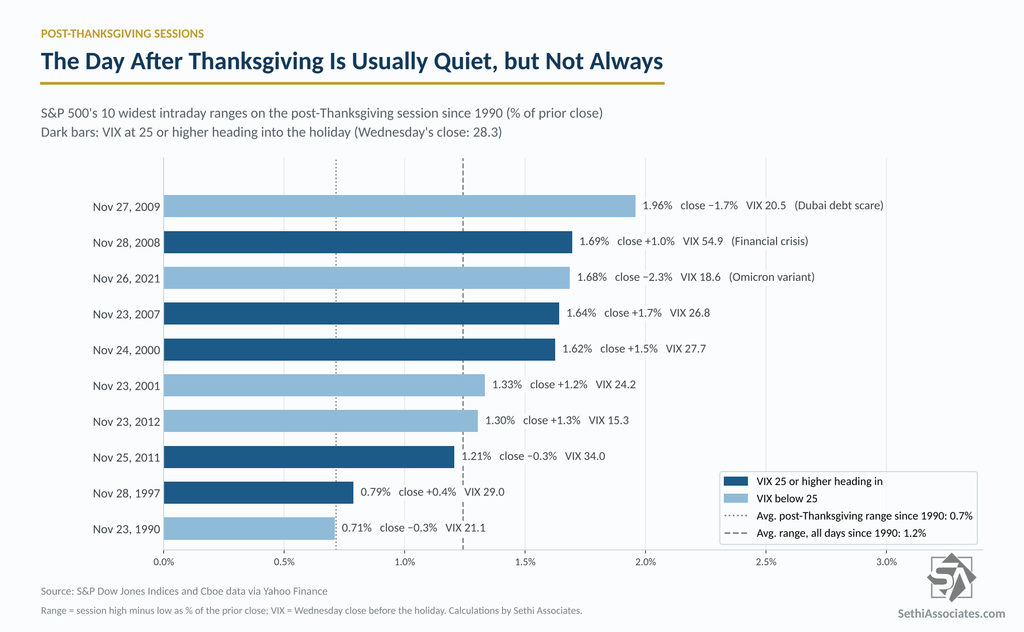
Friday’s half session could add to it. The day after Thanksgiving is usually one of the quietest of the year: since 1990, the S&P 500’s average move that day has been about 0.5% (vs. about 0.75% for all days), and its average intraday range 0.7% (vs. 1.2%). But thin trading can magnify any surprise, as in 2021, when news of the Omicron variant sent the S&P 500 down 2.3%.
The VIX has been a good tell. In the 14 years it was above 20 heading into the holiday, Friday’s range averaged 1.0%, about double the 0.5% when it was 20 or lower, and those years account for eight of the 10 most volatile post-Thanksgiving sessions since 1990. Wednesday’s 28.3 close was the fourth-highest heading into Thanksgiving since 1990, behind only 2008, 2011 and 1997 (which all appear on the chart), and in the six years the VIX was 25 or higher, Friday’s range averaged 1.3%, with five of the six ranking in the top 10.
Further out, the picture is better. The indicators that pointed to Monday’s bounce also point to more upside 6 and 12 months out, and Helene’s indicators still say we should rally again, with her Overbought/Oversold Oscillator set to turn up next week as it drops a string of weak breadth days. But the mechanical buying behind Monday’s surge is spent (see Machines Behind Monday’s Rally), and credit tied to the AI buildout hasn’t bought the rebound.
In any event, the battle between the bulls and bears is unlikely to be settled this week. I’ll still be watching Monday’s highs (7,296 on the S&P 500) and Friday’s lows (6,883), and enjoying some turkey in between.
As always, let’s see what we get and go from there.
The Day(s) Ahead — US Holiday Thursday and a Quiet Post-Thanksgiving Friday
US markets are closed Thursday for Thanksgiving.
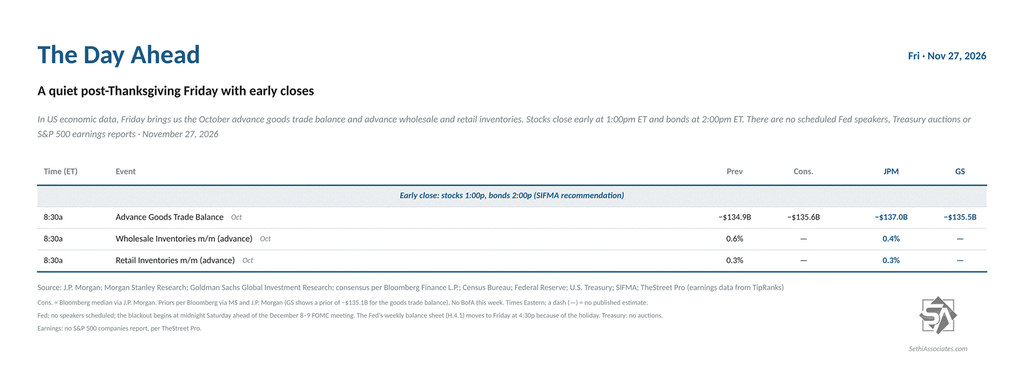
Friday is a quiet post-Thanksgiving session, with stocks closing early at 1pm ET and bonds at 2pm ET. The only US economic data is October’s advance economic indicators report, covering the goods trade balance (consensus -$135.6B, from -$134.9B) and wholesale and retail inventories.
There are no scheduled Fed speakers, and the Fed’s blackout period begins Saturday ahead of the December 8-9 FOMC meeting. The Fed’s weekly balance sheet release moves to Friday afternoon (4:30pm ET) because of the holiday.
There are no Treasury auctions and no S&P 500 earnings reports.
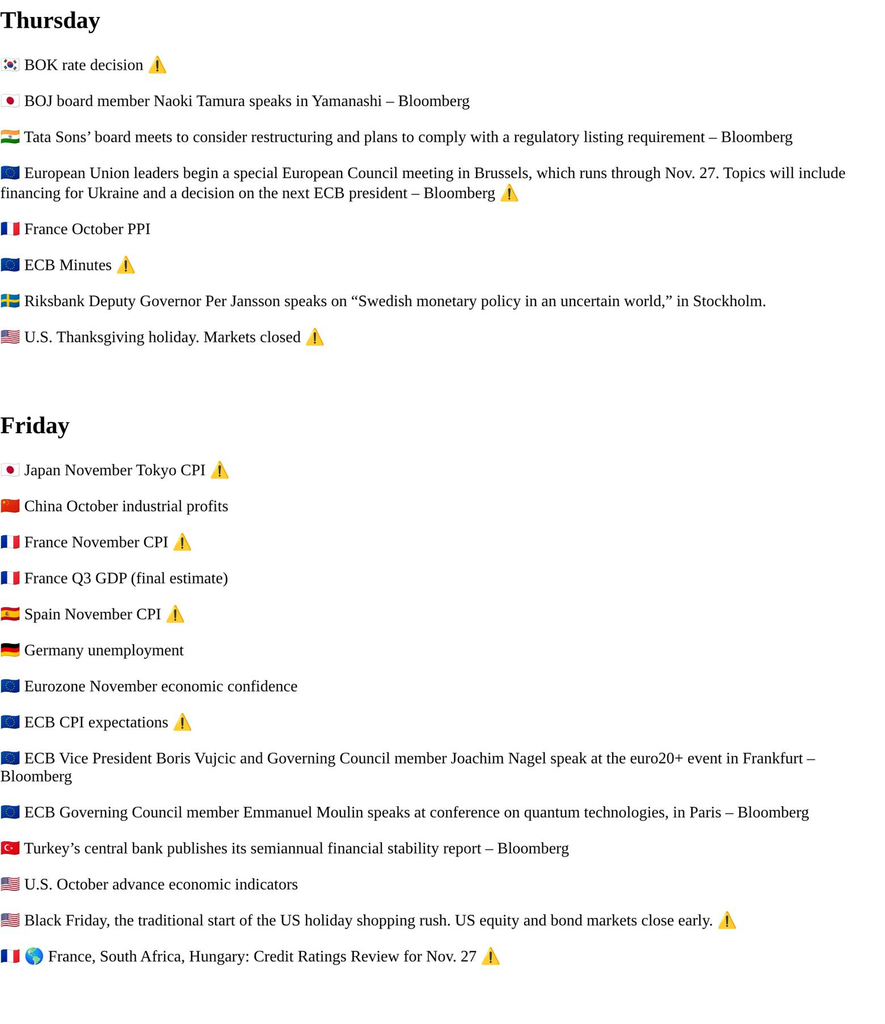
Ex-US highlights on Thursday include the Bank of Korea’s rate decision (Wednesday evening ET), Germany’s December GfK consumer confidence (2am ET), eurozone October money supply (4am ET), Norway’s Q3 GDP and the ECB’s account of its October meeting (7:30am ET). EU leaders also hold a special European Council in Brussels through Friday on Ukraine financing and the choice of the next ECB president.
Friday brings Japan’s November Tokyo CPI (6:30pm ET Thursday), China’s October industrial profits (8:30pm ET Thursday), November flash CPI from France (2:45am ET) and Spain (3am ET), German unemployment (3:55am ET), the ECB’s consumer expectations survey (4am ET) and eurozone economic confidence (5am ET), plus Sweden’s Q3 GDP and Canada’s Q3 current account.
From Christophe Barraud’s international Week Ahead rundown:
At the time of publication, in terms of securities mentioned, Sethi was long AMZN, CEG, GOOGL, GS, MSFT, NVDA, ORCL, QQQ and numerous Treasury ETFs, and short IWM and VOO. In the last 24 hours Sethi bought MSFT and QQQ, added to CEG and covered part of his VOO short.