Fed’s Beige Book Is a Mixed Bag, but Gives Doves Little Ammunition
The November Beige Book was a mixed bag: growth narrowed for a third straight report and the price reacceleration stalled, but the growth outlook was raised, wage growth picked up and firms expect “expenses and prices to continue rising.”
You've reached your free article limit
You've read 0 of 1 free Pro articles.

The Fed released Wednesday afternoon its Beige Book, an important input for most FOMC members because it captures the more granular, ground-level data coming up from the 12 Fed Districts. It was prepared in advance of the Committee’s December 8-9 meeting. The November edition (observations through November 16, compiled by the Atlanta Fed) is a mixed bag, but it gives the doves little to push back on the more hawkish comments from many Fed speakers since the October meeting (see Fed’s Waller Floats a Half-Point Hike if CPI Runs Hot; Dallas’ Logan Adds to 50 Basis Point Speculation; and Fed’s Musalem Wants ‘Several’ Hikes Before Spring, but Note His Record), along with the October minutes, where “almost all” saw more hikes.
Executive Summary
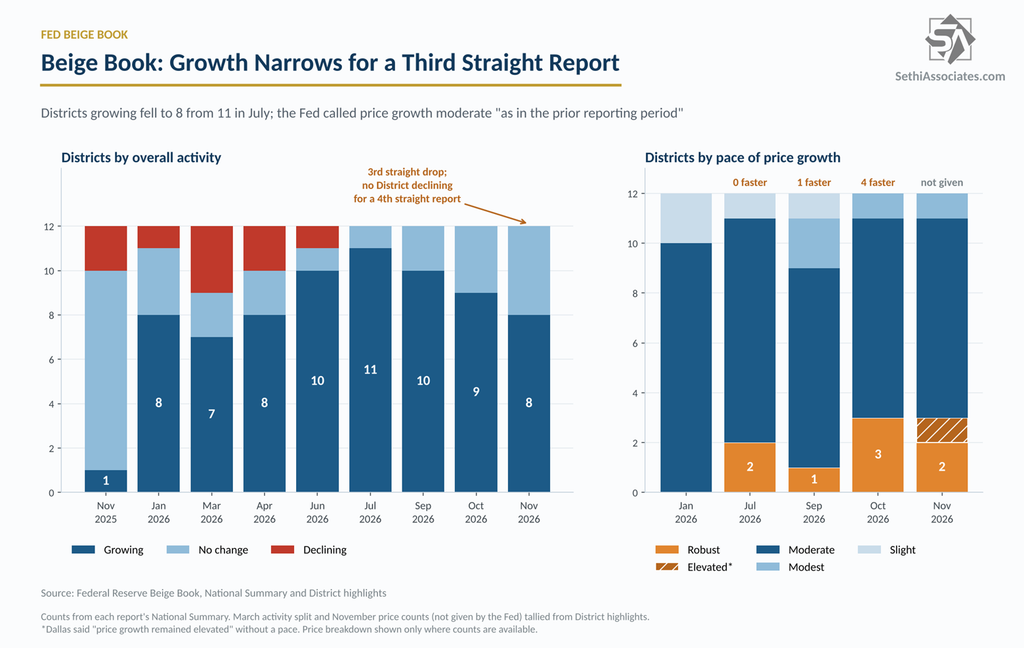
- Growth narrowed for a third straight report, to eight Districts from nine in October (and 11 in July), with four reporting no change, though for a fourth straight report none reported a decline.
- The outlook improved, from “slight growth” in October to “slight to moderate growth.”
- After October’s reacceleration, prices rose “moderately overall, as in the prior reporting period,” and the Fed didn’t flag any Districts with robust or faster price growth.
- Firms still “expected both expenses and prices to continue rising in the coming months,” and input costs kept outrunning selling prices.
- Wages and benefits “rose moderately, an uptick from modest increases in the previous report,” driven in part by cost-of-living adjustments.
- Consumer spending was “little changed,” while housing and construction weakened amid higher borrowing costs.
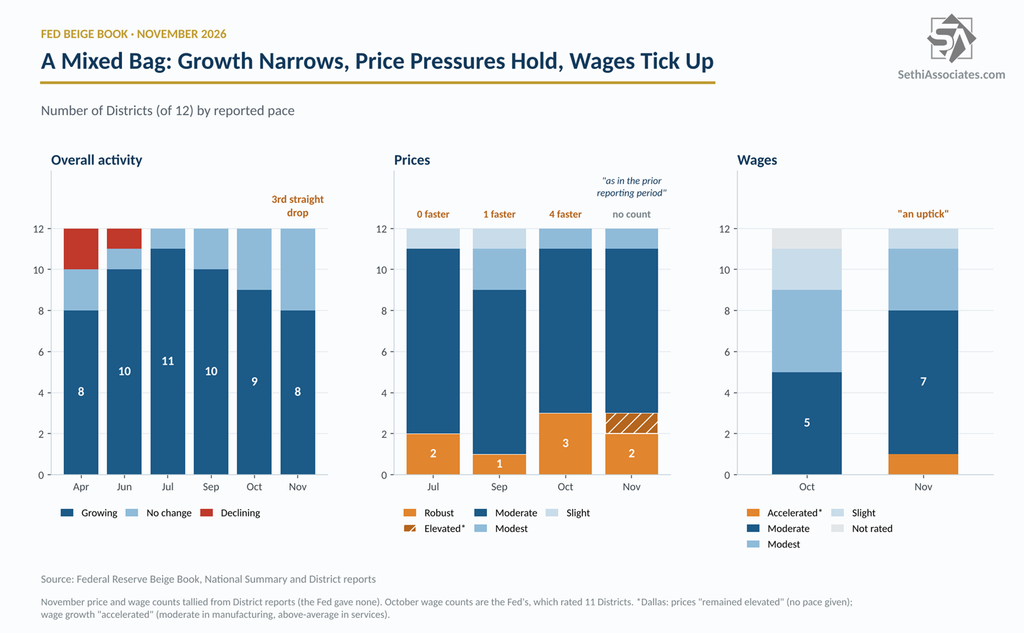
Below is a side-by-side comparison of October vs. November.
Overall Economic Activity
October 2026: “Since the prior Beige Book, two of the twelve Federal Reserve Districts reported moderate growth in economic activity. Three Districts reported modest growth, while four reported slight growth, and three reported no significant change.” “Overall, most Districts reported that firms have maintained a positive economic outlook for the coming months. However, expectations tend to be for slight growth, weighted toward manufacturing and burdened by persistent uncertainties.”
November 2026: “Eight of the twelve Federal Reserve Districts reported growth in the slight to moderate range, while four Districts reported no change.” “Overall, the majority of Districts expected slight to moderate growth.”
Change: growth narrowed for a third straight report, to eight Districts from nine (and 11 in July), with Boston, Chicago, Kansas City and San Francisco reporting little or no change. Dallas, one of October’s two moderate-growth Districts, “slowed to a modest pace.” Still, no District has reported a decline since the June report, and the outlook improved a bit, from “slight growth” to “slight to moderate growth.”
Consumer Spending
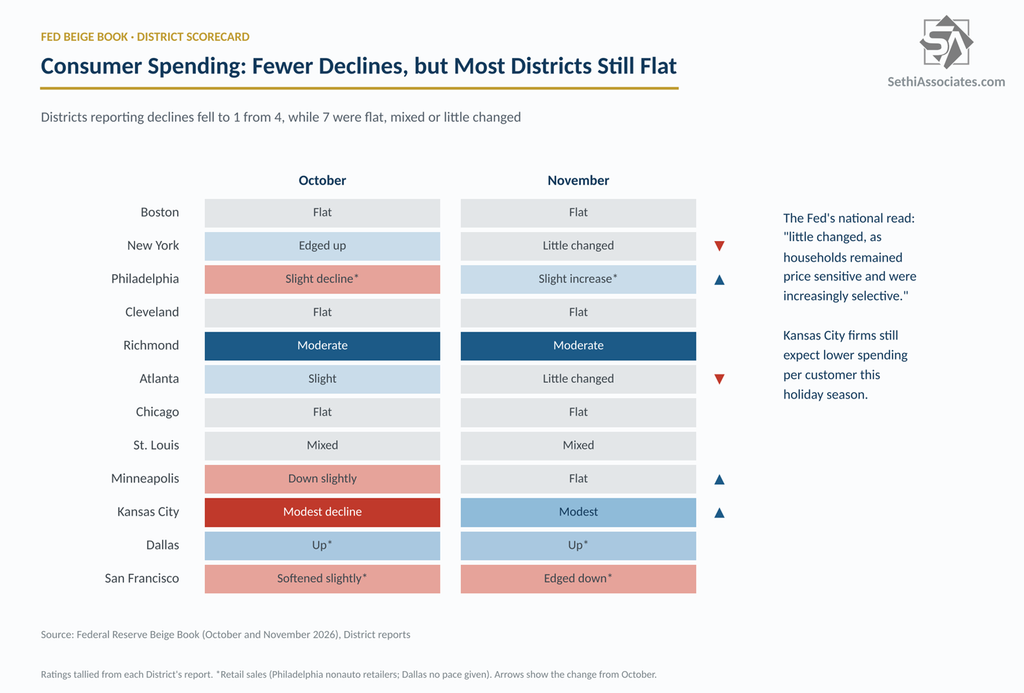
October 2026: “Most Districts reported little or no change in overall consumer spending.” “Over half of the Districts noted that consumer spending was driven by high-income households.” “Auto contacts noted flat to modestly lower sales in five of the six Districts that reported.”
November 2026: “Consumer spending was little changed, as households remained price sensitive and were increasingly selective in discretionary purchases.” “Tourism and travel activity was solid while entertainment and hospitality spending was mixed overall.” “Auto sales softened, which contacts attributed to elevated fuel prices and higher interest rates.”
Change: spending was “little changed” for a second straight report, with households now “increasingly selective.” Higher interest rates joined fuel prices as a drag on autos. Philadelphia retailers did see an improvement, crediting “gas prices easing and the election resolving.”
Manufacturing
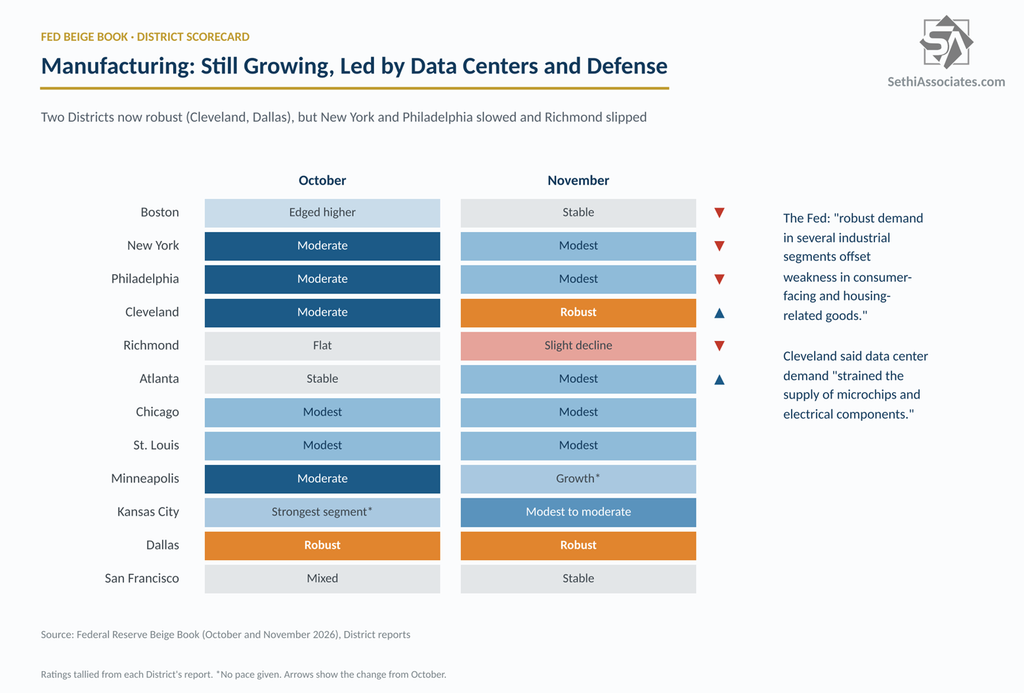
October 2026: “Robust, broad-based growth in manufacturing led the moderate growth reported in the Dallas District. While not as robust, another six Districts reported modest to moderate growth from their manufacturing firms. The remaining five Districts noted little or no manufacturing growth.”
November 2026: “Manufacturing activity grew modestly overall, as robust demand in several industrial segments offset weakness in consumer-facing and housing-related goods.”
Change: manufacturing kept growing, but the split is now clearer. Data centers, power and defense are carrying the sector while consumer and housing-related goods weaken. Cleveland said data center demand “strained the supply of microchips and electrical components,” while Richmond’s manufacturing “declined slightly” even as “[d]efense and data center–related companies” there “continued to report strong growth.”
Labor Markets
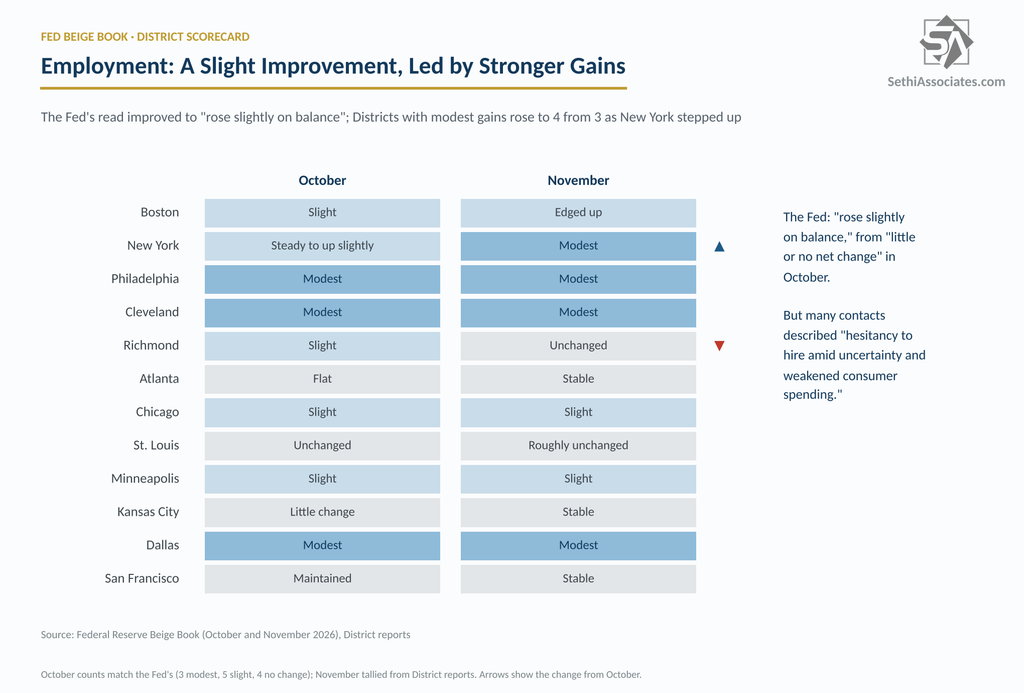
October 2026: “Most Districts described little or no net change in overall employment levels. While three Districts described modest increases, five reported slight increases, and four reported no significant change.” “Five Districts reported that some firms had either reduced staffing levels (through attrition), delayed hiring, or anticipated less job creation after increasing productivity by investing in AI.”
November 2026: “Employment levels rose slightly on balance, with many firms reporting stable head counts and hiring primarily to replace for attrition, while only a minority noted meaningful increases.” “Contacts across several sectors cited steady or rising labor demand, though many also described hesitancy to hire amid uncertainty and weakened consumer spending.” “Labor supply generally remained stable, and while it was often relatively easy to find workers, persistent hiring difficulties continued for skilled and technical roles.”
Change: a slight improvement to “rose slightly on balance” from “little or no change.” New this time though is “hesitancy to hire amid uncertainty and weakened consumer spending.” AI dropped out of the national summary after five Districts flagged it in October; Kansas City and Dallas contacts said it had little impact on head counts so far.
Wages
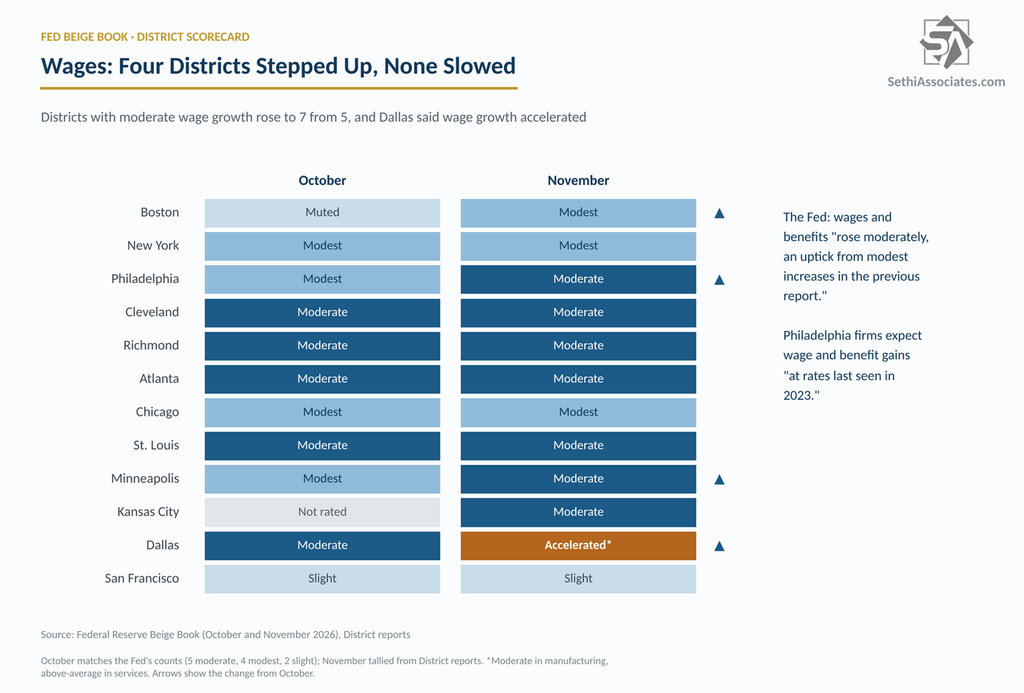
October 2026: “Five Districts described moderate growth in overall wages, four reported modest growth, and two reported slight growth.” “Several Districts noted that inflation has spawned additional wage pressure in the form of higher cost-of-living demands from individuals as well as challenges from rising benefit costs.”
November 2026: “Wages and benefits rose moderately, an uptick from modest increases in the previous report, driven by upward pressure concentrated in hard-to-fill positions and influenced by cost-of-living adjustments and increases in benefit costs.”
Change: upgraded along with the labor market. Philadelphia said wage inflation “appears to be reaching a moderate pace of growth after running at a modest pace since 2023,” and its firms “anticipate higher increases for wages and benefits at rates last seen in 2023.” In Dallas, “[w]age growth accelerated, led by a pickup in the service sector.”
Prices
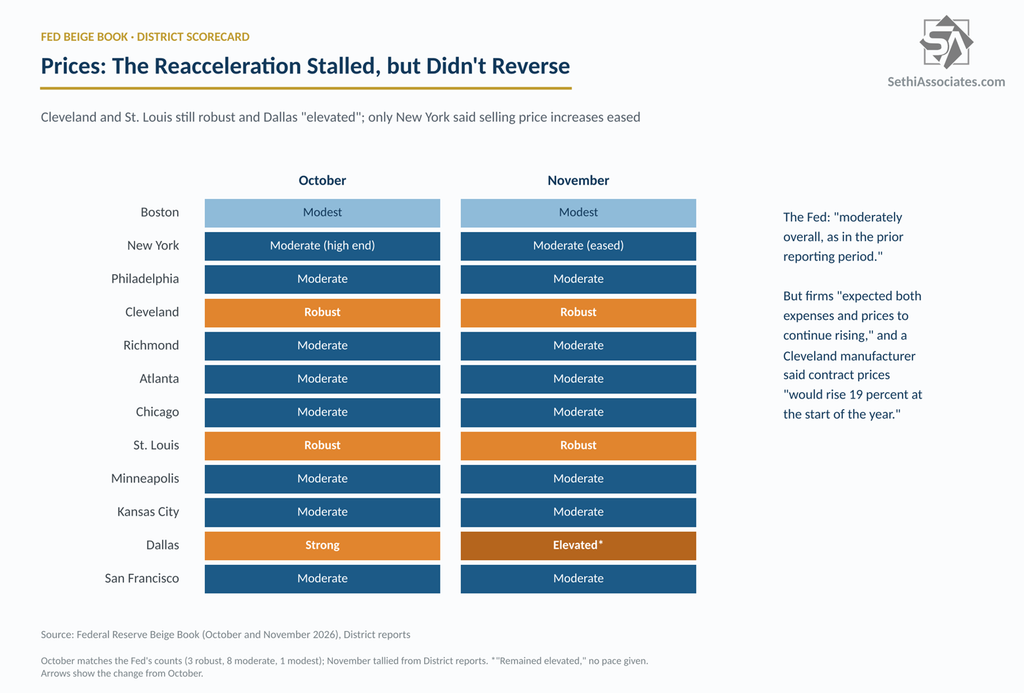
October 2026: “Three Districts characterized overall price growth as robust, while eight noted that growth was moderate—and three of the eight noted that input price pressures were intensifying, if not already growing robustly. One District reported modest price growth. Moreover, four Districts reported that the pace of price increases picked up since the prior period.” “Firms in several Districts cited persistent uncertainty around energy and tariffs and expect that prices will increase further in the coming months, as existing contracts expire, and firms must renegotiate hedge contracts for their own inputs and/or delivery contracts to their customers.”
November 2026: “Prices increased moderately overall, as in the prior reporting period.” “Contacts across a range of sectors reported sustained cost pressure from energy, transportation, healthcare, insurance, and tariff-related expenses.” “Input cost growth generally outpaced increases in selling prices, as competitive pressures and customer price sensitivity limited firms’ ability to fully pass through higher costs.” “Contacts expected both expenses and prices to continue rising in the coming months.”
Change: the October reacceleration didn’t extend, but prices didn’t cool either. The national summary gave no robust or faster-pace counts, and the contract-expiry language is gone. Margins remain squeezed, as input costs outran selling prices. The forward view still points up, and a few Cleveland contacts said “anticipated health insurance cost increases were already factoring into 2027 pricing plans.”
Nonfinancial Services and Banking
October 2026: The national summary did not address services or banking separately beyond noting that “reports on other sectors indicate little growth overall.”
November 2026: “Banking conditions were little changed overall, as loan demand remained subdued, while nonfinancial services activity increased slightly.”
Change: rate hikes are on contacts’ minds. Cleveland commercial clients were eager to “lock in” current rates “ahead of anticipated rate increases in the coming months,” and Dallas bankers said “future rate hikes could reduce the ability of customers to repay loans.” In Kansas City, “more than one third of respondents anticipated some deterioration” in loan quality over the next six months, and Philadelphia credit card volumes fell, “atypical of most years.”
Real Estate and Construction
October 2026: Real estate was not addressed as a national theme.
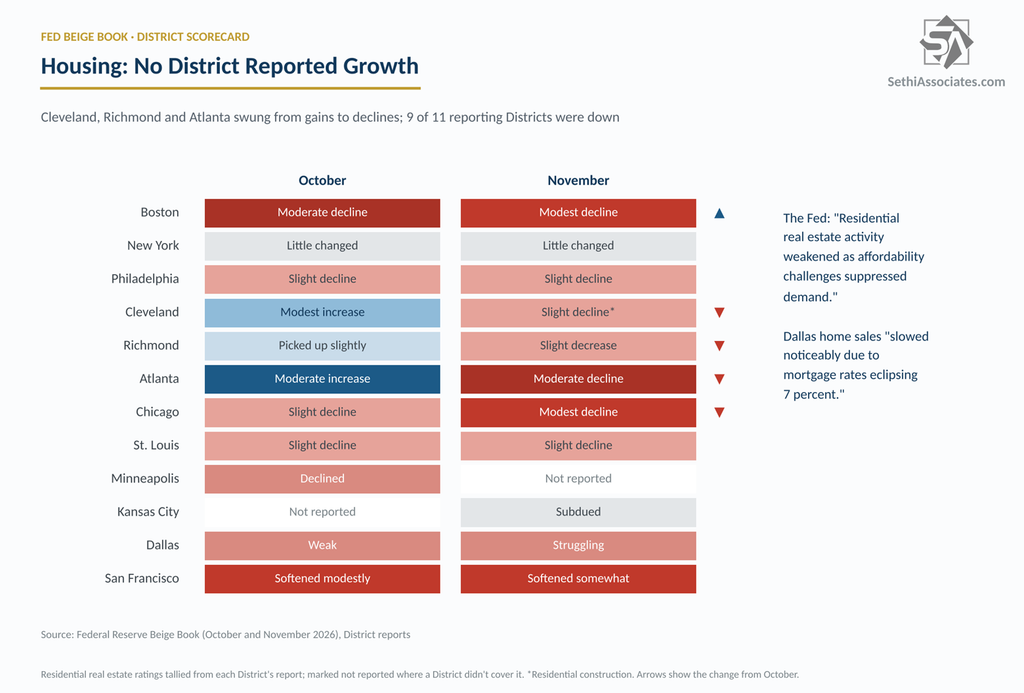
November 2026: “Residential real estate activity weakened as affordability challenges suppressed demand, while commercial real estate activity was mixed.” “Construction activity declined amid higher borrowing costs and elevated construction costs.”
Change: housing is back in the national summary, and it weakened. Dallas home sales “slowed noticeably due to mortgage rates eclipsing 7 percent,” and Philadelphia builders are “anticipating fewer houses to build in 2027 and likely layoffs.” Cleveland called elevated mortgage rates a “wet blanket” on the market.
Agriculture, Energy and Transportation
October 2026: Agriculture and energy were not addressed as national themes, though “higher oil prices permeated all District reports.”
November 2026: “Overall transportation activity grew modestly despite uneven demand, persistent capacity and infrastructure constraints, and rising cost pressures.” “Energy activity grew modestly but investment in this sector remained restrained by elevated geopolitical, policy, and cost uncertainties.”
Change: energy producers aren’t chasing higher prices. Kansas City drilling was “unchanged over the last month,” and Dallas drilling “plateaued after significant increases from May to August.” Shipping costs stayed high: Richmond said Asia-to-U.S. spot rates “rose close to COVID-era highs,” and Dallas said ocean freight rates “were at or near historic highs.”
Other Notable Regional Anecdotes
- Households are hitting their limits. Kansas City said households “reached financial limits when facing major unexpected repairs,” and some employees “had begun using earned wage access to pay for day-to-day expenses such as workplace meals.”
- The strain is moving up the income ladder. A Cleveland county government contact said food and housing insecurity “now even affected middle- to upper-income county employees,” and a Dallas nonprofit saw more demand for financial counseling, “including from middle-class households.”
- Consumers are choosing carefully. A Richmond discount store said “Halloween decoration sales were down but candy purchases were strong,” which it saw as consumers “focusing on essential items.”
- Refiners are running hot. Dallas said Gulf Coast refiners averaged “95 percent utilization in part by deferring routine maintenance.”