A High VIX Makes Post-Thanksgiving Fridays a Lot Less Sleepy
Friday’s half session (stocks close at 1pm ET, bonds at 2pm ET) is usually one of the quietest days of the year. Since 1990, the S&P 500’s average move on the day after Thanksgiving has been about 0.5%, vs. about 0.75% for all days, and its average intraday range 0.7%, vs. 1.2%. But before you …
You've reached your free article limit
You've read 0 of 1 free Pro articles.
Friday’s half session (stocks close at 1pm ET, bonds at 2pm ET) is usually one of the quietest days of the year. Since 1990, the S&P 500’s average move on the day after Thanksgiving has been about 0.5%, vs. about 0.75% for all days, and its average intraday range 0.7%, vs. 1.2%.
But before you decide to sleep in Friday, note that a VIX over 20 changes this Dr. Jekyll into a Mr. Hyde. In the 14 years it was above 20 heading into the holiday, Friday’s range averaged 1.0%, about double the 0.5% when it was 20 or lower. Those years account for eight of the 10 most volatile post-Thanksgiving sessions since 1990. In the six years the VIX was 25 or higher, the range averaged 1.3%, and five of the six rank in the top 10.
Which is where we are today. Wednesday’s VIX close of 28.3 was the fourth-highest heading into Thanksgiving since 1990, behind only 2008 (54.9), 2011 (34.0) and 1997 (29.0).
Most of the 10 most volatile sessions also came during or near bear markets. 2000, 2001 and 2008 came during them, 2007 came six weeks after the October 2007 peak, and 2021 came five weeks before the January 2022 peak. 1990 and 2011 came during declines that just missed 20% (19.9% and 19.4%). Thin trading can also magnify a surprise: in 2021, news of the Omicron variant sent the S&P 500 down 2.3% with the VIX at just 18.6.
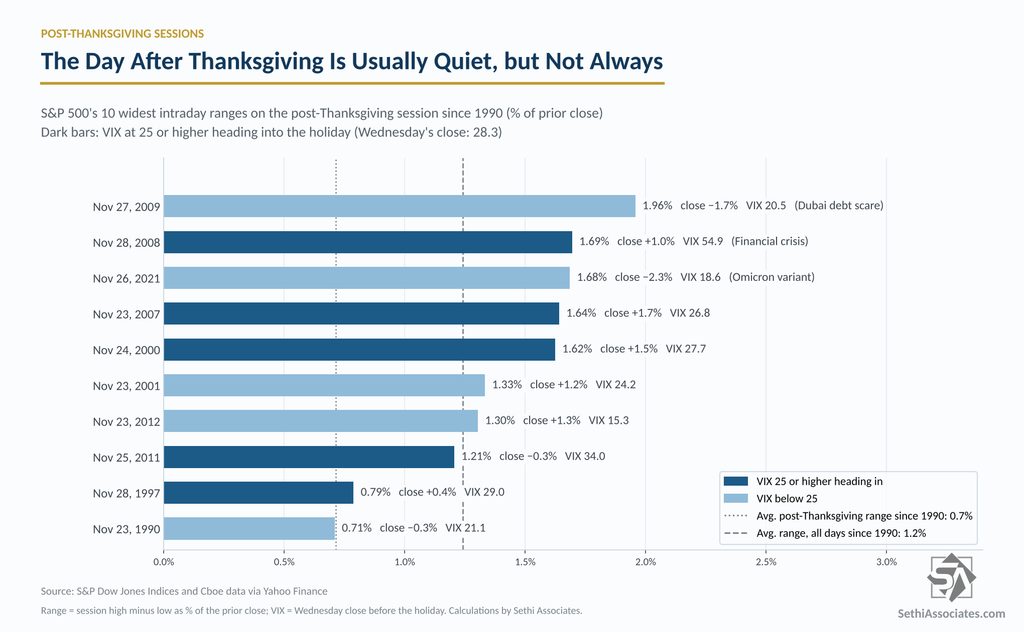
The direction has been a coin flip, though. The S&P 500 rose in seven of the 14 high-VIX sessions (and 21 of 36 overall). Not every high-VIX Friday was wild either: six of the 14 still had ranges of 0.7% or less.
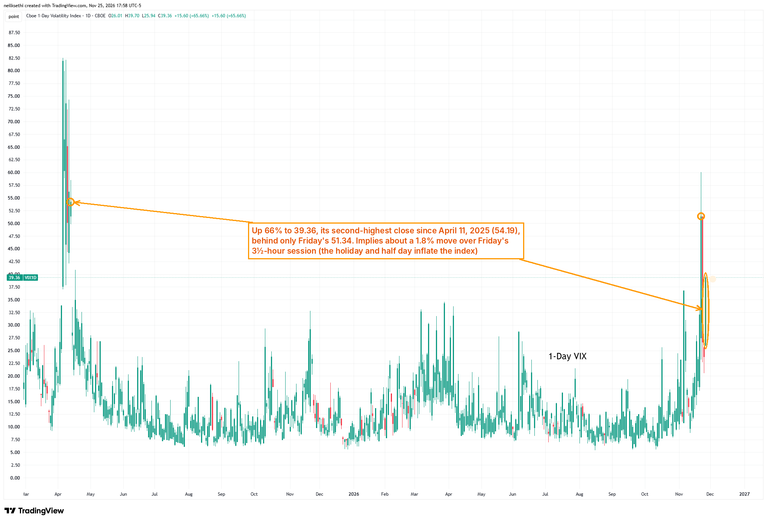
Options are pricing a sizable move. The 1-day VIX jumped 66% to 39.36 Wednesday, its second-highest close since April 2025, though that’s partly mechanical. It measures time in trading minutes, so the holiday gap and the 3½-hour session push it up. Scaled to the shorter session, it implies a move of about 1.8%.