Stock Market Today

Market updates and conversation from TheStreet Pro team. Follow the latest and join the conversation below.

Stock Market Today: November 10, 2026

Newest first · All times Eastern · 7 updates

DATE:
By Neil Sethi

Foreign Demand for Benchmark 10-Year Auction Sees Biggest Drop Since 2016

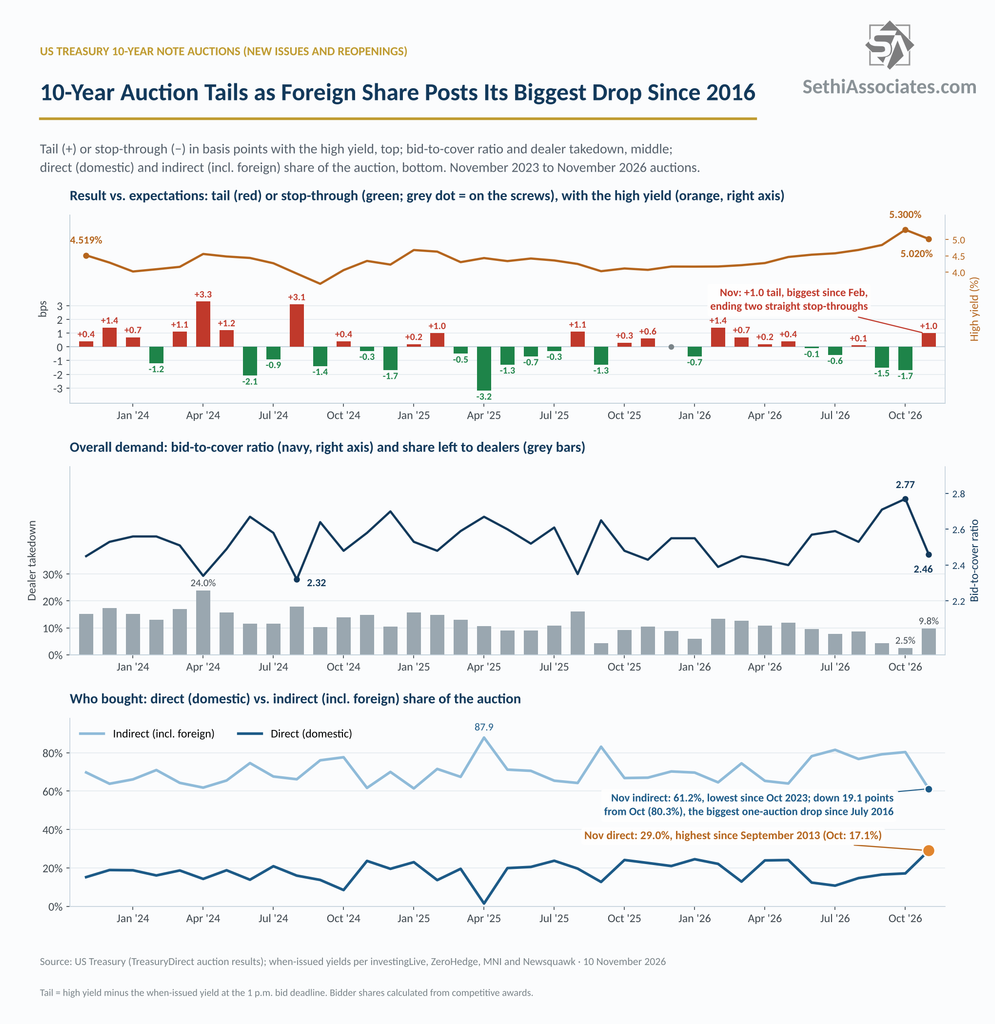
A day after Monday’s 3-year Treasury auction tailed, meaning it sold at a higher yield than the market expected, Tuesday’s benchmark $42 billion 10-year sale had its biggest tail since February as indirect bidders, which include foreign buyers, posted their biggest drop since 2016. October’s 2-year and 5-year sales also tailed last week and the 7-year showed the same pattern of foreign buyers pulling back.

The notes sold at a high yield of 5.020%, 1.0 basis point above the 5.010% when-issued yield just before the 1 p.m. ET bid deadline, according to investingLive and ZeroHedge, the largest “tail” since February. It ends two straight stop-throughs, where an auction sells below the expected yield; October’s was 1.7 basis points. The six-month average is a 0.6 basis point stop-through. The high yield was the lowest since September, down from October’s 5.300%, which was the highest since November 2000. The six-month average is 4.734%.

Overall demand weakened. The bid-to-cover ratio measures how many dollars were bid for each dollar of notes sold. It fell to 2.46, the lowest since May, from 2.77 in October, against a six-month average of 2.60. Dealers take whatever other bidders don’t, and they were left with 9.8%, the most since May. That compares with 2.5% in October and a six-month average of 7.4%.

The weaker demand was due to indirect bidders, who took 61.2%, the lowest since October 2023, down from 80.3% in October. That drop of 19.1 percentage points was the biggest from one 10-year auction to the next since July 2016, based on Treasury data. The six-month average is 76.7%. It’s also the fifth straight note auction, after the 2-year, 5-year, 7-year and 3-year, where the indirect share came in below its six-month average. ZeroHedge said foreign buyers “staged a bit of a strike.”

The lack of indirect demand pulled in direct bidders, mostly domestic investors, who took 29.0%, the highest since September 2013. That was up from 17.1% in October and compares with a six-month average of 15.9%.
investingLive’s Greg Michalowski graded the auction a D+, saying, “The auction was a little soft.” ZeroHedge called it “downright ugly.”

The sale followed another hot core CPI report and Fed Governor Christopher Waller floating a half-point hike if CPI ran hot followed by a hawkish speech from Dallas Fed President Laurie Logan and is evidence a lack of foreign buying is exerting some upward pressure on Treasury yields, although the 10-year yield has since fallen back to just under 5% (4.988% as of this writing).

Treasury’s $25 billion 30-year bond auction follows Thursday.
By Neil Sethi

Dallas’ Logan Adds to 50 Basis Point Speculation

The relatively hawkish Dallas Fed President Logan (a 2026 FOMC voter) is the first speaker after the hot CPI print (Core CPI Comes in Hot Again, Putting a Half-Point Fed Hike on the Table) and Governor Waller’s speech this morning opening the door to a 50-basis point hike at the Fed’s December meeting (Fed’s Waller Floats a Half-Point Hike if CPI Runs Hot).

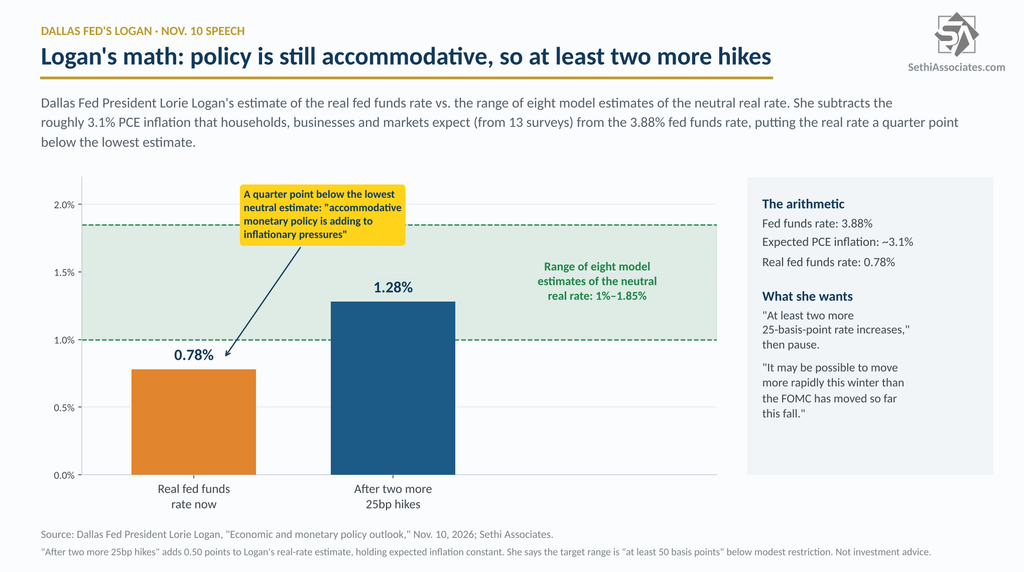
Logan adds to the momentum behind a potential 50 basis point hike (or perhaps back-to-back hikes) saying in a speech at an energy conference that “the FOMC needs to implement at least two more 25-basis-point rate increases,” and “[i]t may be possible to move more rapidly this winter than the FOMC has moved so far this fall.”

Unfortunately the speech is not on the Dallas Fed’s website, so I don’t know the rest of the comments.

https://www.bloomberg.com/news/articles/2026-11-10/fed-s-logan-favors-at-least-two-hikes-says-pace-could-quicken

12.30pm Update – The speech is now posted, and a few other points stand out. She said this morning’s CPI “was higher than expected” and that “I am concerned that PCE inflation could rise when we receive those data for October in a couple of weeks.” She like Waller, though, isn’t calling for a dramatic hiking cycle: “I currently estimate that the fed funds target range is at least 50 basis points—half a percentage point—below the level that would create some modest restriction and begin to bring the inflation trend back to target.”

But she notes the real fed funds rate is just 78 basis points (the 3.88% fed funds rate less the roughly 3.1% inflation that households, businesses and markets expect), a quarter point below the lowest of eight model estimates of neutral, so “accommodative monetary policy is adding to inflationary pressures.”

On October’s skip, she said the volatile markets argued for moving “more gradually,” but “Skipping one meeting does not change the monetary policy destination,” and “the precise timing of each rate increase has little effect on the longer-term rates most borrowers pay.” After two more hikes, “it would make sense in my view to pause and examine economic and financial developments.”

And like Goolsbee yesterday (see the Waller post), she pointed to services which came in hot in October. “Prices for non-housing, non-transportation core services rose 3.2% over the 12 months ended in September,” eight tenths of a point above the pace consistent with the Fed’s target, and those prices “aren’t particularly sensitive to tariffs, conflict in the Middle East or surging demand for computer chips.”

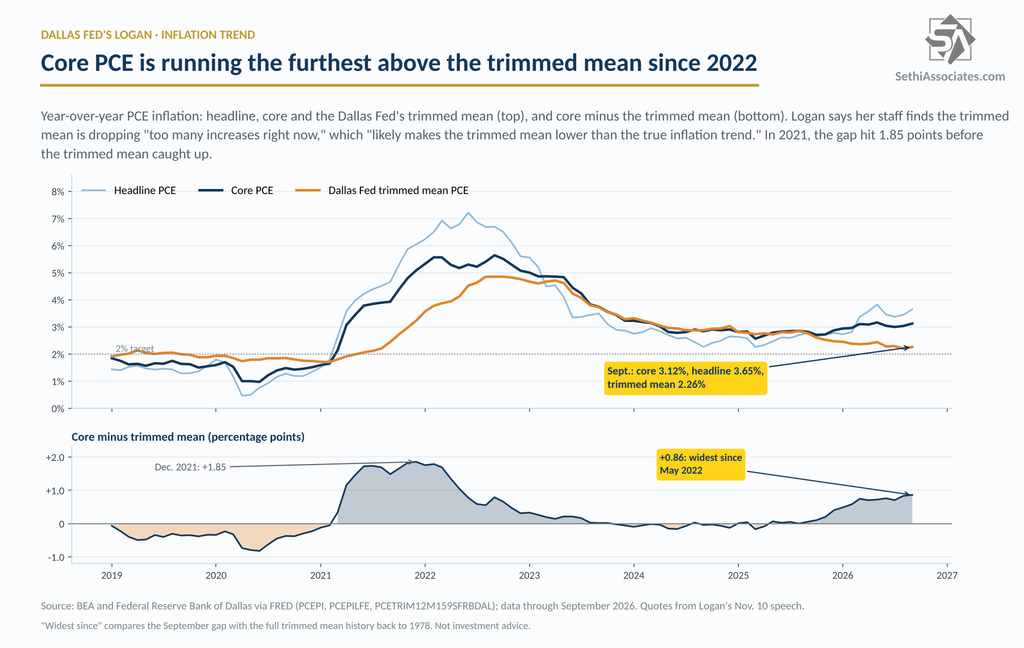
But she downplayed her own bank’s inflation gauge. The Dallas Fed’s trimmed mean PCE was lower, at 2.3% over the 12 months through September, but she said her staff’s research finds “a change in the mix of price increases and decreases is causing the trimmed mean to drop too many increases right now,” which “likely makes the trimmed mean lower than the true inflation trend.”

She, like the other Fed speakers since Thursday, wasn’t moved by markets either. Financial conditions “are currently providing a tailwind,” with credit spreads still “compressed by historical standards,” and the rise in 10-year yields is “more a message that investors believe monetary policy has work to do than an independent headwind for activity.”

By Neil Sethi

An Unprecedented Whipsaw in Investor ‘Fear’

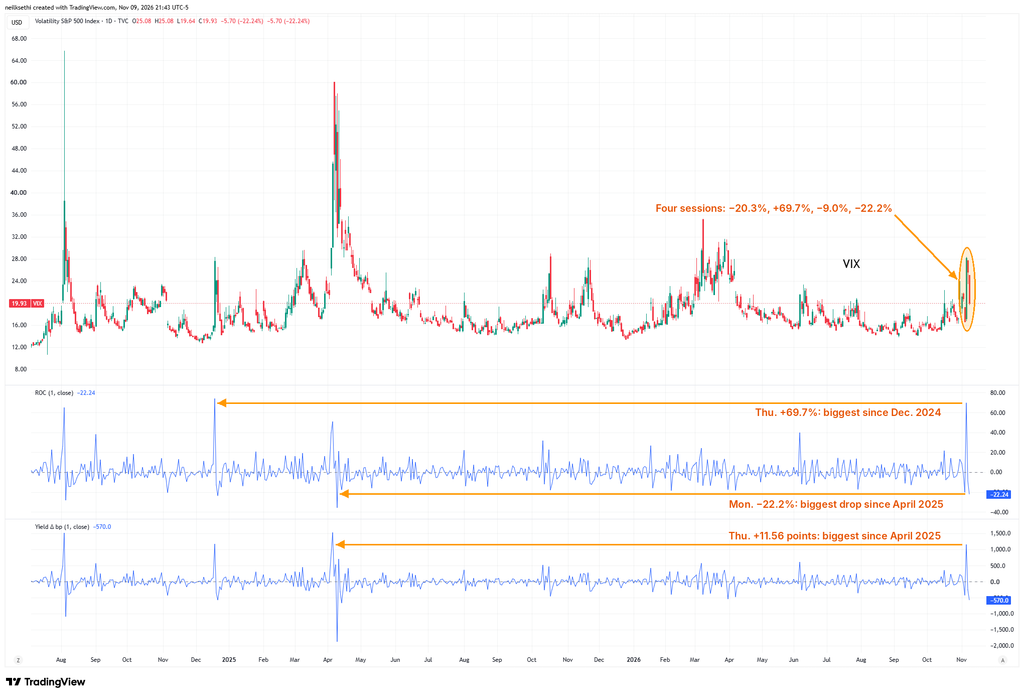
The Cboe Volatility Index (VIX) fell 22.2% to 19.93 Monday. That’s its biggest one-day drop since April 9, 2025, just topping last Wednesday’s 20.3% drop (Investor ‘Fear’ Is Dropping the Most Since April 2025). In between, it jumped 69.7% Thursday, its biggest gain since December 2024 (Wall Street’s ‘Fear Gauges’ Just Jumped the Most in Years. Here’s What Usually Came Next.).

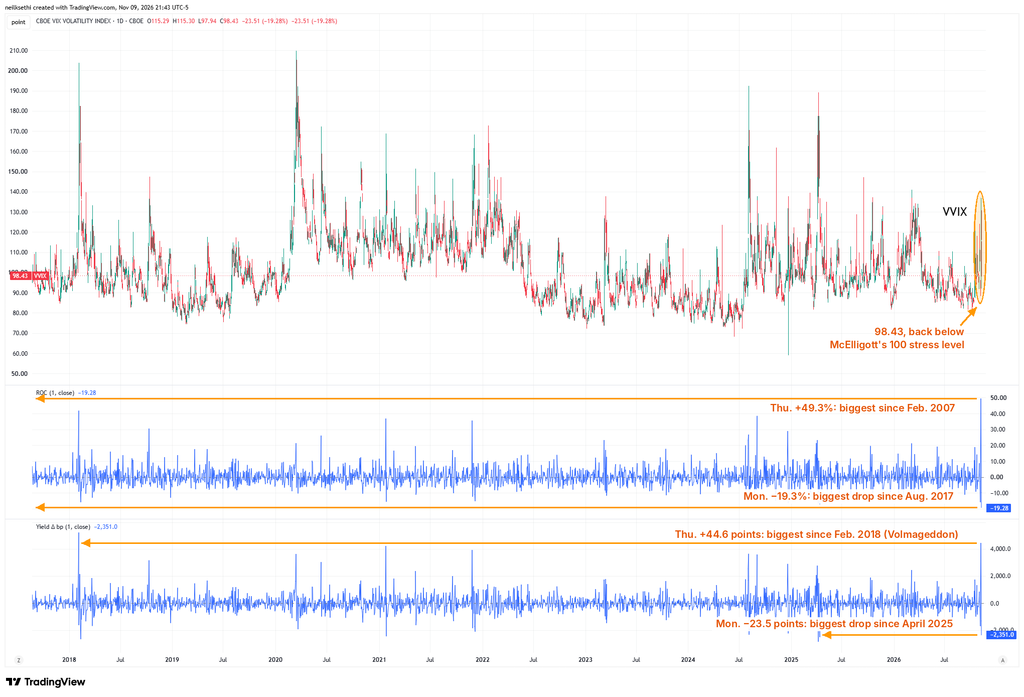
VVIX, which tracks expected swings in the VIX itself, fell 19.3% to 98.43. That’s its biggest drop since August 14, 2017, and the second-largest in data going back to 2007. That followed Thursday’s 69.7% jump, its biggest since December 2024. 

One Precedent

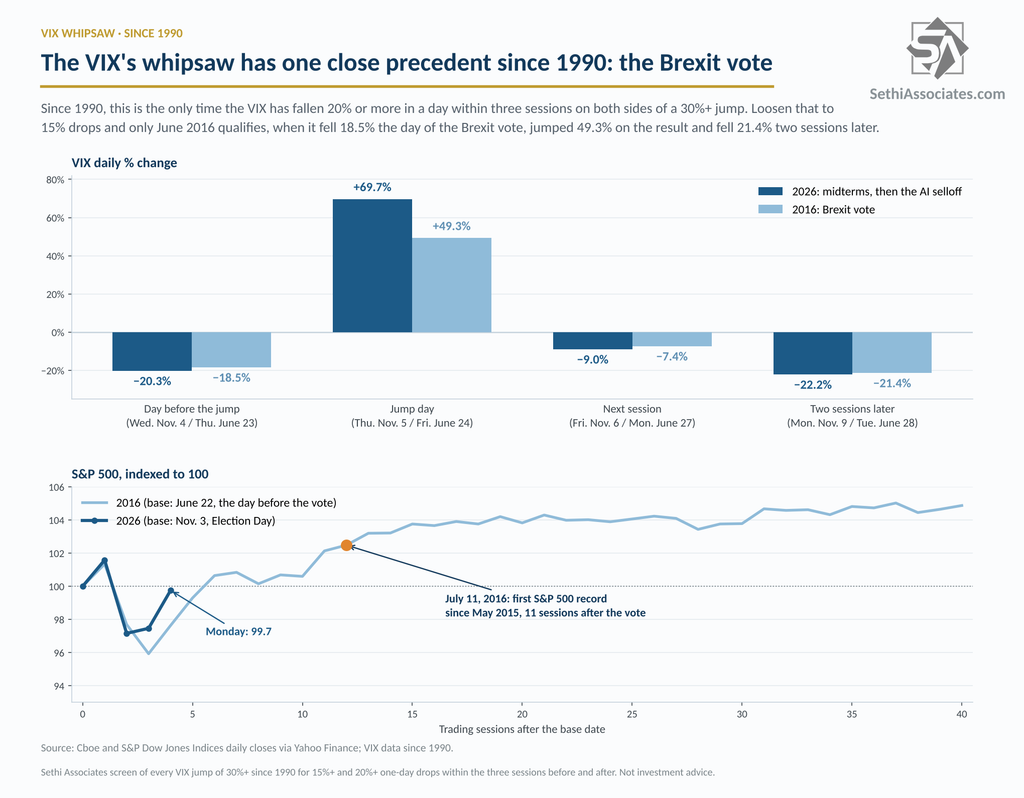
Cboe’s data begins in 1990, and since then this is the only time the VIX has fallen 20% or more in a day within three sessions on both sides of a 30%-plus jump.

You have to loosen that to 15% drops to find another episode that qualifies: the Brexit vote in June 2016.

What Happened With Brexit

The setup also was a historic election. On June 23, 2016, the U.K. voted on whether to leave the European Union, and markets bet that it would stay. The S&P 500 rose 1.3% that day, and the VIX fell 18.5% to 17.25.

Then Leave won. On June 24, the pound fell 7.8% to $1.36, its lowest since 1985, and the S&P 500 fell 3.6%, its worst day since August 2015. The VIX jumped 49.3% to 25.76. Stocks fell another 1.8% the next session, a two-day drop of 5.3%, but the VIX was already easing. On June 28 it fell 21.4% to 18.75 as the S&P 500 rose 1.8%.

June 27 turned out to be the low. The S&P 500 was back above its pre-vote close by July 8. On July 11 it closed at its first record since May 2015, just 11 sessions after the vote. From June 28 (two sessions after the jump, like Monday), the index was up 6.6% a month later and 6.1% three months later. The VIX was down to 13.20 by July 8, and on August 19 it closed at 11.34, its lowest since July 2014.

Two things helped. The 10-year Treasury yield fell to a then-record low of 1.37% in early July. And the Fed, which hadn’t raised rates since December 2015, waited until December 2016 to hike again. The pound didn’t join the rebound, though, and slid to $1.29 by July 6.

What’s Different This Time

Today policy is tightening, not loosening. In 2016, yields hit record lows as the Fed pushed off rate hikes. Now the Fed appears unconcerned about the market volatility, and Monday’s rally pushed the odds of a December hike to 85% from 77% Friday, according to CME FedWatch. The S&P 500 also still has work to do: it’s 1.8% below Wednesday’s close and 3.4% below its October 6 record.

By Neil Sethi

ADP Weekly Hiring Strengthens to Best Since September 26

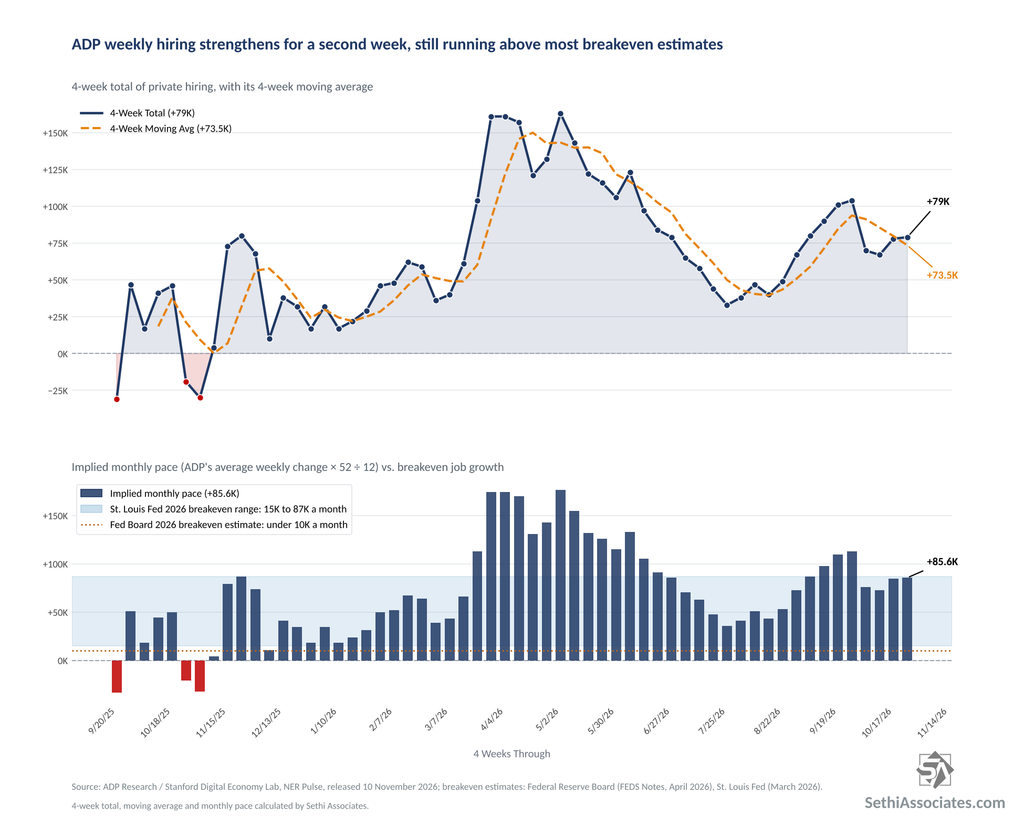
Private employers added 79,000 jobs, or 19,750 a week, in the four weeks ending October 24, the most since the period ending September 26. That’s according to the NER Pulse, ADP’s weekly update of its monthly National Employment Report. ADP also said the four weeks ending October 17 came in at 78,000 (there was no weekly report last week).

The four-week moving average of those totals though still fell for a fourth week, to 73,500, the lowest since the period ending September 12, as the stronger late-September readings dropped out of the average.

The pace remains solid, though. At roughly 85,600 a month, it’s above most estimates of breakeven job growth, the pace needed to hold the unemployment rate steady. The Federal Reserve Board puts that at “less than 10,000 new jobs per month in 2026.” The pace is also near the top of the St. Louis Fed’s range of 15,000 to 87,000. Goldman’s estimate is around 50,000.

By Neil Sethi

Foreign Demand for U.S. Treasury Auctions Remains Tepid as 3-Year Tails

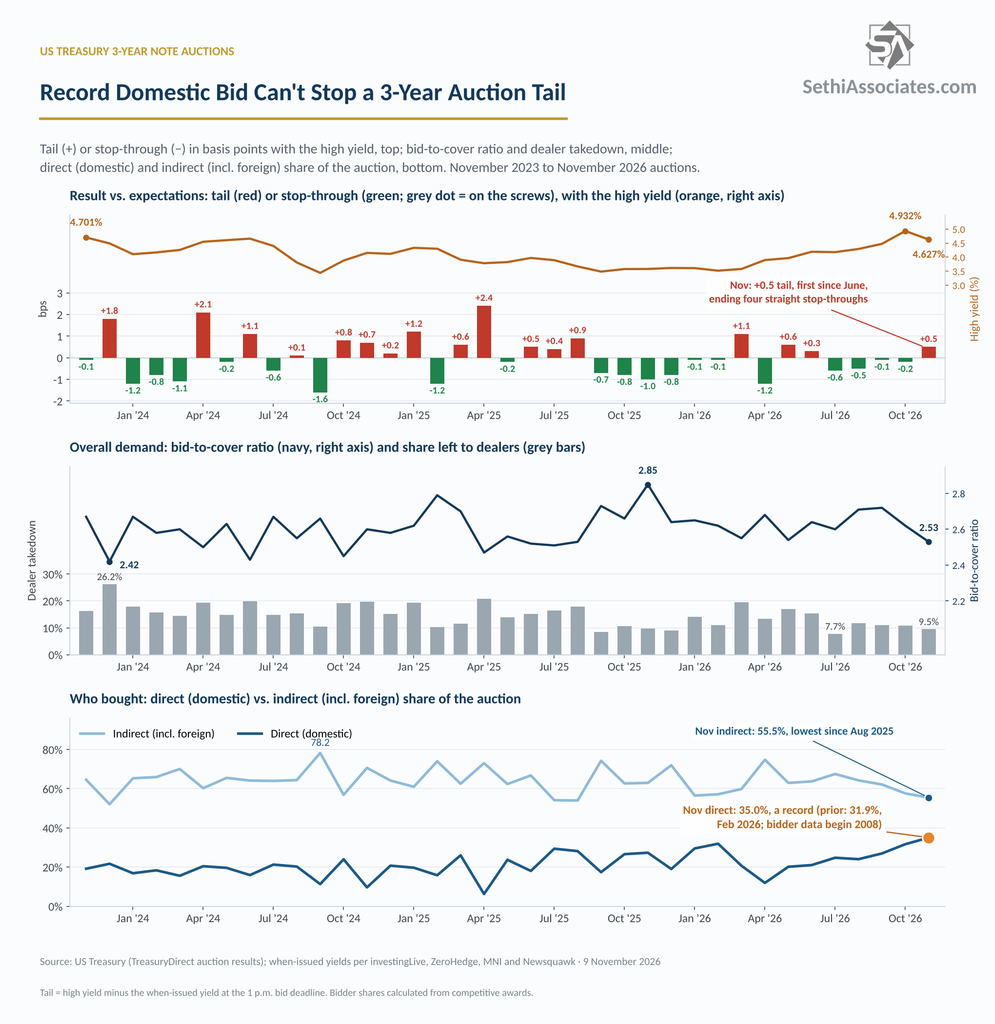
Monday’s $58 billion 3-year Treasury auction, the first of this week’s three coupon sales (more than one year in maturity), tailed (yield above expectations) for the first time since June. That ended a run of four straight stop-throughs (yield below expectations). That was even as direct (domestic) bidders took a record share, not enough to offset softer demand from indirect bidders, a group that includes foreign buyers.

The auction cleared at 4.627%, down from 4.932% in October (the highest since May 2006). That was 0.5 basis points above the 4.622% when-issued yield at the bid deadline, and compares with an average stop-through of 0.1 basis points over the prior six auctions.

Looking at the rest of the metrics:

–Overall demand (bid-to-cover) fell to 2.53, the lowest since August 2025, from 2.62 in October and below the six-month average of 2.64.

–Indirect bidders (which include foreign buyers) slipped to 55.5%, the lowest since August 2025, from 57.6% in October and well below the six-month average of 63.0%.

–Direct (domestic) bidders rose to 35.0%, the highest in Treasury data going back to 2008 (topping 31.9% in February), from 31.7% in October and well above the six-month average of 24.8%.

-That left dealers with 9.5%, the lowest since July, down from 10.7% in October and below the six-month average of 12.2%.

It’s the same story as the 2-year, 5-year and 7-year auctions two weeks ago: domestic buyers took an outsized share while the indirect bid stayed below average. That kept dealers’ share low, but softer overall demand still left a small tail.

The 10-year follows this afternoon and the 30-year Thursday.

By Neil Sethi

Fed’s Waller Floats a Half-Point Hike if CPI Runs Hot

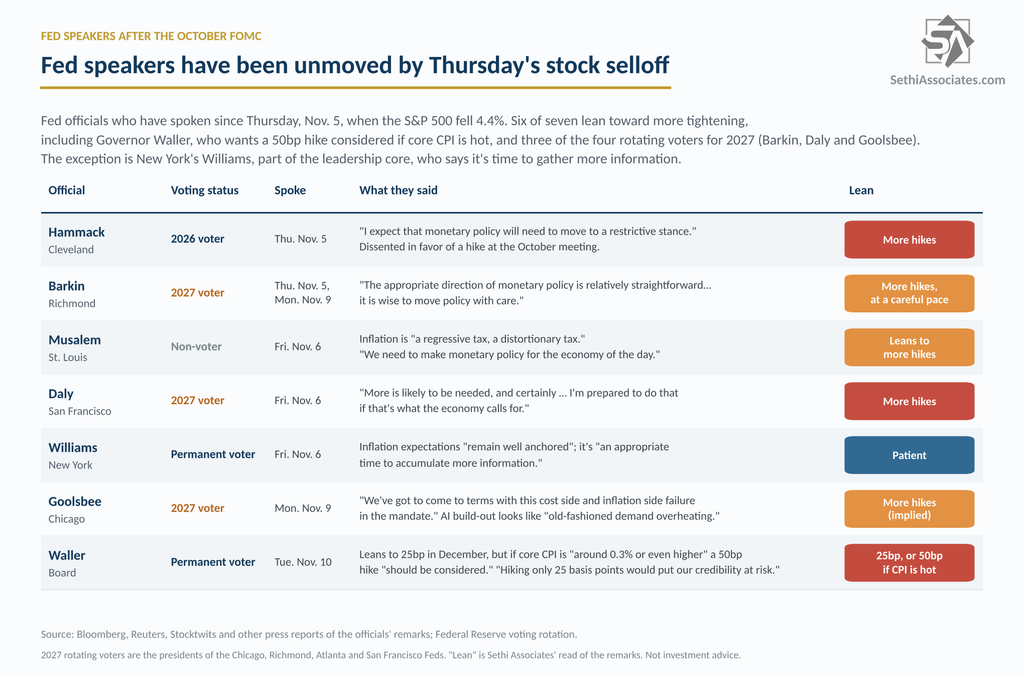
Also from the Week Ahead (The Week Ahead: CPI and Equity Flows Test a Shaken Market), I noted the Fed speakers we heard from during and after Thursday’s selloff, which included Cleveland’s Hammack, Richmond’s Barkin, San Francisco’s Daly, and New York’s Williams, were unmoved by the equity declines, with none mentioning it, instead reiterating their views that inflation remains too high.

Monday added Chicago Fed President Austan Goolsbee, a 2027 voter, to the mix.

“We’ve got to come to terms with this cost side and inflation side failure in the mandate,” Goolsbee said Monday at a Leadership Greater Chicago event, according to Bloomberg. With the labor market and growth stable, he said “the big problem has all been on the inflation side,” and “once it gets overheated, it’s extremely painful to get rid of.”

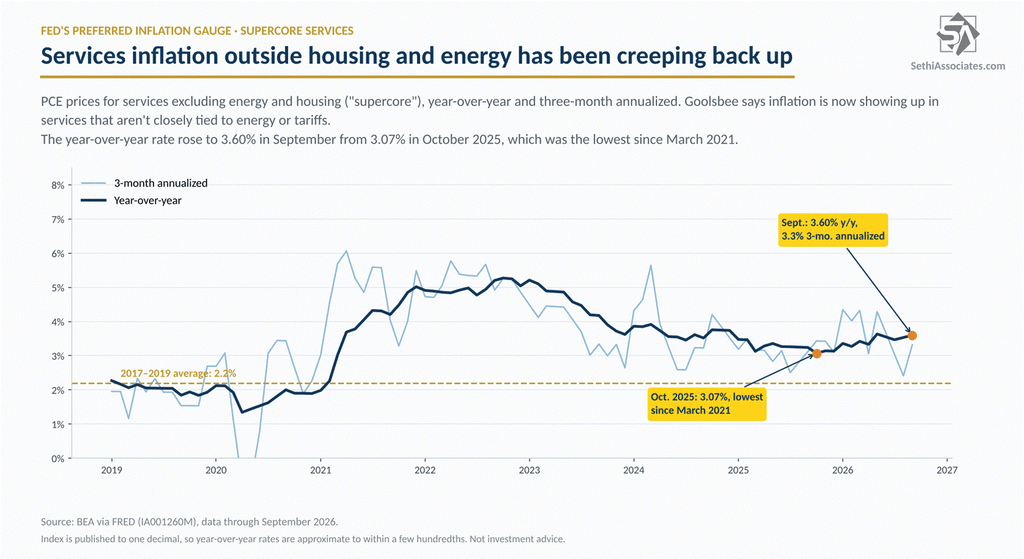
I thought I’d elaborate on a couple of points. First, he says inflation is now showing up in services that aren’t closely tied to energy or tariffs. “Supply shocks are supposed to go away,” he said. “What we’re grappling with is why hasn’t it gone away sooner?” “The PCE data from September back this up, and it’s something to watch in today’s CPI. “Supercore” services inflation (excluding energy and housing) rose to 3.60% year-over-year in September from 3.07% in October 2025, which was the lowest since March 2021.

Second, not only did Goolsbee not mention the potential issues with the AI buildout, he went the other way. “This stuff with the AI data center buildout is, to my eye, starting to look more just like old-fashioned demand overheating,” he said, citing rising costs for land, electricity, chips and construction, and trouble hiring skilled workers like HVAC technicians, per Stocktwits. He also said AI could ultimately mean “long-run deflation,” but anticipation of those gains “can lead to inflation right now,” as rising equity valuations encourage spending, the wealth effect I noted Sunday. “The bigger the hype, the more nervous I am that we’re going to overheat what the economy is capable of in the next six months,” he said, adding, “I’m not saying that it’s a bubble, but it’s certainly almost unprecedented levels of physical investment.”

As noted Sunday, that cuts against how the market has been trading, with AI weakness priced as a reason for fewer hikes. Instead the hawks continue to see AI spending as part of the inflation problem.

Barkin also spoke again Monday, more explicitly talking down risks to the AI buildout. “It’s a big country,” he said. “If they need to build data centers, I would imagine they’ll find some county that wants to.” He said more companies feel pressure to pass on “broad-based” costs, from fuel to chips to health insurance. That said he was more in the Williams camp on pace. “The appropriate direction of monetary policy is relatively straightforward,” he said. “However, risks to the demand outlook remain easy to envision. Because of that, it is wise to move policy with care.”

That puts three of the four 2027 rotating voters (Goolsbee, Barkin and Daly) on record leaning toward more tightening.

The fourth is the Atlanta Fed, which has not named its replacement for Raphael Bostic, who retired when his term ended February 28, 2026. Cheryl Venable, the bank’s first vice president and chief operating officer, has been interim president since March 1.

Then came this morning Fed Governor Christopher Waller, a permanent voter and a leading voice at the Fed, who took it a step further Tuesday morning. He said that if October inflation improves, as he expects, “I am leaning toward supporting an increase in our policy rate of 25 basis points.” But if core CPI comes in “around 0.3% or even higher,” like the past two months, “I believe a 50 basis point hike in the policy rate should be considered at the December meeting,” adding, “Hiking only 25 basis points would put our credibility at risk, a risk I am not eager to take.”

He also said the Fed should “at a minimum, probably take back the three insurance cuts that we put in last year,” which would mean getting back to 4.25%–4.5%, two more quarter-point hikes from the current 3.75%–4% range, and that policy hasn’t been “nearly as restrictive as I thought it was,” according to Bloomberg.

That said he also added in a Q&A the Fed does not want to “slam the economy down.”

“It’s not that we’re going to jack up the policy rate 150 basis points or 200 basis points,” he said. “We are looking forward and saying we need to do something; at a minimum, probably take back the three insurance cuts that we put in last year.”

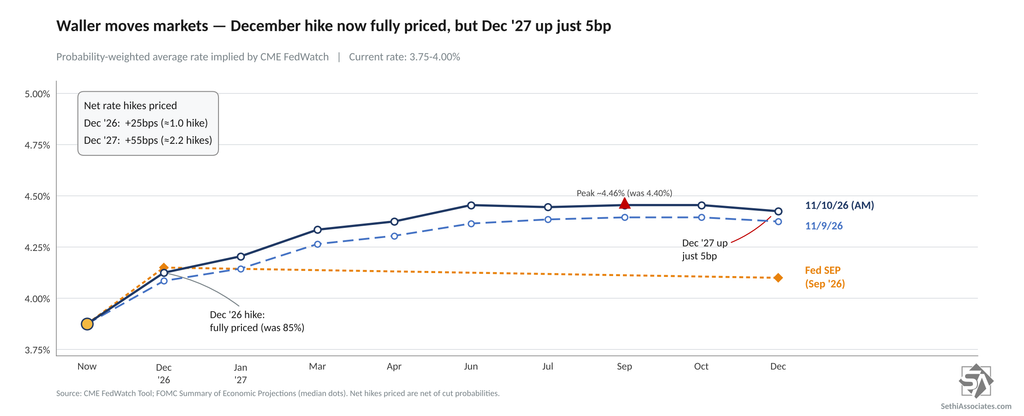
And with the AI trade rebounding Monday, the correlation I noted Sunday between equity moves and hike pricing remained intact. CME FedWatch odds of a December hike rose to 85% Monday from 77% Friday, but Waller extended that move, so they are now pricing a 100% chance of a December hike (1.4% chance of a 50 basis point hike). Down the line, though, less change with just 5 basis points added to December 2027 (55 basis points).

More in Sunday’s The Week Ahead: CPI and Equity Flows Test a Shaken Market.

By Neil Sethi

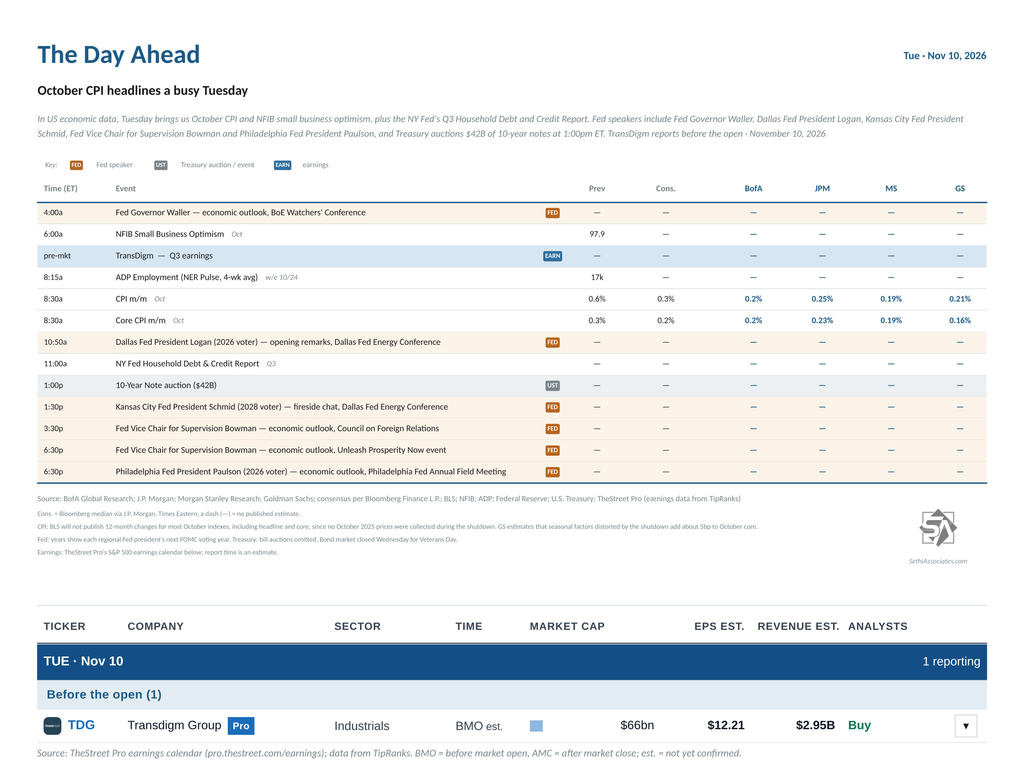
The Day Ahead: October CPI Headlines a Busy Tuesday

In US economic data, Tuesday brings us October CPI and NFIB small business optimism, plus the NY Fed’s Q3 Household Debt and Credit Report. Note that BLS won’t publish 12-month changes for most CPI indexes, including headline and core, since no October 2025 prices were collected during the shutdown. For a CPI preview, see CPI Preview: Cooler, but Probably Not Enough to Stop a December Hike.

Fed speakers include Fed Governor Waller, Dallas Fed President Logan (2026 voter), Kansas City Fed President Schmid (2028 voter), Fed Vice Chair for Supervision Bowman and Philadelphia Fed President Paulson (2026 voter).

Non-Bill (>1yr in maturity) US Treasury auctions bring us a $42B 10-year note sale at 1:00pm ET.

One S&P 500 component reports:

-Before the open: TransDigm (TDG).

But outside the S&P 500 a lot of focus will be on CoreWeave (CRWV). We’ll also hear from Petrobras (PBR), Sea (SE), Vodafone (VOD), Venture Global (VG), and On Holding (ONON).

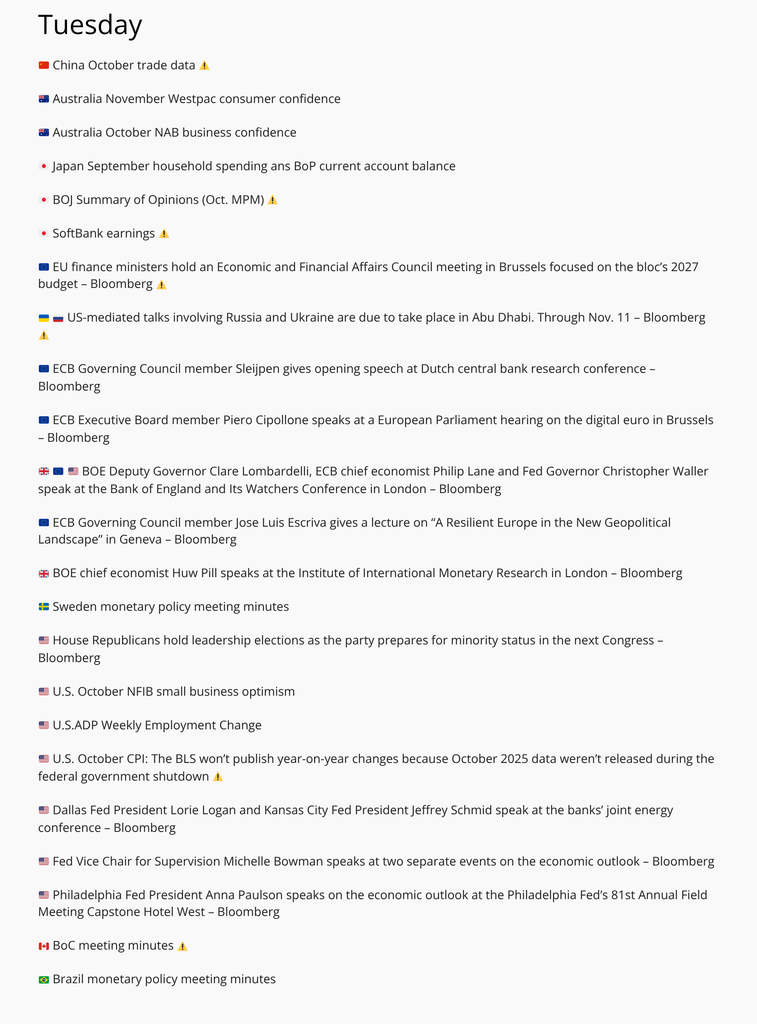
Ex-US highlights include China’s October trade balance, Japan’s October Economy Watchers survey and September household spending, and October CPI in Norway and Denmark. The Bank of Canada releases the Summary of Deliberations from its last meeting (1:30pm ET) and Brazil’s central bank its Copom minutes, while the ECB’s Cipollone, Lane and Escriva and the BoE’s Lombardelli and Pill speak. US-mediated talks between Russia and Ukraine are expected Tuesday and Wednesday.

From Christophe Barraud’s international Week Ahead rundown:

Conversation 0 Comments

One ongoing discussion across all days. Everyone can read; sign in to take part.

Your voice matters. Discussions are moderated for civility. Read our guidelines .

Log in to join the conversation

Loading comments...