Stocks Slip From Records But Pare Losses After Strong 10-Year Auction
Long-end yields again hit multi-decade highs before a historically strong 10-year auction pulled them back, letting large-caps pare losses.
You've reached your free article limit
You've read 0 of 1 free Pro articles.

Quick Summary
- Stocks slipped from records as Treasury yields hit fresh multi-decade highs intraday, though a historically strong 10-year auction pulled yields back and helped the S&P 500 and Nasdaq pare losses.
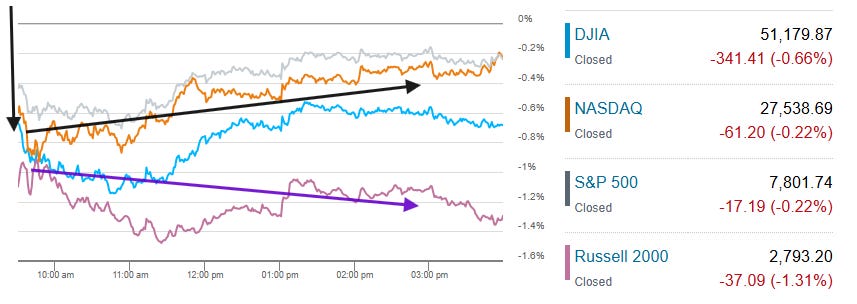
- Indices opened lower and never made it into the green, but the S&P 500 and Nasdaq recovered much of their early losses in the afternoon. Each closed down 0.2%, near their best levels of the session. The Dow Jones Industrial Average was softer, ending down 0.7%, but the small-cap Russell 2000 again saw the worst of it Wednesday ending 1.3% lower and finishing near its lows.
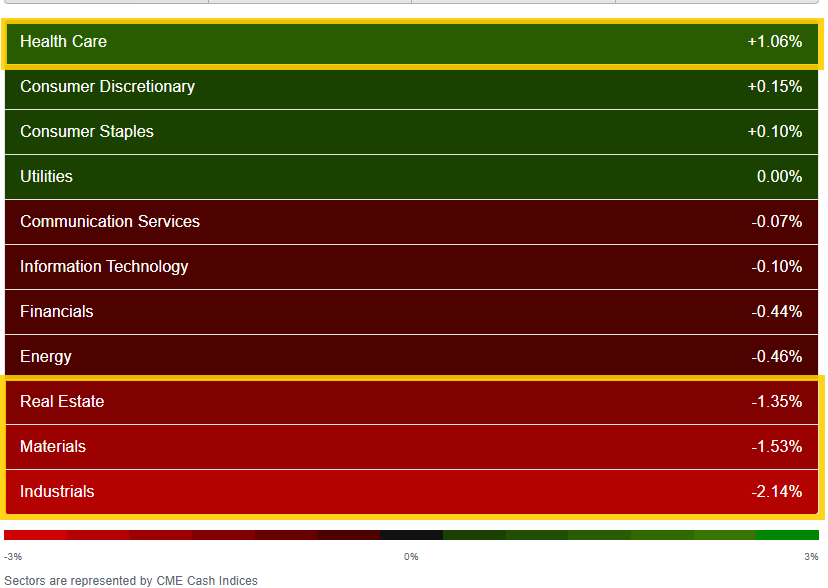
- In another switch, breadth softened to just three of 11 sectors higher after three straight sessions of 10 of 11, and defensive sectors led.
- The 10-year and 30-year yields both touched their highest levels since 2002 before decade-high demand at the $39 billion 10-year reopening saw that auction beat expectations by the most since April 2025 pulling yields lower. The 10-year finished the cash session up about 1 basis point at 5.28%. WTI remained subdued falling 1.3% to about $88 after the IEA backed faster releases from its members’ oil stockpiles.
- Fed rate-hike expectations also softened despite minutes from the September FOMC meeting showing most officials see another hike as likely by year-end with upgraded inflation and growth forecasts, and a NY Fed consumer survey seeing one-year inflation expectations come in at a three-year high.
- Thursday is a very light day highlighted by a speech from Governor Waller, a 30-year bond auction, and weekly jobless claims.
Market Commentary
Equities:
- “With earnings being much more broad based, and with valuations of some of the, call it, non-hyperscaler companies being a little bit cheaper than the valuation of some of these hyperscaler companies,” said BeiChen Lin, head of Canadian strategy at Russell Investments. “I do think it’s reasonable to expect that ultimately market performance will also broaden out as well — in addition to just fundamental earnings.”
- “Everything that wasn’t technology and communication services was just bagged around,” Art Hogan, chief market strategist at B. Riley Wealth said. “I just think you have an opportunity once some of these banks and credit card companies start reporting to really see a nice bounce.”
- “It’s the period before earnings when there’s a bit of a lull, so markets can be pushed around easily,” said Guy Miller at Zurich Insurance. “The focus point is still around bond yields. There was relief yesterday but let’s be clear, nothing fundamental has changed.”
- “Stocks have gotten cheaper since January which is ironic, since we’re hitting all-time highs,” said Nancy Tengler, CEO and CIO of Laffer Tengler. “I don’t mind multiple compression because it tells me that this bull market is sustainable and it elongates it. I like where we sit for this bull market, and earnings growth does ultimately drive stock price performance.”
- “Rates, oil and fiscal constraints remain, but markets have already adjusted through lower multiples and weaker breadth,” a Barclays team led by Emmanuel Cau, head of European equity strategy, wrote in a Wednesday note. U.S. inflation data are moderating and flows of crude oil are improving, they said. At the same time, third-quarter financial reporting should help to reconnect markets with strong fundamentals, while hype surrounding artificial intelligence has calmed as growth remains sound, the strategists added.“Bottom-line, the risk-reward for equities should gradually improve into year-end, provided rates and energy prices stabilize,” they wrote. The strategists prefer stocks from peripheral Europe and Germany to U.S. stocks, with an overweight on Japan equities, and continue to favor AI capital-expenditure beneficiary stocks and banks.
Bonds:
- “Persistently high energy prices keep risks to inflation, policy rates, and benchmark bond yields skewed to the upside,” said Elias Haddad at Brown Brothers Harriman & Co.
- “A Fed pause may not bring down long yields if term premiums remain elevated,” said Ulrike Hoffmann-Burchardi at UBS Chief Investment Office. “Fixing the curve’s long-term problem without fiscal tightening requires two things: productivity-led growth and periods of low real borrowing costs.”
- “There’s investor interest at these relatively elevated yield levels compared to what people have become used to in the last 15 to 20 years, but we need to take it with a grain of salt. There are a lot of other drivers out there that we need to take into consideration as well on a standalone basis,” Bill Merz, head of capital markets research at U.S. Bank Asset Management said. “It was a solid auction.”
- “With the level of rates where they are and the rise that we’ve seen, I think it’s fair to characterize the fact that the margin for error has narrowed as it relates to earnings,” Mike Dickson, head of research and quantitative strategies at Horizon Investments, said to CNBC, before adding that earnings could “still carry the market higher.” He continued, “The level of yields seem very justified, but it doesn’t make them irrelevant.”
- Even with the latest rise in yields, inflation expectations appear “very well anchored,” Dickson said. “If the 10-year started rising because inflation expectations become unanchored, well now it can get a little bit out of control.”
Fed:
- With policymakers’ projections showing more members supporting two hikes this year, ING strategist Francesco Pesole said the scope for a dovish surprise was limited. “Data has been softish since the September hike and markets continue to firmly price a December move, setting a relatively high bar for a positive dollar reaction,” Pesole said.
- “Another rate hike is probably coming this year because current policy isn’t very restrictive,” said David Russell at TradeStation. “With inflation above target and most measures of economic activity strong, price stability is the Fed’s dominant mandate.”
- “US yields have repeatedly struggled to move lower, with higher oil providing the latest trigger for another selloff. The market is increasingly pricing a durably elevated policy rate. Minutes from a meeting widely interpreted as hawkish offer few reasons to challenge that view.” — Skylar Montgomery Koning, Bloomberg macro strategist.
Stock and Sector Breakdown:
Just three of 11 sectors were higher, breaking our three-day streak of 10 of 11, although again just one of the top-four finishers was a mega-cap-dominated growth sector in Consumer Discretionary (same as Tuesday). Otherwise it was defense at the top with Health Care leading (the only sector up over 0.2%) and Staples and Utilities following Consumer Discretionary. Three sectors were down over 1% in Real Estate, Materials, and Industrials.
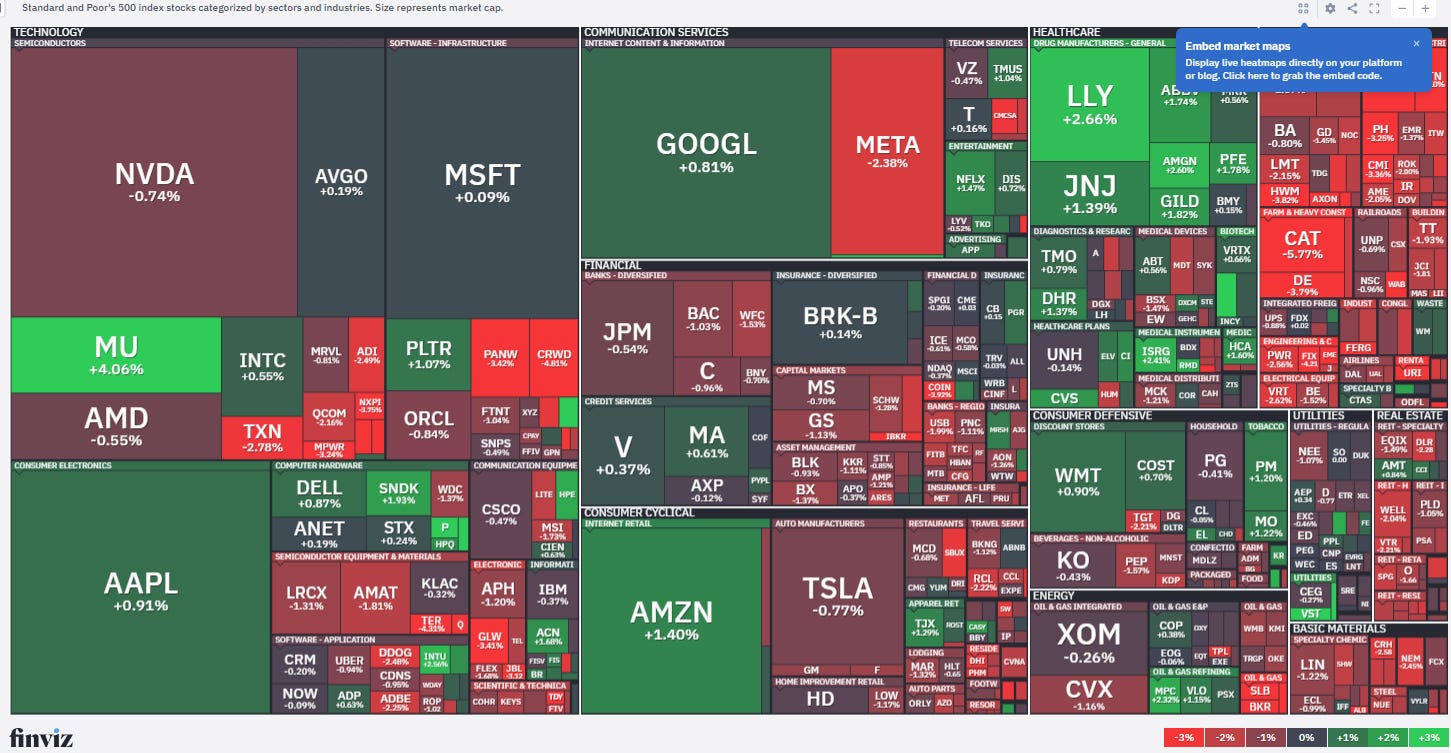
Industrials turned lower after a statement from the Federal Trade Commission announcing a probe into concerns about anticompetitive behavior in the farm equipment industry. Caterpillar’s (CAT) dropped 5.8%, the second worst performer on the S&P 500 Wednesday, and Deere (DE) -3.8%.
SpaceX (SPCX) -2.48% also was sold after the Financial Times reported that the company plans to take on $40 billion in new debt to fund its purchase of chips for its data centers from Nvidia (NVDA) -0.8%. The latest report claimed that SpaceX intends to split this debt into two categories. The first would be $10 billion in debt from new bank loans. The second would be $30 billion in new debt from investors. All of this would help bolster the company’s SpaceXAI business, which is about to be renamed to SpaceXSI.
Semiconductors were also under pressure with the PHLX Semiconductor Index (SOX) finishing down 1.2%. That was despite memory names Micron (MU) +4.1% and Sandisk (SNDK) +1.9% ending solidly higher. Intel (INTC) +0.6% was higher after Lip-Bu Tan, CEO of Intel, said the company is not out of Elon Musk’s Terafab operation.
Health Care was supported by gains in Eli Lilly (LLY) +2.7% and Moderna (MRNA) +4.81%, the latter the second best performer on the S&P 500 Wednesday. The Consumer Staples sector was helped by Constellation Brands (STZ) +2.4% following its earnings report. That was after the stock had initially slid over 4%.
Utilities were flat, but the best performer on the S&P 500 Wednesday was NRG Energy (NRG) +4.84%. Skydance Corporation (SKYD) -6.7% continued its drop after merging with Warner Bros Discovery.
[Note: chart uses futures prices.]
With the weaker breadth, a big drop in the number of large SPX winners (up over 3%) to eight from ~40 Tuesday/Monday, while the number of large losers (down over 3%) grew to ~35 from 11 and eight. As mentioned previously, both of these metrics have remained very (extremely?) subdued since the start of August rarely getting above 50 and only once above 100. Very unusual compared to the past couple of years.
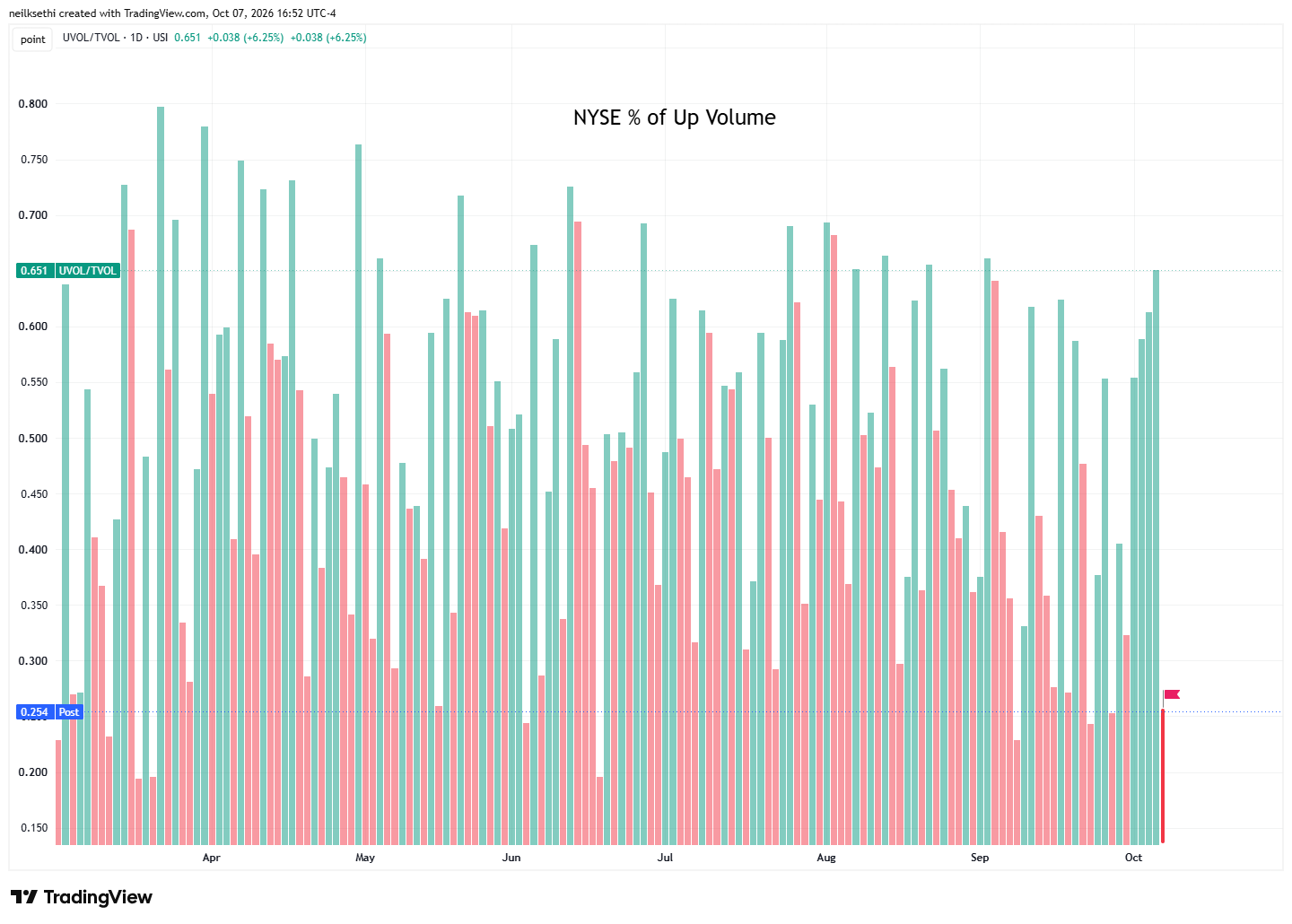
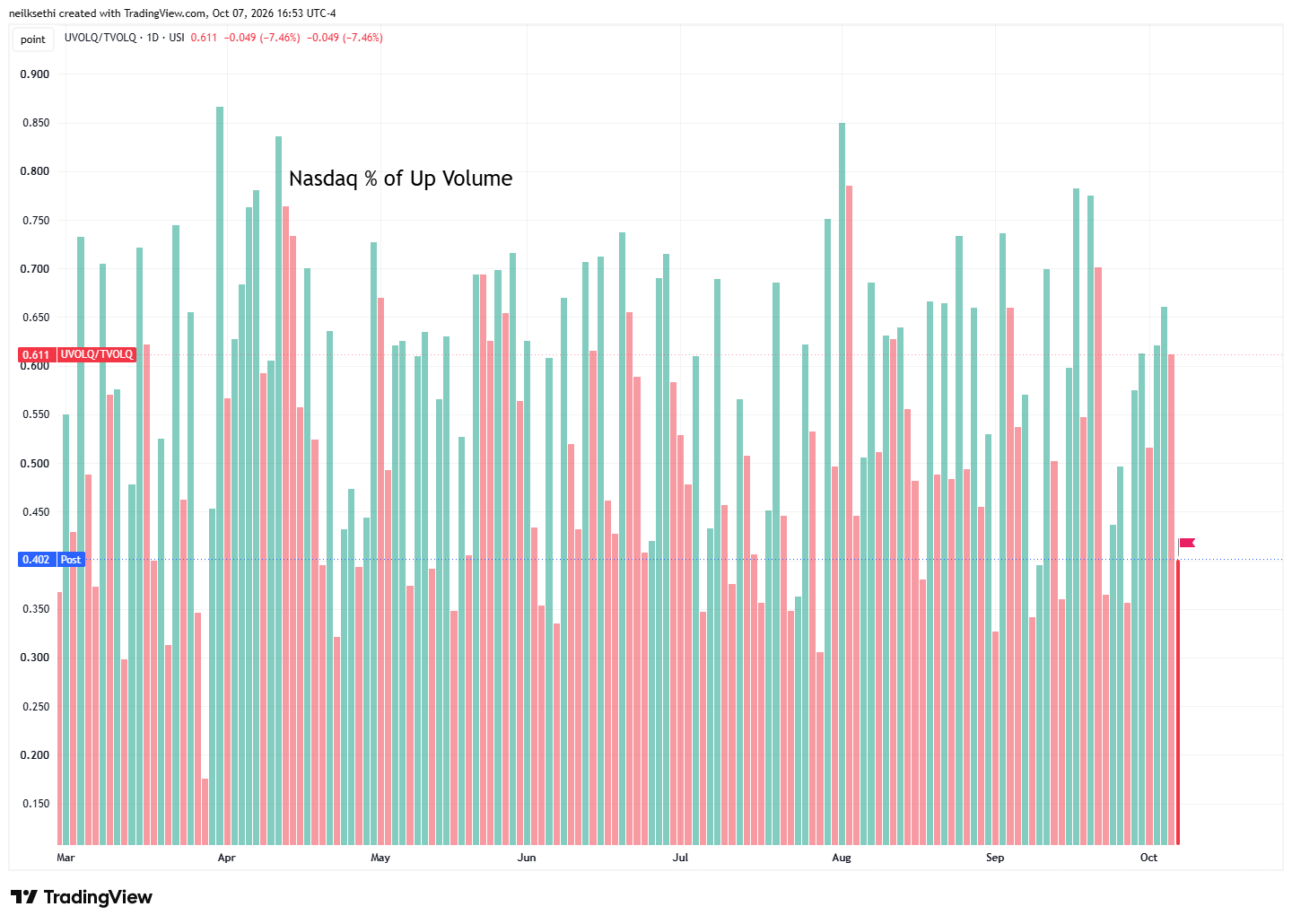
And positive volume also took a turn for the worse softening to 25.4% on the NYSE and 39.9% on the Nasdaq. Both are worse than similarly sized index declines on the respective indices in recent days.
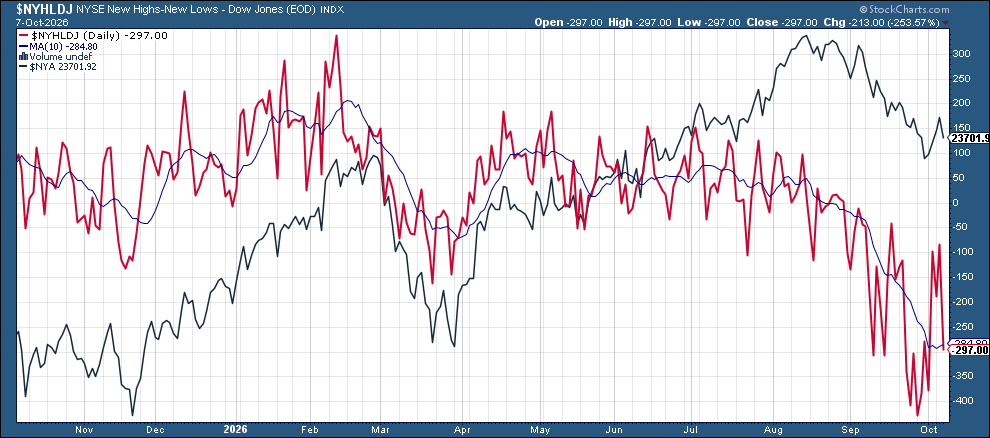
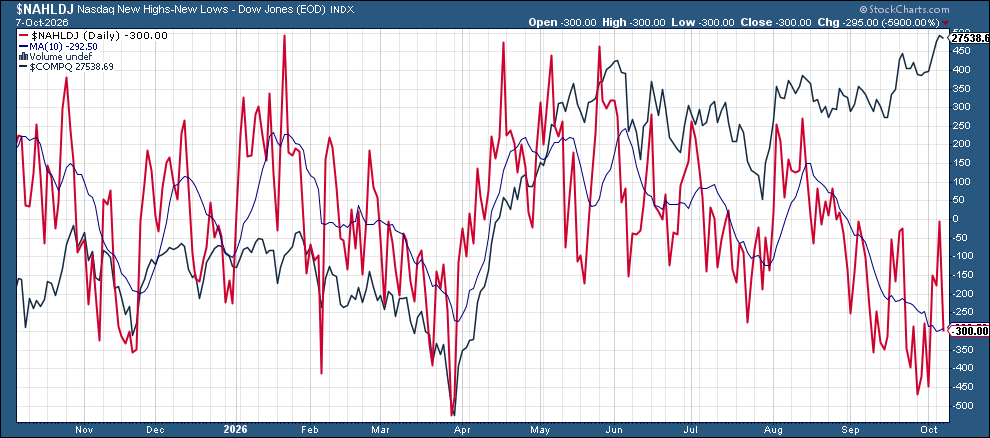
And new 52-week highs minus lows also gave back the improvement from the last couple of sessions falling back to -298 on the NYSE and -312 on the Nasdaq. So that makes it the 28th straight session that the Nasdaq saw more new 52-week lows than new highs.
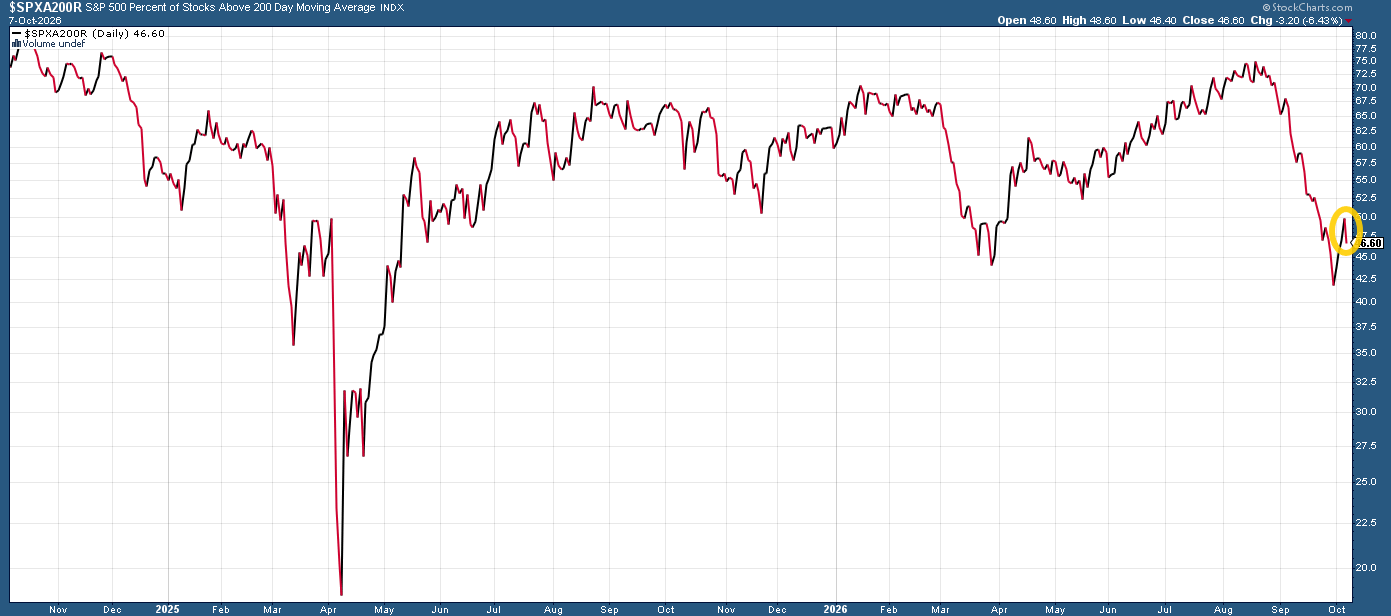
And we did see a softening in the percentage of S&P 500 stocks trading above their 200-day moving average (still under 50%).
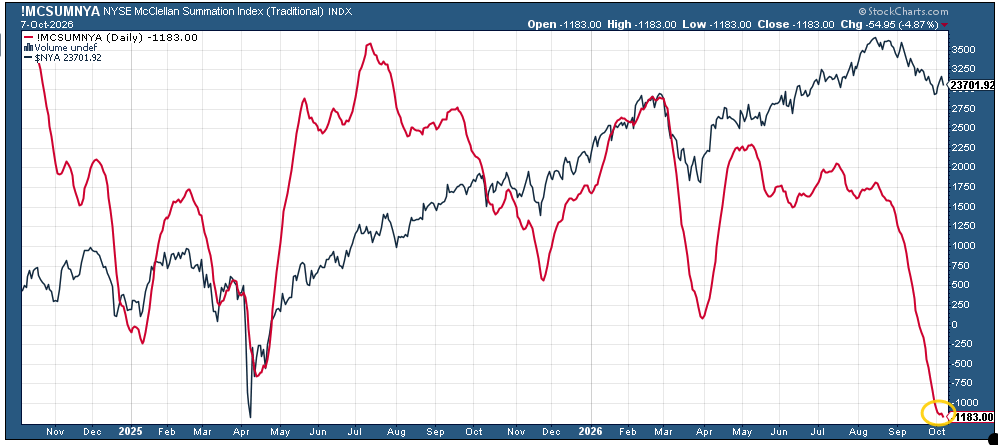
And the McClellan Summation Index (red line, broadly whether the typical stock is doing relatively better or worse than the index) turned back down (if you squint).
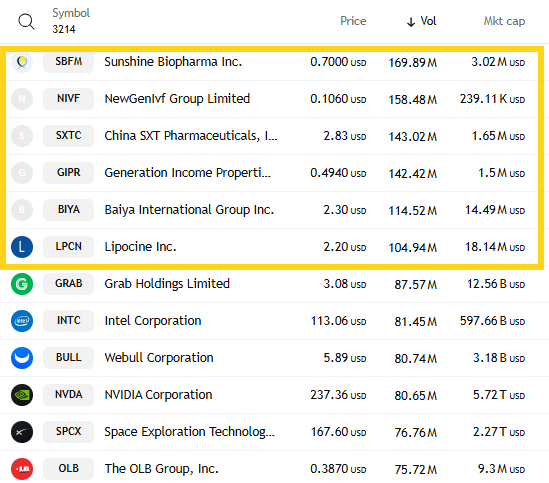
Speculation also dried back up on the Nasdaq with no stocks over 170 million shares traded and just six total over 100 million.
Some Other Stock-Specific Commentary From TheStreet Pro:
- Bob Lang – Chart of the Day: Another EPS All-Stars Winner?
- James “Rev Shark” DePorre – Odd Biotech Action Is Creating Opportunities for Deal Hunters
- Ed Ponsi – Setting New Price Targets for Nvidia, S&P 500, Nasdaq Composite
A Look at the Charts
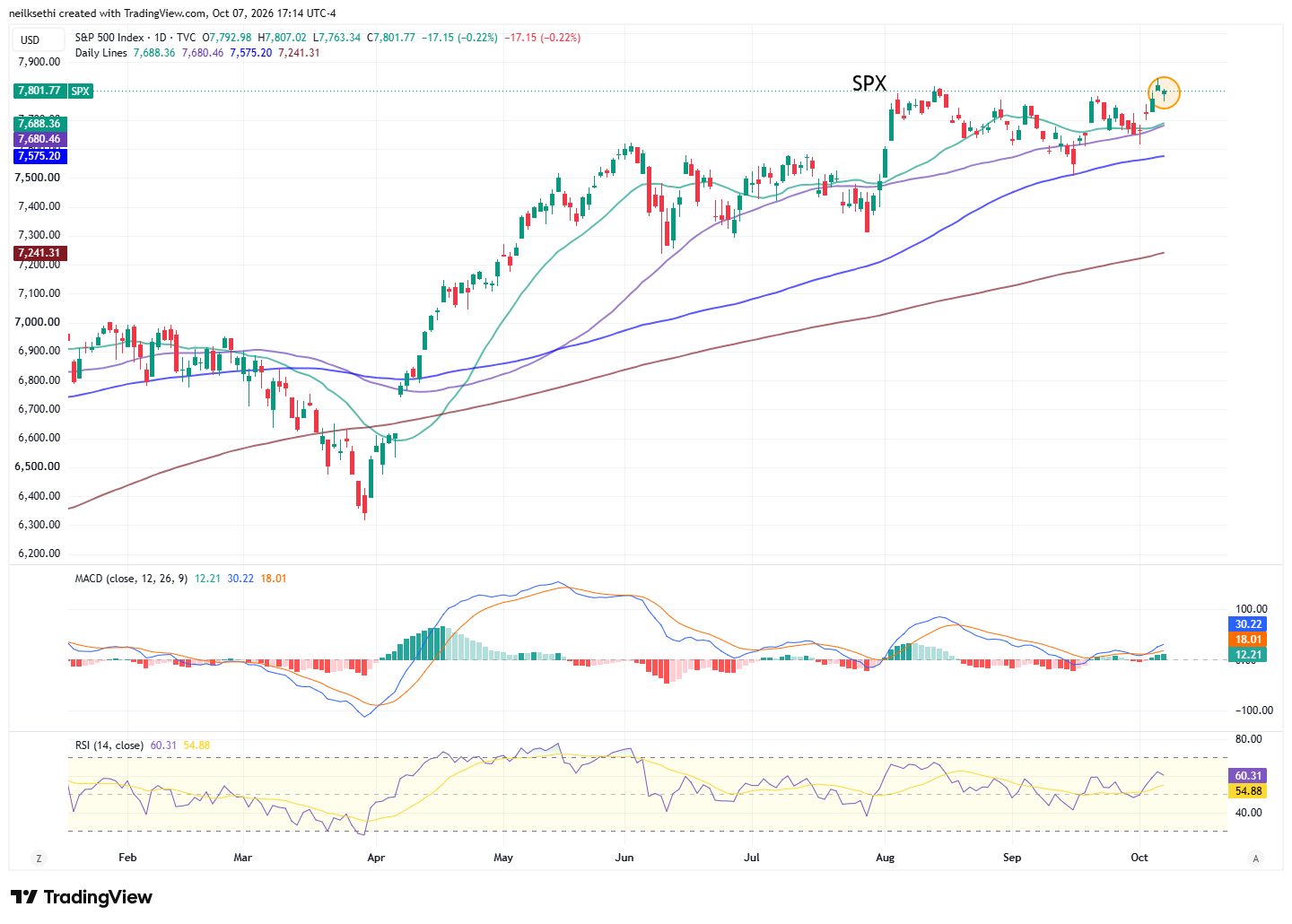
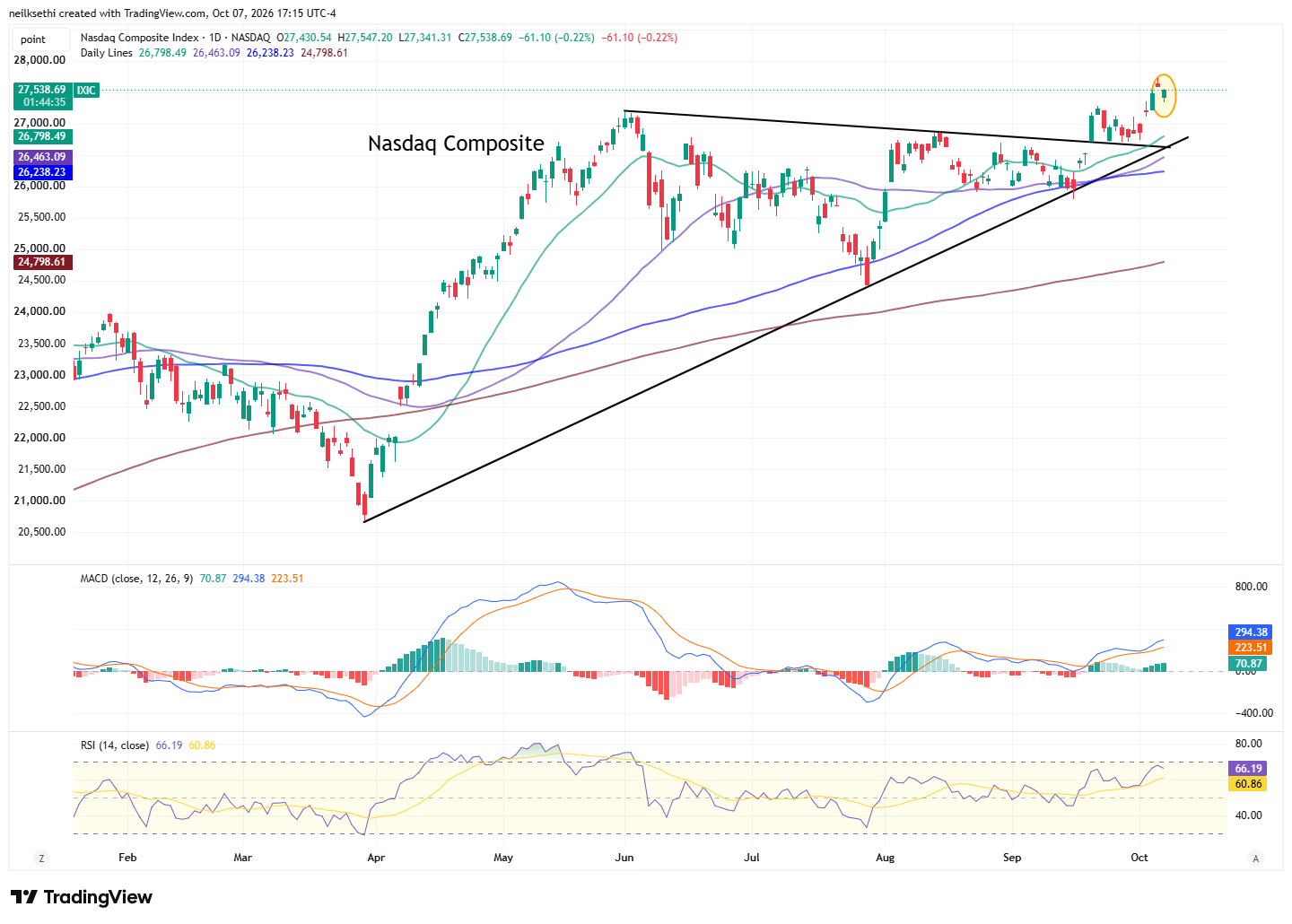
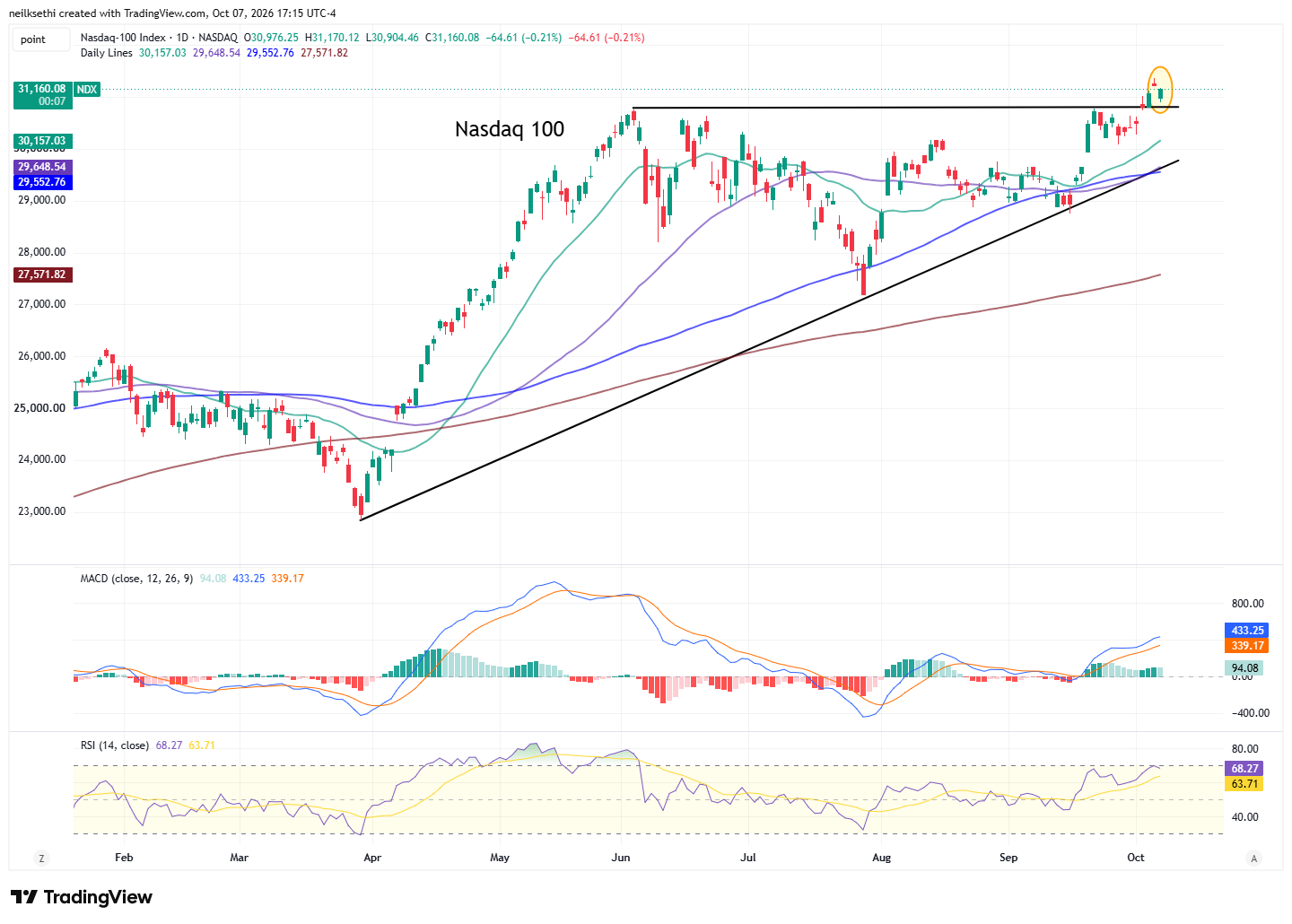
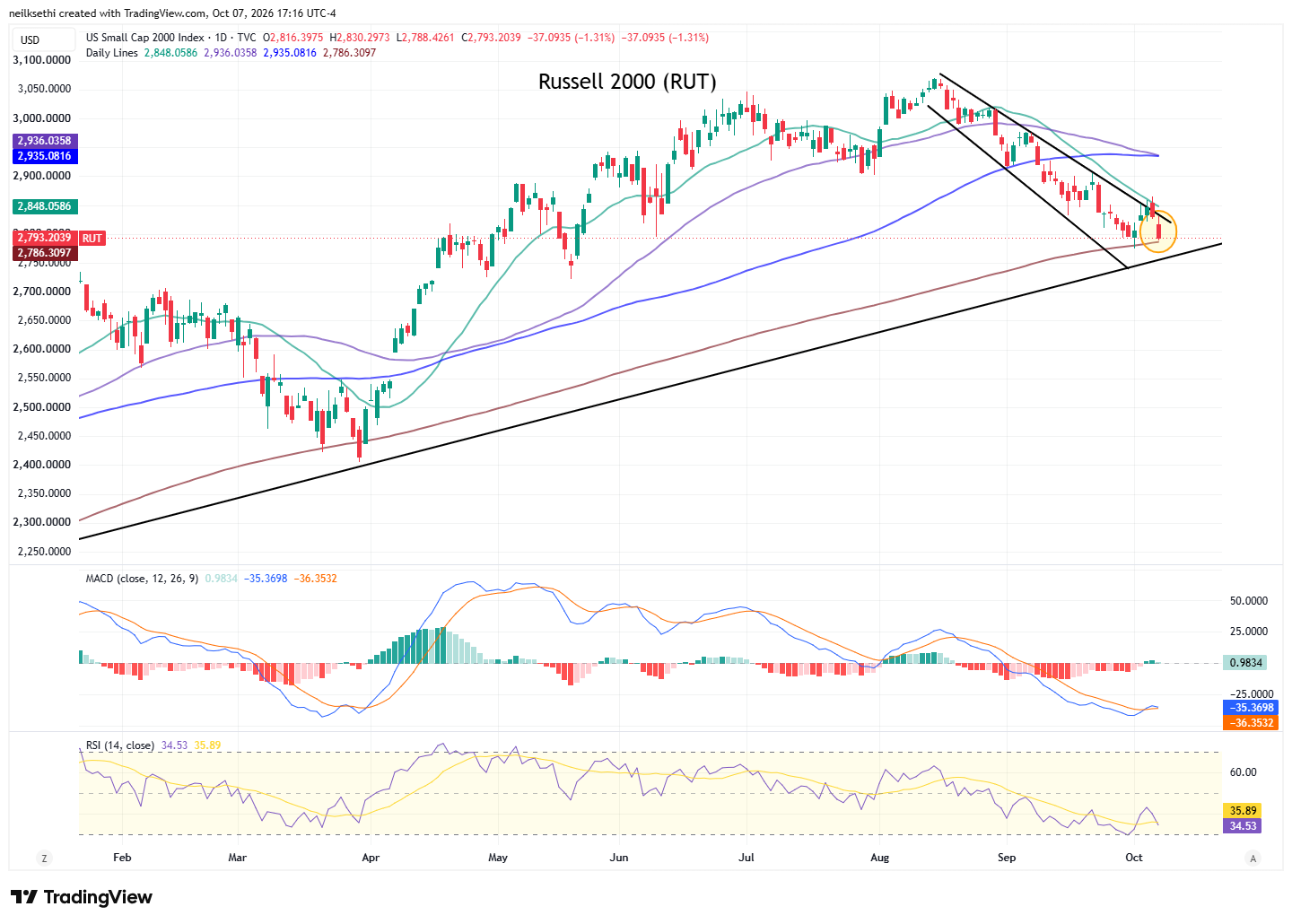
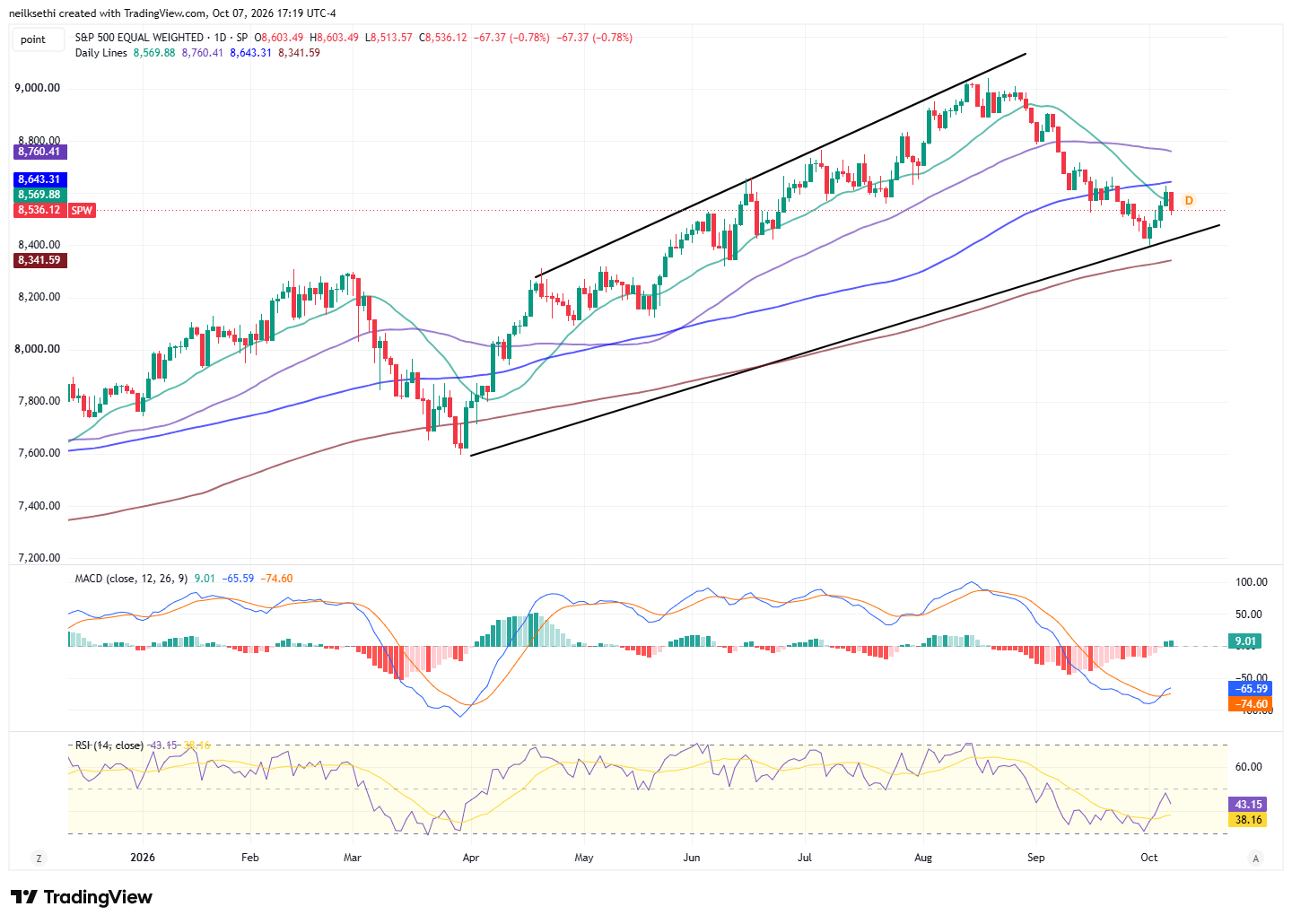
Note on all charts the colored lines are moving averages (the average price over the lookback period — days on the daily charts, weeks on the weekly charts):
20 = green
50 = purple
100 = blue
200 = brownException is monthly charts where blue is 10-month moving average and brown is 20-month moving average.
MACD = Moving average convergence/divergence line, a measure of momentum that compares longer term and shorter term momentum to gauge if a move is strengthening or weakening. This is probably my favorite individual indicator.
RSI = Relative Strength Index (basically what it sounds like) = measures the strength of the move comparing gains to losses over the given lookback window (I use the standard 14 periods).
SPX eased back from its all-time high. The daily MACD and RSI remain positive.
Nasdaq Composite also eased back from its all-time high. Daily MACD and RSI are even more positive here.
The Nasdaq 100 (QQQ) same story. Daily MACD and RSI very positive here as well.
Just when everything was lining up for the Russell 2000 (RUT), it fell back for a second session now down to its 200-DMA and making a fresh closing low. The daily MACD also back to neutral, and the RSI now under 40.
The equal-weighted SPX still in better shape than the Russell 2000 but fell back from resistance of the 100-DMA. It still has a more positive MACD, and the RSI is at least above 40.
Treasury yields “twisted” across the curve again Wednesday with the short end again falling back while the long end rose once again to multi-decade highs:
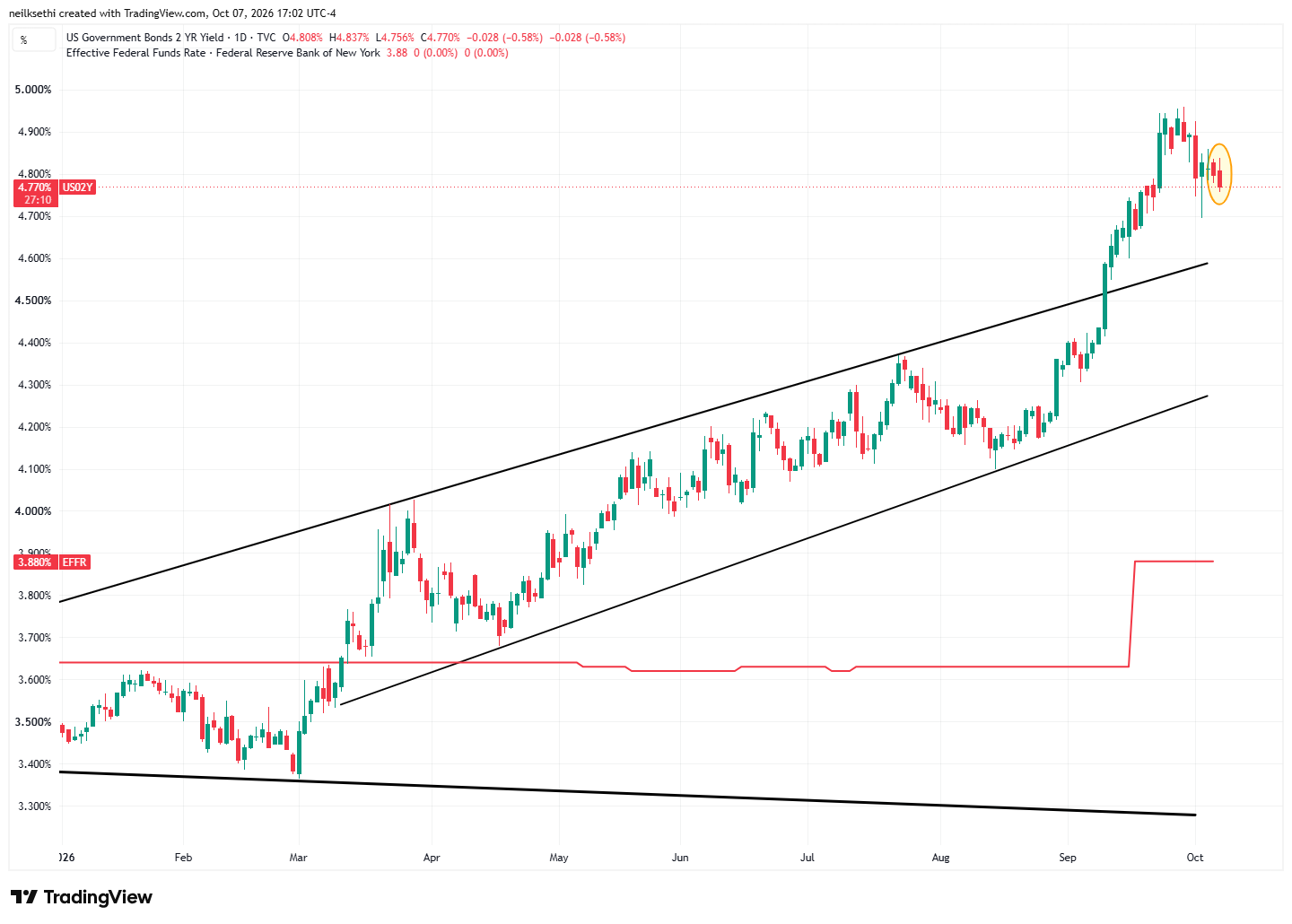
The 2-year Treasury fell 3 basis points (including the after-hours) down for a third session.
It is still ~89 basis points above the Effective Fed Funds rate, so still calling for (at least a couple) more rate hikes but a little less violently now.
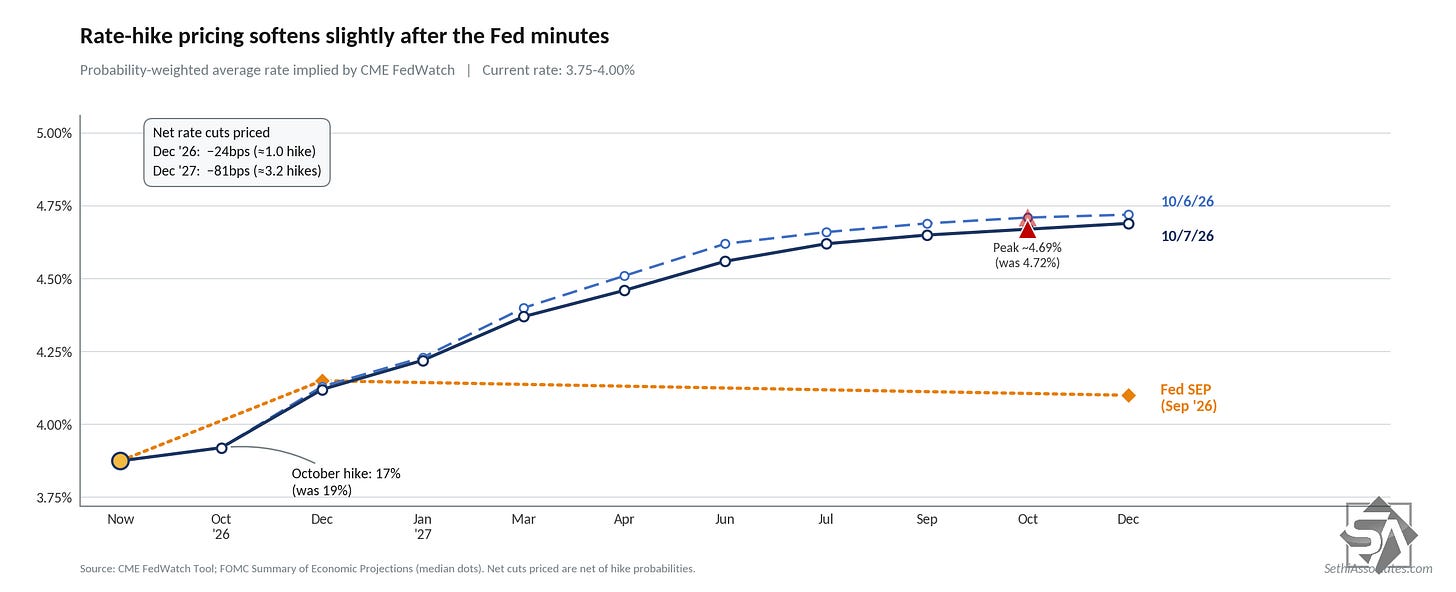
In that regard, Fed rate hike bets eased back again with October at 17% and a 14% chance of two hikes this year. 2027 sees ~81 basis points of hikes through next December down from closer to 90 at the end of last week.
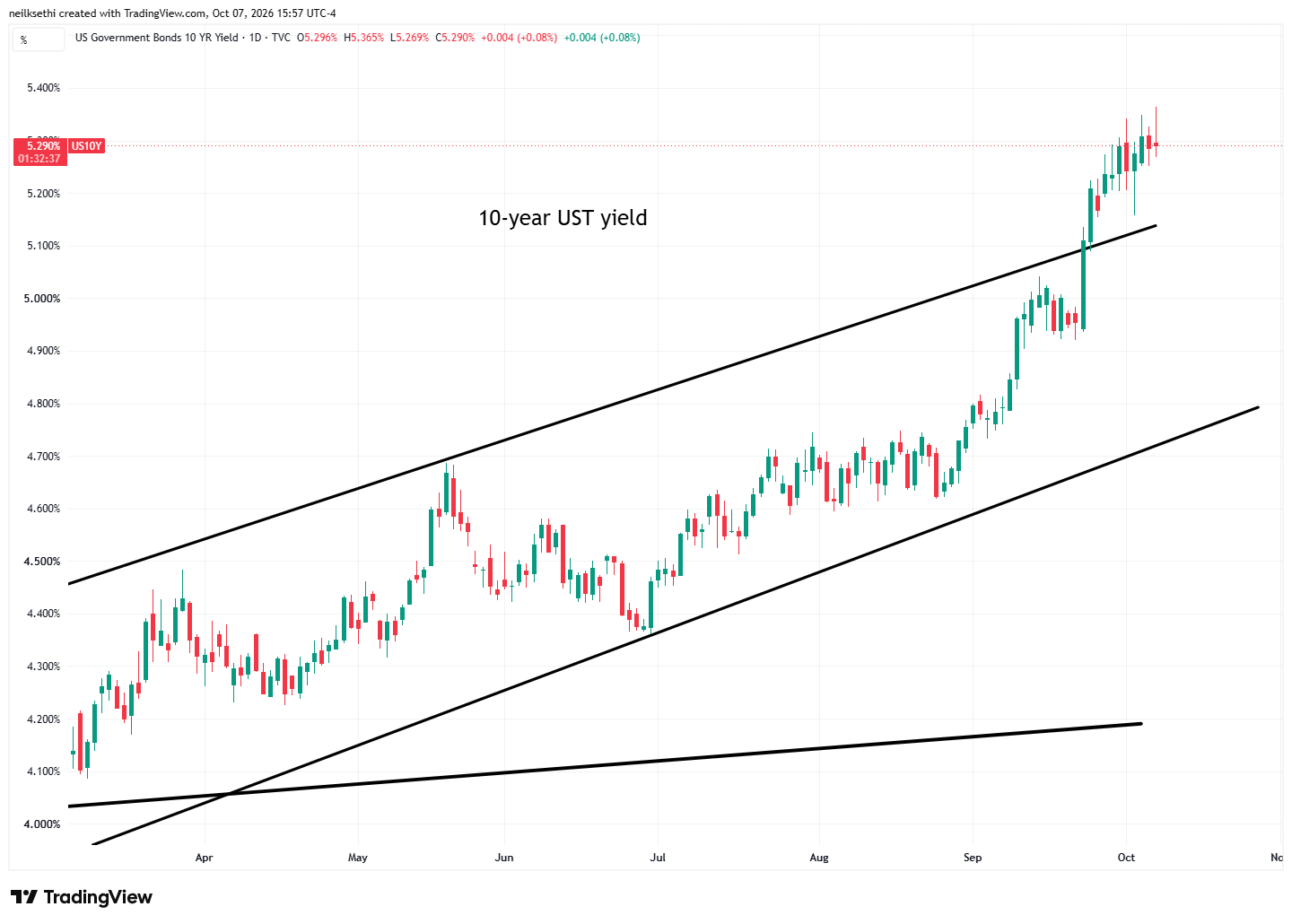
10-year yields were at new post-2002 highs earlier in the session, but a super-strong 10-year auction pulled them lower, finishing flat on the day.
On that 10-year auction:
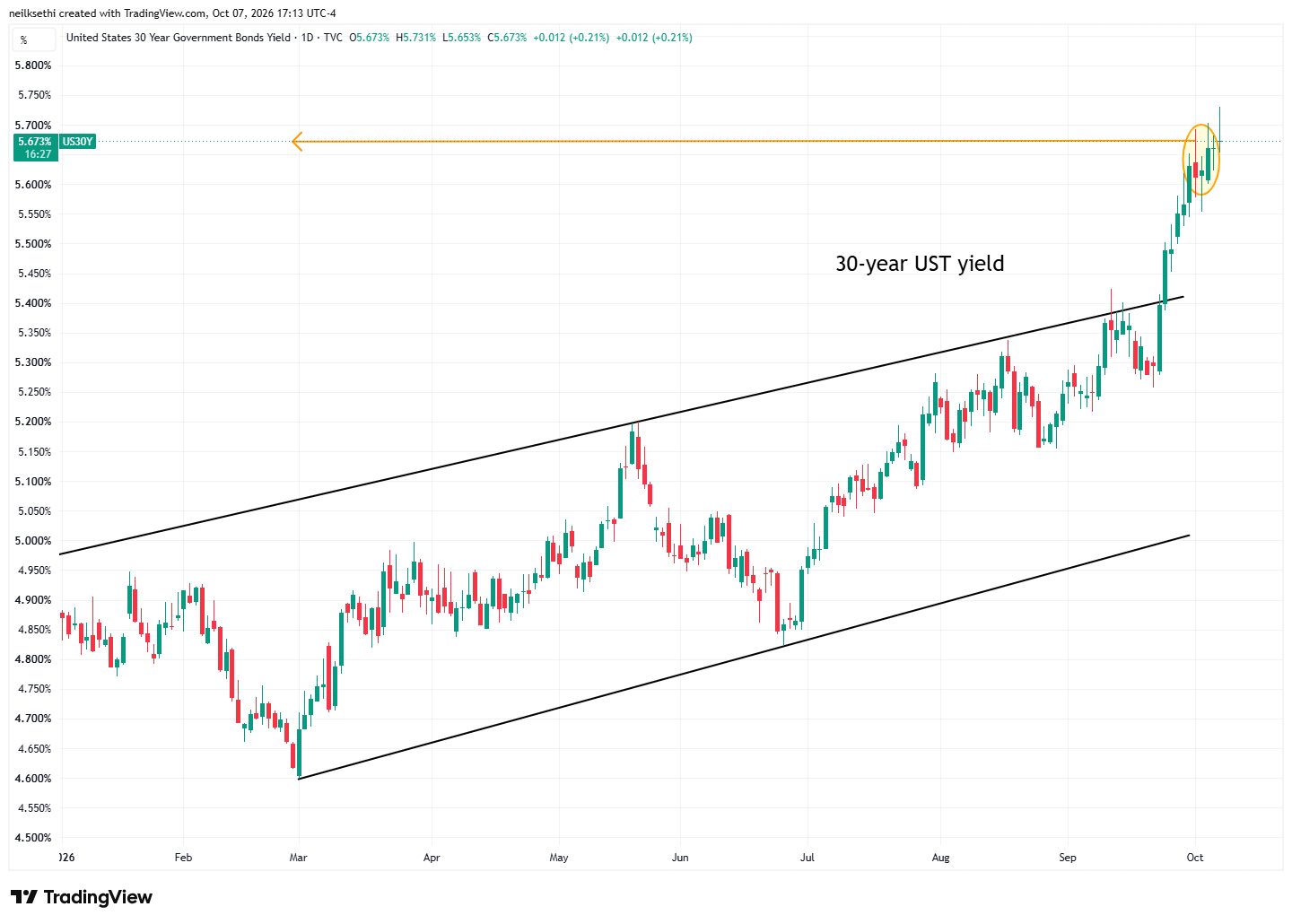
30-year yields though up a basis point to 5.67% (including after-hours), a fresh highest close since May 2002.
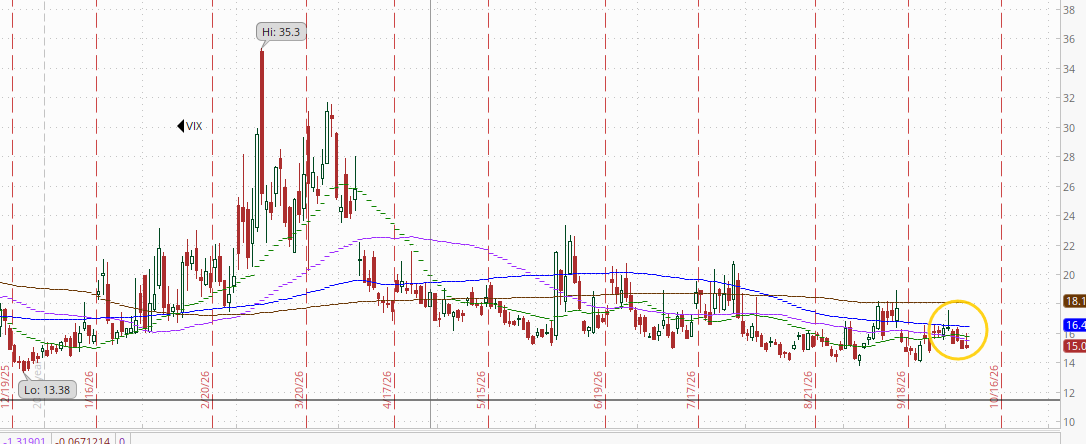
The VIX was unperturbed by the equity weakness, remaining at 15.1. That’s consistent with ~0.95% average daily moves in the SPX over the next 30 days.
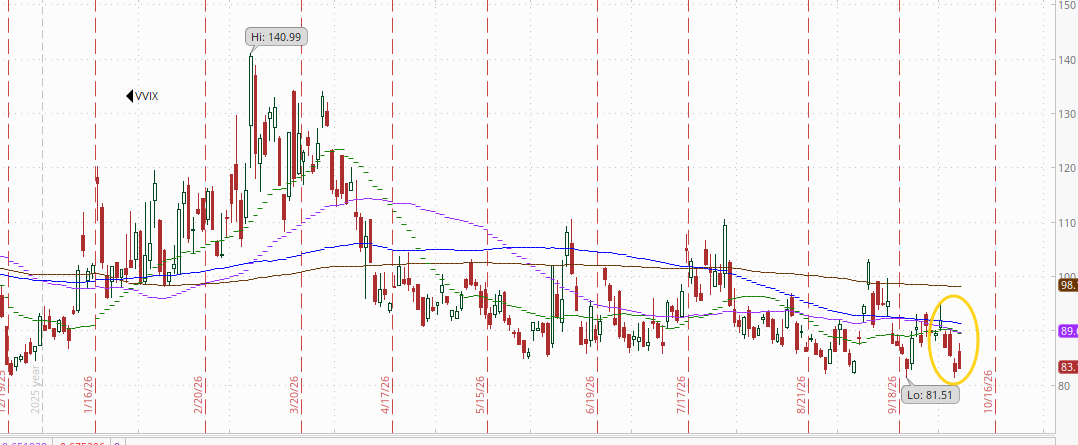
The VVIX (VIX of the VIX) moved a little off the lowest close since December Tuesday to 83.2, still one of the lowest closes of the year.
The current level is consistent with “subdued” daily moves in the VIX over the next 30 days (historically, normal is 80-100, although we haven’t been below 80 since July 2024). Above 100 is the level flagged by Charlie McElligott as indicating higher stress.
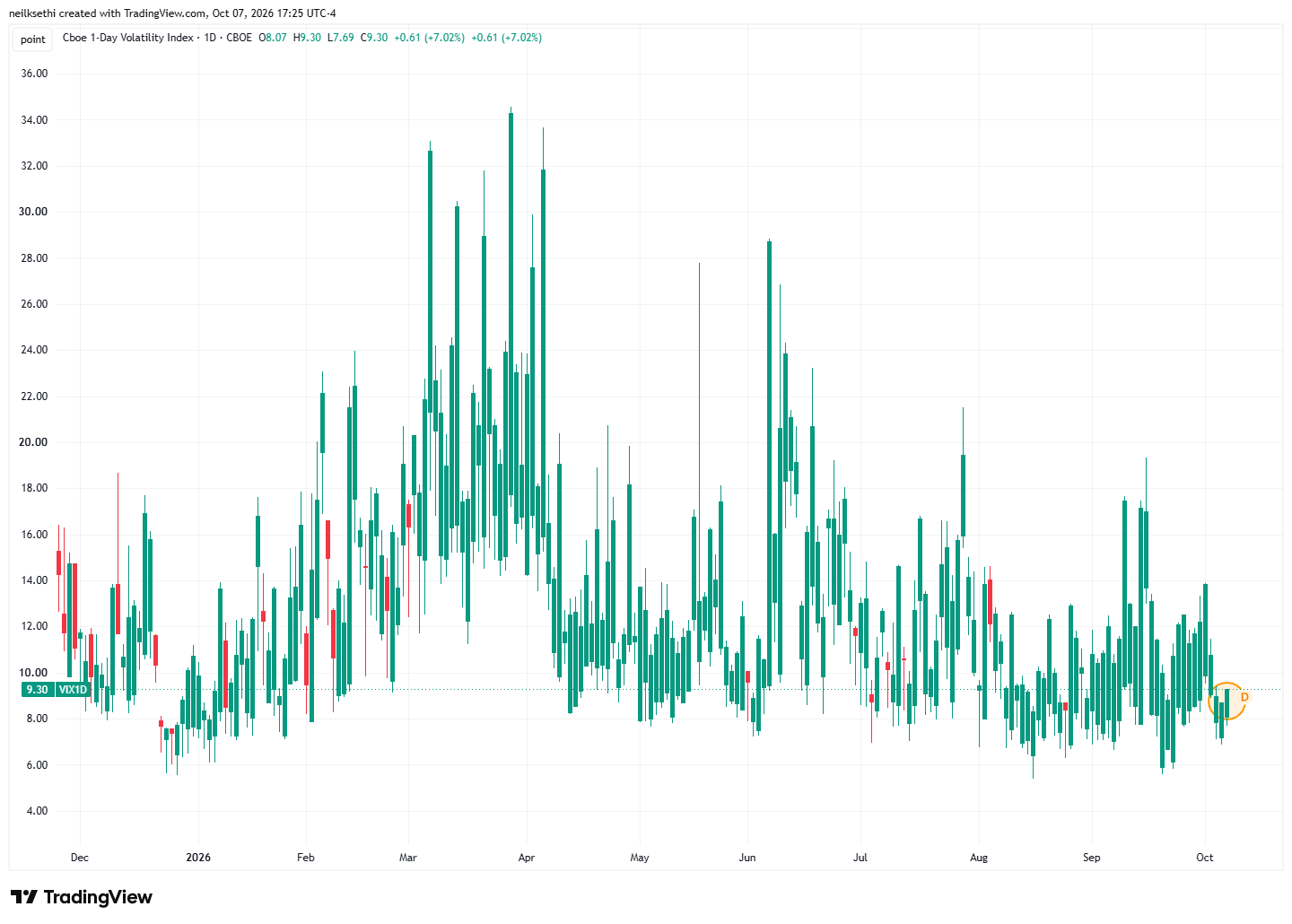
1-day VIX also edged higher to 9.3, also still one of the lowest closes of the year. The current reading isconsistent with a move of 0.59% in the SPX next session.
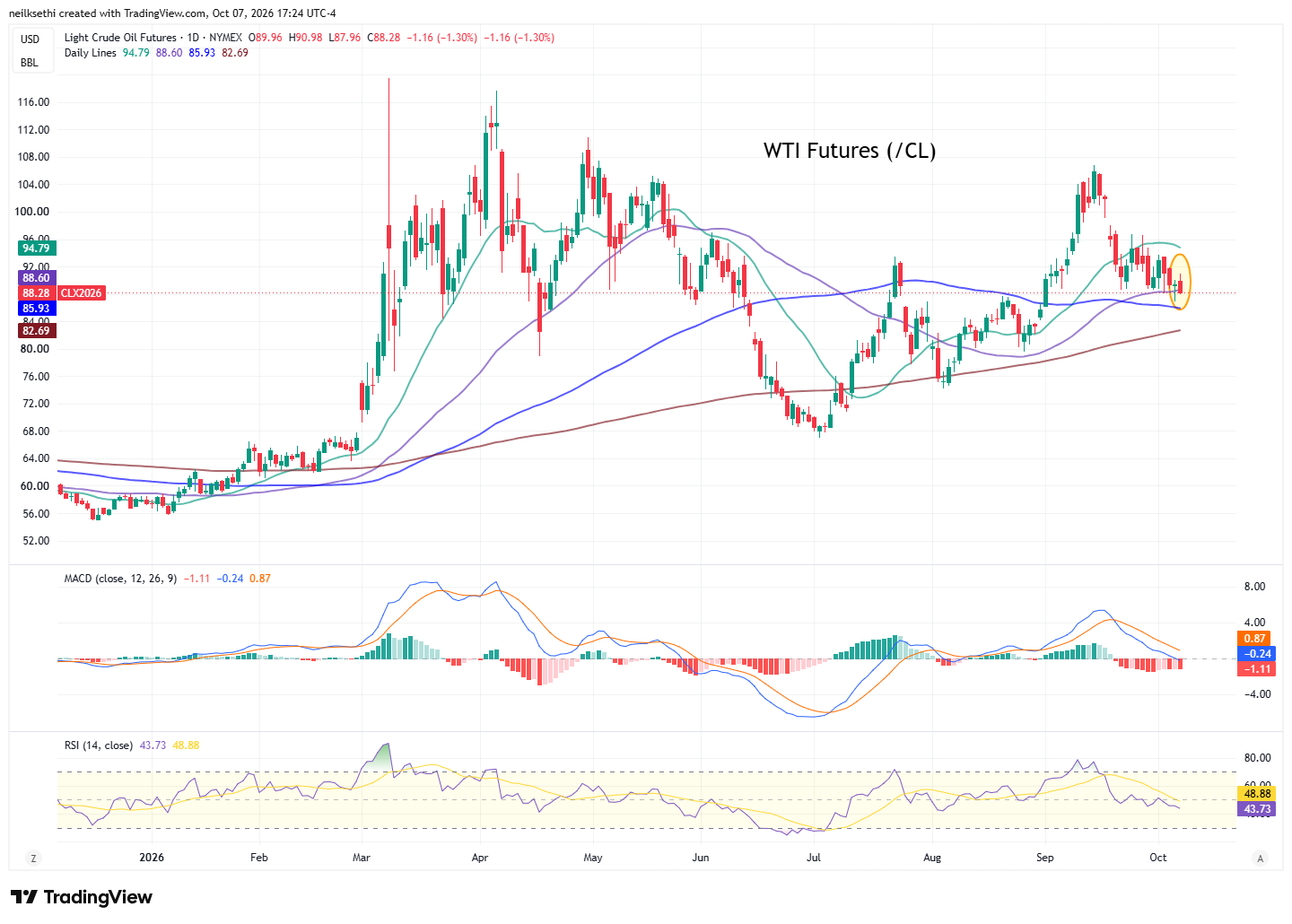
WTI futures (/CL) eased back to the lowest close since August (including after-hours) finishing right on the 50-DMA.
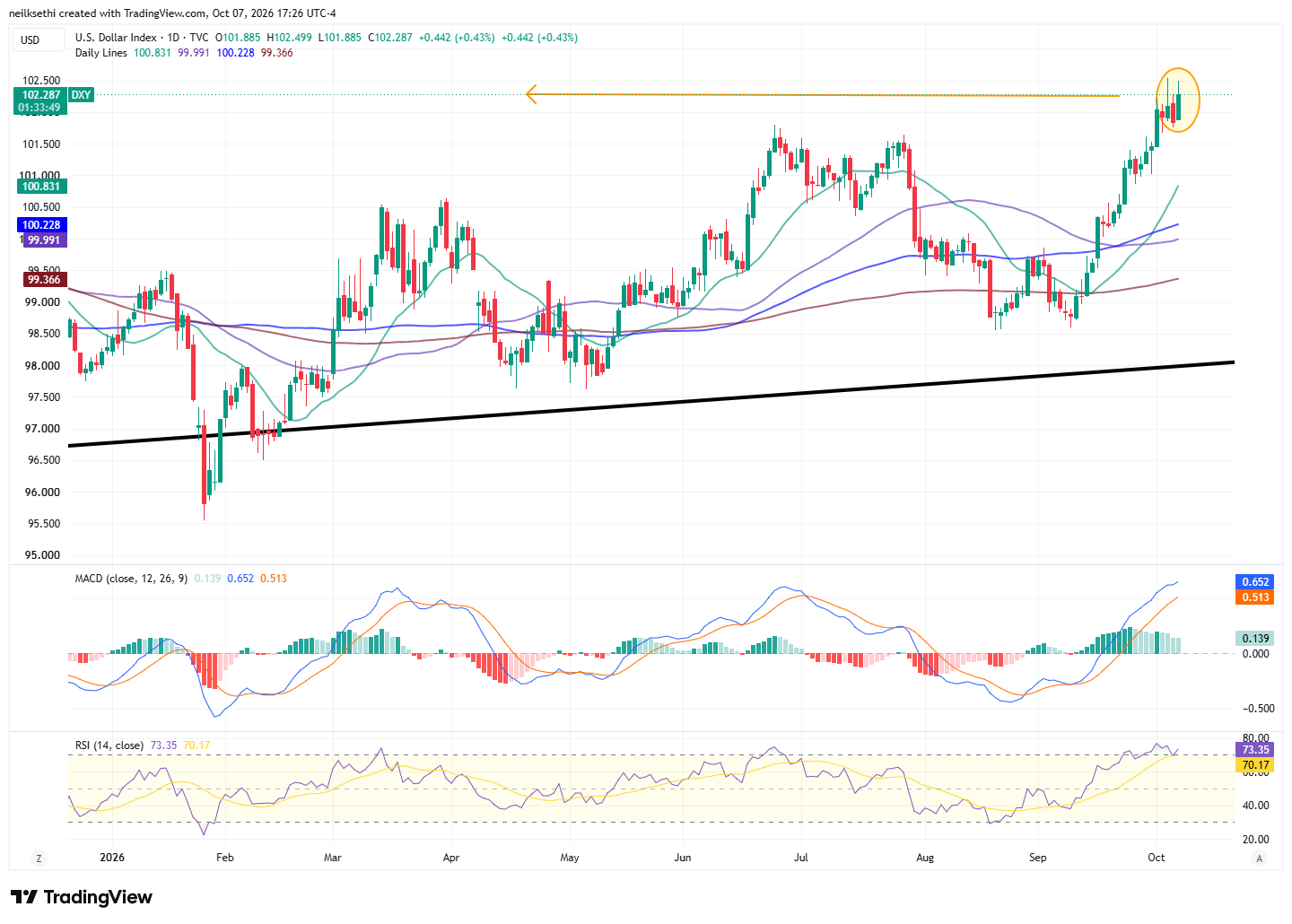
The DXY dollar index (which is fixed weighted with a heavy (57%) weighting vs the euro), a new highest close since April 2025 .
As I mentioned three weeks ago “The daily MACD remains positive and the RSI is above 60 so it continues to have strong technical support.” I mentioned Thursday “This opens up a run higher, although it’s the most overbought since September 2023.”
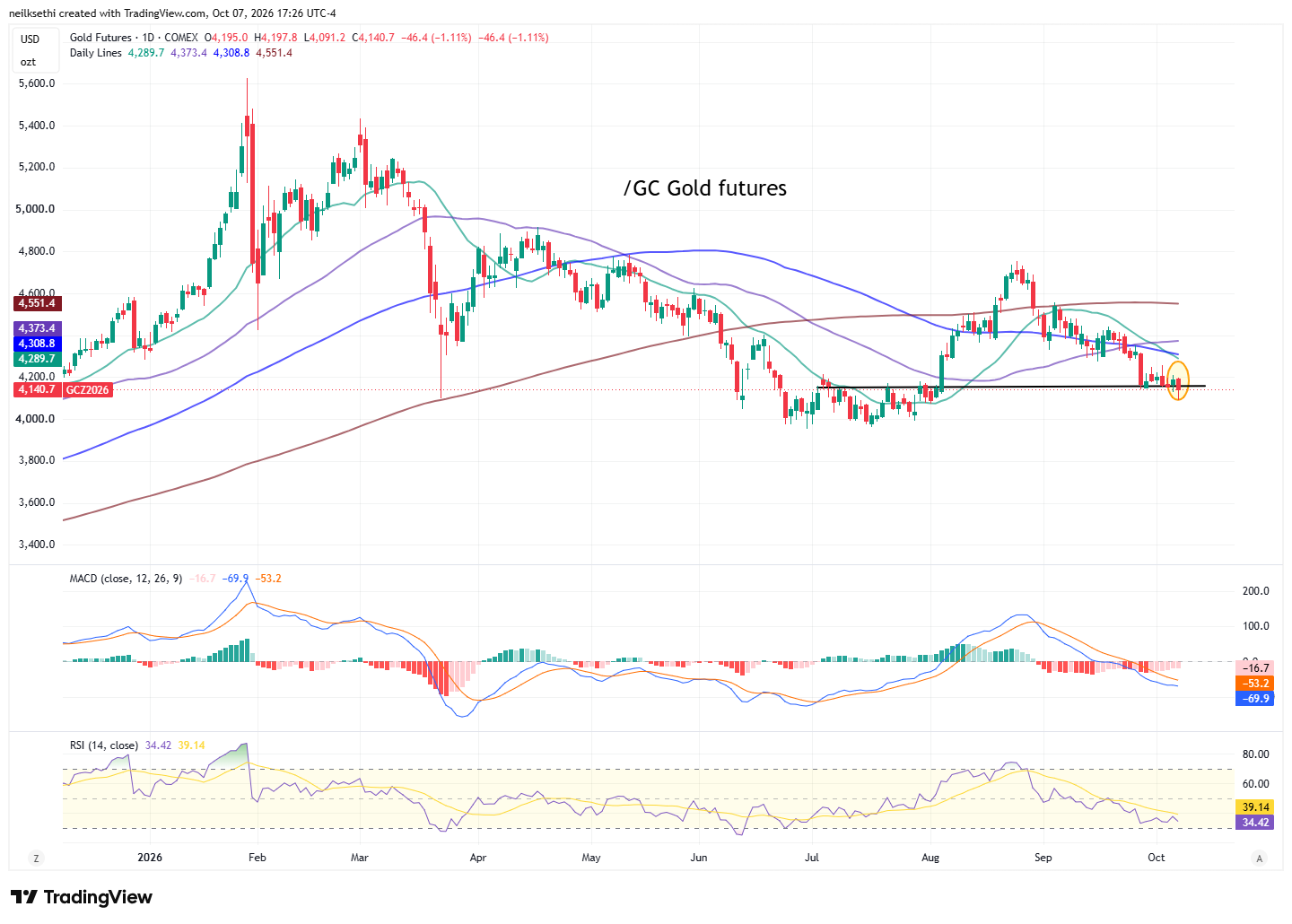
Gold futures (/GC) continue to hang on to support by the slimmest of margins. The daily MACD remains negative and the RSI is under 40, so as I said Tuesday “not a lot of confidence that it holds, but you never know.”
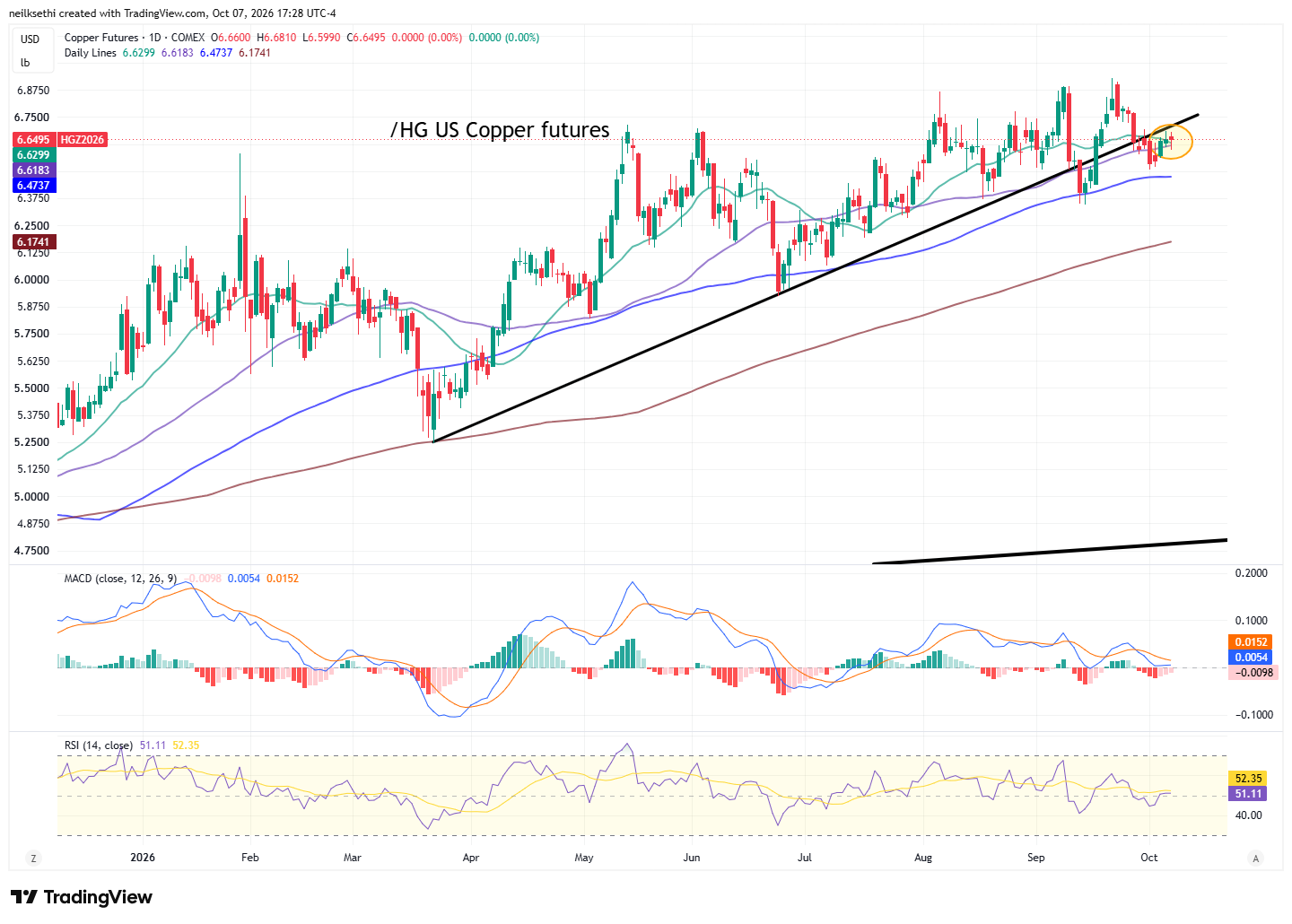
U.S. copper futures (/HG) flat on the day, overall the same level they were at May 13th. Daily MACD still tilts negative while the RSI is neutral.
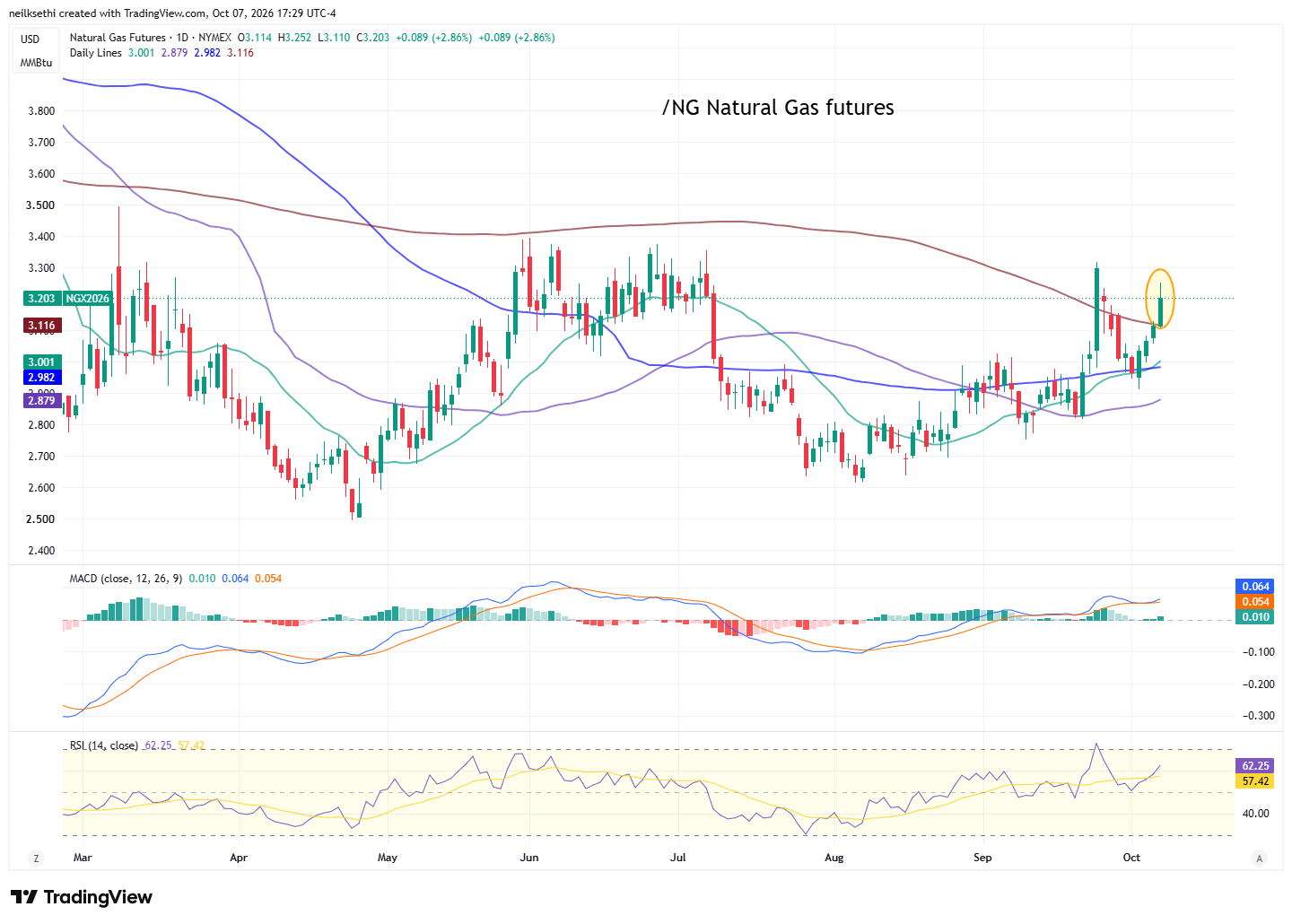
U.S. natural gas futures (/NG) up for a fourth day and clearing the 200-DMA moving towards the top of the trading range stretching back to March.
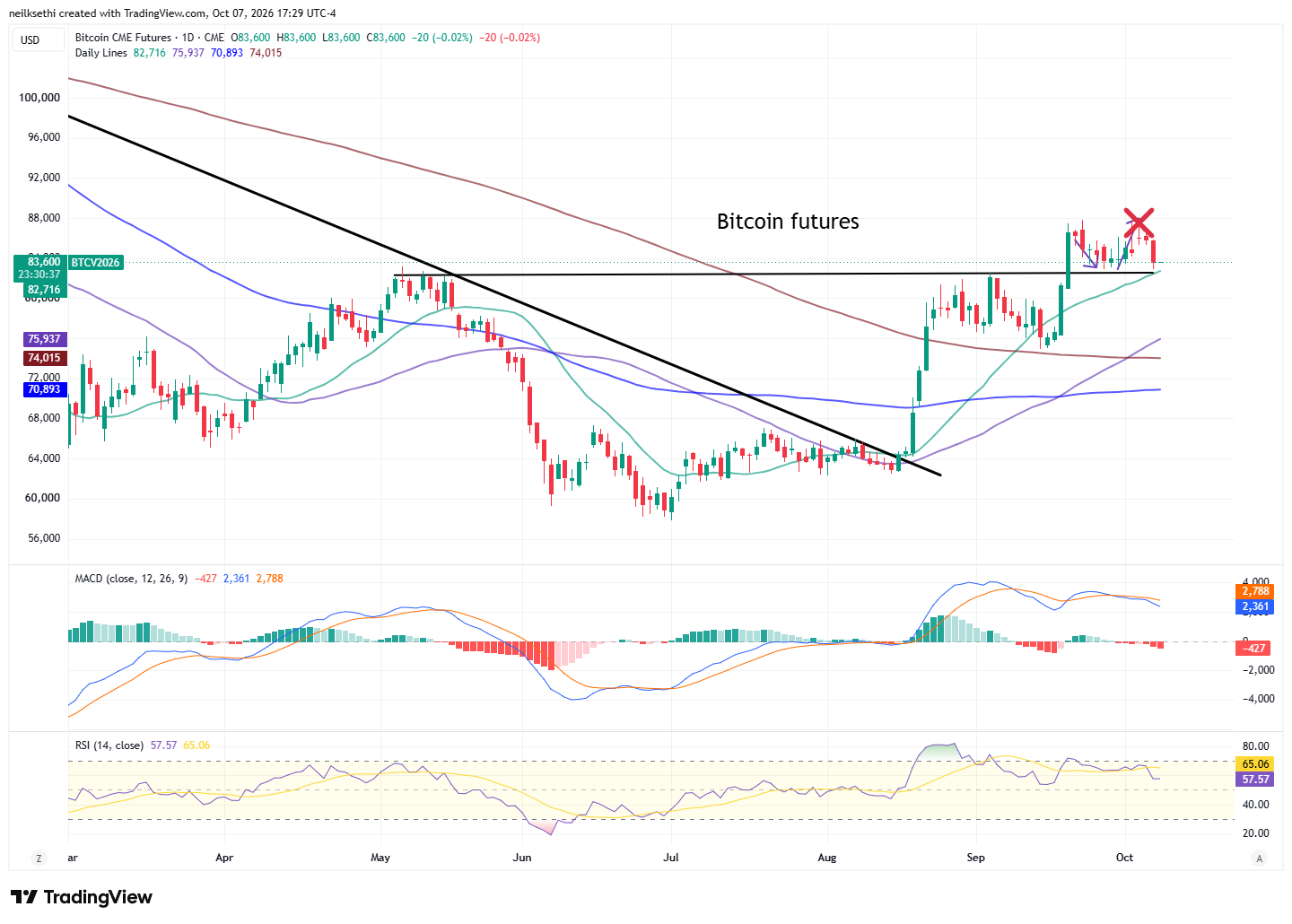
Bitcoin futures fell 2.6% giving back the incremental improvement over the past week and killing my “potential path” (for bulls) I laid out two weeks ago (in purple). I’ll remove that tomorrow. It did though hold the breakout level of $82,500, so now starting to look like a “bull flag,” so I’ll draw that in tomorrow. Daily MACD now tilts negative though while the RSI remains positive. Bulls are looking for a close above $88,000, bears under $82,500.
More From TheStreet Pro:
- Chris Versace –
- James “Rev Shark” DePorre –
- Bret Jensen – Rising Rates, Record Diesel Prices Make a Toxic Brew
And From Me If You Missed It:
- Consumer Inflation Expectations Jump to 3-Year High But Job Worries Ease And Spending Growth Rises
- Fed Minutes Confirm Hawkish Shift
Miscellaneous:
Wrap-Up: A Pause, Or Is It More?
I said Sunday:
For now the setup remains constructive for the reasons mentioned above, and gamma levels remain high which should dampen volatility. So I’m starting the week eyeing higher levels — with, of course, a plan if indices go the other way.
And then Monday and Tuesday:
So far so good, with the Tech trade continuing to power higher and joined by even more of the non-Tech stocks Monday (although breadth metrics remain weak). Technicals are also improving on the indices as we went through earlier. Now, if we could just get that softening in bond yields.
For now, though, not much to complain about. The light week continues Tuesday, so fingers crossed we continue to get another grind higher in equities.
Today things turned weaker with the Tech trade taking a breather and all of the pro-cyclical sectors other than Consumer Discretionary falling with defensives leading. This is something we’ve seen from time to time, but it has yet to stick beyond a few days (remember Staples’ big outperformance vs. the SPX at the end of July? — yeah, neither did I until I looked at the chart).
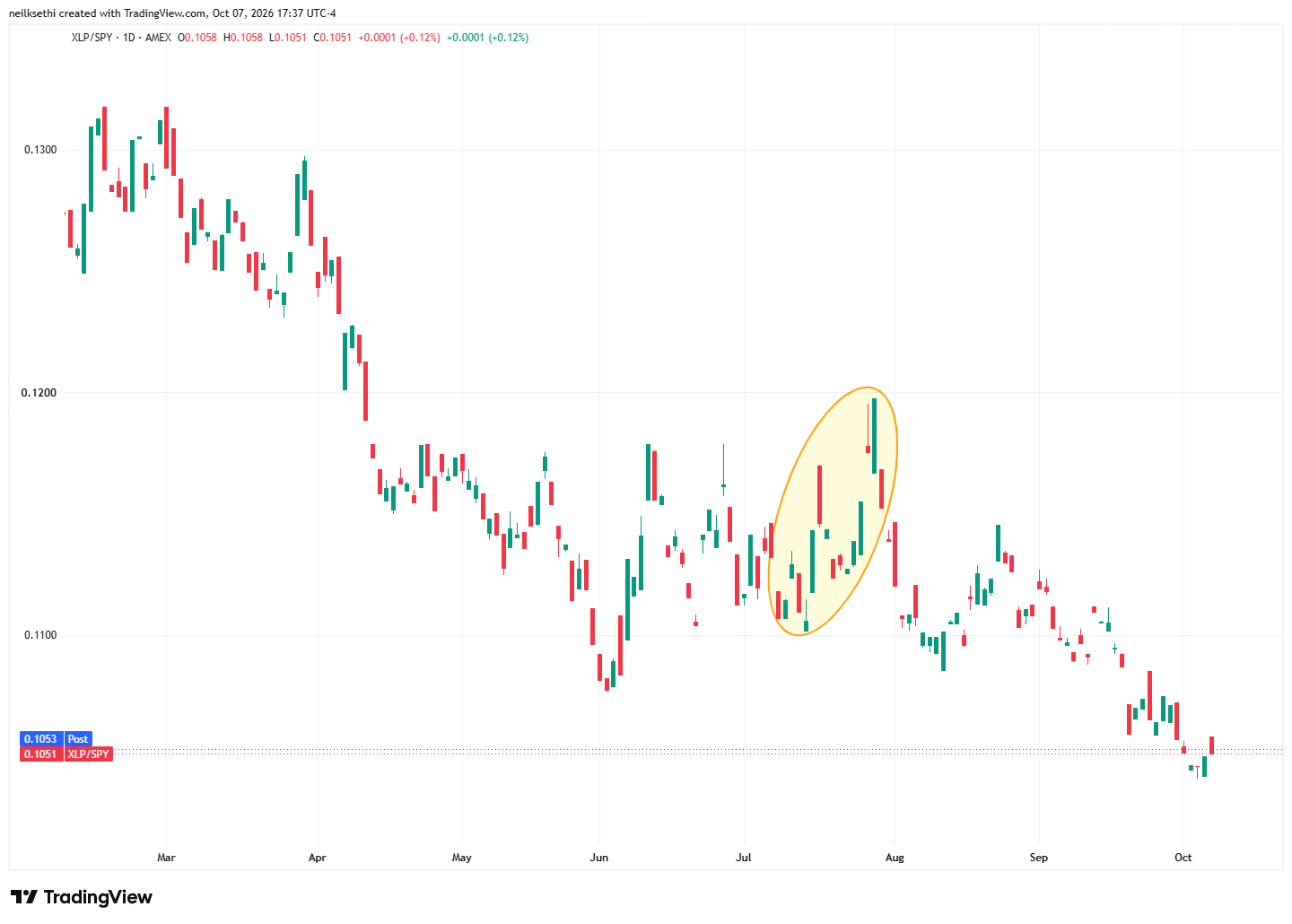
One day doesn’t even make a pattern let alone a trend, so let’s see how things go tomorrow. It’s a very light day with the possible exception of us getting something noteworthy on monetary policy from Governor Waller or a bad 30-year auction (which seems unlikely after the stupendous 10-year auction today).
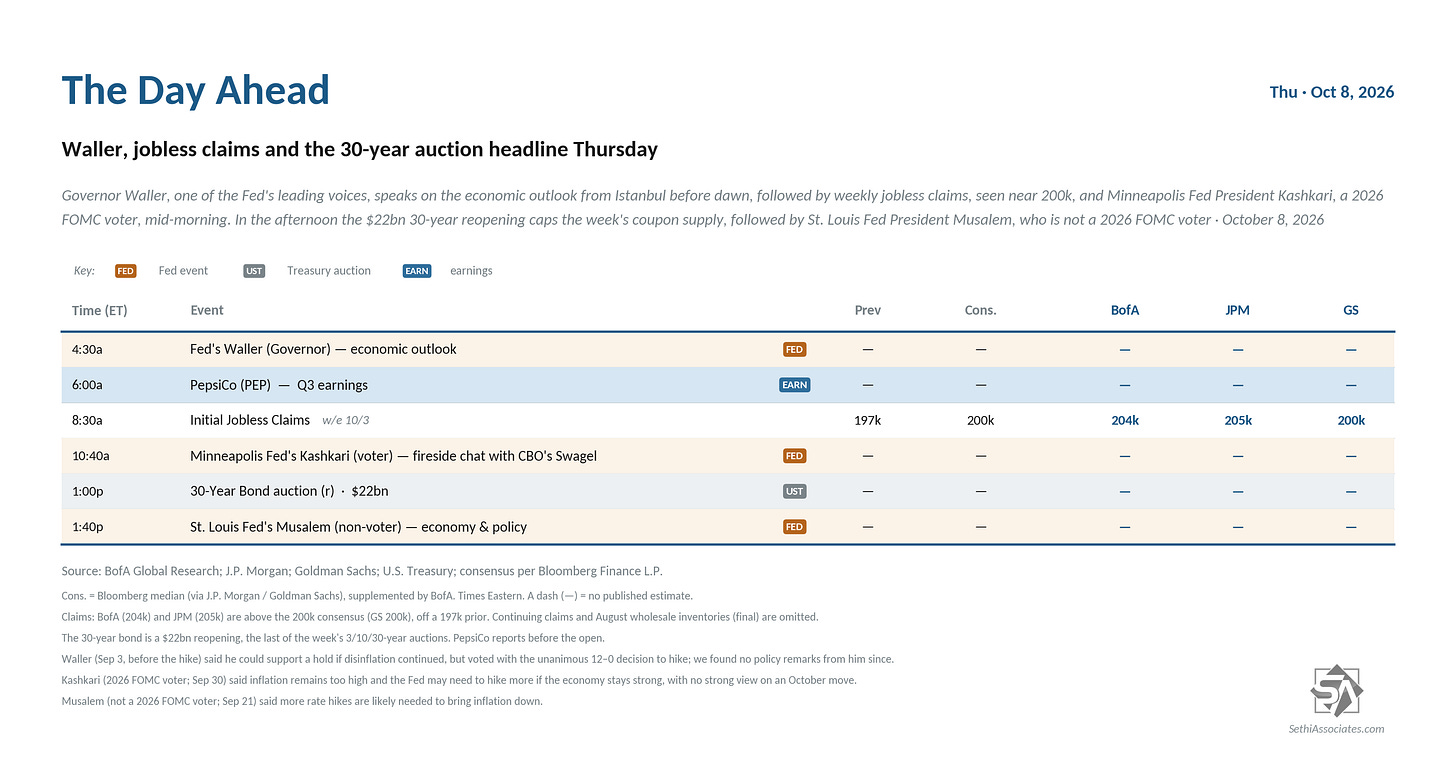
The Day Ahead: Light Week Continues
U.S. economic data Thursday brings us just weekly jobless claims.
Fed speakers pick back up headlined by Governor Waller, a leading voice, and one we haven’t heard speak about monetary policy since the September FOMC. We’ll also hear from regional Fed presidents Kashkari and Musalem.
Non-Bill (>1yr in maturity) U.S. Treasury auctions wrap up with 30-year bonds.
We’ll get one SPX component reporting Thursday in PepsiCo (PEP).
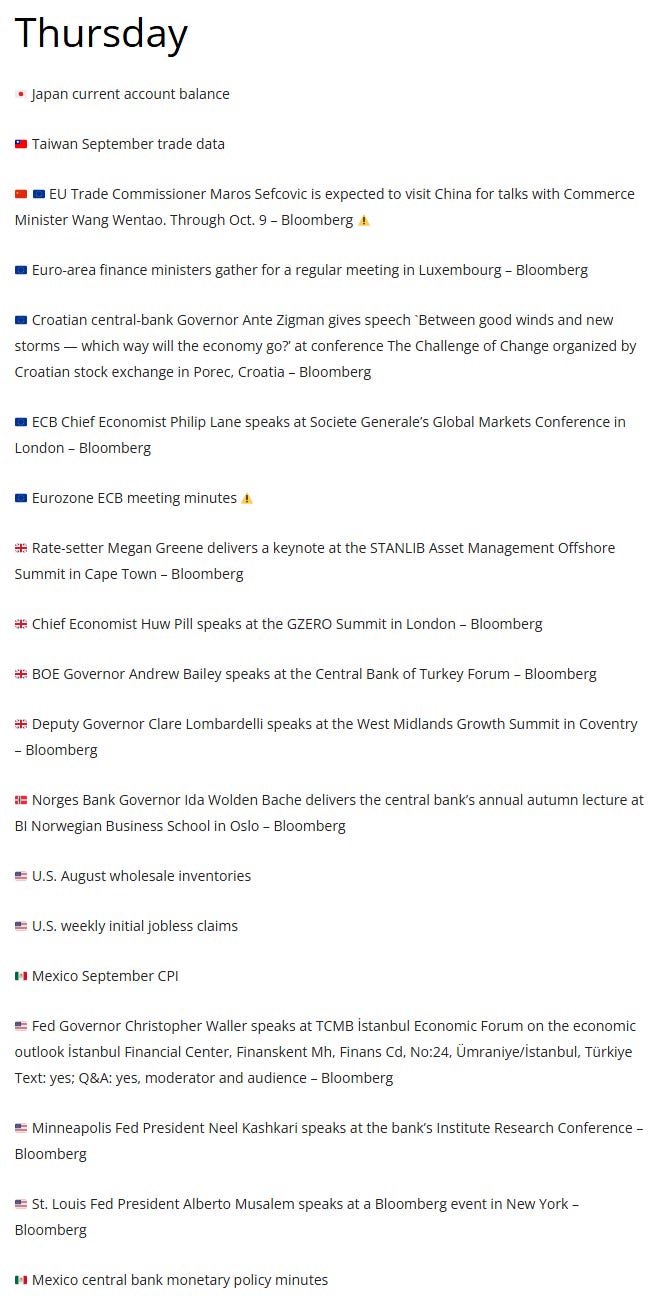
Ex-U.S. highlights include ECB minutes, U.K. September RICS house price balance, Japan September Economy Watchers survey, August BoP current account balance, BoP trade balance, Germany August trade balance.
Also China returns from its week-long holiday.
From Christophe Barraud’s international Week Ahead rundown:
At the time of publication, in terms of equities mentioned, Sethi was long NVDA, SPCX, MU, SKYD, QQQ, SPY, RSP, IWM, CPER, IBIT, and numerous equities in the energy sector.
As a reminder comments are encouraged. If they are directed at me, please put @NeilSethi in front.