Fed Minutes Confirm Hawkish Shift
The September minutes reflected a material hawkish shift from the July meeting with all backing the increase and ‘most’ expecting another hike before the end of the year
You've reached your free article limit
You've read 0 of 1 free Pro articles.
Executive Summary
The minutes of the Federal Open Market Committee’s September 15–16 meeting confirm a committee that has fully moved from debating whether to hike to delivering one, and most expecting another.
- “All participants” supported the 25 basis point increase to 3.75% to 4%, and “almost all” assessed that “while inflation risks were tilted to the upside, risks to the labor market had diminished.”
- “Most participants assessed that another increase in the target range for the federal funds rate would likely be appropriate by year end.”
- Officials said they “had not seen sufficient progress on lowering inflation in recent months.” The staff raised its inflation forecast for 2026 through 2028 and pushed the return to 2% out to 2029 while also raising its growth and labor market outlook.
The minutes of the September 15–16 meeting, Kevin Warsh’s third as chair, contained few surprises given the already known unanimous vote and the shift in the statement, plus commentary from Fed officials. They did shed some light on two things: how broad the support for the hike was, and how many officials expect more.
As a reminder, the Fed raised the federal funds rate by a quarter point to a range of 3.75% to 4% on a 12–0 vote. That was its first rate increase since July 2023, after five straight holds that followed three cuts in late 2025. In July, Cleveland Fed President Beth Hammack, Minneapolis Fed President Neel Kashkari and Dallas Fed President Lorie Logan had dissented in favor of a hike. This time there were no dissents. The statement added one line: “Today’s policy action will support a timelier return to the Committee’s 2 percent goal.” It also dropped July’s language that inflation was “in part reflecting supply shocks that have driven price increases in certain sectors, including energy.”
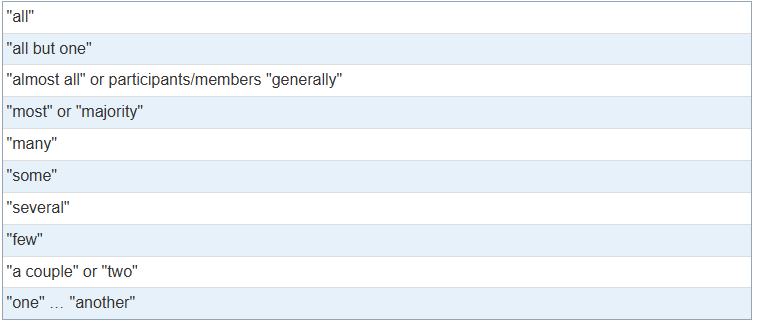
As usual, it helps to keep in mind the Fed’s own scale for the quantifiers it uses in the minutes:
A Unanimous Hike, for Different Reasons
“All participants supported raising the target range for the federal funds rate 1/4 percentage point to 3-3/4 to 4 percent.” The shift in the balance of risks drove the decision: “almost all participants assessed that, while inflation risks were tilted to the upside, risks to the labor market had diminished and were now broadly balanced.”
But while participants agreed on the general reasoning, there was nuance:
“Many [so a little under half] participants emphasized that a higher path for the target range would be prudent on risk-management grounds, providing insurance against inflation remaining persistently above target due to stronger-than-expected demand or further adverse supply shocks.”
“A number of participants viewed a higher path for the target range as necessary based on their modal outlooks rather than on risk-management grounds.” [“a number of” isn’t on the Fed scale].
“Some [slightly less than ‘many’] participants remarked that a higher policy rate would diminish the risk of persistently elevated inflation unanchoring inflation expectations and becoming further entrenched.”
Likely in the same group as those who wanted to hike based “on their modal outlooks,” a “couple of participants remarked on having increased their estimate of the neutral federal funds rate.”
Another Hike Likely by Year-End
This is perhaps the most important line in the minutes: “With regard to the outlook for monetary policy beyond the current meeting, most participants assessed that another increase in the target range for the federal funds rate would likely be appropriate by year end.”
“Most” means a majority. In July, “many” (just under half) said tightening “would likely be necessary if inflation did not decline,” so there was a big shift in sentiment in the seven weeks between those meetings. As in July, no participant discussed rate cuts, and this time the word doesn’t appear anywhere in the minutes.
“Several” participants went a little further, stating “that they viewed the current policy rate as not restrictive or only mildly restrictive.”
It didn’t hurt that markets were expecting the hike. The New York Fed’s markets desk noted that investors “placed high odds on a 25 basis point increase” going into the meeting. It attributed the shift in expectations “in part to FOMC communications as well as to the incoming inflation data.” That was up from about 36% (per Bloomberg) when the July minutes were released.
Inflation: Not Enough Progress
Participants “noted that inflation remained elevated and that they had not seen sufficient progress on lowering inflation in recent months.” → The staff estimated total personal consumption expenditures (PCE) inflation “edged up to 3.8 percent in August,” with core PCE at 3.4%.
The composition mattered. “Several participants observed that the rate of price increases in the core goods category also remained elevated, as effects of the AI buildout appeared to increase while the effects of tariff increases waned.” Several also noted that core services excluding housing “remained elevated.”
Inflation Risks Were Seen as Skewed Further to the Upside:
“Some participants remarked that those risks had become more skewed to the upside in recent months.”
“Many participants cited their business contacts and business surveys as reporting increased cost pressures.” — this one seems to have hit home with a number of the regional bank presidents who have mentioned this as creating “a need to act” (Hammack).
“Some participants noted that businesses appeared to have been more successful in passing cost increases through to consumers.”
“Many participants assessed that the longer energy prices remained elevated, the greater the risk that cost increases in certain sectors could lead to broader price pressures.”
“Some participants commented that the AI buildout could cause aggregate demand to outpace aggregate supply over the medium term, putting upward pressure on inflation.”
There was also a caution against reading too much into recent softer readings. “A few participants observed that the 3-month change measure of core PCE inflation showed a material decline since the start of the year.” They cautioned, though, that this measure “has shown a strong tendency to understate inflation in the second half of the year compared with the first half.”
Longer-term inflation expectations remain anchored, although “several” participants noted that short-term measures were elevated.
The Methodology Change
The Bureau of Economic Analysis (BEA) is changed how PCE inflation is calculated with its end-of-September release. Under the new methodology the staff estimated August inflation would be 3.6% headline year-over-year and 3.2% core, versus 3.8% and 3.4% under the old method. When the August data did come out, core come in at just 3.0%.
A few participants said “software and portfolio management fees in particular” had “made relatively large contributions to recent PCE inflation readings.” They expected those contributions “would likely be reduced somewhat with the upcoming changes to the BEA’s methodology.”
Labor Market: Near Maximum Employment, Risks Balanced
The unemployment rate was 4.1% in July and August, 0.3 percentage point below its average in the second half of last year. Payroll gains “picked up notably in August, reflecting increases across a range of industries.”
Participants “generally viewed the labor market as close to maximum employment.” “A majority of participants assessed that the labor market had strengthened a bit recently.” They “generally viewed the upside and downside risks to the labor market as broadly balanced,” which is the first time this year the minutes have not described employment risks as tilted to the downside. We know from some speakers since the meeting (Chicago Fed President Goolsbee for example) that they haven’t changed their thinking much despite the weaker September payrolls report.
Several participants noted that labor market dynamism remained “unusually low,” with low hiring and layoffs, a low job-finding rate and elevated long-term unemployment. On wages, some pointed to strong gains for skilled workers tied to the AI buildout. Others said aggregate wage growth “was moderate and consistent with inflation moving toward 2 percent.”
Growth and Financial Conditions: Still Supportive
“Participants generally assessed that economic activity was expanding at a solid pace. Robust business investment and resilient consumer spending had supported economic activity, even as adverse supply shocks from geopolitical developments had intensified. Several participants commented that the underlying momentum in the economy appeared to have increased,” as the “scale and pace of the AI buildout had continued to surprise to the upside.”
Many participants still saw financial conditions as supportive despite the rise in yields, “with equity prices having risen substantially this year and spreads on corporate bonds having remained narrow.” Housing was the exception, with mortgage rates “remaining at elevated levels.”
“Several participants noted that business activity had also been supported by factors such as the high level of corporate earnings, less restrictive regulations, and tariff refunds.”
That was consistent with the staff outlook as well:
The markets desk noted that 2-year to 10-year Treasury yields rose about 35 basis points over the intermeeting period (they have risen another 26 basis points since the meeting). Market commentary pointed to geopolitical developments, uncertainty around the Treasury’s buyback program, and “competition for capital from heavy private debt issuance to finance the development of artificial intelligence (AI) infrastructure” as reasons for higher term premiums.
Several participants noted that low- and moderate-income households faced strains, “with higher energy prices weighing disproportionately on their real disposable income.”
Staff Forecast: Inflation Higher for Longer, Growth Stronger
The staff’s inflation forecast was “somewhat higher for 2026 through 2028” than in July. Inflation is now projected to reach 2% in 2029, a year later than previously forecast.
At the same time, the growth and labor outlooks were upgraded. Real gross domestic product (GDP) is now projected “to outpace potential through 2028.” The unemployment rate is expected “to remain below the staff’s estimate of the longer-run rate through 2029.” Risks to growth and employment were seen as “roughly balanced,” after being skewed to the downside in July. Risks to inflation remain skewed to the upside.
The full minutes are available here.