Market updates and conversation from TheStreet Pro team. Follow the latest and join the conversation below.
Stock Market Today: October 29, 2026
Newest first · All times Eastern · 8 updates
DATE:
By Ed Ponsi
Updates on GOOG and META
Just opened a small position in GOOG at $280. There is good support near $271, so I see it as a high-reward, low-risk opportunity. Now that the stock has dropped 13% today and nearly 30% since May, GOOG is reasonably valued.
We also added to our initial position in META, and now have a cost basis of about $630 in that stock. This plan was laid out in a previous article.
Writing up GOOG and META with charts and explanations now, article to follow tomorrow morning.
7-Year Auction: Foreign Demand Stays Soft but Domestic Demand Steps Up
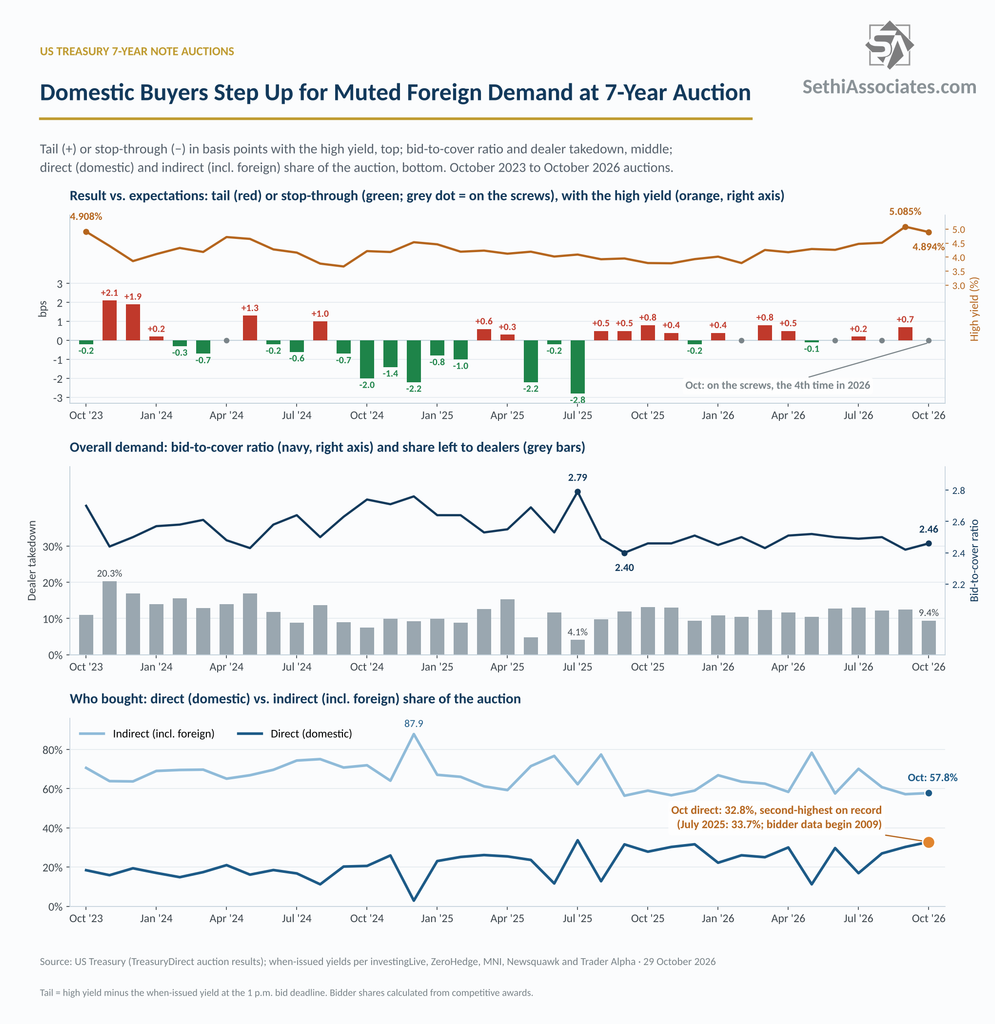
The last of this week’s three coupon (more than one year in maturity) Treasury auctions came today in $44 billion of 7-year notes, and it continued the week’s theme of domestic buyers picking up the slack from softer foreign demand.
At Monday’s 2-year, indirect bidders (which include foreign buyers) fell to the lowest since November 2021 as direct (domestic) bidders took a record share. Indirect demand recovered somewhat in Tuesday’s 5-year but was still below the six-month average, and today’s 7-year was a similar story but direct bidders took the second-largest share on record keeping the end result in line with expectations and leaving dealers with less than at either of the previous two auctions (9.4%, versus 13.0% at the 2-year and 10.6% at the 5-year)
The sale cleared at 4.894%, down from 5.085% in September (the highest on record for this maturity). It came in “on the screws” (right in line with expectations) against a when-issued of 4.894%, much better than the +0.7 basis point tail in September (the biggest since March), and versus a six-month average tail of +0.2 basis points. Interestingly, it was the fourth 7-year auction to price on the screws in 2026.
Looking at the rest of the metrics:
-Overall demand (bid/cover) rose to 2.46 from 2.42 in September, but stayed below the six-month average of 2.49.
-Indirect bidders (which include foreign buyers) edged up to 57.8% from 57.2% in September (the lowest since November 2025), but remained well below the six-month average of 63.7%.
-Direct (domestic) bidders jumped to 32.8%, the highest since July 2025 and the second-highest in Treasury data back to 2009 (after July 2025’s 33.7%), from 30.3% in September and well above the six-month average of 24.2%.
-That left dealers with 9.4%, the lowest since December 2025, down from 12.5% in September and below the six-month average of 12.1% (the record low was 4.1% in July 2025).
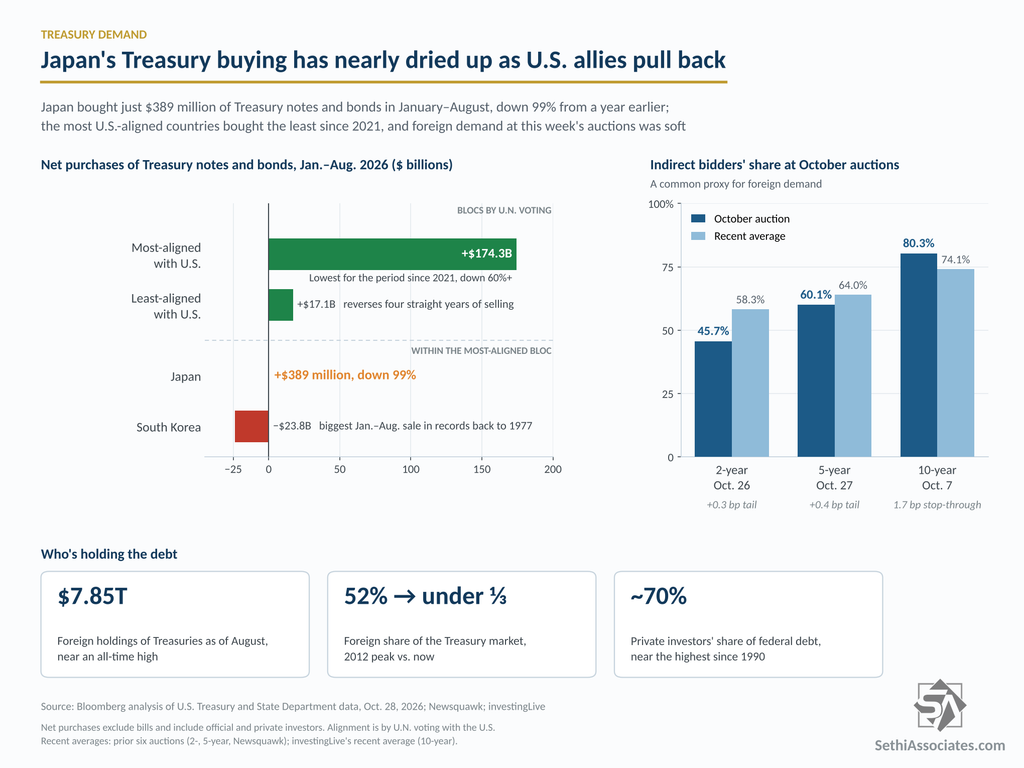
So at all three auctions this week, indirect bidders took a below-average share (45.7%, 60.0% and 57.8%), which was offset at least in part by direct bidders taking more (41.3%, 29.4% and 32.8%).
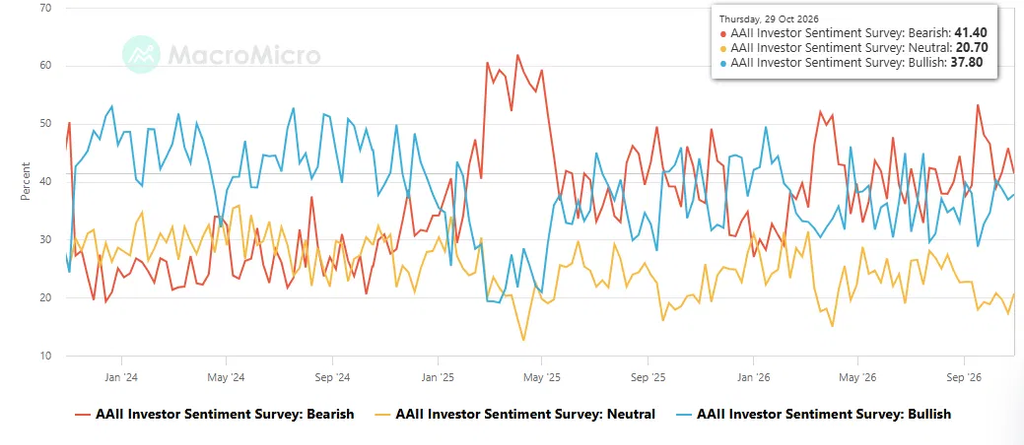
American Association of Individual Investors (AAII) retail-focused weekly investor survey edges less bearish:
AAII Bulls (those who see higher stock prices in 6 mths, blue line) edged up to 37.8% from 36.9% the prior week, moving back above the long-term historical average of 37.5% after a week below.
Bulls, though, remained below the level of the Bears (who see lower stock prices in 6 mths, red line), even as the Bears fell to 41.4%, the least in three weeks, from 45.8% the prior week (and further below the 53.3% six weeks ago, the highest since May 2025).
That leaves Bulls above Bears just twice in the last 15 weeks. Bears also remain above the long-term average of 31.0% for a 37th straight week (and they’ve only been below it 9 weeks since Dec 12, 2024).
The Neutral camp (yellow line) rose to 20.7%, the most in three weeks, from 17.3% (which was the least since early April). It remains under the long-run average of 31.5% and has been over that only twice since July 2024.
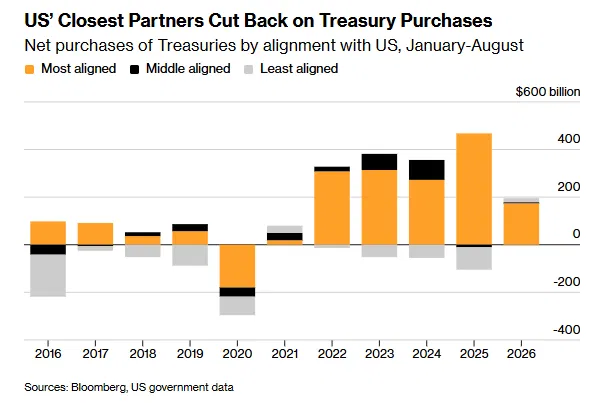
Countries most aligned with the U.S. bought a net $174.3 billion of Treasury notes and bonds in the first eight months of 2026, according to Bloomberg’s analysis of Treasury and State Department data. That’s the least for the period since 2021 and down more than 60% from a year earlier. Bloomberg ranks alignment by how often countries vote with the U.S. at the United Nations.
Asia led the retreat:
Japan, the biggest foreign holder, bought just $389 million, down 99% from a year earlier.
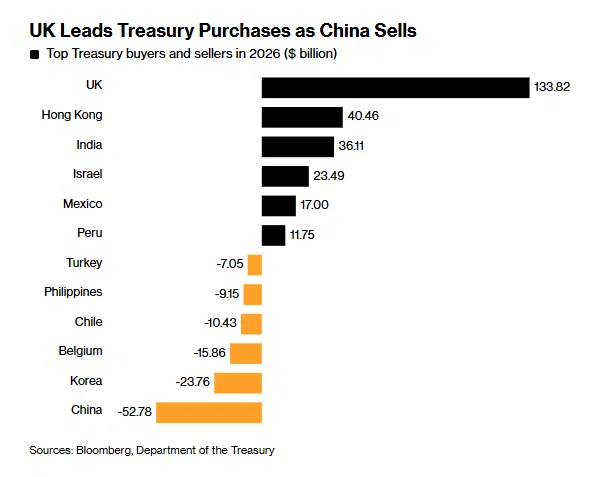
South Korea sold $23.8 billion, the most for the period in records going back to 1977.
Taiwan was also a net seller.
The least-aligned countries bought $17.1 billion, reversing four straight years of selling over the same period. China remained the biggest seller, while the UK, Hong Kong and India were the biggest buyers. The data cover both government and private investors, and Bloomberg notes that holdings can be credited to the country where they’re held through custodians rather than to the actual owner.
Bloomberg cites weak currencies, rising yields at home, growing demand for stocks and unease over U.S. policy as possible factors. The yen hit a four-decade low this year, and the won fell to its weakest since 2009.
“The Treasury market isn’t losing foreign buyers — it’s losing automatic buyers,” Masahiko Loo, a senior fixed-income strategist at State Street Investment Management, told Bloomberg.
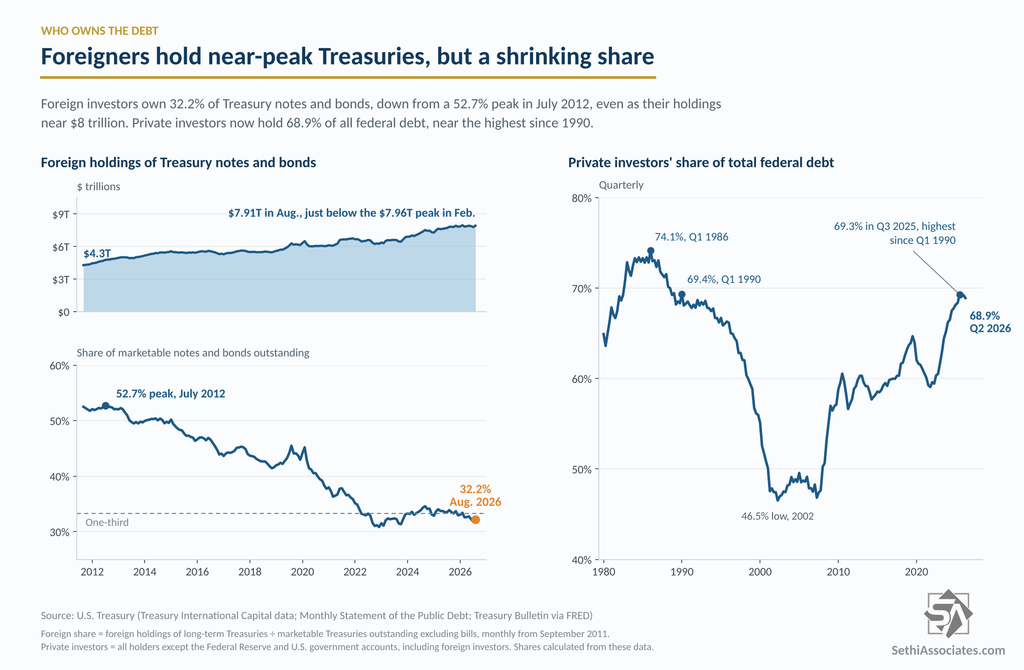
Private investors, including hedge funds, banks and mutual funds, have stepped in, lifting their share of federal debt to about 70%, near the highest since 1990. Foreigners still owned $7.85 trillion of Treasuries as of August, near a record. But their share of the market has shrunk to less than a third, from a peak of 52% in 2012.
The tradeoff is price. “The Treasury will fund itself — the question is the price and the volatility of the price,” said Shoki Omori, Deutsche Bank’s chief fixed-income strategist for Japan..
Jobless Claims Refuse to Budge as Four-Week Average Hits Lowest Since 1969
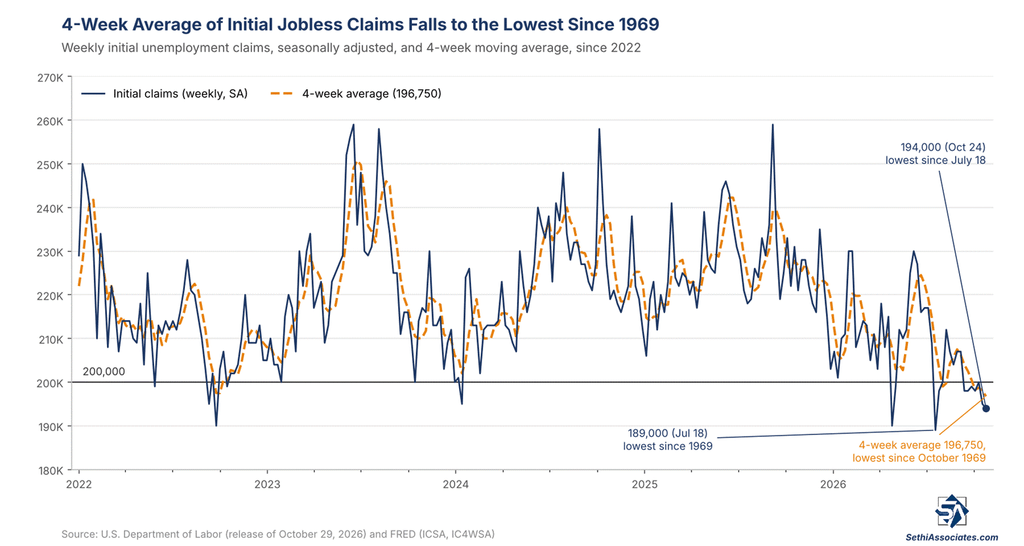
Initial jobless claims for the week ending October 24: 194,000 (estimate 199,000; previous 194,000; revised previous 195,000)
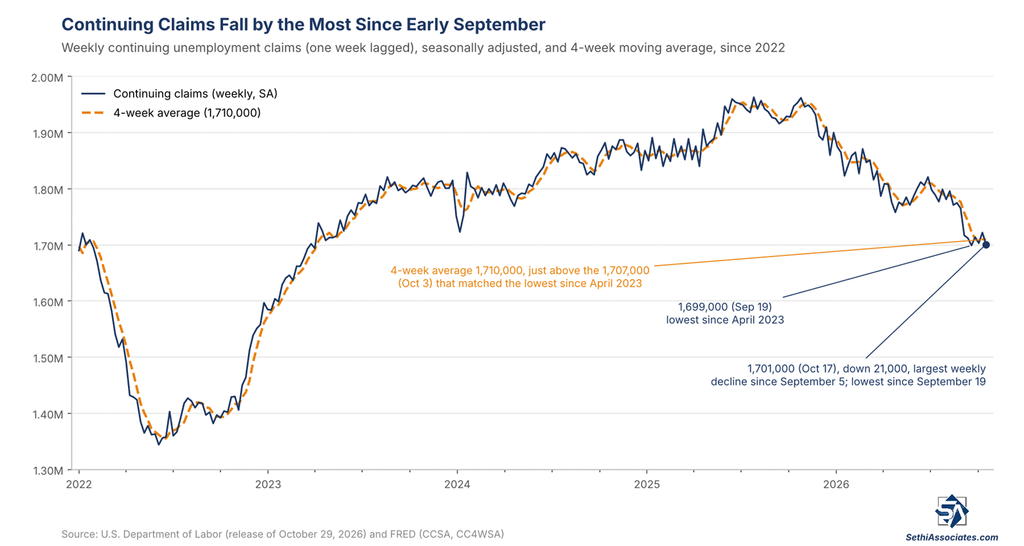
Continuing claims for the week ending October 17: 1,701,000 (previous 1,728,000; revised previous 1,722,000).
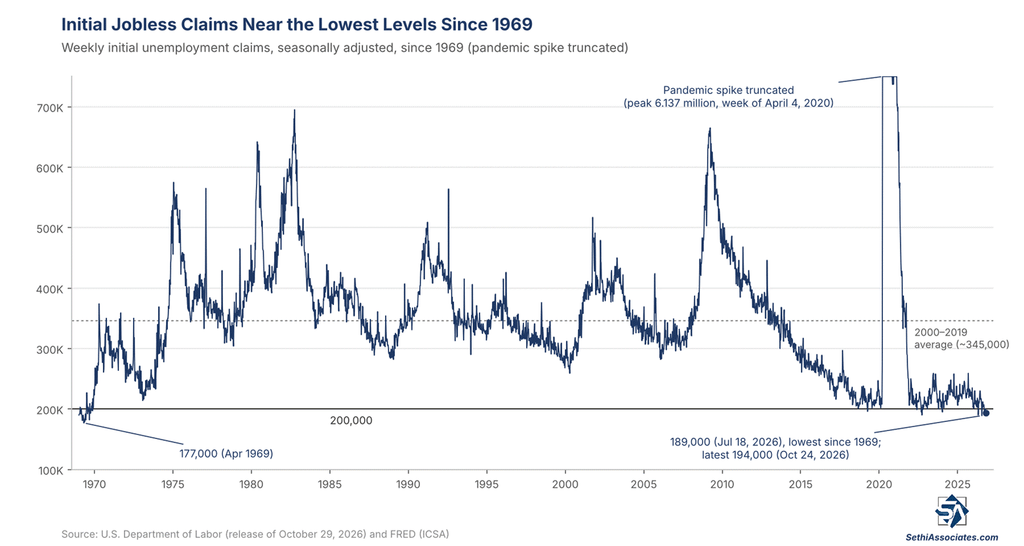
After bottoming at 189,000 in mid-July — the lowest reading since 1969 — initial jobless claims have barely budged, this week edging down 1,000 in the week through October 24th to 194,000, the lowest since July 18 (from an upwardly revised 195,000 the prior week). That makes it only the 17th week below 200,000 since 1969, leaving claims near cycle lows at the bottom of the relatively narrow range that has held since November 2021. It is also the second straight week below that mark, following the four-week run from September 12 through October 3, the longest since 1969.
The four-week average fell 1,250 to 196,750, the lowest since October 1969 (30,000 lower year-over-year).
Continuing claims (seasonally adjusted) in the week through October 17 (one week lagged) fell 21,000, the largest weekly decline since September 5, to 1,701,000, the lowest since September 19 (after a 6,000 downward revision to the prior week), leaving them just above the 1,699,000 hit four weeks earlier, the least since April 2023, and towards the bottom of the roughly 1.70 million to 2.0 million range that has held since mid-2023 — historically low, though not quite as low as initial claims.
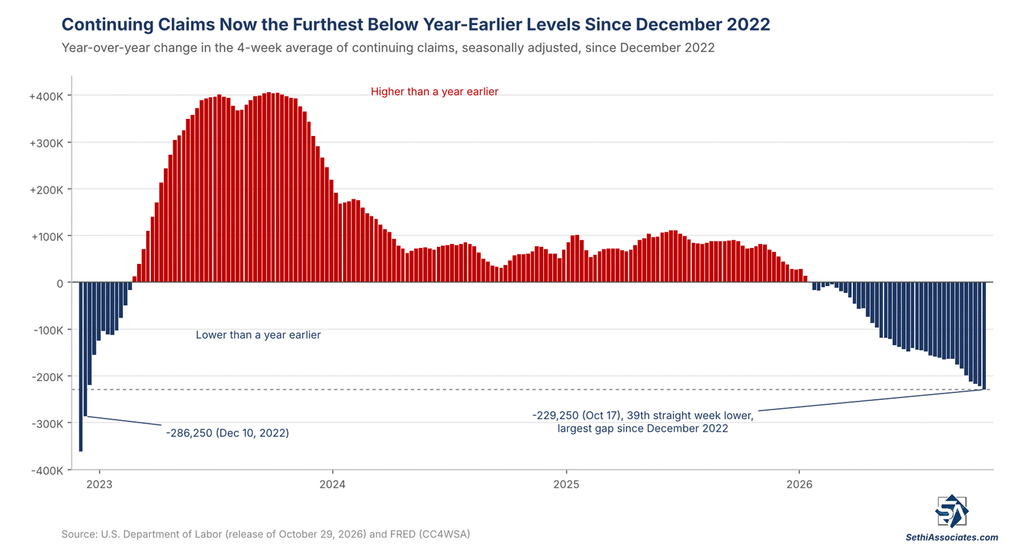
The four-week average of continuing claims edged up 500 to 1,710,000 (after a 1,500 downward revision to the prior week), just above the 1,707,000 two weeks earlier that matched the lowest since April 2023, and remains lower year-over-year for a 39th straight week (down 229,250) — the largest such gap since December 2022.
The 20-year pre-pandemic average for initial claims is 345,000 and continuing claims roughly 2.9 million.
Lagarde to Leave ECB Early, Adding to Leadership Turnover
After months of speculation that she would leave before her eight-year term ends in October 2027, European Central Bank President Christine Lagarde announced today that she will step down on February 7, 2027, just hours ahead of the Governing Council’s latest rate decision, according to Bloomberg. Hers is the third of the six Executive Board seats set to turn over by May.
Lagarde becomes only the second president in the ECB’s 28-year history to leave early, after Wim Duisenberg, whose shortened stint had been agreed in advance to break a France-Germany deadlock before the bank’s launch.
Lagarde, 70, told fellow policymakers she wanted “greater freedom to express her views” because she could not stay neutral on developments in France ahead of its April presidential election, the Financial Times reported. She has ruled out running herself and has been in talks to chair the World Economic Forum. In a video message, she said she leaves with “a sense of good work done, and an ECB that is fit for the future,” per Bloomberg.
The Decision
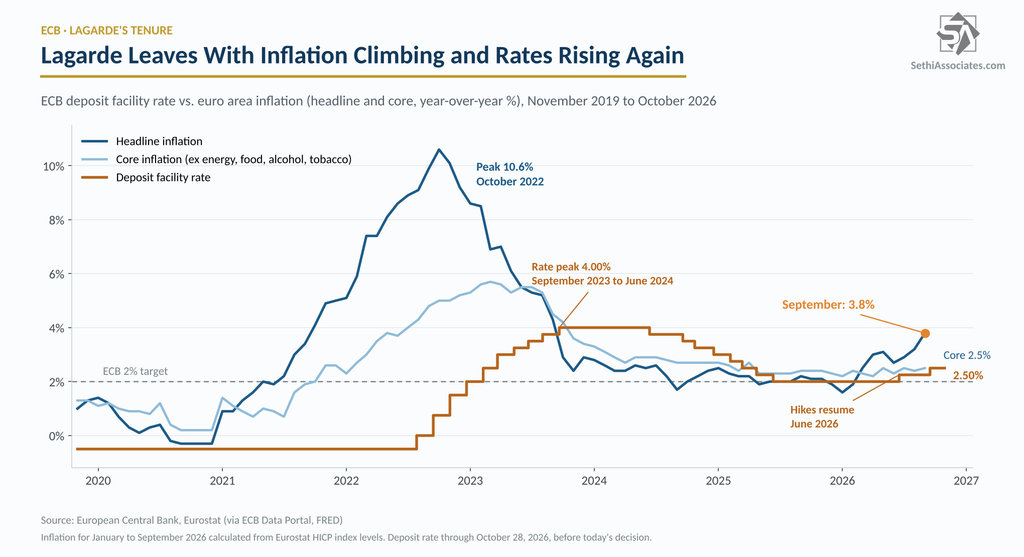
Markets and economists widely expect the ECB to hold its deposit rate at 2.50% later this morning as officials weigh higher energy prices and recent bond-market turmoil. That would follow hikes in June and September to counter elevated inflation tied to the Iran war, but markets expect further tightening, Bloomberg noted. Bloomberg Economics expects Lagarde to wrap up the hiking cycle in December, which could give her successor some room before any further rate changes are needed. Euro area inflation rose to 3.8% in September from 3.2% in August, with core at 2.5%, according to Eurostat.
The decision is due at 9:15 a.m. ET, followed by Lagarde’s press conference at 9:45 a.m. ET.
The Succession Race
Three of the six Executive Board seats — the presidency, the chief economist and the markets portfolio — turn over by May. Isabel Schnabel is leaving a year early to join the International Monetary Fund and Philip Lane’s term expires in May, so governments will likely try to settle all three in one deal, with EU summits in November and December, per Bloomberg.
For the presidency, Spain is backing Pablo Hernández de Cos, general manager of the Bank for International Settlements and former Bank of Spain governor, while the Dutch government is backing former Dutch central bank chief Klaas Knot, the FT reported. Economists surveyed by Bloomberg in October see De Cos as the favorite. Knot built a reputation as a hawk during the eurozone debt crisis but has since softened into a pragmatist seen as responsive to bond-market stress, according to The Wall Street Journal, which also noted that an outsider can’t be ruled out given Lagarde herself was a last-minute pick in a 2019 package deal.
The timing also lets President Emmanuel Macron help pick Lagarde’s successor before his final term ends, with far-right candidate Marine Le Pen leading French polls, which risks accusations of political encroachment on the ECB’s independence, Bloomberg added. Banque de France’s governor also left early, with Macron naming his chief of staff, Emmanuel Moulin, to the post.
Market Reaction
The news barely moved markets following the announcement. The euro was down 0.1% against the dollar at $1.114, per the FT, while the 10-year German Bund yield was 1 basis point lower at 3.36% and the French-German 10-year spread held at 154 basis points, according to Bloomberg. That spread recently hit its widest since 2011, and French long-term borrowing costs topped 5% last week for the first time since 2002 per the FT. Berenberg chief economist Holger Schmieding told the FT the departure doesn’t change the outlook for ECB policy or for how the bank handles French risks.
Q3 GDP Trackers Cluster Near 3.3%, but GDPNow’s History Says Watch for an Upside Miss
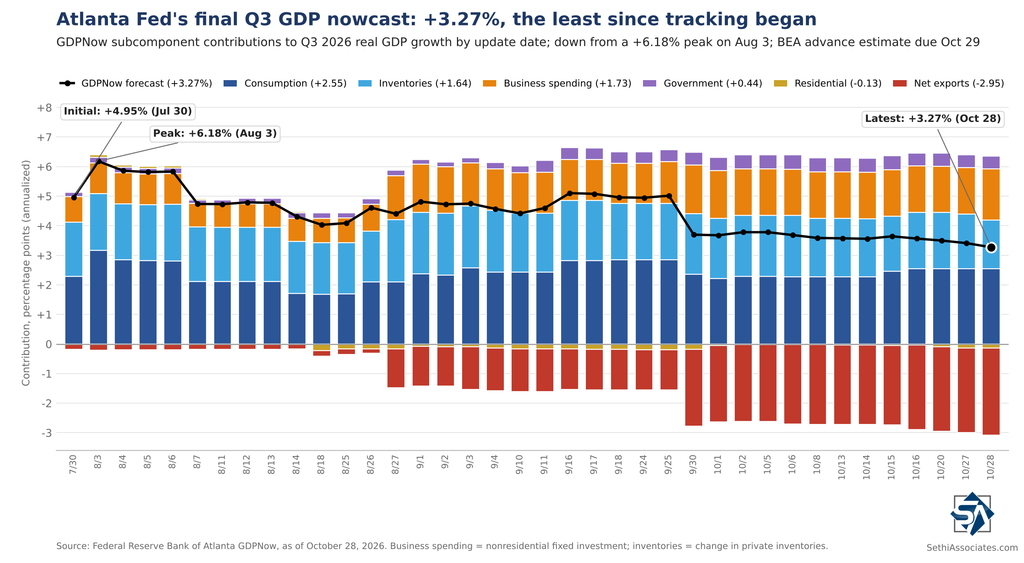
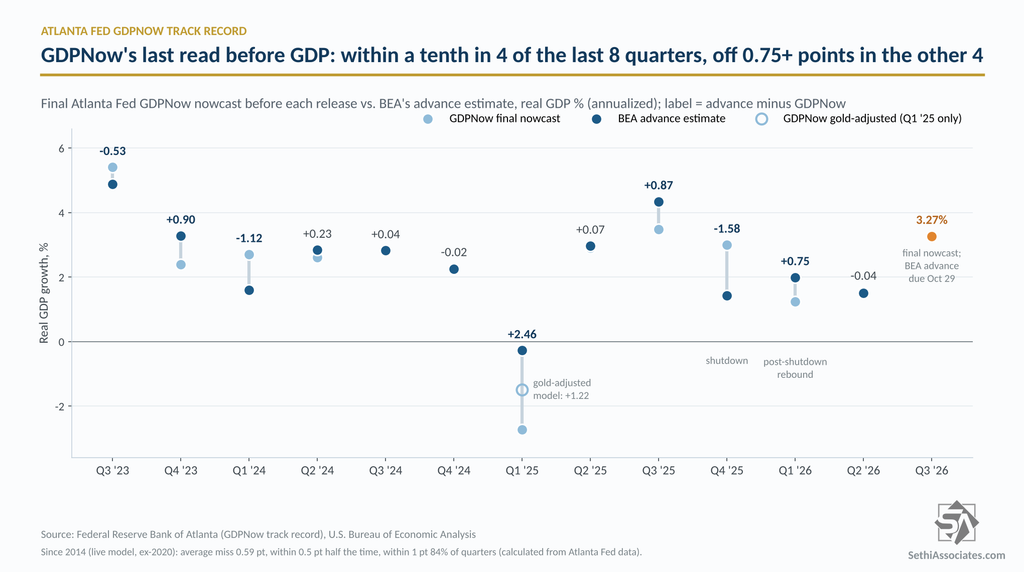
Ahead of Q3 GDP later this morning the Atlanta Fed’s GDPNow final Q3 nowcast came in at 3.27% Wednesday, the least since it initiated tracking for the quarter, down from its 6.18% peak on August 3.
Over the past two years, GDPNow’s last reading before the advance GDP report has been either very close or well off, with little in between. It was within a tenth in four of the last eight quarters (Q3 and Q4 2024, Q2 2025 and Q2 2026) and off by 0.75 percentage point or more in the other four.
Over its history since 2014 (excluding 2020), GDPNow’s average miss has been 0.59 point. It has been within half a point half the time and within a point 84% of the time.
But a couple of unique historical tendencies are worth keeping in mind:
▪ GDPNow’s final reading usually falls from where it stood a month before the release (34 of 56 quarters excluding 2020). That’s what we saw in Q1 and Q2, and now Q3, down 1.75 points from 5.02% on September 25. But when it has fallen more than half a point in that final month, the actual print has come in above its final reading in 16 of 22 quarters.
▪ In third quarters specifically, the advance print has come in above GDPNow’s final reading in 10 of 14 quarters (excluding 2020), by an average of 0.31 point.
Here’s GDPNow’s final breakdown of the components as of October 28 and changes from my last update October 20:
Consumption = +2.55% (0.00%)
Business spending (nonresidential fixed investment) = +1.73% (+0.16%)
Inventories = +1.64% (−0.21%)
Government = +0.44% (0.00%)
Residential investment = −0.13% (−0.03%)
Net exports = −2.95% (−0.09%)
GDPNow Forecast: +3.27% (−0.23%)
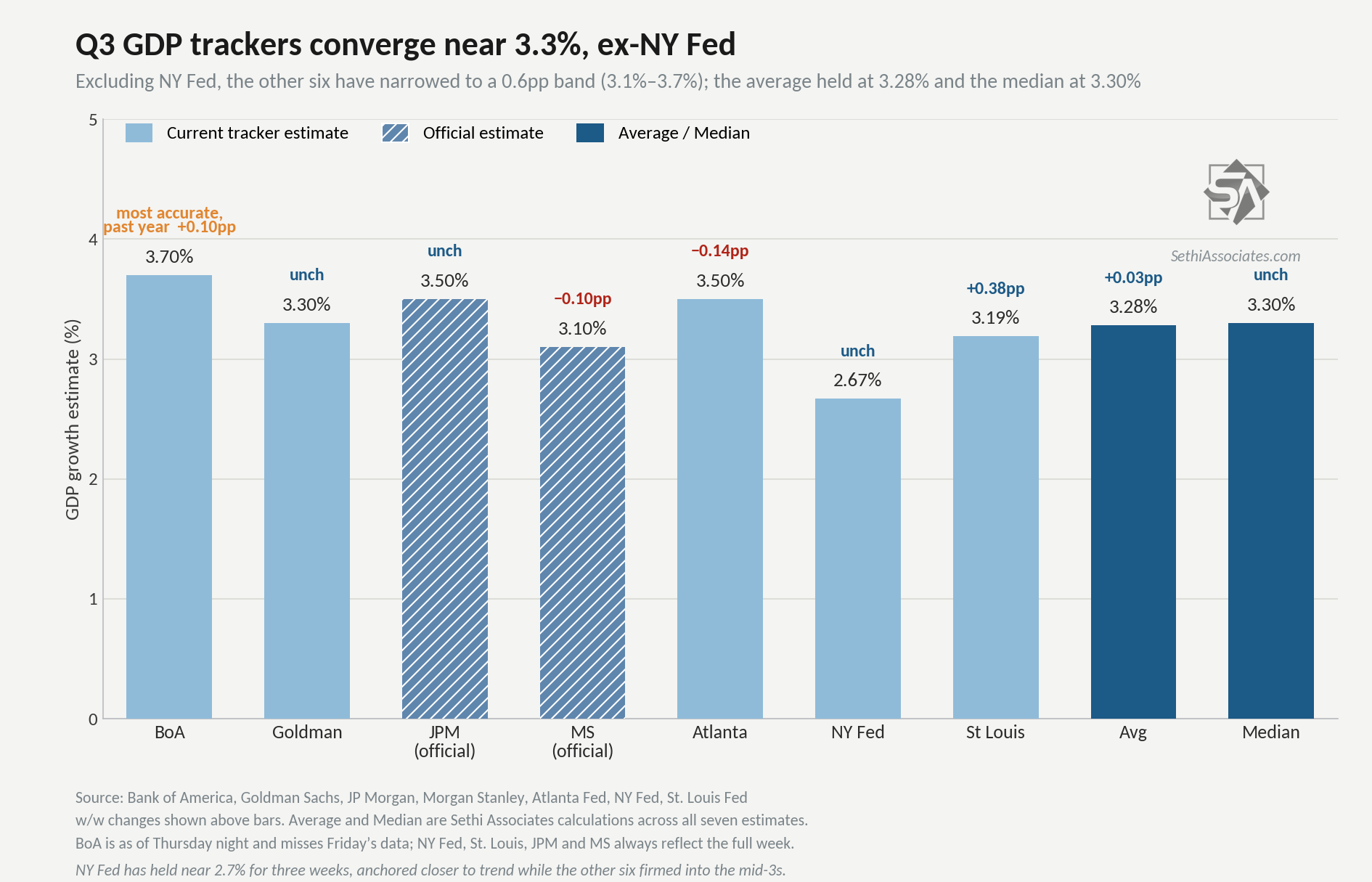
GDPNow, though, has plenty of company this quarter. As of Friday, six of the seven major trackers I follow were between 3.1% and 3.7%. The outlier is the New York Fed’s Staff Nowcast at 2.67%, where it has held for three weeks. The average as of Friday was 3.28% and the median 3.30%.
Bank of America’s tracker has been the most accurate of the group over the past year and is the highest this quarter at 3.70%.
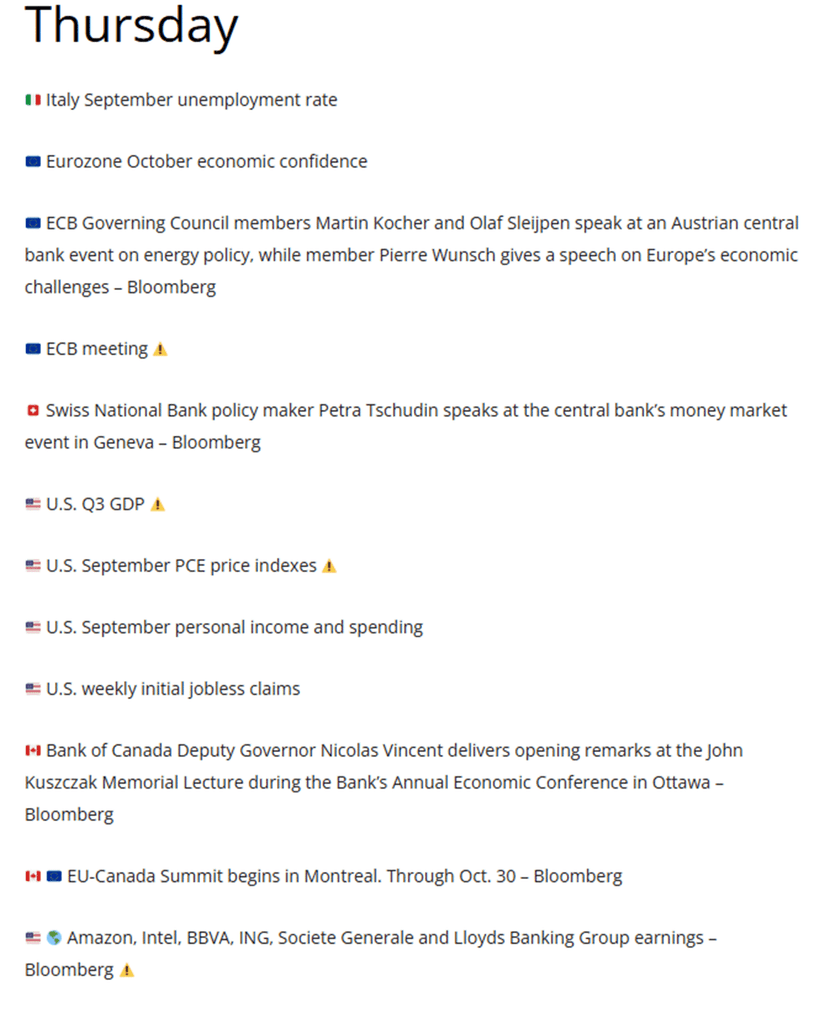
Thursday’s Schedule: GDP and Amazon Headline Another Busy Day
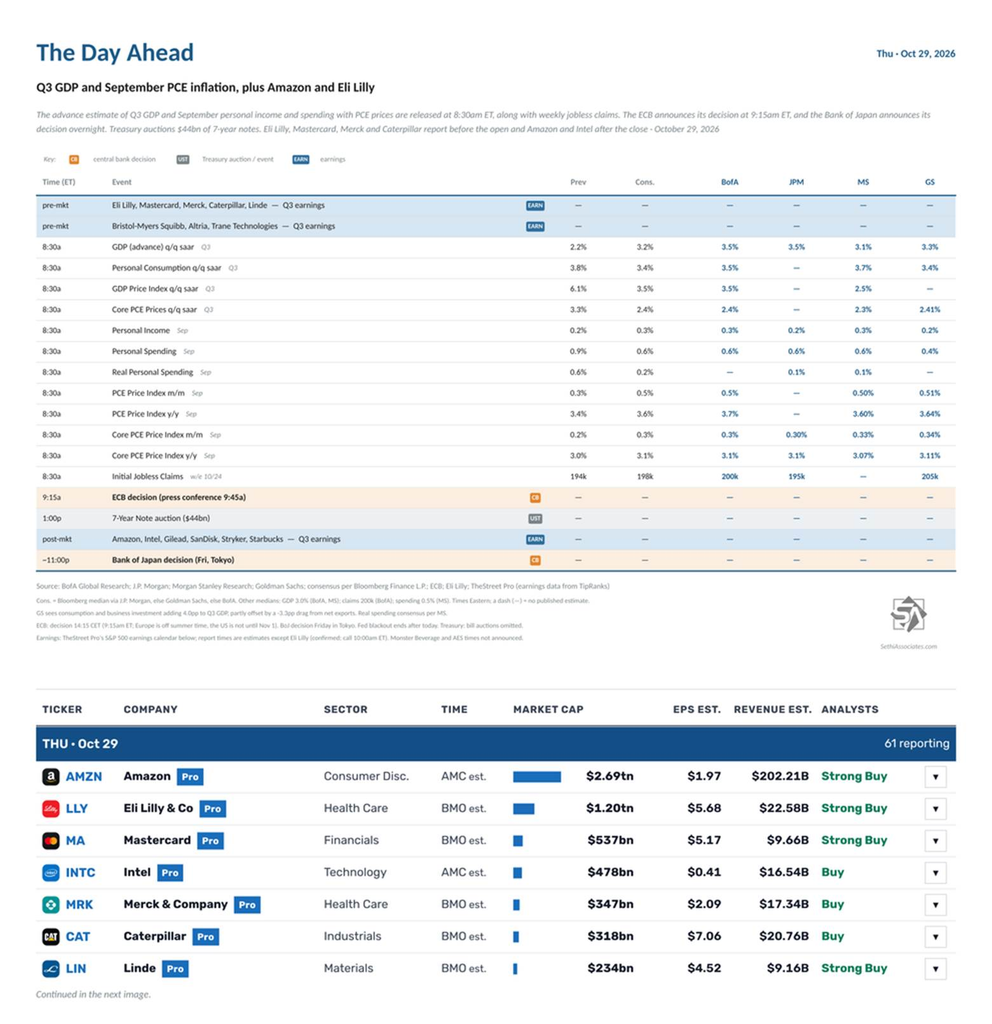
US economic data includes the advance estimate of Q3 GDP, which will incorporate September personal income and spending with PCE prices that will also be separately reported. We’ll also get weekly unemployment claims.
The Fed’s blackout period extends until midnight, with Fed speakers resuming Friday.
The non-Bill (>1yr in maturity) US Treasury auction is $44bn of 7-year notes.
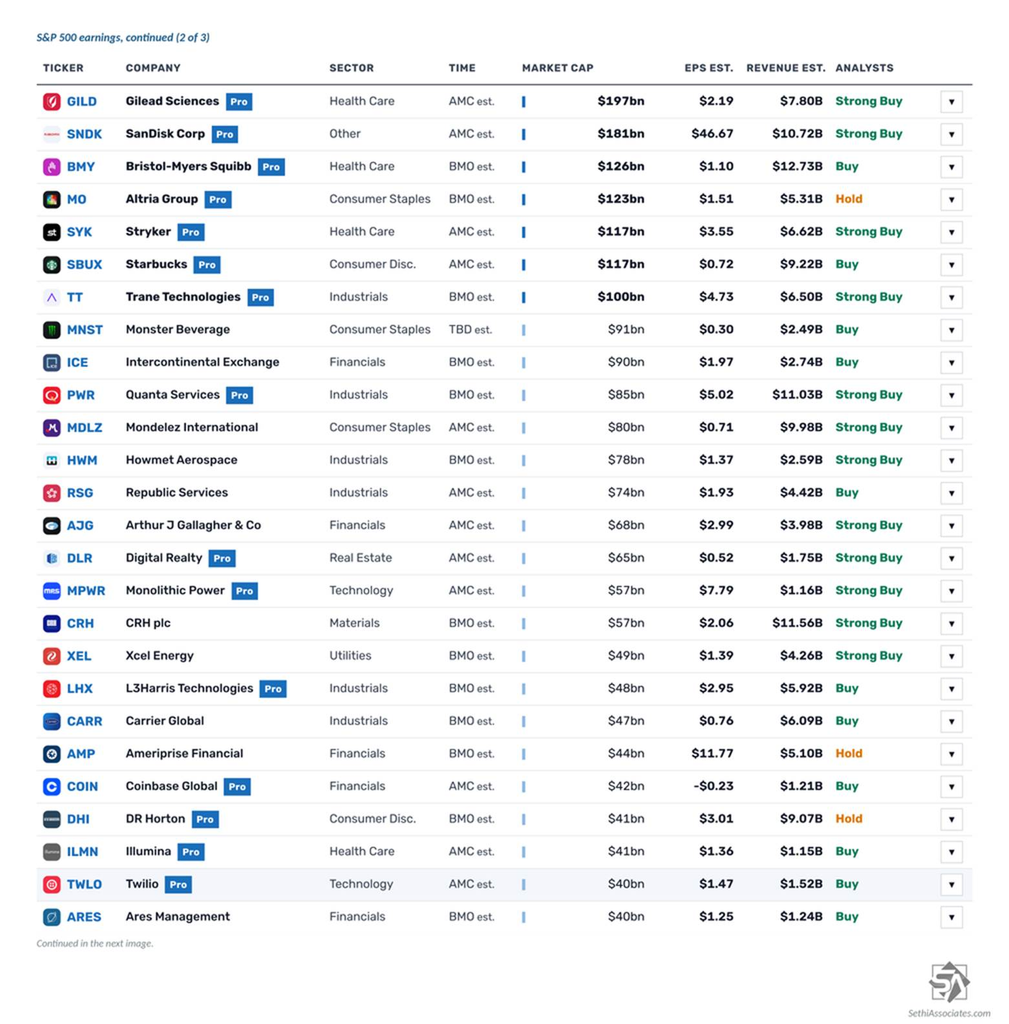
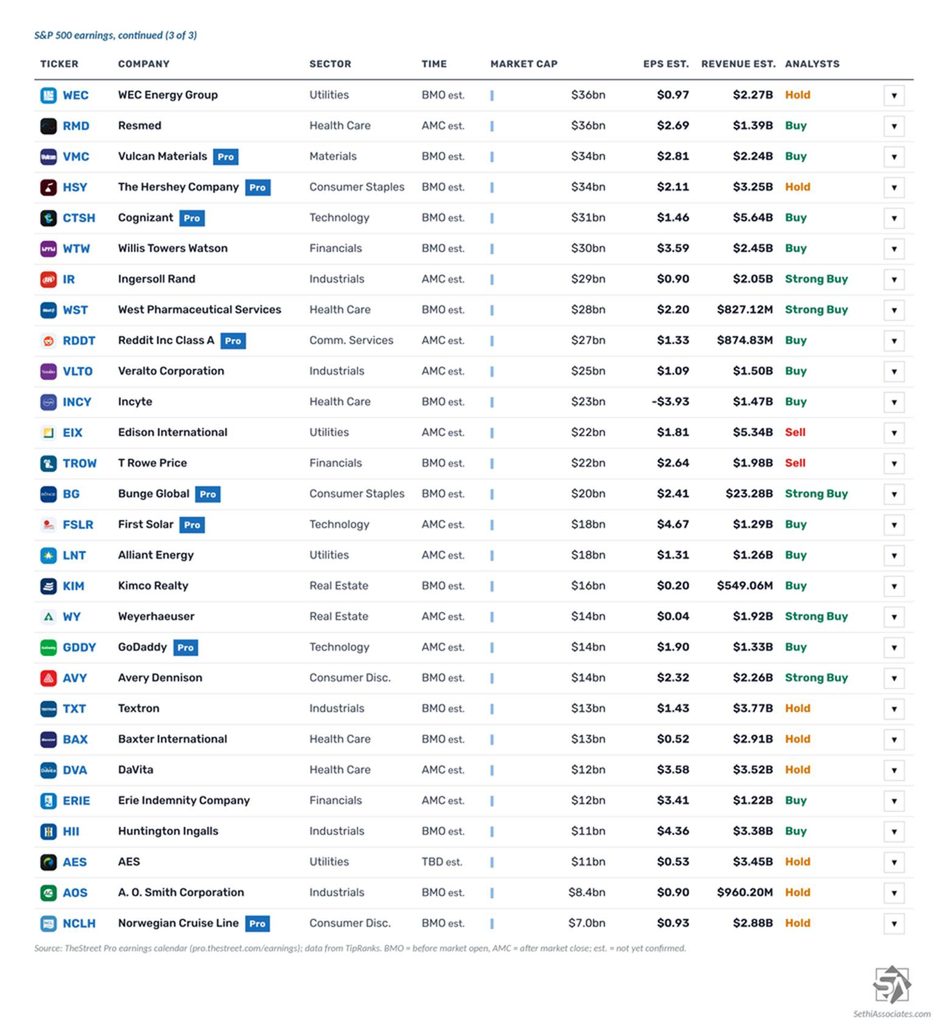
61 S&P 500 components report, 14 of them with market caps over $100bn:61 S&P 500 components report, 14 of them with market caps over $100bn:
Before the open: Eli Lilly (LLY), Mastercard (MA), Merck (MRK), Caterpillar (CAT), Linde (LIN), Bristol Myers Squibb (BMY), Altria (MO), Trane Technologies (TT), Intercontinental Exchange (ICE), Quanta Services (PWR), Howmet Aerospace (HWM), CRH (CRH), Xcel Energy (XEL), L3Harris (LHX), Carrier (CARR), Ameriprise (AMP), D.R. Horton (DHI), Ares Management (ARES), WEC Energy (WEC), Vulcan Materials (VMC), Hershey (HSY), Cognizant (CTSH), WTW (WTW), West Pharmaceutical (WST), Incyte (INCY), T. Rowe Price (TROW), Bunge (BG), Kimco Realty (KIM), Avery Dennison (AVY), Textron (TXT), Baxter (BAX), Huntington Ingalls (HII), A.O. Smith (AOS) and Norwegian Cruise Line (NCLH)
After the close: Amazon (AMZN), Intel (INTC), Gilead (GILD), SanDisk (SNDK), Stryker (SYK), Starbucks (SBUX), Mondelez (MDLZ), Republic Services (RSG), Arthur J. Gallagher (AJG), Digital Realty (DLR), Monolithic Power (MPWR), Coinbase (COIN), Illumina (ILMN), Twilio (TWLO), ResMed (RMD), Ingersoll Rand (IR), Reddit (RDDT), Veralto (VLTO), Edison International (EIX), First Solar (FSLR), Alliant Energy (LNT), Weyerhaeuser (WY), GoDaddy (GDDY), DaVita (DVA) and Erie Indemnity (ERIE)
Time not announced: Monster Beverage (MNST) and AES (AES)
Outside the US, Shell (SHEL), TotalEnergies (TTE) and Volkswagen (VWAGY) report.
Ex-US highlights include a policy decision from the ECB, UK September net consumer credit and M4, Japan October consumer confidence index, Italy September unemployment rate, October consumer confidence index, economic sentiment and manufacturing confidence, Eurozone October economic confidence and Sweden Q3 GDP indicator.
Conversation 0 Comments
One ongoing discussion across all days. Everyone can read; sign in to take part.
Your voice matters. Discussions are moderated for civility. Read our guidelines .
Log in to join the conversation