Core CPI Comes in Hot Again, Putting a Half-Point Fed Hike on the Table
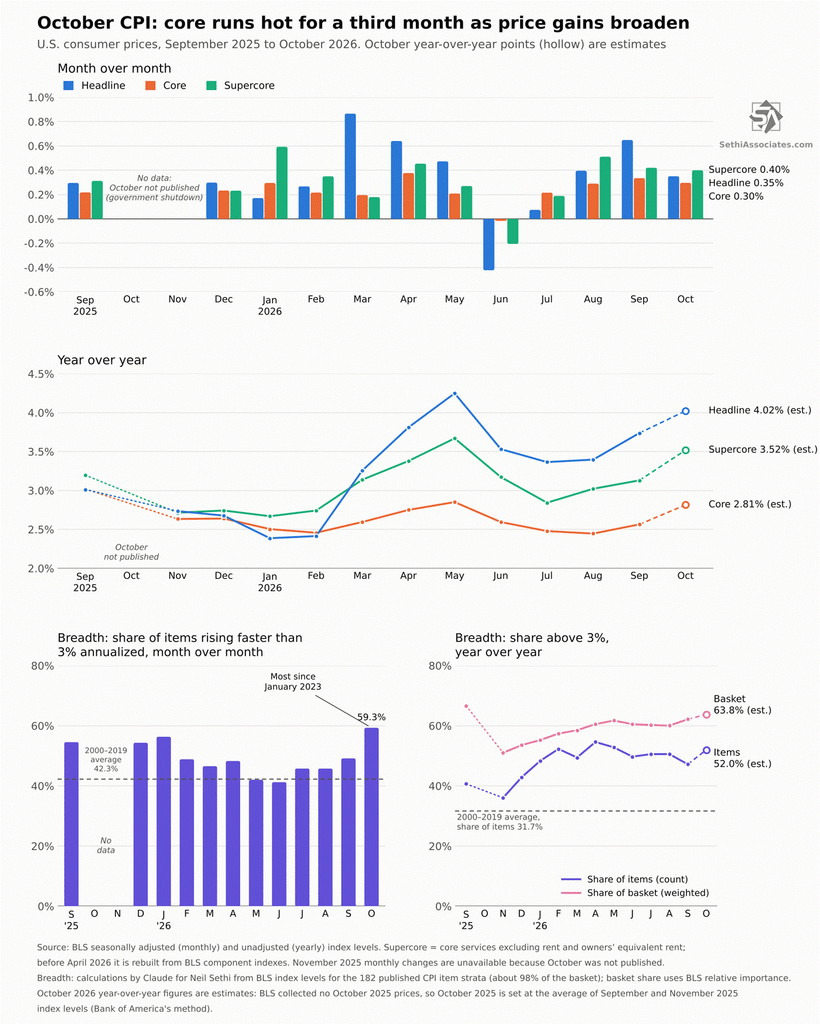
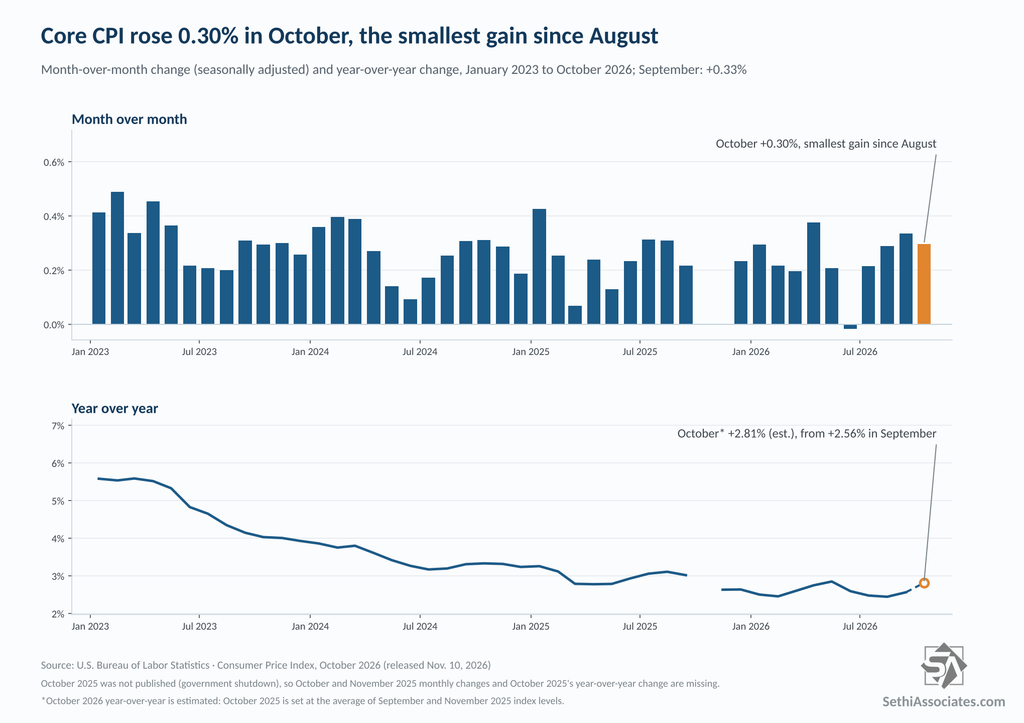
Core prices rose 0.30% in October, a third straight month of 0.29% or more, and right at the threshold Fed Governor Waller set this morning for considering a 50 basis point hike in December.
You've reached your free article limit
You've read 0 of 1 free Pro articles.

— U.S. CPI, October (month-over-month): 0.4% (estimate 0.3%; prior 0.6%)
— Core CPI (month-over-month): 0.3% (estimate 0.2%; prior 0.3%)
— CPI Supercore (month-over-month): 0.40% (prior 0.42%)
— Year-over-year: not published by the BLS for October
Executive Summary
- Core hot for a third month. Excluding food and energy, prices rose 0.30% after 0.33%, a third straight month at 0.29% or more and above the 0.2% consensus. That’s right at the “around 0.3% or even higher” threshold Fed Governor Christopher Waller set this morning for considering a 50 basis point hike (see Fed’s Waller Floats a Half-Point Hike if CPI Runs Hot).
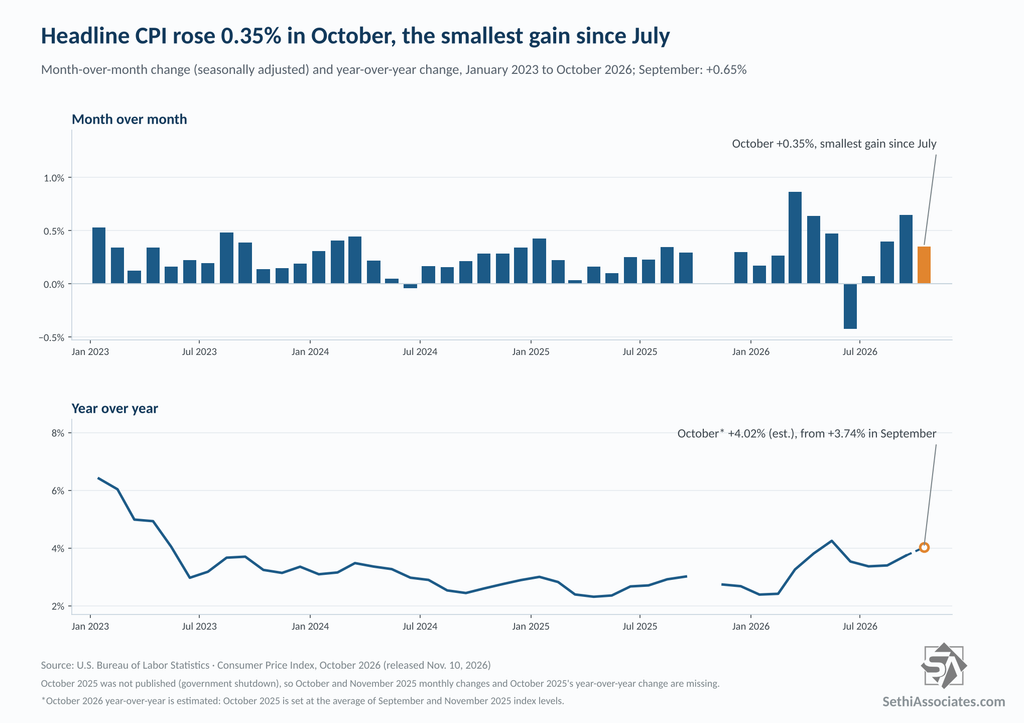
- Headline also hotter than expected. Headline consumer prices rose 0.35% in October, the smallest gain since July, after 0.65% in September, but above the 0.3% consensus and above every estimate but one (per ZeroHedge).
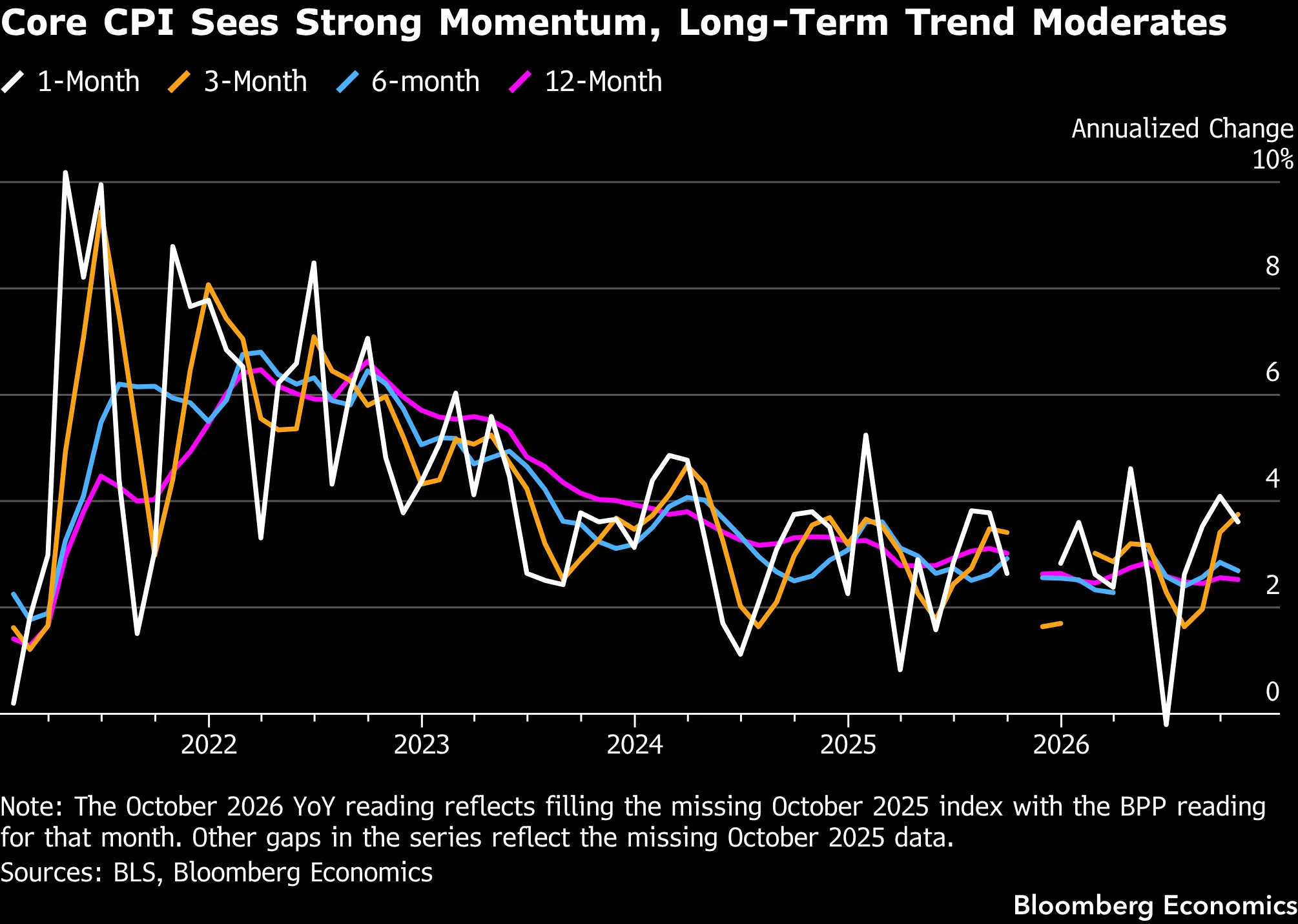
- Annual inflation accelerated, by our estimate. The BLS did not publish year-over-year rates because no October 2025 prices were collected during the shutdown. Our estimates put headline inflation at 4.02%, up from 3.74%, and core at 2.81%, up from 2.56%, both the highest since May.*
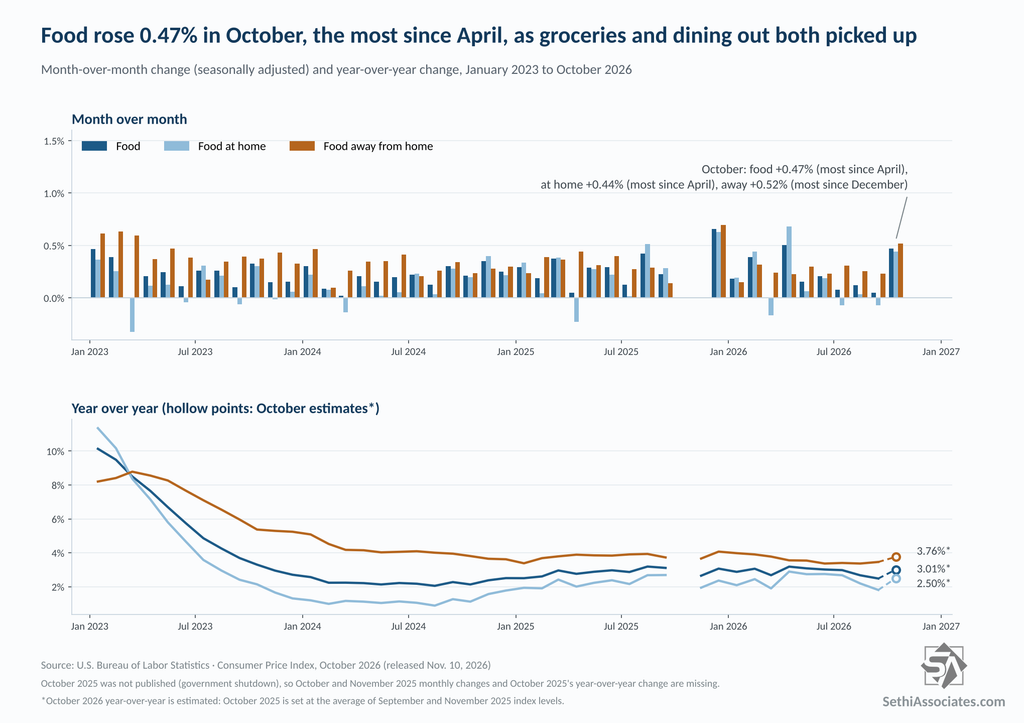
- Food picked up. Food rose 0.47%, the most since April, with groceries up 0.44% after a decline and dining out up 0.52%, the most since December.
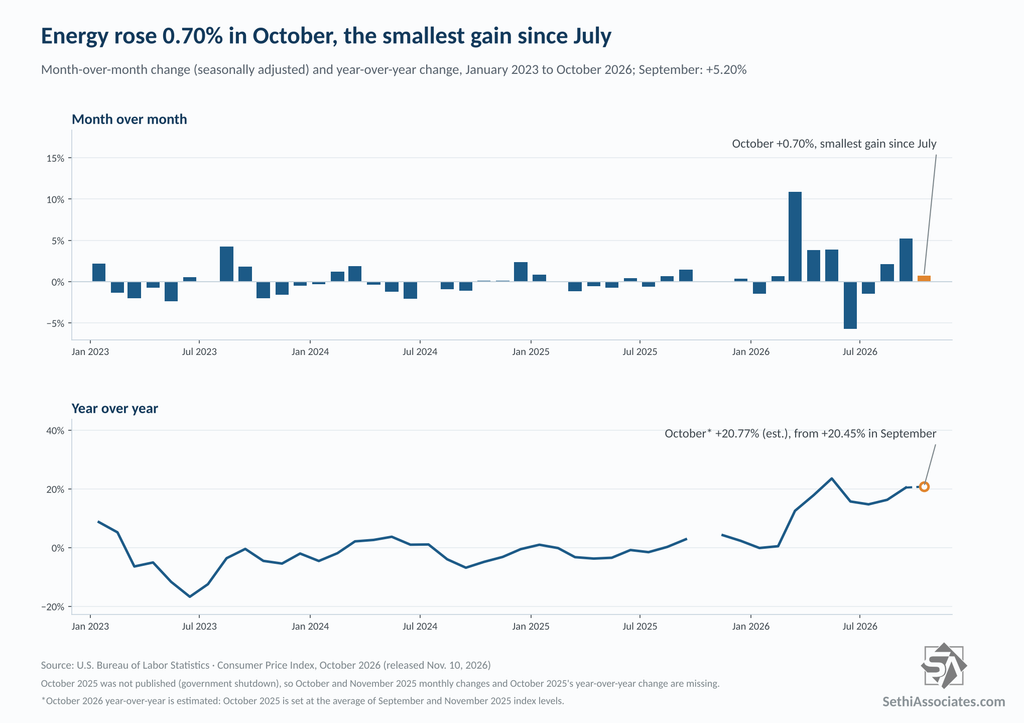
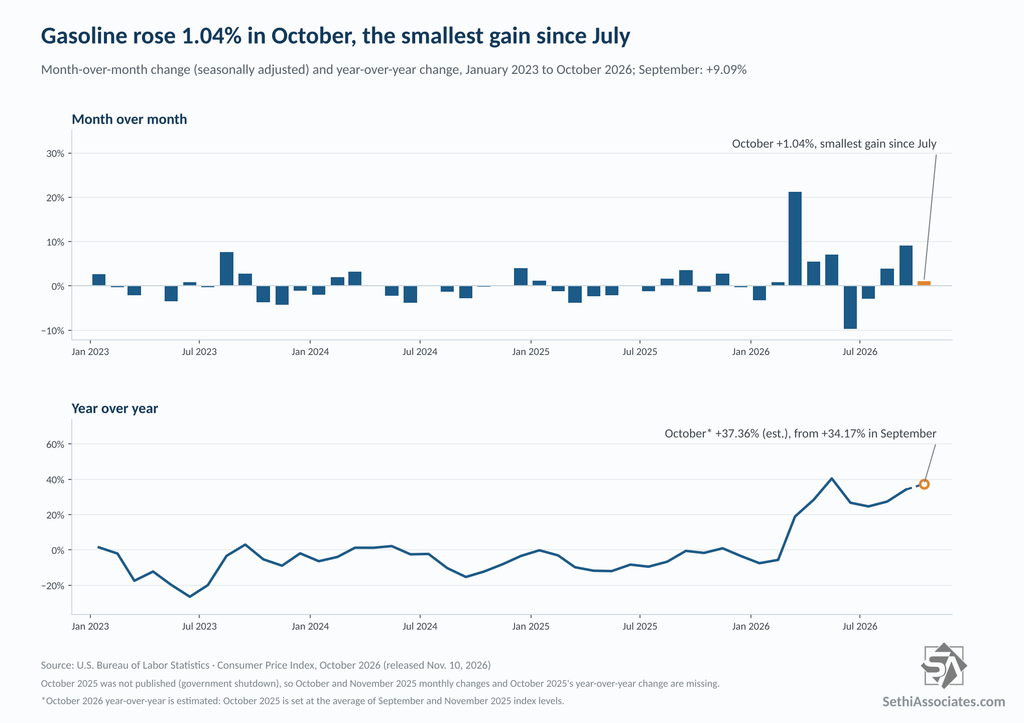
- Energy, though, cooled. Energy rose 0.70% after 5.20%, with gasoline up 1.04% after 9.09%.
- Shelter also eased. Shelter rose 0.30%, the smallest gain since August, with owners’ equivalent rent up 0.32% and rent up 0.20%. Bloomberg said shelter accounted for more than 30% of the monthly increase.
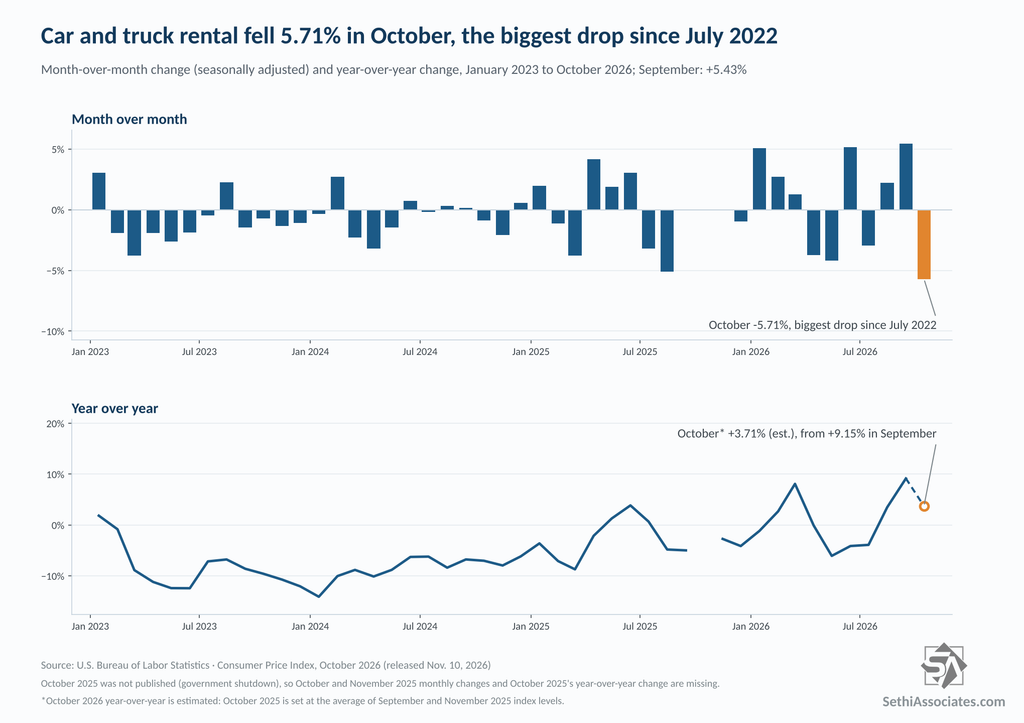
- Services firm, autos soft. Transportation services rose 0.84%, the most since January, and motor vehicle insurance rose 0.71%, the most since January 2025, while car and truck rental fell 5.71%, the biggest drop since July 2022, and used cars fell 1.22%, the most since January.
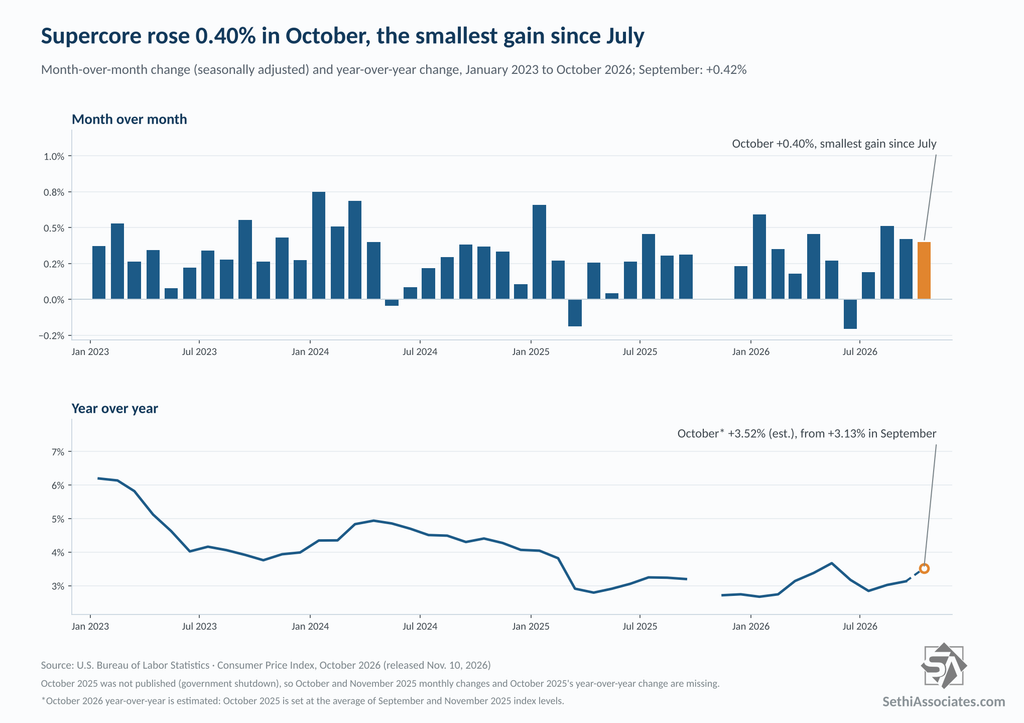
- Supercore stayed elevated. Core services excluding housing, something mentioned by Waller in his speech today (and Chicago Fed President Goolsbee yesterday), rose 0.40% after 0.42% in September, and by our estimate 3.52% from a year earlier, the most since May.*
- Breadth widest since early 2023. 59.3% of categories rose faster than a 3% annualized pace on the month, the most since January 2023, up from 49.2% in September.
- Real paychecks improved to flat. Real average weekly earnings edged up 0.02% after a 0.38% drop in September, revised from 0.51%.
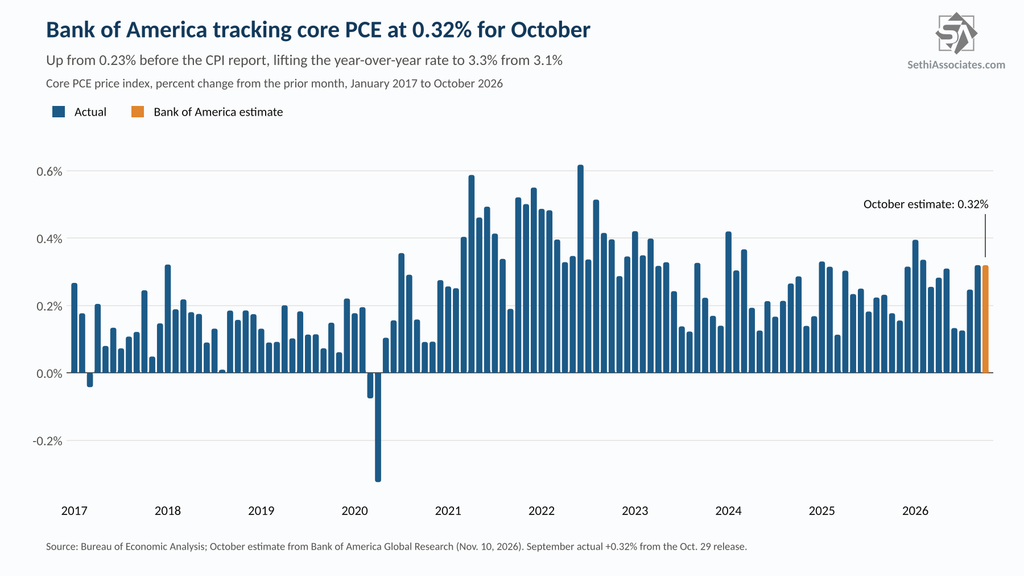
- Core PCE. Bank of America raised its October core PCE tracking estimate to 0.32% from 0.23%, which would lift the year-over-year rate to 3.3% from 3.1%, “a clearly hawkish development.” It said that would meet Waller’s threshold for a 50 basis point hike, though it still expects 25.
- The Fed angle. After the report, CME FedWatch showed a 14% chance of a 50 basis point hike in December, with 28 basis points priced, up from 21 basis points Monday, and 63 basis points of hikes priced through December 2027, about two and a half hikes, up from 50. The two-year Treasury yield rose 11 basis points.
Now let’s take a deeper look with lots of charts and details:
Headline consumer prices rose +0.35% in October, the smallest gain since July, after +0.65% in September, but above the +0.3% expected. ZeroHedge noted that only one of 70 analysts expected a hotter reading. Prices are up +30.83% since January 2020.
The BLS did not publish 12-month changes for October because the government shutdown left no October 2025 prices. To keep the year-over-year series going, we estimated October 2025 index levels as the average of September and November 2025, the method Bank of America uses in its CPI tables. On that basis, headline inflation rose to an estimated +4.02% from +3.74%, the highest since May.*
Energy rose +0.70% after +5.20% in September, with gasoline up +1.04% after +9.09%. The BLS noted that “before seasonal adjustment, gasoline prices decreased 0.7 percent in October.” Electricity rose +0.94%, the most since April, while utility (piped) gas fell -0.76%. Fuel oil rose +2.00% after +15.33%.
By our estimate, energy is up +20.77% from a year earlier, with gasoline up +37.36%, while electricity eased to +3.97% and natural gas to +3.59%.*
Food rose +0.47%, the most since April, after +0.05% in September, with groceries (food at home) up +0.44%, also the most since April, after -0.07%. Per the BLS, “four of the six major grocery store food group indexes increased in October, while one index decreased.” Other food at home rose +0.74%, meats, poultry, fish and eggs +0.54% (beef +0.92%, eggs +0.58%), fruits and vegetables +0.60%, and dairy +0.62%, while nonalcoholic beverages fell -0.27% and cereals and bakery products slipped -0.03%. Coffee fell -3.59%, a record monthly drop, Bloomberg noted, while baby food and formula jumped +5.07%, a record increase. Dining out (food away from home) rose +0.52%, the most since December, with full-service meals up 0.7%, per the BLS.
By our estimate, food is up +3.01% from a year earlier, with groceries up +2.50% and dining out up +3.76%.*
Stripping out food and energy, core prices rose +0.30%, a third straight month at +0.29% or more as noted by Waller this morning, after +0.33% in September and above the +0.2% expected. By our estimate, core is up +2.81% from a year earlier, the most since May, after +2.56%.*
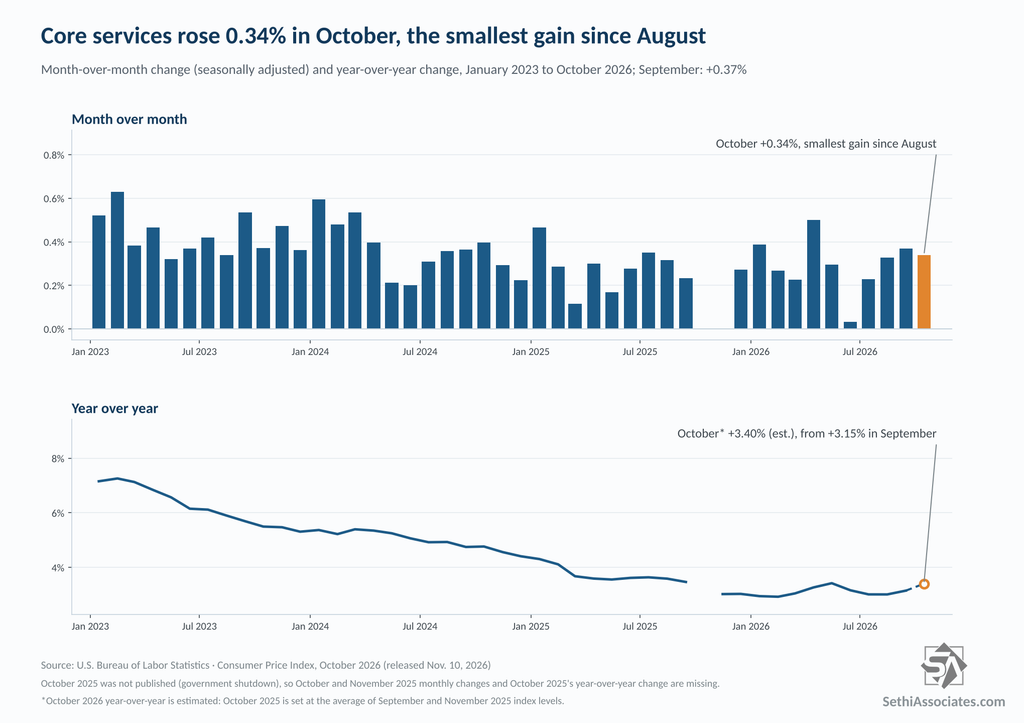
Core services rose +0.34%, the smallest gain since August, after +0.37%. Bloomberg’s Enda Curran said that “as always, it’s a line up of usual suspects in terms of where price pressures were evident: recreation, medical care, motor vehicle insurance, furniture and education.” By our estimate*, core services are up +3.40% from a year earlier.
Transportation services rose +0.84%, the most since January, as motor vehicle insurance rose +0.71%, the most since January 2025, and vehicle maintenance and repair rose +0.62%, while airline fares rose +0.41% after +1.16%. But car and truck rental fell -5.71%, the biggest drop since July 2022, after September’s +5.43%.
Medical care services rose +0.30%, the most since July, with hospital services up +0.79%, the most since January, dental services +0.82% and physicians’ services +0.41%. Health insurance fell -1.85%, the biggest drop since September 2023. Bloomberg’s Jeffrey Sparshott noted that economists had expected the decline, and that the BLS does not price insurance premiums directly, using an indirect “retained earnings method” in its semiannual update instead. Recreation services rose +0.88%, the most since December, and education +0.33%, while communication slipped -0.09%.
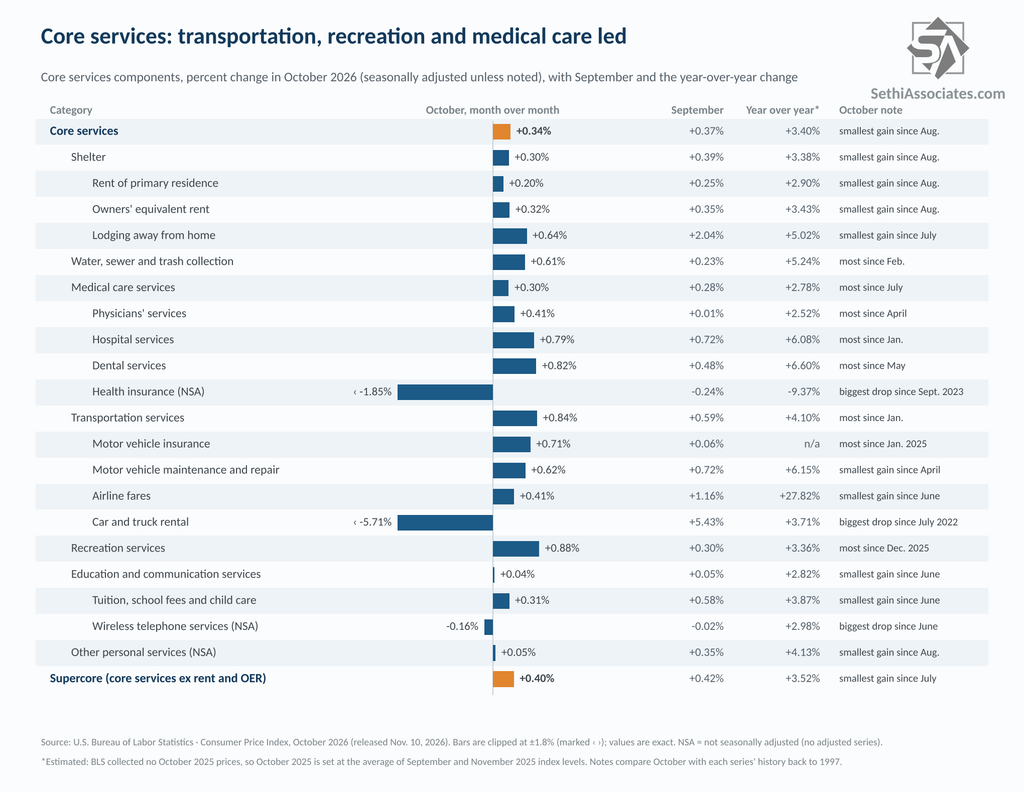
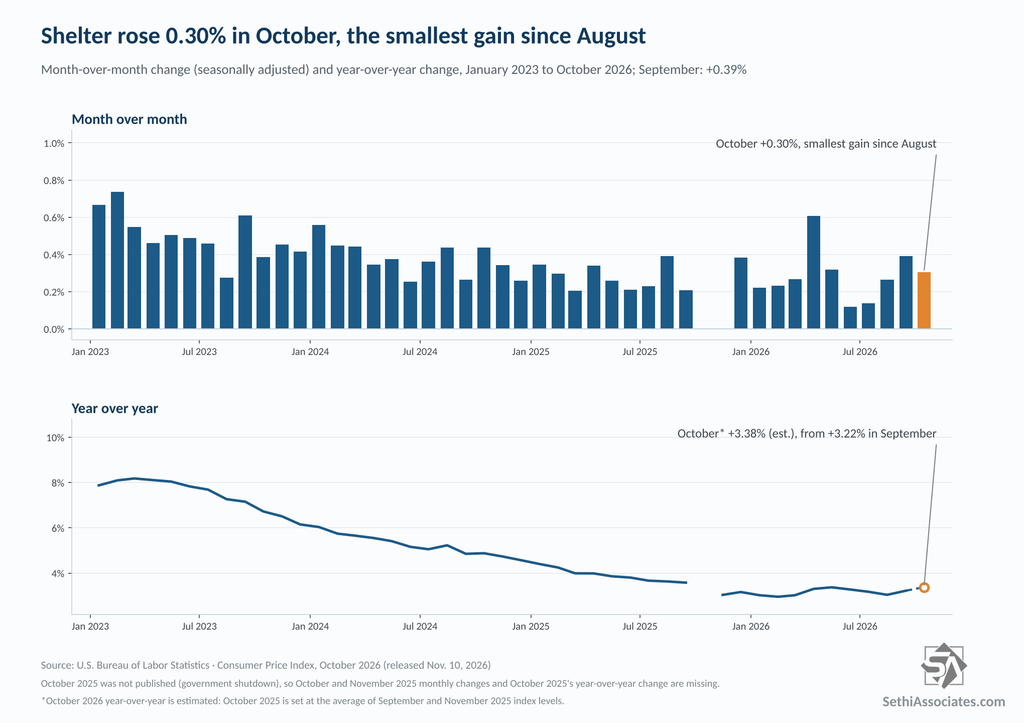
Shelter rose +0.30%, the smallest gain since August, after +0.39%, as owners’ equivalent rent rose +0.32% and rent of primary residence +0.20%. Bloomberg said shelter accounted for more than 30% of the monthly increase in prices. Lodging away from home rose +0.64% after +2.04%.
By our estimate shelter is up +3.38% from a year earlier, with owners’ equivalent rent +3.43% and rent +2.90%.*
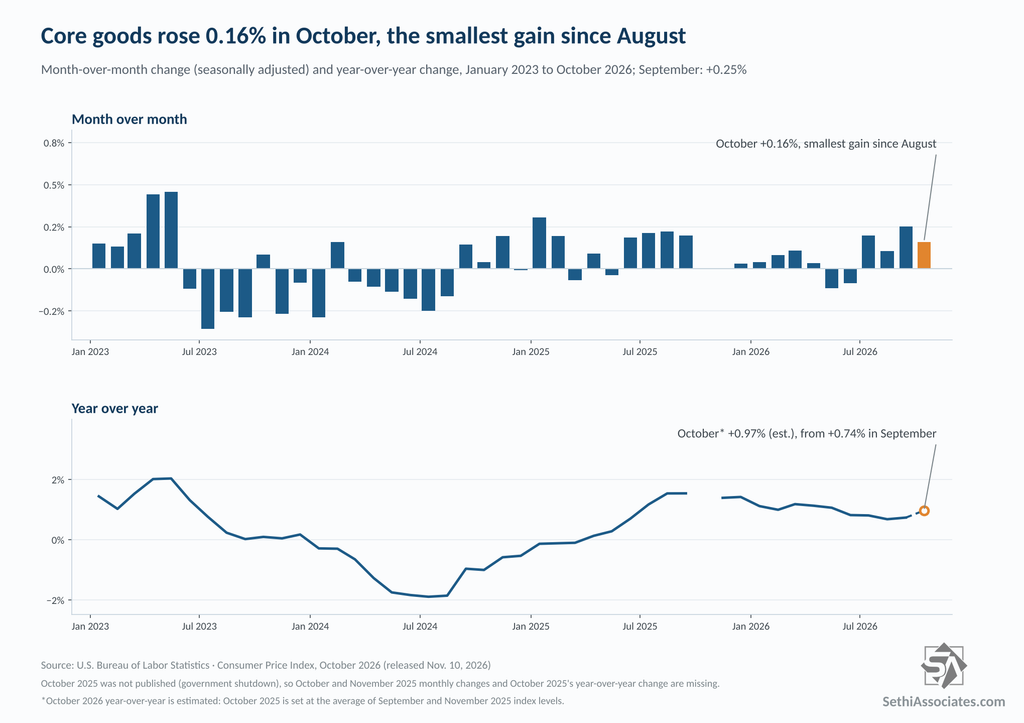
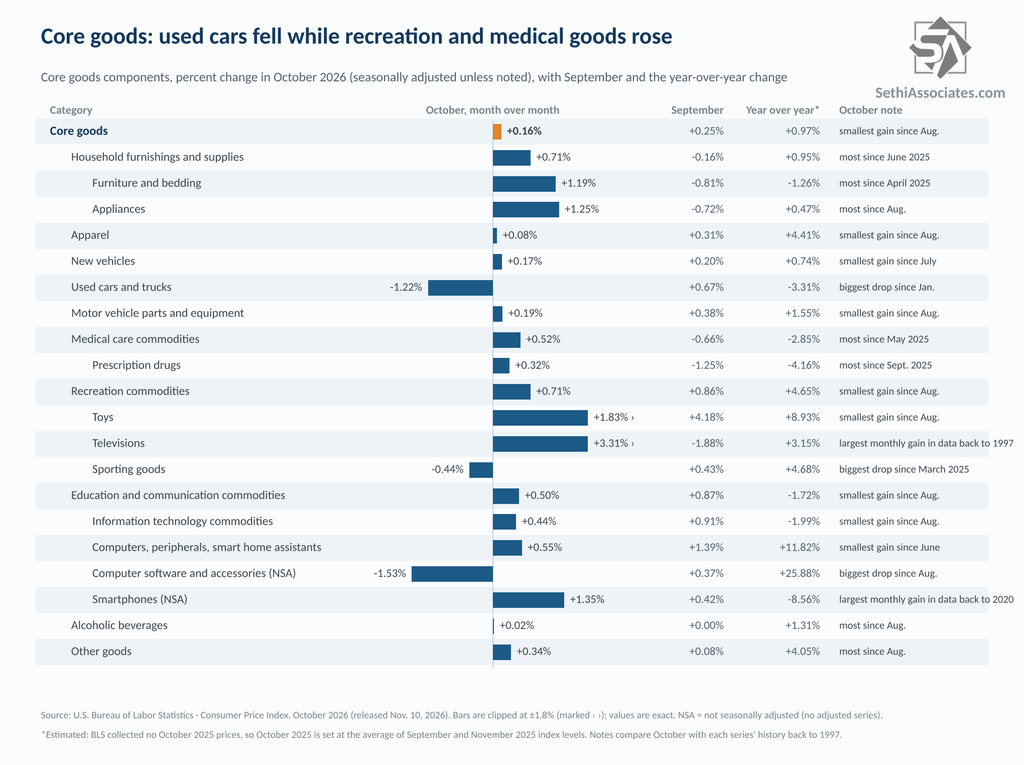
Core goods rose +0.16%, the smallest gain since August, after +0.25%. Used cars fell -1.22%, the most since January, while new vehicles rose +0.17%. Apparel rose +0.08%, medical care commodities +0.52%, the most since May 2025, with prescription drugs up +0.32%, and toys +1.83% after September’s record +4.18%. Bloomberg noted that smartphones posted a record monthly gain, which its Micah Barkley said came “as smartphone makers compete for memory chips amid surging demand for RAM from the artificial-intelligence industry.” Computers rose +0.55%, while computer software fell -1.53%.
By our estimate, core goods are up +0.97% from a year earlier, the most since May, after +0.74%.*
Supercore (core services excluding housing), which was referenced by Governor Waller this morning, remained elevated at +0.40% after +0.42% in September. By our estimate, it is up +3.52% from a year earlier, the most since May, after +3.13%.*
Breadth: the widest monthly gains since early 2023. Fed Chair Kevin Warsh has pointed to breadth, the share of categories with prices rising faster than 3%, as a key indicator. In October, 59.3% of the 182 CPI item categories rose at a monthly pace that would exceed 3% over a full year, the most since January 2023 and up from 49.2% in September, against a 42.3% average from 2000 to 2019. Over three months, the share rose to 52.5%, the most since March, and over six months to 42.4%, the most since July, from 37.7%. Bloomberg Economics had estimated the six-month measure at around 42%.
Looking year-over-year, our estimate is that 52.0% of categories rose more than 3%, the most since May, up from 47.2%, or 63.8% of the basket by weight, the most since September 2025. The share above 5% rose to 26.0% of categories (15.8% of the basket) from 23.0%, while the share falling from a year earlier dropped to 20.8% from 27.5%.*
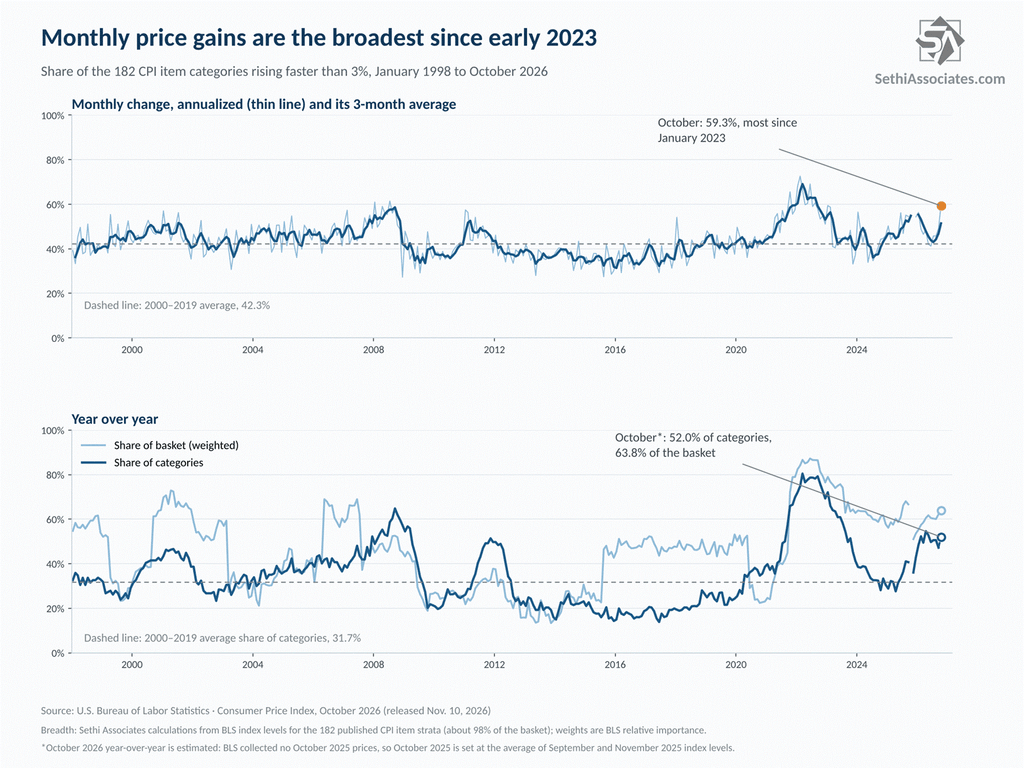
* Year-over-year figures for October are estimates. The BLS collected no October 2025 prices, so we set October 2025 index levels at the average of September and November 2025 (Bank of America’s method). Breadth figures are our own calculations from BLS index levels, not a BLS or Street-published statistic.
On the read-through to households, real (inflation-adjusted) average weekly earnings edged up +0.02% in October after a -0.38% drop in September, revised from an originally reported -0.51%. The BLS did not publish a year-over-year change, but by our estimate real weekly earnings fell -0.22% from a year earlier, the biggest decline since May, after a revised +0.04% in September (originally -0.09%).* Bloomberg cited RSM US chief economist Joseph Brusuelas’s estimate of a 4% increase in headline prices from a year ago, compared with average hourly earnings up 3.1%, making October “the seventh consecutive month where inflation has outpaced pay.”
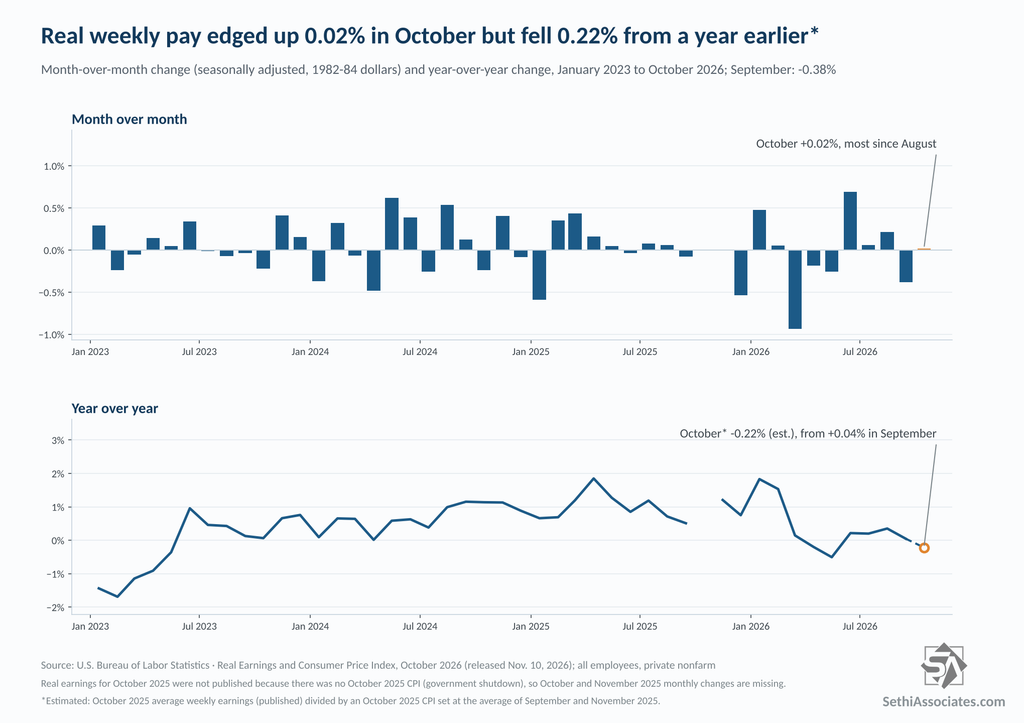
Bloomberg’s Sarah Foster noted that, indexed to January, headline inflation has risen 3.33% this year, “roughly a percentage point faster than wages (2.29%).”
Core PCE
Bank of America said the CPI data “topped our expectations, driven in part by broad-based strength in goods inflation. This could be evidence of energy and AI related input cost pass through.” It is now tracking October core PCE at 0.32% month over month, up from its initial 0.23% estimate, which it said “would lift the y/y rate to 3.3% from 3.1%, which is a clearly hawkish development.” For headline PCE, it is tracking 0.34% and 3.9% from a year earlier.
“Our core PCE tracking estimate would meet Governor Waller’s threshold for a 50bp hike in December based on his remarks from this morning,” Bank of America said. “That helps explain the move in market pricing. We still think the Fed goes 25bp for now, but the door to a larger hike at its next meeting has opened further after today’s data.”
Fed Readthrough
Before the report, Fed Governor Christopher Waller said in a speech in London: “If, as I expect, the monthly rate of inflation improves in October, I am leaning toward supporting an increase in our policy rate of 25 basis points. But if the October CPI inflation data out later today are similar to the past two monthly readings — with core CPI inflation around 0.3% or even higher — then a stronger policy move may be needed. In that case, I believe a 50 basis point hike in the policy rate should be considered at the December meeting.”
After the report, the CME FedWatch tool showed a 14% chance of a 50 basis point hike at the December 8–9 meeting, with 28 basis points priced, up from 21 basis points Monday, and 63 basis points of hikes priced through December 2027, about two and a half hikes, up from 50 basis points. The two-year Treasury yield rose 11 basis points.

Curran wrote that “we may have a new Fed debate over coming weeks — it’s no longer about hiking in December, it’s by how much,” though “we haven’t had any indication of support for [a 50 basis point move] so far, but we have a full slate of speakers to get through over coming days — not least Vice Chairs Jefferson and Williams.”
And Bloomberg Economics’ Anna Wong and Troy Durie: “October’s CPI report is the last one the FOMC will see before its Dec. 8-9 meeting – and it’s hot. For a Fed sounding the alarm on inflation, October’s CPI likely sealed the deal for a December rate hike. Still, details of the report were better than the headline. Core goods inflation came down meaningfully, driven by price cuts in cars. AI-exposed electronic items also moderated – the data suggest AI-driven inflation has peaked from a few months ago. The hot print was driven by bulk items exposed to increased metal and freight charges, recreation services and stray items in services. The bar for not hiking is now high. Even if financial conditions tighten sharply — as we expect — our new baseline is that the Fed is likely to raise rates in December.”
Christopher Hodge of Natixis called the third straight core print rounding to 0.3% an “unacceptable pace for the Fed,” adding: “Given the stickiness of inflation, though not reaccelerating, and Waller’s comments, 50bps is squarely on the table for the Fed in December.” He also noted that November CPI will be released the day after the December meeting: “The FOMC will have access to that, but obviously we will not. Even if markets are pricing 25 for December, if the November print is high, that could be a good time for a surprise jumbo hike.”
Other Analyst Reaction
- Alex Pelle, Mizuho: “The Fed skipped October and now will probably need to do some make up. [The] debate will likely be between 25 vs 50 bps at the December meeting (not 0 vs 25).”
- Eric Winograd, AllianceBernstein: “The lack of downward momentum in the inflation data argues that the Fed has more work to do. I expect quarterly hikes (25 bps) until downward momentum becomes more evident.”
- Steve Sosnick, Interactive Brokers: “At first glance there is nothing to like. Both headline and core rose faster than expected, and stocks and bonds are responding in an accordingly negative manner. These numbers make it very difficult to refute Christopher Waller’s comments about the need to hike in December.”
- Ira Jersey, Bloomberg Intelligence: “The higher-than-expected CPI print across the board puts Waller’s 50-bp December on the table, so the knee-jerk bear flattening not a big surprise. We think the curve will continue to flatten until such time the Fed stops. If it does go 50 bps in December, we think the odds they finish with a March increase is extremely high.”
- Audrey Childe-Freeman, Bloomberg Intelligence: “This means yield-driven dollar upside for now, though a more aggressive Fed this year would raise question marks as to how much tightening will be in the pipeline for 2027.”
- “It’s clear the Fed can hike a little bit more in an effort to calm inflation without harming the labor market, as the labor market is already on sound footing,” said Skyler Weinand at Regan Capital per Bloomberg.
- ZeroHedge noted that “this appears to be ‘peak energy’ CPI as oil and refined product prices have fallen notably since this print,” and Bloomberg reported that U.S. gasoline prices have dropped below $4 a gallon.
The next CPI and Real Earnings reports, for November, are due the day after the Fed’s December 8–9 meeting.