Equity Indices End Lower, But Bounce on Hopes For More Restrained Fed
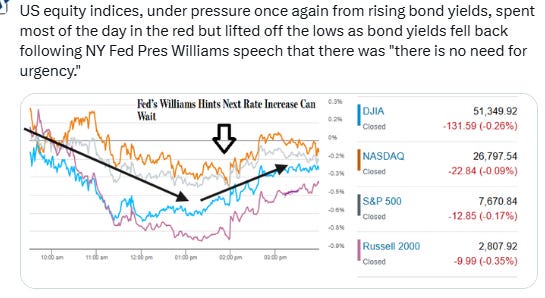
Major indices were down for a second session Tuesday but finished well off the lows after a key Fed voice said there’s “no need for urgency” on rate hikes.
You've reached your free article limit
You've read 0 of 1 free Pro articles.
Quick Summary
- The S&P 500 fell again Tuesday despite a fall in oil prices as the 30-year Treasury yield hit its highest levels since 2002. The major averages though finished well off their lows after NY Fed President Williams said there’s “no need for urgency” on rate hikes which saw yields pull back, boosting equities.
- Indices spent most of the day in the red though under pressure from rising yields which hit new highs before the Williams speech. At day’s end the Dow Jones Industrial Average was -0.3%, S&P 500 -0.2%, Nasdaq -0.1%, and Russell 2000 -0.4% — all down a second straight session.
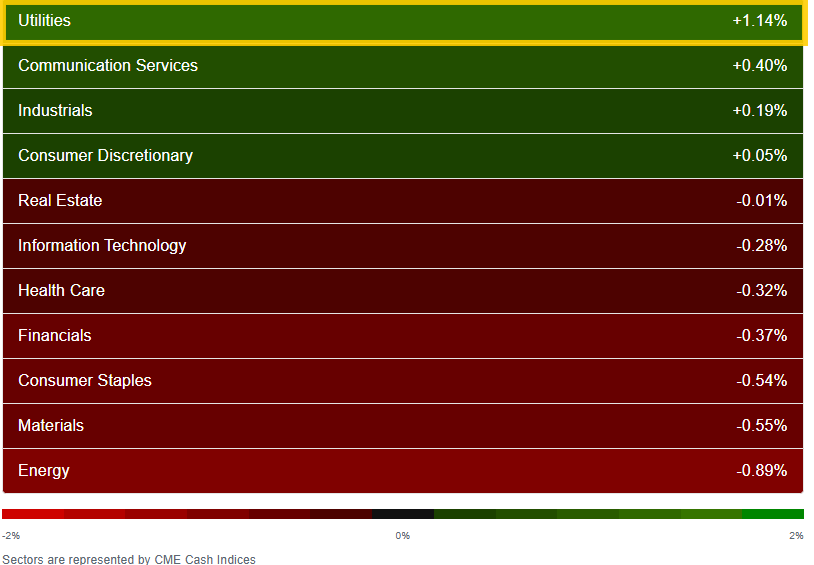
- Breadth stayed soft with 4 of 11 sectors higher, led by a bounce in beaten-down Utilities (+1.1%, the only sector up more than 0.4%).
- The 30-year Treasury yield touched ~5.62% intraday (highest since 2002) and the 10-year ~5.29% — but Williams’s remarks sent October hike odds tumbling to ~50% from ~70% (according to CME’s FedWatch tool).
- The rise in yields during the session was despite WTI falling 3.4% to ~$89 (Brent below $103) as Saudi Arabia boosted flows through a key pipeline, overshadowing concerns over a US-Iran stalemate. The kingdom was said to have restored about half the capacity of its East-West pipeline following drone attacks. In the US, the Trump administration is releasing up to 40 million barrels from the nation’s emergency reserve, further pressuring prices on Tuesday. While the nearest Brent contract remains in the triple digits, it’s just a day away from expiry on Wednesday, and the more active December futures settled near $96.
- Data also reduced concerns about “too strong” growth as job openings hit a 5-month low and consumer confidence fell to its lowest since 2014.
- Attention turns to a full Wednesday calendar headlined by the August personal income and spending report (our most complete look at incomes and spending which also contains PCE prices, the Fed’s preferred inflation gauge). We’ll also get the third estimate of Q2 GDP accompanied by the annual revisions to GDP and PCE, and the September ADP job growth report among others.
Market Commentary
Equities:
- The latest labor-market data reinforces the “low-hire, low-fire” backdrop that has taken hold, according to Bret Kenwell at eToro. On the consumer-confidence front, he says the disappointing headline figure should not come as a surprise. “Sentiment now sits at multi-year lows as persistent inflation and higher costs weigh on households,” Kenwell noted. “The question becomes whether we’ll see this materialize into weaker consumer spending — a question that earnings season will help answer.”
- “The markets are believing that inflation will come down [and] that it will come with demand destruction,” Jeff Klingelhofer, a managing director and portfolio manager at Aristotle Pacific Capital, told CNBC. “That’s why equities are down [and] that’s why rates are up…the markets are shifting to a belief that [Fed chairman Kevin] Warsh has that resolution.”
Bonds:
- “This week’s data will test how much more the long end can absorb,” said Laura Cooper, global investment strategist and head of macro credit at Nuveen. “Core PCE and payrolls will be particularly important, although we see relatively benign prints as not adding to the hawkish narrative.”
- “Investors remain very focused on inflation and they’re more worried about the fiscal deficits here in the U.S… [as well as] the amount of Treasury supply,” JoAnne Bianco, senior investment strategist at BondBloxx Investment Management, told CNBC. “All of those things make them think there needs to be more term premium.”
- “With the PCE [inflation] report on Wednesday and the jobs report on Friday, it is a pretty big week for markets,” Michael Kramer of Mott Capital Management says in a bulletin sent late Monday. “Clearly, numbers that come in higher than expected in either report could be enough to send yields even higher. The trouble is that above 5.25%, a move to 5.5% becomes a fairly easy path, with little resistance in the way,” he adds.
- Mizuho Securities’ senior economist, Alex Pelle, thinks U.S. 10-year yields have probably gone high enough to warrant rating them somewhere between “somewhat cheap” and “close to fair value.” While not discounting the possibility that rates trade a bit higher, Pelle’s base case is that eventually they will settle “modestly lower.” In a note published late on Monday, Pelle outlined his view that the Fed will probably hike twice more but he struggles to see the case for the policy rate rising to 5% as markets currently seem to be pricing. There is no fundamental justification for the recent weakness in bonds, Pelle argues, so he thinks technical factors and positioning probably explain the move. Pelle says the rise in Treasury yields is doing some of the heavy lifting for Fed Chair Kevin Warsh by perhaps subduing some consumer demand, and if data comes in strong this week — as Pelle suspects — then markets may frontload those expected rate hikes.
Fed:
- “Overall, the latest communications are consistent with our baseline projection of two additional 25 basis point hikes in December and March, though two-sided risks surround this outlook. A further tightening of the labor market, stubborn underlying inflation, or evidence that AI-related capital expenditure is broadening demand could bring an October hike into play,” said analysts at Deutsche Bank in a note published late Monday.
- “We read this as most consistent with skipping October and hiking in December,” said Krishna Guha at Evercore.
Stock and Sector Breakdown:
Sector breadth remained soft with 4 of 11 sectors higher Tuesday (after 3 Monday) led by a bounce in beaten down Utilities (see post below) the only sector up over +0.4%. On the other side though after eight sectors were down more than that Monday just three were Tuesday (Staples, Materials, Energy) but none more than -0.9%.
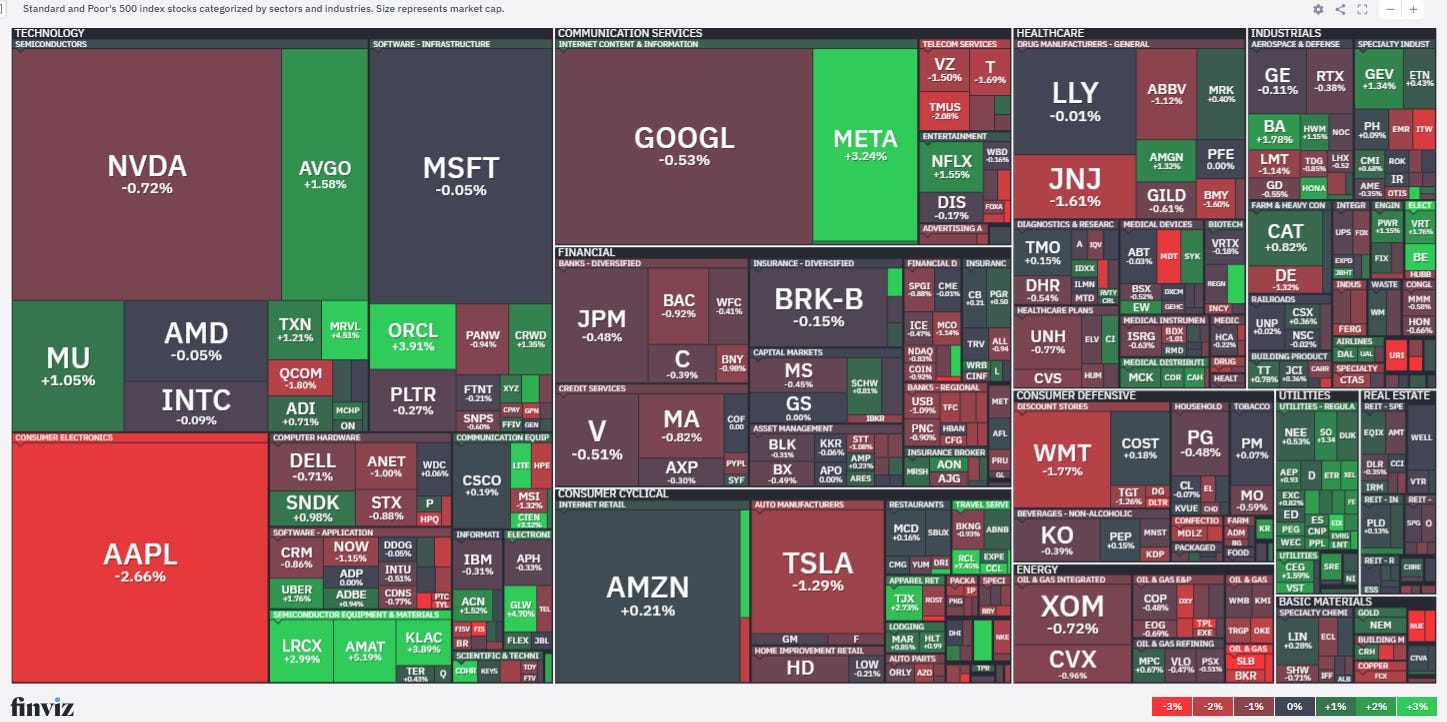
While the huge Tech sector was lower (-0.3%) today it wasn’t due to semiconductors which saw a solid session. The PHLX Semiconductor Index (SOX) rose 1.3%. AI-linked names such as Bloom Energy (BE) +10.80%, the second best performer in the S&P 500, also did well. The company also benefited from five-star Morgan Stanley analyst David Arcaro reiterating a Buy rating and a $310 price target. Meta Platforms (META) +3.3% also was higher after the social media and AI company announced Muse for Small Business.
The top performer on the S&P was Carnival (CCL) +13.5% after reporting better-than-expected earnings and record Q3 revenue and lifting its full-year forecast, with the broader cruise group also benefiting from the sharp decline in oil prices. Competitor Royal Caribbean (RCL) was +7.5%. Also in the sector, Carvana (CVNA) +5.2% rallied alongside CarMax (KMX) +4.80% following the latter’s better-than-expected Q2 report.
The consumer staples sector was a notable underperformer, as Walmart (WMT) -1.75% weighed on the group and the price-weighted DJIA after Target (TGT) -1.25% announced permanent price reductions on nearly 2,000 apparel, footwear, accessories, and home products ahead of the holiday season, raising the prospect of increased pricing pressure across general merchandise.
Apple (AAPL) -2.7% fell as Chief Executive Officer John Ternus, just weeks into the role, moved to overhaul the iPhone maker in an effort to accelerate product development, broaden its range of devices, and create a leaner organization with a greater focus on engineering, according to Bloomberg.
Fair Isaac Corp. (FICO) -26.5% easily led all S&P 500 decliners (the only component down more than -3.7%). The stock plunged after FHFA Director Bill Pulte said Fannie Mae (FNMA) and Freddie Mac (FMCC) will move to a single pricing grid incorporating VantageScore alongside the existing FICO Classic model. Previously, the two scores could lead to different mortgage pricing. Now that difference is going away, which could make it easier for lenders to use VantageScore and create more competition for FICO.
[Note: chart uses futures prices.]
The number of large SPX winners (up over 3%) improved to ~20 from just two Monday, while the number of large losers (down over 3%) dropped back to six from ~40. As mentioned previously, both of these metrics have remained very subdued since the start of August rarely getting above 50 and only once above 100.
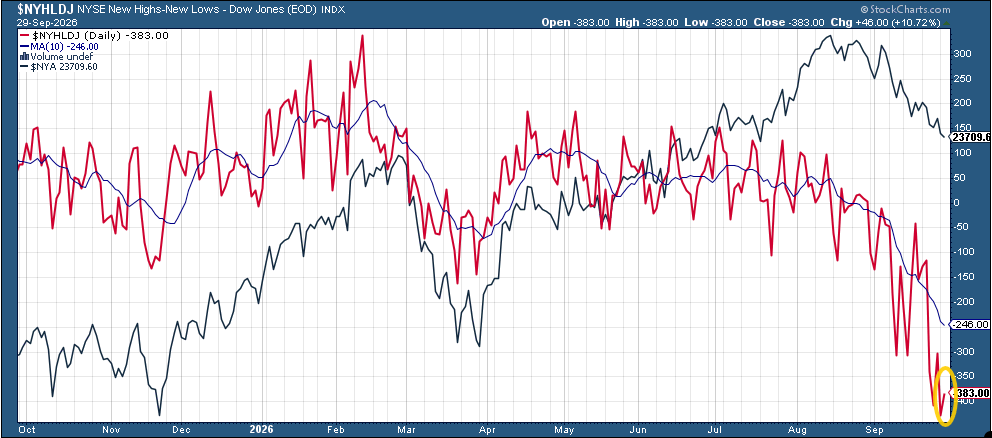
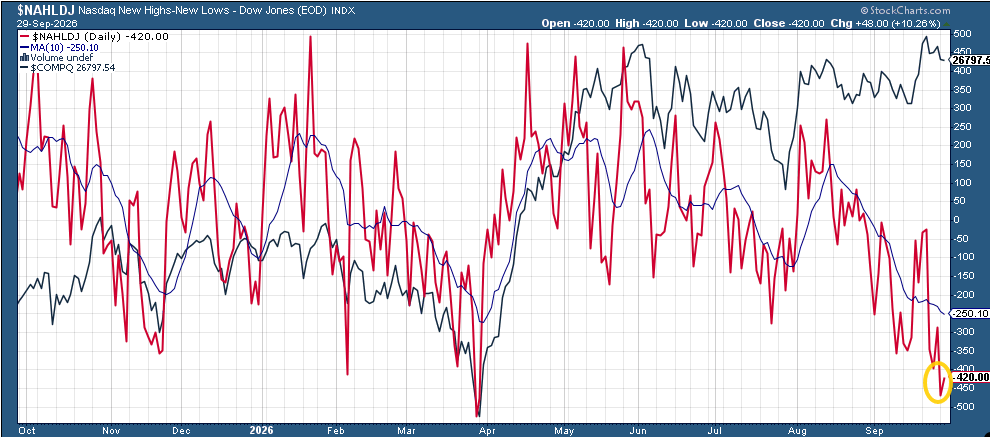
Some breadth metrics also improved slightly. New 52-week highs vs lows rose to -384 from -426 on the NYSE and to -425 from -451 on the Nasdaq. The former, outside of liberation day, was the least since October 2023, and the latter the least since April (and before that liberation day).
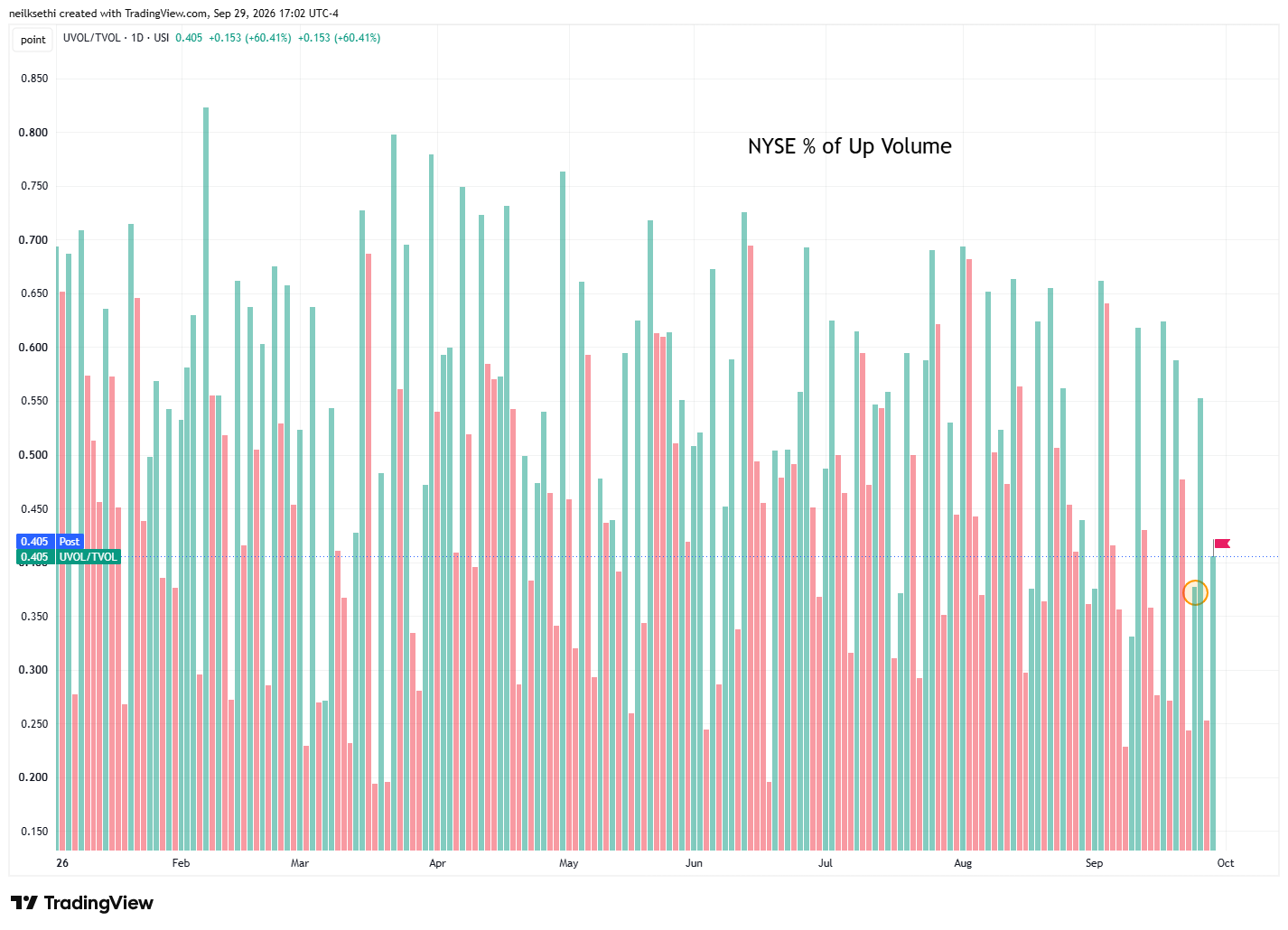
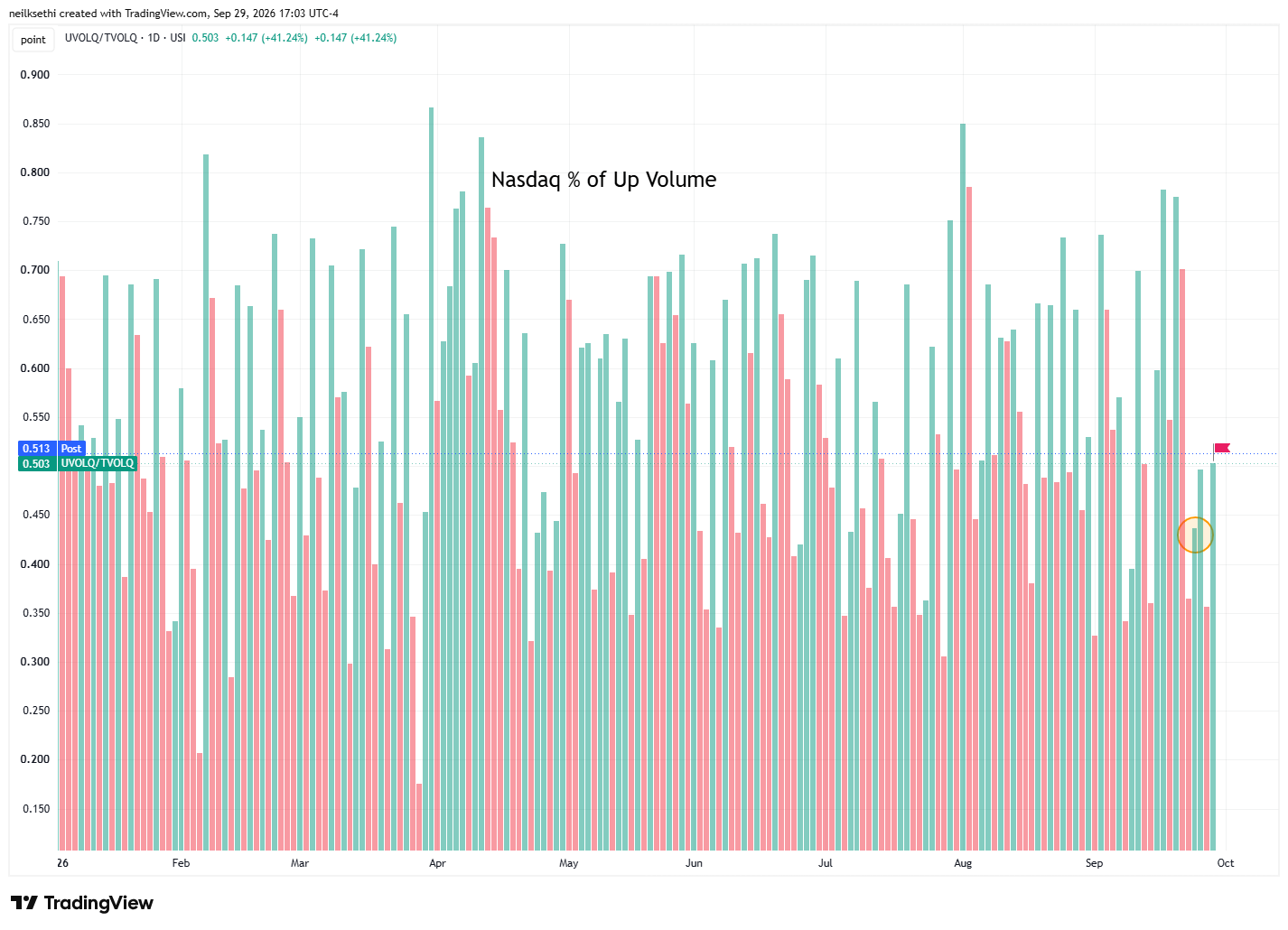
And positive volume improved to 40.5% and 50.3% on the NYSE and Nasdaq respectively after losing -0.2% and -0.09%. Compare to Thursday when they were 37.7% and 42.5% (circles) despite better index performances of -0.13% and +0.01%.
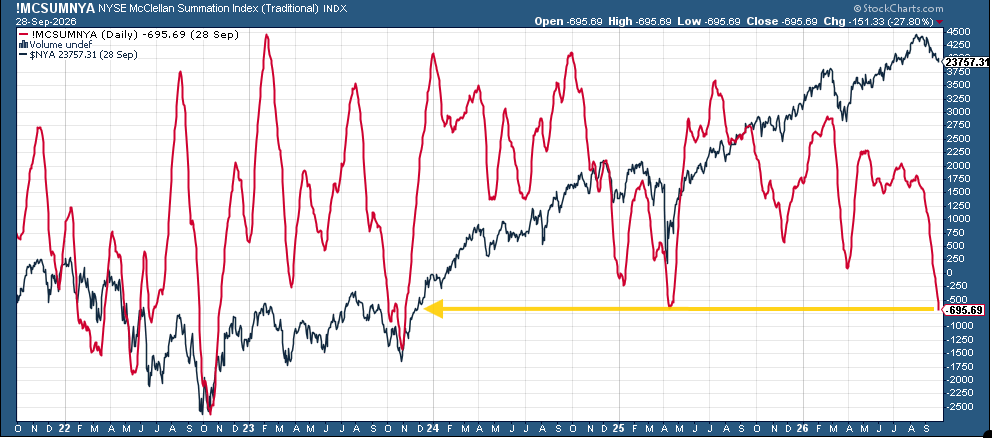
But the McClellan Summation Index (red line, broadly whether the typical stock is doing relatively better or worse than the index) broke the liberation day lows to the least since November 2023.
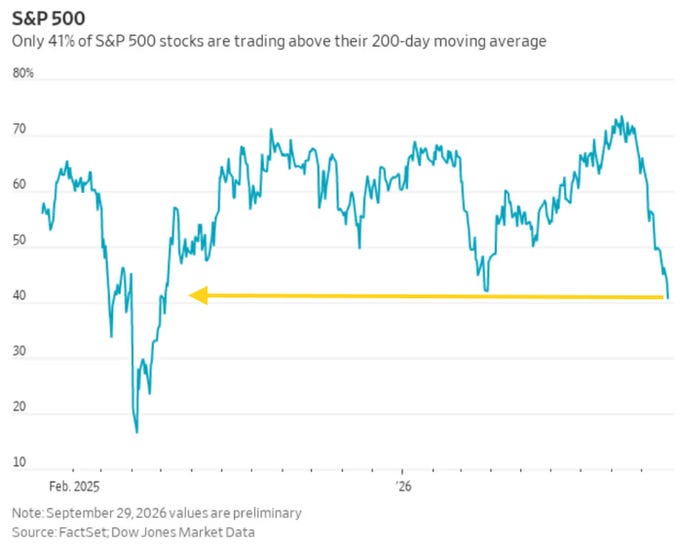
As of Tuesday afternoon, we were down at just 40.8% of S&P 500 stocks trading above their 200-day moving average — the lowest number since May 6, 2025.
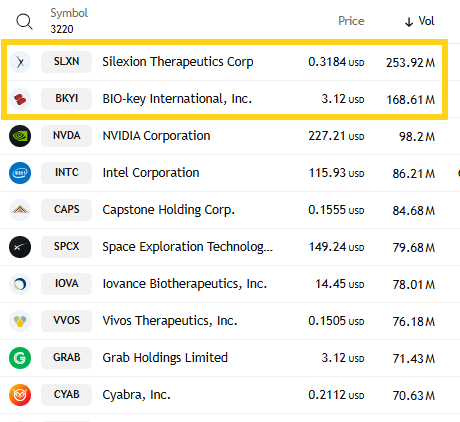
While speculative activity has been almost completely sucked out of the market. Just two stocks traded over 100 million shares on the Nasdaq, neither over 255 million. We’ve seen nearly 20 stocks over that mark at times with the top stocks often well over 1 billion shares.
Some other stock-specific commentary from TheStreet Pro:
- Chris Versace –
- Stephen Guilfoyle –
- Bob Byrne –
- Ed Ponsi – New Grades, Price Targets for the Top-3 Stocks in Market’s Hottest Sector
A Look At The Charts
Note on all charts the colored lines are moving averages (the average price over the lookback period — days on the daily charts, weeks on the weekly charts):
20 = green
50 = purple
100 = blue
200 = brownException is monthly charts where blue is 10-month moving average and brown is 20-month moving average.
MACD = Moving average convergence/divergence line, a measure of momentum that compares longer term and shorter term momentum to gauge if a move is strengthening or weakening. This is probably my favorite individual indicator.
RSI = Relative Strength Index (basically what it sounds like) = measures the strength of the move comparing gains to losses over the given lookback window (I use the standard 14 periods).
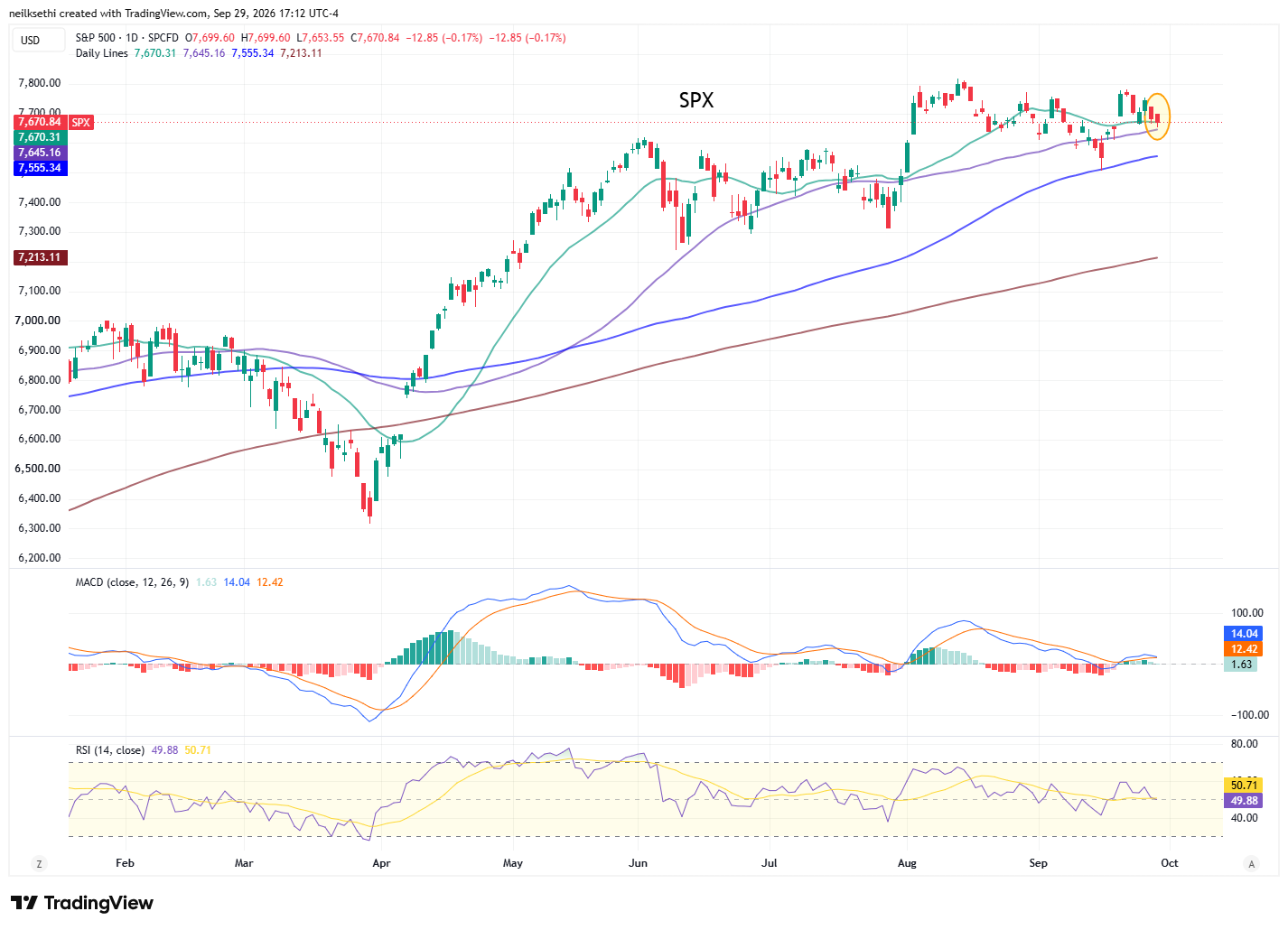
SPX eased back to just above the 50-DMA. The daily MACD and RSI have now softened to neutral.
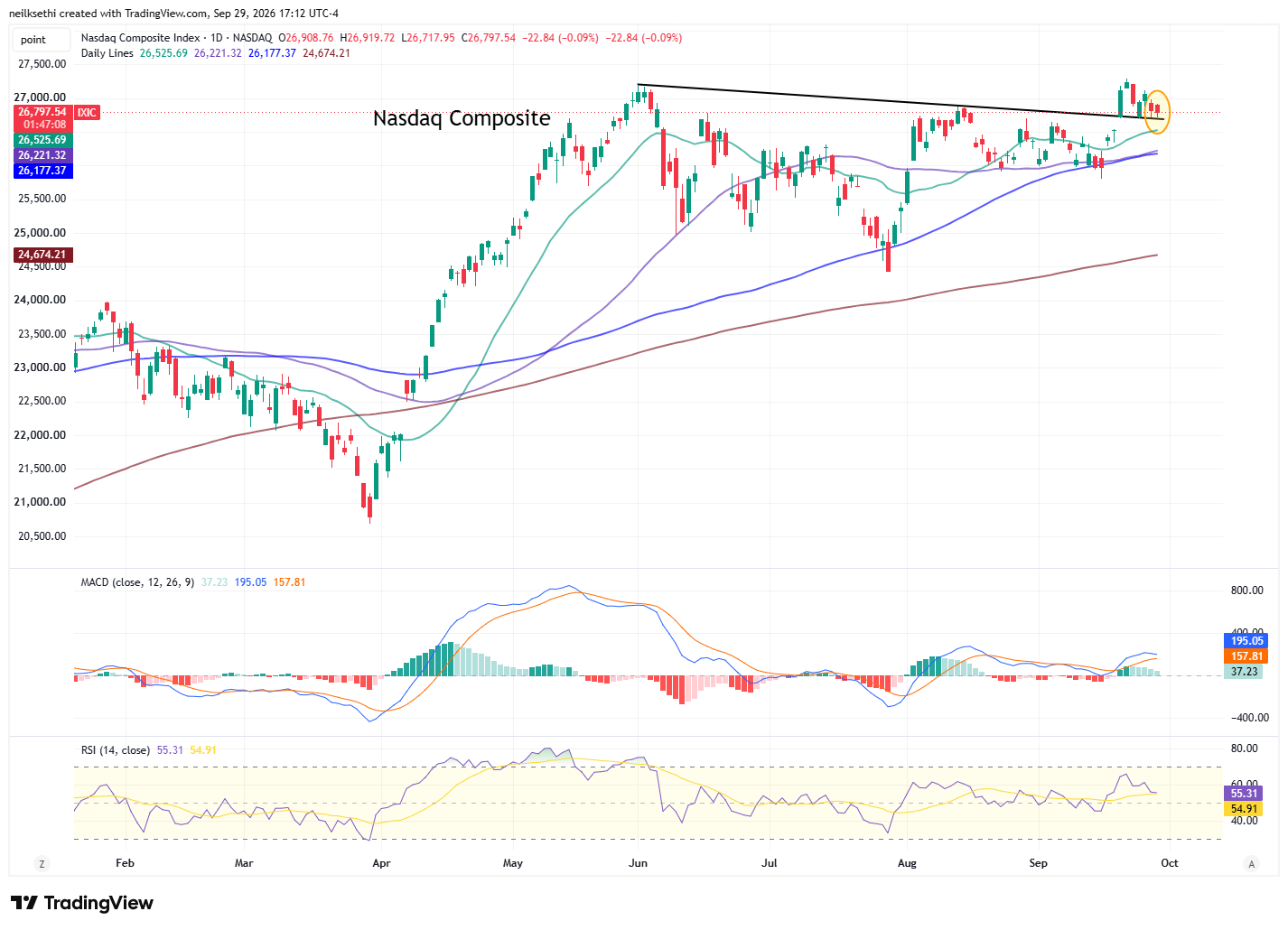
Nasdaq Composite again tested its former resistance which again held.
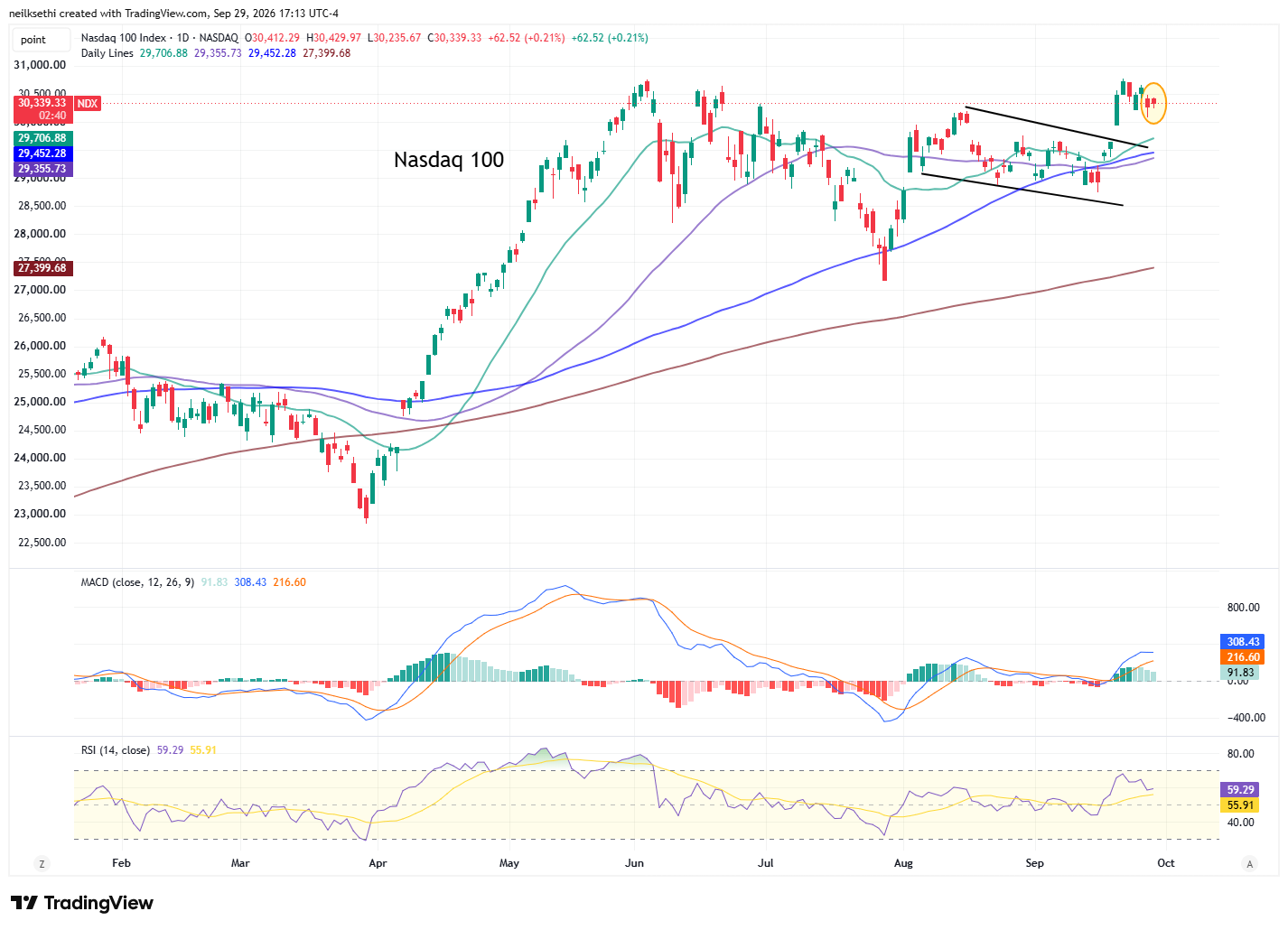
The Nasdaq-100 (QQQ) also remains just below its all-time high. Daily MACD and RSI also positive here.
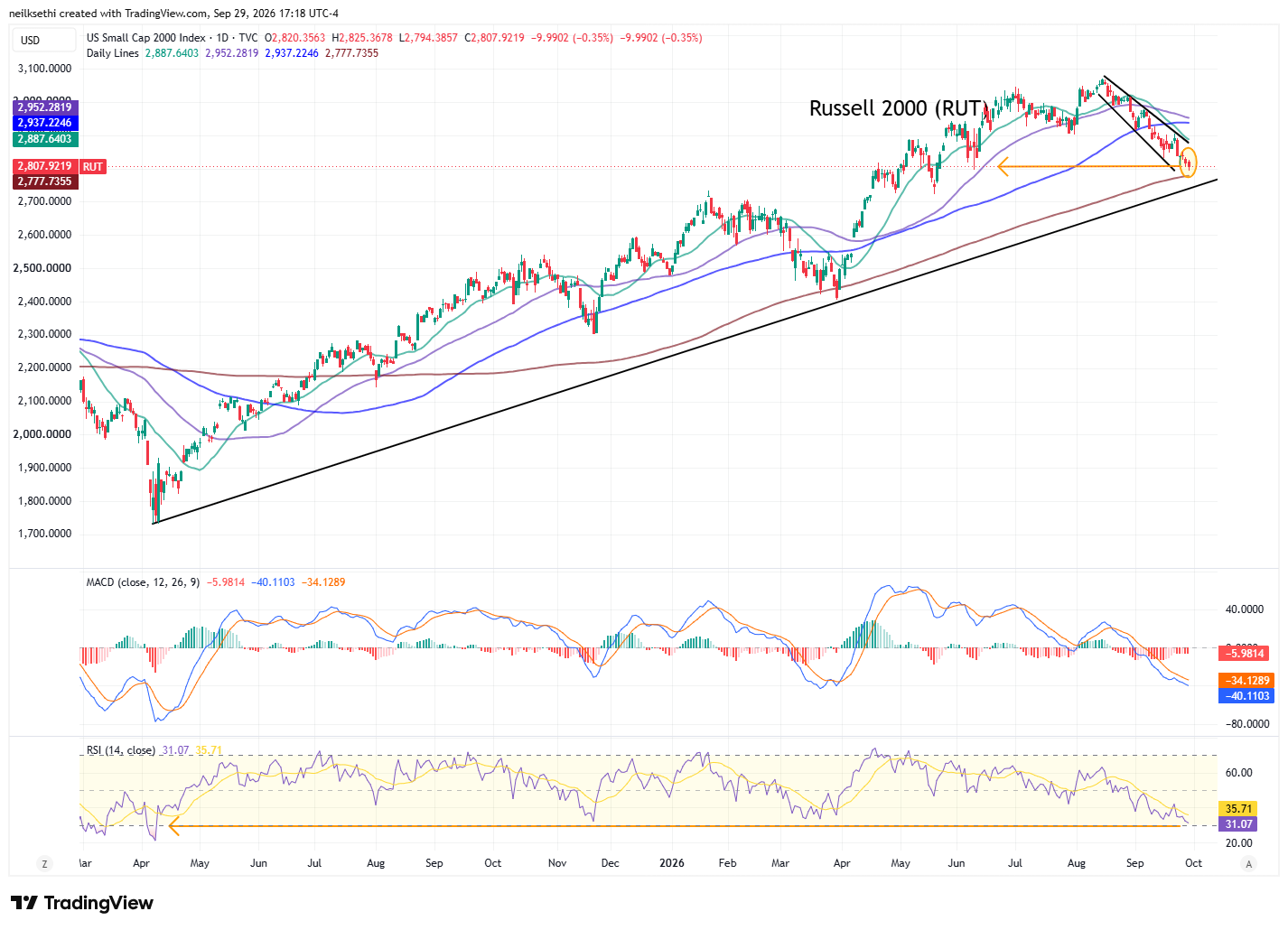
The Russell 2000 (RUT) I said at the end of August was “much more problematic,” and that remains the case as it fell to the lowest close since May. Its daily MACD remains in “go short” positioning, and the RSI is closing in on 30, the lowest since the post-liberation day low. Getting closer to that test of the 200-DMA I mentioned two weeks ago.
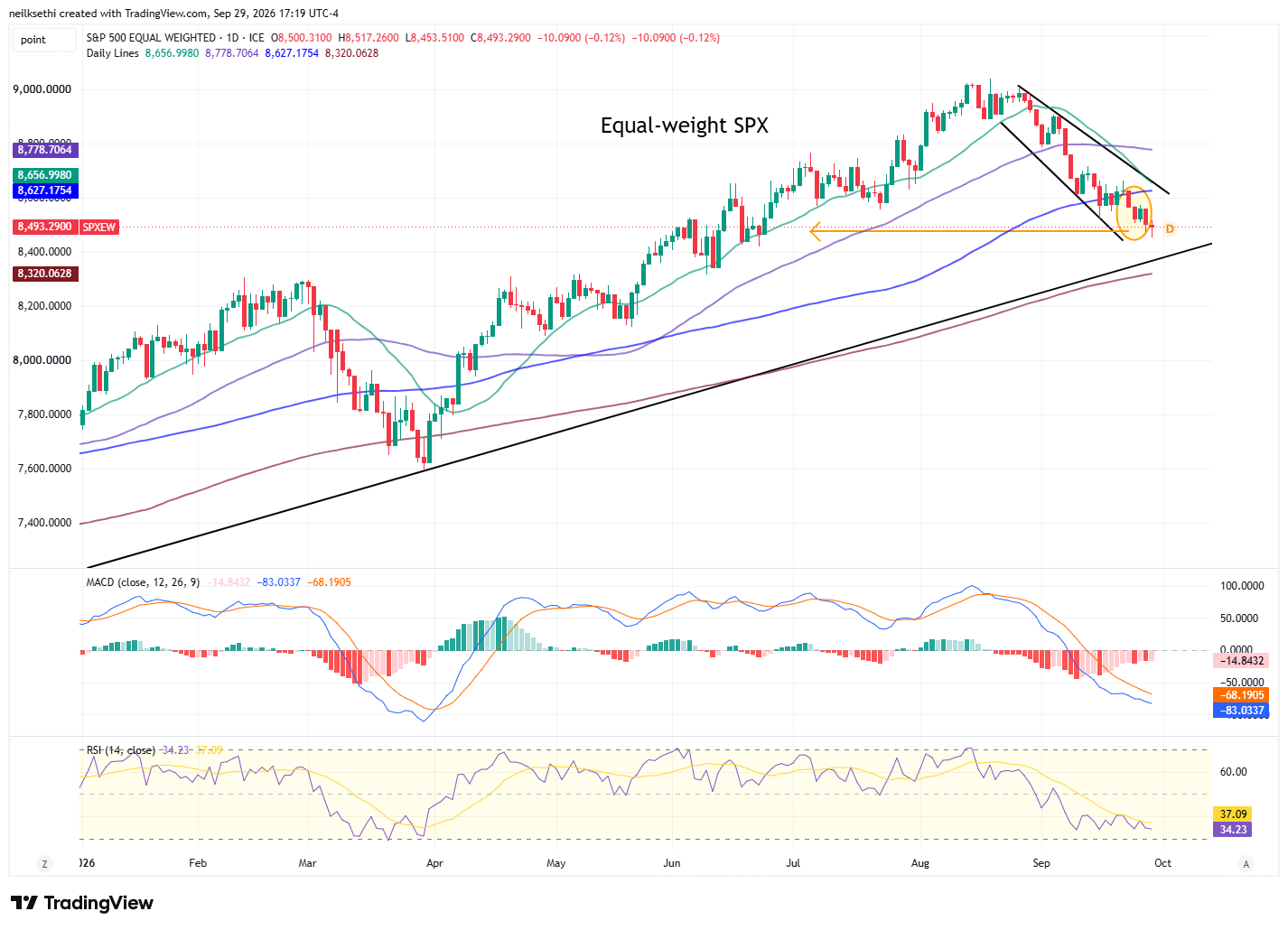
The equal-weighted SPX I said two weeks ago is “back to concerning.” I mentioned then “I did take off most of my holdings in (RSP) for now. I’ll be looking for a tradeable bottom to form.” Like the RUT daily MACD and RSI are weak. Has some room to get there, but like the RUT that uptrend line/200-DMA area might be the place for a buy.
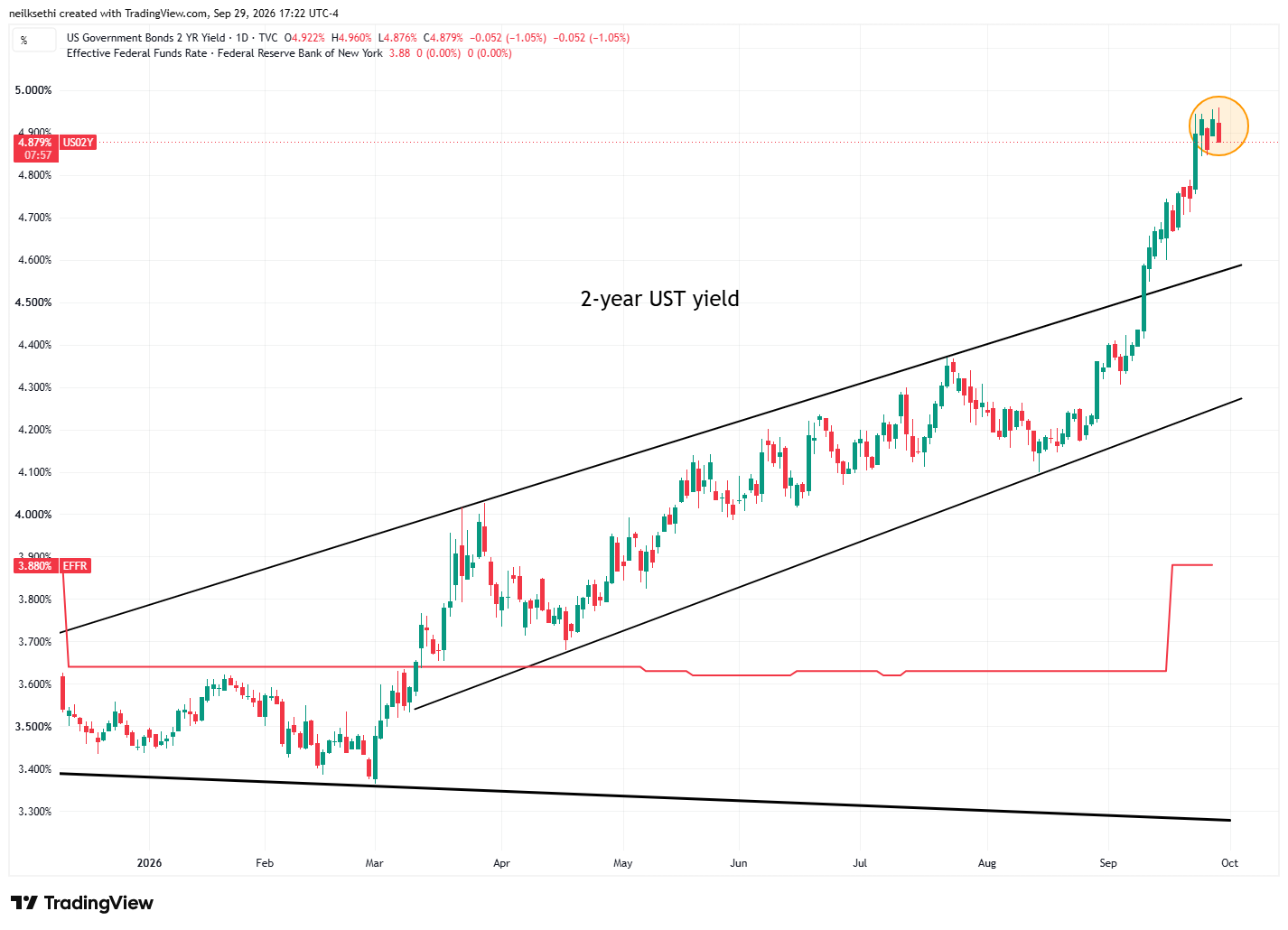
Treasury yields were up before the speech by NY Fed President Williams (see post below) which saw 2-year yields drop sharply while also softening gains for longer maturities:
The 2-year Treasury fell 5 basis points (including the after-hours) from the highest close since May 2024 Monday (including after-hours).
It is still ~109 basis points above the Effective Fed Funds rate, so still screaming for (a few) more rate hikes.
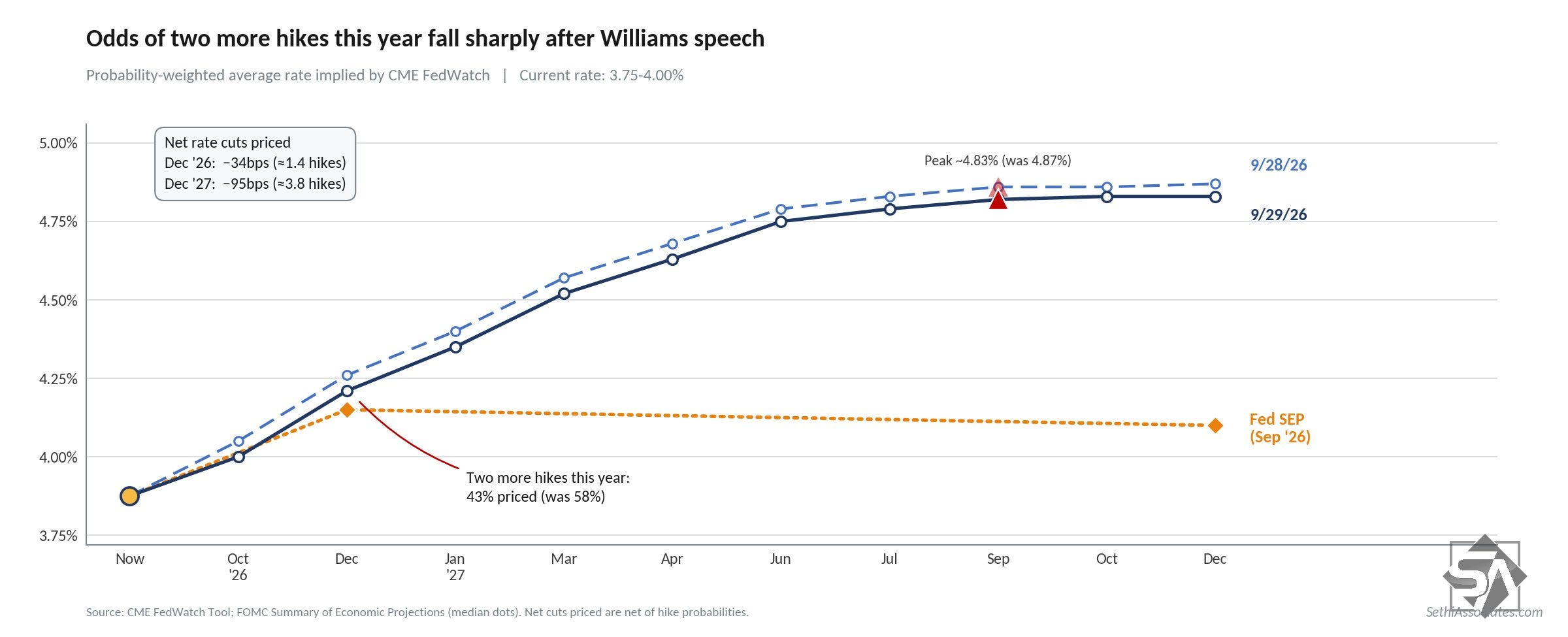
Following Williams’ speech, pricing for an October hike on CME’s Fedwatch tool fell from a 70% chance to a 51% chance while the chances of two hikes this year fell from 58% to 43%.
Still though 95 basis points of hikes (almost four) priced through the end of next year.
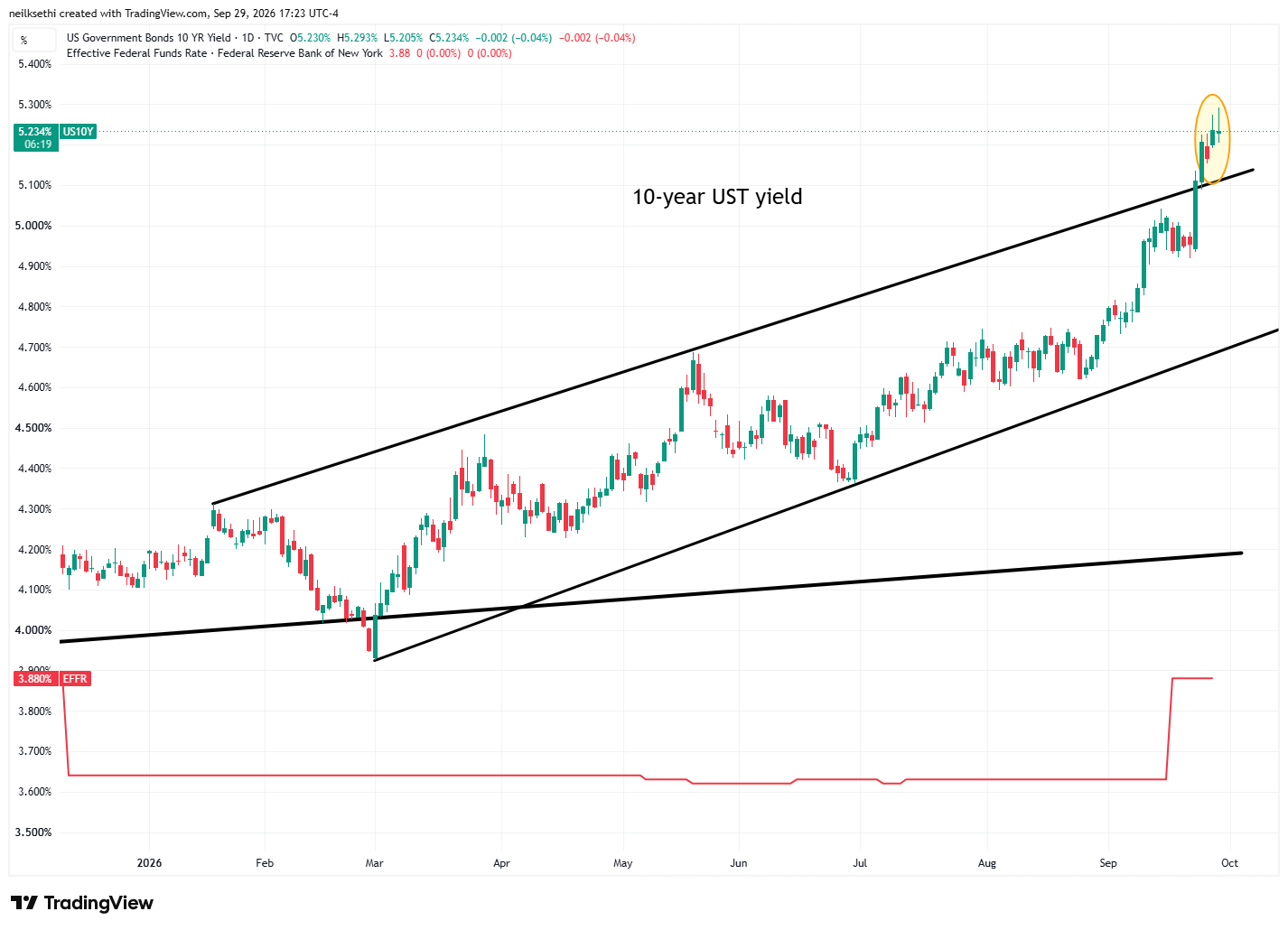
10-year yields softened to unchanged (including the after-hours), just off the highest close since June 2007.
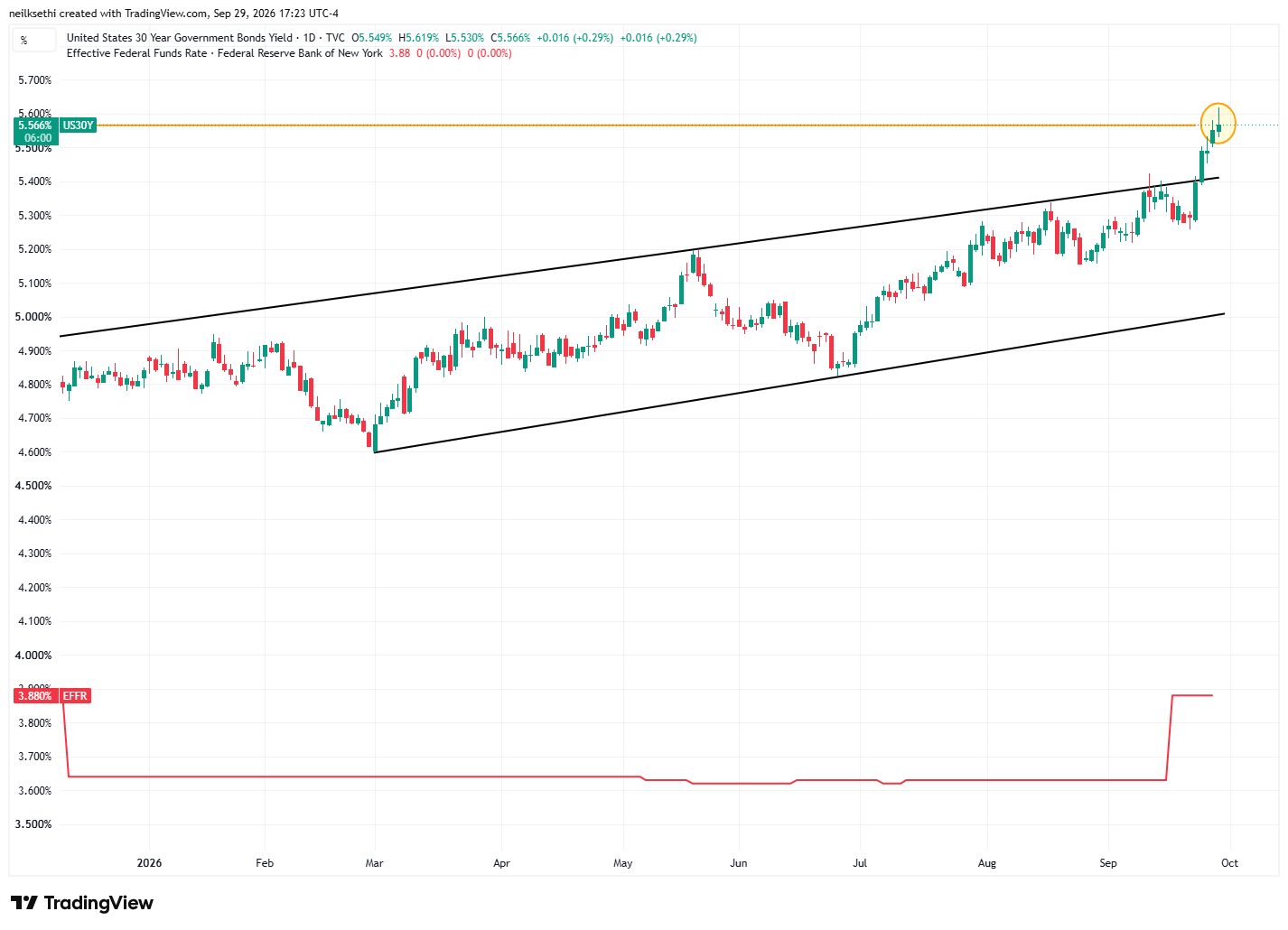
30-year yields up 2 basis points to 5.57%, the highest close since May 2002.
FWIW, I continue to scale in across the curve, with the largest position I’ve had in coupon bonds in years, although I continue to prefer municipals.
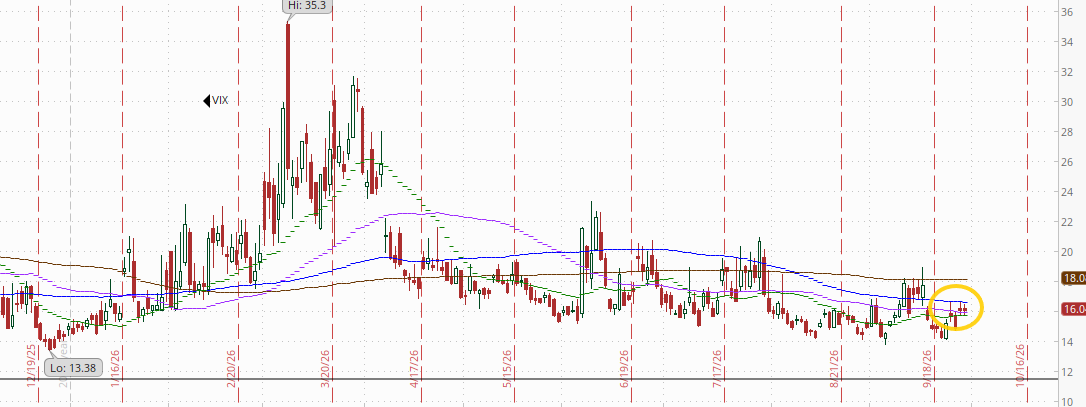
VIX remains remarkably quiescent at 16.1. That’s consistent with ~1.01% average daily moves in the SPX over the next 30 days.
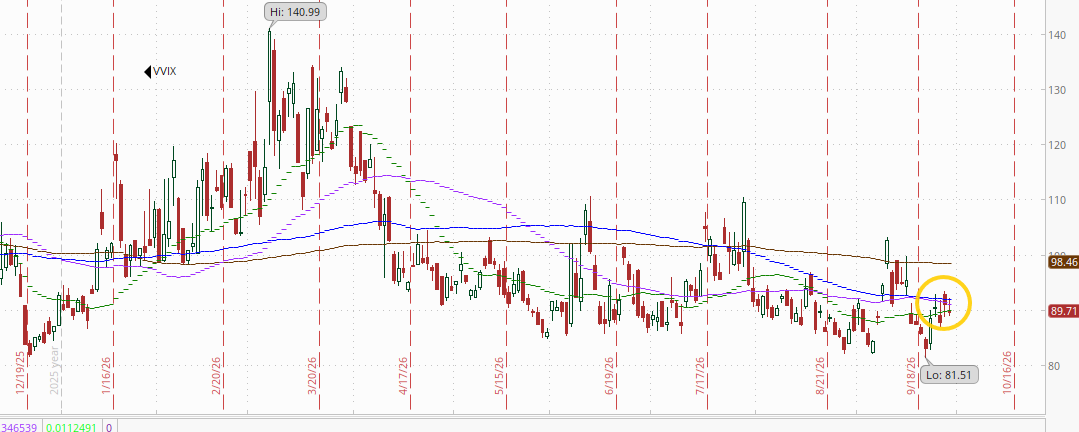
The VVIX (VIX of the VIX) eased to 89.7, also remaining very subdued.
The current level is consistent with “moderate” daily moves in the VIX over the next 30 days (historically, normal is 80-100). Above 100 is the level flagged by Charlie McElligott as indicating higher stress.
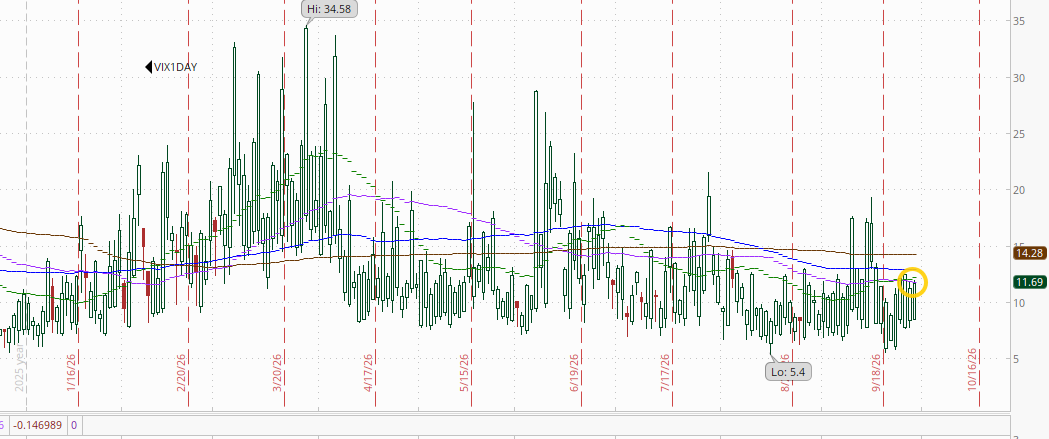
1-day VIX little changed at 11.7. The current reading isconsistent with a move of 0.75% in the SPX next session.
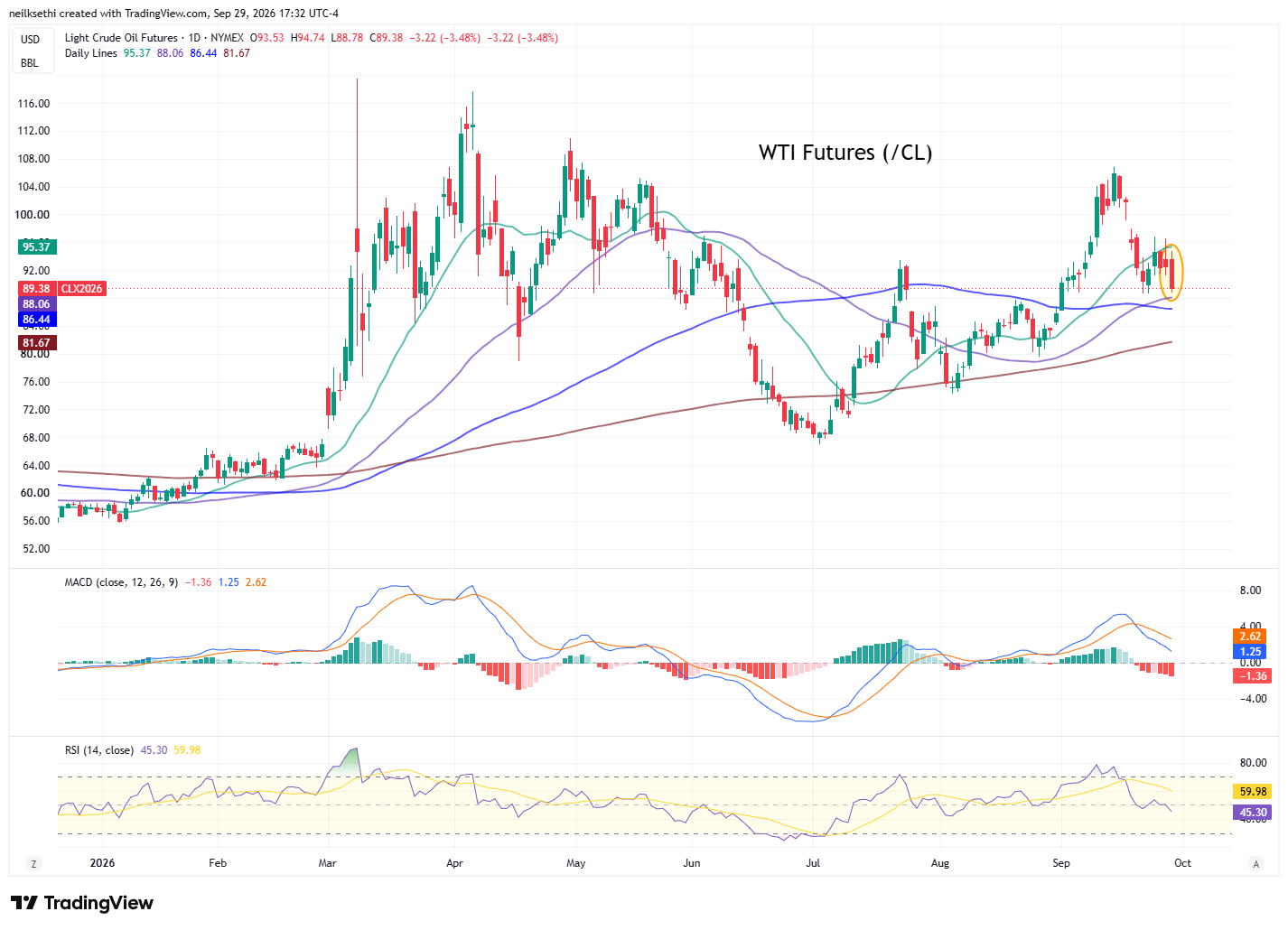
WTI futures (/CL) down -3.5% to the lowest close since August.
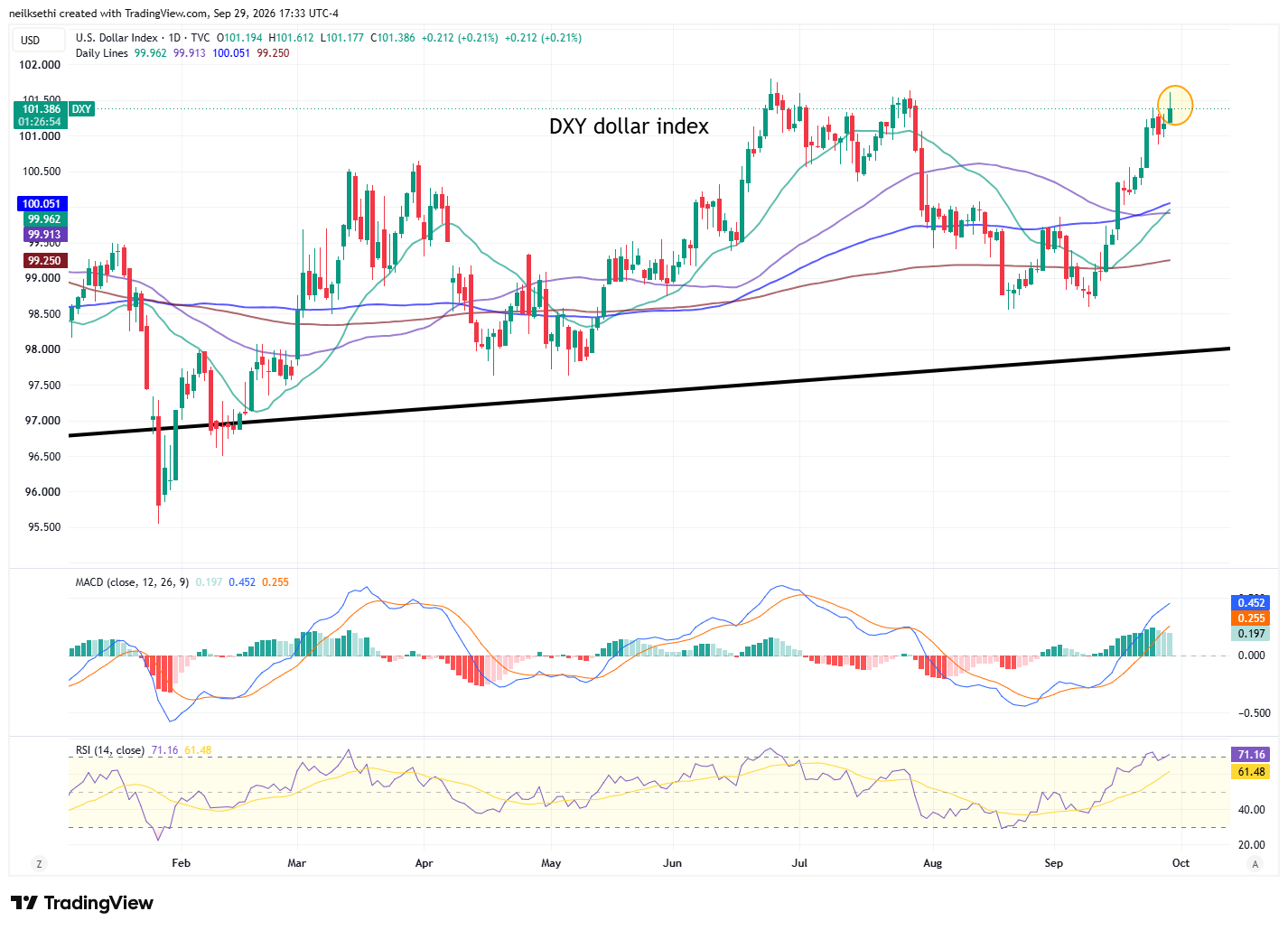
The DXY dollar index (which is fixed weighted with a heavy (57%) weighting vs the euro), pressed higher once again at one point within pennies of the highs of the year.
As I mentioned two weeks ago “The daily MACD remains positive and the RSI is above 60 so it continues to have strong technical support.”
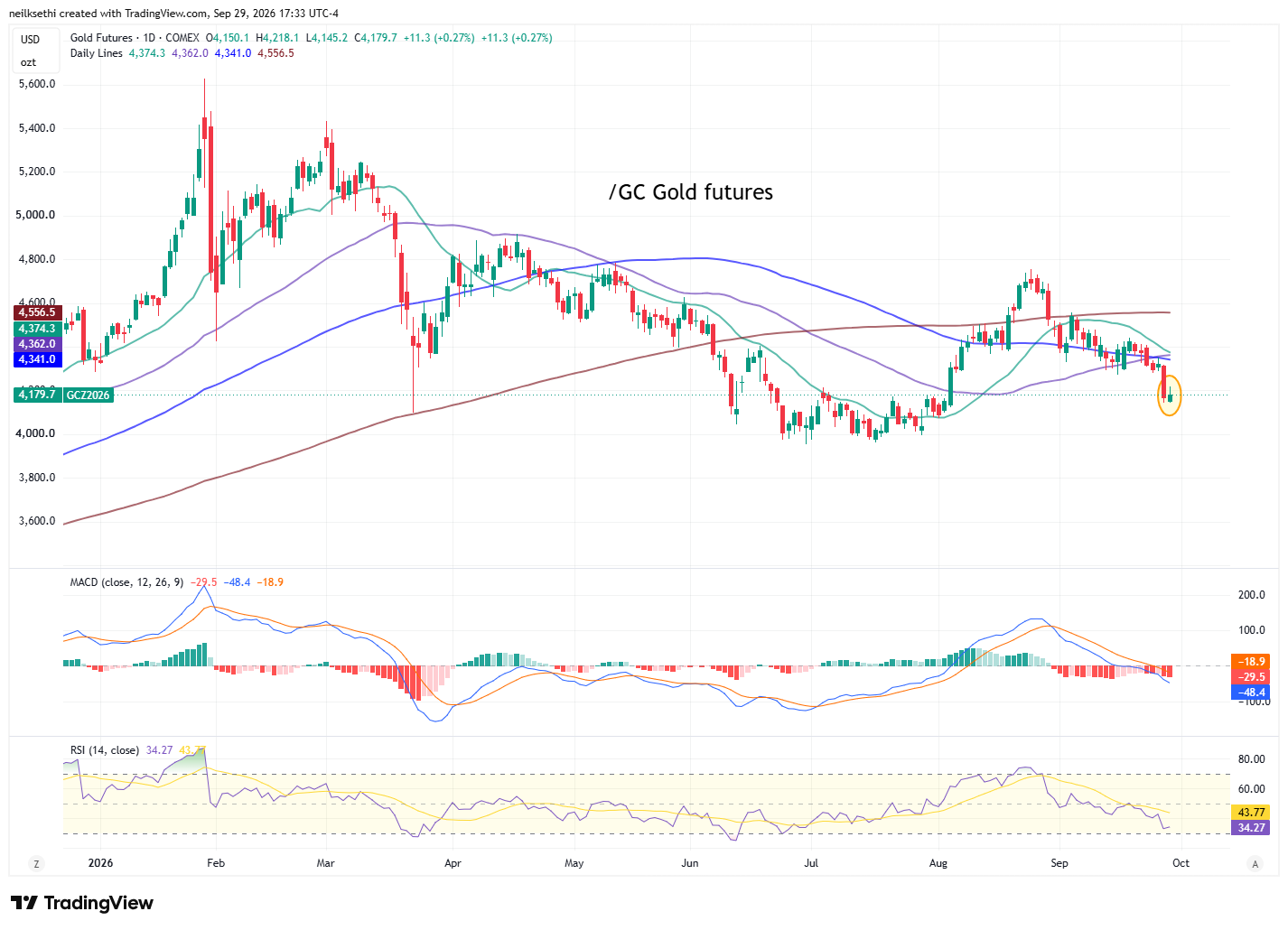
Gold futures (/GC) trying to stabilize after its worst session since June 10th. The daily MACD remains negative and the RSI is under 40.
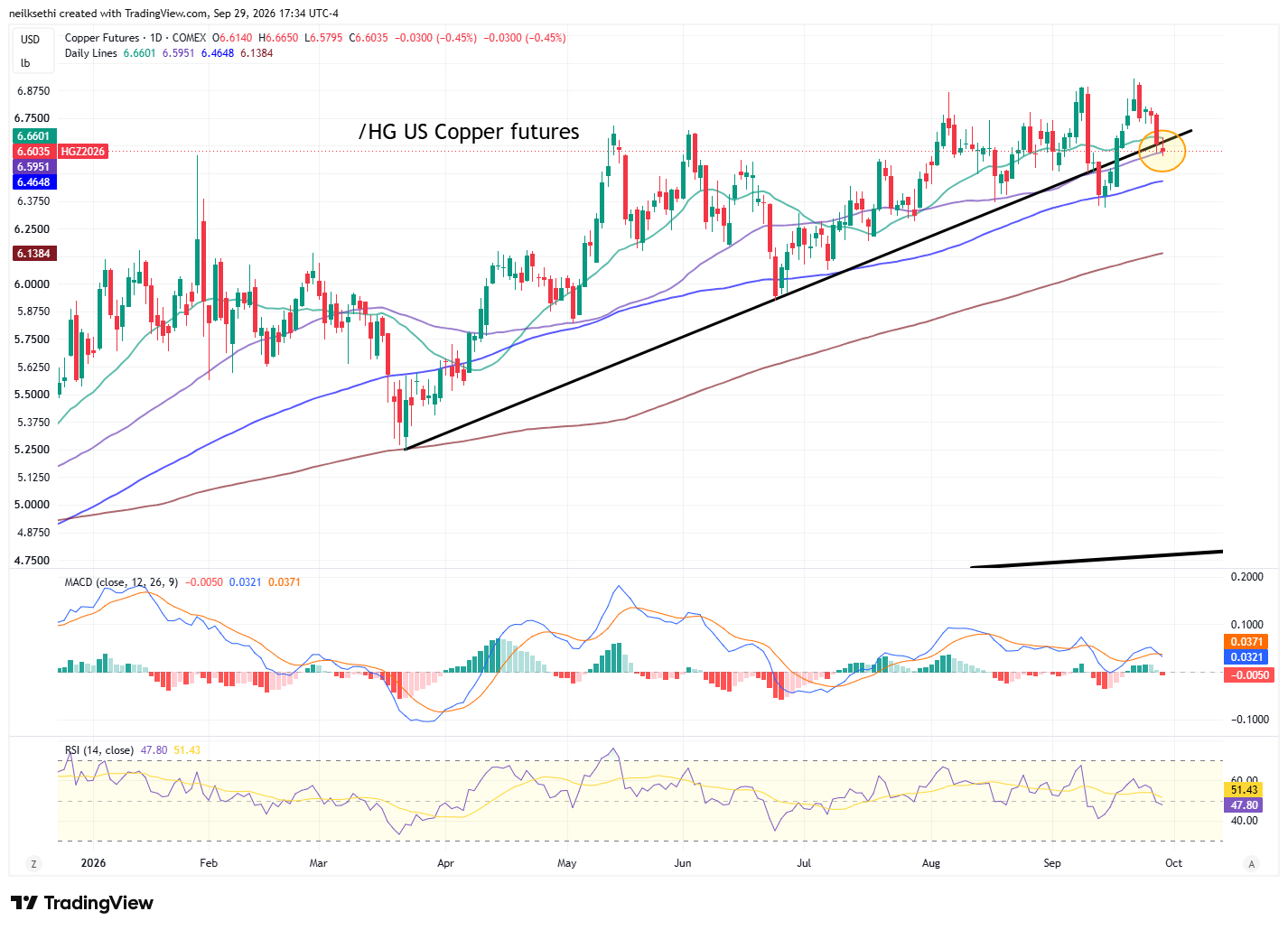
US copper futures (/HG) eased back now just holding the 50-DMA. Daily technicals have now softened to negative. Given it made its stand at the start of the month at the 100-DMA, I’m going to give it that room again this time.
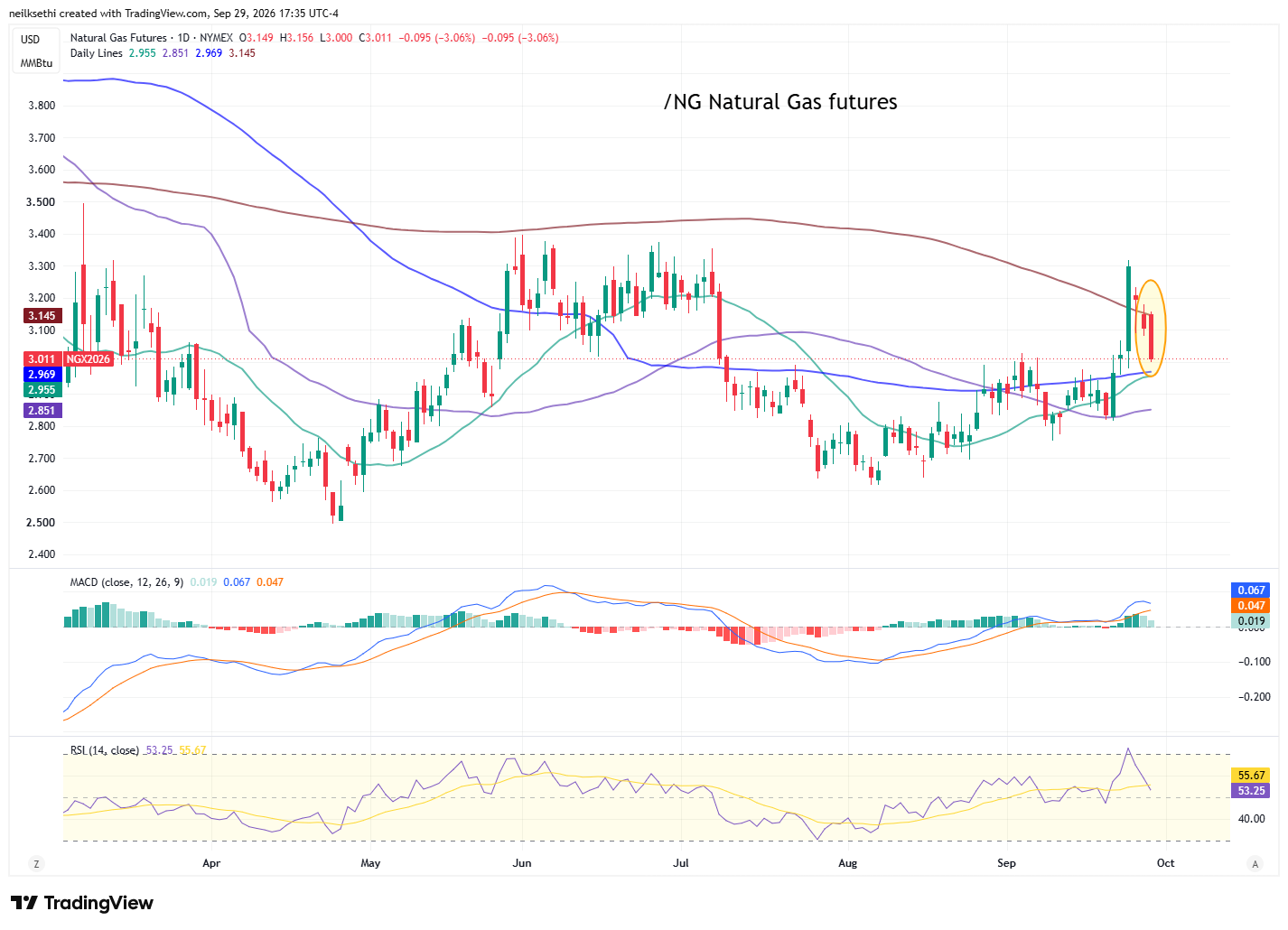
US natural gas futures (/NG) fell back for a third day, now having given back all of the 9.1% rip higher Thursday per my note that “that is starting to look like it was just a big short-covering rally.”
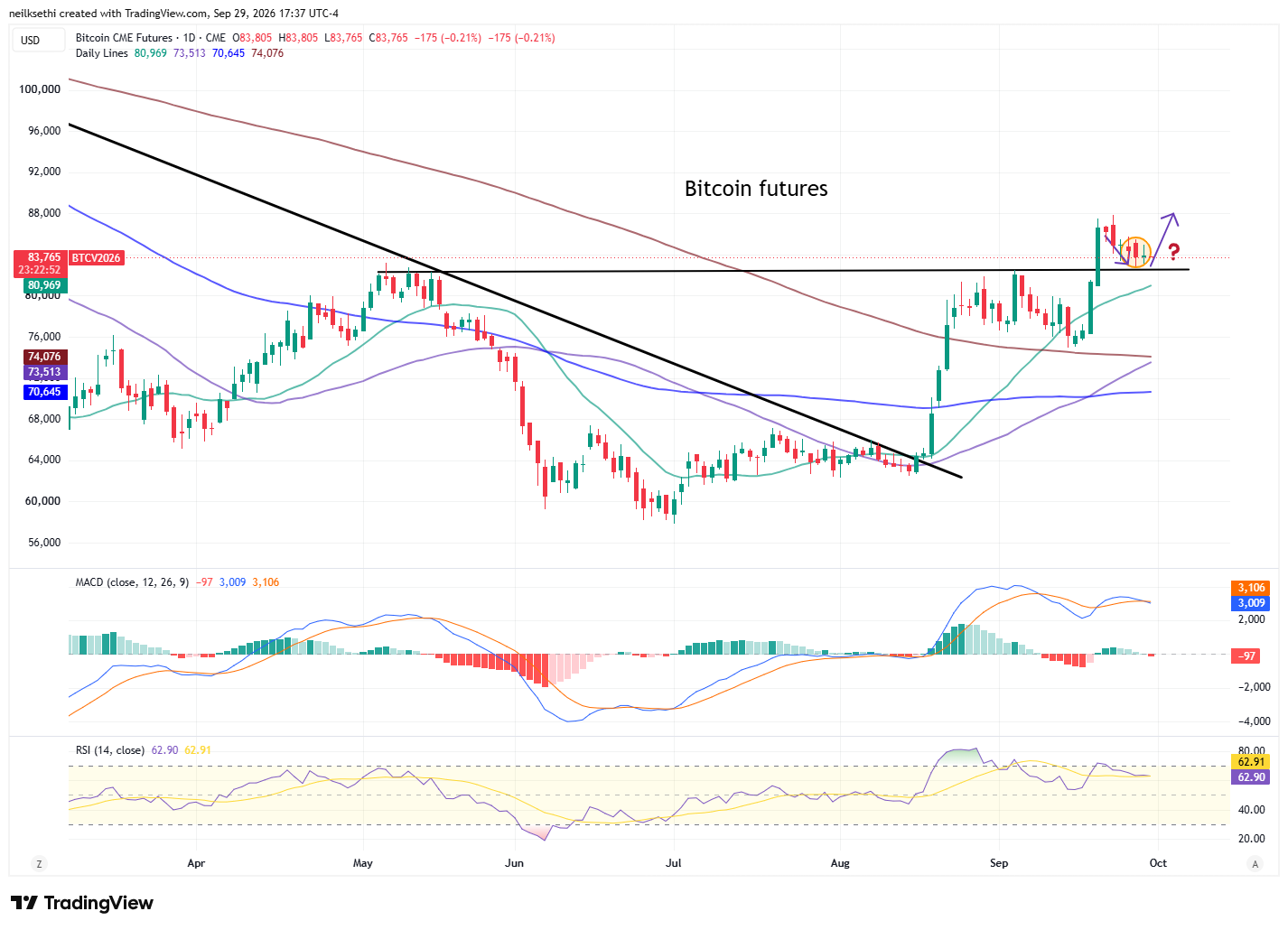
Bitcoin futures up (barely) for the first time in six sessions, for now keeping alive the “natural path” (for bulls) I laid out on Wednesday (in purple). Needs to hold that breakout level. A break of $82,000, and I will be selling. Daily MACD and RSI remain positive for now.
More From TheStreet Pro:
- Chris Versace –
- Stephen Guilfoyle – Is the AI Gravy Train About to Get a Yellow Signal?
- James “Rev Shark” DePorre –
- Alex Frew McMillan – Another Trump-Xi Meeting Disappoints, Though China Can Claim Win
And From Me If You Missed It:
Miscellaneous:
Wrap-Up – A Reason For Hope?
I said last week in Wednesday’s wrap-up:
The gravitational pull of surging interest rates was too powerful for even the renewed Tech trade to escape Wednesday. I had mentioned in prior weeks that it would be difficult for stocks to succeed if rates were going to continue ratcheting higher, let alone a jump like we saw today.
I had hoped that we had seen the highs, at least in the short term, but clearly not. We are unfortunately now apparently in a “good news is bad news” (and vice versa) cycle, and given my positive outlook on the economy, I’m not sure how much bad news we’re going to get… So it seems we’ll just have to wait for this most recent leg in yields to run its course. We’re already above levels that I thought would cap things so I’m taking the other side of this trade, but it could be some time before that pays off the way things are going.
This hasn’t dented my longer-term optimism though, and the pullback is creating what will prove to be bargains in many stocks.
And I noted Monday
today was a reprise of Wednesday’s action. A push higher in interest rates sucking the life out of even the previously strong Tech trade. As to Tech that was a one-day blip and the trade came back Thursday and Friday. Will we see something similar this time as well?
As to the non-Tech trade, I will continue with my now well-worn statement that we have gotten to a place where things are very stretched in terms of the rout in bonds and non-Tech areas of the market. As I have noted, though, these things can continue well beyond where they “should,” so your guess is as good as mine as to when we see at least a short-term reversal. It will come at some point, so all we can do in the meantime is wait and try to stick with what’s working.
And today was tracking along with Monday’s action, right up until NY Fed President Williams’ speech discussed above. Could that mark a turning point in this seemingly never-ending press higher in yields? Certainly too early to tell, but we can always hope right? As noted we’re also seeing more and more calls to buy bonds, and we know that pension funds are modeled to be big buyers this week.
So as I said Monday, “Let’s see what we get tomorrow.”
I thought I would also add some sage advice from one of RevShark’s columns today:
There is not much to do here but stay patient and resist the temptation to bottom fish stocks that have no support. The pull is strongest exactly now, when names are down a lot and look cheap, and it is exactly the wrong instinct. A stock in a downtrend with no base under it can fall far further than looks possible, and buying it because it is lower is how you end up averaging down into a hole. I already am kicking myself for not being more patient on a couple of recent buys but I still have plenty of buying power.
The opportunities are being created in these 400 new lows, but they are not ready. The signal I am waiting for is a change of character in oil and bonds, not a lower price on a stock I like. Until the pressure that is driving this lets up, the smart move is to keep the cash, keep the list and let the correction do its work.
The Day Ahead – Kicking Things Up Another Gear
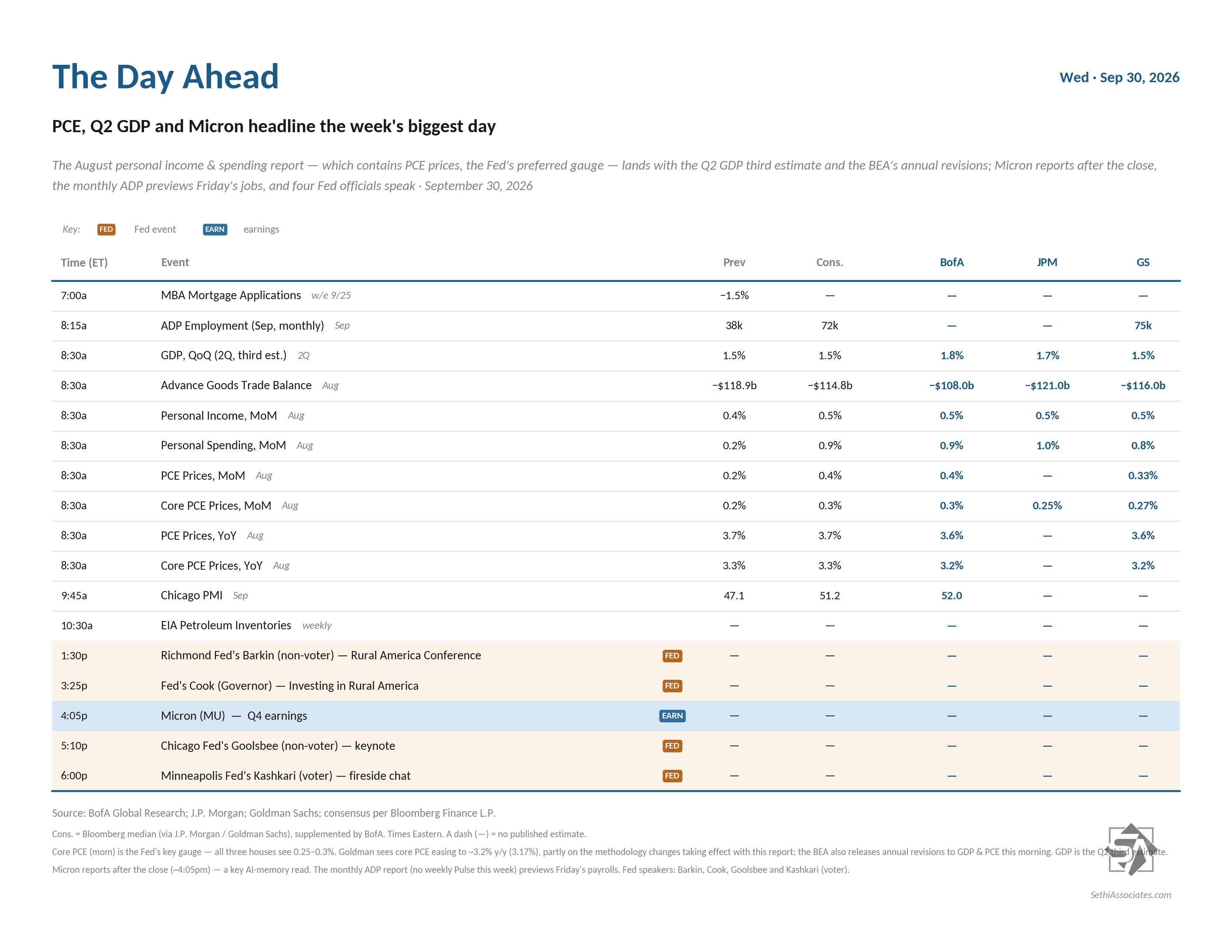
US economic data again picks up further with the August personal income and spending report (our most complete look at incomes and spending which also contains PCE prices, the Fed’s preferred inflation gauge). We’ll also get the third estimate of Q2 GDP accompanied by the annual revisions to GDP and PCE (see post from JPM’s Feroli below), the September ADP job growth report, August goods trade balance, and weekly mortgage applications and US petroleum inventories.
Fed speakers continue and we’ll again hear from Governor Cook and regional presidents Barkin, Goolsbee, and Kashkari who we’ve heard from at least once in the past week (most multiple times).
Non-Bill (>1yr in maturity) US Treasury auctions off this week.
We’ll get three SPX components reporting Wednesday highlighted by memory maker and AI bellwether Micron (MU) along with Jabil (JBL) and FactSet (FDS).
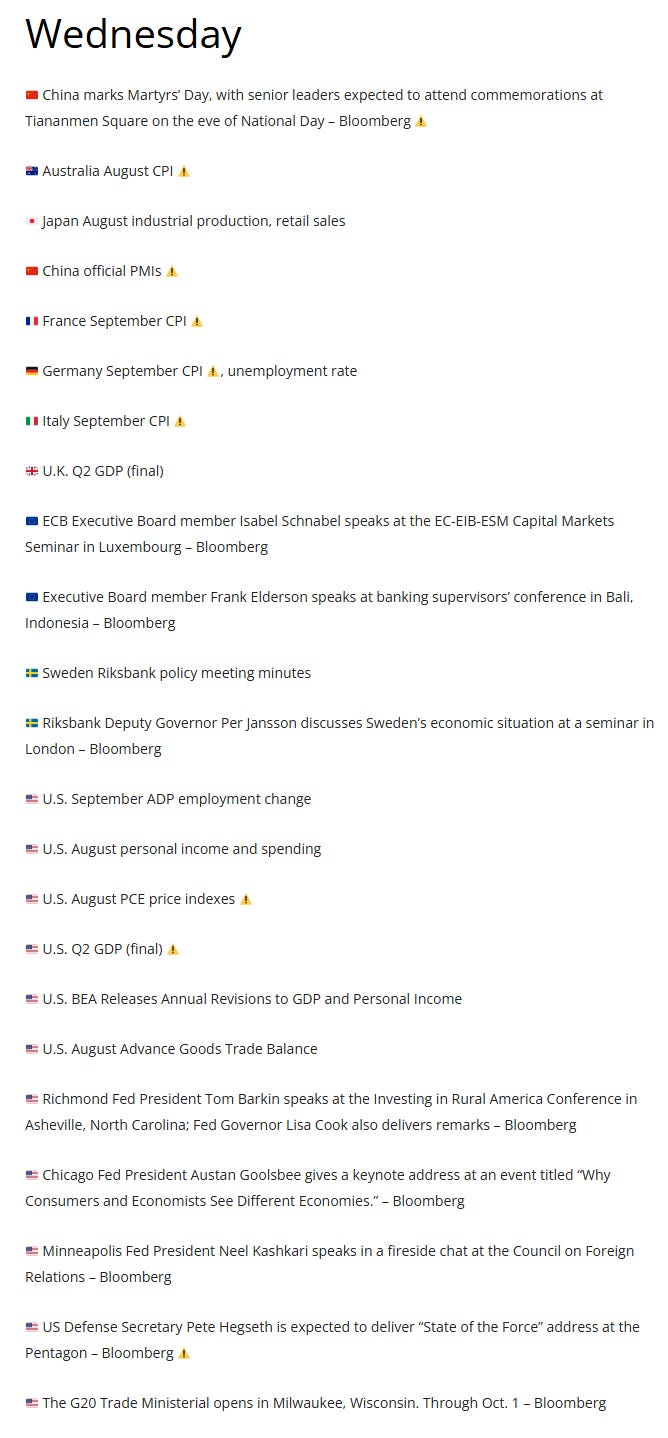
Ex-US highlights are China September PMIs, UK September Lloyds Business Barometer, Q2 current account balance, Japan August retail sales, industrial production, housing starts, Germany September CPI, unemployment claims rate, August import price index, retail sales, France September CPI, August PPI, consumer spending, Italy September CPI, consumer confidence, economic sentiment, manufacturing confidence, Australia August CPI.
From Christophe Barraud’s international Week Ahead rundown:
At the time of publication, Sethi was long BE, CCL, AAPL, QQQ, SPY, CPER, IBIT, and numerous equities in the energy sector.
As a reminder comments are encouraged. If they are directed at me, please put @NeilSethi in front.