VIDEO: Bob Byrne Finds AI Investing Opportunities
The latest in our series where we get to know TheStreet Pro’s team. Bob Byrne is an experienced investor and board member who sees incredible opportunities in AI.
You've reached your free article limit
You've read 0 of 1 free Pro articles.
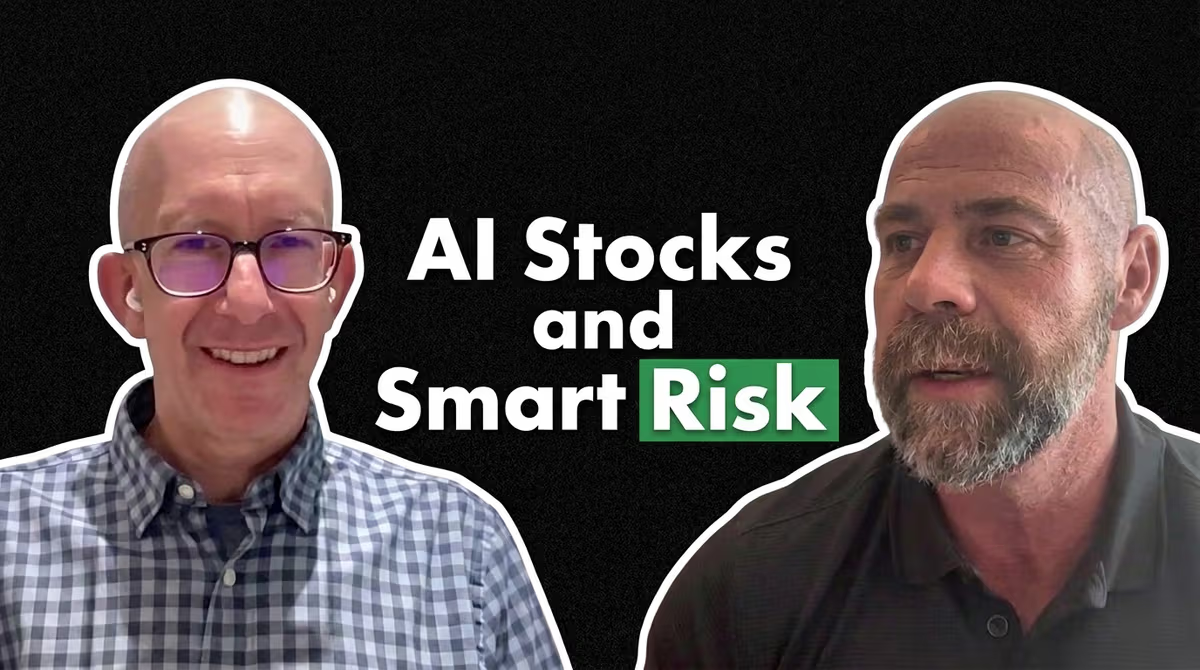
We sat down last week to get to know Bob Byrne a little better. Bob is a trader and professional investor who has a deep understanding of AI through seats on boards of companies in the space. If you enjoy this conversation and want to learn more, read the first in his series on AI: Who Gets Paid When You Ask AI a Question?
Topics we covered in our conversation include:
• Bob Byrne’s trading journey began during the dot-com era, starting as a college student trading online in the late 1990s before spending roughly 20 years as a professional trader. He later wrote for Real Money, consulted with public and private companies, and rejoined TheStreet Pro around 2021-2022.
• His current focus is on technology-driven themes, particularly artificial intelligence, data centers, digital assets, Bitcoin, and emerging areas like robotics and physical AI. He emphasizes understanding the entire ecosystem behind trends rather than simply investing in well-known names like Nvidia.
• Bob’s investing philosophy centers on thematic investing and risk management. He believes individual investors gain an edge through patience and time horizon management, allowing long-term growth stories to play out while carefully controlling risk through proper position sizing.
• His biggest investing lesson came from his worst trade. After losing roughly half his account in AOL during the AOL-Time Warner era, he realized the importance of discipline and education. That experience ultimately pushed him into professional trading and shaped his approach to risk.
• His core advice is “a chip and a chair.” Investors should never risk so much on a single position that they’re forced out of the game. He stresses emotional discipline, accepting losses quickly, learning from mistakes, and remaining unemotional, noting that the most successful traders he knew were consistently stoic regardless of daily gains or losses.
Video
Transcript
Jason Meshnick (00:00:00)
Hi there and welcome to another segment in our series introducing you to the Street Pros contributors. Today we are going to be speaking with Bob Byrne to learn a little bit more about him. ⁓ hi Bob and welcome to our Getting to Know You series.
Bob Byrne (00:00:13)
No, I appreciate it. Good to be here.
Jason Meshnick (00:00:15)
Yeah, great great to have you on here finally. Okay, so ⁓ what we’re doing as you and I have talked about off camera, we’re gonna start with a fun fact and then run through a bunch of other questions. So let’s kick it off there. What what is your fun fact that you have that you’d like to know ⁓ our subscribers to know about you?
Bob Byrne (00:00:32)
Gosh, so when I think about it, I so I moved, so I live in Park City, Utah, right? Ski town. I moved here ⁓ in 2007 from Austin, Texas. And the entire reason I moved here was I walked out of my office one day after a very long day of trading. And I looked at my wife and I said, I’m done with the heat. I can’t do this. I gotta live somewhere where it’s colder in a ski town. And so I wanna, it was a matter of weeks. I called one of my trading partners who at the time lived in Washington State.
I said meet me meet me in Park City. We’re gonna go look for real estate. So I found a rental, moved up here. I looked at five ski towns, but right I needed somewhere that had a an airport, you know, a little bit going on, not just kind of a mountain town. ⁓ And yeah, moved up here and ⁓ since then it when we moved up here, I had a I had a one-year-old. My daughter just turned one. My son has been born in Park City. My son is my ski partner, my fishing partner, ⁓ and now frequently steals my cars.
Jason Meshnick (00:01:25)
⁓ Of course. Yeah. ⁓ Well, as someone who lives in a mountain town as well, although I think I’m really at the at the base of the mountains, in the in the plains, ⁓ I completely identify with that. So, yeah, it’s
Bob Byrne (00:01:27)
Yeah. ⁓
Bob Byrne (00:01:38)
You know, there’s there there’s something about like a long, hard day of work, but when you walk outside and you’re in the mountains, a little bit cooler air, it’s little bit different vibe, right? Most of the people in a ski town, they moved there for one reason, right? They wanted to be in that ski town. So it’s it’s it’s pretty cool.
Jason Meshnick (00:01:46)
Yeah.
Jason Meshnick (00:01:53)
It is, exactly. And you know, the fact that I can get out of here and you know, between meetings, if I have a half an hour between meetings, I’ve got a hike I can do. Like it just it just resets everything. So I agree. ⁓ Yeah, awesome. ⁓ okay, let’s talk about your tenure with pro. So just give us a little little ⁓ you know, background on on your career and then how long you’ve been with pro. ⁓ what you do outside of pro as well for work.
Bob Byrne (00:02:02)
Hundred percent.
Bob Byrne (00:02:16)
Yeah, so I started trading actually I wanna say it was sophomore into junior of college, going back a bit, right? ⁓ So that would you’re talking nineteen ninety seven and ninety eight. I started trading I think it was ninety-seven, you know, back in the days of like Day Tech, if you remember that, just on your website. It was like you you would enter your order to buy a stock and within the next three or four minutes, five minutes, you’d find out if you ever actually bought the damn thing. Right. So I mean it’s going back a minute. ⁓
Around late 98, I ended up joining my first retail trading firm in Austin. ⁓ about 130 traders. This is back, you know, pre-HFT, pre-pre-machines, pre-algorithm. a lot of fun, right? There was nothing better than trading retail back in those days. So I traded for 20 years. In in kind of in the middle of that, around 2008, I joined, I think it was then Real Money. ⁓ wrote there pretty solidly for about 10 years. ⁓
⁓ went off, wrote other newsletters and started doing a lot of consulting on with pub public companies and private companies. Came back to to the Street Pro. I guess around 2022, 2021. And been been there since, yeah.
Jason Meshnick (00:03:22)
Yeah, great. ⁓ yeah, that’s that’s awesome to know. And and so since you started ⁓ trading with Day Tech back in the day, ⁓ you and I were probably on opposite sides of the trades. I was probably your market maker for some of those. ⁓ So
Bob Byrne (00:03:36)
You know, the trade I still remember that one was if you think back to a maritrade, AMTD. I remember putting out ⁓ I think I went out to buy 600 shares of stock. ⁓ And I hit enter on Day Tech. And by the time that order came back to tell me I was filled, the stock had gone up ten 10 points. Okay. And the thing was, is it that’s just how the internet the internet stocks moved, but it was like the reporting was so bad.
Jason Meshnick (00:03:40)
Uh-huh.
Jason Meshnick (00:03:53)
Yeah, those are crazy days.
Bob Byrne (00:04:02)
And I remember that I think came back and I ⁓ God. And I’m sitting there trying to hit sell. I’m a junior in college. I was like, my God, that’s gonna pay for a lot. Let’s go. So yeah. Th those were crazy times.
Jason Meshnick (00:04:12)
Yeah, they were seriously crazy times. I mean, even as a market maker, ⁓ just the electronic markets were always so much faster than the human markets, and it was just just kind of amazing to watch. ⁓ awesome. So let’s talk a little bit about your investment philosophy and style, kind of thinking about from the perspective of our subscribers, who would get the most out of reading you? Like, you know, who who really should be focusing on Bob Byrne?
Bob Byrne (00:04:34)
You know, okay, the majority of the stuff I do right now, it it’s absolutely technology, right?
I do do a lot of things that they they might cross over into crypto, but don’t think about it as crypto in the sense of like you know, you hear the word DGEN and the guys are out there trading NFTs. That’s not it. I’m I’m interested in in crypto, you know, Bitcoin, Ethereum, how they overlay with and interact with AI, agentic, that whole type of move. A lot of what I do right now is around AI data center, agentic type, transitioning. It’s
When you look at every business right now, everyone looks at AI and thinks open AI, anthropic, NVIDIA. The reality is we’re sort of at that very beginning stage where every company out there is rushing to figure out how we can implement AI to increase our productivity. So when the stuff that I’m gonna follow, it is it is gonna be higher growth, it is gonna be higher risk, higher reward, typically, a little bit more volatility for sure. ⁓ if you think market cap-wise,
I I I sort of run the gamut, right? I’m gonna go anywhere from all the way down to a micro cap, all the way up to the NVIDIA. It depends on where it is in the stack, right? But in general, technology, ⁓ I made a living as a day trader for 20 years, right? For 18 of those 20 years, I did not hold a stock overnight. Ever. In fact, the better part of that, if I remember right, my average hold time on a position was 90 seconds. Okay. Now ⁓ I’m nothing like that. Why? Because it at least the way I see things.
Your edge as an individual investor, it actually comes with your ability to both manage your own risk, especially if you’re not managing other people’s money and you don’t have that mandate, but it’s your it’s your control of time horizon. Right? Sometimes you find a really great story, a really great growth story, ⁓ but it’s not gonna play out in five minutes. It’s gonna take time and you have to manage your risk to a lot for that time.
Jason Meshnick (00:06:30)
L let me ask you a question about that. It’s kind of a a follow up question. So when you’re looking at a lot of those, are they the kind of securities that you would assume kind of trend or is it ⁓ sort of the moves happen slowly, slowly, slowly and then all at once? Kind of like, you know, big jumps, or are they or they’re more trending kind of stocks?
Bob Byrne (00:06:50)
In my own opinion, until they’re well known, they’re trending. Like if you look at some of the best, blow up a chart of ⁓ golly, pick, you know, ⁓ go to the AI trade in general, right? When again, people hear AI and they think NVIDIA. That’s yeah, it’s the it’s the big, you know, elephant in the room and all that.
But to get to NVIDIA, you need GE Vernova, the guys that make the Gen sets, you need Bloom Energy, ⁓ you know, the guys that make these fuel cells, all the way down to every aspect, the semiconductor parts of it, the optical parts. Up until everyone on CNBC is talking about them, they trend beautifully. Because the only people that are really getting into these things are sort of the geeky folks that actually enjoyed learning about if I ⁓
If I take an AI thing, right, a company or a product and break it apart to find all the little companies that supply it, it it takes kind of a nerd to do that. And so when you’re talking about this situation, until everybody knows about it, they tend to trend really well. Once everyone knows about it, they become a lot choppier and a lot more volatile.
Jason Meshnick (00:08:01)
Okay. Interesting. Yeah, that’s that’s great. And I I in in talking to you about some of this stuff, I feel like you have a handle on the ⁓ on the entire business of AI, right? It’s not these aren’t just names, right? These aren’t just stocks for you. This is an entire business and you’re looking at the entire industry ⁓ yeah, as as a growth business.
Bob Byrne (00:08:20)
Hundred percent, right? So ⁓ I do have I I have a lot of ⁓ exposure, especially on the data center side. So I I am a independent director at host digital. So host digital actually just did a reverse merge onto the NYSC. ⁓ so I’ve gotten to see what it takes. Like everyone thinks data center, right? It’s just a piece of real estate. ⁓ You know, CNBC actually ran an article recently where they’re talking about open AI and anthropic
And the you know the Frontier Labs, right? The the Chat GPT and and and Claude, they’re all out there trying to get these great big gigawatt campuses. Well, the problem with those is you can’t get permitting very quickly. So in the time that it takes to build this massive, you know, one gigawatt campus, you could take a smaller company and they could go build, ⁓ you know, 20, 50 megawatt campuses.
And the big frontier labs are realizing that, well, golly, we’re not gonna have these big campuses, these gigawatt campuses until 2028, 2029, 2030. We got to supplement that in the meantime, right? Because we’re already using up all the available compute as it is. And so those big companies are now going toward those littler companies that can find kind of the smaller scale data center that can be energized immediately and go to work.
Right. And so that’s that is the data center side. And then yes, when you’re on the on the AI side, ⁓ every company plays a different role in these things. And the one thing about AI that seems to be different from past cycles that I’ve seen, companies sort of end up doing this with each other. One will get leapfrogged and that other one down here, they’re not out. Give give them two months and they’ll find a way to get right back up here. ⁓
It’s an excit it’s an exciting trend. It’s it’s volatile. No one knows where it’s going, but if you think about it, we’ve all been focused on AI and data center. We haven’t even begun talking about physical AI, which is robotics. You know, people the the closest thing people are getting to physical AI is that you got a Tesla vehicle coming up with no steering wheel to pick you up in Austin now. Right? Your autonomous vehicle. That’s another step, but I mean, we haven’t even gotten into the humanoids and everything else.
Jason Meshnick (00:10:22)
Right.
Bob Byrne (00:10:29)
⁓ I can tell you that’s one of the areas on private markets I do do a lot in private markets. That is what there is an enormous amount of kind of like that silicon sand hill road money is going into that right now.
Jason Meshnick (00:10:41)
Interesting. Yeah, that that’s great. And we should definitely talk more about that. And I know that you’re going to be writing more about that too for ⁓ for our ⁓ watchers today, but also for our subscribers. ⁓ just in the interest of time, let’s move on to so in the past I’ve asked about ⁓ you know, what what your best trade is and what you learn from that, but it seems like ⁓ when people talk about their best trade, a lot of times, you know, a best trade can be luck or just being in the right place at the right time. So I think a better question is just what does a good trade look like to you?
Bob Byrne (00:11:12)
A good trade starts by sizing appropriately, right? So it really does come down to your time frame. If if you’re day trading, if you’re day trading, you’re ⁓ what I would consider to be a good trade is one where you don’t throw caution to the wind. You know clearly where you are wrong. For whatever reason you bought it, if it’s a technical part pattern, if it’s a moving average, whatever it is, you know the point where you are wrong. And if it if drops below that, you don’t second guess it.
You don’t re-analyze it, you get out. Maybe then you reanalyze it, but you get out. That’s your day trade. For what I’m doing now, which is, I guess you could call it a little bit more thematic, right? I’ve got a theme, and I’m looking for reasons perhaps to enter and exit that theme at certain times. Take a company, Marvell. Great chip. ⁓ look at Jensen Wong from Nvidia. He’s already, he’s already been out there talking about how Marvell is. ⁓
I want to say it’s like a $250 billion company right now, but it’s basically a trillion dollar company that’s hanging out with the other $250 billion company. So it’s going there. ⁓ a good trade there, a good thesis, is understand either why he believes it’s getting there, research why, how could it get there, what has to happen for it to get there, and then figure out what your risk metrics are to enter that trade and either to hold it, trade around it, whatever that is. ⁓ So ⁓
For me, it’s identifying the theme from there, identify when or where I would get out of that. Another example would be Bitcoin, right? I have a pretty strong ⁓ sense, ⁓ I have an opinion that Bitcoin is going to go significantly higher. Does not matter why. It doesn’t matter if you put a tinfoil hat and you think it’s all a bunch of conspiracy or who cares? Okay. I think it’s gonna go higher. ⁓ I owned a little bit of Bitcoin when it was up there at 100K. ⁓
I had no interest in selling it. I sized my position in such that if this thing just got killed, I got in there initially thinking it’s a call option. I have no idea where it’s going to go. I cannot control this volatility, but I do believe it’s going higher. And I bought more of it when it was down around 64,000 or 65,000 down there. Wrote about it a bit on the street the whole time. Its use cases are only now, in my opinion, becoming obvious. Right? As those use cases become more obvious.
Bob Byrne (00:13:31)
I will size my position up. So I’ve got my position. As my thesis around it builds, I will continue to add to it. But I will trade around it.
Jason Meshnick (00:13:40)
That’s great. Yeah, that that’s important. ⁓ position sizing is is something that people don’t talk enough about and it and it really is ⁓ it really is one of the most important pieces of of investing. Yeah. Mm-hmm. ⁓ so from that, how about ⁓ what was your worst trade and what’d you learn from that?
Bob Byrne (00:13:48)
Yes.
Yeah, a hundred percent agree.
Bob Byrne (00:13:58)
My worst trade is actually what pushed me ⁓ out of trading ⁓ at ⁓ my apartment in college and over onto a retail floor. And this is back where right we just talked about risk management position trading. So if you guys think back to when AOL and Time Warner did their merger, ⁓ I was doing pretty well as a, you know, just a stupid college kid making a pretty good, ⁓ pretty good side hustle trading out of my apartment. And then I thought, man, I’m gonna go big on this thing.
And I went big on AOL and I think I lost 50% of my account. And to this day, I remember calling my now wife, my girlfriend, then and saying, ⁓ man, I just realized I’m an idiot. I said, if I don’t figure out what the hell I’m doing, I’m just gonna lose all my money. ⁓ And that I want to say that within a couple days, I drove down, went to this first firm, and it wasn’t anything magical, right? If you think back, and you probably already know this, that the retail firms back in the 90s.
You didn’t go in there and get some magic education, right? There was no curtain and there was no wizard of oz back there. You walked in, they gave you a seat, they charge you a seat fee, and your education was finding a few people in there that you just kind of clicked with or vibed with that had been doing it some amount of time longer than you, and you learned from them. And that’s what I did. ⁓ And so, like one of my longtime trading partners, I actually learned it learned from at that firm.
And yeah, that that was hands down the worst trade and the best trade ever. If I had not lost half my account, there’s not a world I would have entered that that kind of career path early on.
Jason Meshnick (00:15:33)
Yeah, that’s awesome because I I I think that’s a great point because oftentimes people’s biggest loss ends up being the thing that really set them on the right path. And and you wanna have that loss.
Bob Byrne (00:15:35)
Okay.
Bob Byrne (00:15:41)
You know, I can tell you this right now. I don’t know a single person, at least in my orbit, that had what, you know, they would consider to be a successful trading career that did not begin with arguably a crippling loss. And they look, they either hung it up and said, The hell, this is not for me. ⁓ Or they said, Wow, I’m dumb, but I’m gonna learn this. ⁓
Jason Meshnick (00:16:02)
Well, you know, they say there’s no old trader or sorry, there are are old traders and there are bold traders, but there are no old bold traders.
Bob Byrne (00:16:09)
So it’s very, very true.
Jason Meshnick (00:16:12)
One of my favorites. Okay. ⁓ so I think that’s a pretty good lead in right there to ⁓ what investment wisdom do you have for our viewers?
Bob Byrne (00:16:22)
A chip and a chair. As long as you got a as long as you got a chip and a chair, you’re not out of the game. Okay? Don’t don’t take risk. I don’t care how certain you are about an investment, a theme, a trade, or a dice roll. Don’t bet your stack on any one trade.
Jason Meshnick (00:16:24)
A chip and a chair.
Bob Byrne (00:16:43)
Some of the stupidest things I’ve ever heard are repeat. I’m all in on this trade. it’s never gonna fail. I’m all in. ⁓ You know, you might be right on the on the trend, you might be right over time, but what is your time frame for the position? Can you afford it? What happens in the interim? What happens when the Fed does something you can’t control? What happens when you know someone in Washington does something that you didn’t predict? So it it is risk management, it’s always ensuring.
That if you feel very strongly about an investment, size it enough so that it matters, but not so much that it puts you out of the game when you’re wrong. And you’re gonna be wrong a lot. I mean, look, ⁓ what is it? Paul Tudor Jones, I think, was right, like 25, 30% of the time, made up made a fortune. You will not be right, you know, most times you will not be right the majority of the time. So make sure you size it accordingly. And then
Jason Meshnick (00:17:26)
Exactly.
Jason Meshnick (00:17:32)
Yeah.
Bob Byrne (00:17:33)
Also remember it’s right. Think back to Dora. What was they that? Nemo. ⁓ Remember Dory, the little fish that had no memory? Be Dory. Right? ⁓ Once you lose it, or once you lose the trade, once it learn from it and then move on. It’s dead. It’s gone. It’s never coming back. Right? Don’t get caught up in it. Trading should be ⁓ wildly unemotional. The best traders I knew.
Jason Meshnick (00:17:48)
Right, exactly.
Bob Byrne (00:17:54)
were stoic, it just didn’t matter. You did not know on any given day if they were up big on the day or down big on the day. Because it was just it’s trading. It’s a video game.
Jason Meshnick (00:18:05)
Awesome. I love it. Be dory. ⁓ so do you have anything else you’d like our ⁓ our viewers to know or anything ⁓ that you think makes the Street Pro so special to you?
Bob Byrne (00:18:16)
We’ve got a pretty diverse group of people there. I mean, you know, when you think about what what Dougie does on his diary, ⁓ look, Helene, I’ll tell you what, I have been reading Helene since before I ever joined. I mean, going all the way back to the early days of Kramer, Todd Harrison, and the lot, ⁓ and Rev, I mean, my gosh. So I will say I when it comes to technical analysis, look, if that’s your jam, I I don’t think you’re gonna find anyone much better. I mean, I learned a ton from Helene. I still learn learned a ton from Helene. ⁓
So I I would just say it’s it’s it’s got kind of the best group of people that have been around for ages. There’s not much that crew hasn’t seen.
Jason Meshnick (00:18:53)
Yeah, I I completely agree. Yeah. It’s it’s amazing. I even, you know, with my CMT and a decade trading, ⁓ I still learn things from Helene. I it’s an honor to edit her every day because I still learn from her process.
Bob Byrne (00:19:03)
Mm-hmm.
Bob Byrne (00:19:07)
And I would encourage every reader here, if you like Bitcoin, to email Helene and tell her why you like it.
Jason Meshnick (00:19:13)
⁓ Ha ha ha. ⁓
Bob Byrne (00:19:15)
Don’t tell her I said it. ⁓
Jason Meshnick (00:19:17)
I’m going to make sure she knows that when she gets inundated with with emails about Bitcoin, ⁓ we’ll we’ll out her ⁓ out you. ⁓ awesome. All right. Well thank you, Bob. I appreciate that. And it’s it’s great to you get you on camera and and learn a little bit more about your process. And I think it really benefits everyone having you here as part of the Street Pros team. Awesome.
Bob Byrne (00:19:26)
Yep.
Bob Byrne (00:19:39)
I appreciate it very much. Thank you.