A Stretched Market and Huang’s Return Combine For Stocks’ Best Day Since April 2025
Markets were already rebounding when Nvidia’s surprise decision to reinstate its CEO sent the Nasdaq to its biggest opening gain on record, but many are warning against chasing the bounce and history is mixed.
You've reached your free article limit
You've read 0 of 1 free Pro articles.

Executive Summary
In Sunday’s Week Ahead (The Week Ahead – Time For a Bounce?) and a string of posts this morning (see today’s Stock Market Today), I provided a laundry list of indicators arguing for a bounce this week. So a bounce wasn’t unexpected. What was though was the Nasdaq’s biggest opening gain on record and the S&P 500’s since 2020. That carried through to the best day for stocks since April 2025 and snapped the S&P 500’s seven-day losing streak.
The S&P 500 rose 4.7% to 7,237 and the Nasdaq Composite 6.5%, both their best days since April 9, 2025, recovering about half and nearly 60% of last week’s losses, respectively. The Nasdaq-100 gained 6.9%, the Russell 2000 3.4% (its best day since March 31) and the DJIA 3.0%, or nearly 1,450 points, its biggest gain since November 4. All three major averages are still below their 200-day moving averages, though, with the Nasdaq about 4% under its line.
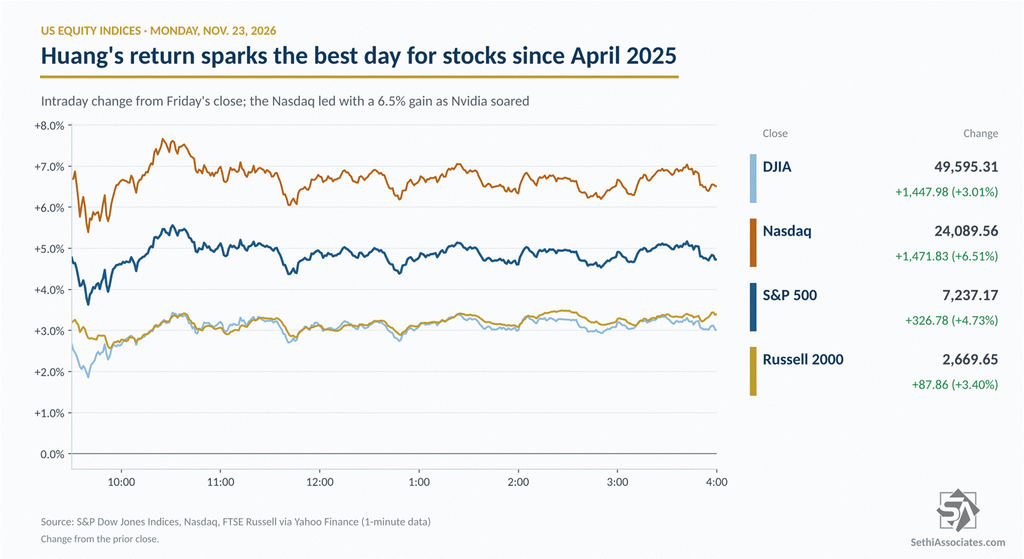
Nearly all of it came at the open: the Nasdaq Composite opened 7.3% higher, its biggest opening gain in data back to 1991, and the S&P 500 opened 4.6% higher, its biggest since March 2020, and both then spent the day in a much smaller trading range (more here: What Big Gap-Up Opens Like Today’s Have Meant for Stocks).
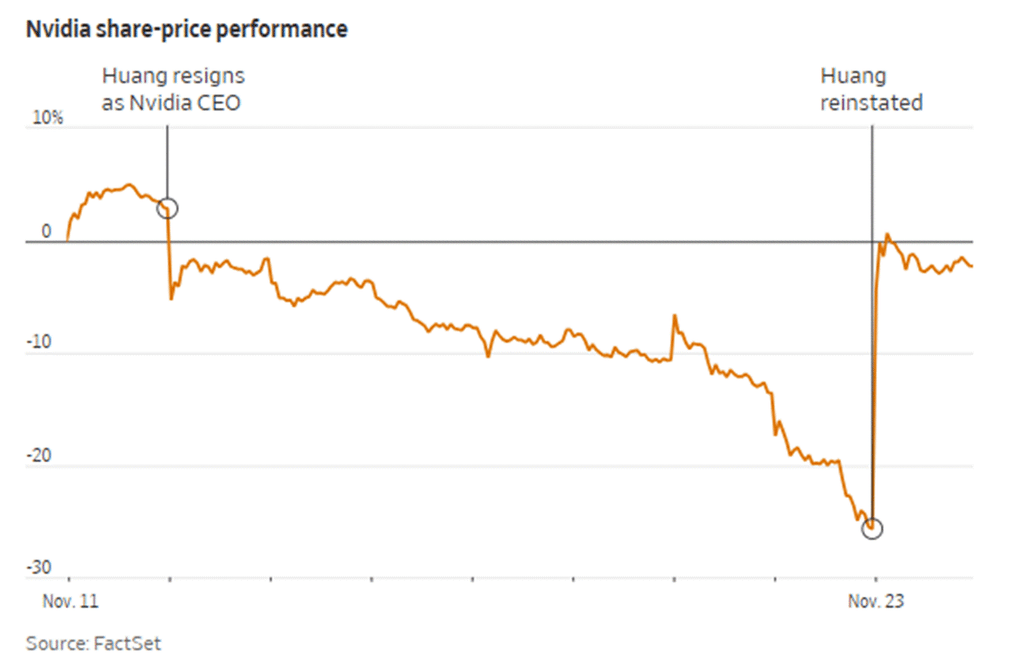
Nvidia (NVDA) soared 31.5% to $165.05, its biggest one-day gain since May 2003 and the third biggest in its history, after its board reinstated Huang as CEO, president and director, effective immediately, 11 days after he was ousted. The board said it received input from senior levels of the US government and that his return “poses no national security risk,” while the independent investigation into his ties to a Megaspeed executive will “proceed to conclusion” and the company formed a new National Security and Export Control Committee.
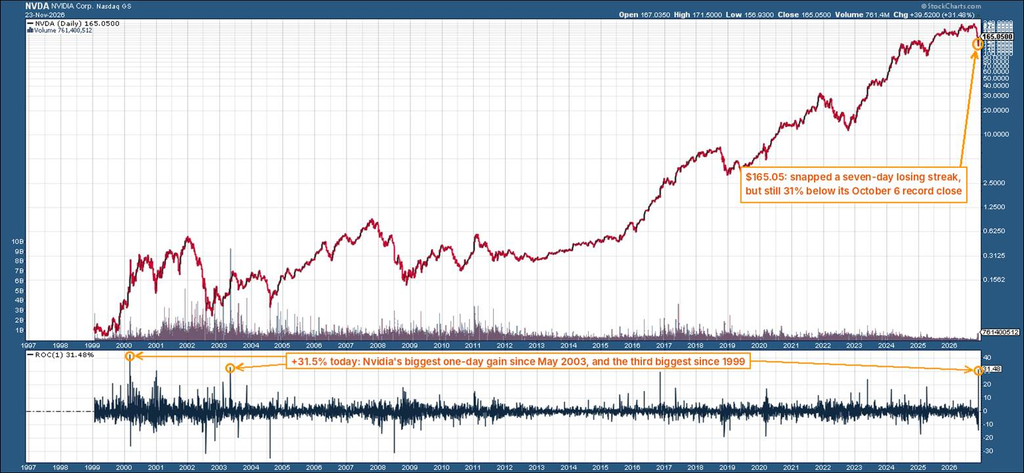
President Trump wrote on Truth Social that “the United States Government has no reason to believe that Jensen’s return to NVIDIA poses any risk to National Security.” Trump later said in an interview that Huang “did nothing wrong” and that he had spoken with the board and “convinced” them, while Sen. Chuck Schumer pledged investigations into potential wrongdoing. The gain snapped a seven-day losing streak and added an estimated $952 billion in market value, more than twice the previous one-day record for a US company. Even so, the stock is still about 5% below its November 11 close, before his exit was announced, and 31% below its October 6 record close.
Not everyone is convinced the story is over. Doug Kass said he doesn’t for a minute believe any meaningful due diligence on “the Huang affair” was done by the Trump administration, so the rally “may have a shorter half life,” and Bret Jensen noted that the SEC inquiry into Nvidia’s accounting practices reported Friday is likely to remain an overhang until it’s resolved.
The VIX fell 26% to 26.6, its seventh biggest one-day percentage drop in data back to 1990 and the biggest since April 9, 2025. Treasury yields rose, with the 2-year up 5 basis points to 4.66% at the settle as December hike odds rose back to fully priced (see FedWatch below) and the 10-year up 1bp to 4.92%. Monday’s $69 billion 2-year note auction was solid (more on that tomorrow). The dollar rose 0.5%, gold (+3.9%), copper (+2.7%) and bitcoin futures (+4.9%) bounced, while WTI crude fell 3.9% to $80.17 and natural gas 6.7%.
In economic data, S&P Global’s November flash composite PMI slipped to a four-month low but still points to growth of about 3% (more here: Flash PMI Slips to a 4-Month Low, Signals 3% GDP Growth).
Tuesday brings Conference Board consumer confidence, the $70 billion 5-year note auction and earnings from Dell, Analog Devices and Medtronic (see the Day Ahead below).
My look at today’s charts follows in a separate post later this evening.
Market Commentary
Nvidia:
- “Turns out Jensen Huang is just too big to fire, as the company quietly realized nobody else can run that place. The market agreed pretty quickly, and honestly that’s a decent read on how much of Nvidia’s story was always about the guy in the leather jacket. The business itself didn’t break while he was gone, but the episode showed that the story is a lot more fragile than the chips, and Nvidia’s stock trades on the story. It’s a nice relief for the AI names, but with the board’s investigation still set to run its course, I wouldn’t call this chapter totally closed just yet,” said David Wagner, portfolio manager at Aptus Capital Advisors.
- “Nvidia’s earnings and near-term business fundamentals are the same with or without Jensen Huang. But as an investment, Nvidia is a fundamentally different stock with Jensen at the helm. He’s the visionary who built it into the world’s most valuable company, and his leadership changes what I think Nvidia can become over the next decade,” said Joe Tigay, portfolio manager at Equity Armor Investments.
- “It seems as though the board buckled under market and administration pressure,” said Steve Sosnick, chief strategist at Interactive Brokers. “It will mollify shareholders of NVDA and even the market as a whole. Buckle up for a series of Congressional investigations into Huang, Lutnick and others once the new Congress is seated.”
- “All the questions I was answering over the weekend now flip on their head. The concern for future growth in this market was how much Nvidia was involved not just in the production of their equipment, because that’s a big deal for data centers and such, but also for the financing. That level of uncertainty was something that the market was clearly uncomfortable with. With Jensen coming back in and being the dealmaker and also responsible for allocating that capital, that level of certainty comes back with him,” said Brian Mulberry, chief market strategist at Zacks Investment Management.
Equities:
- “Today’s buoyant recovery is emblematic of how much influence one man can have on AI momentum, the global economic expansion and the bull market in stocks,” wrote Jose Torres, senior economist at Interactive Brokers, adding that with Huang back at the helm and oil prices at a 13-week low, “the setup is conducive for a year-end surge.”
- Tech and chip stocks had been hammered on “indiscriminate selling on fear,” and “when things are this oversold, a little good news goes a long way,” said Keith Lerner, chief investment officer at Truist Advisory Services. That has investors shifting from guarding against further downside to covering shorts and considering the need to get back in, he said.
- “The market has effectively gone from panic to ‘never mind,'” said Mark Hackett at Nationwide. “It’s a reminder that emotional markets are incredibly difficult to predict, and reacting to every swing can be more dangerous than the volatility itself.”
- “The ‘Trump put’ is back in the conversation. … Our read is that policymakers are willing to step in when stress in such a strategically important sector starts spilling into the broader market. For U.S. stocks, the next test is whether that willingness extends to concrete policy action,” said Ken Mahoney, CEO of Mahoney Asset Management.
- “The market was already oversold, and bearish sentiment was very high,” said Matt Maley, chief market strategist at Miller Tabak + Co. “However, the issues of data center delays and enterprise push back on pricing have not gone away. So, the core problems have not changed. Therefore, this might not be long-term the catalyst the bulls are looking for.”
- “Jensen Huang’s return restores and rebuilds confidence in the AI ecosystem: its major suppliers, its core building blocks, and its demand outlook,” said Hendi Susanto, portfolio manager and research analyst at Gabelli Funds, though the trade “still has to push through a lot of noise about financing, geopolitics, durability and skepticism, even though companies across the AI supply chain keep reporting strong demand.”
- “This will be a bumpy road over the coming months. That said, the technology age of AI is coming one way or another … and this is not going to slow down the 160 GW of backlog/demand power through 2029,” said Dan Ives, global head of technology research at Wedbush Securities.
- “Stock market corrections can sometimes end as quickly as they begin, and we believe the bottom in stocks is likely in,” said Glen Smith at GDS Wealth Management.
Stock and Sector Breakdown
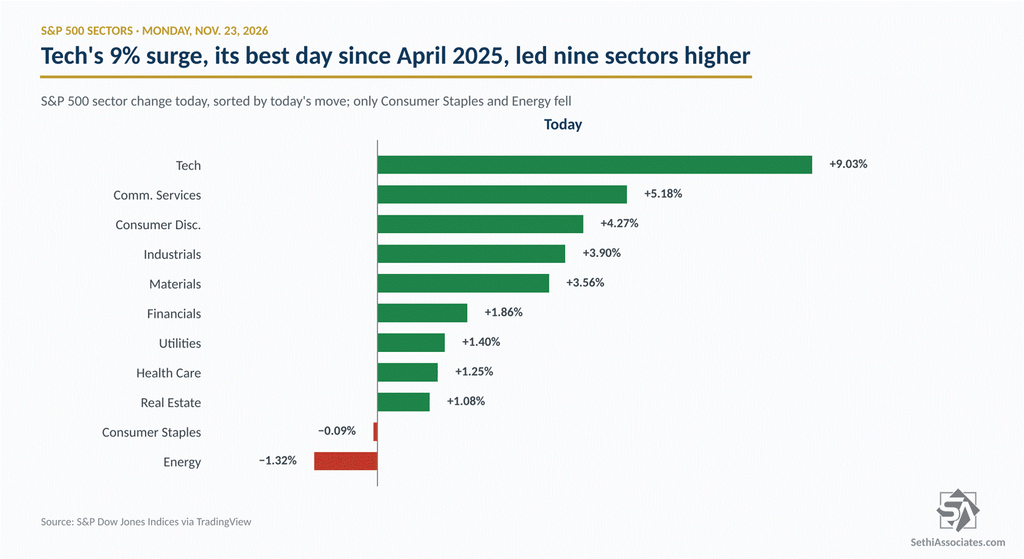
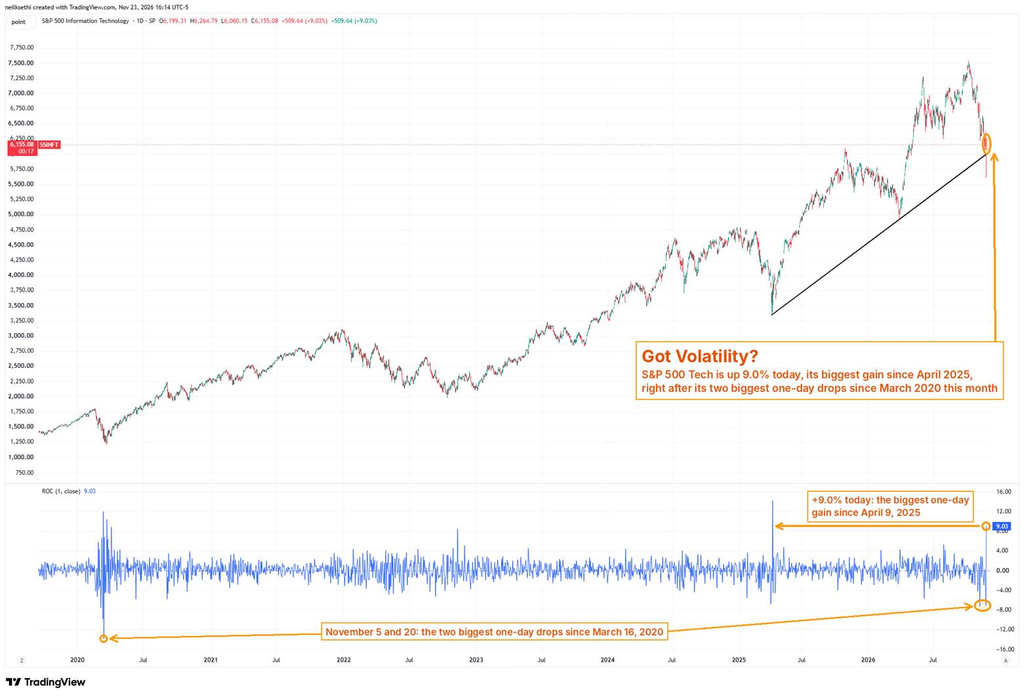
Nine of the 11 S&P 500 sectors rose, led by Tech’s 9.0% surge, its biggest gain since April 2025, which came right after its two biggest one-day drops since March 2020 earlier this month (November 5 and November 20). Communication Services (+5.2%), Consumer Discretionary (+4.3%) and Industrials (+3.9%) followed, while Energy (-1.3%) fell with oil and Consumer Staples (-0.1%) slipped.
416 S&P 500 stocks rose and 81 fell, up from 124 gainers Friday. 180 rose more than 3%, one of the highest numbers we’ve seen since the summer, but not the highest, while just five fell more than 3%.
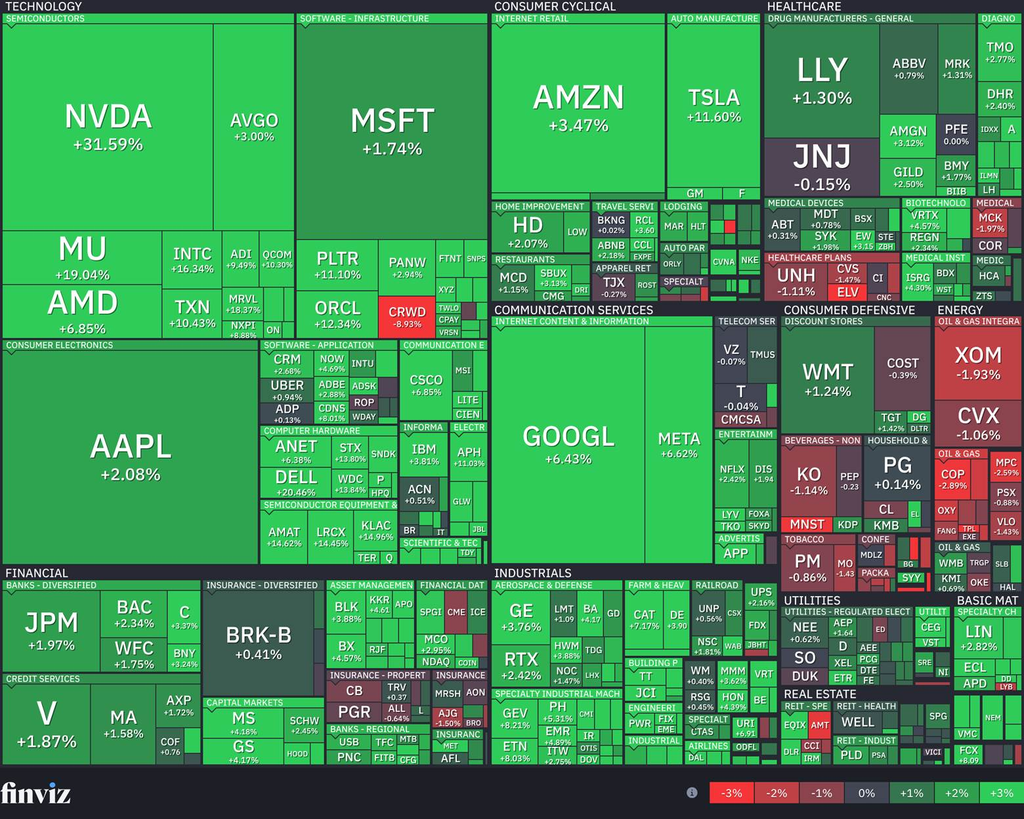
Nvidia was the S&P 500’s top performer, as noted above. CrowdStrike (CRWD) was the worst performer, down 8.9%, after agreeing to buy Zscaler (ZS) in an all-stock deal valued at about $43.9 billion and releasing its fiscal third-quarter results early. Zscaler jumped 18%. Sarge, who added to his CrowdStrike position on weakness overnight, walked through the deal, the early results and his plan for the stock.
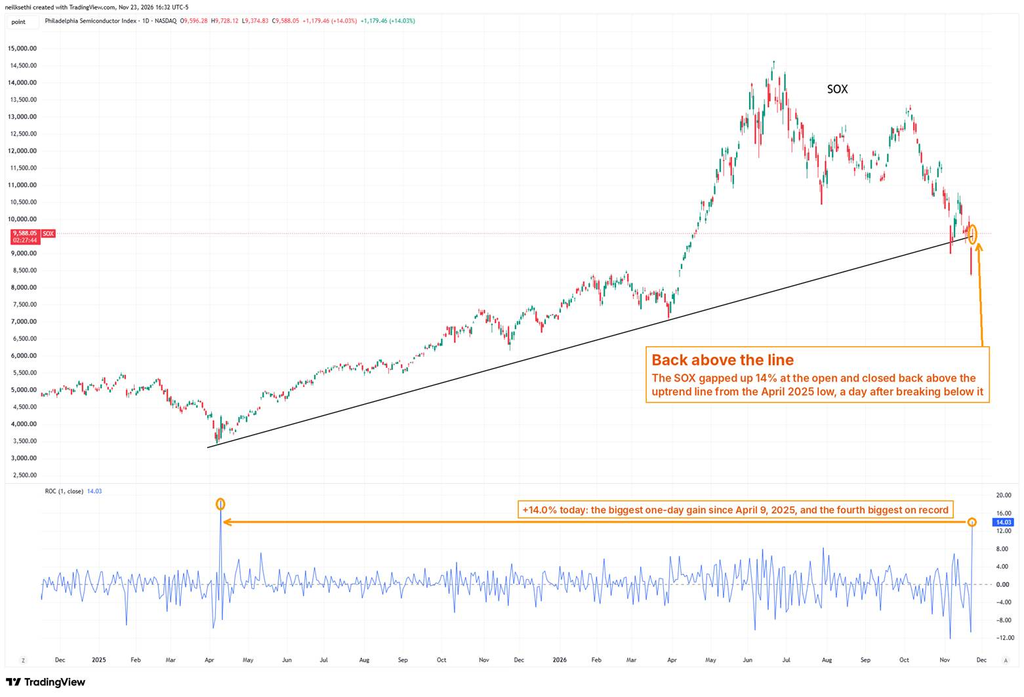
AI hardware names led the rest of the gainers. The SOX jumped 14%, its fourth biggest gain on record and its best day since April 9, 2025, with Micron (MU) up 19% (I’ll have a post on Micron’s valuation likely tomorrow), Marvell (MRVL), Lumentum (LITE) and Hewlett Packard Enterprise (HPE) up 17% to 18%, Intel (INTC) up 16% and chip-equipment makers KLA (KLAC), Applied Materials (AMAT) and Lam Research (LRCX) up 14% to 15%. Dell (DELL) rose 20% ahead of its report Tuesday night, and Doug Kass sold his position into the strength. Outside the S&P 500, neoclouds CoreWeave (CRWV) and Nebius (NBIS) gained 20% or more, and Arm (ARM) rose 16% after CEO Rene Haas extended his contract through 2033. Power names GE Vernova (GEV) (+8%) and Bloom Energy (BE) (+18%) rallied on expectations for continued data center spending.
Among the megacaps, Tesla (TSLA) and Palantir (PLTR) jumped 11%, while Meta (META) and Alphabet (GOOGL) rose more than 6%, Amazon (AMZN) 3.5% and Broadcom (AVGO) 3%. Oracle (ORCL) gained 12% after confirming it had secured the financing to fulfill its OpenAI contract, and Amazon is reportedly paying about $7.5 billion for AI startup Decart’s technology. Apple (AAPL) (+1.9%) and Microsoft (MSFT) (+1.7%) lagged. Energy stocks such as ConocoPhillips (COP) fell about 3% as oil slid.
Anthropic (ANT) sat out the rally, slipping 1.4% to $87.64, about 6% above its $83 IPO price. Peter Tchir said Anthropic “needs to perform” for the “liquidity event” behind last week’s selling to be over. SpaceX (SPCX) rose 4% after Jefferies started coverage with a Buy rating, and Bob Lang says that as it builds a base between 120 and 130, it should soar in 2027.
Many on TheStreet Pro urged caution about chasing the bounce. Rev Shark asked whether a bounce this big can be trusted, noting that lasting lows usually come after a test, and later said those who rode the decline down now have “a chance to reduce the positions you wish you had sold last week at much better prices.” Helene said the market’s next move may depend on one word: panic, noting that we still haven’t had a 90% downside volume day, and Sarge said this is a market too fast for our own good. Bob Lang said something finally broke on the S&P 500 chart last week, with long-term support around 5,800, and Bret Jensen said stocks need to end this holiday week solidly higher or a bear market could be on the near-term horizon. Chris Versace flagged resistance at the S&P 500’s and Nasdaq’s 200-day moving averages, and Bob Byrne noted that four Wall Street legends, from Stan Druckenmiller to Goldman’s David Solomon, all gave the same answer on AI: “I don’t know.”
Peter Tchir, who started nibbling Friday, took off all the longs he added Friday into the rally. Doug Kass sold all his index trading longs at 4:41am with S&P futures up 185 handles, cut his individual tech and financial stocks back to small-sized, and by early afternoon had taken a small short in SPY and QQQ, which he added to a little later.
After the close, Agilent (A) rose about 5% after fiscal fourth-quarter results topped estimates and it guided fiscal 2027 earnings to $6.73 to $6.86 a share. Hewlett Packard Enterprise (HPE) gave back about 6% after hours, despite fiscal fourth-quarter results that topped its own outlook, with adjusted EPS of $1.43 against guidance of $1.20 to $1.30 and revenue up 50% to $14.5 billion (server revenue nearly doubled). It also raised its fiscal 2027 outlook to revenue growth of 27% to 35% and adjusted EPS of $5.05 to $5.35.
FedWatch
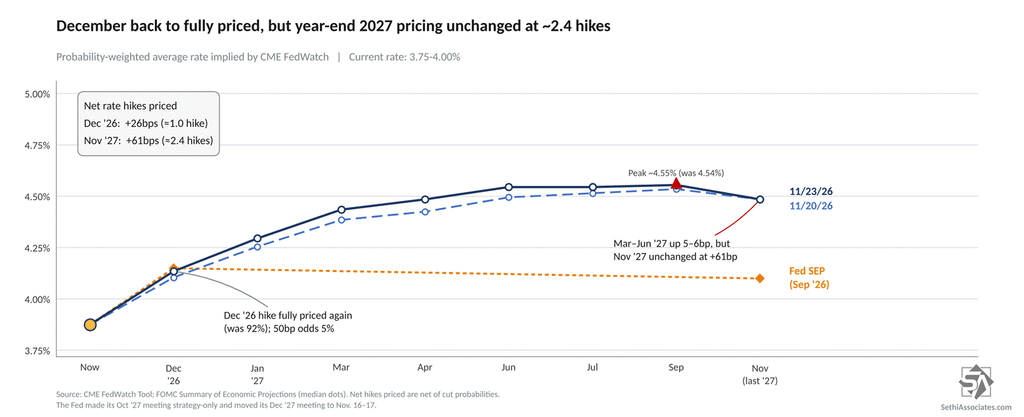
With the equity rally, a December hike is back to fully priced (with a 5% chance of a 50 basis point hike), up from 92% Friday, at 26 basis points of hikes, from 23bp. Pricing for the end of next year was unchanged, with 61 basis points of hikes through the Fed’s final 2027 meeting in November, about two and a half hikes, per CME FedWatch.
More From TheStreet Pro
Chris Versace —
- Equity Futures Bring Some Market Relief: 8 Key Items Shaping the Stock Market Monday
- Updating Portfolio, Bullpen Valuations Tables Ahead of a Pivotal Week
- Submit Your Questions for Wednesday Office Hours
Stephen “Sarge” Guilfoyle — Trading Around Small-Cap Positions
Doug Kass’s Diary:
- My Editorial in Barron’s Over the Weekend
- Why the GOAT Is Not Playing Now
- S&P Update
- Boockvar on the Stock Market Wealth, China Buying Gold
- Charting the Late Morning Market
- Tech vs Financials and Sector ETFs
Note: Doug posted 40 Diary entries today; these are the market ones not linked above. You can see all of them here.
And From Me If You Missed It
- The Week Ahead – Time For a Bounce?
- Monday’s Calendar – Flash PMIs, Fed’s Williams, and a 2-Year Auction
- History Says Last Week’s Lopsided Selling Volume Leads to Bounce
- VIX Above 30 at Options Expiration Usually Means Higher Stocks Ahead
- More Signals Pointing to a Bounce This Week
- S&P 500 Is Most Oversold Since April 2025, Not Much of a Buy Signal
- Flash PMI Slips to a 4-Month Low, Signals 3% GDP Growth
Miscellaneous
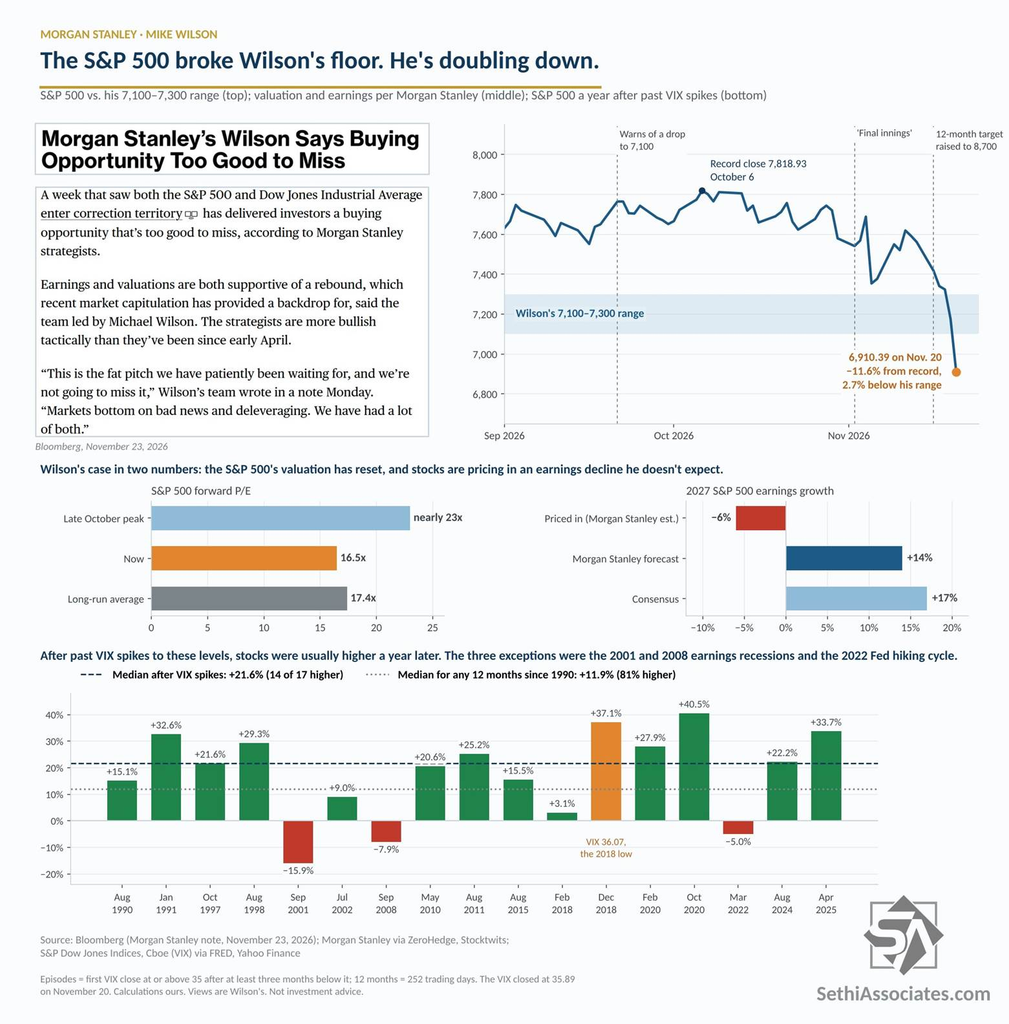
Morgan Stanley’s Mike Wilson doubled down on buying the selloff after the S&P 500 broke below his 7,100 downside target. In Monday’s note, his team called it “the fat pitch we have patiently been waiting for, and we’re not going to miss it,” adding that “markets bottom on bad news and deleveraging. We have had a lot of both.”
How we got here:
- In late September, he warned of a drop to as low as 7,100 before the bull market resumed.
- In early November, he said the correction was in its final innings, with a 7,100 to 7,300 range. On November 16, he raised his 12-month target to 8,700.
- On Friday, the S&P 500 closed at 6,910.39, 2.7% below the bottom of that range and 11.6% below the October 6 record, capping a seven-day losing streak, the longest since February 2020.
Why he’s pressing the call rather than backing off:
- He calls the break below his range an overshoot of fair value driven by forced deleveraging. His team is more bullish tactically than at any time since early April.
- Sentiment: his sentiment indicator hit -1.6 and the VIX hit 36, both matching December 2018, and hedge fund positioning is similarly washed out.
- Valuation: the S&P 500’s forward P/E has dropped from nearly 23 in late October to 16.5, below its 17.4 long-run average, and the Nasdaq-100’s is under 17, below its pandemic low.
- Earnings: by his math, stocks are pricing in about a 6% drop in 2027 earnings. He forecasts 14% growth, and consensus is 17%.
- He likes hyperscalers, industrials, quality cyclicals with improving estimates and companies benefiting from AI adoption.
- The main risk is still a hawkish Fed, but he thinks market pricing is “far too hawkish” and expects a calmer message in December than some fear.
History backs him, with a catch. Since 1990, the VIX has had 17 episodes where it first closed at 35 or higher (Friday’s close was 35.89):
- The S&P 500 was higher 12 months later in 14 of the 17, with a median gain of 21.6%, compared with 11.9% for any 12-month stretch since 1990.
- December 2018, the episode he compares this one to, was followed by a 37.1% gain.
- But the first spike often wasn’t the low. In eight of the 17, the S&P 500 fell more than 5% further within three months, including another 34.9% in 2008 and 24.9% in 2020.
- The three losing years were 2001 and 2008, both earnings recessions, and 2022, a Fed hiking cycle.
History would suggest his call should hold unless earnings roll over or the Fed gets much more aggressive. The market is already pricing in an earnings drop he doesn’t expect, so the bigger swing factor is the Fed, the one risk he concedes. Morgan Stanley chief economist Seth Carpenter acknowledged in his Sunday Start note that clients pushed back hard on the bank’s “Embracing Risk” outlook, and that even if the bank is right, the path through 2027 “will not be smooth or linear.”
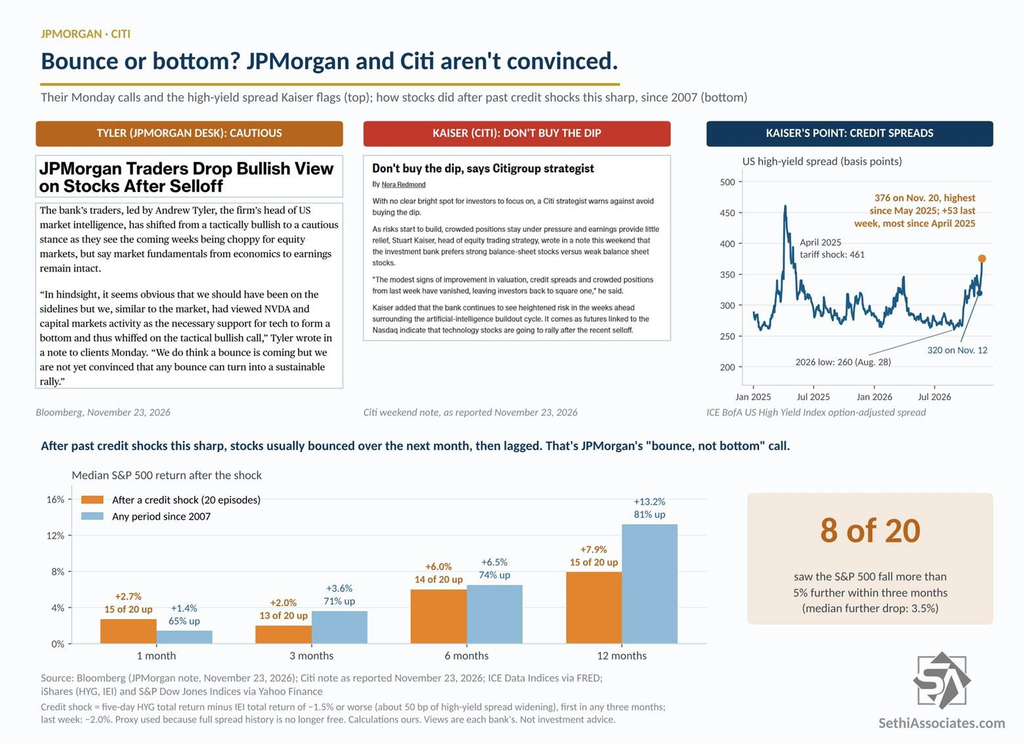
Not everyone is buying the dip. JPMorgan’s trading desk and Citi’s head of equity trading strategy are telling clients to be careful:
- JPMorgan’s desk, led by Andrew Tyler, dropped its tactically bullish call for a cautious one and admitted it “whiffed.” The desk had counted on Nvidia and capital markets activity to put in a bottom for Tech.
- Tyler expects a bounce but is “not yet convinced that any bounce can turn into a sustainable rally,” citing uncertainty over interest rates and what it means for 2027 and 2028 earnings.
- He would turn bullish again on four things: a reset in positioning, cyclical stocks beating defensives, lower volatility and the Fed putting off a December hike to January or March. He still says fundamentals “from economics to earnings remain intact.”
- Citi’s Stuart Kaiser says don’t buy the dip: “The modest signs of improvement in valuation, credit spreads and crowded positions from last week have vanished, leaving investors back to square one.” He prefers companies with strong balance sheets over weak ones and sees heightened risk around the AI buildout in the weeks ahead.
The credit market backs up a cautious approach:
- The US high-yield spread (ICE BofA index) widened 53 basis points last week to 376, the biggest weekly widening since the April 2025 tariff shock and the widest level since May 2025.
- It had narrowed to 320 on November 12, the “modest improvement” Kaiser says has now vanished.
- It’s 116 basis points above its 2026 low of 260, set on August 28.
- Since 2007, weeks with credit stress this sharp (measured by high-yield bond ETFs against Treasuries) have usually brought a bounce. The S&P 500’s median gain over the next month was 2.7%, about double the usual 1.4%.
- But the bounce has tended to fade. The median 12-month gain was 7.9%, vs. 13.2% for any 12-month stretch since 2007, and in eight of 20 cases stocks fell more than 5% further within three months.
So the credit history sides with JPMorgan’s timing call: a bounce is likely, but a lasting bottom probably needs spreads to stop widening first.
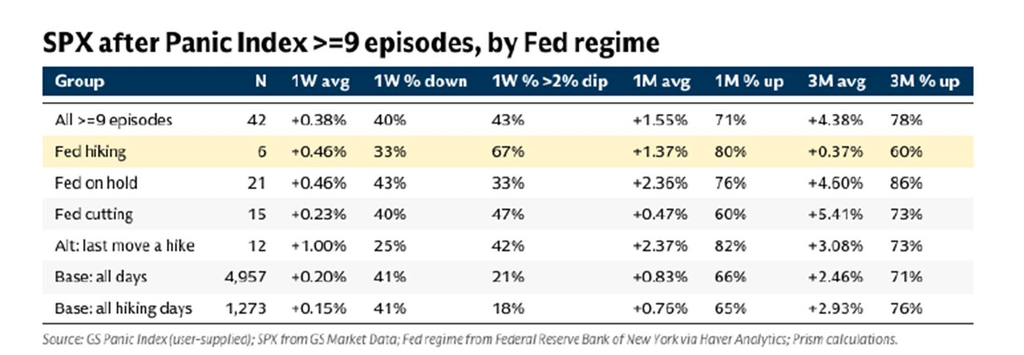
Goldman’s Peter Callahan: “Generally speaking, panic like we’ve recently seen has been a good opportunity to start adding risk. But there are two important differences with today’s setup that we’re getting pushback on. The first is the Fed, which is hiking rather than cutting. It doesn’t change the tactical setup, however in the five episodes where panic exceeded 9 during a hiking regime, subsequent three-month returns averaged just +0.4%.”
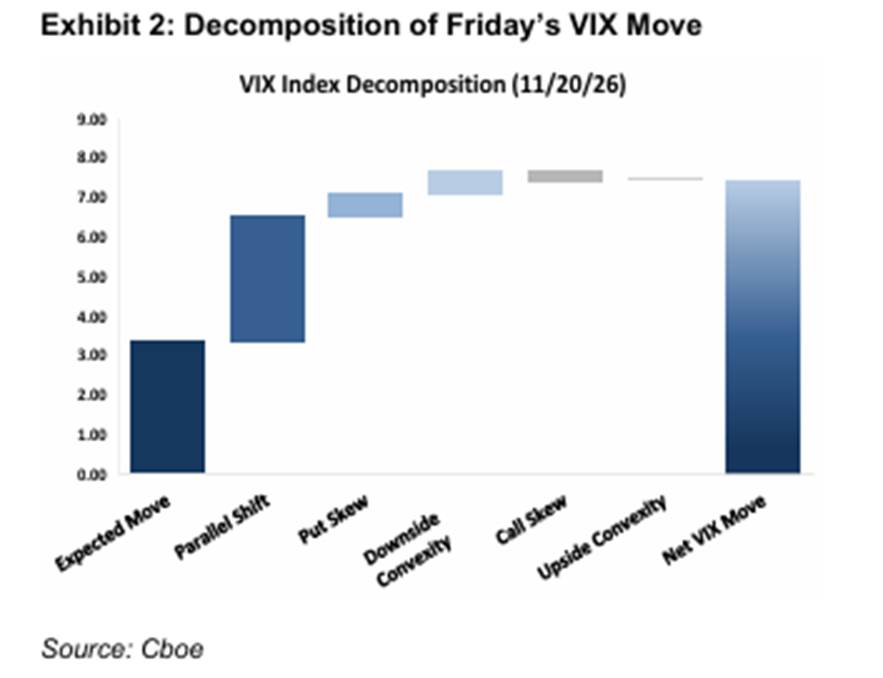
Cboe’s Mandy Xu says Friday’s VIX move, while large, was “surprisingly orderly.” The selloff in the S&P 500 (-3.7%) and the increase in fixed-strike vols (+3.2 points) accounted for almost 90% of the 7.4-point VIX increase. Very little came from demand for downside puts: changes in skew and convexity contributed just 0.9 points, whereas demand for downside protection made up almost half of the November 5 VIX spike. S&P 500 one-month skew spiked to the 95th percentile after the November 5 selloff but only steepened modestly to the 80th percentile Friday. Also notable was the lack of demand for upside calls, with call skew falling and call convexity unchanged. “It seems that while there was little panic on Friday, investors were also not positioning for a quick rebound.”
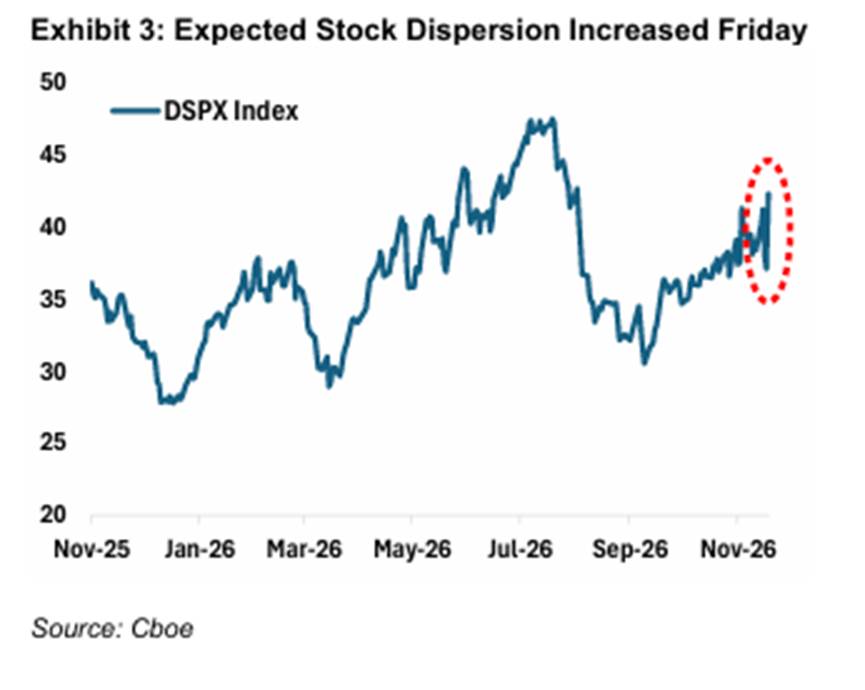
And while correlations had been increasing during the selloff, Xu says that changed Friday, when the move was “about idiosyncratic risk, not macro.” Single-stock vol outpaced the increase in index vol, with Cboe’s VIXEQ index jumping more than 11 points to a one-year high of 58% (vs. 7 points for the VIX), and expected dispersion increased even as the market sold off almost 4%. That comes as investors rotate out of the AI theme into other sectors rather than selling everything indiscriminately. Tech vols have risen the most, with QQQ one-month implied vol jumping more than 20 points last week, the most of any global index, while small-cap volatility, which has little exposure to the AI theme, trailed large caps, narrowing the Russell 2000-S&P 500 one-month implied vol spread to a six-year low of 1.4%.
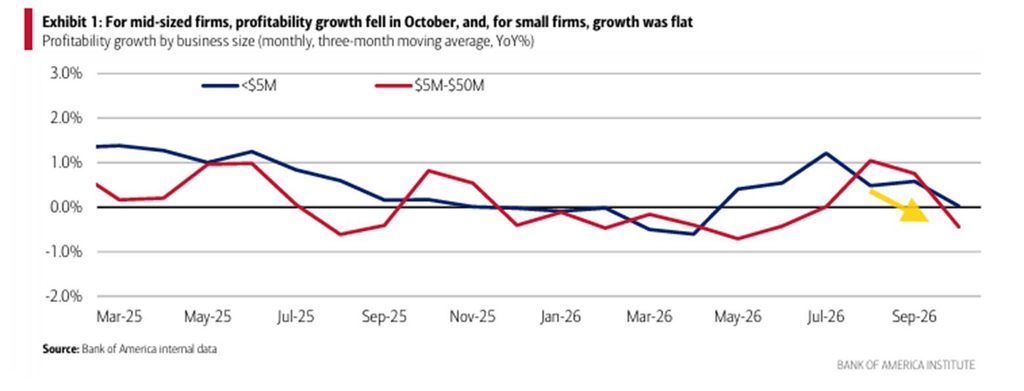
BofA Institute says small and mid-sized businesses’ financial performance kicked off the fourth quarter with “a tepid start.” Bank of America business account data indicate profitability momentum softened in October, with growth roughly flat among small firms (under $5 million in annual revenue) and turning negative among mid-sized firms ($5 million to $50 million). “While one month does not establish a broader trend, the moderation suggests businesses’ concerns about higher costs may increasingly be reflected in margins as the tariff refund buffer wanes.”
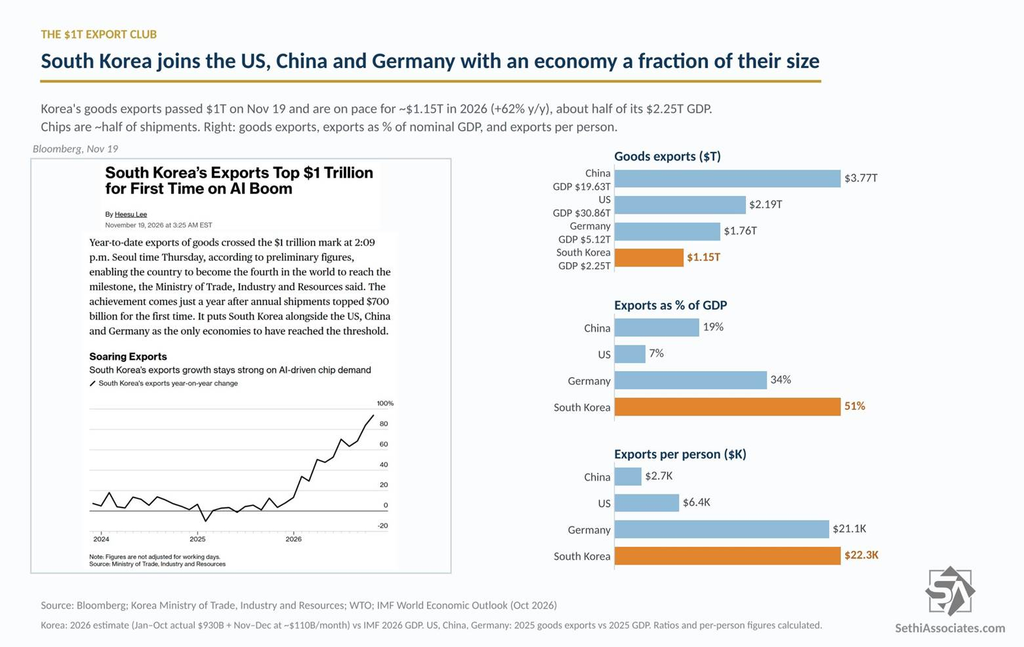
South Korea’s exports topped $1 trillion for the first time, making it only the fourth country to reach the mark, after the US, China and Germany, per Bloomberg. What stands out is how small Korea’s economy is next to the rest of the club:
- The IMF puts Korea’s 2026 GDP at about $2.25 trillion, about 7% the size of the US economy, about a tenth of China’s and about 40% of Germany’s.
- At the current pace, Korea finishes 2026 near $1.15 trillion of exports (up about 62% y/y). That’s about 51% of GDP, vs. about 34% for Germany, about 19% for China and about 7% for the US.
- That works out to about $22,000 of exports per person, edging past Germany (about $21,000) and far above the US (about $6,000) and China (about $3,000).
- In 2025 Korea was the world’s eighth-largest exporter at $710 billion, behind the Netherlands, Hong Kong, Japan and Italy. This year it passes all four.
As you might guess, semiconductors are the main engine:
- Chip exports hit $56.4 billion in October, up 259% y/y and 49% of all exports. For 2025 as a whole the share was 24%, itself a record.
- Chip exports for January through October (about $397 billion) are already more than double the total for all of 2025 ($173 billion).
- Much of it is price rather than volume. Bank of Korea data show electronics export values rising far faster than volumes as memory chip prices climb.
- October’s 93.7% jump in total exports was the biggest since 1974. By my math, chips supplied about 73% of the $56 billion y/y gain, AI-server-heavy computer exports (+497%) about 9% and petroleum products (+80% to $6.9 billion) about 6%.
- Non-chip exports rose 34% in October, though two extra working days helped. The petroleum surge is mostly oil prices (the EIA has Brent averaging $97 this year vs. $69 in 2025), and much of it washes out because Korea imports the crude: its energy imports jumped 86% in early November.
Korea’s leverage to the AI trade is what makes its trade data, published at the 10- and 20-day marks each month, a key early read on that cycle (Chair Warsh said at the October FOMC press conference that he watches Korea’s economy, as it tells him “what is on planes and ships coming this way”). Two things to watch:
- Momentum: daily exports adjusted for working days eased to $5.24 billion in October from September’s record $5.63 billion, but the first 10 days of November ($33.5 billion, a record for that stretch) showed no stall.
- Concentration: the boom hasn’t reached Korean households. Q3 GDP beat at +1% q/q, but private consumption shrank. That’s the backdrop for Thursday’s Bank of Korea decision.
Wrap-Up — That Was the Easy Part?
As mentioned at the top, I was expecting a bounce today, just not with the violence of what we got today. And those same indicators I mentioned the past few days suggest we’ll hold at least some of today’s gains through the week and the month. For example, after the 30 monthly expirations since 1990 with the VIX at 30 or higher, the S&P 500 was higher a month later 77% of the time, and after the 40 prior clusters of three roughly 80% NYSE downside days since 1996, 70% of the time. Big S&P 500 gap-ups like today’s have usually kept going too, with the index higher a month later 72% of the time.
But the indicators also say things will remain rocky. After those 30 expirations, the median worst close over the next three months was 4.9% below the expiration-day close, and the VIX got back below 20 within a month only once (December 2018) and within three months only five times. The Nasdaq has also had a mixed track record after big gap-ups: since 2003, it was higher a week and a month later only 55% of the time, with a median gain of just 0.3%, below an average day. In BTIG’s three precedents for last I’ll have an SMT post on that tomorrow). And the extreme volatility is not going to encourage systematic strategies from entering.
So one might say the “easy” money has been made. The technicals will take time to come around, as we’ll see in tonight’s charts post, and the lows haven’t been tested yet, which Rev Shark notes is what would make them more durable. The story behind the rally may not be finished either, with Kass skeptical of the vetting behind Huang’s return, Bret Jensen expecting the SEC’s accounting inquiry to remain an overhang and Steve Sosnick of Interactive Brokers bracing for Congressional investigations. As Matt Maley put it, outside of Nvidia, “the core problems have not changed,” and markets are again fully pricing a December rate hike.
That said, a V bottom is certainly not out of the question. Many of the indicators that argued for this bounce argued for one in April 2025, and that never came close to revisiting those lows.
As always, let’s see what we get and go from there.
The Day Ahead — Consumer Confidence, a 5-Year Auction and Dell
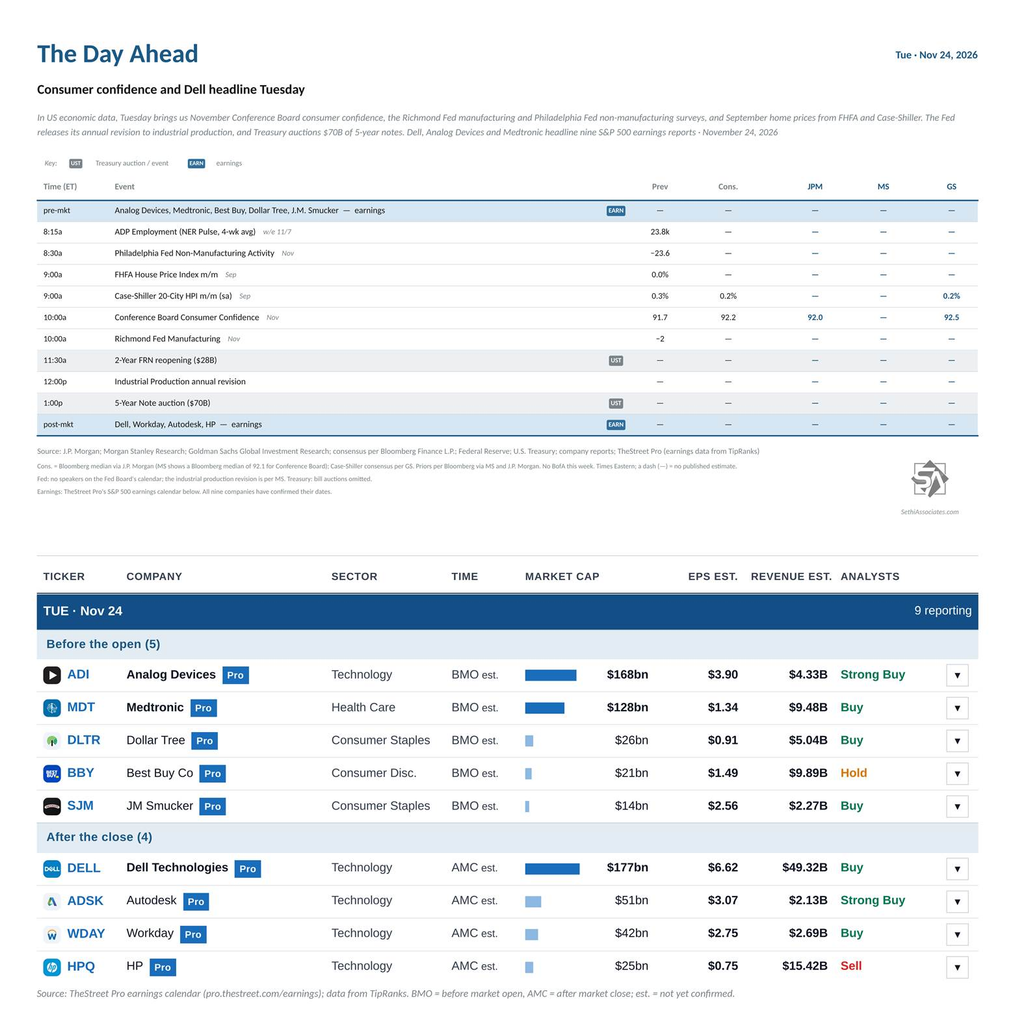
The most notable US economic data Tuesday is November Conference Board consumer confidence, with consensus at 92.2, up from 91.7 (Goldman expects 92.5). We’ll also get the Richmond Fed manufacturing and Philadelphia Fed non-manufacturing surveys for November, September home prices from FHFA and Case-Shiller (consensus +0.2% m/m for the Case-Shiller 20-City index, from +0.3%) and ADP’s weekly employment data. The Fed releases its annual revision to industrial production at noon ET.
There are no scheduled Fed speakers between now and the December meeting.
Non-Bill (>1yr in maturity) US Treasury auctions include a $28B 2-year FRN reopening at 11:30am ET and $70B of 5-year notes at 1pm ET.
Nine S&P 500 components report, three of them with market caps over $100B:
- Before the open: Analog Devices (ADI), Medtronic (MDT), Best Buy (BBY), Dollar Tree (DLTR) and J.M. Smucker (SJM).
After the close: Dell (DELL), Autodesk (ADSK), Workday (WDAY) and HP (HPQ). - Outside the S&P 500, Dick’s (DKS), Burlington (BURL) and Abercrombie & Fitch (ANF) report before the open.
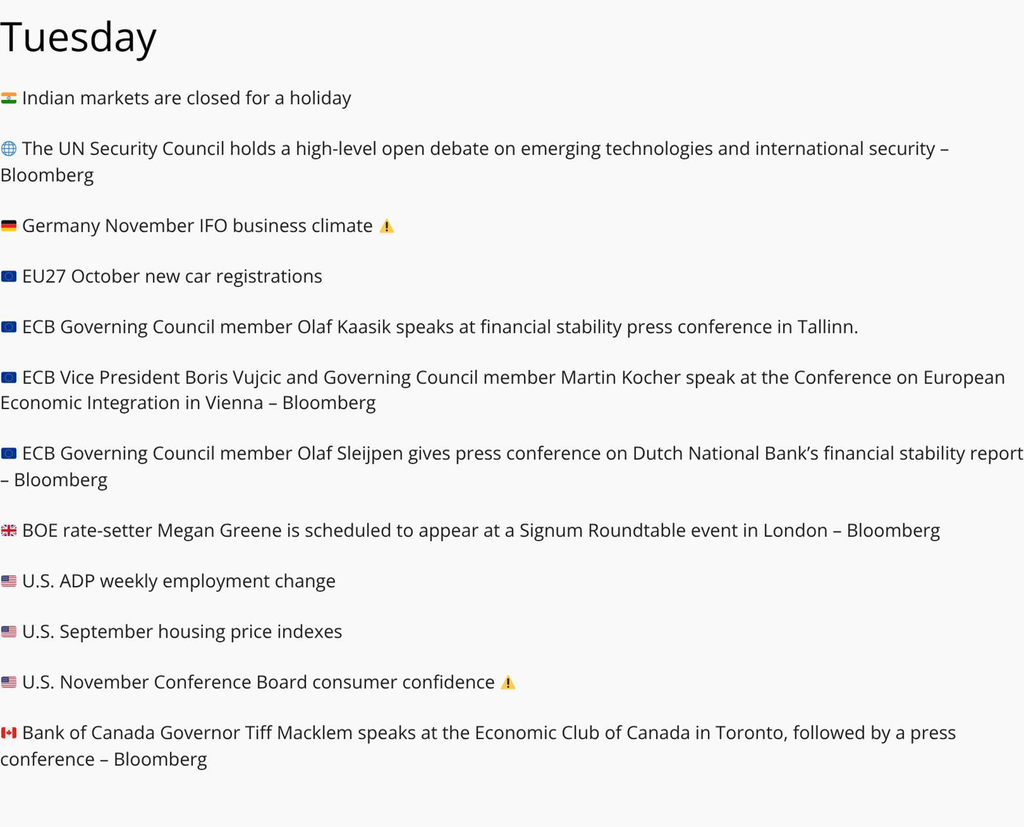
Ex-US highlights include Japan’s November flash PMIs (7:30pm ET Monday) and Germany’s November Ifo business climate survey (4am ET), along with EU new car registrations for October. ECB Vice President Vujcic and Austria’s Kocher speak at a conference in Vienna, the Dutch and Estonian central banks present financial stability reports, the BoE’s Greene appears at an event in London, and Bank of Canada Governor Macklem speaks on the economic outlook and the challenges facing monetary policy in Toronto (12:40pm ET, with a press conference at about 2pm ET).
Indian markets are closed again for a holiday.
From Christophe Barraud’s international Week Ahead rundown:
At the time of publication, in terms of securities mentioned, Sethi was long AMZN, GOOGL, NVDA, ORCL, PLTR, SOXL, ZS and numerous Treasury ETFs, and short IWM, MRVL and VOO. In the last 24 hours Sethi covered his CPER short, reinstated his PLTR long and VOO short, and trimmed SOXL.