4 Wall Street Legends Offer the Same 3-Word Response to AI Uncertainty
Wall Street legend Stan Druckenmiller and the leaders of Goldman Sachs, Apollo and Blackstone all admit they can’t see six months ahead on AI stocks.
You've reached your free article limit
You've read 0 of 1 free Pro articles.
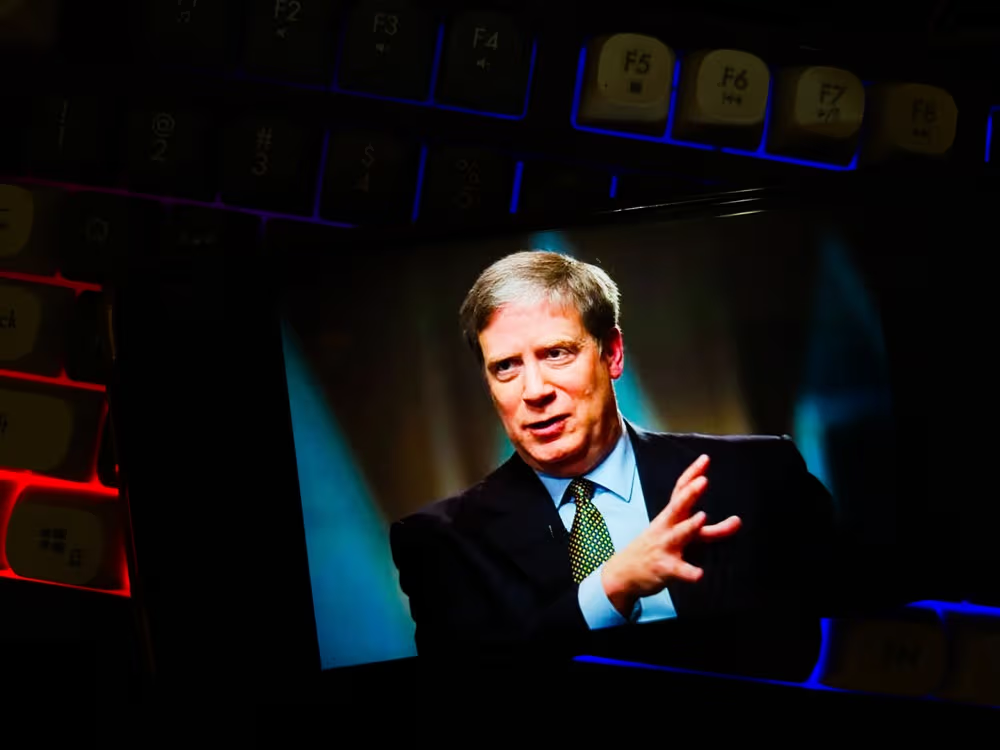
Stan Druckenmiller has an auto-reply now.
His interviewer teased him about it on stage at the TomorrowX Summit in Austin last week, and he leaned right in.
“It’s auto-reply. Don’t talk to me. I’m not playing.”
In roughly 50 years of managing money, he has never had a down calendar year. Yet he wasn’t the only giant there who admitted he can’t see past the next few months. Goldman Sachs (GS) CEO David Solomon, Apollo (APO) CEO Marc Rowan and Blackstone (BX) President Jon Gray each said some version of the same three words: I don’t know.
My last column covered Druckenmiller’s macro worries. This one is about how four of the best capital allocators alive handle a market none of them can read.
Druckenmiller Doesn’t Guess, He Waits
Druckenmiller ignores Wall Street’s risk models and watches his own profit and loss. When it stops behaving, he cuts back, and right now he’s neither long nor short stocks. He doesn’t call that a slump.
“I’m not cold,” he said. “I’m in an out streak.”
Like a hitter who isn’t seeing the ball, he steps out of the box and waits, then swings big once he can see it again. This break “could last two days or six months,” he added.
He isn’t bearish, either. He said he wouldn’t dare short AI with this much innovation underway.
Solomon Thinks in Decades, Not Quarters
“I have no idea what’s going to happen in the next, you know, three to six months,” Solomon said. “But when I look out over the next 10 years, I’m incredibly optimistic.”
When the moderator noted that many AI stocks are down 50% or more, Solomon called it “a recalibration of the growth curve” and said the multiples “look more attractive to me than they did, you know, six months ago.”
From a banker who earns fees whether clients buy or sell, in my experience, that’s about as close to a buy signal as you’ll hear on a public stage.
That’s also music to index investors. You don’t need to pick the AI winner to own the Invesco QQQ Trust (QQQ), the Technology Select Sector SPDR Fund (XLK) or the VanEck Semiconductor ETF (SMH) through this selloff. You’re buying the decade Solomon likes and skipping the six months he can’t see.
Rowan Reads it Like a Lender, Because He Is One
“Valuations are not cheap,” Rowan said. “Is risk elevated? Yes. Risk is elevated.”
If the revenue doesn’t show up, “There will be low returns. There will be stranded capex.”
His sharpest point was about neoclouds, which rent out AI computing power. Some are worth $50 billion to $60 billion while their bonds trade at 15%, as if stock and bond buyers see two different futures.
“It seems a little schizophrenic,” he said.
Gray Says the Bubble Talk Went Too Far
“There’s definitely high bubble alert on in the markets,” Gray said.
But in 2000, Cisco traded at 130-times forward earnings. Today, demand is outrunning supply, and the biggest spenders should generate about a trillion dollars of cash flow before capex and taxes next year.
“I think the negativity has gone too far in aggregate,” Gray added.
Market Proved All 4 Right in 1 Afternoon
Anthropic (ANT) opened at $111.50, more than 30% above its $83 IPO price, and closed at $97.17 on a day the Nasdaq fell and AI chip stocks sank. That morning, I wrote that I wouldn’t buy at the open. By Friday, the stock had briefly given back its entire first-day pop, and anyone who chased it at the open was down 25%. That’s what a market that can’t see six months out looks like.
I’m still a buyer, just not at any price. Maybe AI models do become commodities someday. Even so, I think Anthropic becomes far more than a model company, built into the apps, agents and businesses that AI is only starting to reshape. I expect to own ANT within the next year, ideally closer to $55, though that may be a pipe dream. Then again, Facebook (META) went public at $38 in 2012 and traded below $18 about four months later.
So, Why Can’t Anyone See Six Months Out?
Ask Druckenmiller which AI bear case he respects most, and his answer is four words long.
“Politics slash the financing,” he said.
The first half is voters turning against data centers. The second is the borrowed money paying for more of this buildout, at rates Rowan already mentioned.
The politics moved first. Several data center states flipped from red to blue on election day, and former White House AI czar David Sacks warned that their new Democratic governors have promised construction moratoriums. He also fears a federal agency approving every AI model before release.
“It will be like the DMV,” he said.
I’m 100% in favor of real AI safety guardrails, and we’ve seen enough hacking to know they aren’t good enough yet. But government moves slowly, and a DMV for AI hands the race to China.
Every data center should have its community’s backing, and the early builders screwed up by not taking care of those towns. That’s fixable, but a moratorium isn’t the fix. Block a data center that could have been built on reasonable terms, and it simply moves one or two states over, taking the jobs and tax revenue with it. The politician who let it walk will likely hear about it from voters at the next election.
Nobody Knew in 1998 Either
I started trading in 1998, and none of us knew how the internet would change the way we live, work, shop and play. On AI, some think it kills jobs and the purpose people find in work. Others believe workers who embrace AI will replace those who refuse. I’m in the second camp, and I think we’ve barely begun to see how much AI will change the way we work and live.
That uncertainty, plus machines trading against machines, is why I expect runaway bull markets followed by fast, terrifying crashes. This correction looks more like a narrative panic than a collapse in demand. Nobody is walking away from GPUs, memory or data centers. Financing got harder with the 10-year treasury yield above 5%, and losing Jensen Huang — the closest thing the AI trade had to a messiah — hurt. But AI is bigger than one man, and if the story improves even a little, these stocks can snap back fast. Then the cycle repeats. The narrative turns wildly bullish, and stocks rip to unsustainable highs, until it flips for reasons almost no one can pin down and the crash blows up over-leveraged investors.
Druckenmiller knows the straight-up kind better than anyone. In January 2000, he sold the Nasdaq, then bought it back the day it peaked.
“I think I missed the top by an hour,” he said.
Asked what he learned, he gave the week’s most honest answer.
“I said nothing,” he responded. “I knew it. I just couldn’t help myself.”
If Druckenmiller can’t call the next six months and still gets swept up by FOMO, the rest of us shouldn’t pretend we can. So, know your time frame.
Traders need to move and pivot like Druckenmiller, because this market punishes anyone who freezes. Long-term investors not held hostage to a benchmark or limited partners should know which companies they’d own beyond the next six months, and buy them when everyone else is selling. That’s my plan for Anthropic.
At the time of publication, Byrne was long QQQ