Flash PMI Slips to a 4-Month Low, Signals 3% GDP Growth
November flash composite PMI eased to 54.6, the lowest since July, as services and manufacturing growth both slowed.remained elevated.
You've reached your free article limit
You've read 0 of 1 free Pro articles.
US S&P Global Composite PMI: 54.6 (est 55.6; prev 55.9)
— Manufacturing PMI Nov P: 54.5 (est 54.5; prev 54.9)
— Services PMI: 54.7 (est 55.5; prev 56.1)
Executive Summary
- The November US flash Composite PMI Output Index eased -1.3pts to 54.6 from 55.9 in October, “indicating sustained strong economic growth but with the pace of expansion down to its lowest since July.” The manufacturing PMI dipped -0.4pts to 54.5, a three-month low, while services fell -1.4pts to 54.7, a four-month low.
- New orders growth cooled for a second month to the weakest since July, “led by a marked slowing of new business inflows into the service sector,” and exports fell “for the first time in four months.”
- Capacity stayed tight. Backlogs rose again in both sectors, hiring was “the joint-third largest seen for over four years,” with factory job creation “the second-strongest since July 2021,” and supplier delivery times lengthened the most since August 2022.
- Selling price and input cost inflation both cooled, “helped by lower fuel prices,” but “remained elevated,” while sentiment “revived from October’s five-month low” on “hopes of reduced political instability following the midterm elections.”
- Per Williamson: “Although output growth slowed in November, recent readings have been impressively strong, and the PMI surveys still point to GDP rising at an annualized rate of about 3% in the fourth quarter.”
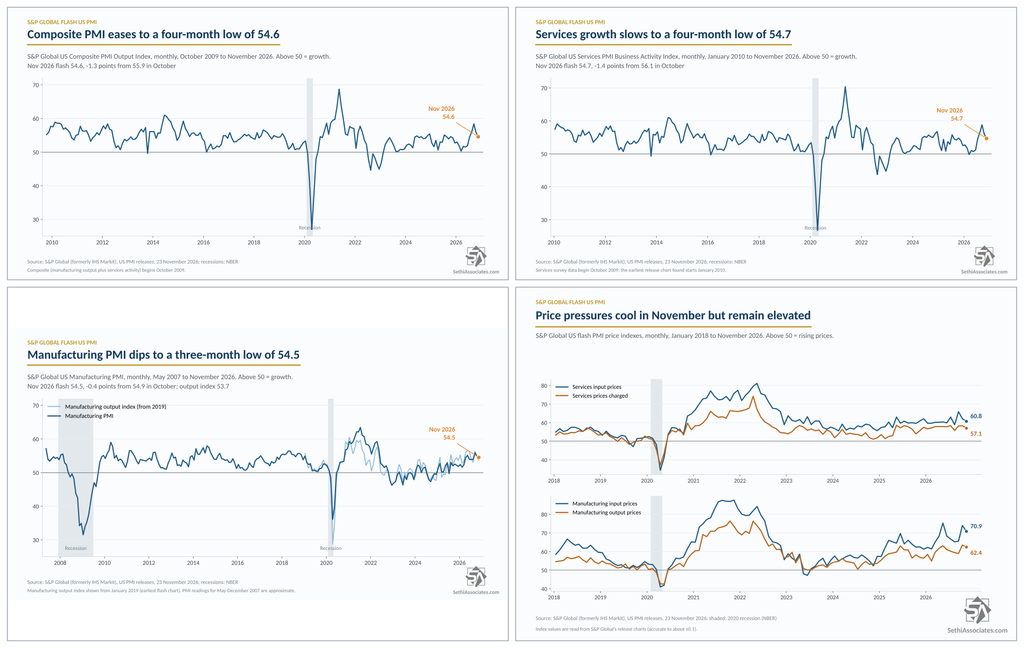
The November US flash Composite PMI Output Index eased -1.3pts to 54.6 from 55.9 in October, the lowest since July, but still “indicating sustained strong economic growth.” It is the 46th month of expansion.
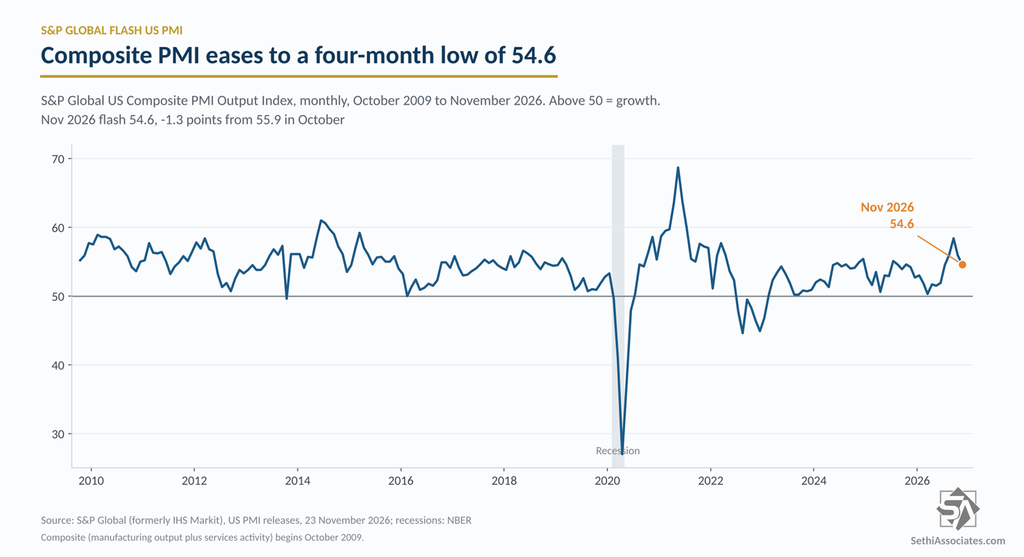
The manufacturing PMI fell -0.4pts to 54.5, a three-month low, registering “an improvement in business conditions for a sixteenth successive month but with the rate of increase easing for a second month running,” though it “remained above the average seen so far this year.” Manufacturing output eased -0.8pts to 53.7, also a three-month low.
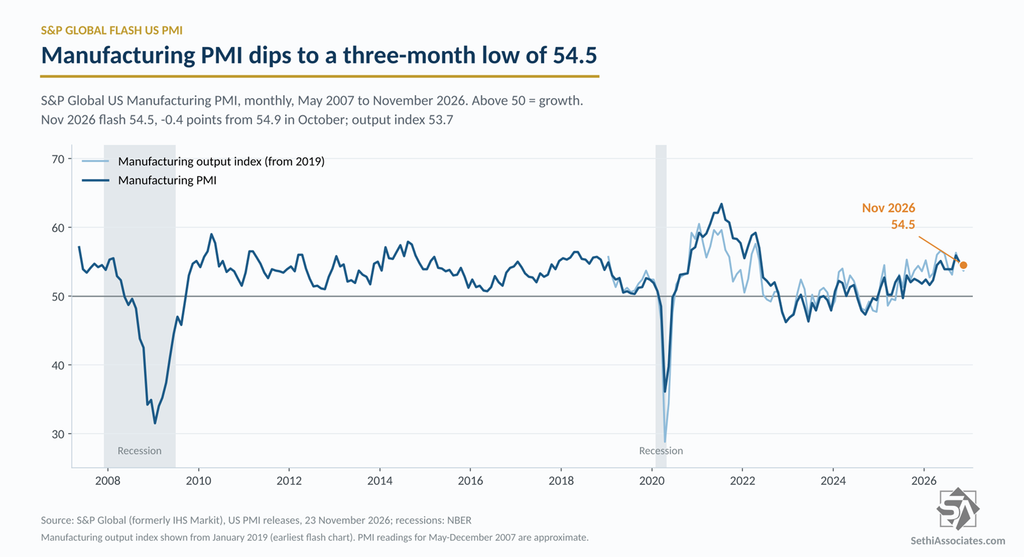
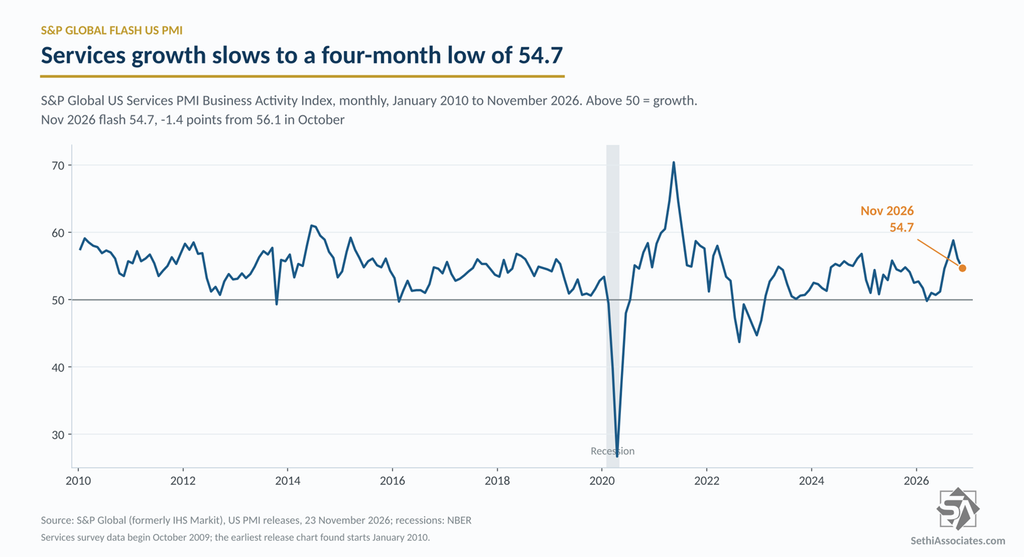
Services slipped -1.4pts to 54.7, a four-month low, though “service sector growth outpaced manufacturing for a fifth successive month.”
Looking at the components:
New Orders cooled for a second month to the weakest since July, “led by a marked slowing of new business inflows into the service sector, commonly linked to heightened uncertainty among customers, high prices and some reports of demand being reduced via higher interest rates.” At factories, though, new orders “grew at a marginally faster rate,” albeit at “the second-weakest seen over the past eight months.” Per Bloomberg, “strong consumer spending, investment related to artificial intelligence and outlays on national defense have supported US businesses and boosted profits this year.”
Sentiment revived from October’s five-month low, but the sectors diverged — “An improvement in business prospects in the service sector, in part reflecting hopes of a more stable business environment after the midterm elections, was offset by reduced sentiment in the manufacturing sector. Manufacturing optimism was dampened by cost and supply availability concerns alongside persistent policy uncertainty, notably in relation to tariffs.”
Exports fell for the first time in four months, dragging “on order book growth.”
Backlogs rose further in both sectors as “slower output growth was also associated with constrained operating capacity, resulting in a further rise in backlogs of uncompleted work in both manufacturing and services.”
Employment growth moderated for a second month but was “the joint-third largest seen for over four years,” with factory job creation “the second-strongest since July 2021” — “Firms took on additional staff to help reduce backlogs…with an especially strong gain reported in the manufacturing economy to accompany solid – but slowing – service sector jobs growth.”
Supply Chains — supplier delivery times lengthened the most since August 2022, while manufacturers reported “the first fall in inventories of purchases since February” — “Longer delivery times were often associated with global trade disruptions, and were especially widely cited for various metals and electronics components.”
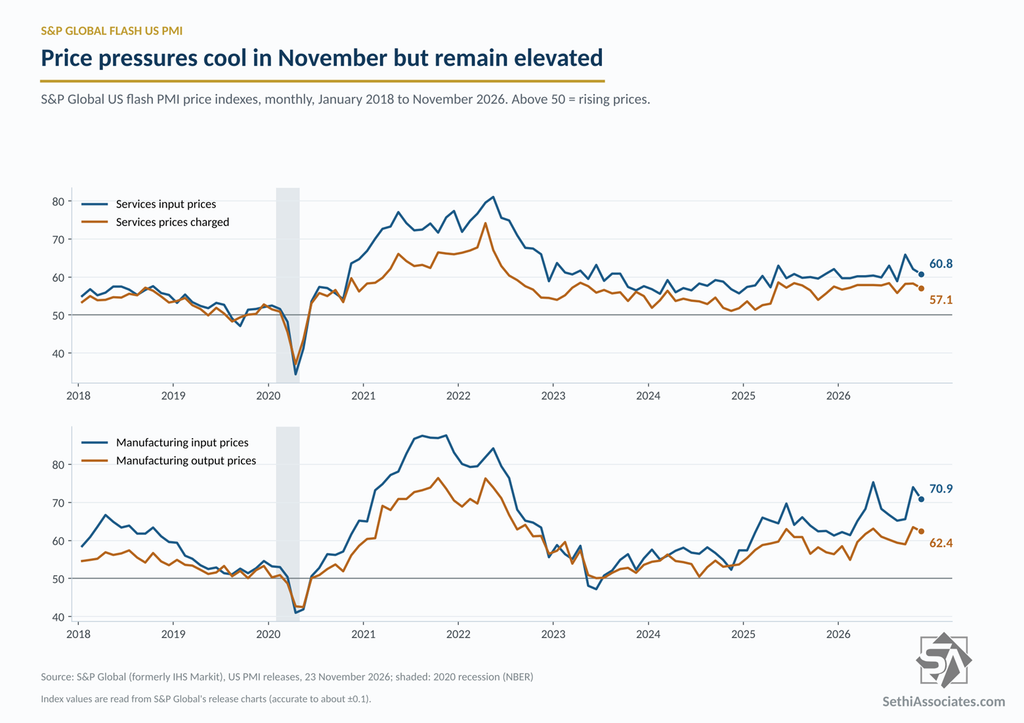
Selling Prices rose at a reduced rate after October’s increase, which “had been the largest since August 2022,” with “manufacturing selling prices rising especially sharply” — “November’s rise was consequently only slightly below the average seen in the year-to-date.”
Input Prices cooled for a second month but stayed “above the year-to-date average” — “Firms reported higher prices for a wide variety of inputs from suppliers, as well as higher wage pressures. Manufacturing cost growth remained particularly high by historical standards.” Bloomberg noted price gauges “rose at the slowest pace since August but were still elevated.”
Comments from Chris Williamson, Chief Business Economist at S&P Global Market Intelligence, who notes the surveys still point to fourth-quarter GDP growth of about 3% annualized, but warns price gauges remain consistent with inflation “well above the Fed’s 2% target”:
“Although output growth slowed in November, recent readings have been impressively strong, and the PMI surveys still point to GDP rising at an annualized rate of about 3% in the fourth quarter. Growth also remained encouragingly broad-based across both manufacturing and services, with both sectors also still taking on additional staff in numbers that are indicative of a further strong payroll gain during November.
“A key concern is the elevated cost of living and resulting pressures on affordability, and the survey price gauges remain at levels consistent with inflation running well above the Fed’s 2% target in the coming months, despite some moderation of the rate of inflation in November. Supply disruptions, widely linked to global shipping delays, also appear to have become more widespread, adding to firms’ concerns about being able to fulfil orders and likely to add further to underlying price pressures in the coming months.
“The survey also provides insight into business confidence after the midterm elections, and it’s encouraging to see confidence revive from the low seen ahead of the elections in October. But business growth expectations clearly remain subdued by historical standards, with political uncertainty and inflation firmly front and center of business minds as they look to navigate the year ahead.“