Monthly Roundup: After a Great September, We Await Opportunities in October
With multiple headwinds still in play heading into earnings season, we will pick our spots when they present themselves.
You've reached your free article limit
You've read 0 of 1 free Pro articles.
Following further gains in September that led all the major market indexes to close out the the third quarter with nice gains, the start of October with several headwinds and an extended market valuation brought something different for investors. While the market recovered some ground on Friday following a deal to re-open closed ports and a stronger-than-expected September jobs report, that employment data gives the Fed some breathing room when it comes to dialing back monetary policy.
As a reminder, good news for the economy is not so good news for the market’s expectation for rate cuts in the coming months. While some of the headwinds we cited this week have fallen by the wayside, the market is waiting to see what’s next for the Israel-Iran conflict, election uncertainty remains, and valuation remains stretched as September-quarter earnings season gets underway.
We are not ones to chase stocks, but as you saw in early August, we like to take advantage of opportunities as they present themselves to us. Based on the market reaction to the handful of companies that recently reported their quarterly results, our thinking is the current market setup will not reward companies that come up short with their quarterly results and year-end guidance. That means the September-quarter earnings season could be a rocky one for the market, especially if companies sharing initial 2025 guidance confirm consensus 2025 EPS expectations for the S&P 500 need to be reined in.
As you’ll read in the next section, we’ve identified a few positions that, should they continue to rise, are potential fodder for some profitable trimming. Should that happen, combined with the cash we raised in late August, we’ll be in a good spot to take advantage of opportunities should they present themselves as earnings season progresses.
Catching Up on the Portfolio This Week
September was a bright spot for the portfolio as it outpaced the S&P’s gain. However, the market selloff that accompanied the start of October was felt across some, but not all of our holdings. The military escalation in the Middle East helped boost our shares of Lockheed Martin LMT while those for Axon Enterprise AXON, Meta META, Morgan Stanley MS, ServiceNow NOW, Marvell Technology MRVL and Nvidia NVDA also gained.
We didn't make any trades in the portfolio this week, although a few of our positions, including Lockheed Martin, Axon, and Mastercard MA, have chugged higher putting them in either overbought territory or past our current price target. Friday’s robust September Employment Report means we may have some tinkering to do with our Mastercard target, but recognizing the stretched market valuation, some prudent portfolio management may be called for before too long.
During the week we added a new contender to the Bullpen in the form of Bright Horizons Family Solutions BFAM. We did this based on rumblings employers may seek greater return-to-office moves in 2025. As we do more work on these shares, including potential price targets and entry points, we’ll be listening for such indications as we navigate the September-quarter earnings season. For newer members, just because a position enters the Bullpen does not guarantee it will graduate to the portfolio. We view the Bullpen much like its namesake in Major League Baseball, where a relief pitcher may warm up but may not be called into the game.
Should we see a pullback in the market, we’ve shared levels at which we may dip further into existing positions, and we’ll be updating those levels early next week. In the case of new prospects as well as our existing positions, we will continue to focus on well-positioned companies with superior EPS growth prospects. Positions we are interested in building up further at the right price points include Dutch Bros BROS, Meta, ServiceNow, and Eaton ETN.
This Week's Portfolio Videos
Normally, we cover a lot of ground during the week in our Daily Rundowns. Following a family loss, we expect to be back on schedule next week. Next week also brings our Quarterly Members Only Call where Chris Versace and Conway Gittens will be discussing the market, the economy, and the portfolio.
Monday, September 30: Never Mind Powell, It’s the Jobs Data That Will Matter
Key Global Economic Readings
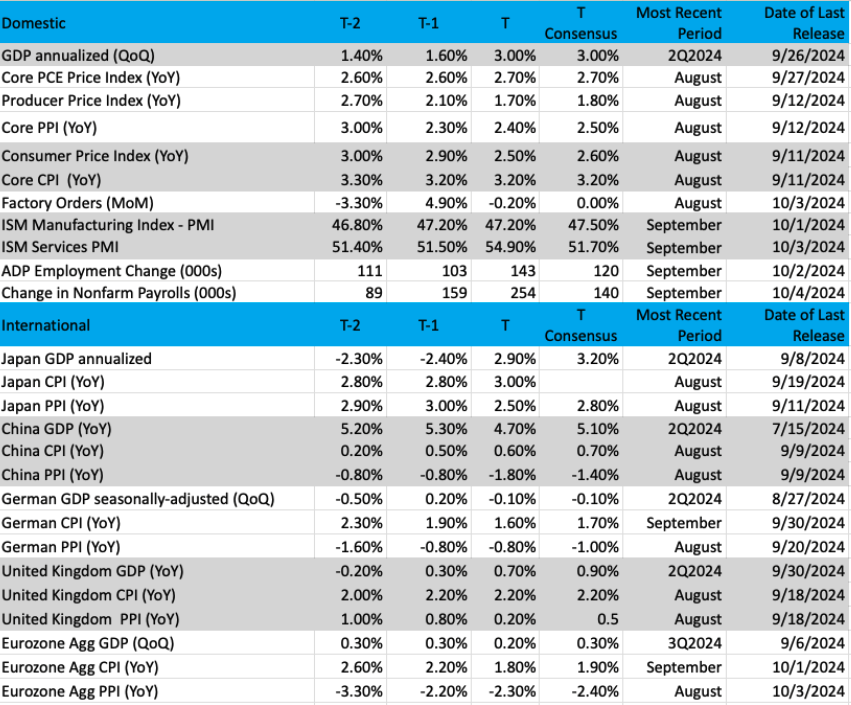
(Note: T is the most recent period, T-1 is the prior period's reading and T-2 is two periods back, the intent being to illustrate any trends)
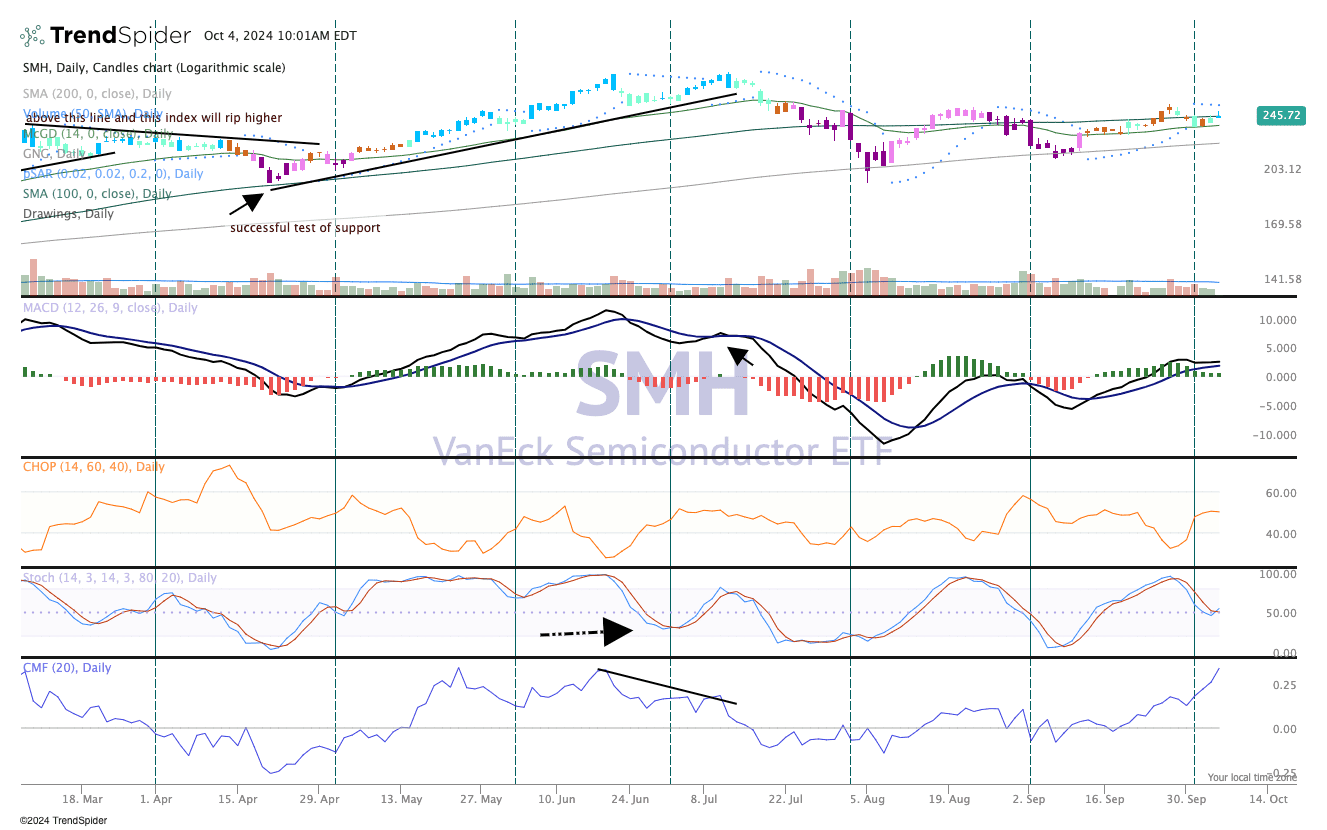
Chart of the Week: VanEck Semiconductor ETF (SMH)
Semiconductor stocks are tough to analyze. They move well when the economy is strong but tend to retreat sharply when it is poor. The semis tend to act like a heavyweight in the tech sector when it is weak, but a nice balloon when it is strong. At this point it is hard to handicap which direction this group will head, but coming into earnings season it is probably higher.
Just when it appeared the semiconductor stocks were ready to take a leg down on the chart they came back to life in a big way. We can see since early August the VanEck Semiconductor ETF (SMH) has been flattening out. Yet, we do see a glimpse of a budding uptrend, with higher lows and slightly higher highs.
Very slowly the price chart shows the SMH turning from neutral to bullish. Candles are teal right now, which is basically a cautious bullish stance based on the GoNoGo composite of indicators. When that turns blue (bullish) we should see a breakout in the SMH (but we won’t jump ahead yet).
The other indicators have also slowed down but are using the past week’s strong price move to build momentum. The stochastics are starting to turn up as is the Moving Average Convergence Divergence (MACD), but the money flow is very impressive, reaching levels not seen since the summer. This indicates big money is flowing to this group aggressively.
During this earnings season, watch this semiconductor (SMH) group closely. While many of the big names such as Nvidia and Marvell do not report until November, other names are likely to pick up the baton and run if this group remains of interest.
Other charts we shared with you this week were:
Sunday, September 29: When Will the Russell 2K Join the 'All-time High' Party?
Sunday, September 29: ServiceNow (NOW) - ServiceNow Pulls Back For Another Buying Opportunity
Tuesday, October 1: United Rentals (URI) - This Outperforming Stock Is Entering Uncharted Waters
Wednesday: October 2: Welltower (WEL) - This Bullpen Stock's Action Is a Little Too Impressive
Friday, October 4: Universal Display (OLED) - This Portfolio Holding Looks Ready to Light Up
The Week Ahead
When we return from the weekend, we’ll collect a few more pieces of August and September economic data, but make no mistake, coming off Thursday’s September ISM Service PMI report and Friday’s robust September Employment Report, the market will be focusing on the September Consumer Price Index and Producer Price Index reports.
meanwhile, reports from last week should drive a positive revision for the Atlanta Fed’s rolling GDP forecast on Tuesday, October 8. That should crystalize the growing probability of a no-landing scenario for the economy as will the Citibank Economic Surprise index pushing further into positive territory.
However, the September Service PMI revealed its price component spiked to its highest level since January, suggesting we may not see as much progress in the September inflation data as was previously thought. Our thinking is the market may have to come around to the realization the Fed may not deliver as many rate cuts as it expects over the next few months. Next week’s inflation data could be the catalyst for that unfolding and given how the market has melted higher, shrugging off other concerns in the process, such a re-think could have repercussions. With that thinking in mind, should the market push higher early next week, it may lead us to do some prudent portfolio management.
Next week also brings the Fed’s September meeting minutes and we’ll be interested in the behind-the-scenes conversation that prompted the Fed’s 50-basis point rate cut. In reading those minutes, we’ll also be looking for indications of what could lead the Fed to decide between a 25 and 50-basis point rate cut or none at all in the months ahead.
Here's a closer look at the economic data coming at us next week:
U.S.
Monday, October 7
· Consumer Credit – August (3 PM ET)
Tuesday, October 8
· NFIB Small Business Optimism Index – September (6:00 AM ET)
· Trade Balance – August (8:30 AM ET)
Wednesday, October 9
· MBA Mortgage Applications Index – Weekly (7:00 AM ET)
· Wholesale Inventories – August (10:00 AM ET)
· EIA Crude Oil Inventories – Weekly (10:30 AM ET)
· FOMC Meeting Minutes – September (2 PM ET)
Thursday, October 10
· Initial & Continuing Jobless Claims – Weekly (8:30 AM ET)
· Consumer Price Index – September (8:30 AM ET)
· EIA Natural Gas Inventories – Weekly (10:30 AM ET)
Friday, October 11
· Producer Price Index – September (8:30 AM ET)
· The University of Michigan Consumer Sentiment Index (Preliminary) – October (10:00 AM ET)
International
Monday, October 7
· Japan: Leading Economic Index (Preliminary) – August
· Germany: Factory Orders – August
· Eurozone: Retail Sales - August
Tuesday, October 8
· Germany: Industrial Production - August
Thursday, October 10
· Japan: Eco Watchers Survey - September
Friday, October 11
· Germany: Inflation Rate – September
· Japan: Machine Tool Orders – September
· UK: GDP, Industrial Production - August
As you can see below, we will also be wading into the start of the September-quarter earnings season next week. It begins with results from PepsiCo (PEP) and slowly builds until we have our first wave of bank earnings on Friday. As we parse the results from JPMorgan (JPM) and Wells Fargo (WFC) and drink in their expectations for the final quarter of the year, we’ll factor what we learn into our view for the portfolio’s positions in Bank of America and Morgan Stanley.
As companies get ready to report their Q3 2024 results, we’ll also be on guard for earnings pre-announcements from companies that are competitors, customers, and suppliers for our holdings.
One thing we noticed this week following disappointing quarterly results from Levi Strauss (LEVI) and pulled guidance from Nike (NKE) is the market is not in a forgiving mood. With the market’s P/E and dividend yield valuations stretched and investors still in “Greed” mode, unless a company delivers a pristine quarterly earnings report and bulletproof guidance, its shares could come under pressure. For us, that’s another reason to sit on the sidelines and let stock prices come to us.
Here's a closer look at the earnings reports coming at us next week:
Tuesday, October 8
· Open: PepsiCo (PEP)
Wednesday, October 9
· Open: Helen of Troy (HELE)
Thursday, October 10
· Open: Delta Air Lines (DAL)
· Close: Domino’s Pizza (DPZ)
Friday, October 11
· Open: Black Rock (BLK), BNY Mellon (BNY), Fastenal (FAST), JPMorgan Chase (JPM), Wells Fargo (WFC).
Portfolio – September Quarter Earnings Schedule:
Below is a mixture of announced and tentative reporting dates for the portfolio’s holdings. As we move deeper into the September-quarter earnings season, we’ll be updating this list as needed:
October 8 – PepsiCo (PEP)
October 15 – Bank of America (BAC)
October 16 – Elevance Health (ELV), Morgan Stanley (MS)
October 17 – Taiwan Semiconductor (TSM)
October 22 – Alphabet (GOOGL), Lockheed Martin (LMT), Microsoft (MSFT)
October 23 – Meta Platforms (META), United Rentals (URI)
October 24 – Apple (AAPL), Amazon (AMZN), Labcorp (LH), Mastercard (MA)
October 28 – Waste Management (WM)
October 29 – Eaton Corp (ETN)
October 31 – Builders FirstSource (BLDR), Universal Display (OLED)
November 6 – Dutch Bros (BROS), Qualcomm (QCOM)
November 7 – Axon (AXON), Trade Desk (TTD), Vulcan Materials (VMC)
Portfolio Investor Resource Guide
· Economic Data: Here's a List of Links to the Key Economic Data We Closely Watch
· Investing Terminology: 16 Key Terms Club Members Should Know
· 10-Ks: Want to Know About a Stock? Read the Company's Reports
· 10-Qs: Unlock the Numbers and Key Information Behind Your Stock With the 10-Q
· Income Statement: Our Cheat Sheet to Understanding This Financial Document
· Balance sheet, Cash Flow Statements, and Dividends: How to Know If a Company Is Off-Kilter? Read Its Balance Sheet
· Valuation Metrics: Everyone Wants a Value. Here's How Investors Can Find
The Portfolio Ratings System
1 - Buy Now (BN): Stocks that look compelling to buy right now.
2 - Stockpile (SP): Positions we would add to on pullbacks or a successful test of technical support levels.
3 - Holding Pattern (HP): Stocks we are holding as we wait for a fresh catalyst to make our next move.
4 - Sell (S): Positions we intend to exit.
ONES
Alphabet GOOGL; $167.06; 1,035 shares; 3.66%; Sector: Communication Services
UPDATE: As one of the leading market-cap names and a member of the Magnificent 7, Alphabet/Google has been hamstrung for weeks by attempts by the U.S. and other governments to call them a monopoly. When justice is involved, and litigation becomes a long road to resolution we find many long-term investors would prefer to stay on the sidelines. That lack of support saw GOOGL shares fade by almost 9% during the September quarter. That seems to have been the case for Alphabet, the company put up some strong earnings in July, but their troubles just seem to mount. Yet, a recent fall to the 200-day moving average from highs reached in July seems to have interested some buyers of the stock. Further, the company had announced in April a massive stock buyback program, and we suspect the company may have been actively buying shares as recently as early September to help buoy the stock. Alphabet continues to race with the competition over AI domination, and we continue to see its position in Search and YouTube making it a strong competitor. Pivotal Research slapped a price target of $215 on the stock with a Buy rating this past week, a tad higher than our $210 price target. Because we are still in the relatively early innings when it comes to AI revenue generation, we will be patient with Alphabet and GOOGL shares. We continue to see the company well positioned, given its treasure trove of data across its search, advertising, and YouTube businesses, which should benefit the company in the coming months with an upswing in digital advertising. As AI matures, we see it bringing further lift to Google Cloud’s revenue and profit generation. In our last Monthly Roundup, we noted that GOOGL shares had been trapped between support near $156 and resistance between $171-$174. That support has moved up to $158-$162, and a pullback to the lower end of that range is a level that could lead us to pick up some additional shares.
1-Wk. Price Change: 1.9%; Yield: 0.5%
INVESTMENT THESIS: We believe that while search and digital ad dominance are what will carry shares in the near- to mid-term, longer-term it is the company's artificial intelligence "moat" that will provide for new avenues of growth. AI is what has made the company's search, video, and targeted ad capabilities best-in-class and is the driving force behind the company's success in voice (Google Home) and autonomous driving (Waymo). Furthermore, we believe it is this AI expertise that will also make the company more prevalent in other industries, including healthcare via its subsidiary Verily, as AI and machine learning continue to disrupt operations across industries. Adding to our positive view of the company's future opportunities, we believe that Alphabet's free cash flow generation and solid balance sheet set it apart and are what will allow the company to continue taking chances on far-out ground-breaking and potentially world-changing projects. The company is also preparing to roll out Gemini Subscription with enterprise plans for workspace, according to a report. All good news for Alphabet.
Target Price: Reiterate $210; Rating: One
Panic Point: $145
RISKS: Regulatory risk (data privacy), competition, and macroeconomic slowdown impacting consumers and therefore ad buyer activity.
Amazon AMZN; $186.51; 946 shares; 3.73%; Sector: Consumer Discretionary
UPDATE: Shares of Amazon (AMZN) rebounded in September but declines in July and August meant they were a modest drag on our performance during Q3 2024. As we get ready for the seasonally strongest time of the year for the company, Amazon announced it will hold a Prime Big Deal Day on October 8-9, similar to what it did last year. With retailers sharing that consumers remain selective, we continue to see them utilizing Amazon to stretch their spending dollars. Holiday shopping forecasts from Deloitte, Adobe (ADBE), and others point to continued share gains by digital shopping this year, setting the stage for strong performance by Amazon. Meanwhile, comments from ServiceNow (NOW), Salesforce (CRM), and others peak to corporate uptake of AI. That and the continued migration to the cloud sets up Amazon Web Service rather well. As seasonal strength takes hold, it should bring with it some nice margin leverage following cost reductions put in place over the last several quarters. We continue to see Amazon investing in AI and data center, which should bode well for AWS and could bring even more savings to its other businesses. We’ve also noticed the growing ad revenue stream at the company’s streaming offerings, another driver of margin improvement and cash flow. The recent move lower has AMZN shares approaching their 50-day moving average near $179 with even more support near $177. A successful test in the coming days could signal the worst is behind us as folks get ready for the company’s October event.
1-Wk. Price Change: -0.8%; Yield: 0.0%
INVESTMENT THESIS: We believe upside will result from Amazon's continued eCommerce dominance, AWS's continued leadership in the public cloud space, and ongoing growth of the company's advertising revenue stream, which feeds off Amazon's eCommerce business. Additionally, we think profitability will continue to improve as AWS and advertising account for a larger portion of total sales as both these segments sport higher margins than the eCommerce operation. While we believe the increasing share of the revenue from these higher margin businesses will be key to driving profitability longer-term, we think margins on eCommerce stand to improve as the company's infrastructure is further built out and economies of scale further kick in. The embedded call option is that management is always looking to enter a new space and generate new revenue streams.
Target Price: Reiterate $220; Rating: One
Panic Point: $148
RISKS: High valuation exposes the stock to volatile swings, eCommerce has exposure to slower consumer spending and competition, management is not afraid to invest heavily, potential headwinds resulting from new eCommerce regulation in India, and management is not scared to invest aggressively for growth, which can at times cause volatile reactions as near-term concerns arise relating to the impact on margins.
Bank of America Corp. BAC; $40.11; 4,675 shares; 3.97%; Sector: Financial Services
UPDATE: Over the last few weeks, BAC shares have been rangebound leaving them little changed during Q3 2024. In mid-September, following the Fed’s 50-basis point rate cut and outlook for further monetary policy loosening, we used a recent pullback in BAC shares to add more to the portfolio. Toward the end of September, we upgraded BAC shares to a One rating from Two, keeping our $49 price target. Our thinking is further rate cuts by the Fed should stimulate various parts of BofA’s business lines, including mortgages and wealth management. Falling rates should also translate into lower hurdle rates for investment banking activities, another positive for BofA’s business and our shares. Bank of America is on track to open more than 165 new financial centers across 63 markets by the end of 2026. We see this as a part of management’s ongoing efforts to pick up incremental market share for its consumer banking business, one that should also see its mortgage and loan activity benefit as interest rates decline further. Upcoming catalysts include quarterly earnings from JPMorgan Chase (JPM) and Wells Fargo (WFC) on October 11. Bank of America is slotted to report its September quarter results on October 15 with Morgan Stanley to follow the next day.
1-Wk. Price Change: 1.8%; Yield: 2.6%
INVESTMENT THESIS: Bank of America is one of the world's leading financial institutions, serving individual consumers, small and middle-market businesses, and large corporations with a full range of banking, investing, asset management, and other financial and risk management products and services. The company provides unmatched convenience in the United States, serving approximately 67 million consumer and small business clients with approximately 3,900 retail financial centers, approximately 16,000 ATMs, and award-winning digital banking with approximately 56 million verified digital users. Bank of America is a global leader in wealth management, corporate and investment banking, and trading across a broad range of asset classes, serving corporations, governments, institutions, and individuals around the world. Bank of America offers industry-leading support to approximately 3 million small business households through a suite of innovative, easy-to-use online products and services. The company serves clients through operations across the United States, its territories, and approximately 35 countries. From a reporting perspective, the company's business breaks down as follows: Net Interest Income breakdown: Consumer Banking 57%, Global Banking 23%, Global Wealth & Investment Management 14%, and Global Markets 6%; Income Before Tax breakdown: Consumer Banking 42%, Global Banking 27%, Global Wealth & Investment Management 16%, and Global Markets 15%. Bank of America pays a quarterly dividend of $0.22 per share.
Target Price: $49; Rating: One
Panic Point: $32
RISKS: Financial markets, fiscal, monetary, and regulatory policies, economic conditions, and credit ratings.
Builders FirstSource BLDR; $192.28; 650 shares; 2.64%; Sector: Industrials
UPDATE: When took on shares of Builders FirstSource (BLDR) in June, our thesis hinged on the Fed eventually embarking on a rate-cutting cycle that would strengthen housing construction. At the same time, homebuilder focus on margins would be a positive for Builder’s value-added products. That line of thinking played out extremely well in July, August, and especially September, leaving BLDR shares up 40% for Q3 2024. Following strong second-half delivery guidance from Lennar (LEN) and KB Home (KBH), we boosted our BLDR price target to $235 from $205. We weren’t the only ones; Loop Capital boosted its target to $230 while Oppenheimer lifted its to $225. We continue to see Builders and its shares benefiting as the Fed moves further down the rate curve over the coming 12-15 months, setting up what could be a very robust 2026 for housing construction and BLDR shares. August 2024 mortgage applications for new home purchases increased 4.4% year over year and were flat with July 2024 levels. During the month, MBA estimated new home sales increased almost 15% over the month, reaching the fastest sales pace since February 2022. We should be getting the September figures from MBA in around two weeks. With Bankrate showing the current average interest rate for a 30-year fixed mortgage is 6.26% compared to almost 6.6% in mid-August and roughly 7% in mid-July, we would be surprised if the year-over-year gains in mortgage applications for new home purchases in September failed to emerge. While we wait for more thesis-confirming housing construction data and homebuilder delivery schedules, given our new price target, should BLDR shares pass the $210 level, we may be inclined to revisit our One rating.
1-Wk. Price Change: -1.0%; Yield: 0.0%
INVESTMENT THESIS: Builders FirstSource is a supplier and manufacturer of building materials, manufactured components, and construction services to professional homebuilders, sub-contractors, remodelers, and consumers. The company’s top-10 customers account for 15% of net sales and are comprised primarily of the largest national production homebuilders, including publicly traded companies such as D.R. Horton, Dream Finders Homes, Lennar Corp., Pulte, Taylor Morrison Home, and Toll Brothers. The company is leveraging its national manufacturing footprint to grow its higher-margin value-added products as homebuilders look for more efficient ways to construct homes. We see this driving faster revenue and earnings growth in the coming quarters as the eventual rate-cutting cycle by the Fed lifts the demand for housing.
Target Price: $235; Rating: One
Panic Point: $160.
RISKS: Economy, interest rates, commodity pricing, and supply chain risks.
Dutch Bros BROS; $32.53; 3,540 shares; 2.44%; Sector: Consumer Cyclical
UPDATE: We used the post-June quarter earnings pressure to call up Dutch Bros from the Bullpen with a $39 price target in early August. During the month we added not once but twice to the position and over the following weeks the shares rebounded above $35 from below $29 but have since traded off. Some may be concerned about consumers being selective, but our thinking is that concern is overshadowed by the company’s footprint expansion. As the Fed moves deeper into its rate-cutting cycle hurdle rates and borrowing costs for new construction projects should improve. Given its cash-rich balance sheet, access to capital, and current footprint, this suggests Dutch Bros could continue to expand at a healthy clip in 2025. With BROS shares back near levels where we picked up our last batch of shares, the risk-to-reward tradeoff for newer members and the portfolio skews favorably.
1-Wk. Price Change: 0.2%; Yield: 0.0%
INVESTMENT THESIS: Dutch Bros is an operator and franchisor of drive-thru shops that focus on serving high-quality, hand-crafted beverages with unparalleled speed and superior service. As of June 30, 2024, there were 912 shops in operation in 18 U.S. states, of which 612 were company-operated and 300 were franchised. Coffee-based beverages make up ~50% of the menu mix, and ~25% of the menu mix is based upon the company’s proprietary Blue Rebel energy drink, which is highly customizable with flavors and modifiers and can be served blended or over ice. The energy platform helps unlock the afternoon daypart and broadens the company’s appeal. The remaining 25% of the menu mix is a wide variety of teas, lemonades, sodas, and smoothies. Through the first half of 2024, Dutch Bros opened 81 shops and targets 150-165 new ones for all of 2024. The company’s west-to-east expansion is a time-tested strategy that should drive revenue and EPS growth over the next several years.
Target Price: Reiterate $39; Rating: One
Panic Point: $25
RISKS: Commodity risks, labor costs, interest rate risk, inflation.
Marvell Technology MRVL; $73.41; 2,690 shares; 4.17%; Sector: Technology
UPDATE: After rebounding sharply in August and into early September, Marvell shares gave back some of those gains over the last few weeks. Despite that fall, which occurred amid multiple positive data points for AI and data center chip demand, MRVL remained a positive force for the portfolio in Q3 2024. We remain upbeat with Marvell’s prospects due to ramping AI and data center demand, especially as its chip relationships with Microsoft, Amazon, Meta, and Google come on stream. We are also seeing growing evidence of AI adoption in the enterprise, including the uptake of AI-enabled PCs and other devices. That reinforces our view that Marvell’s enterprise networking and carrier infrastructure segments should rebound in the coming quarters as AI gobbles up existing network capacity. We see our MRVL thesis playing out over several quarters, and we are inclined to be long-term holders of the shares. Upcoming catalysts we are watching include next week’s AI event by AMD as well as September revenue and earnings from Taiwan Semi and Hon Hai/Foxconn.
1-Wk. Price Change: 3.4%; Yield: 0.3%
INVESTMENT THESIS: Marvell is a fabless supplier of high-performance standard and semi-custom infrastructure semiconductor solutions. These solutions power the data economy, enabling the data center, carrier infrastructure, enterprise networking, consumer, and automotive/industrial end markets. With roughly 75%-80% of Marvell's revenue stream tied to digital infrastructure, we see it continuing to benefit from rising content consumption and creation. Pointing to that rising demand that necessitates network densification and the build of digital infrastructure, Ericsson sees global monthly average usage per smartphone reach 46 gigabytes (GB) by the end of 2028 vs. 19 GB in 2023 and 15 GB in 2022.
Target Price: Reiterate $95; Rating: One
Panic Point: $55
RISKS: Technology risk, customer risk, competition risk, reliance on manufacturing partners, and supply chain constraints.
Morgan Stanley MS; $107.88; 1,885 shares; 4.30%; Sector: Financial Services
UPDATE: While shares of Morgan Stanley coasted higher in September at a slightly quicker pace than they did in August, their total gain during Q3 2024 tallied more than 7%. In mid-September, following the Fed’s 50-basis point rate cut and outlook for further monetary policy loosening, we added more MS shares to the portfolio. Our thinking is further rate cuts by the Fed should stimulate investment banking and wealth management activity, positive for Morgan’s business and our shares. We are already seeing interest rates tied to high-yield savings accounts start to decline. Falling rates should also translate into lower hurdle rates for investment banking activities, while reports from JPMorgan point to a pickup in IPO activity ahead with a dozen or so companies going public in the current quarter. Barclays joins our thinking, sharing it sees Morgan's investment banking business accelerating in 2025-2026. Other upcoming catalysts include quarterly earnings from JPMorgan Chase and Wells Fargo on October 12, and Bank of America on October 15. Morgan Stanley reports on October 16. Late this week, HSBC upgraded MS shares to Buy from Hold, placing a $118 target on them.
1-Wk. Price Change: 3.6%; Yield: 3.4%
INVESTMENT THESIS: Morgan Stanley reports in three business segments: Institutional Securities (42% of trailing 12-month revenue, 38% of trailing 12-month Income Before Tax), Wealth Management (48%, 55%) and Investment Management (10%, 6%). While the IPO window has yet to reopen, the potential IPO class for 2024 continues to build with recent additions including Panera Bread, Reddit, Fanatics, and Skims, which is backed by Kim Kardashian. This along with the Fed increasingly likely to start cutting rates in H2 2024, suggests we are far closer to the IPO window opening on a sustained basis than we have been in some time. That would be a boon to private equity firms and others that have been nursing IPO candidates during the dark period and a positive for Morgan's investment banking business. Marginally lower rates could also generate a pick-up in M&A activity as the cost of capital with rates improving. As the Fed continues its cutting cycle to get rates back to normalized levels, that effort would also reduce rates for stock market alternatives, ones that quashed the "there is no alternative" trade earlier this year. That along with folks continuing to be behind in retirement savings bodes well for Morgan's wealth management business in the coming quarters.
Target Price: $120; Rating One
Panic Point: $84
RISKS: Market and interest rate risk, credit risk, country risk, and operational risk, including cybersecurity.
Nvidia Corp. NVDA; $124.92; 1,510 shares; 4.00%; Sector: Technology
UPDATE: Despite all of the positive signals about AI demand during the last few several weeks, including BlackRock’s (BLK) new $30 billion AI investment fund, Nvidia (NVDA) shares rose only modestly in September. Paired with similar gains in August, NVDA shares closed Q3 2024 down 1.7%. Entering the final quarter of the year this week, CEO Jensen Huang said that demand for the company’s next-gen AI Blackwell chip is “insane.” During the interview, Huang also said Nvidia plans to update its AI platform each year with the intention of increasing performance by two to three times. With Blackwell expected to cost between $30,000-$40,000 per unit, that should allow Nvidia to continue fetching a pretty hefty price tag for its AI solutions. Blackwell unit shipments are expected to start this quarter and ramp in the following ones, bringing with it a nice step up in Nvidia’s revenue. As Blackwell production ramps, we should see margins improve as Nvidia moves down the production curve. We are still in the early innings of what many are calling the AI revolution. As we move from AI interest to AI adoption, we expect demand for data center and computing power to climb, driving demand for Nvidia’s chipsets resulting in growing revenue and earnings. Next week we’ll be interested in what Advanced Micro Devices (AMD) says at its “Advancing AI" event, and we’ll be keeping our eyes open for September revenue reports from Taiwan Semi (TSM) and Hon Hai/Foxconn. Ramping revenue at those companies should offer another round of confirmation for ramping AI and data center demand. Other data points to come will be updated capital spending comments from Meta, Amazon, Microsoft, and Alphabet. As we incorporate those data points into our thinking, we’ll adjust our NVDA price target as needed. When the shares pass the $130-$135 level, barring any upside price target adjustment, we may revisit our One rating.
1-Wk. Price Change: 2.9%; Yield: 0.0%
INVESTMENT THESIS: Nvidia is well positioned to benefit from ramping AI and data center spending. The company pioneered accelerated computing to help solve the most challenging computational problems. Nvidia is now a full-stack computing infrastructure company with data-center-scale offerings that are reshaping the industry. The company's full stack includes the foundational CUDA programming model that runs on all Nvidia GPUs, as well as hundreds of domain-specific software libraries, software development kits, or SDKs, and Application Programming Interfaces, or APIs. This deep and broad software stack accelerates the performance and eases the deployment of Nvidia accelerated computing for computationally intensive workloads such as artificial intelligence, or AI, model training and inference, data analytics, scientific computing, and 3D graphics, with vertical-specific optimizations to address industries ranging from healthcare and telecom to automotive and manufacturing. Nvidia reports in two business segments: Compute & Networking and Graphics. The Compute & Networking segment (78% of revenue, 85% of operating income) is comprised of Data Center accelerated computing platforms and end-to-end networking platforms, including Quantum for InfiniBand and Spectrum for Ethernet; NVIDIA DRIVE automated-driving platform and automotive development agreements; Jetson robotics and other embedded platforms; Nvidia AI Enterprise and other software; and DGX Cloud software and services. The Graphics segment (22% of revenue, 15% of operating income) includes GeForce GPUs for gaming and PCs, the GeForce NOW game streaming service and related infrastructure; Quadro/NVIDIA RTX GPUs for enterprise workstation graphics; virtual GPU, or vGPU, software for cloud-based visual and virtual computing; automotive platforms for infotainment systems; and Omniverse Enterprise software for building and operating metaverse and 3D internet applications.
Target Price: $155; Rating One
Panic Point: $100
RISKS: Market and interest rate risk, credit risk, country risk, and operational risk, including cybersecurity.
Qualcomm Inc. QCOM; $168.90; 1,034 shares; 3.69%; Sector: Technology
UPDATE: Shares of Qualcomm (QCOM) continued to drift lower during September adding to their decline over the preceding months. All the while, the outlook for the smartphone market and PC markets continued to improve as evidenced by comments from Taiwan Semi (TSM), Micron (MU), and Canalys as we head into the seasonally strongest time of the year for QCOM shares. Market chatter during the quarter about Apple’s modem efforts and the potential impact on Qualcomm made the rounds. We shared our view as to why the market was overreacting to an event that best case for Apple would start slowly and with lower-end iPhone models in the coming years. As Qualcomm makes inroads with AI PC vendors, leveraging its AI relationship with Microsoft (MSFT), there is also the potential for greater adoption of cellular connectivity and modems in the notebook PC market. While volumes in the AI PC market are smaller compared to the smartphone market, the price point for Qualcomm’s AI PC Snapdragon offering (~$700) is considerably higher compared to its smartphone offering (~$200). This year less than 10% of all notebook PCs are expected to ship with that connectivity but that is expected to ramp to nearly half of all shipments in the next few years. And, as we’ve discussed, other opportunities in the auto and IoT markets should help reduce Qualcomm’s exposure to the smartphone market. To that end, during September Honeywell (HON) announced it is working to develop an artificial intelligence-enabled Multi-Modal Intelligent Agent for Honeywell mobile devices powered by Qualcomm’s technologies. As that mix shift occurs, we could see the market revisit how it values QCOM shares. Despite speculative headlines, we do not see Qualcomm acquiring Intel, and we explained our thought process here. The next set of catalysts we are watching for QCOM shares are the September revenue reports from TSM and Hon Hai as well as their September quarter results.
1-Wk. Price Change: -0.7%; Yield: 2.0%
INVESTMENT THESIS: Qualcomm focuses on foundational technologies for the wireless industry, including 3G (third generation), 4G (fourth generation), and 5G (fifth generation) wireless technologies and processor technologies including high-performance, low-power computing, and on-device artificial intelligence technologies. As a connected processor company, its technology roadmap aims to enable the connected intelligent edge (the next generation of smart devices) across industries and applications beyond handsets, including automotive and the Internet of Things (IoT). Qualcomm has three reportable segments: QCT (Qualcomm CDMA Technologies) semiconductor business, which develops and supplies integrated circuits and system software based on 3G/4G/5G and other technologies for use in mobile devices; automotive systems for connectivity, digital cockpit, and ADAS/AD; and IoT including consumer electronic devices; industrial devices; and edge networking products. QCT accounts for 80%-85% of revenue. QTL (Qualcomm Technology Licensing) licensing business grants licenses or otherwise provides rights to use portions of the company's intellectual property portfolio, which includes certain patent rights essential to and/or useful in the manufacture and sale of certain wireless products. QTL accounts for ~15% of Qualcomm's revenue but contributes a greater portion of the company's operating income.
Target Price: $255; Rating: One
Panic Point: $148
RISKS: Customer risk, technology advancement, competition risk, third-party supplier, and manufacturing partner risk.
Universal Display OLED; $211.71; 880 shares; 3.94%; Sector: Technology
UPDATE: While there were few developments during September for Universal Display (OLED) what we did see led the shares to rise more than 8%, clawing back much of their August selloff. That rebound in the stock led us to do some prudent portfolio management in late September, locking in a sizable gain for the portfolio. After booking that trade, we purposely kept a meaningful position in OLED shares to capture the continued adoption of organic light-emitting diode display technology across a growing array of applications beyond smartphones. We will also be gauging reception for new foldable smartphone models and other larger form factor ones that consume greater quantities of organic light-emitting diode chemicals. With roughly 50% of the smartphone market penetrated by organic light-emitting diode displays, 3% of the TV market, and 2% of the PC and tablet market, we see a long runway ahead for OLED shares even before we factor in automotive lighting and the general illumination market. Upcoming catalysts will be September revenue reports from Taiwan Semi and Hon Hai/Foxconn and their September quarter earnings reports as well as others in the smartphone food chain.
1-Wk. Price Change: 2.8%; Yield: 0.8%
INVESTMENT THESIS: Universal Display focuses on the development and commercialization of organic light-emitting diode (OLED) technologies and materials for use in display and solid-state lighting applications. OLED displays are capturing a growing share of the display market, especially in the mobile phone, television, monitor, wearable, tablet, notebook, personal computer, augmented reality (AR), virtual reality (VR), and automotive markets. This adoption reflects advantages over competing display technologies with respect to power efficiency, contrast ratio, viewing angle, video response time, form factor, and manufacturing cost. Universal's business strategy is to develop new OLED materials and sell existing and new materials to product manufacturers for display applications, such as mobile phones, televisions, monitors, wearables, tablets, portable media devices, notebook computers, personal computers, and automotive applications, and specialty and general lighting products. The company also looks to license its OLED material, device design, and manufacturing technologies to those manufacturers. As such, Universal has a significant portfolio of proprietary OLED technologies and materials with more than 5,500 patents issued and pending worldwide.
Target Price: Reiterate $250; Rating: One
Panic Point: $155
RISKS: Patent and Intellectual property protection; maintaining OLED manufacturing and customer relationships; technology risk; market risk.
Vulcan Materials Company VMC ; $2411.43; 613 shares; 3.13%; Sector: Building Materials
UPDATE: Shares of Vulcan fell sharply in early August following the company’s June-quarter results, which led us to trim our long-term price target to $300 from $310. While VMC shares recovered some of that lost ground in September, they closed Q2 2024 up modestly. The company was hard hit by counterproductive construction weather in Q2 2024 and Vulcan management cautioned that happened again in July. Odds are that will be the case with September following Hurricane Helene but that event should also bring about a rebuilding wave that should be positive for aggregate and concrete demand. Construction spending data and other indicators have painted a positive demand backdrop for Vulcan, however. The move by the Fed to cut rates will lower project hurdle rates, benefiting non-residential construction activity as well as housing construction. As that happens, we should also start to see the benefit of CHIPs Act funding on construction activity. All of this offers a favorable medium to longer-term outlook for Vulcan’s aggregates business and our shares. Late this week, Vulcan announced it will acquire Wake Stone Corporation, an aggregate supplier in the Carolinas, a move that will extend its footprint rather nicely. We continue to rate VMC shares a One, but we see the $230 level as a compelling level at which newer members could comfortably add VMC shares to their holdings.
1-Wk. Price Change: -3.5%; Yield: 0.8%
INVESTMENT THESIS: Vulcan Materials operates primarily in the U.S. and is the nation's largest supplier of construction aggregates (primarily crushed stone, sand, and gravel), a major producer of asphalt mix and ready-mixed concrete, and a supplier of construction paving services. Its products are the indispensable materials used in building homes, offices, places of worship, schools, hospitals, and factories, as well as vital infrastructure including highways, bridges, roads, ports and harbors, water systems, campuses, dams, airports, and rail networks. Ramping spending associated with the Biden Infrastructure Law should drive demand for Vulcan's products over the coming years. Vulcan has historically complemented its organic growth prospects by acquiring businesses to expand its geographic reach and product scope. Since 2014, the company has acquired more than two dozen companies, including the 2021 acquisition of U.S. Concrete. That combination has allowed the company to deliver steady top and bottom-line growth over the last decade, with only a modest decline when the pandemic hit in 2020.
Target Price: Reiterate $300; Rating: One
Panic Point: $225
RISKS: General economic and business conditions; dependence on the construction industry; timing of federal, state, and local funding for infrastructure; changes in the level of spending for private residential and private nonresidential construction.
TWOS
Apple AAPL ; $226.80; 790 shares; 3.80%; Sector: Technology
UPDATE: While shares of Apple (AAPL) were a nice performer for us during Q3 2024, rising more than 10%, looking at the chart, we can see the shares have been largely rangebound during September. Early in the month, Apple unveiled its latest iPhone, Apple Watch, and AirPods hardware as well as an early iteration of Apple intelligence. As we shared at the time, we were underwhelmed by Apple Intelligence, but we also understand Apple will be deploying more capabilities with future software releases. Our thinking is this could lead to a slower-than-expected start for the much-discussed iPhone upgrade cycle, leaving the bulk of it in the near term to very favorable trade-in values for older iPhones. Chatter in the second half of September points to extended ship times for the newest iPhone models but they are somewhat less compared to prior years. While Apple may be off to a slow start with Apple Intelligence, we continue to see the company and its install base leaving it in a strong position as Apple intelligence capabilities grow. In keeping with our Two rating, should we see Apple shares pull back after the company’s September quarter earnings report to more attractive levels, such a reset may lead us to nibble on the shares.
1-Wk. Price Change: -0.4%; Yield: 0.4%
INVESTMENT THESIS: While we acknowledge that near-to-midterm performance remains heavily influenced by iPhone sales, the dynamic is shifting as investors finally place greater emphasis on Services growth. We are bullish on the 5G upgrade cycle and believe longer-term upside will continue to come as Services revenue grows its share of overall sales. Services provide for a recurring revenue stream at higher margins, a factor that serves to reduce earnings volatility while allowing for a higher percentage of sales to fall to the bottom line; as a result, we believe that Services growth and the installed base, are much more important than how many devices the company can sell in each 90-day period. In addition to improved profitability, we also believe the transparent nature of this revenue stream will demand an expanded price-to-earnings multiple as segment sales grow. Furthermore, we believe that Apple's desire to push deeper into the healthcare arena will help make its devices invaluable as more life-changing features are added and the company works to democratize health records. Lastly, also see upside resulting from increased adoption of wearables (think the Apple Watch) and potential new product announcements such as an AR/VR headset or an update on Project Titan, the company's secretive autonomous driving program.
Target Price: Reiterate $250; Rating: Two
Panic Point: Reiterate $185
RISKS: Slowdown in consumer spending, competition, lack of new product innovation, elongated replacement cycles, failure to execute on Services growth initiative.
Applied Materials Inc. AMAT; $201.97; 627 shares; 2.68%; Sector: Semiconductor Manufacturing
UPDATE: Following the August decline in shares of Applied Materials (AMAT), we picked up more for the portfolio in early September near $180. As we made that trade, we also reduced our AMAT price target to $220 from $240 and lowered our panic point to $160. That decision was influenced by the uncertain capital spending future at Intel (INTC). Over the ensuing weeks, the shares rallied higher due in part to positive capital spending comments issued by Micron (MU) during its recent earnings call. We continue to see Applied’s financials improving as rising chip capacity utilization levels drive incremental chip equipment demand and the impact of reshoring spending, like the U.S. CHIPs Act, kicks in. Recent reports suggest strong AI demand has led to full utilization of Taiwan Semi’s fab capacity and that means capital spending will be a big topic when that company reports its quarterly results on October 17. As clarity over Intel’s future is had and as we digest upcoming semi-cap capital spending remarks, we’ll fine-tune our AMAT price target as needed.
1-Wk. Price Change: -1.4%; Yield: 0.8%
INVESTMENT THESIS: Applied provides manufacturing equipment, services, and software to the semiconductor, display, and related industries. With its diverse technology capabilities, Applied delivers products and services that improve device performance, power, yield, and cost. Applied's customers include manufacturers of semiconductor chips, liquid crystal, and organic light-emitting diode displays, and other electronic devices. Applied operates in three reportable segments: Semiconductor Systems (73% of 2022 revenue, 78% of 2022 operating income), Applied Global Services (22%, 19%), and Display and Adjacent Markets (5%, 2%). Key customers include Samsung (12% of 2022 sales), Taiwan Semiconductor (20%), and Intel (10%).
Target Price: Reiterate $220; Rating: Two
Panic Point: $160
RISKS: Manufacturing and Supply Chain, Competitive Factors, Government Regulation, Technology Change.
Axon Enterprise AXON; $421.80; 443 shares; 3.95%; Sector: Aerospace & Defense
UPDATE: Shares of Axon were a strong performer for the portfolio in September and for all of Q3 2024, rising 9.5% and more than 35%, respectively. Back in August, we did some prudent trimming of the position, locking in heady gains but we also downgraded the shares to a Two rating. Our view has been that the key to further upside past in the shares and Wall Street price targets will be the continued mix shift toward higher-margin cloud services. Following a management presentation in mid-September, we boosted our AXON price target to $415 and lifted our panic point for the shares. That presentation hit on public safety being a bipartisan issue in the current presidential election, potential share gains inside the company’s existing client base, and as software continues to account for a larger part of the company’s revenue mix, it will have a nice impact on margins and bottom-line performance. That last part has been a key part of our AXON thesis. JMP Securities followed our price target bump, lifting its Axon target to $430 from $375 while Baird upped its to $400 from $360. The company is expected to report its quarterly results around November 6. Ahead of that, we will be digging deep into quarterly results and guidance from competitor Motorola Solutions (MSI).
1-Wk. Price Change: -6.7%; Yield: 0.0%
INVESTMENT THESIS: Axon Enterprise develops, manufactures, and sells conducted energy devices and cloud-based digital evidence management software designed for use by law enforcement, corrections, military forces, private security personnel, and private individuals for personal defense. The company operates in two segments: Taser and Software & Sensors. Taser develops and sells CEDs used for protecting users and virtual reality training. Software & Sensors manufactures fully integrated hardware and cloud-based software solutions such as body cameras, automated license plate reading, and digital evidence management systems. Axon delivers its products worldwide and gets most of its revenue from the United States. President Biden's fiscal year 2023 budget requests a fully paid-for new investment of approximately $35 billion to support law enforcement and crime prevention — in addition to the president's $2 billion discretionary request for these same programs. According to Mordor Intelligence, the wearable, and body-worn cameras market on its own was valued at $1.62 billion in 2020 and is expected to reach $424.63 billion by 2026.
Target Price: Reiterate $415; Rating: Two
Panic Point: $325
RISKS: Manufacturing and supply chain, competitive factors, government regulation, technology change.
Costco Wholesale COST; $883.11; 210 shares; 3.93%; Sector: Consumer Staples
UPDATE: Following a strong performance in August, Costco shares were little changed in September following another month of enviable comp sales that pointed to further consumer wallet share gains. Heading into Costco’s quarterly earnings in late in September, the shares were flying high. Despite solid results, we opted to keep our above-consensus $950 price target intact while others once again lifted theirs. We did so given the near-term risk associated with the port strike that could be a thorn in the holiday shopping season. Costco agreed with us despite having prepared for the strike, backing our view the duration of the strike will be the determining factor for how much of an impact it will have on the economy, supply chains, and inflation pressures. Costco aims to add another 26 net new locations in the coming year after opening 30 over the last 12 months, 14 of which opened in the August quarter. These recent and projected openings should help drive further gains in the company’s membership, which included 76.2 million paid households, up 7.3% year over year, and 136.8 million cardholders, also up 7% year over year, exiting August. To that, we can add the 35.4 million paid executive memberships, up 9.6% versus last year. In thinking about those figures, let’s remember the membership price increase went into effect on September 1, so it makes sense that as newer memberships anniversary, Costco will see more benefits from that price increase. If we were to see COST shares pullback near $850, that could be a reason for us to revisit that rating. Other potential catalysts that could lead us to revisit both our price target and rating are Costco’s upcoming monthly sales report.
1-Wk. Price Change: -0.3%; Yield: 0.5%
INVESTMENT THESIS: We like Costco's long-term prospects, driven by a club-based operating model that focuses on volumes, not margins, and therefore offers its customers a value proposition of everyday low prices. The strength of this model has created an incredibly loyal customer base with low churn and continued share gains in both bricks-and-mortar and e-commerce. This is a global concept, evidenced by the strength of sales both in the U.S. and abroad, which includes an emerging China opportunity. We see the company's membership model as a key differentiator vs. other retailers and its plans to open additional warehouse locations in the coming quarters should drive retail volumes and the higher-margin membership fee income as well. We also appreciate management's approach to capital returns and their willingness to return cash when it is in excess on the balance sheet.
Target Price: Reiterate $950. Rating: Two
Panic Point: $750
RISKS: Inability to pass through higher costs, fuel prices, weaker consumer, and membership churn.
Eaton Corp. ETN; $333.05; 300 shares; 2.12%; Sector: Industrials
UPDATE: Since initiating and building our position in Eaton (ETN) during August as a way for the portfolio to benefit from the looming electricity demand pain point, the shares have been a double-digit performer for us. In September, IDC published its latest forecast that backs our thinking. IDC expects the surging demand for AI workloads will lead to a significant increase in datacenter capacity, energy consumption, and carbon emissions, with AI datacenter capacity projected to have a compound annual growth rate (CAGR) of 40.5% through 2027. Accordingly, AI datacenter energy consumption is forecast to grow at a CAGR of 44.7%, reaching 146.2 Terawatt hours (TWh) by 2027 with AI workloads consuming a growing portion of total datacenter electricity use. While we have enjoyed ETN’s gains, we do not have a full position in the shares, and they are on our shopping list should we see a pullback to strong support levels. Early in September, Morgan Stanley initiated coverage on ETN shares with an Overweight rating and a $370 target, which is $20 higher than ours. On September 16, citing "robust" data center power demand growth and prospects for "outsized' earnings growth over the next several years, Citi initiated coverage of Eaton with a Buy rating and a $348 price target. Eaton will report its next earnings on October 28, and we expect to learn more about its collaboration with Tesla (TSLA) on home energy storage deployments. During the upcoming earnings season, we’ll also be listening for 2025 capital spending comments not only from Big Tech but also from U.S. electric utilities.
1-Wk. Price Change: 1.4%; Yield: 1.1%
INVESTMENT THESIS: Eaton is an intelligent power management company that makes products for data center, utility, industrial, commercial, machine building, residential, aerospace, and mobility markets. That business is positioned to capitalize on the megatrends of electrification, energy transition, and digitalization. We see Eaton helping address the power pain point created by data center, EV charging infrastructure, and other drivers of electricity demand. Research estimates that data center power demand will grow 160% by 2030, accounting for 3%-4% of global power up from 1%-2% today. Data centers will use 8% of U.S. power by 2030, compared with 3% in 2022.
Target Price: Reiterate $350; Rating: Two
Panic Point: $250
RISKS: Raw material costs, labor costs, end market volatility, government legislation.
First Trust Nasdaq Cybersecurity ETF CIBR; $59.78; 2,530 shares; 3.20%; Sector: Cybersecurity
UPDATE: Shares of this cybersecurity ETF traded off in September, leaving its Q3 2024 gain at 5.0%, a tad below the market. While we hear about new cyberattacks each week, the biggest hack we’ve heard about in some time came during the quarter when it was revealed nearly three billion people may have had their personal data compromised. It is considered one of the largest breaches of data ever, covering nearly 45% of the entire world population. We still believe heavy spending in this space is necessary for businesses to protect their crown jewels. Bad actor usage of AI in their attacks means we are not likely to see any slowdown in cybersecurity spending on the horizon. Navigating the upcoming earning season, we’ll be listening for management comments about cybersecurity spending, revisiting our $62 price target as needed. When cybersecurity companies report their earnings, we’ll be looking for rising deferred revenue metrics in their financials, a harbinger of higher revenue ahead. For newer members who have missed out on CIBR shares, we see strong support between $55-$57.
1-Wk. Price Change: 1.0%; Yield: 0.0%
INVESTMENT THESIS: The First Trust Nasdaq Cybersecurity ETF seeks investment results that correspond generally to the price and yield (before the fund's fees and expenses) of an equity index called the Nasdaq CTA Cybersecurity Index. The Nasdaq CTA Cybersecurity Index is designed to track the performance of companies engaged in the cybersecurity segment of the technology and industrial sectors. It includes companies primarily involved in the building, implementation, and management of security protocols applied to private and public networks, computers, and mobile devices to protect the integrity of data and network operations. To be included in the index, a security must be listed on an index-eligible global stock exchange and classified as a cybersecurity company as determined by the Consumer Technology Association. Each security must have a worldwide market capitalization of $250 million, have a minimum three-month average daily dollar trading volume of $1 million, and have a minimum free float of 20%.
Target Price: Reiterate $62; Rating: Two
Panic Point: Reiterate $48
RISKS: Cybersecurity spending, technology, and product development, the timing of product sales cycle, new products, and services in response to rapid technological changes and market developments as well as evolving security threats.
Labcorp Holdings Inc. LH; $216.00; 610 shares; 2.79%; Sector: Healthcare
UPDATE: Labcorp shares were strong performers for the portfolio in July and August but gave back some of those gains in September. That led the stock to gain just under 10% for Q3 2024, making them a far better performer than the S&P 500 over the same period. We continue to favor Labcorp as part of our Aging Population investment theme and as management continues to expand its testing capabilities. While we boosted our price target to $235 in August, in September Evercore ISI lowered its price target on Labcorp to $240 from $250, while Jefferies upped its target to $265 from $245 citing continued robust volume levels at diagnostic lab companies. In our August Monthly Roundup, we shared an uptick in Covid cases as well as the WHO’s naming mpox a global health emergency could stoke testing volumes. This week Piper Sandler started LH with a neutral rating but a nice $235 target. We see support for the shares near $212 and that would be a level at which we may consider adding more to the portfolio. LabCorp will officially announce earnings on October 24th.
1-Wk. Price Change: -2.7%; Yield: 1.3%
INVESTMENT THESIS: Labcorp is a global leader in innovative and comprehensive laboratory services that provides vital information to help doctors, hospitals, pharmaceutical companies, researchers, and patients make clear and confident decisions. By leveraging its diagnostics and drug development capabilities, the company provides insights and accelerates innovations to improve health and improve lives. The company is organized under two segments, consisting of Diagnostics Laboratories (Dx), which includes routine testing and specialty/esoteric testing, and Biopharma Laboratory Services (BLS), consisting of Early Development Research Laboratories and Central Laboratory Services. Our attraction to LH shares stems from the combination of the aging population driving diagnostic testing growth and the increasing array of diagnostic testing as well. That combination is expected to drive the healthcare testing services market to $12.6 billion by 2029, from $7.4 billion in 2024, according to Markets and Markets. To augment its position in oncology, women's health, autoimmune diseases, and neurology, the company has been expanding through acquisitions and partnerships with health systems and regional local labs.
Target Price: Reiterate $235; Rating: Two
Panic Point: Reiterate $190
RISKS: Macroeconomic factors, changes in healthcare reimbursement models and products, government regulations, product discontinuations or recalls.
Lockheed Martin Corp. LMT; $605.13; 247 shares; 3.16%; Sector: Aerospace & Defense
UPDATE: It’s been an amazing journey higher for Lockheed Martin over the last few months as the company finally got F-35 shipments started again and geopolitical tensions as well as global defense spending ticked higher. That led LMT shares to put on a dazzling performance during Q3 2024 after building a strong base during the spring and early summer months. During September several contracts were won by Lockheed Martin with the U.S. military, defense department, and other sovereign countries, which should lift its multi-year backlog higher when it reports on October 15. When we boosted our LMT price target to $575 from $540 we said there was likely further upside to that target subject to management updating Lockheed’s multi-year delivery plan later this year. On Thursday, we lifted our price target to $625 and hoisted our LMT panic point to $515 following further escalation in the Israel-Iran conflict and Lockheed boosting its quarterly dividend while also upsizing its buyback program. With LMT shares exiting this week in overbought territory, should further escalation between Israel and Iran pop them even higher, we may elect to lock in another slice of 30% gains since mid-July.
1-Wk. Price Change: 3.9%; Yield: 2.2%
INVESTMENT THESIS: Lockheed Martin is the largest defense contractor globally and has dominated the Western market for high-end fighter aircraft since the F-35 program was awarded in 2001. Lockheed's largest segment is aeronautics, which is dominated by the massive F-35 program. Lockheed's remaining segments are rotary and mission systems, which is mainly the Sikorsky helicopter business; missiles and fire control, which creates missiles and missile defense systems; and space systems, which produces satellites and receives equity income from the United Launch Alliance joint venture. Historically, the stability of defense spending has been a haven during periods of economic uncertainty, and we see that repeating once again even as geopolitical conflicts are likely to lead to incremental demand for Lockheed's products. The company has increased its dividend consistently over the last 19 years and is widely expected to boost it again in the coming days. In October 2022, Lockheed announced its board authorized the purchase of up to an additional $14.0 billion of LMT stock under its share-repurchase program.
Target Price: $625; Rating: Two
Panic Point: $515
RISKS: Contracts and budget risk with the U.S. government and the Department of Defense, F-35 program funding and renewal, competition, and subcontractor issues.
Mastercard MA; $497.70; 275 shares; 2.90%; Sector: Info. Tech
UPDATE: Following the breakout posted by Mastercard (MA) shares in August, the shares continued to chug higher in September, bringing their Q3 2024 gain to nearly 12%. We continue to see Mastercard’s business benefiting from the ongoing shift to digital payments, and we await news on its China initiative, however, the run in the stock since late July means they have eclipsed our $490 price target. August Personal Income and Consumption figures were lower than expected and down compared to recent months. At the same time, the personal savings rate came in at 4.8%, its lowest level so far this year and a continuation of the steady slide lower from 5.5% in January. These figures help explain the comments we’ve heard from retailers in recent weeks about consumers becoming more selective, discerning, discriminating, or choosy. While lower interest rates could stoke consumer spending levels in the coming quarters, slower-than-expected job creation and reduced wage gains could lead us to make some decisions about the future role of MA shares in the portfolio.
1-Wk. Price Change: 0.8%; Yield: 0.5%
INVESTMENT THESIS: Mastercard is a card network company that benefits from the secular shift away from cash transactions and toward card-based and electronic payments. On Covid-19 dynamics, we view MA as a "reopening" play and an economic recovery play within technology because its cross-border volumes fell sharply during the pandemic but will rebound as mobility increases and travel restrictions ease. Mastercard has more international exposure relative to Visa (V), making its growth outlook more susceptible to new travel restrictions. However, we view MA as the better long-term play as we are betting on that inevitable recovery.
Target Price: Reiterate $490; Rating: Two
Panic Point: $400
RISKS: The recovery in cross-border transactions, regulation in the payments market, competition from other fintechs, and pricing pressures.
Meta Platforms META; $595.94; 110 shares; 1.39%; Sector: Communication Services
UPDATE: In late May, we added Meta to the Bullpen because we saw the company well positioned to participate in the shift in advertising dollars to digital platforms, especially in a presidential election year. At that time, we indicated we would not rush to initiate a position, preferring instead to be disciplined buyers. In early August, the market pullback and oversold status of several Big Tech companies led us to establish a position in META shares with a $575 target. The shares have since climbed more than 20%. We like the company’s multiplatform offering which should allow it to outpace overall social media account growth. Per data from Meltwater, the number of active social media identities reached 5.17 billion in July, up 5.8% or 282 million new user identities over the last 12 months. When we pair this with market share data from GlobalStats, we find Meta’s platforms have been gaining share in recent months from Twitter/X, Pinterest (PINS), LinkedIn, and Tumblr. Following Meta’s September Connect event, we boosted our META price target to $630 from $575 not for the company’s latest mixed reality hardware but because of AI comments from CEO Mark Zuckerberg. He shared that Meta’s AI assistant has about 500 million monthly active users and suggested that it is on track to be the most-used AI assistant by the end of this year. That confirms Meta has made meaningful progress on AI that has the potential to drive greater interaction across Meta’s platforms. Our thinking is that should drive content consumption and advertising revenue as well as margin improvement in the coming quarters. When Meta reports its September-quarter results on October 30, we expect the market will be focused on its spending comments. Should management telegraph greater spending than anticipated by the market, we could see META shares trade off much as they have in the past when such comments have been made. If that comes to pass, it could bring an opportunity for us to build up the portfolio’s exposure to META shares.
1-Wk. Price Change: 5.0%; Yield: 0.3%
INVESTMENT THESIS: Meta segments its business between Family of App Products, which includes Facebook, Instagram, Messenger, Threads, and WhatsApp, and Reality Labs Products, which includes its metaverse and investments and future product R&D. Family of Apps accounts for ~99% of company revenue and 100% of company operating profit. Substantially all of Meta’s revenue is currently generated from advertising on Facebook and Instagram. Family daily active people (DAP) was 3.27 billion on average for June 2024, an increase of 7% year-over-year. Meta forecasts capital expenditures of approximately $37 billion to $40 billion in 2024 and expects its capital expenditures to grow significantly in 2025 to support our AI research and product development efforts. Meta is positioned to benefit from the ongoing shift toward digital advertising and the adoption of AI across its product offerings. We recognize Meta is ramping up capital spending as part of the current AI arms race, but we see that as an investment that should drive productivity in its core advertising business. As the company harvests that investment, we could see a step up in margins much like we saw in 2023.
Target Price: Reiterate $630; Rating: Two
Panic Point: $435
RISKS: Ability to add and retain users and user engagement; marketing spend; new products or changes to existing ones; competitive risk, geopolitical risk.
Microsoft Corp. MSFT; $416.06; 425 shares; 3.75%; Sector: Technology
UPDATE: Similar to other large tech stocks, shares of Microsoft made modest progress in September after being a drag on the portfolio earlier in Q3 2024. During the quarter, we added to our MSFT holdings, but soon thereafter Microsoft confirmed its fiscal 2025 capital spending will be above fiscal 2024. That was no surprise given growing speculation about Microsoft’s goal to double cloud revenue in the next few years. Mid-September Microsoft approved a new $60 billion stock buyback program and boosted its quarterly dividend by 10% to $0.83 per share. The first of this new dividend will be paid on December 23, 2024, to shareholders of record on November 21, 2024. Our take on both is that they support the company’s expected growth path as cloud, AI, and the PC upgrade cycle ramp. We continue to see Microsoft well positioned for AI adoption in the enterprise and cloud, and recent signs from ServiceNow (NOW), Salesforce (CRM), and others tell us that this is happening. While we have an almost full MSFT position in the portfolio, the shares are converging on their 200-day moving average near $415. A successful test could prove to be a nice place for folks who are underweight MSFT shares to grab some. Much like our thinking for META shares, should Microsoft signal even greater capital spending prospects when it reports its September quarter. During September, Microsoft announced multiple AI and data center investments, including its participation in BlackRock’s (BLK) new $30 billion AI investment fund and its plan to invest $1.3 billion in Mexico to enhance AI infrastructure over the next few years.
1-Wk. Price Change: -2.8%; Yield: 0.8%
INVESTMENT THESIS: We believe the cloud to be a secular growth trend and that upside to the shares will result from Microsoft's hybrid cloud leadership as the company grabs market share in this expanding industry. While companies may look to build out multi-cloud environments, Microsoft's Azure offering will be a prime choice thanks to its decision to provide the same "stack" used in the public cloud, to companies for their on-premises data centers. Additionally, we would note that hybrid environments are currently the preference for most companies because they allow them to maintain critical data in-house while taking advantage of the agility and scalability provided by public clouds. Outside of the cloud opportunity, we maintain a positive view on the company's growing gaming business, which we believe is becoming an increasingly prominent factor in the Microsoft growth story as gaming becomes more mainstream, management works to convert its gaming revenue from one-time license purchase to a recurring subscription model and as technologies like augmented/virtual reality evolve. Finally, as it relates to LinkedIn and other subscription-based services such as O365 and various Dynamics products, we continue to value them highly for their recurring revenue streams, which, we remind members, provide for greater transparency of future earnings.
Target Price: $480; Rating: Two
Panic Point: Reiterate $350
RISKS: Slowdown in IT spending, competition, cannibalization of on-premises business by the cloud.
PepsiCo Inc. PEP; $167.97; 800 shares; 2.85%; Sector: Consumer Defensive
UPDATE: After turning in flat performance in August, PepsiCo (PEP) shares drifted lower in September leaving their gain for Q3 2024 at just over 3%. But as we’ve noted before, PepsiCo’s sales and earnings are back-half weighted with 57% of its sales on average coming in the September and December quarters and 31% of its annual sales in the December quarter. That has typically led PEP shares to perform well in the last few months of the year, and that’s what we aim to capture provided the narrative remains on track. Price targets seem to be converging on our $185 target with JPMorgan lifting its to $185 from $182 while BofA trimmed its to $185 from $190. Setting the stage for PepsiCo’s earnings on October 9, McCormick & Co. (MKC) reported positive volume growth but noted a greater promotional environment. Should PepsiCo echo that our questions will be on margin and bottom-line prospects for the current quarter. We will be keeping a close eye on 200-day moving average support near $168.
1-Wk. Price Change: -1.2%; Yield: 3.2%
INVESTMENT THESIS: PepsiCo is one of the largest food-and-beverage companies globally. It makes, markets, and sells a slew of brands across the beverage and snack categories, including Pepsi, Mountain Dew, Gatorade, Doritos, Lays, and Ruffles. The firm uses a largely integrated go-to-market model, though it does leverage third-party bottlers, contract manufacturers, and distributors in certain markets. In addition to company-owned trademarks, Pepsi manufactures and distributes other brands through partnerships and joint ventures with companies such as Starbucks. The combination of the consumable nature of those products along with PepsiCo's ability to realize price increases has led to consistent revenue, EPS, and dividend growth during both the Great Recession and the Covid pandemic.
Target Price: Reiterate $185; Rating: Two
Panic Point: $148
RISKS: Economic conditions, supply chain constraints, raw material costs.
ServiceNow NOW; $917.68; 66 shares; 1.28%; Sector: Technology
UPDATE: Shares of ServiceNow (NOW) have been a solid contributor to the portfolio since we initiated a position in early June, including a Q3 2024 gain of almost 14%. In September, William R. McDermott, Chairman & CEO, gave the company's presentation at the Goldman Sachs Communicopia conference, and while AI was a key part of it, it was a great reminder of why we picked up NOW shares when we did. We continue to see ServiceNow well positioned for AI adoption as it focuses on removing friction from enterprise workflow. McDermott said that the number-one use case for GenAI is process automation and ServiceNow aims to be the AI platform for business transformation. McDermott said that Nvidia CEO Jensen Huang refers to ServiceNow as the "AI operating system for the enterprise." Helping support that claim, McDermott shared ServiceNow released out-of-the-box GenAI for financial services, retail, telco, media, technology, and the public sector. All of these industries now are getting GenAI use cases out of the box. This is part of ServiceNow looking to capture the 36% of the $3 trillion expected to be spent on AI by enterprises through 2027 that it addresses. We’ve commented before that if we could go back in time and load up even more on NOW shares than we did in June we would have. While we can’t go back in time, we will keep our eyes open for opportunities to add to the position.
1-Wk. Price Change: 4.1%; Yield: 0.0%
INVESTMENT THESIS: The addition of ServiceNow adds exposure to the enterprise as it deploys AI-enabled solutions across its enterprise workflow platform. The company’s “Now Platform” is a cloud-based solution with embedded AI and machine learning (ML) capabilities that help unify and digitize workflows, driving productivity. At the heart of it, the company’s platform automates workflows across an entire enterprise by connecting disparate departments, systems, and silos in a seamless way to unlock productivity. ServiceNow counts more than 8,100 global customers, including 85% of the Fortune 500, with 97% of its revenue from subscriptions that have notched a 98% renewal rate.
Target Price: Reiterate $900; Rating: Two
Panic Point: $675
The Trade Desk TTD; $113.00; 1,485 shares; 3.55%; Sector: Technology
UPDATE: Trade Desk shares continued to be a strong performer in September, adding to their August gains. That combined move led TTD shares to post a double-digit gain for Q3 2024. The continued move higher in September led us to take a fraction of our TTD chips off the table, booking a nice win in the process. We also downgraded TTD to Two rating from One. Fueling that continued ascent, the company continues to benefit from the overall mix shift toward digital advertising as advertisers look to reach consumer eyeballs. It is also benefiting from the growing use of advertising business models across streaming video platforms and digital audio like those found at Netflix (NFLX), Disney (DIS), Warner Bros. Discovery (WBD), Amazon, Spotify (SPOT) and others. Those efforts along with the continued adoption of mobile advertising as well as that for digital audio, including podcasts, have Trade Desk thinking its addressable global digital advertising market has the potential to reach $1 trillion. We called out Trade Desk as a beneficiary of President Biden opting out of the 2024 presidential race with VP Kamala Harris getting the nod. We’ve expected a contentious race, and we think that will be the case even more so now with both parties leaning into digital advertising to get their messages out ahead of Election Day. We see that growing digital advertising in H2 2024 on top of the ongoing share gains from analog advertising. In early September, BofA initiated coverage on TTD shares with a Buy rating and a $135 price target. This week, Truist upped its Trade Desk price target from $108 to join us at $120.
1-Wk. Price Change: 3.2%; Yield: 0.0%
INVESTMENT THESIS: The Trade Desk offers a cloud-based ad-buying platform that empowers its clients to plan and manage data-driven digital advertising campaigns across ad formats and channels, including video, display, audio, digital-out-of-home, and social. Modalities for those campaigns span a multitude of devices, such as computers, mobile devices, televisions, and streaming devices. This positions the Trade Desk to benefit from an accelerating shift toward digital advertising. That shift is expected to see digital advertising account for more than 70% of total ad spending in 2025 rising to ~74% by 2027. We also see the company benefiting from the use of digital advertising in the 2024 presidential campaign, which is expected to grow more than 150% compared to 2024, putting it around $3.5 billion.
Target Price: Reiterate $120; Rating: Two
Panic Point: $85
RISKS: Advertising spending; customer risk and loss; evolving market dynamics and competitive landscape; platform disruptions and outages.
United Rentals URI; $789.52; 148 shares; 2.47%; Sector: Industrials
UPDATE: Following last August selloff that continued into early September for United Rentals (URI) shares, we upgraded our rating to a Two from Three on September 13. Shortly thereafter, the shares catapulted higher ater the Fed’s larger-than-expected rate cut and projections that call for further loosening of monetary policy over the next several quarters. One of the catalysts behind that upgrade was management’s presentation at an investor conference, where it said that we are still in the relatively early innings when it comes to the various infrastructure spending programs and other growing markets, including data center. All told, the company sees roughly $2 trillion in non-residential construction spending unfolding over the next decade. While that should keep the company busy, management said it continues to look for nip-and-tuck acquisitions to expand or bolster its geographic reach as well as to enter new product markets. To that, we can layer in improving prospects for the housing market as the Fed rate cuts help improve affordability and stimulate demand. Early confirmation of that led us to boost our URI price target to $875 from $775 and lift our panic point as well. To us, this means 2025-2026 could be the peak of construction activity, and that means we will continue to be long-term owners of URI shares. Upcoming catalysts will be United’s earnings report near October 23 as well as results from Caterpillar (CAT) and the homebuilders.
1-Wk. Price Change: -3.0%; Yield: 0.8%
INVESTMENT THESIS: United Rentals, the largest equipment rental company in the world, operates throughout the United States and Canada, and has a limited presence in Europe, Australia, and New Zealand. It serves industrial and other non-construction; commercial (or private non-residential) construction; and residential construction. Industrial and other non-construction rentals represented approximately 50% of rental revenue, primarily reflecting rentals to manufacturers, energy companies, chemical companies, paper mills, railroads, shipbuilders, utilities, retailers, and infrastructure entities; commercial construction rentals represented approximately 46% of rental revenue, primarily reflecting rentals related to the construction and remodeling of facilities for office space, lodging, healthcare, entertainment, and other commercial purposes; and residential rentals around 4% of revenue. We see the company benefiting on three fronts — the seasonal uptick in construction spending; the release of funds and projects associated with the five-year Biden Infrastructure bill; and the company's nip-and-tuck acquisition strategy that should further enhance its geographic footprint.
Target Price: Reiterate $875; Rating: Two
Panic Point: $650
RISKS: Industry and economic risk, competition and competitive pressures, and acquisition risk.
Waste Management WM; $208.09; 530 shares; 2.33%; Sector: Industrials
UPDATE: Shares of Waste Management were rangebound during September, trading between $202-$210. In August, Stericycle (SRCL) shareholders voted to approve the merger with Waste. We have a favorable view on that transaction as it expands Waste’s addressable market, and we see the opportunity for the disciplined Waste management team to trim costs and lift Stericycle’s margins. We look forward to Waste’s formal integration plans, which could be a catalyst for the shares and could bring a reason for us to revisit our price target. We continue to favor Waste’s sticky residential waste business and would not be surprised by nip-and-tuck acquisitions for it. Paired with further gains in the use of automation, we see additional margin opportunities for that business. We also see Waste’s non-residential business benefiting from the same tailwinds that keep us bullish on residential and non-residential construction prospects over the coming quarters. With support between $202-$206, if WM shares find their way back to those levels now that the Fed has started cutting rates, it would be an ideal level to pick up additional WM shares. On Thursday, William Blair initiated coverage on a handful of waste companies, including an Outperform rating on WM. The company will report its September-quarter results on October 29.
1-Wk. Price Change: 1.3%; Yield: 1.4%
INVESTMENT THESIS: 2024 will see more nonresidential construction activity because of the Biden Infrastructure Law, but now we can finally factor in activity for the CHIPs Act, which saw its first award this week. Other potential drivers include spending associated with the Inflation Reduction Act, including the much-awaited start of building out a nationwide network of EV charging stations. Recently President Biden announced an $8.2 billion passenger rail project, which will likely take several quarters to come onstream, leading us to think it's more of a 2025 catalyst. Alongside that bright outlook for WM's commercial business, automation efforts and pricing power in its sticky residential business should drive margins and EPS generation higher in the coming quarters.
Target Price: Reiterate $220; Rating: Two
Panic Point: $183
RISKS: Industry and economic risk, competition and competitive pressures, and acquisition risk.
THREES
Elevance Health ELV; $492.07; 230 shares; 2.39%; Sector: Health Care
UPDATE: Elevance was a strong performer for the portfolio in H1 2024, but as the shares approached our price target, we reduced our rating to a Three in late August. In September, ELV stock fell more than 6% and between that pullback and our Three rating, we are closely following what is being said about healthcare coverage and Medicare. When Elevance reports on October 16, prospects for further footprint expansion and cost containment will be two factors we focus on the most. This week Cantor Fitzgerald reiterated its Overweight rating and placed a $600 price target on the shares, a move that follows Stephens & Co. reiterating its Overweight with a target of $615 during September.
1-Wk. Price Change: -6.1%; Yield: 1.3%
INVESTMENT THESIS: Elevance, formerly Anthem/Blue Cross Health, is a premier healthcare brand that appears to be in the sweet spot for HMO companies. Mostly domestic, this company has a wide reach and coverage across the U.S., serving more than 118 million people via medical, pharmacy, clinical, and care solutions. Founded in 1944, Elevance offers a terrific business model that works in boom or bust economic times. The opportunity to find a company with reliable and dependable revenue and cash flows is right here with Elevance. Revenue growth for this company has surged in recent years, with better than double-digit growth since 2018 as the company thrived during the pandemic.
Target Price: Reiterate $560; Rating: Three
Panic Point: $450
RISKS: With any insurance business the risk is high for changes in regulation and government programs. Since the onset of Obamacare more than 10 years ago, companies like Elevance have changed their model to be more in line with a better cost/benefit analysis, reducing waste and squeezing out excesses (as was outlined and suggested in Obamacare). Separately, as the population increases and ages, there is more opportunity for Elevance to grow, but with those changes, there is a risk. Lastly, competition is brisk with some very strong opponents who keep their costs low (Humana, Cigna, UNH, CVS/Healthnet).