A Little-Known Fact
Nvidia’s (NVDA) shares are 5% lower than 12 months ago.
Position: None
BY Doug Kass · Nov 4, 2026, 3:09 PM EST
 Doug KassDoug Kass
Nvidia’s (NVDA) shares are 5% lower than 12 months ago.
Position: None
BY Doug Kass · Nov 4, 2026, 3:09 PM EST
Position: None
BY Doug Kass · Nov 4, 2026, 3:04 PM EST
Two interesting data points on AI agents like Muse from earnings just reported:
* Uber (UBER) recorded 320 million rides and Uber Eats orders during Halloween week alone. Of that total, only four rides, and 500 Uber Eats orders came from agents.
* Booking.com (BKNG) reported, and indicated almost no impact from AI agents skirting their system.
Both are outperforming by a fair bit today.
In both cases, I really do not understand the use case for an agent.
For example, in the case of travel, you could do a simple search and query “give me a list of hotels in Paris near the Eiffel Tower for under $500 a night that were not firebombed in the recent riots” and then go to one of Booking’s websites and look at the details of each hotel and book. Or more simply, on one of the Booking websites, just put in Eifel tower as the location, price limit of $500 a night (or sort by price), and then pick one.
Or you could do the same query on an agent, and add “and then book it for me.” Which is possible. But who really wants to let the agent to make the decision for them? Shopping also happens to be something people like to do. Then of course you are taking all sorts of risk w/regard to the agent having your credit card, and the decisions it actually makes.
It is not different for booking a ride via Uber. There is no value added to asking the agent “book me a ride to point A, but I don’t want to pay more than $20.” The agent does not get to pick the price. This adds no value beyond going to the Uber app itself, and seeing the prices, and deciding if you want the ride. Thusly the four car rides booked via an agent.
It is not that different for Uber Eats. People like to shop the actual options. Only the biggest nerds with invented use cases, will do things like “order me what I ordered last Friday night” or “I want to make meatloaf, please deliver me all the ingredients.” There is some novelty to this, but really, is it all that useful? For those that like to cook, do you really want the agent making the choice of both recipe, and the different ingredients? Plus, what do you do when it sends you road kill? And again, the agent has your credit card!
That is why the agents are barely being used even when they are FREE. A lot of downloads, little practical use or value.
Then hundreds of billions of capex, for what seem to be very limited and not high value-added use cases. Angry Birds added more value!
I will be shocked if there is any return at all on all the capex. These agents seem to be a solution for a problem that really does not exist. But they have created a lot of borrowings and stock sales, that is for sure.
I am also curious if you can get Muse to play in the Metaverse on your behalf while wearing Oculus VR goggles?
Position: None
BY Doug Kass · Nov 4, 2026, 2:30 PM EST
BY Doug Kass · Nov 4, 2026, 2:13 PM EST
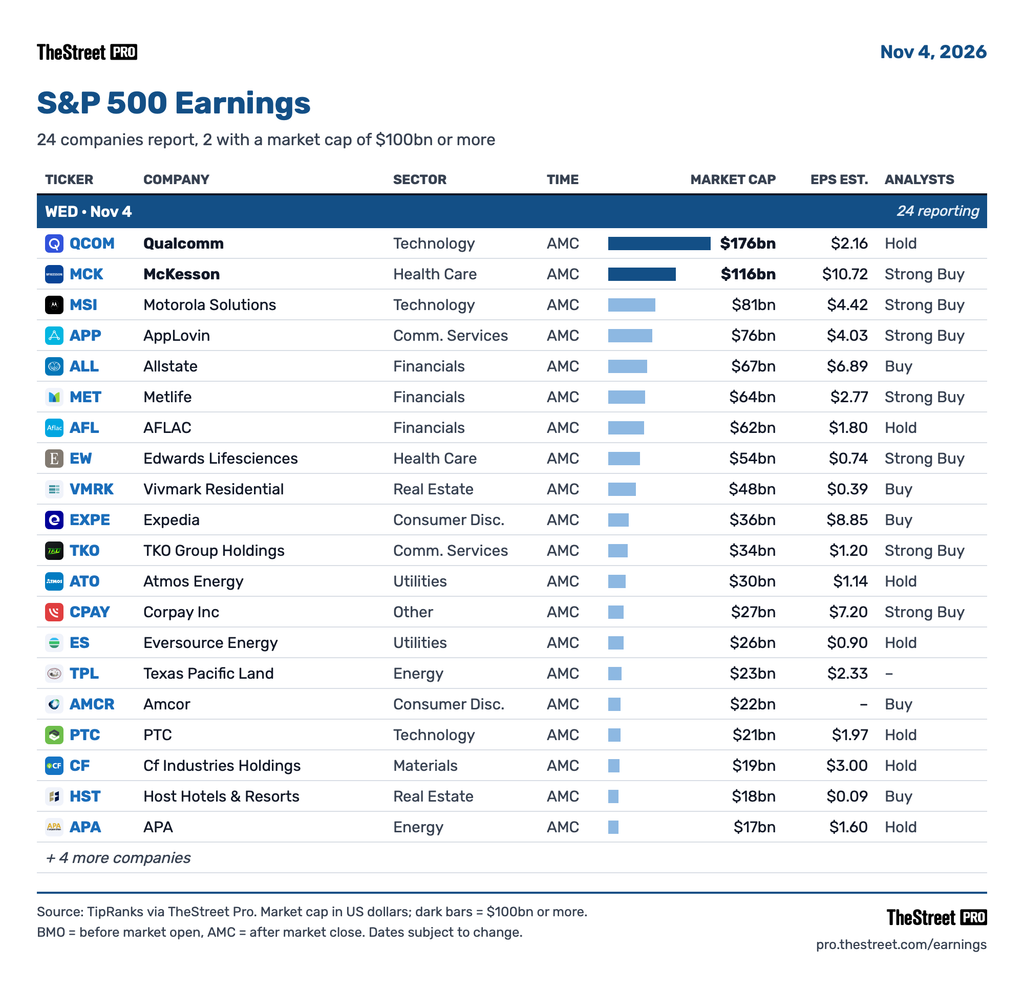
Earnings After the Close (Nov 4)
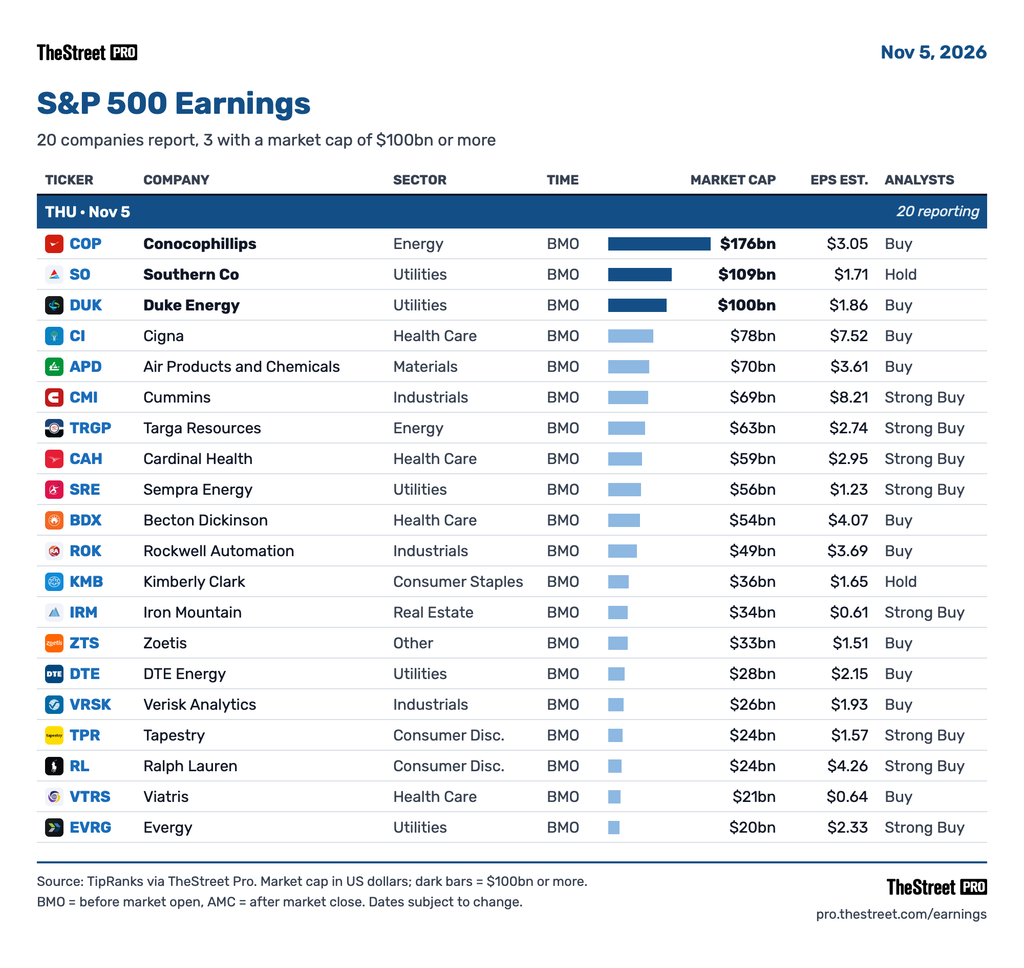
Earnings Before the Open (Nov 5)
Position: None
BY Doug Kass · Nov 4, 2026, 2:08 PM EST
With the smell of deflation in the air (oil, etc.), consumer staples are the world’s fair today.
I will feed the ducks and sell some more of my names in this space.
Position: Long KO (VS), PG (VS), KMB (VS)
BY Doug Kass · Nov 4, 2026, 12:42 PM EST
Position: None
BY Doug Kass · Nov 4, 2026, 12:20 PM EST
The following is from Peter Boockvar:
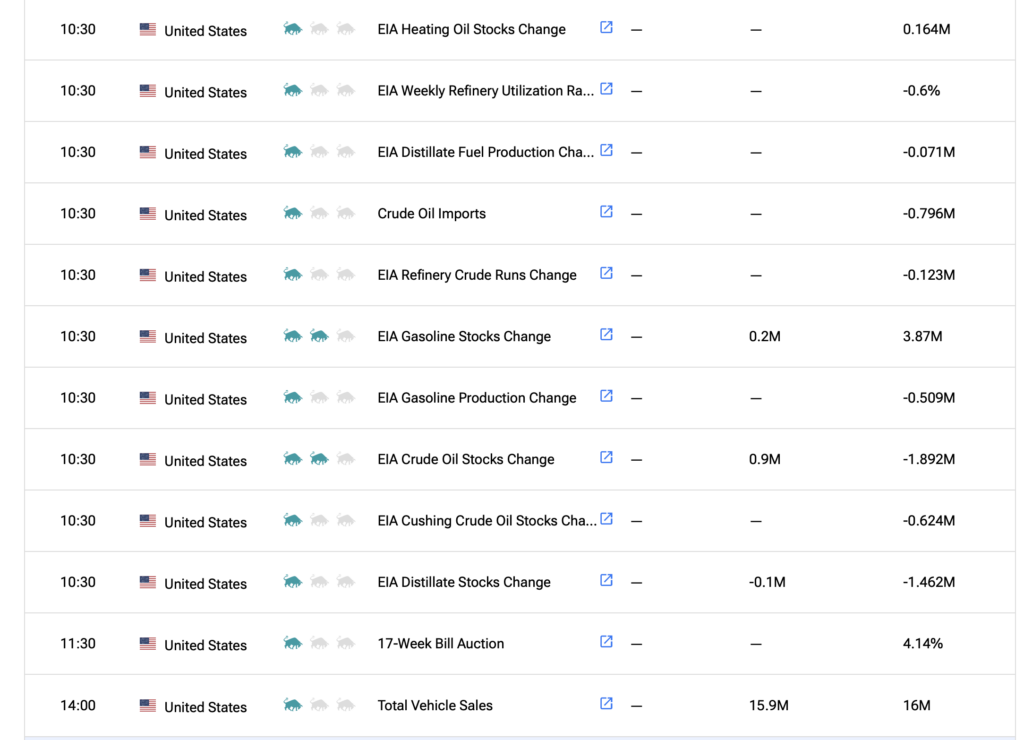
The October ISM services index fell a touch to 54.5 from 54.9 and just below the estimate of 54.8. The Business Activity component in particular fell by 2.7 pts to 53.8 which is the lowest since September 2025.
New orders remained well above 50 but declined by 3.9 pts to 55.9, a 4 month low. Backlogs rose 1.4 pts to 58, the highest since July 2022. Inventories slipped by 2.4 pts to 55.4, about in line with the 6 month average.
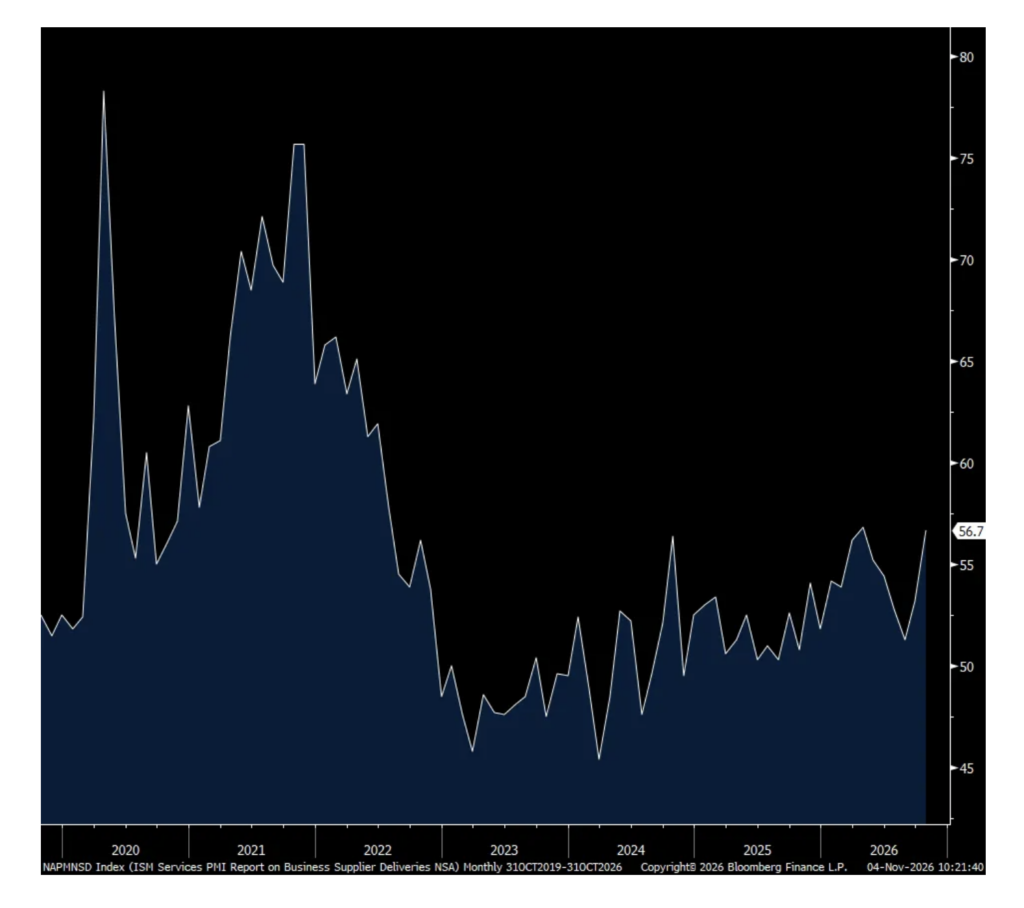
Reflecting still supply chain challenges, Supplier Deliveries rose by 3.5 pts to 56.7, the highest since April. Prices Paid fell 1 pt but staying very elevated at 73. To both of these components, the ISM said “Tariffs and fuel cost impacts continued to be the most-cited issues impacting respondents’ supply chains, while many respondents indicated they are not yet seeing the full impact of these cost escalations or have not passed them through to customers. This indicates that more pricing pressure is on the way if oil and tariff cost impacts are not mitigated, even if they do not increase from current levels. Commentary on supply chain constraints increased significantly month over month.”
Also of note, “No commodities were reported as down in price in October, with fuel reported as up in price for a ninth month in a row. Memory products were reported as up in price for the 10th month in a row, and memory components were reported as in short supply. The number of commodities in short supply decreased from seven to three, all related to computer technologies.” 17 industries of 18 paid higher prices and none paid less.
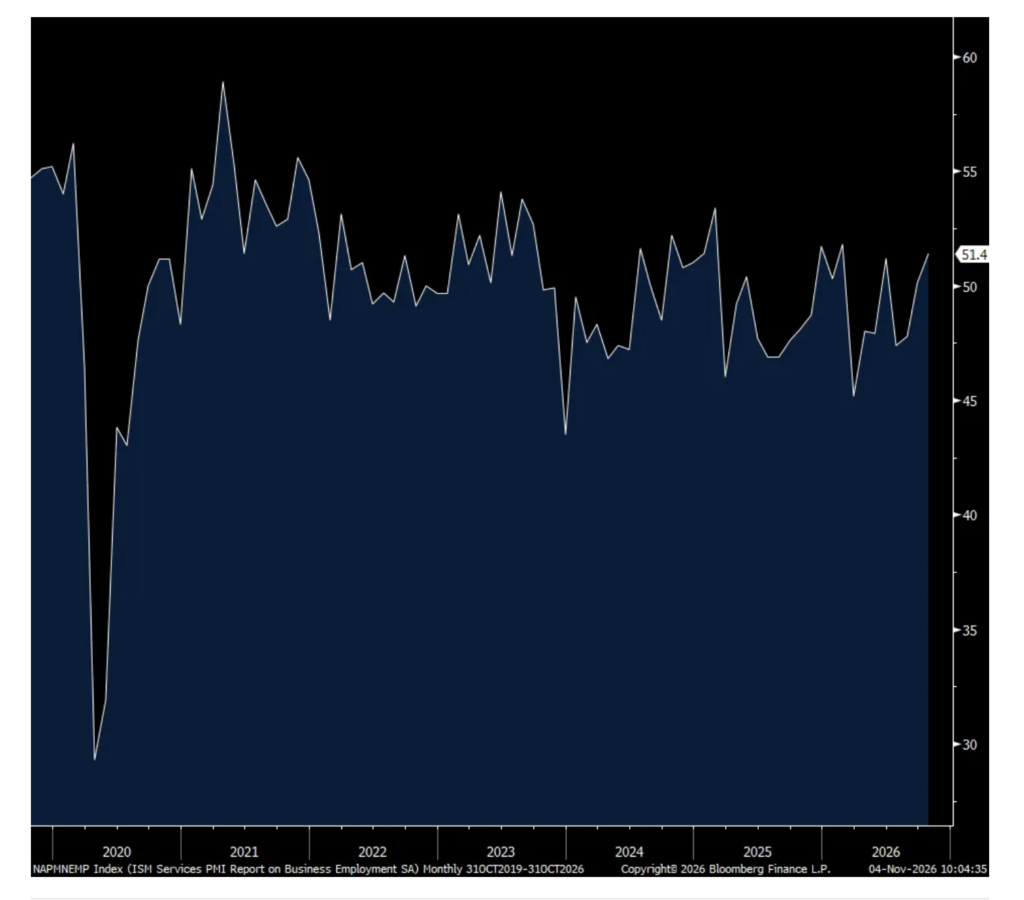
Employment was just above 50 for a 2nd month, up 1.3 pts to 51.4.
Industry breadth improved with 15 of 18 seeing an expansion in their business vs 13 in September. Just two reported a contraction vs four last month.
Bottom line, the services side of the economy remains the dominant force and continues to contribute most of the growth and we have a good idea of the main contributors.
With respect to the respondent comments seen below, tariff talk is still around.
“Fuel and freight markets continue to exert pressure on distribution cost planning. The continued war in Ukraine and drought in the Midwest along with fuel and fertilizer costs are driving up the cost of wheat (30 percent year-over-year).” [Accommodation & Food Services]
· “Overall demand is sluggish.” [Agriculture, Forestry, Fishing & Hunting]
· “Activity remains steady, with a strong backlog of institutional and commercial projects. Material availability has generally improved, though some mechanical and electrical equipment still requires early procurement. Labor shortages and wage pressure continue to impact the market, while higher financing costs are causing owners to closely evaluate project budgets and schedules. Overall outlook remains cautiously positive.” [Construction]
· “Purchasing operations continue to be impacted by elevated costs for goods and services, particularly in construction, facilities maintenance, technology and contracted services. Ongoing uncertainty surrounding tariffs, labor availability and broader economic conditions continues to influence supplier pricing and procurement planning. While overall supply chain conditions have stabilized compared to previous years, suppliers remain cautious with pricing commitments, and cost pressures continue to affect budgets.” [Educational Services]
· “Our company’s AI utilization is increasing, but we have guardrails in place to cap token utilization and evaluate TCO. The price of diesel has impacted our commercial trucking business, and Hurricane Isaias temporarily caused a moratorium on binding certain policies in parts of Alabama, Mississippi and Florida.” [Finance & Insurance]
· “Fuel prices are impacting many of our consumables and delivered goods. This has reduced margins, as we have not passed the expense to our customers because we believe it will be a short-term condition.” [Information]
· “While business activity remains strong, the impacts of tariffs, increased fuel prices, and longer lead times are becoming more challenging.” [Management of Companies & Support Services]
· “Tariffs are causing havoc with international merchandise sourcing.” [Retail Trade]
· “Generation demand is strong. Supplies for services, equipment and materials are constrained. Nuclear uprates (or power level increases) and next-generation plants have strong tailwinds but regulatory headwinds.” [Utilities]
· “Tariff policy remains the main driver of landed cost: Section 301 duties in force since late July replaced the expired flat tariff, raising duties on Southeast Asian canned and dry goods. Ocean freight from Asia remains elevated and volatile, and U.S. East Coast port congestion is expected in November. El Niño is constraining fish supply, and we have suspended one source. Some Asian suppliers have delayed shipments by weeks or months and are raising prices on beverage items and reducing prices on others. Inventory is high in aggregate but unevenly distributed, so service gaps persist on selected items.” [Wholesale Trade]
ISM Services
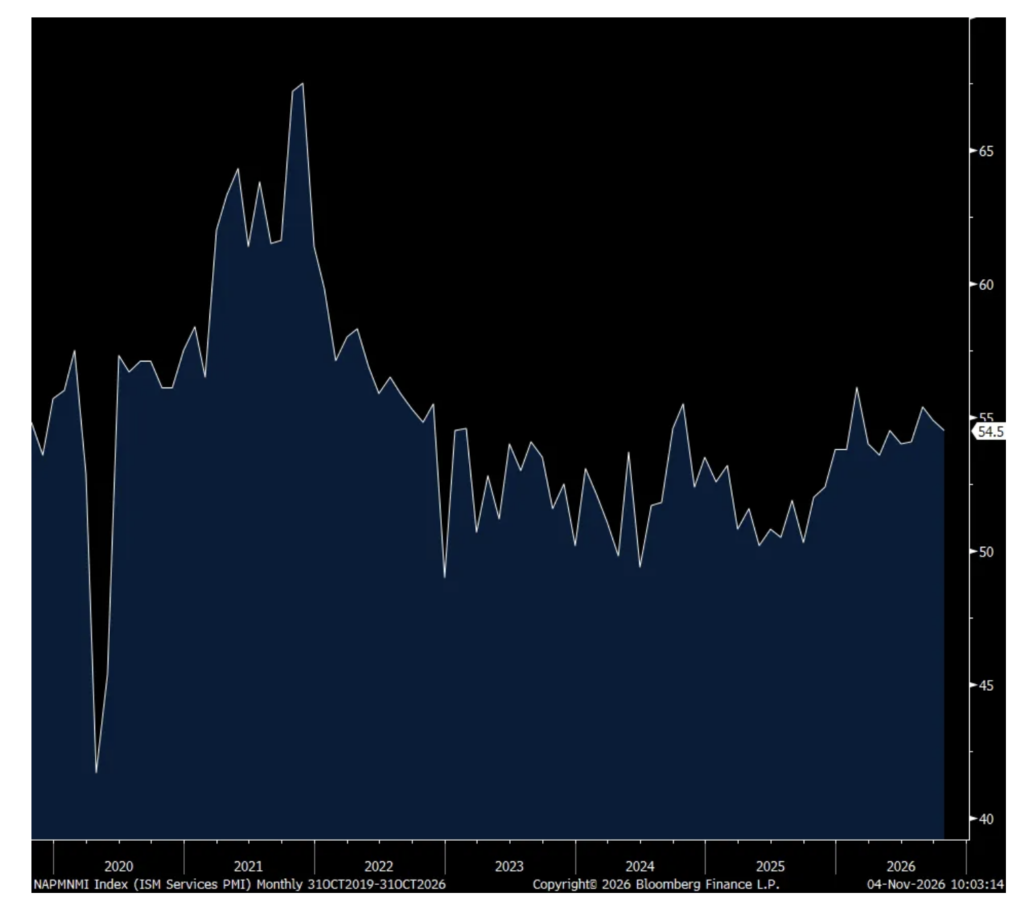
Business Activity
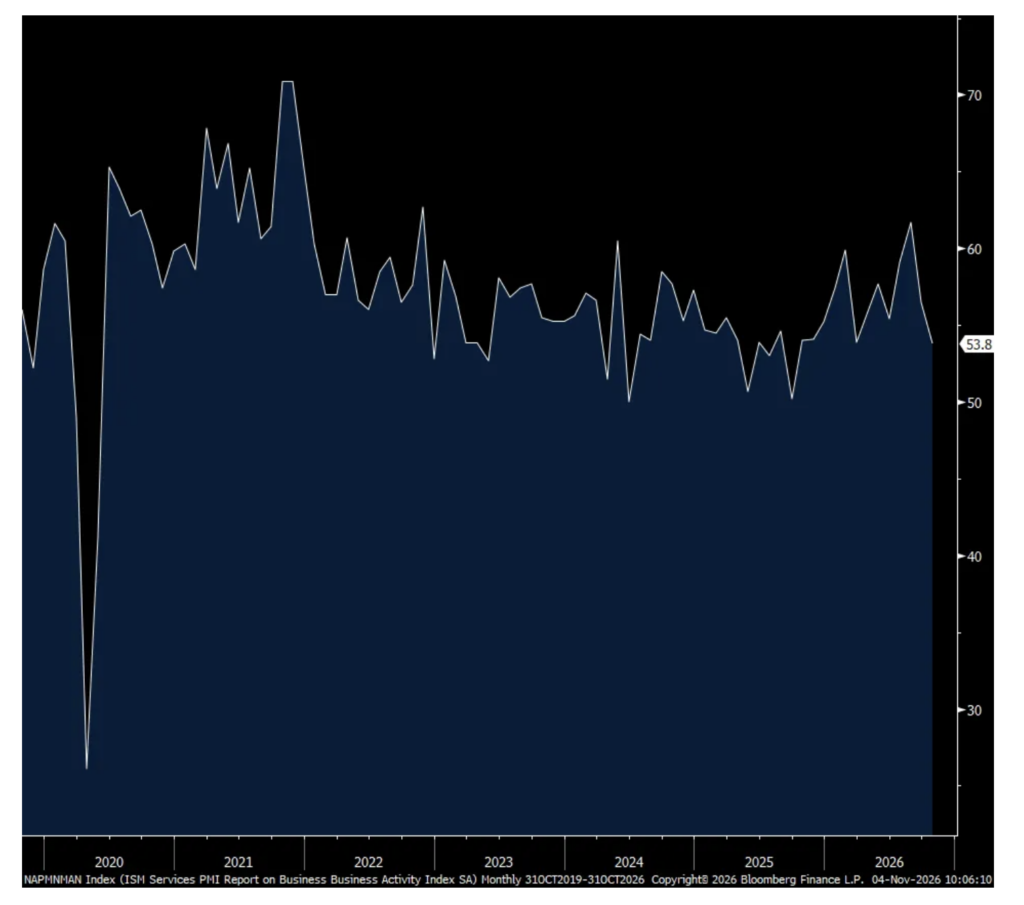
New Orders
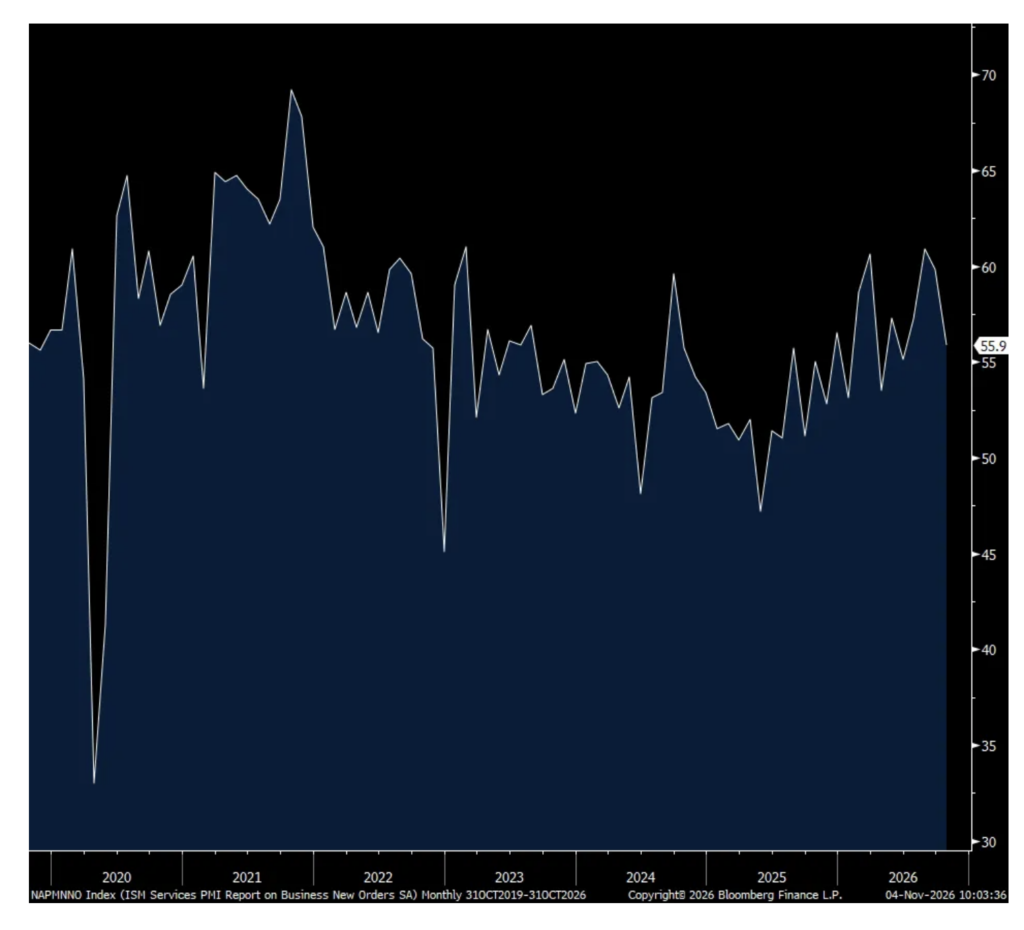
Prices Paid
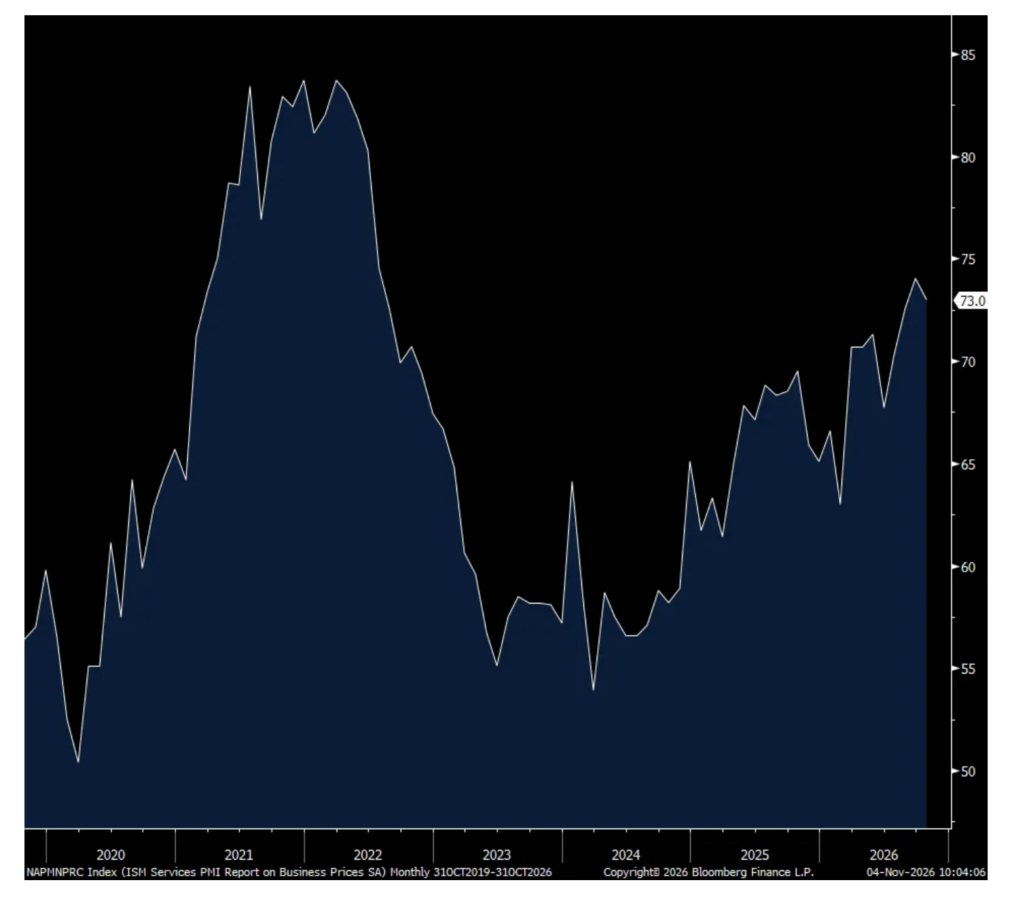
Supplier Deliveries
Employment
BY Doug Kass · Nov 4, 2026, 11:45 AM EST
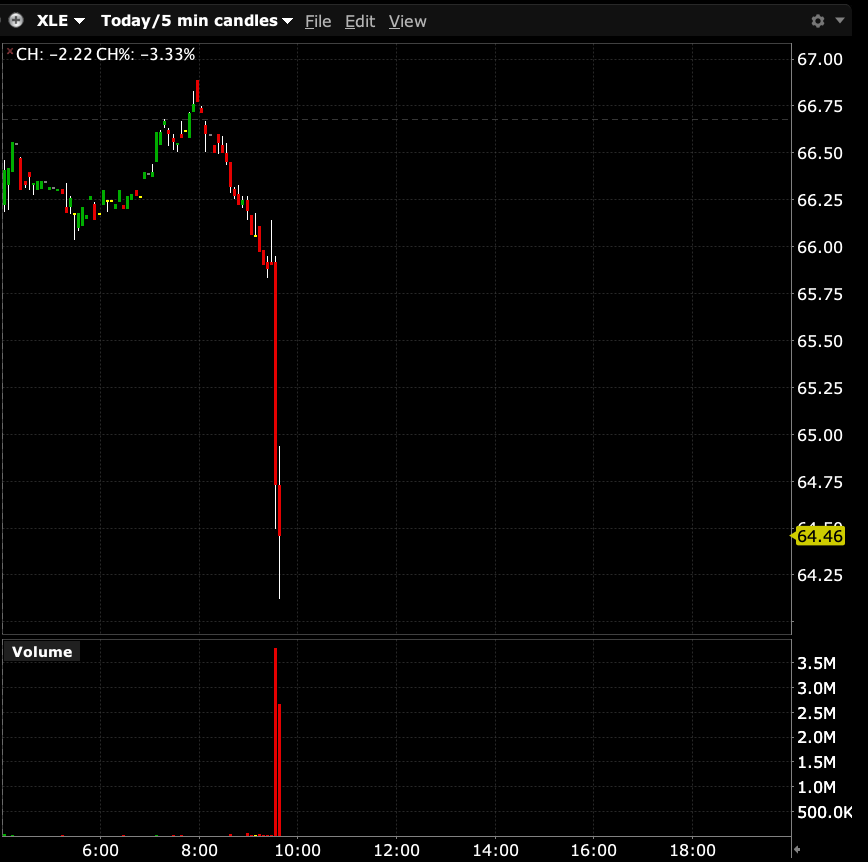
– NYSE volume 46% above its one-month average;
– Nasdaq volume 24% above its one-month average;
– VIX index: down 16.42% to 17.41
SOURCE: Interactive Brokers
SOURCE: Barchart
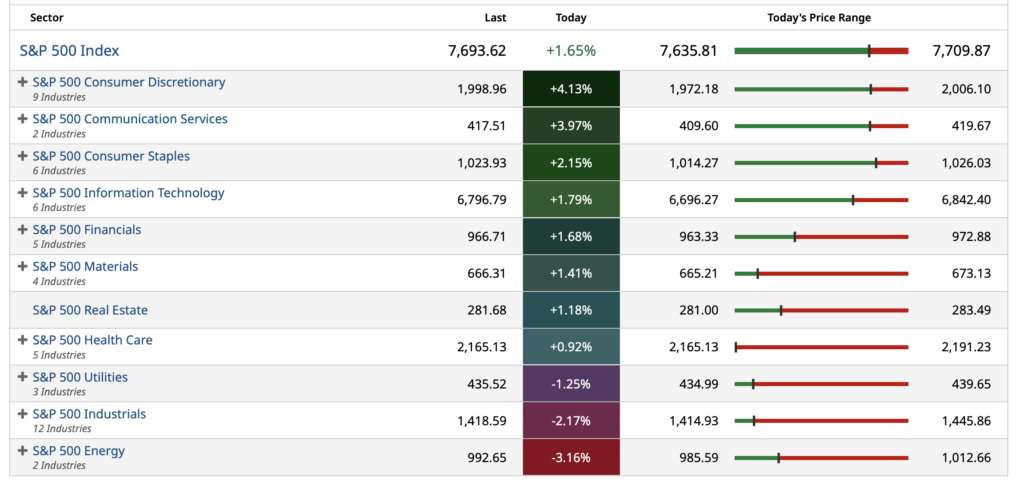
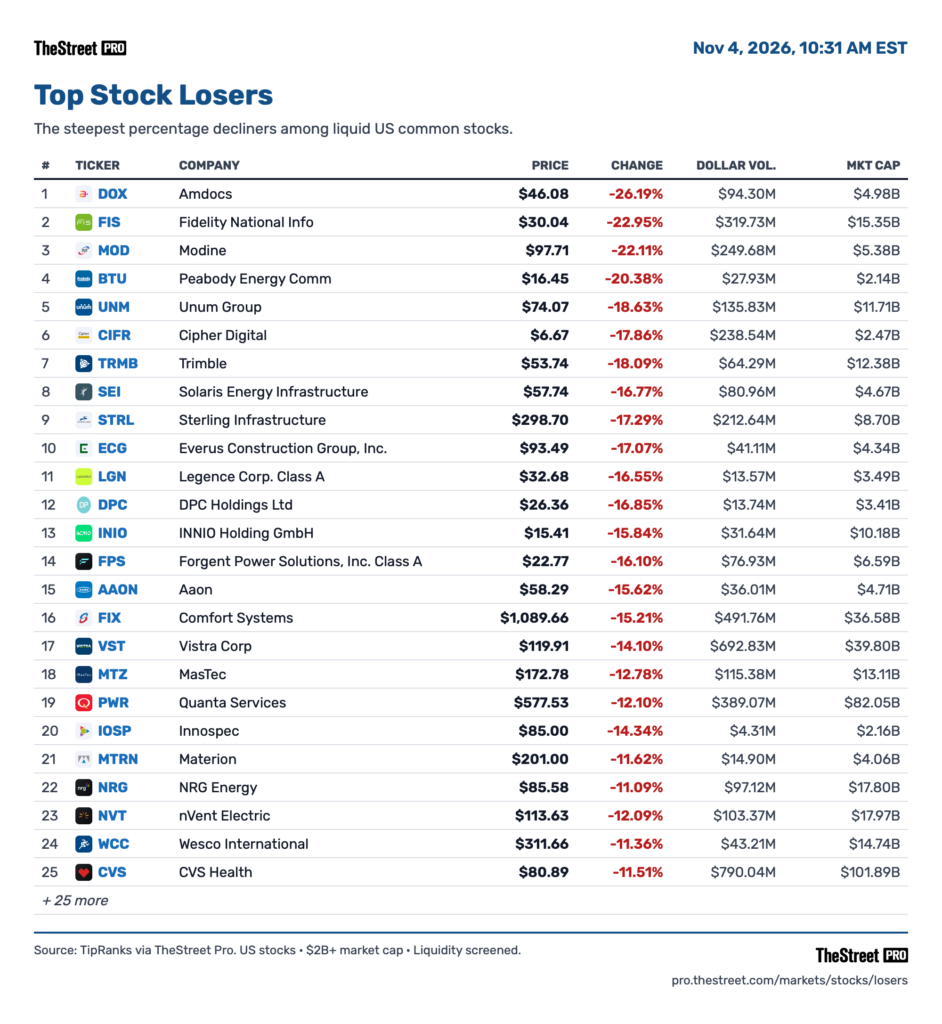
SOURCE: TheStreet Pro
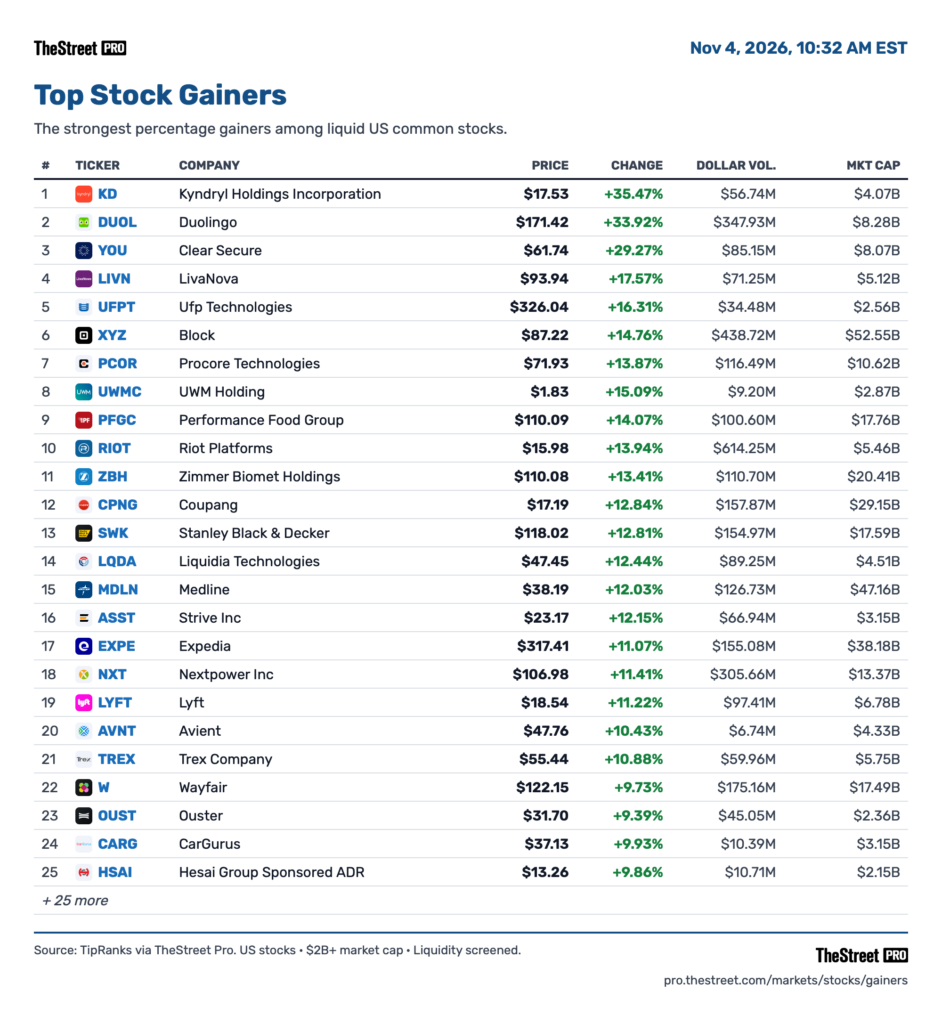
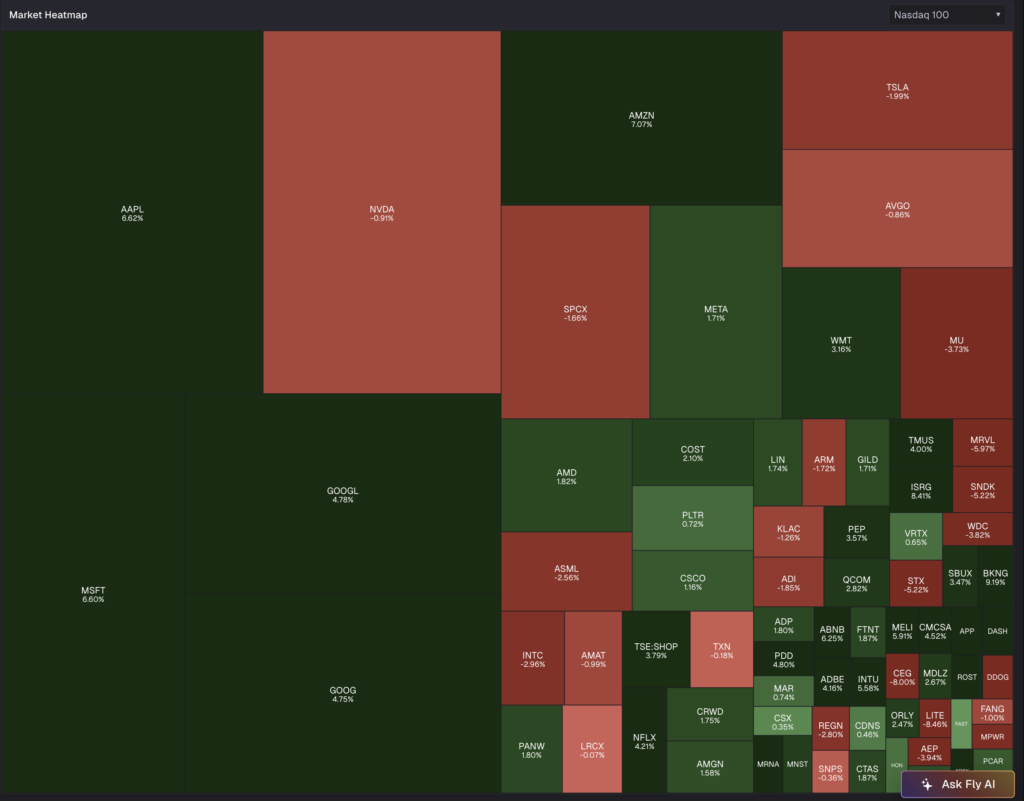
SOURCE TheFly
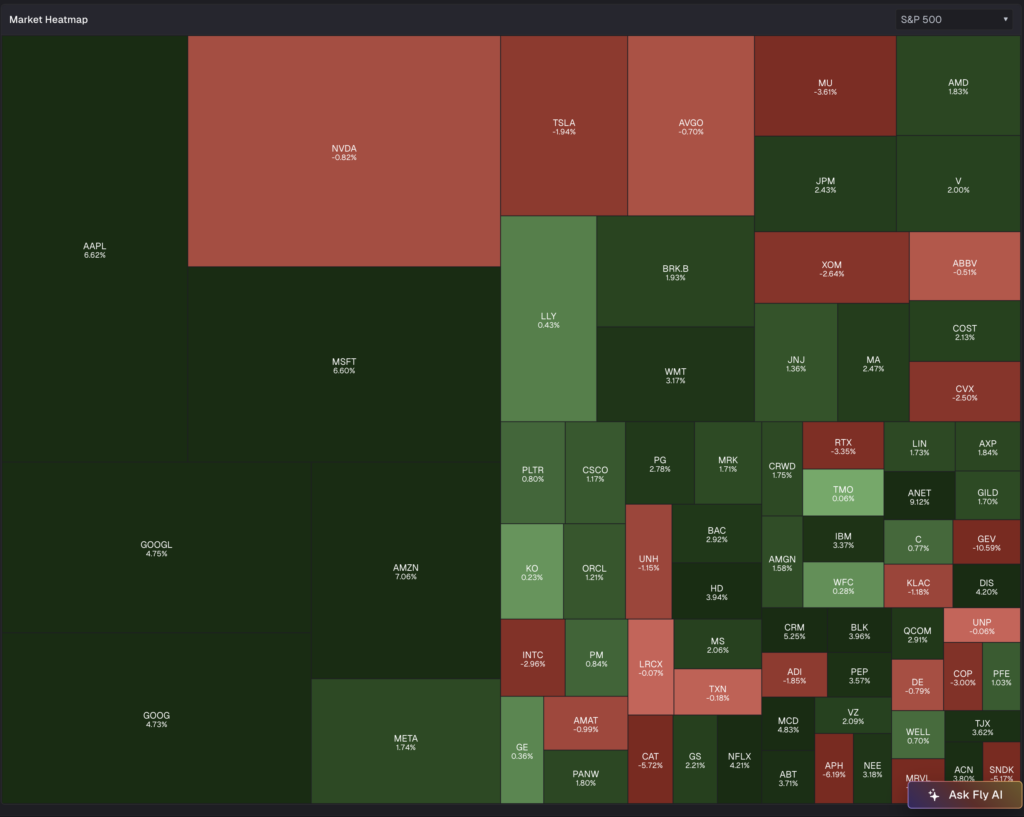
BY Doug Kass · Nov 4, 2026, 11:15 AM EST
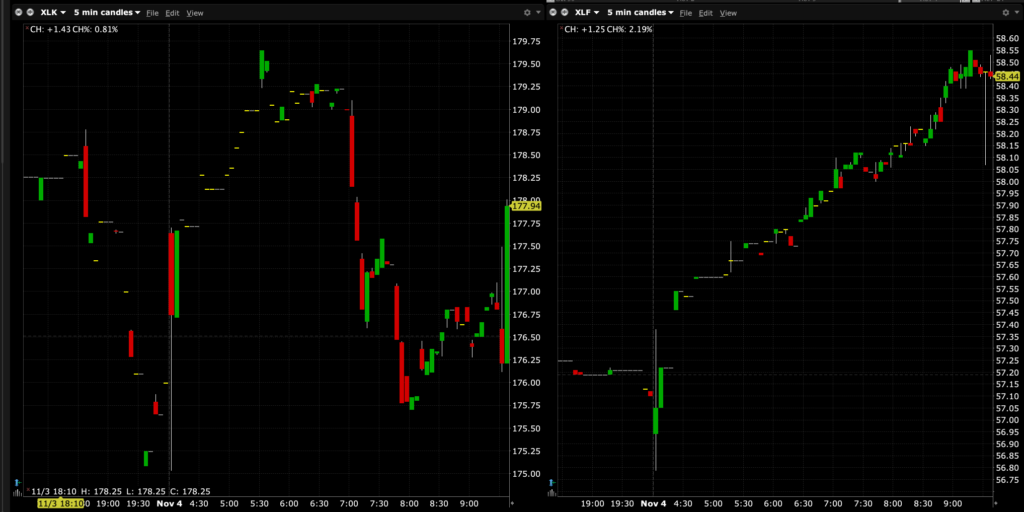
BY Doug Kass · Nov 4, 2026, 10:45 AM EST
I added to my SPY short at $768.41
Short SPY M
BY Doug Kass · Nov 4, 2026, 10:41 AM EST
I have a heavy research day with calls at 10:30, noon and 3:15 p.m..
A heads up.
Positions: None.
BY Doug Kass · Nov 4, 2026, 10:16 AM EST
As it relates to heavily weighted large-cap technology, the election will likely delay the construction of data centers.
This means an entire portion of large cap (the “component” companies like Broadcom (AVGO), Nvidia (NVDA), Micron (MU), Advanced Micro Devices (AMD), Intel (INTC), Sandisk (SNDK), etc.) all face an increasingly uncertain sales and profit outlook. (Peripheral AI/data center “plays” like GEV, CAT et al will likely suffer, too). The neoclouds (like Coreweave CRWV) have even more serious problems ahead.
These memory and chip stocks represent a meaningful portion of the QQQs.
This is an abrupt development and with so many long the newly vulnerable areas a more prounounced period of underperformance may occur over the next few weeks.
Ergo, the Nasdaq may lose its leadership role that it has had for a decade.
Positions: None.
BY Doug Kass · Nov 4, 2026, 9:31 AM EST
The following is from Peter Boockvar:
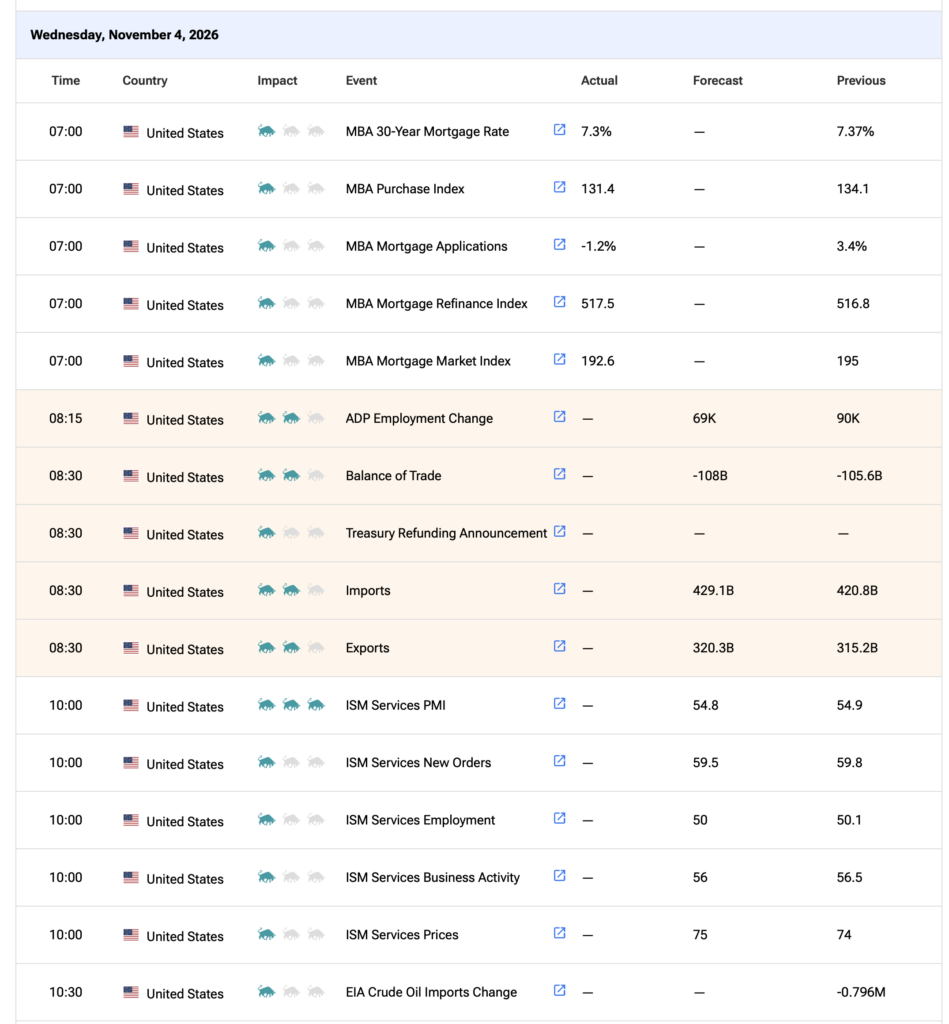
ADP said a net 86k private sector jobs were added in October, 19k above the estimate and the same pace as seen in September. Encouragingly, employers of all sizes saw job growth.
Sector wise in services, trade/transportation/utilities was the biggest contributor, adding 39k, followed by education/health, up 28k, leisure/hospitality up 19k and ‘other’ up by 10k. On the flip side, jobs were lost in professional/business services by 27k and information by 2k.
With goods, hiring was all driven by construction, rising by 13k, mostly offset by a decline of 8k in natural resources/mining and down 1k for manufacturing.
With respect to wages, the median increase for ‘job stayers’ was 3%, the same pace seen in September. For ‘job changers’, it held at 4.8% which remains the best since July ’25.
Bottom line, private sector job growth was good in October relative to the new normal with the more subdued increase in the labor force. Some pockets of weakness seen as stated but overall good job growth in the month. Certainly much is related to the data center build, helping construction and the trade/transportation/utility component, along with healthcare.
With respect to the Treasury refunding announcement, no changes were made and Treasury yields are little changed in response. But, some tweaks to the wording of the statement gives Bessent some future room to alter the maturity cadence of issuance to maybe even more shorter duration Treasuries.
BY Doug Kass · Nov 4, 2026, 9:16 AM EST
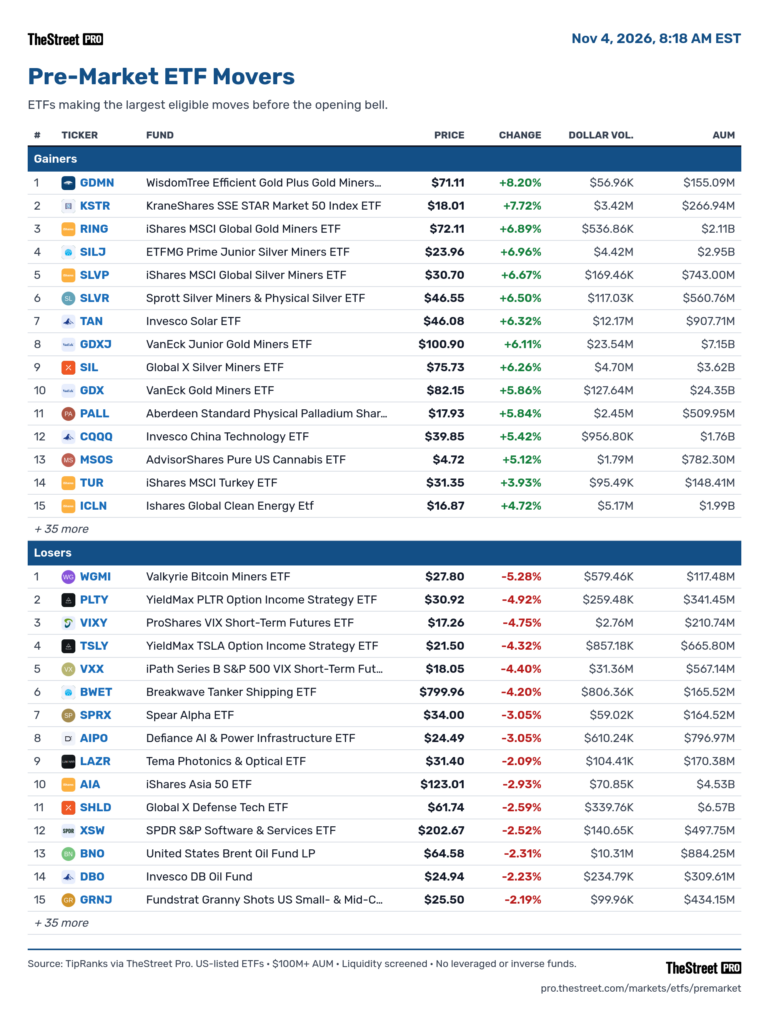
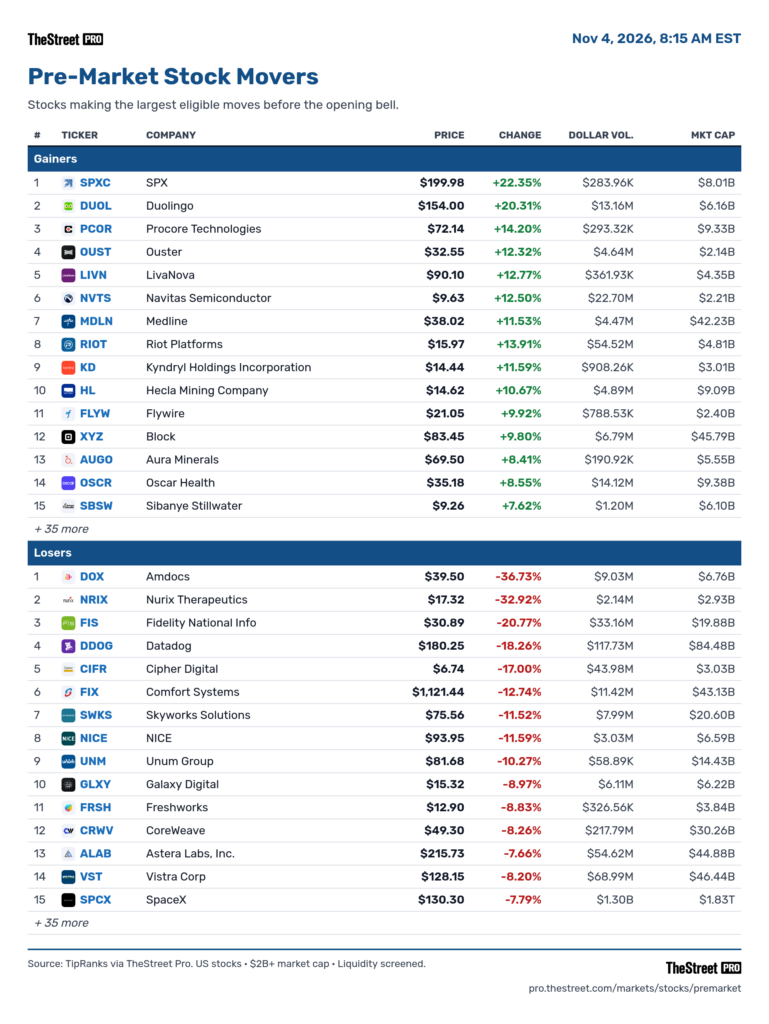
– ALIT +23% (Q3 exceeded expectations for a third straight quarter and the full-year outlook was raised)
– DUOL +20% (bookings beat, daily-user growth accelerated to 29% and full-year guidance was raised)
– CPSH +19% (record Q3 revenue, margin expansion and the first tungsten-alloy order from a defense contractor)
– HELE +16% (received a non-binding $37-per-share cash acquisition proposal)
– RIOT +15% (signed a 910-MW AI-campus lease carrying approximately $28 billion of initial-term contract value)
– OUST +13% (record Q3 revenue rose 50%, the Q4 outlook was strong and Cantor Fitzgerald upgraded to Overweight)
– FTCI +12% (Q3 revenue rose 25% sequentially, backlog reached roughly $640 million and Q4 guidance implies 46% sequential growth)
– NVTS +12% (Q3 beat, double-digit sequential Q4 growth was guided and two brokers upgraded to Buy)
– HL +11% (Q3 profit increased and production guidance was revised as precious-metal prices rallied)
– XYZ +9.7% (Q3 beat across key metrics, the 2026 outlook was raised and initial 2027 targets topped expectations)
– OSCR +9.6%, MOH +5.8%, HCA +6.1%, CNC +4.9% (health insurers and hospital operators rise after the Democratic sweep improved prospects for healthcare spending and ACA support)
– CDE +7.2%, AG +6.7%, PAAS +6.3%, EQX +6.7% (precious-metals miners rise as gold and silver jump on dollar weakness and lower yields)
– CSIQ +7.1%, FSLR +7.3%, RUN +7.0% (solar names rally after the Democratic sweep improved expectations for renewable-energy policy support)
– SAN +6.6%, DB +6.9%, ING +5.7%, LYG +5.0%, HSBC +5.4% (European bank ADRs rise amid a post-election rotation into lenders and a weaker dollar)
– NVO +5.3% (adjusted Q3 profit beat and the full-year sales and operating-profit outlook was raised on stronger GLP-1 demand)
– ANET +4.5% (Q3 revenue surged 59% and substantially exceeded guidance, with a strong Q4 outlook)
– EW +3.5% (Truist upgrades to Buy after positive PROGRESS trial results expanded the TAVR opportunity)
– CPNG +2.6% (constant-currency sales beat guidance, Q4 margins are expected to improve and Citi upgraded to Buy)
– MCD +2.2% (Q3 profit beat as international strength offset sluggish US sales)
– DOX -36% (FY27 guidance was far below expectations as a dispute with a major customer threatens revenue; Oppenheimer downgraded)
– NRIX -33% (partner discontinued the Phase 1 STAT6-degrader trial and terminated the program, eliminating related milestones and royalties)
– FIS -22% (Q3 EPS missed despite a revenue beat, while the CFO departure added uncertainty)
– TBLA -21% (Q3 revenue missed and Q4 and full-year sales guidance came in well below consensus)
– CIFR -14% (KBW downgraded to Market Perform as election results increased regulatory and permitting risk for data-center expansion)
– FIX -14%, CRWV -6.6%, VST -8.7%, VRT -6.8%, GEV -6.5%, ALAB -6.8% (AI-infrastructure and power names fall on fears of tighter data-center oversight, permitting delays and reduced buildout)
– DDOG -12% (Q3 beat, but the Q4 revenue guide was only in line and implied sharp growth deceleration versus elevated expectations)
– NICE -12% (Q3 beat, but margins compressed sharply, revenue guidance was merely reiterated and a 5% workforce reduction was announced)
– SWKS -12% (first combined outlook following the Qorvo transaction disappointed as handset softness outweighed expected synergies)
– DJT -11% (positions tied to Trump’s political fortunes unwind after Democrats swept both chambers of Congress)
– SEDG -9.1% (Q3 EPS beat, but Q4 revenue guidance was far below consensus)
– HUT -8.2%, CLSK -11%, IREN -5.6% (digital-infrastructure names fall as Democratic victories in key states raise risks to planned data-center capacity)
– GEO -6.7%, CXW -5.0% (private-prison operators fall as the Democratic sweep threatens immigration-enforcement spending expectations)
– TSLA -4.6% (Musk-linked shares absorb a political-risk premium after Democratic victories, including a Texas governor upset)
– LMT -4.2%, NOC -3.2%, RTX -3.1% (defense names fall on expectations that a Democratic Congress may constrain planned military-spending growth)
– TOST -3.6% (strong operating metrics were offset by mixed EPS headlines and the announced CFO departure)
– CVS -3.5% (earnings beat and guidance rose, but the anticipated breakup announcement triggered a sell-the-news reaction amid execution and star-rating concerns)
BY Doug Kass · Nov 4, 2026, 9:07 AM EST
source: Interactive Brokers
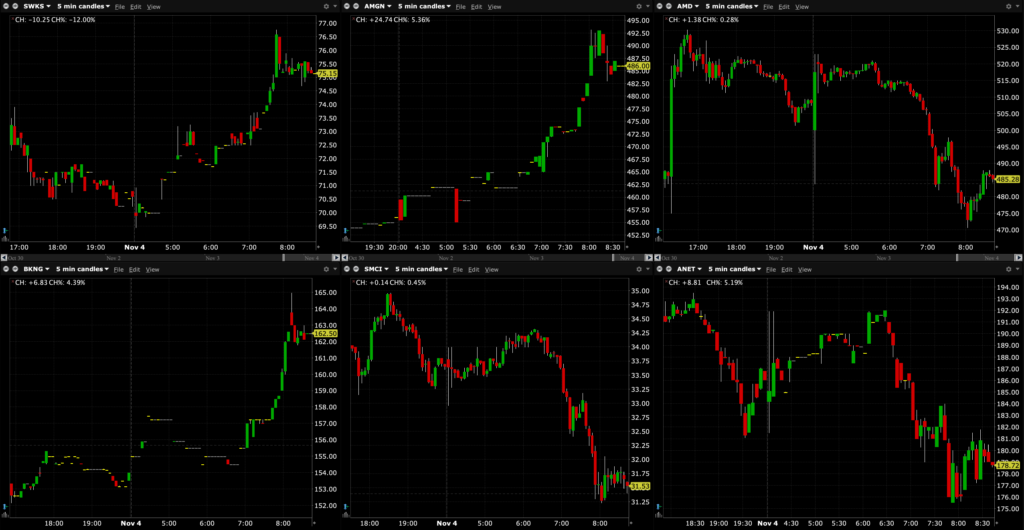
Chart from 8:34 a.m. ET
BY Doug Kass · Nov 4, 2026, 9:01 AM EST
The following is from Peter Boockvar:
A tsunami but how many will get built?/Bull case for oil/Other notables
That was not a blue wave but a tsunami to a jaw dropping extent as voters revolted against the pain of inflation, both for businesses and consumers but I’ll leave the politics from here to others because as investors and market participants we have to be dispassionate and apolitical and focus more on what the actual economic and market impacts of policy will be. As I said yesterday, from the standpoint of DC, a split government will lead to no change in really anything at the federal level over the next two years.
That said, just as oil people count barrels, the results of the Governorships will have us counting data centers and we’ll have to assume we’re going to now get less of them as was threatened on the campaign trail. I think the question from here is whether the data center industry pivots to those states that want them. The Federal Reserve needs to start counting too as it of course feeds directly into the pace of growth, inflation and the state of the stock market.
I’m going to include here what Comfort Systems said on their earnings call a few weeks ago, the provider of HVAC systems:
“So if you were a large hyperscaler and you were laying your bets on which states you wanted to do work in, where you place your bets, where you go do your work and make your commitments is going to be influenced by your perception of whether the Governor in that state wants people in that state to have jobs, right?”
For those of you (me) who went to bed when the S&P futures were down around 100, it was about 1am est when they started to rebound and I have no idea why other than maybe getting saved by AMD’s results and at least clarity on the election results, whether one is happy with them or not.
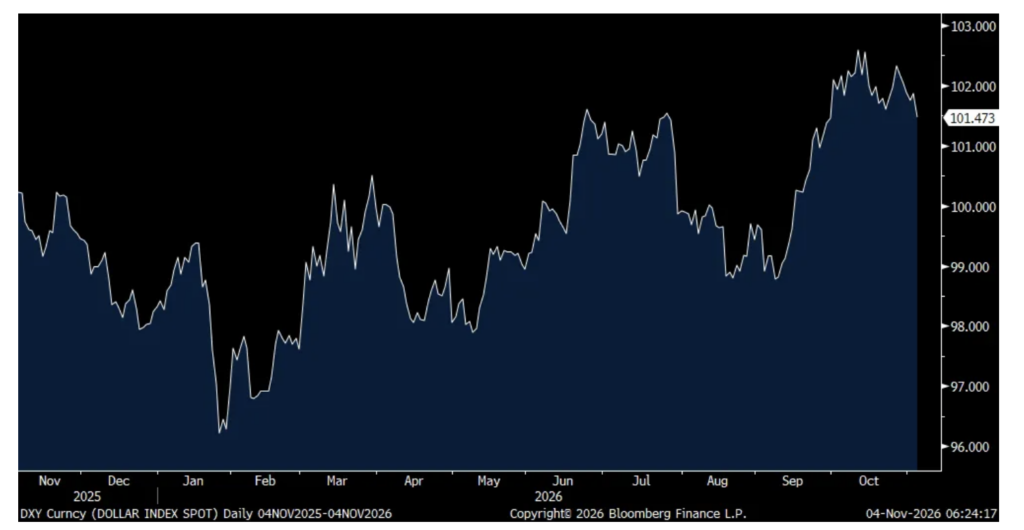
I’m going to highlight the US dollar that in response to the election results is trading at its lowest level in 5 weeks (though still in an uptrend technically) and in turn gold is rallying by 2.8%. Also helping, maybe, was the news yesterday that central bankers are very much interested in owning more of it.
Of focus today too, at 8:30am est we’ll hear details on the Treasury refunding plan in terms of maturity cadence.
DXY
With another dip in the average 30 yr mortgage rate to 7.3%, refi’s were flat after rising last week. Purchases fell 2% w/o/w after rising last week for the first time in 8 weeks.
If you’re long oil, I believe this is the bull case from here.
Very noteworthy from Saudi Aramco on the oil markets and the reasoning partly why we remain long the space:
“Since disruptions began, the global market has lost over 3 billion barrels of liquid supply. Alternative flows including export via our East-West pipeline and strategic petroleum reserve releases have narrowed the cumulative deficit to around 2 billion barrels. The remaining gap was balanced by demand management and substantial withdrawals from commercial inventories. While these actions have bought time, they are not a permanent solution.”
“The resulting market tightness is increasingly evident in physical prices. Buyers competing for immediately available barrels have driven physical prices above futures, and strong demand with constrained supplies has pushed refining margins to record levels.”
“Looking ahead, the market faces additional pressure from both seasonal and structural demand. Global product stocks are now alarmingly low, particularly for diesel, and with diesel demand expected to increase further in Q4, the market faces further pressure heading into winter. In 2027, global liquids demand is projected to expand by around 2.4 million barrels per day as demand management measures ease.”
“Beyond meeting additional demand, the market also faces the challenge of replenishing depleted inventories. More oil will be needed to rebuild inventories and fill additional storage capacity, a process which could take up to two years.”
From AMD, up this morning:
“Data center revenue growth has accelerated sequentially every quarter this year, with the segment contributing 64% of total revenue in the third quarter, up from 47% just one year ago. We expect that acceleration to continue in the fourth quarter, driven by increased demand for inference and agentic workloads and the ramp of our newest products.”
“We now expect server revenue to double y/o/y in 2027, and data center AI revenue to grow even faster than we projected 90 days ago. As a result, we expect Data Center to be more than 80% of our total revenue in 2027 and to drive the majority of our revenue and earnings growth.”
The area of weakness, “PC sell through slowed late in the quarter as higher memory and component costs weighed on demand…In 2027, we are planning for PC market unit shipments to decline by a double digit percentage.”
From Eaton, up 7% yesterday, has been a big beneficiary of the data center buildout with their electrical equipment:
“Growth in Electrical Global was even stronger with 27% organic growth and strength across all end markets. And across the business, demand is both accelerating and broadening. Our Electrical and Aerospace combined book-to-bill remained strong at 1.2…While demand is broad based across end markets, you can see here that the data center orders for the 12 months rolling are over 100% and revenues up 65% remain really strong.”
Most don’t think Expeditors International when referring to the AI data center buildout but the logistics broker said this:
“Airfreight demand remained strong during the quarter, with record global air tonnage increasing approximately 13% y/o/y, driven primarily by continued growth in South Asia, where export tonnage increased most notably.Hyperscaler demand, which also includes shipments from Tier 1 and Tier 2 suppliers supporting AI infrastructure, was a significant driver of volume growth, while air capacity remains constrained by limited fleet expansion and ongoing new aircraft delivery delays.”
From Sysco, down 9% yesterday:
“Traffic to restaurants per Black Box was down 2% in the quarter. The traffic performance for the quarter is consistent with the calendar y/o/y performance and remains a headwind for the industry. Additionally, the Cyclospora outbreak had an adverse impact on the middle of the quarter, softening traffic to restaurants and restaurant operator volume during August.”
“Sysco specifically had stronger volume performance in July and September as customers bounced back quickly after the Cyclospora traffic headwind.”
“Rising fuel costs are impacting the supply chain and end customers…inbound logistics costs have risen due to the continued increase in diesel fuel…Our team has done an excellent job of hedging fuel costs on the outbound delivery aspect of our business, but the rising cost of fuel is harmful to end consumer disposable income.”
“Lastly, food cost inflation came in lower than planned during the quarter…The deflation of food in Q1 was helpful for end consumers but create some short-term pressure on our P&L.”
With their guidance, “Based on the current outlook, we expect inflation of approximately 1% to 1.5%.” With fuel, they have customer surcharges that mitigates their own costs.
From Shopify, also down 9% yesterday:
With regards to the agentic shopping revolution and its impact on retail, “Now while the volume is still small here, adoption is growing and the early signals show that this has the potential to become a very powerful service area. Here’s what we’re seeing. AI traffic is up 2.6x y/o/y. Orders are growing even faster at 3.3x. AI channels are sending shoppers straight to product pages at 3x the rate of organic search, and shoppers are converting 64% more often.”
There was not one question about what they are seeing with consumer spending on the call but on CNBC, Harley Finkelstein, the President, basically said consumer spending is fine based on what they see.
From Yum Brands, down a touch yesterday and the owner of KFC and Taco Bell:
“From a low point in July, Taco Bell US same store sales strengthened week after week, and since the end of September, the brand has been outperforming the QSR industry on same store sales growth.”
With KFC US, “the brand continues to navigate a competitive QSR environment.”
In the fast lane of the economy, pun intended, Ferrari rallied almost 3% yesterday and said this:
“we see healthy demand across all the models and across all the geographies. There are some areas where, for example, the hybrid is preferred to ICE and vice versa, or the six cylinder to eight cylinder. But we see a healthy demand across all the models and I would say we are very pleased about the product we are able to offer our clients.”
From Booking Holdings, with mixed results and a stock down a touch premarket:
“Travel demand was resilient in the quarter, although we saw some moderation towards the end of the period. Prices increased as we saw constant currency ADRs up approximately 3% y/o/y, primarily driven by Europe but also by the US and Asia.”
“We saw a slight expansion in the booking window in Europe and at the global level, while the booking window in the US moderately contracted.”
“Looking at room night growth by booker region, Europe grew high single digits…Asia grew high single digits…US grew mid single digits.”
“Moving to our thoughts for the fourth quarter, the travel environment is mixed…Domestic travel continues to hold up, as we are seeing travelers take shorter trips and choose destinations closer to home. In October, a number of external factors have also affected demand, including disruptions to travel to and from the Middle East, the conflict’s broader indirect effects, such as elevated airfares and localized unrest in certain European cities.”
Avis Budget said something similar in their earnings release, “The third quarter demonstrated continued progress in how we manage our fleet, with third-quarter Americas utilization being the best we have had in 20 years despite a softer travel demand environment.”
Ahead of the US ISM services index, China’s private sector October services PMI fell to 50.8 from 51.6. Hong Kong’s got back above 50 at 50.2, up 1 pt. In Singapore, its PMI remained well above 50 but a bit less so at 56.7 vs 58.1.
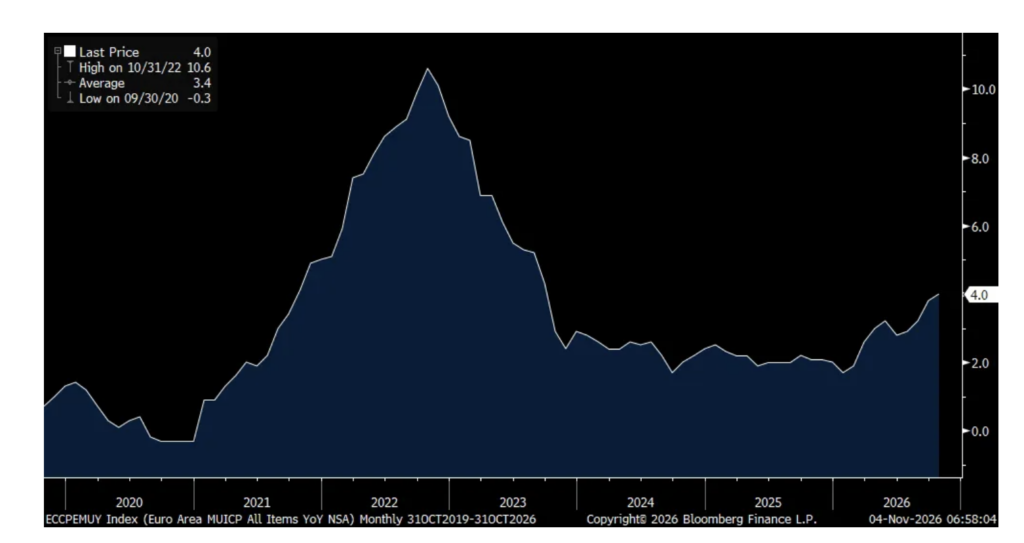
In the Eurozone, headline inflation rose 4% y/o/y in October, up from 3.8% in September but as expected. The core rate was higher by 2.5%, the same pace seen last month and also in line. Services inflation in particular was up 3.3% y/o/y and non-energy industrial goods prices grew by 1.2% y/o/y. As there were no surprises, European bond yields are down slightly but we might get another rate hike from the ECB next month.
The final Eurozone October services PMI was 51.4 vs 53 last month with not surprisingly a 5 pt decline in French services to 46.2. The final UK services PMI rose .7 pts m/o/m to 52.8 which is the highest since February.
Eurozone CPI y/o/y
BY Doug Kass · Nov 4, 2026, 8:45 AM EST
BY Doug Kass · Nov 4, 2026, 8:28 AM EST
BY Doug Kass · Nov 4, 2026, 8:19 AM EST
Source: TipRanks
BY Doug Kass · Nov 4, 2026, 8:16 AM EST
I added to my SPY short at $763.25.
I have a research breakfast. Back at about 8:30 AM.
Position: Short SPY (M)
BY Doug Kass · Nov 4, 2026, 7:16 AM EST
Position: None
BY Doug Kass · Nov 4, 2026, 6:15 AM EST
Position: None
BY Doug Kass · Nov 4, 2026, 6:05 AM EST
The S&P Short Range Oscillator is less overbought at 0.73% vs. 2.37%.
I put out a SPY short at 4:33 AM with S&P futures +43 handles.
Position: Short SPY (S)
BY Doug Kass · Nov 4, 2026, 5:55 AM EST
I am back shorting SPY at $758.55 and added to my short at $760.72.
Position: Short SPY (S)
BY Doug Kass · Nov 4, 2026, 5:45 AM EST
Starting with the 82nd Congress in 1951, a Democratic Congress and Republican President is the most likely combo at 22 years (out of 75). But the two worst years ever (1974 and 2008) happened these years, along with the 5th and 6th worst (1957 and 1973). Of course, all of those Show more

Good morning. From its session low of 7.490 $ES_Z has rallied almost 195 handles in an almost straight line. It is now trading near session highs at 7.657.50 +70.75.
Not being hyperbolic. To be honest, I would be surprised if Nasdaq doesn't finish DEEP in the red today. Narratives about gridlock and elections being good for markets are all swell...but you can draw a very straight line from this election result to a seismic shock to dataShow more


$ES_Z is trading 7,520.75 -77.00 From someone who never makes predictions: This is very likely the way the mkt finds a tradeable low. Not clear if it happens tonight or tomw. But it could. 46 years of trading mkts, watching the tape trumps quants telling you about seasonality.