Monday’s After-Hours Advancers and Decliners
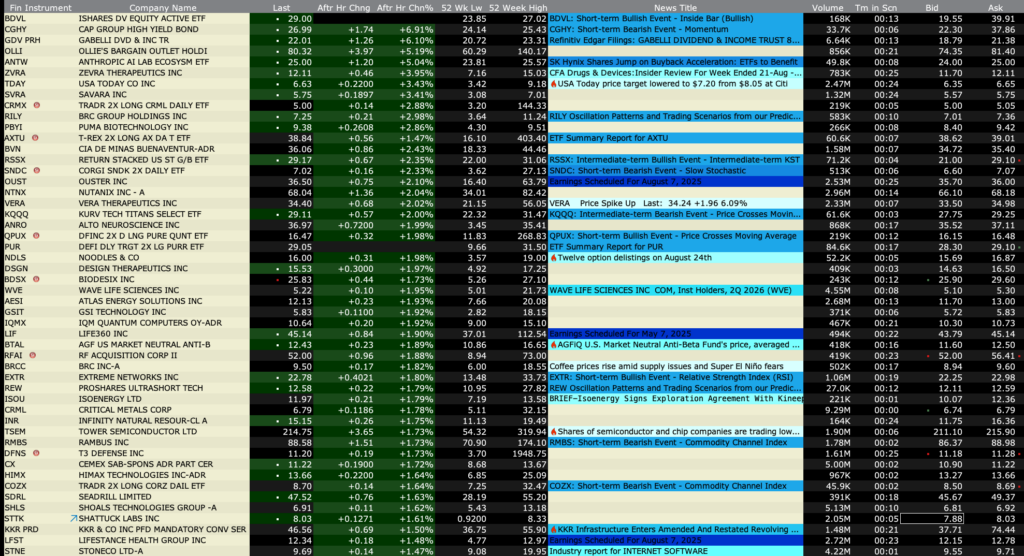
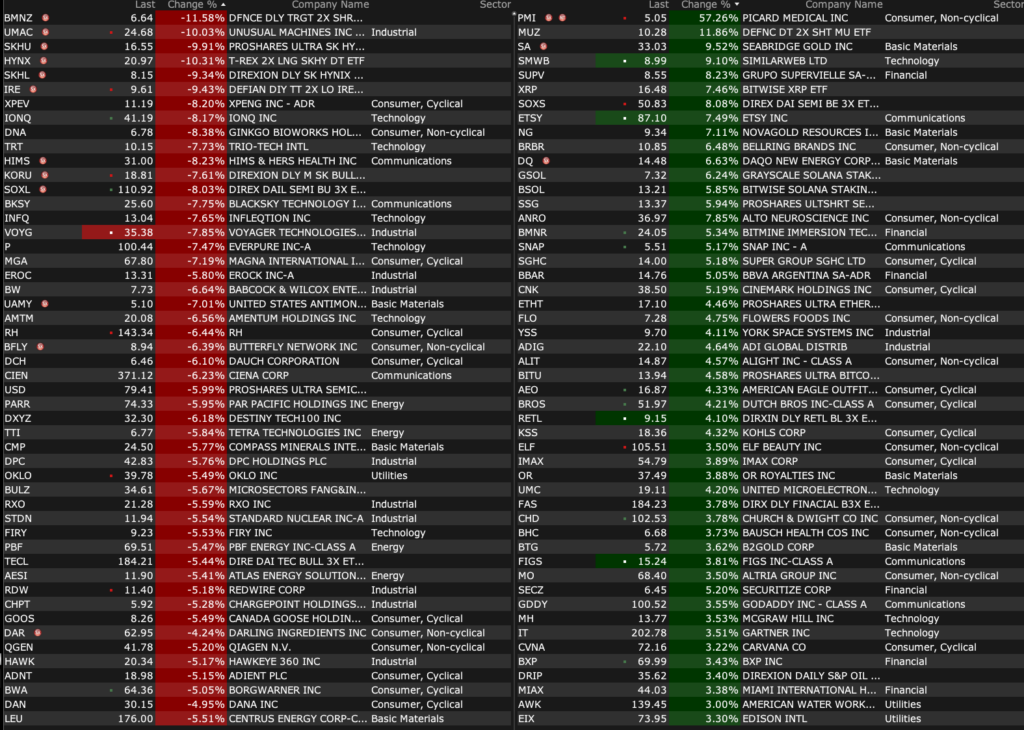
After-Hours % Advancers
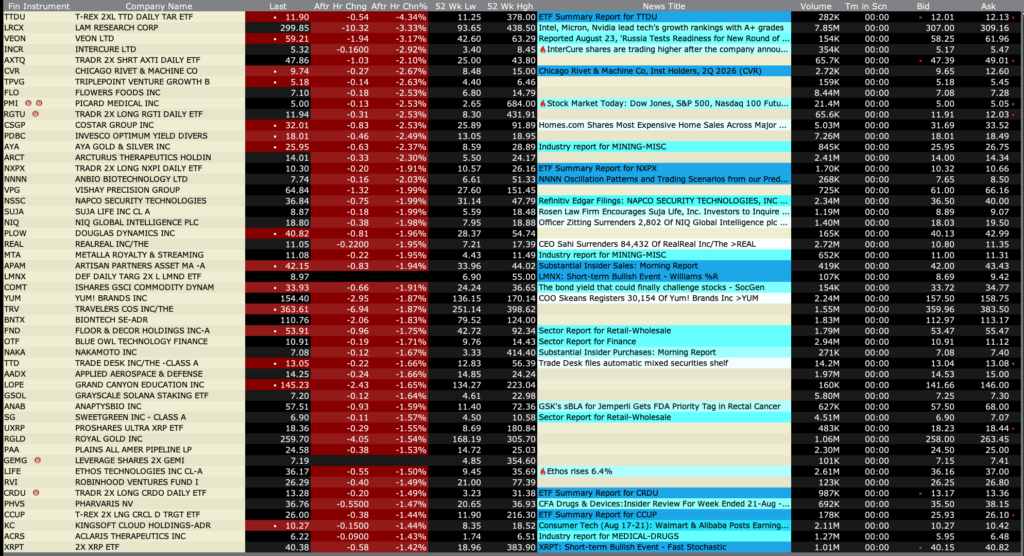
After-Hours % Decliners
Position: None
BY Doug Kass · Aug 24, 2026, 4:40 PM EDT
 Doug KassDoug Kass
After-Hours % Advancers
After-Hours % Decliners
Position: None
BY Doug Kass · Aug 24, 2026, 4:40 PM EDT
Closing Volume
– NYSE volume 16% below its one-month average
– NASDAQ volume 15% below its one-month average
– VIX index: up 4.76% to 15.85
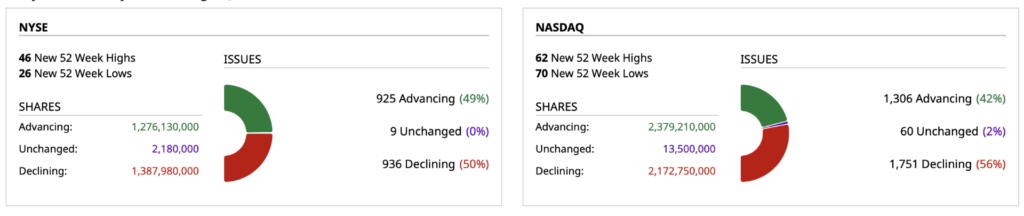
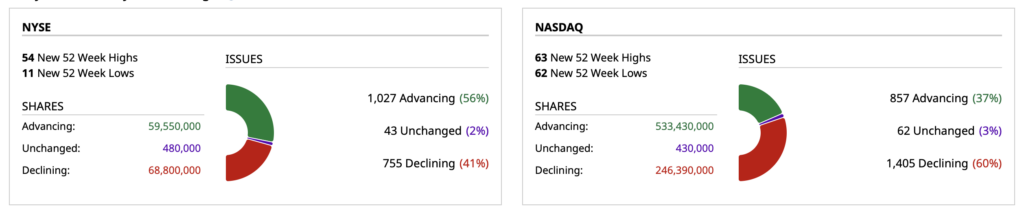
Breadth
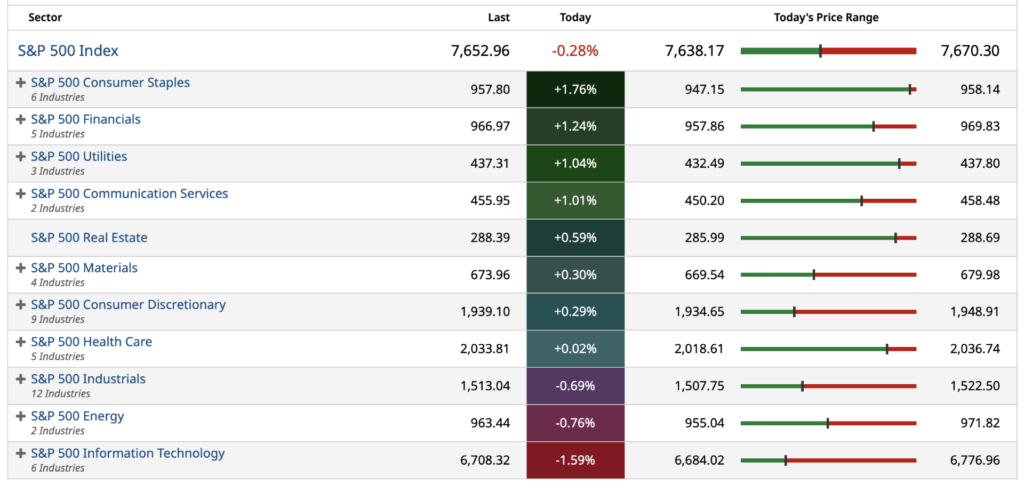
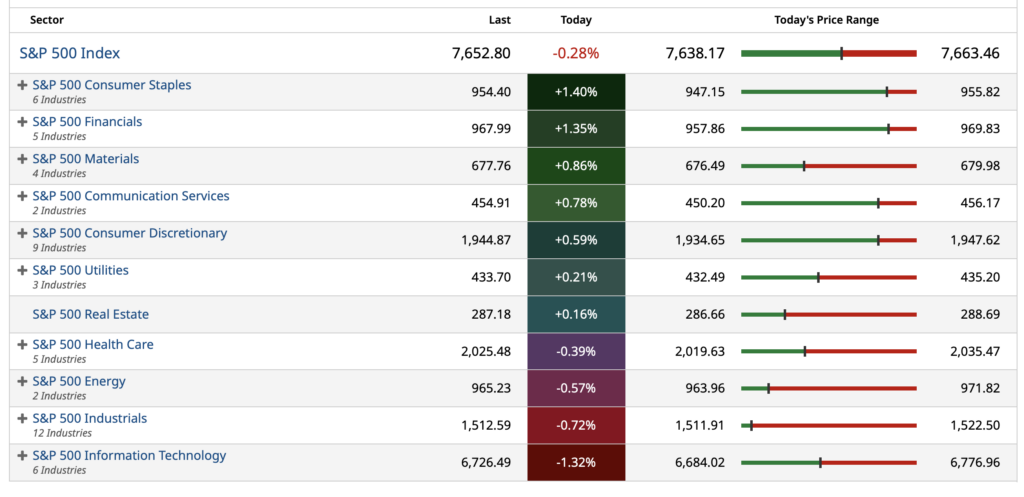
S&P 500 Sectors
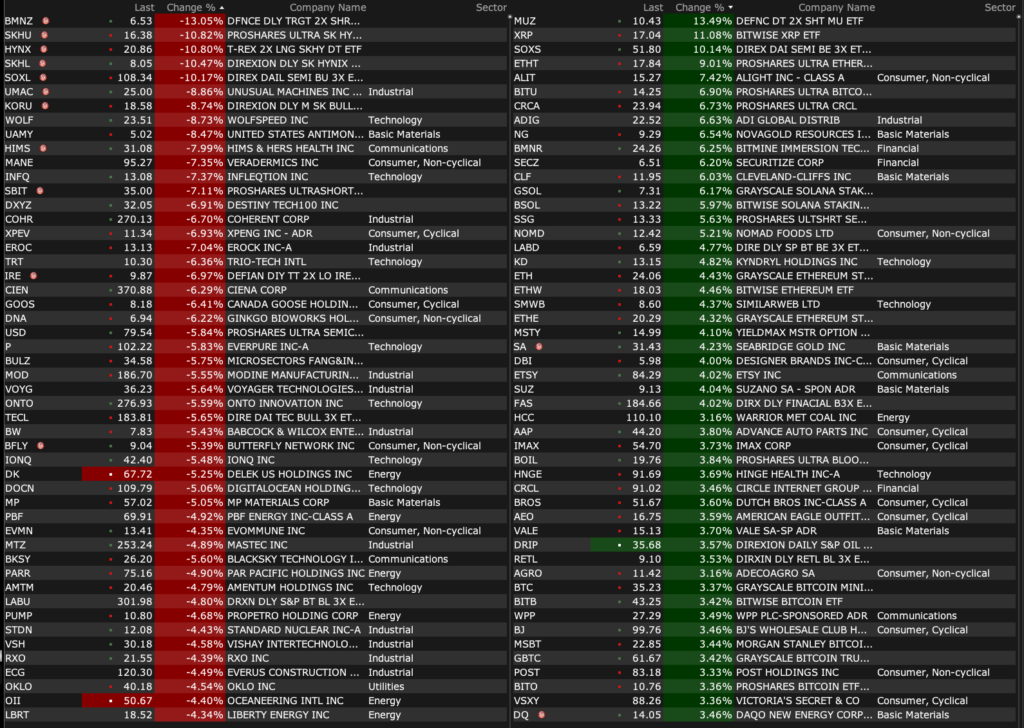
% Movers
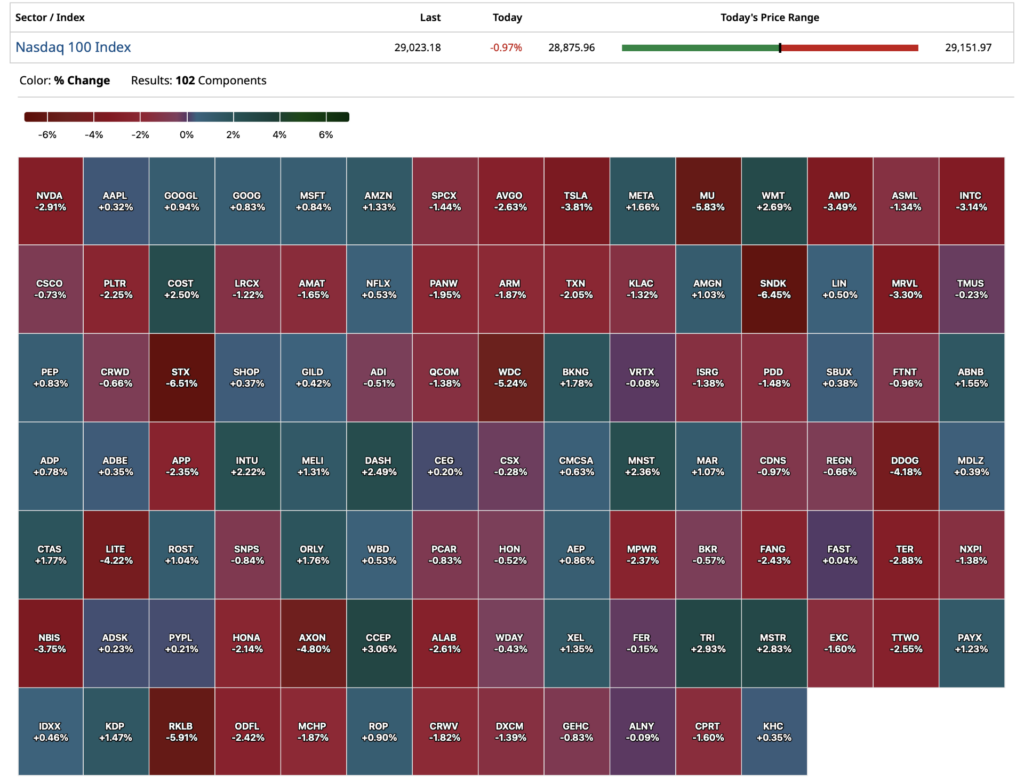
Nasdaq 100 Heat Map
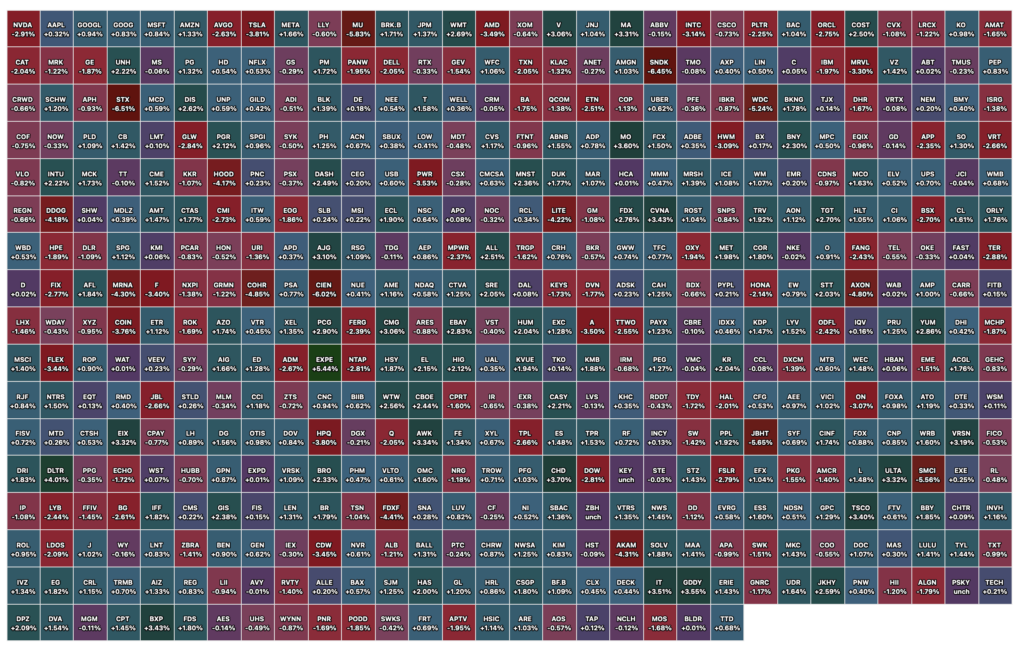
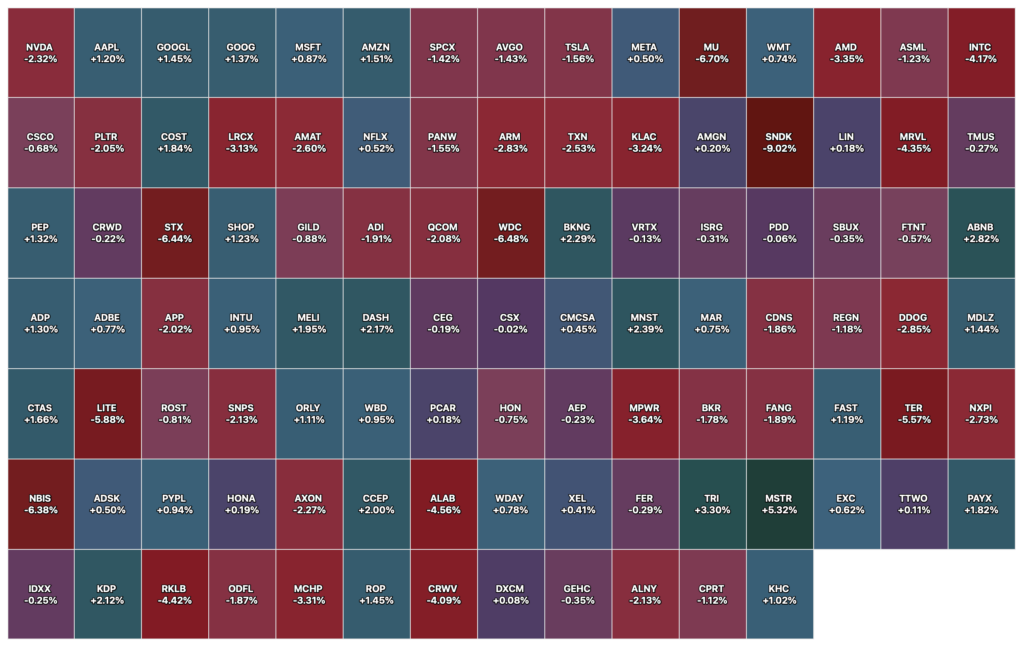
Closing S&P 500 Heat Map
Position: None
BY Doug Kass · Aug 24, 2026, 4:31 PM EDT
“If trees could scream, would we be so cavalier about cutting them down? We might, if they screamed all the time, for no good reason.”
– Jack Handey
I thought quite a lot about the markets over the weekend and I revisited my mid-August column “But If, Baby, I’m The Bottom… You’re The Top!“
I concluded then and I believe stronger now, in light of the events of the last two weeks (in AI, market structure, valuation, geopolitical, interest rates, inflation, deficit/debtload, etc.) the following:
* Upside reward is dwarfed by downside risk.
* Having an outsized or even an in-line long exposure entails not only a great deal of risk — but is literally gambling (due to the risks of an uber leveraged market structure — in products and strategies).
* In general, market participants are unduly optimistic and positioned very long with limited cash reserves (as a percentage of the portfolio).
* The singular notion that since S&P EPS growth will be robust this year (+20%) so equities are undervalued is challenged by the reality of history (I didn’t get to it today but will tomorrow!).
From August 18 (bears rereading):
At words poetic, I’m so pathetic
That I always have found it best,
Instead of getting ’em off my chest,
To let ’em rest unexpressed,
I hate parading my serenading
As I’ll probably miss a bar,
But if this ditty is not so pretty
At least it’ll tell you
How great you are.
You’re the top!
You’re the Coliseum.
You’re the top!
You’re the Louve Museum.
You’re a melody from a symphony by Strauss
You’re a Bendel bonnet,
A Shakespeare’s sonnet,
You’re Mickey Mouse.
You’re the Nile,
You’re the Tower of Pisa,
You’re the smile on the Mona Lisa
I’m a worthless check, a total wreck, a flop,
But if, baby, I’m the bottom you’re the top!
– Cole Porter, You’re The Top
What follows is a compilation of my Daily Diary posts and communications I have had with my hedge fund’s (Seabreeze Partners) Limited Partners over the last 30 days.
In this month’s commentary I will call upon the opinions of DoubleLine Capital’s Jeffrey Gundlach, Berkshire Hathaway’s Warren Buffett (his famous “God’s Plan” quote in 1999) and former Morgan Stanley investment strategist Barton Biggs (in his “rosy scenario” condition). I will supplement their words with data and statistics that support our market and economic fears. Finally, I will expand on the temporary loss of price discovery and the gamification of our markets — both of which are contributing to our market concerns.
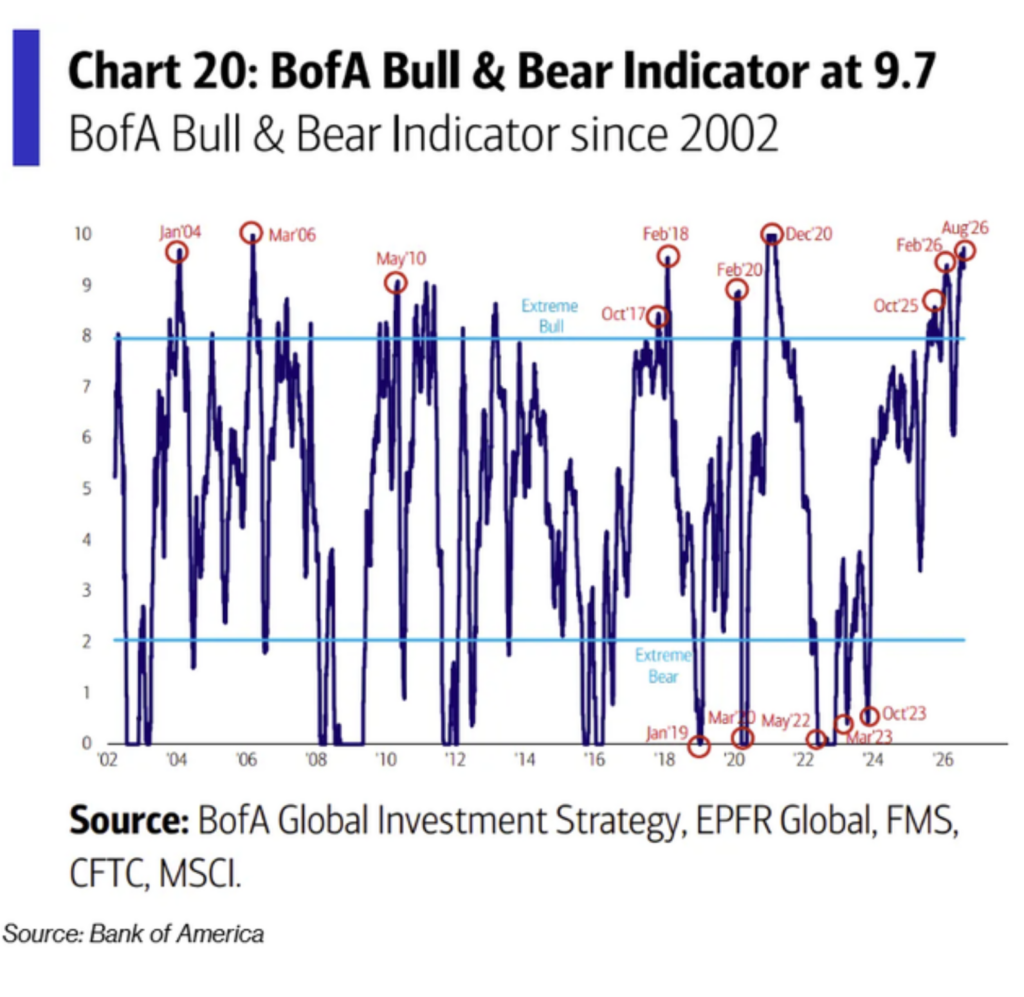
Based on most traditional metrics we are likely approaching an extreme level of investor optimism — reminiscent of early 2000 (the end of the dot-com boom) and late 2007 (which preceded The Great Financial Crisis):
“It is said no one “rings a bell” at risk market tops, but there are declarations of new asset classes involving “financial innovation” abetted by questionable ratings to watch for.”
– Jeffrey Gundlach, August 15, 2026
“Once a bull market gets underway and once you teach the point where everybody has made money no matter what system he or she followed, a crowd is attracted into the game that is responding not to interest rates and profits but simply to the fact that it seems a mistake to be out of stocks. In effect, these people superimpose an I-can’t-miss-the-party factor on the fundamental factors that drive the market. Like Pavlov’s dog, these “investors” learn that when the bell rings — in this case, the one that opens the New York Stock Exchange at 9:30 AM — they get fed. Through this daily reinforcement, they become convinced that there is a God and that He wants them to get rich.”
– Warren Buffett, November 1999
Here is more (statistical and concrete) evidence of the extreme bullishness that exists today:
“The ancient poet Philostratus said, “For the gods perceive things in the future, ordinary people things in the present, but the wise perceive things about to happen.”
– Barton Biggs, Hedgehogging
My favorite investment strategist of all time was Morgan Stanley’s (MS) Barton Biggs. Biggs used the phrase “Rosy Scenario” in the 1980s-2000s to describe his famous macro warnings and concerns that typically occurred late in a maturing bull market. In times like this, Biggs would detail the underlying and evolving risks that multiplied as investors’ narratives turned overly optimistic — convincing themselves that everything would work out perfectly in the future (despite the appearance of clouds overhead).
Importantly, he viewed Mr. Market as a manic depressive with huge mood swings. Investors, he surmised, should bet against him, not with him, especially when he is raving:
Barton Biggs was a cynical and wonderful wordsmith (his book “Hedgehogging” is a must-read!).
According to Biggs, a “rosy scenario” is a market backdrop in which investors extrapolate non-inflationary growth indefinitely, believing in a new paradigm of non-interrupted growth in which investors and policy makers assume perfect economic and market outcomes.
Biggs was particularly critical of overly ambitious company earnings forecasts (of an AI-kind?). He would often raise market concerns when the risk premia collapsed based on a growing consensus that “nothing bad can happen.”
If Barton Biggs were alive today, he might caution that the current bullish narratives have overwhelmed sober analysis.
Biggs would likely (as I am) be worried about several legitimate headwinds that exist now, in the belief that Mr. Market has been resilient in the face of items that would normally have produced less robust or even negative investment returns.
We have previously highlighted some of the following concerns last month — most have deteriorated further, surprisingly as equities continue their ascent. Specifically, the price of oil, interest rates, inflation, the level of the U.S. deficit/debt load and valuations are all higher over the last month. (Another example is that when President Trump signed the first memo of understanding for a peace treaty with Iran, the S&P Index was about 6500. It is now at 7800 despite no cessation of hostilities.)
Well respected by many, no doubt (if he were still with us) Biggs’ concerns about a “Rosy Scenario” would be seen in Barron’s “Up and Down Wall Street” column this coming weekend – perhaps with the following warning:
“Warren Buffett, a man, like me, who believes in America and the Tooth Fairy, presents the dilemma best. It’s as though you are in business with a partner who has a bipolar personality. When your partner is deeply distressed, depressed, and in a dark mood and offers to sell his share of the business at a huge discount, you should buy it. When he is ebullient and optimistic and wants to buy your share from you at an exorbitant premium, you should oblige him. As usual, Buffett makes it sound easier than it is because measuring the level of intensity of the mood swings of your bipolar partner is far from an exact science.”
Let’s reexamine some of my prior concerns:
* The lack of fiscal discipline in Washington, D.C. (on both sides of the political aisle), which has raised the U.S. annual deficit and overall debt load is being ignored by most investors.
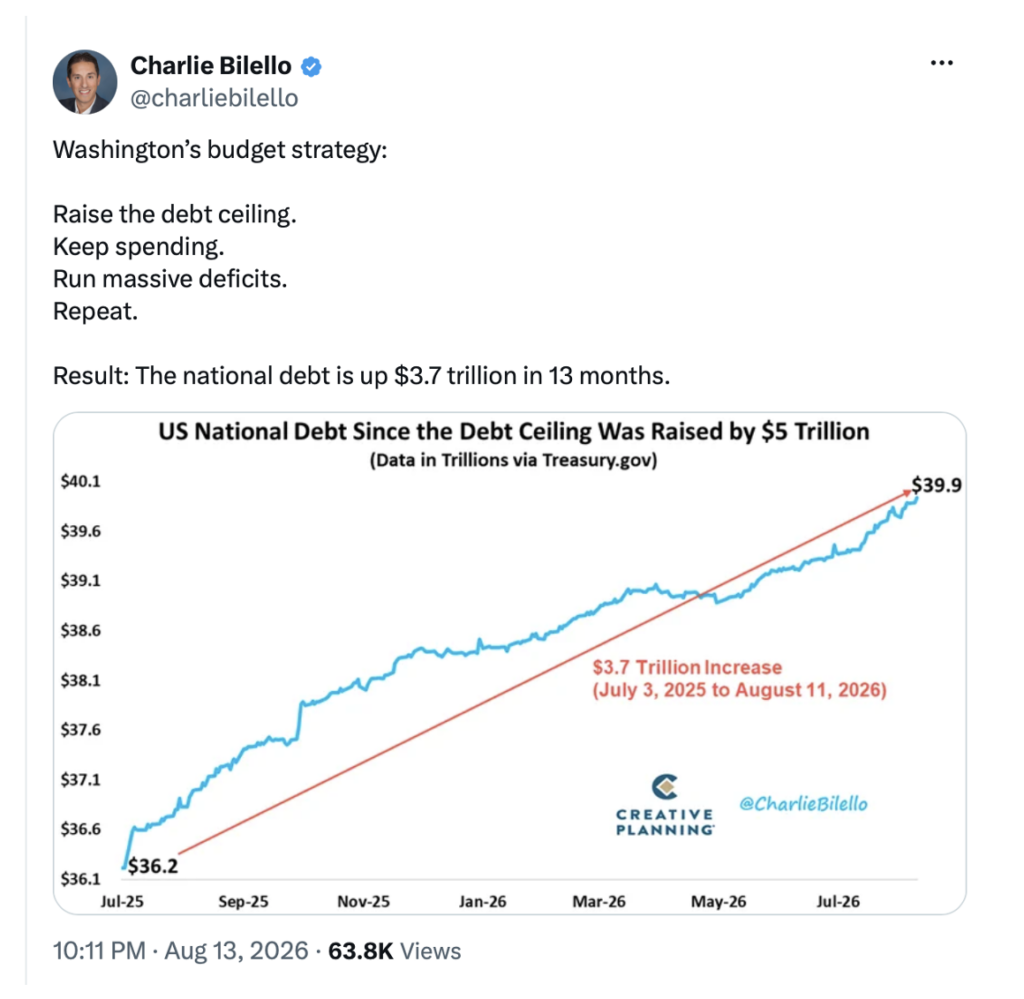
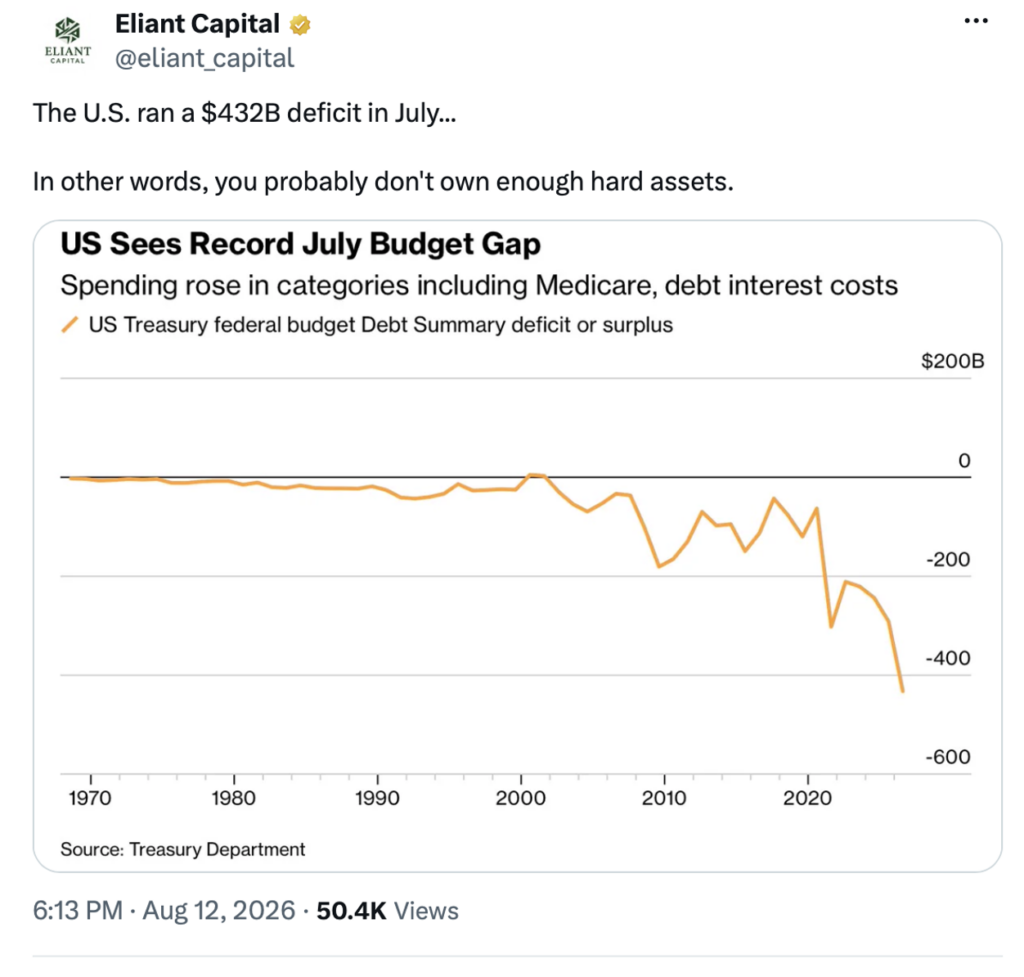
My good pal John Mauldin delivered an excellent analysis of our federal debt problem over the weekend in a “Thoughts From The Frontline” entitled “Caught in a Debt Trap.”
* Every bubble ends in a debt crisis. It is our view that the AI bubble will also end in a debt crisis. (See Quoth The Raven’s “The Real AI Crash Will Start This Year“.)
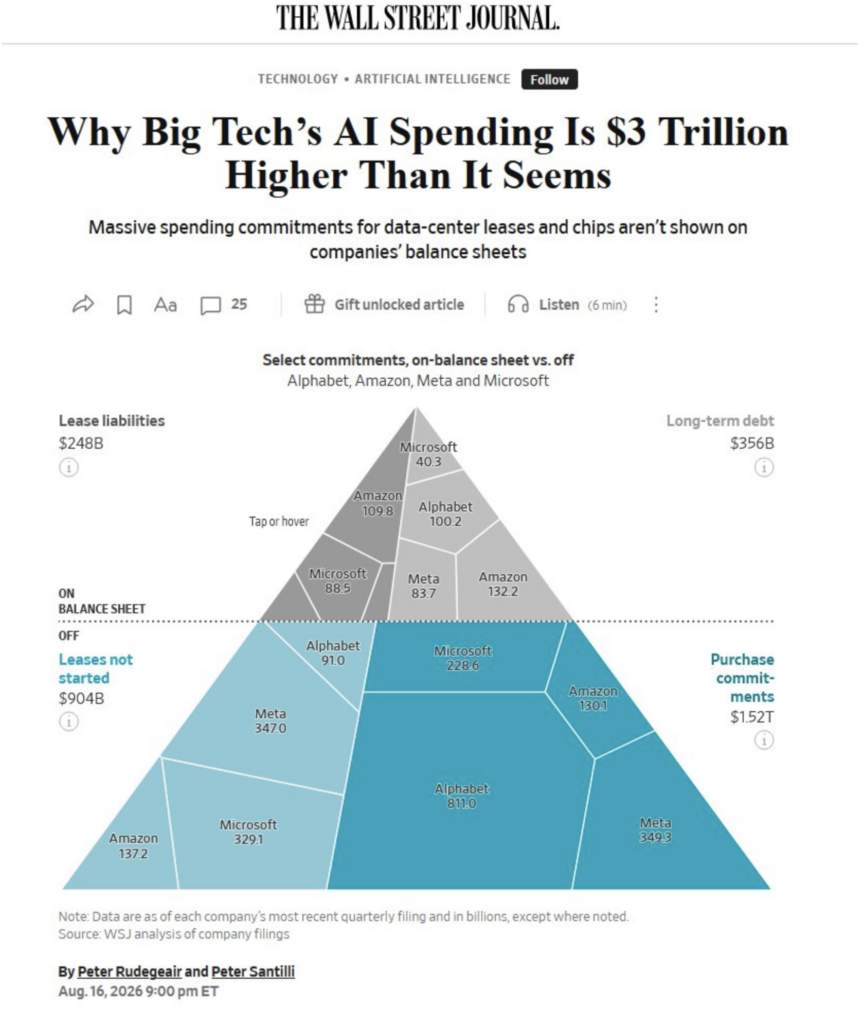
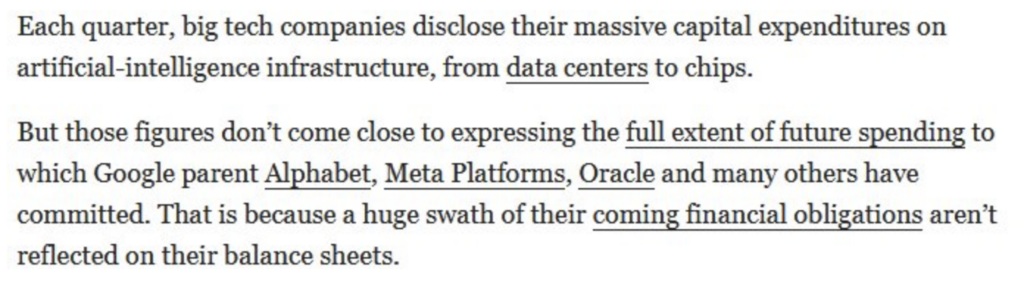
The must-read of the weekend goes to Stock Bubbles Don’t Scare U.S. in last week’s Wall Street Journal. The conclusion alone was worth the price of admission:
“We are heading into a danger area now, thanks to the money being poured into artificial intelligence. Estimates of $7 trillion to be spent on data centers in the next four years are enough to seriously damage the economy if productivity gains aren’t big enough to justify it. And the increasing use of debt financing means that if AI more broadly turns out to be a bubble, it could hit the financial system, too. That isn’t something the broader market could ignore.”
Moreover, the circular AI vendor financing gambit remains problematic, with OpenAI, seen as an unprofitable AI lab which may not achieve enough consistency and level of income to satisfy its burgeoning capital plans and service its debt load:
* The equity risk premium (which, astonishingly, for the first time in nearly three decades) has morphed into an equity risk discount. A paper-thin equity risk premium has historically foreshadowed very low forward investment returns. We don’t expect it to be different this time.
* Rising global interest rates that will likely stay higher for longer. Interest rates are the foundation of every valuation model:
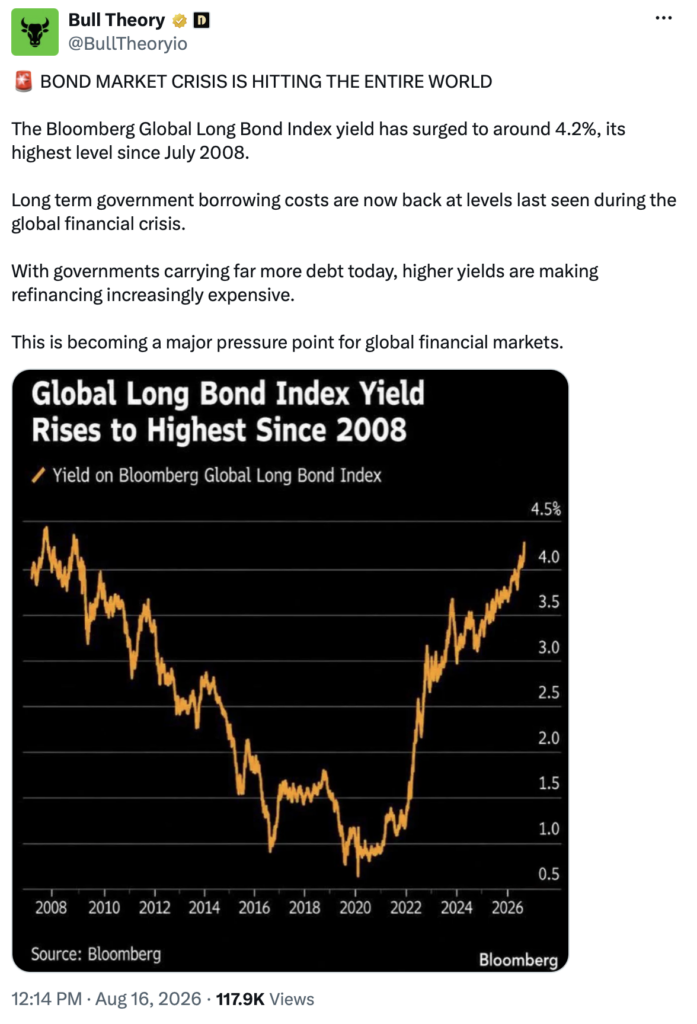
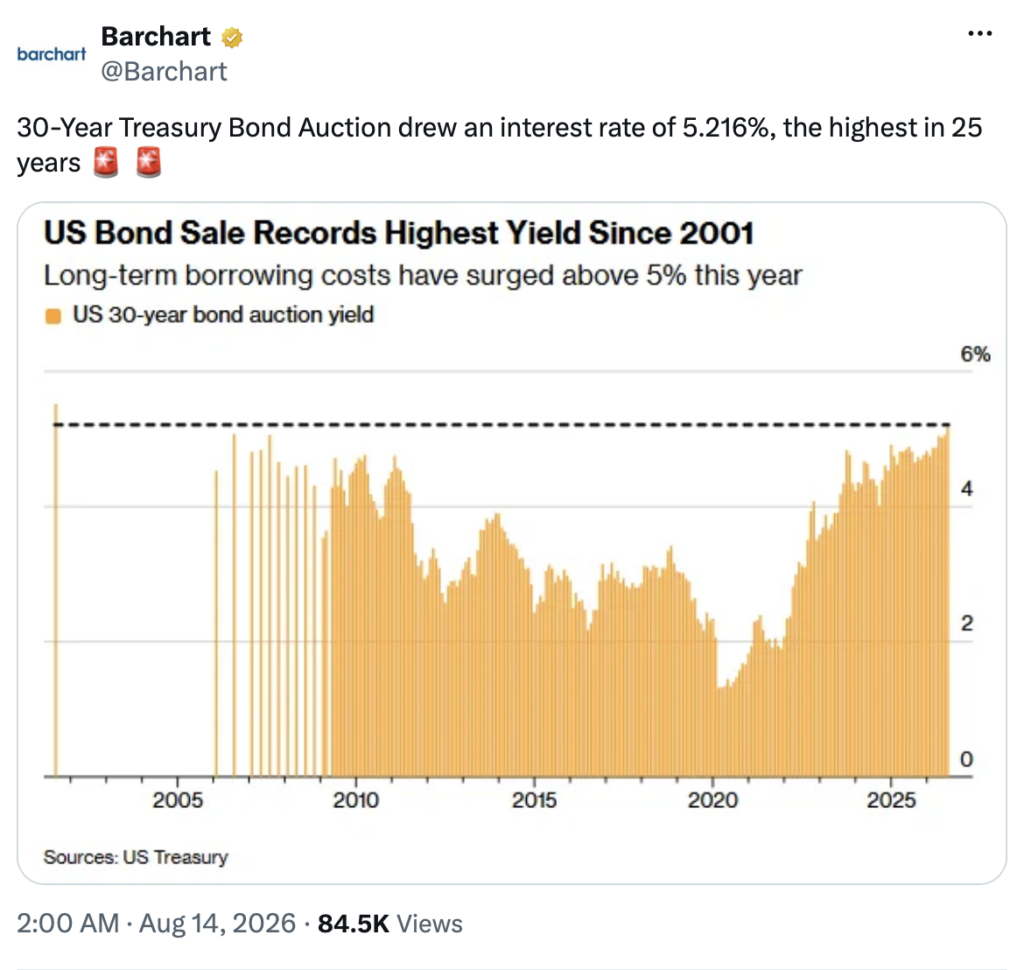
Despite the large miss to Q2 GDP expectations, Japanese bond yields (the last cheap global funding source) are rising as the BOJ faces reality:
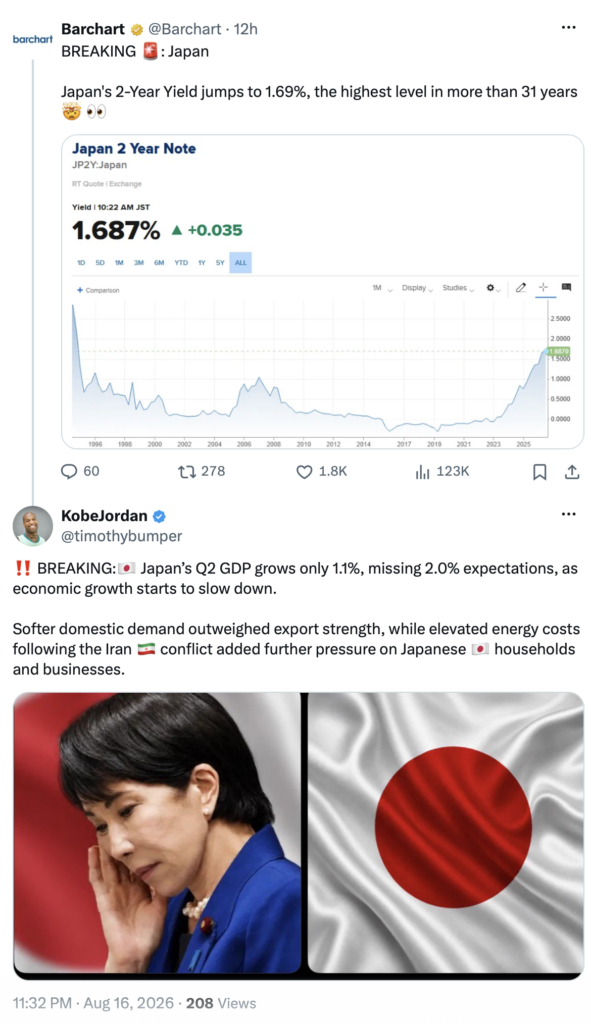
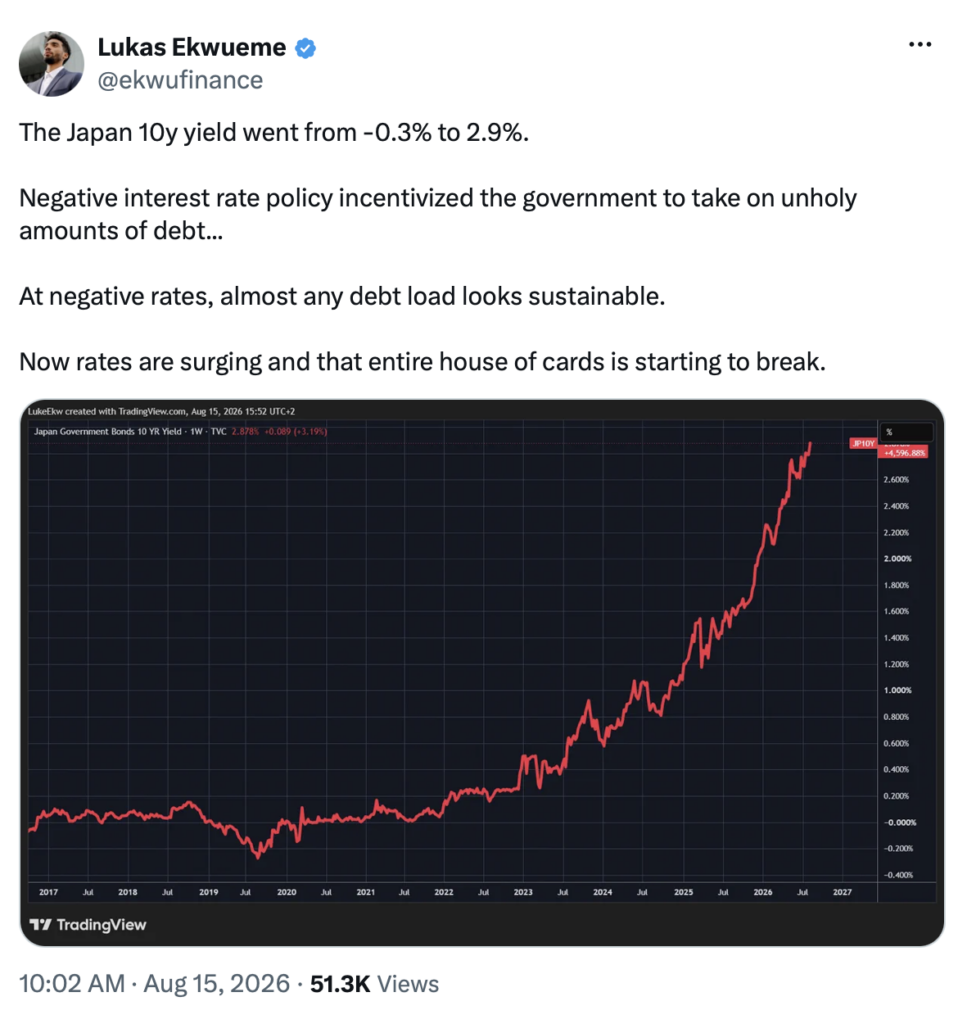
* Persistent inflation. Recent data points suggest inflation, like interest rates, will be higher for longer.
* Elevated valuations (with traditional metrics (like Shiller’s CAPE Ratio or Buffett’s Ratio (total equity capitalization divided by Global GDP) in the 98%-tile and more than two standard deviations above their historical averages:
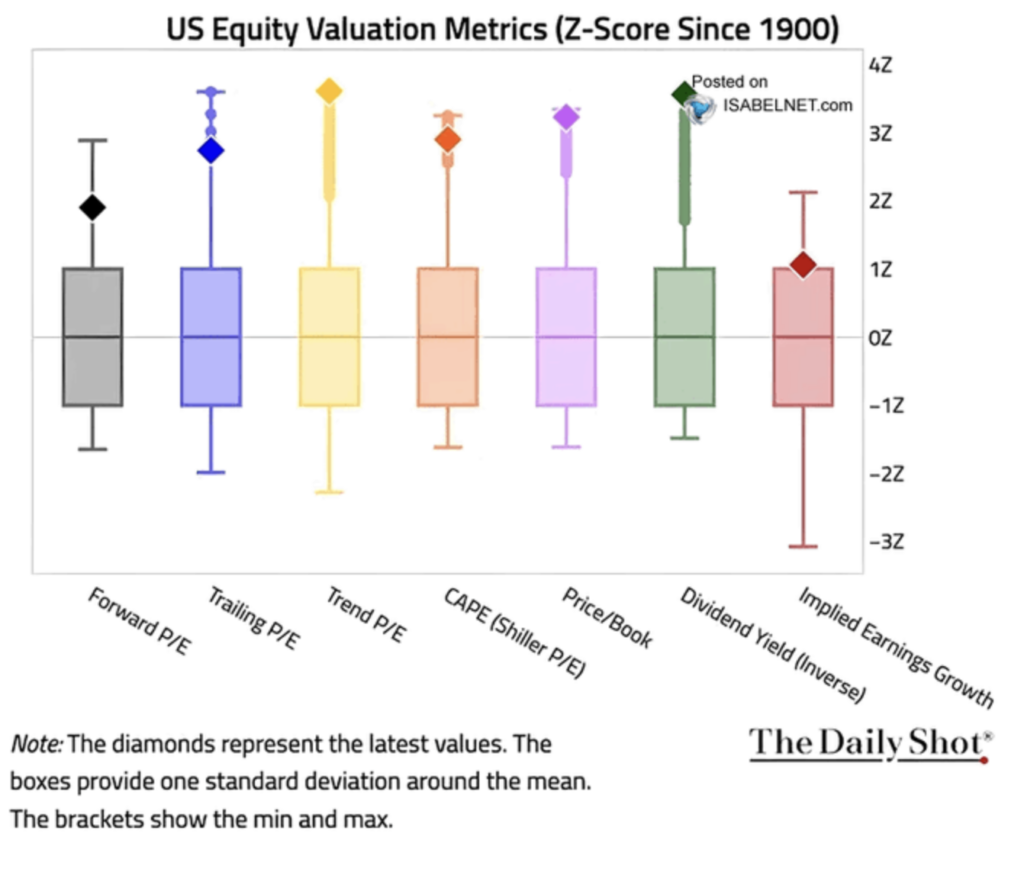
U.S. stocks have priced in a lot of good news, with most valuation metrics more than two standard deviations above their historical averages.
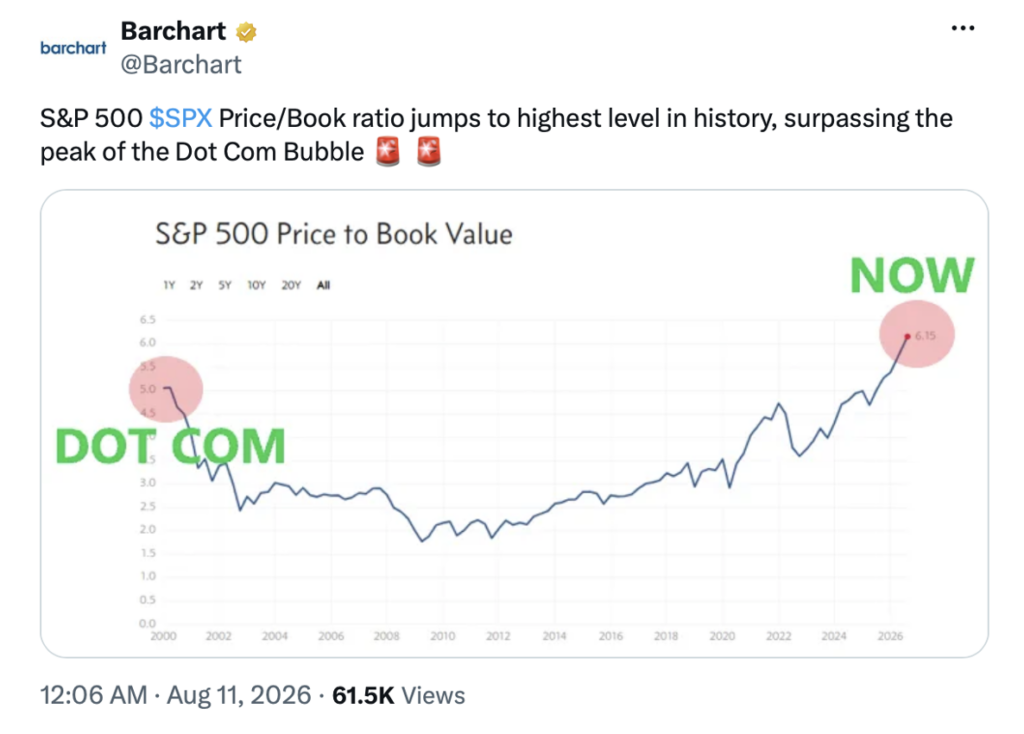
Last month we cautioned about market structure — specifically that there is too much hidden (and not-so hidden) leverage in our capital markets.
The July implosion of Leopold Aschenbrenner’s Situational Awareness hedge fund (a name that represents a true oxymoron!) briefly threw the market into a tailspin. The liquidation of the hedge fund’s public holdings might represent the first shot across the bow of today’s leveraged markets.
* The temptation to discard textbook theory in favor of the assessment of the cold, automated factors that are driving our markets is intense
* Though frustrated and incorporating some fractal analysis into our investing process, we are resisting the temptation to be totally absorbed (corrupted?) by changing market structure
I would like to end today’s commentary by highlighting the gamification of our markets (and the loss of price discovery) — two close relatives to our market structure concerns…
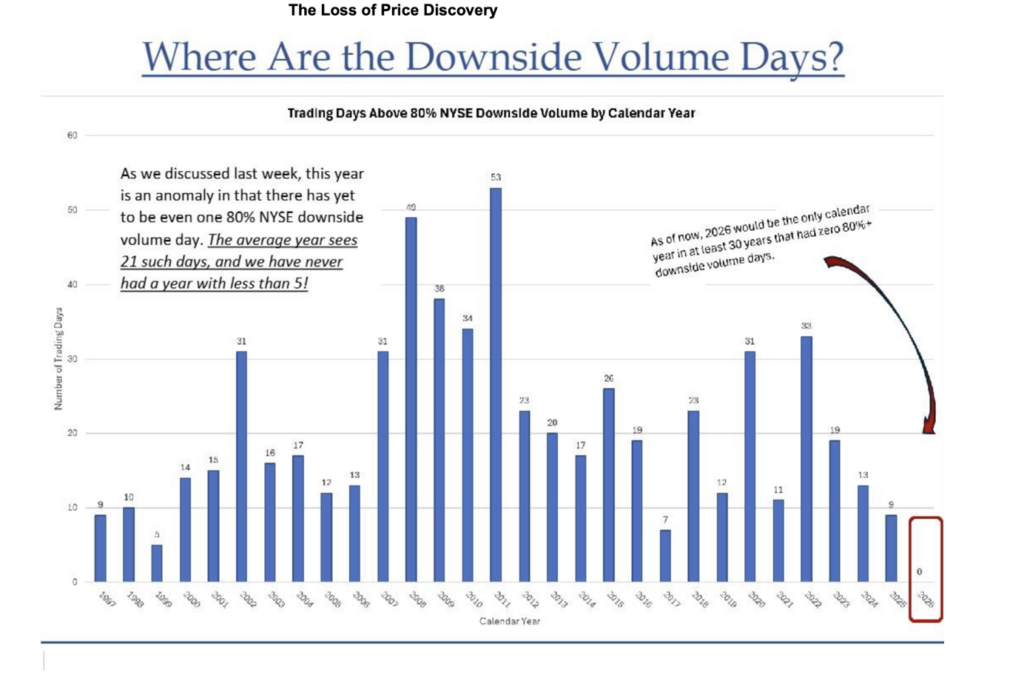
In the good old days, the core purpose and foundation of our markets was for capital to be allocated based on the calculus of fundamental values.
Companies were evaluated by fundamental research, which included (but not restricted to) the relationship to tangible and intrinsic values, an assessment of balance sheets and present value was based on valuation models. Interest rates were at the core of this calculus, using a risk-free rate of return in model building.
Portfolio selection was also based on the quaint notion that managements should be visited and assessed, competition reviewed so investors could determine whether secular earnings expectations would exceed of disappoint relative to consensus expectations.
The analytical process was plodding — slow money vs. fast money, if you will!
This process no longer exists.
Instead (as I recently noted in “An Adverse Market (Structure) Event is Growing More Likely”), traditional and fundamental analysis has been replaced by what can only be described as an algorithmic battleground and hyper-financialized casino (all engineered to extract premium), as active investment management is now dominated by passive investment management (that worships at the altar of price, knowing little about value and everything about momentum).
This helps to explain why rising interest rates (a 4.73% 10-year Treasury note yield) and oil prices, persistent inflation, improvisational and undisciplined foreign and fiscal policy and an equity risk DISCOUNT are increasingly being ignored.
Let’s examine and understand the cold, automated mechanics driving the contemporary market matrix (H/T
1. The High-Frequency Mirage and the Passive ETF Loop
The primary engine behind today’s erratic, valuation-defying price action is the symbiotic relationship between High-Frequency Trading (HFT) algorithms and Passive Basket ETFs.
When a major macroeconomic data point crosses the terminal wires—such as a contractionary labor report or an inflation print—human traders attempt to digest the long-term systemic implications. HFT bots, however, operate on tunnel vision. They are pre-programmed to scrape headlines for specific trigger words and instantly execute massive buy or sell scripts within milliseconds based on a rigid, binary logic (e.g., “Soft data equals guaranteed central bank liquidity injections”).
This initial algorithmic impulse triggers the passive basket ETF loop. Trillions of dollars are parked in automated index funds that must maintain strict, weight-adjusted allocations. When the HFT bots jam index futures higher, these passive ETFs are structurally forced to blindly market-buy every single underlying stock in their basket.
Valuation metrics, credit default risks, and balance-sheet cracks are completely ignored. The result is a vertical rocket ship move built on “phantom liquidity”—a superficial pump that creates an optical illusion of market strength while the underlying economic foundation is actively skyrocketing or fracturing underneath the surface.
2. The Options Casino: Gamma Squeezes and Dealer Hedges
Once the HFT machines set the momentum in motion, the modern market’s most manipulative force takes over: The Options Market Maker Hedging Loop.
Retail trading platforms have effectively gamified options trading, turning complex derivative instruments into cheap casino chips. When a wave of momentum buyers floods an asset, aggressively purchasing out-of-the-money call options, they unwittingly trigger a violent, mechanical feedback loop known as a Gamma Squeeze.
Options market makers (the massive institutional desks writing these contracts) are risk-neutral operators. They do not want to bet on whether a stock goes up or down; they simply want to collect premium cash. However, when an asset begins rising toward a heavily crowded options strike, the Delta (the probability of that option expiring in-the-money) violently explodes toward 1.00.
To maintain delta neutrality and protect their balance sheets from astronomical upside risk, the market makers’ automated software is legally and structurally forced to blindly and aggressively market-buy millions of shares of the underlying equity.
The computers don’t care that the stock is fundamentally overvalued. This forced institutional buying hits a thin after-hours or early-morning order book, creating a supply vacuum that vacuums the price upward in a series of long, violent green candles. It is an option-fueled illusion designed to optimize dealer delta profiles and trap late-day breakout chasers right beneath a major institutional ceiling.
3. The Institutional Pushback: Breaking the Machine
The natural frustration for traditional investors is watching bad economic data twisted into a “liquidity party,” while asset prices flatline or surge on completely hollow structures. But the smart money—sophisticated macro hedge funds and risk officers—does not fight the HFT bots head-on. They exploit the structural blind spots of the machine to systematically extract wealth from the crowd.
The institutional pushback occurs through a calculated, two-stage operational playbook:
The Midday Premium Bleed
During the high-volume environment of the morning session, market makers keep their bid-depth dense to absorb the order flow. But as the session marches into the midday lunch hour, aggregate volume naturally thins out.
Rather than chasing the HFT momentum, institutional desks utilize this quiet block to completely flatline the asset. They construct a tight horizontal trading band, letting the clock do the heavy lifting. This allows Theta (time decay) to ruthlessly strip the remaining cash value out of the expiring, overvalued options, turning the retail crowd’s leverage into dust by the minute.
The Power Hour Trapdoor
The true structural reversal triggers when the market crosses into the late-afternoon clearing window heading toward a weekly expiration. By this point, the out-of-the-money options have seen their premium values completely decimated.
The market makers’ automated risk parameters run their end-of-day calculations and realize the probability of those options expiring in-the-money is near zero. Suddenly, the regulatory and capital mandate to hold those millions of shares of underlying stock hedges completely vanishes.
The computers turn off their artificial buy programs and instantly unleash a cascading wave of automated, de-hedging market-sell orders to dump their excess share inventory back into the public float simultaneously. Because the broader economy is facing structural cracks, there is no organic institutional cash buying resting on the floor to absorb that sudden supply shock. The bids are stripped from the Level 2 ladder, the trapdoor slams shut, and the asset suffers a severe, vertical mean-reversion flush to catch up with macroeconomic reality.
The New Market Paradigm
The modern stock market is no longer a pristine measurement of corporate health or a passive vehicle for long-term capital compounding. It is a highly sophisticated, electronic wealth-extraction matrix dominated by algorithmic delta-hedging, passive index inelasticity, and behavioral manipulation.
To survive in this ecosystem, an investor must look past the flashy, empty marketing headlines and the short-term algorithmic wiggles. Success requires standing shoulder-to-shoulder with the structural mechanics of the tape—understanding that when the technical and options springs are stretched to their absolute physical limits against an institutional ceiling, fundamental gravity and options expiration math will always look to claim their due.
Position: Short SPY (VS)
BY Doug Kass · Aug 24, 2026, 3:46 PM EDT
I am further reducing consumer staples exposure on the strong move today and over the last week — PEP, PG, KMB and KO.
These stocks have been reasonably good performers and stalwarts in a backdrop of volatility.
The recent advance has reduced the reward vs. risk.
Position: Long PEP (VS), PG (VS), KMB (VS), KO (VS)
BY Doug Kass · Aug 24, 2026, 2:35 PM EDT
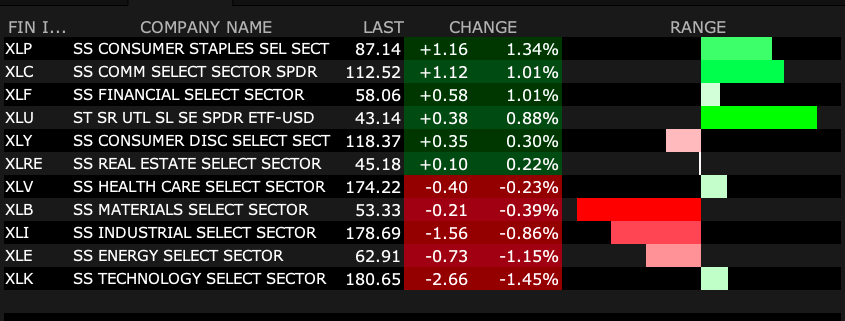
At 2:12 pm:
Position: None
BY Doug Kass · Aug 24, 2026, 2:31 PM EDT
Wolf Street howls about hocus pocus at the Treasury.
Position: None
BY Doug Kass · Aug 24, 2026, 2:07 PM EDT
Position: None
BY Doug Kass · Aug 24, 2026, 1:15 PM EDT
BY Doug Kass · Aug 24, 2026, 1:00 PM EDT
Position: None
BY Doug Kass · Aug 24, 2026, 12:45 PM EDT
Position: None
BY Doug Kass · Aug 24, 2026, 12:30 PM EDT
I am back short CoreWeave (CRWV) at $85.58.
Position: Short CRWV (VS)
BY Doug Kass · Aug 24, 2026, 12:14 PM EDT
BY Doug Kass · Aug 24, 2026, 11:50 AM EDT
Per my “More Tales from Nvidia“ this morning, this excerpt is interesting too.
Again, I wonder how these things can go public and how auditors and bankers can sign off on this.
And look at what this implies about OpenAI’s valuation as it moves toward an IPO:
OpenAI’s equity — valued north of $850 billion — is functionally the junior tranche of a capital structure whose senior claims, the take-or-pay compute obligations, exceed any revenue path management itself has articulated.
On those numbers, the equity is effectively underwater, and the market has not priced it that way because it still treats those obligations as service agreements rather than what they are economically: debt.
The Teaser Period: Why The AI Boom Is Hitting A Reset Wall
I shorted Nvidia (NVDA) on the early morning strength.
Position: Short NVDA (VS)
BY Doug Kass · Aug 24, 2026, 11:40 AM EDT
I have been steadily adding to my fave ETF shorts, JOET and GRNY.
Position: Short JOET (VS), GRNY (M)
BY Doug Kass · Aug 24, 2026, 11:30 AM EDT
BY Doug Kass · Aug 24, 2026, 11:20 AM EDT
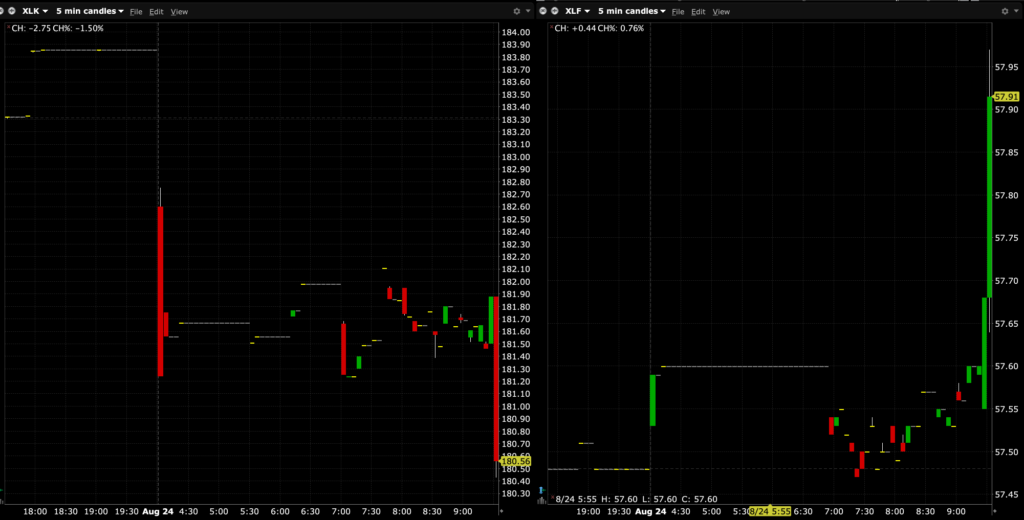
Chart from 9:35 a.m. ET
Positions: None.
BY Doug Kass · Aug 24, 2026, 10:30 AM EDT
From my pal “Meet” Bret Jensen:
Bret Jensen
3m ago
The price of the AI infrastructure buildout will continue to climb but will not result in additional compute capacity. Just higher costs.
Some of Nvidia Corp.’s biggest customers have been told that the prices of servers containing its artificial intelligence chips are going up more than 15% in many cases with memory chip costs soaring. The price hikes will go into effect on systems shipped early next year and will impact systems including those with the flagship Vera Rubin and Grace Blackwell chips
1
Reply
Share
Positions: none
BY Doug Kass · Aug 24, 2026, 10:10 AM EDT
The following is from Peter Boockvar:
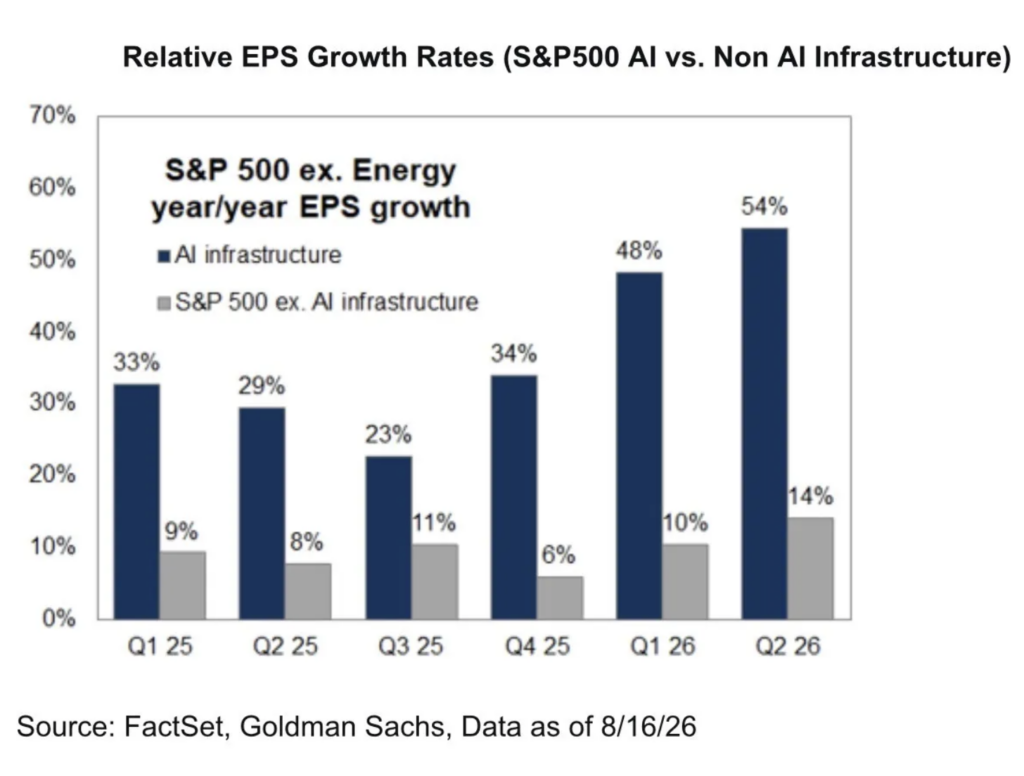
My friend Cameron Dawson at NewEdge Wealth had a great chart over the weekend breaking down the earnings growth contribution from AI infrastructure vs everything else. I will add, that ex AI infrastructure includes financials where the big money center banks are benefiting from robust capital markets, which includes AI financing and also energy stocks that of course was helped by higher crude and product prices.
I bring this up to highlight again how much economic growth, earnings, margins and stock prices depends on this GenAI data center construction.
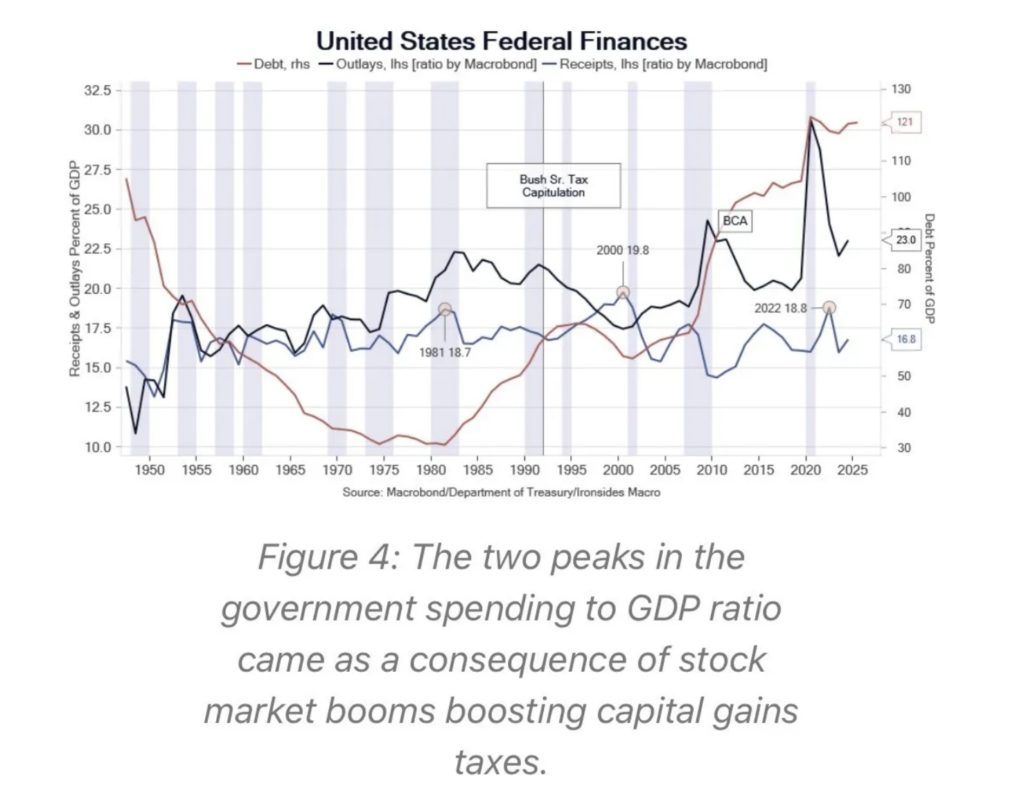
Another chart I saw over the weekend that resonated and something discussed here in the past was from my friend Barry Knapp at Ironsides Macro as we all debate the hedge fund like move by Scott Bessent who essentially shorted long dated US Treasuries because he didn’t like the rise in rates, whether due to excessive supply, both corporate and Treasury, or something else, like JGB yields or inflation, I’ll add. With respect to the deficit side, it’s not politics to say that we cannot tax our way out of this; it is the math instead as the biggest problem is our spending largesse. That is seen in this chart.
The long term average with respect to tax revenue as a % of GDP is about 17% whether tax rates were up or down and that is where we stand about now. Spending as a % of GDP has a long term average of about 20% vs 23% today. Again, it’s the math.
With respect to the Japanese, the BoJ and the JGB market, I saw a Reuters headline last night that said “BoJ considering quicker pace of rate hikes.” Markets aren’t responding to it just yet as let’s get the September hike under our belt first.
I’ll argue again that the Treasury attempt to cap long rates by issuing more short-term paper as the financing tool will tether US government interest rate expense ever closer to what the Federal Reserve does with the fed funds rate. I don’t think this is something Kevin Warsh will talk about in his speech Friday but it is a new element he’s going to have to deal with. Also, his plan to let markets work more in terms of pricing the cost of capital has now been met with another non-market actor.
While we shouldn’t expect ‘forward guidance’ on policy, he can at least lay out a framework around what will shape his view on the direction of rates based on inflation, growth, etc…Or, maybe we’ll just have to wait for the results of the task forces to get an idea of that.
There was just one earnings call of note on Friday, ahead of a bunch more retail related releases this week and it was from BJ’s Wholesale Club and whose stock rose 5.6%. From them:
Merchandise comps rose 3.1% and was “driven by a healthy balance of traffic and ticket.”
“Our perishables, grocery and sundries division delivered solid comp growth of 2.8% in the quarter, led by grocery.”
With general merchandise, “Consumer electronics continue to lead the way and home was a strong contributor.”
“Gas prices remained elevated during the quarter, and our members continued to seek us out for the value we offer at the pump…Gas prices are about as visible as it gets for consumers. There’s a price on every street corner, and our members know that we offer great value.”
“Taking a step back to assess the consumer environment, the K-shaped economy persists, though we did see some sequential improvement during the quarter. We drove comp growth across all income cohorts, which is encouraging, and our value proposition continues to resonate broadly. That said, the vast majority of our growth continues to be driven by our higher income members, which is consistent with what we’ve seen for some time now.” I bolded to highlight.
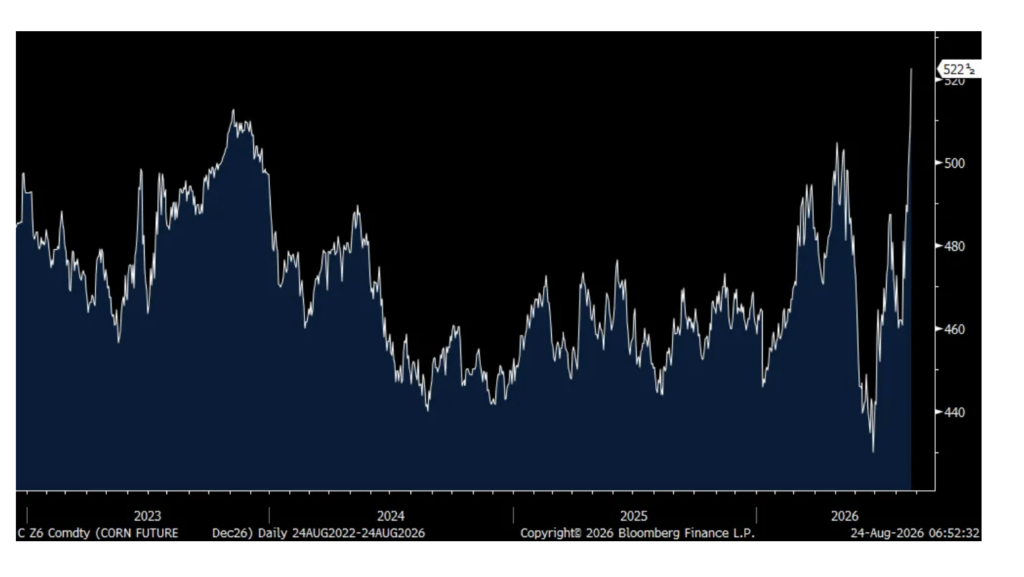
Last week I mentioned the rise in ag prices and our positive stance on this part of the commodity sector believing it was going to join the overall commodity bull market. If you didn’t see, corn today is breaking out to multi year highs, up another 2.7% today. A combination of worries about supply shipments out of the Black Sea and the possibility that the US harvest may not yield as many bushels as expected when seen in a few months.
The Bloomberg Agriculture Index is just about $.20 from the highest level since very late December 2023.
Corn front month
Bloomberg Commodity Index
BY Doug Kass · Aug 24, 2026, 9:49 AM EDT
I lost much of my Trulieve (TRLV) long on expiration and thru assignments last week and on Friday.
I plan to reload $9-$10.
Position: TRLV VS
BY Doug Kass · Aug 24, 2026, 9:37 AM EDT
Selling more (PEP) on the premarket gap (now +$7 in the last week).
Position: Long PEP VS
BY Doug Kass · Aug 24, 2026, 9:15 AM EDT
-XPON +76% (acquires Eastern Louisiana oil and gas exploration opportunity for $3.4M)
-NSSC +21% (earnings, color)
-RUM +7.0% (affiliate enters ~$13.7B, 6-yr GPU services agreement with US cloud customer; grants warrant for up to 50.8M shares at $0.01/shr)
-SPRB +5.1% (plans Q4 BLA submission for TA-ERT in Sanfilippo Syndrome Type B)
-PDD +4.4% (earnings, color)
-ZJK +3.3% (secures large-volume AI infrastructure component purchase orders)
-MSTR +2.4% (establishes USD Cash pool; Sells 18.26M MSTR shares for $2.0B net via ATM)
-WULF +2.3% (Kentucky PSC approves agreement for up to 482 MW at Justified Data Campus)
-ALGT +2.0% (Raymond James Raised ALGT to Strong Buy from Outperform, price target: $116)
-RGNX -22% (FDA places clinical hold on RGX-121 for MPS II; BLA resubmission not expected near term)
-AAOI -13% (files to sell up to $600M common stock shares)
-XPEV -6.1% (earnings, guidance)
-AZTA -6.0% (appoints Dr. Martin Madaus interim President and CEO; affirms FY26 guidance)
-GOOS -4.2% (Wells Fargo Cuts GOOS.CA to Underweight from Equal Weight, price target: C$10)
-MRVL -3.2% (trading lower ahead of earnings this week)
-BABA -2.2% (prices HK$80B placement of 710M shares at HK$112.70/shr)
BY Doug Kass · Aug 24, 2026, 9:10 AM EDT
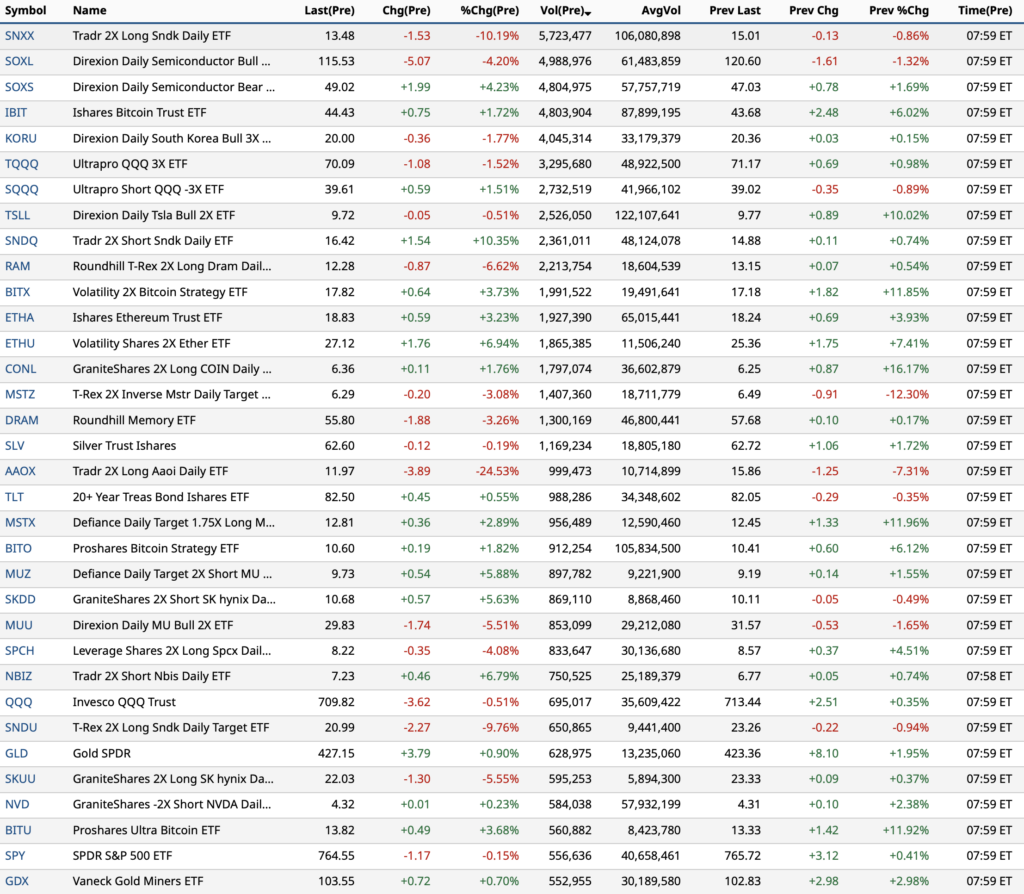
Positions: None.
BY Doug Kass · Aug 24, 2026, 9:00 AM EDT
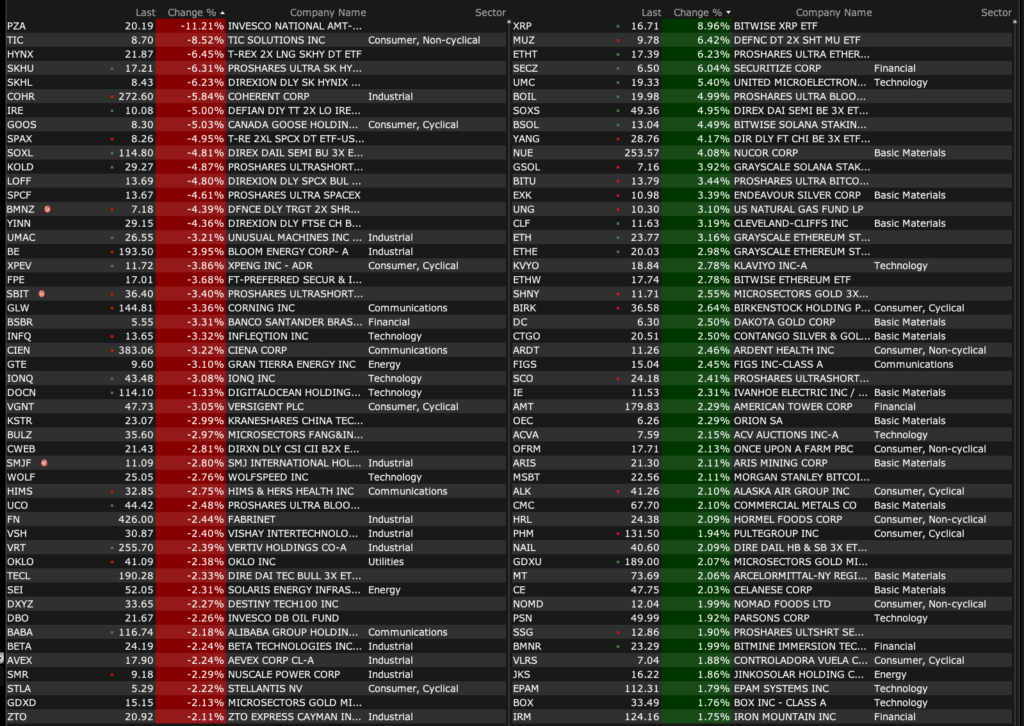
Positions: None.
BY Doug Kass · Aug 24, 2026, 8:45 AM EDT
11 a.m.: Treasury buy-back announcement (liq support);
11:30 a.m.: Treasury hosts a $92B 3 and a $79B 6-Month Bill Auction;
3:00 p.m.: Treasury inv. class auction data
8:30 a.m.: Chicago Fed National Activity Index (July)
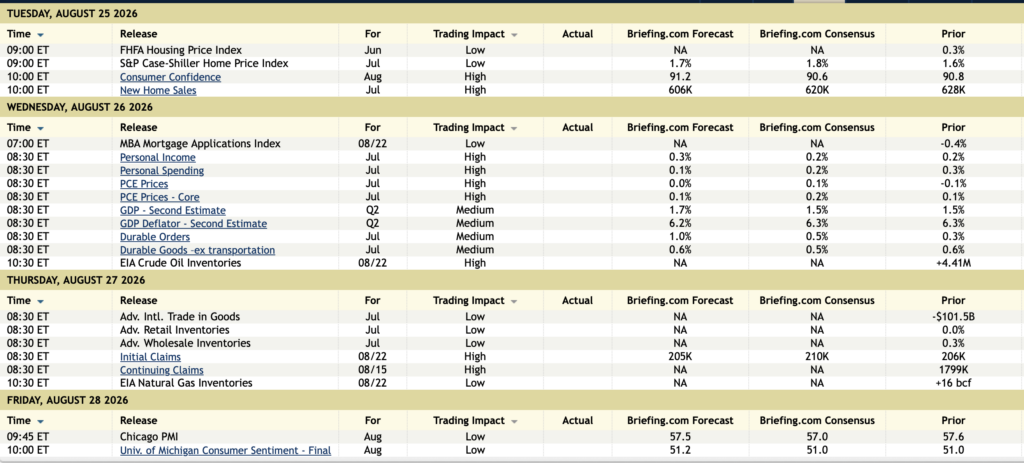
Positions: None.
BY Doug Kass · Aug 24, 2026, 8:30 AM EDT
* Jerry Jordan Jr.
Position: None
BY Doug Kass · Aug 24, 2026, 7:45 AM EDT
It looks like Broadcom (AVGO) is already back for another fix.
It really makes me wonder how there is enough savings in the world to do this, although the Treasury market is telling you there isn’t:
Broadcom CDS Explodes As It Seeks Up To $100 Billion In Massive Off-Balance Sheet Debt Deal
At any rate, it is interesting that both Anthropic and OpenAI seem to be furiously racing to get their IPOs done. It almost sounds desperate — from both them, and their mouthpieces. What is the rush? Is the rush perhaps that they see things starting to get really ugly and they want to get public before that happens? It seems to me neither company is in any shape to go public.
The top level picture is ugly for the industry. Slowing token growth and a massive decline in token pricing.
The details of OpenAIs last quarter, as reported by the WSJ, were incredibly ugly. A sharp deceleration in revenue growth, they lost $12.3 billion and they lost almost $2 for every $1 of revenue. More executive turnover and turmoil lately. From my perspective, no way this is a public vehicle. And I also thought it was a non-profit? Maybe losing almost $2 for every $1 of revenue is what non-profit means?
Although Anthropic’s last hyped quarter seemed to be OK on the surface — that was peak tokenmaxxing and they benefited from what appeared to be a 1x subsidy from SpaceX (SPCX). But now, things seem to be slowing for them too. There is this data showing their ARR from coding flattening all of the sudden, after a sharp increase:
Others are now claiming their total ARR missed expectations recently, which would make sense in light of the overall macro trend of crashing token prices and slowing growth:
Why the rush, and how can these companies go public in the face of this?
I think I know why the rush, but I am not sure how they can go public while at the same time knowing how they can go public.
They go public with sell-side models that are about as good as all the models Cathie Wood and ARK made up for Tesla (TSLA). There will be models with completely made up numbers going 10-20 years into the future that are completely unforecastable, and a giant multiple will be put on those numbers as well. The way the models will be made start with this query from the boss: “pull numbers out of your ass, back into a model that can be used to justify the IPO price.”
The IPO is the ultimate end of the shell game that has been played to this point. These things are not investments, they are just part of a shell game. The valuation is walked up round to round by the venture guys and their own customers, just because. It is all a bet on the notion that these businesses can be taken public at any price. Whatever the last rounds private valuation was, Wall Street will be able to make up a number for the IPO that is substantially higher. Then they just hope the public mania continues, and they can get out.
But the challenge is obviously getting harder. The amount of money/savings in the world is growing short. SpaceX didn’t work out great. The theoretical market caps of these things are all gigantic. The unlocks are huge. It is very challenging for the stocks to be the rocket ships people want them to be. It is especially challenging in the face of what appear to be sharply decelerating fundamentals.
They don’t belong public, yet the rush to go public is on. They also want and need the money to stay alive at the rate they burn it. While pre-mature IPOs may extend the shell game for awhile longer, ultimately they may be the beginning of the end. Both Anthropic and OpenAI have had the benefit of operating under the cover of darkness. Once they go public, the sunshine will be let in for everyone to see.
Side note, good and funny:
A few more thoughts:
* Big picture, the whole AI trade and industry, after seemingly starting to stall out about 20 months ago for a variety of reasons, engaged on its big second leg which re-ignited reflexive momentum and revenue growth in the space for two primary reasons: It became clear the U.S. government was going all in on the sector (from a stock perspective, following the government might be more important than following the Fed) and then the wave of increasing stock prices and unheard of levels of circular financing emerged, which goosed the whole space from a revenue and stock price perspective. It really was a reflexive investment and stock price momentum boom.
Now, political pressure is going the other way. It is clear where Democrats stand. And now, even Republicans are going in the opposite direction, and hard in the opposite direction. The general population, globally, hates AI.
Governor Abbott Directs Comprehensive Data Center Audit
Governor Ron DeSantis Signs Law to Protect Floridians from Subsidizing Data Centers
The circular financing that was part of the reflexive feedback loop cannot accelerate from the levels it is at and I doubt it can sustain the levels it is at. The big spending public companies (GOOGL, META, AMZN, MSFT, etc.) are now different combinations of cash flow negative, full of debt, or full of debt plus off-balance sheet commitments. The amount of market cap ascribed to the space now is just massive and might be getting bigger depending on what happens with OpenAI and Anthropic. There continues to be substantial equity issuance (including insider unlocks) and debt issuance. And the economics of the industry remain highly negative. On top of this, the world is short savings to finance all of this stuff.
Just like the political cycle is turning, it feels like the funding cycle has at best peaked as well. Said another way, the second derivative of all of this is likely to turn negative.
* This is interesting, one more potential risk on top of what I just cited along with open source and the overall lack of economics in the industry. A potential move to much cheaper and much more efficient small language models:
If this is true, the hyperscalers are toast
* I have a huge issue with how the frontier model businesses (and their hypesters) like OpenAI and Anthropic position their revenue. They refer to it as ARR, as in Annualized RECURRING Revenue. I do not know they can be allowed to do that as part of an IPO, and how their auditors and bankers can stand behind the use of any term other than “REVENUE.”
ARR is capitalized much differently than normal period revenue (ergo revenue Walmart (WMT) reports for selling food and general merchandise for example). ARR is viewed as more valuable revenue, because it is perceived as annuity revenue that will not go away. Annuity revenue is much more valuable than period revenue for that reason.
Which is why companies try to build their revenue models around ARR, and then seek to capitalize themselves on that basis as well.
But, ARR really is an overhyped concept. I understand why companies build their revenue models around it, and why they try to capitalize themselves on that basis, but very few things really are ARR. Nearly all the companies that sell software on this basis are doing it with a combination of either one-year contracts, or 3-5 year contracts that come with a discount.
However, that too can also go away, and people know it. That is why investors sold the stocks off hard recently during the AI meltup. At least, in the case of those businesses, companies and auditors had a reason to refer to it as ARR, because they had a reasonable expectation it would be annuity like revenue, even though there was no guarantee, as is now being born out.
In my view, in the case of the frontier models, I do not understand how they can they consider their revenue to be anything close to ARR and anything different than normal revenue. I can all go poof in seconds, for a variety of reasons:
* We know about the shift to open source models. Even AT&T (T) is now doing this. And they are as big and dumb and low risk of a company as you can think of. You would think they are exactly the type of company that would overpay for the frontier models, kind of like the old notion of buying from IBM (IBM). But nope, even they are shifting to much cheaper open source. Think about what more tech savvy companies are doing and those that are smaller and more nimble as well:
AT&T is Using Open Source Models to Curb Anthropic Bills
* Customers can shift between models, even the frontier models, whenever they want. They have already done this. There are no barriers to entry or lock in or switching costs. Whatever model is the best at any given point in time, they can switch to. Business seems to flip flop all over the place. It is a commodity product.
* Then there remain to be all sorts of future technology risks we do not even know about. A potential move to small language models, as linked to above. Or new technologies and approaches that emerge, like neuro symbolic AI or world models, or who knows what else.
My view, the revenue the frontier models have is no different than the revenue Netscape, Yahoo, WeWork, Nike, Kodak, Zerox, Polaroid, Mikes Buggy Whip Company or Pete’s Vinyl Record Company had. It is not ARR and should not be quoted that way. Nor should the auditors or bankers allow for that, in my opinion.
Further, I have argued (above) that these companies do not belong public and should not be public but are rushing to go public because they (and their investors including the circular ones) have all of the exact same concerns I do. I ask again, what is the rush? I think their own behavior in this regard speaks volumes.
Relatedly, these are two good substacks on the issues I have cited this morning:
ARR vs ARR. Watch out for this one sly trick.
BREAKING: More bad news for the frontier AI companies
Position: None
BY Doug Kass · Aug 24, 2026, 7:00 AM EDT
* And a teaser of today’s column on the relationship between earnings and stock prices…
Position: None
BY Doug Kass · Aug 24, 2026, 6:19 AM EDT
Wolf Street howls about the end to financial repression.
The Bond Market Is Finally Functioning Again, after 14 Years of Financial Repression | Wolf Street
Quoth the Raven– “Bonds Will Break Warsh at Jackson Hole.”
Bonds Will Break Warsh At Jackson Hole – by Quoth the Raven
Position: None
BY Doug Kass · Aug 24, 2026, 5:55 AM EDT
The Short Range S&P Oscillator slipped back into a modest oversold at -0.29% vs. 0.08%.
Position: Short SPY (VS)
BY Doug Kass · Aug 24, 2026, 5:45 AM EDT
“.. Some are viewing it as an 'oh shit' moment," an AI industry advocate told POLITICO. "Others are brushing it off like it's nothing, and those people have to get their heads out of their asses. This could go south for them, fast." @politico politico.com/news/2026/08/2…

Over the past week, we are seeing some early cracks in our GPU availability data...not going to overreact but have to call balls and strikes...On net, bad combo w/ the Anthropic ARR miss.
The core and foundational (principal) reason Bulls are optimistic is the EPS story (+20% year over year) Panelists and guests on the show espouse this view without much analysis. Market rationale based upon one factor is usually incorrect - but many investors seek a simple Show more
JUST IN 🚨: Strategic Petroleum Reserve falls to lowest level since 1982 📉 📉

Joined CNBC's @SquawkCNBC to talk about how 70% of AI revenues are coming from Anthropic and OpenAI, NVIDIA's vendor financing by proxy, and how outside of unprofitable and unsustainable AI labs, there's single-digit billions of dollars of demand for AI compute and software.
Friendly reminder... this chart below is why Anthropic's ARR disappointed, and why they're rushing to dump the IPO onto retail bagholders It's also why Jensen Huang is backstopping $500B in bagholder loans to new GPU buyers The great AI Commodification is officially here

Anthropic Claude Code tracked ARR reached $15.12B for the week ending Aug. 10, representing 21.9% of Anthropic’s total tracked ARR. Latest tracked growth: +5.2% MoM. Full tracking update: blog.tickertrends.io/p/claude-code-…

@hedgeye interviews one of my best pals and one of the most thoughtful investors extant.... Jerry "The Little Chief" Jordan. @lighthousejerry His dad Jerry "The Chief" Jordan, double Harvard (and former Overseer), was my mentor at Putnam Management Company (where he managed

"The CNBC Hosts and Panelists Said What?" (Issue #12) We remain short $SPCX from $213. SPCX's IPO price was $135 and the shares peaked above $$225 and currently are at $111. I seriously doubt that the many talking heads who excitedly recommended $SPCX even read the IPO
AI circle jerk explained.

Me explaining AI to friends

All in the last 24 hours. All Republicans. Life comes at you fast.


CITADEL WARNS BESSENT’S BUYBACKS COULD BACKFIRE Citadel Securities calls Treasury’s expanded bond buybacks “financial repression,” warning they could weaken the dollar and fuel inflation. Bessent’s strategy aims to suppress long-term yields, potentially using Treasury’s cash Show more


