Does an Auction for a Rare Ferrari Say Anything About the Strength of the Economy?
It’s car week! Business leaders and wealthy consumers will be taking over the Monterey Peninsula to share and buy rare cars. What does this market say about the health of the economy?
You've reached your free article limit
You've read 0 of 1 free Pro articles.
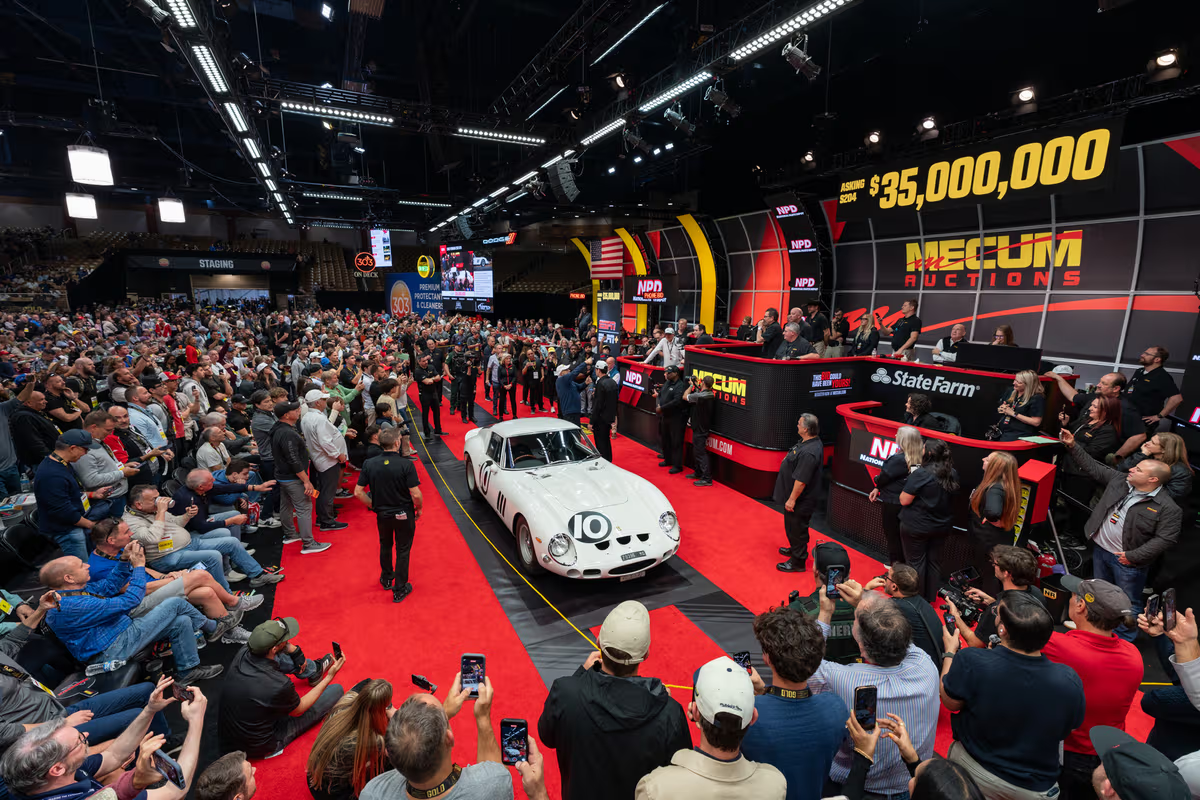
Last week, I shared my video interview with Mecum Auctions’ CEO, Dave Magers, where we discussed the market for collector cars and the economics of the industry. This weekend, I’ll be in Monterey for the tail end of car week. I’ll probably miss all of the auctions, though I’m bidding on two race cars, but my goal is to have conversations with people in the industry to understand a little bit more about whether this market is any kind of leading indicator for the economy.
For those who missed it, you can also watch the video here. But I thought it would be helpful to share some of what I learned from Dave. There are three main topics: the economics of car collecting, the investment side of the industry, and how much of it is driven by the social side.
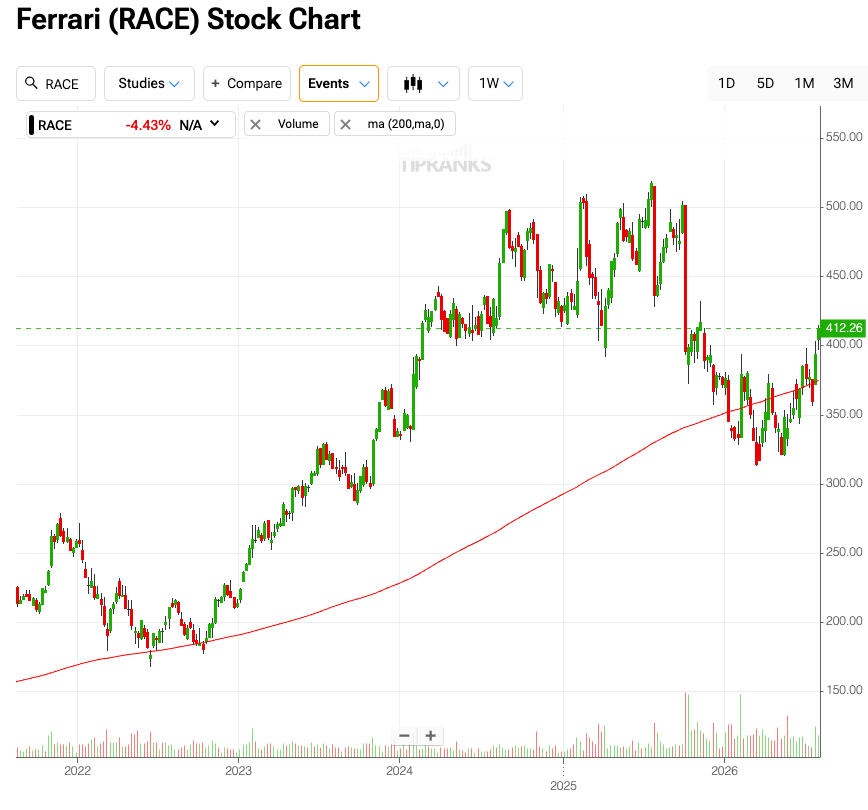
I think it’s also interesting to look at the market for brand-new collector cars. And the easiest way to understand that market is by looking at shares of Ferrari (RACE) stock. My thoughts on Ferrari and a price chart are near the end of the article.
The Economic Side of Car Collecting
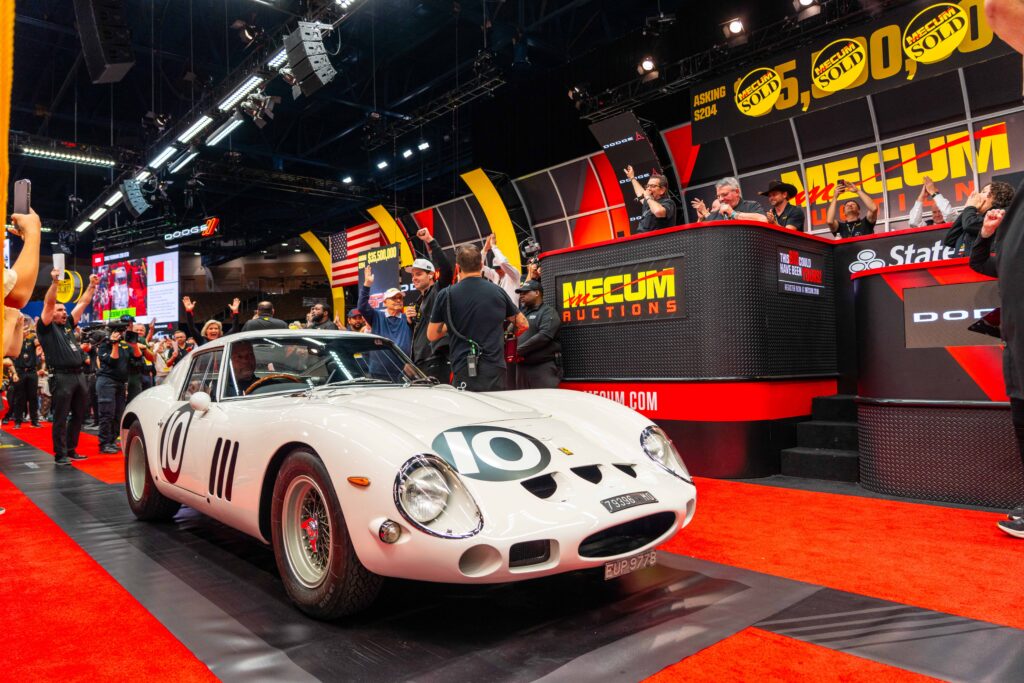
Let’s kick off what I learned by discussing the economics of the collector car market. What most of us want to know is whether the party will continue. I asked Dave that question and, while he wasn’t going to make a forecast, his “nowcast” is that the market remains strong. Mecum’s Kissimmee auction was a record, even if you were to exclude the sales of the $38 million Ferrari 250 GTO and the $125 million in sales of the Bachman Collection cars. Money continues to flow into this asset class.
Pent-up demand is one reason. The tariff announcements in 2025 effectively froze the market. As car collectors began to understand the impact of tariffs, the market began to warm up, and 2026 has seen record-breaking results. Dave says that it’s not the tariffs that were the problem; it was the uncertainty. Markets operate most effectively when everybody understands the rules and plays by them.
The economic concept of supply and demand matters in collector car markets. According to Dave, that’s fundamental to car collecting. For decades, the Baby Boomers drove the market. But that’s changing. Demand is now coming from younger demographics. At the top of the market, that means that we’ll continue to see record prices of more modern Ferraris and supercars. Radwood Era cars, from the 1980s and 1990s, are hot, too. But demand is heating up for Japanese cars and early 2000s era cars, as the millennials go after the cars they virtually drove in games like Gran Turismo.
Collector Car Market and Investing
Dave emphasized that the top thing to look for when investing in a collector car is quality. As they say, if you buy the best you can afford, you’ll only buy once and cry once. I’ve made that mistake in the past. My 1959 Morgan +4 needed a new steel frame. My 1967 Lotus Elan needed everything. I paid up for my Porsche 911, and it’s rewarded me with cross-country trips, rallies, and new friends. In addition to lower ownership costs, quality cars are easier to sell because future buyers are doing the math.
Dave noted that the record-setting Ferraris in the Bachman collection were known to be of the highest quality and that this was the first time they’d come up for sale. They went for a premium because of that. They were low-mileage cars in excellent condition with documented history. Those things are irreplaceable-a car is only new once.
It’s hard to know what will be hot. Sure, there’s the 30-year rule. That rule says that we want the poster cars of our youth and are finally able to afford them beginning when we’re around 45. But there’s more to it than that. It’s also about style. Dave tells us that one hot segment of the market is vintage pickups. People just love them because of the vibe they offer. I’ve got two friends who are not into cars but love their vintage pickups.
It can be hard to take money out of your savings to buy a collector car, especially at today’s prices. Mecum will finance the car for you, which might make it easier. But if you decide to sell some stock, you can tell your advisor that you’re simply diversifying. Dave says that the market for collectible cars isn’t very correlated with the stock market or the economy. In good times, when the market rallies, people feel good about spending the money to buy their dream car. When the market is down, they figure they’re better off buying that car today rather than watching their stock portfolio circling the drain. We certainly saw that to be true during the pandemic. But during a major bear market, like the 2008 Financial Crisis, collector car prices slid along with most other assets. Buyer beware.
Collecting is Driven by Social Interactions
Finally, the real reason why we love cars. The people and the social interactions. The economics and investing aspects of car collecting don’t work without the social side.
In-person events matter. I asked Dave whether the online auctions, like Bring-a-Trailer, have impacted Mecum’s IRL (in real life) business. He said yes, for the better. A rising tide lifts all boats. I think you can say the same for the effect that social media has had on real-life events like Luftgekuhlt or The Quail. Online enthusiasm for cars has made us crave real-life experiences and connections with the people we meet online who may live in other states.
Those in-person events can also lead to increased values of the cars that get us into the events we want to be a part of. Look at the rise of Safari Porsches. Owners take those cars into the back woods, driving fast across terrain previously only accessible by truck. Similarly, pre-1959 race cars found new life on the road by participating in the Colorado Grand, a thousand-mile rally across spectacular mountain roads. Having that event as part of a car’s history only adds to its value. Same with high-end shows like the Pebble Beach Concours d’Elegance. These all add to a car’s provenance and create greater demand for that example than a similar car that wasn’t invited to participate.
Is Ferrari Stock a Buy? We’ll See.
In addition to the auctions, I’ll also be watching the price of Ferrari. The stock had been performing as well as the company’s endurance cars (which won the 24 Hours of LeMans) until late 2025, when they crashed. Shares seem to have found a bottom and are trying to move up again. That double bottom suggests a price of at last $425, though there’s plenty of resistance in this area. Ferrari is not a car company; it is a luxury good manufacturer, and I think it’s also an interesting bellwether. Is Ferrari a buy here? I think the results of this week’s auctions could be an interesting indication about whether the uptrend will resume.
Final Thoughts
Those two race cars I’m bidding on will probably never be truly collectible. They’re too scruffy and not rare enough to be invited to the elite events. But they’ll provide access to the type of racing that I love and create important new experiences that will make them investments in my personal well-being.
While I’m in Monterey next week, I’ll be trying to answer three questions:
- How healthy is the market for collectibles?
- Who’s selling? Is it driven by demographics or something different?
- What lessons does this have for the economy?
Mecum’s Dave Magers says the market is healthy, and I have no reason to doubt him. But I’ll be looking to see whether recent growth will continue, or whether there are cracks beginning to form. There are a number of very rare cars coming up for auction this week, and they might hold the key to what happens next in the stock market.
What questions would you like answered about the market for collector cars? Do you think this market, which is a luxury market and driven by wealthy consumers and business leaders, is important to track?