Following Tariff Truce Update, Investors Can Expect More From Trump-Xi Summit
We’ve already got a market-relevant impact on tariffs, but what are the other main points of contention as the “G2” gather?
You've reached your free article limit
You've read 0 of 1 free Pro articles.
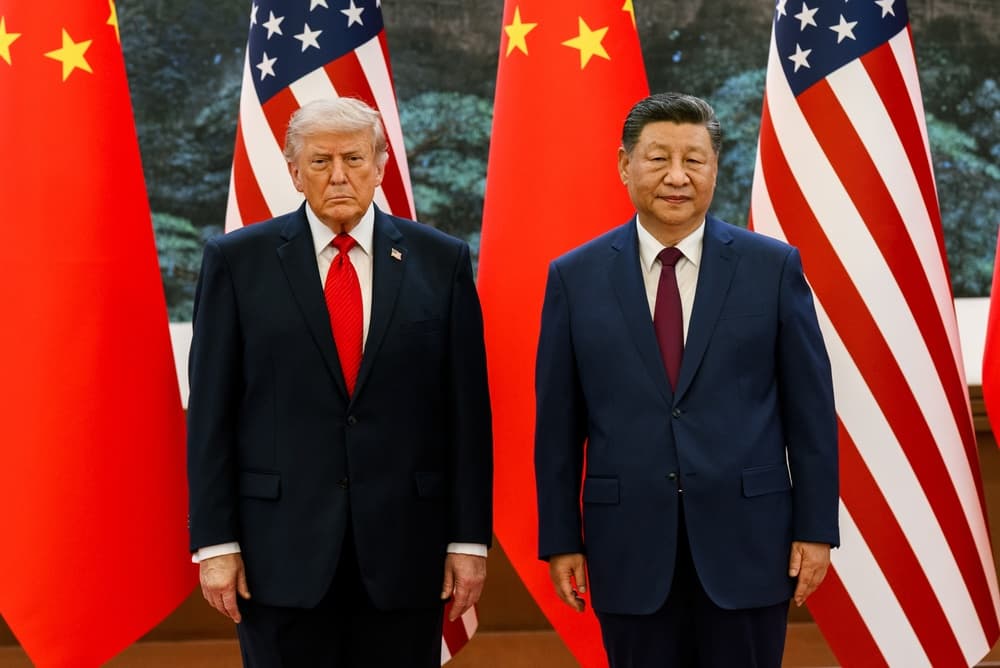
International investors are watching Washington on Thursday and Friday, as Chinese President Xi Jinping comes to town for his second summit this year with U.S. counterpart Donald Trump. This meeting of the “G2” leaders of the world’s largest economies is likely to be long on pomp, but can we expect substance?
We do have market-relevant news already, with U.S. Treasury Secretary Scott Bessent indicating that the two sides have agreed a two-month extension in their tariff truce. That removes one of the significant overhangs surrounding these talks.
Tariff Truce Pushed into 2027
As I noted in my last column, there was a November 10 deadline looming for the end of the suspension of tariffs as high as 145% on the U.S. side and 125% from China. But the two nations have agreed to extend the tariff truce for two months, through January 10.
Treasury Secretary Scott Bessent has already had two meetings with Chinese Vice Premier He Lifeng in New York, pointing on social media to “substantive discussions” ahead of the Xi-Trump summit. The aim is to explore a larger U.S.-China trade agreement, although there’s no indication of how far-reaching it would be.
“We met today to see if we could do a bigger deal as opposed to just a series of smaller things,” Bessent said on Wednesday, after 12 hours of talks on Sunday at the JPMorgan Chase (JPM) headquarters, and another 90 minutes of face time with He at the World Bank HQ on Wednesday.
China Not Following Through on Commitments
China has largely not followed through on its commitments agreed to when Trump traveled to Beijing in May. At that time, it agreed to purchase 200 Boeing (BA) aircraft, and buy at least $17 billion in U.S. farm goods per year through 2028.
China had essentially stopped sourcing soybeans, the “undisputed king of U.S. food exports,” from the United States during the U.S.-China trade war. China, the destination for some 60% of all soybean shipments, switched its sourcing to countries such as Brazil and Argentina instead. Beans from those countries remain cheaper, since China has imposed a 10% retaliatory tariff on U.S. soybeans that remains in place.
U.S. farm lobbyists from the American Soybean Association and the National Sorghum Producers have written to Trump, seeking to get China’s retaliatory tariffs removed and for China to follow through on its purchase commitments. It has confirmed close to 10 million metric tons of U.S. soybean sales from this year’s crop, according to the U.S. Department of Agriculture, although China agreed to buy 25 million metric tons per year. China has also not bought any U.S. corn this season, and sorghum purchases remain below normal levels.
U.S. ‘Examining’ Bigger Deal
Bessent noted that China has been lagging on that $17 billion purchase pledge, although he believes it will hit the 25-million-ton commitment on soybeans. With Xi and Trump likely to meet later this year in Shenzhen for the APEC Summit and in Miami for the G20, Bessent said U.S. negotiators are “open to the idea” of continuing existing agreements, or “examining the bigger deal,” adding that the U.S. side is “fine with both.”
That sounds an awful lot like he doesn’t expect extensive progress. U.S. officials had previously mentioned a three- or six-month extension to the tariff truce.
Besides tariffs and the Chinese purchase of U.S. goods, other key sticking points will be the controls of the sale of U.S. technology, particularly chips, into China, as well as how AI is governed and policed.
China is likely to push for the United States to suspend arms sales to Taiwan. The Trump administration has a $14 billion shipment of weapons to the self-governing democracy on hold, which Trump calls a “very good negotiating chip.” U.S. negotiators may push for China to guarantee a steady supply of rare earths and minerals that are critical in the construction of cars, energy machinery and military jets.
5 Meetings in a Matter of Months
Still, Trump and Xi had not met for six years when they held a one-day summit in Busan, South Korea, in October 2025. Now the two men are likely to meet face-to-face another four times inside 2026, with the current Washington summit a reciprocal visit after Trump’s state visit to Beijing from May 13 to 15.
We would hope to see progress out of those talks. Bessent did say we may at least see the two sides agree to remove tariffs on some $30 billion in bilateral trade, likely in financial services and farm goods.
China and the United States have also agreed to create an AI “hotline” between Washington and Beijing so the two nations can alert each other to AI safety incidents.
Not Keen to Stall Progress on AI
But neither side appears keen to hold back on the pace of progress in the “AI arms race.” Trump says he does not want to “stifle” U.S. AI growth, while the state-owned, English-language Global Times newspaper — often used to communicate China’s foreign policy to an international audience — indicated in an editorial that the calls for a slower pace of AI development from the likes of Anthropic CEO Dario Amodei amount to a “Cold War playbook” aimed at containing China.
China also did not follow through on the “Phase One” trade deal from 2019 and the Trump 1.0 administration. China agreed to buy $200 billion in additional U.S. exports in what Trump dubbed a “historical trade deal.” But, albeit with the pandemic disrupting global supply chains, its purchases did not even match import levels from before the U.S.-China trade war kicked off in 2018.
The “only undisputed ‘historical’ aspect of that agreement is its failure,” the Peterson Institute for International Economics said in its analysis of Phase One.
Playing Up Pageantry
China is playing up the pageantry of Xi’s state visit, noting that Donald and Melania Trump greeted Xi and soprano singer Peng Liyuan, Xi’s wife, at the airport “in a rare planeside welcome,” complete with honor guards, a 21-gun salute and a military flyover. The Chinese media are always keen to note that Trump treats Xi as his equal.
China is also holding back its cards, however. When asked about the upcoming APEC Economic Leaders’ Meeting due to take place on November 18 to 19, the Chinese foreign ministry says the two countries “maintain communication on interactions between the two heads of state,” and whether China will invite Trump to attend.
Chinese markets, which are closed on Friday for the Mid-Autumn Festival, did not respond to the tariff extension. The CSI 300 index of the largest listings in Shenzhen and Shanghai fell 1.7% on Thursday, to continue a glum year for Chinese equities. The Chinese benchmark is down 5.9% year to date.
No Chinese Chiefs
China was initially pushing for top executives from the Bank of China, Chinese electric-vehicle (EV) maker BYD (BYDDY) (HK:1211), battery giant CATL (CYATY) (HK:3750), electronics manufacturer Hisense Home Appliances (HISEF) (HK:0921) and smartphone maker Xiaomi (XIACY) (HK:1810) to rank among the Chinese business leaders due to accompany Xi. But according to Reuters, there’s no Chinese corporate delegation, with one source pointing to troubling ties between Chinese companies and the Chinese military.
While Japan has agreed a $550 billion investment and loan package into the United States, and South Korea has made a $350 billion commitment, Chinese investment is complicated by the state-owned backbone of much of China’s industry, as well as likely surveillance of private Chinese companies by Beijing. Trump said he would welcome Chinese car companies if they produce on U.S. soil, something U.S., Japanese and Korean companies all oppose.
Tech Who’s Who
The U.S. corporate congregation is a who’s who of tech names: Alphabet (GOOG) chief Sundar Pichai; Amazon.com (AMZN) founder Jeff Bezos; Apple (AAPL) executive chairman Tim Cook; Dell Technologies (DELL) founder Michael Dell; Meta Platforms (META) founder Mark Zuckerberg; Microsoft (MSFT) CEO Satya Nadella; Nvidia (NVDA) CEO Jensen Huang; OpenAI CEO Sam Altman; Qualcomm (QCOM) CEO Cristiano Amon; and Tesla (TSLA) and SpaceX (SPCX) CEO Elon Musk.
On the non-tech side, Citigroup (C) CEO Jane Fraser, JPMorgan Chase CEO Jamie Dimon and Pfizer (PFE) CEO Albert Bourla are also due to attend.
Many of those companies would like to see enhanced access to the Chinese market. China will surely be pushing for an easing of restrictions on high-end chip supplies from the likes of Nvidia.
I’m concerned that Trump may cede too much ground on Taiwan in a bid to strike a trade deal. It is also a thorny issue as to what standard of U.S. tech is permitted for export into China. But on the trade front, it’s excellent news to have the United States and China warming on the diplomatic front.
The White House harks back to some of the earliest détente between the two nations. Thursday night’s meal will begin with a toast of Schramsberg Blanc De Noir, the same California sparkling wine used at the 1972 “Toast to Peace” when Richard Nixon visited Chinese Premier Zhou Enlai. The rest of the menu, with a main course of sesame-crusted sea bass, “showcases American ingredients with subtle Chinese influence,” according to Melania Trump’s statement.
At the time of publication, McMillan was long BYDDY, MSFT and NVDA.