Asian Markets Brace for Geopolitical Crosswinds
What can we expect out of meetings between U.S. President Donald Trump and the leaders of China, Britain and Japan?
You've reached your free article limit
You've read 0 of 1 free Pro articles.
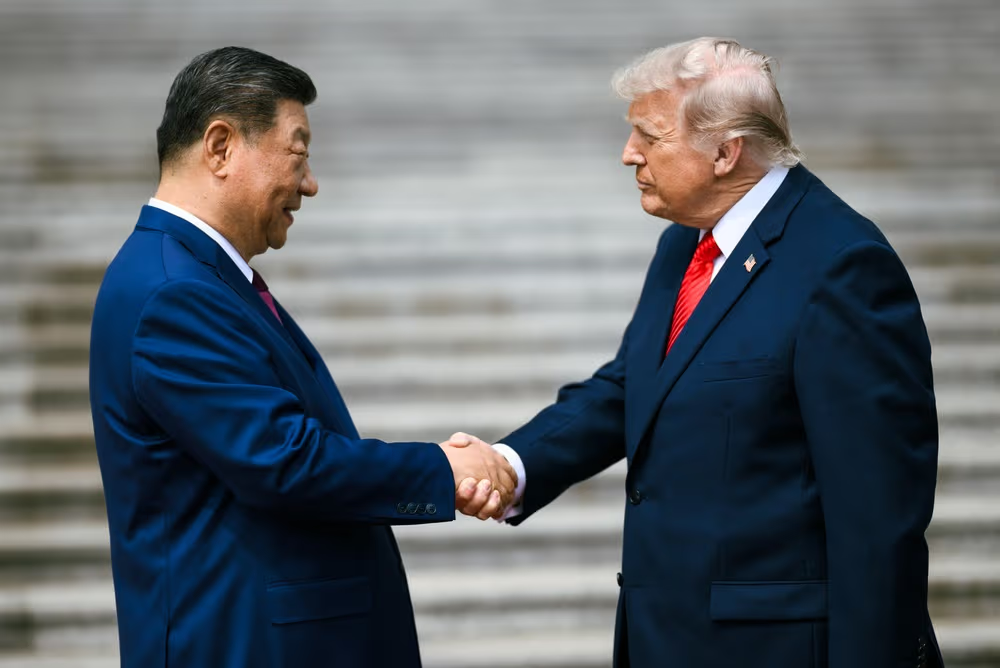
In a holiday-shortened week, investors in East Asia will be watching as the leaders of Japan, China and Britain get facetime with U.S. President Donald Trump. We can expect discussion, if not progress, on key issues such as auto and chip exports as well as regulation of AI.
Japanese Prime Minister Sanae Takaichi is due to meet Trump on Tuesday, on the sidelines of the United Nations General Assembly.
New British Prime Minister Andy Burnham is also due to get face time with Trump on Tuesday, their first in-person meeting since Burnham took office on July 20.
Trump and First Lady Melania then meet Chinese President Xi Jinping and his wife, Peng Liyuan, on Wednesday, ahead of a state dinner on Thursday, with the state visit due to run through Friday.
Trump to Play Nice?
What can investors expect out of these high-level meetings?
Trump has criticized Burnham as “extremely liberal” and belittled the former mayor of Greater Manchester as the “mayor of a town.” Angry that Britain didn’t join U.S. strikes on Iran, he’s called the country a “dying” nation “on the edge of disaster.”
But Trump inevitably plays nice in person, as we’ve seen when he meets self-professed socialist and New York City mayor Zohran Mamdani. A “100% Communist Lunatic” and “total nut job” suddenly becomes someone Trump thinks will do a “great job.”
Britain on the Front Foot
Burnham said he and Trump have “found a connection” in two phone calls since he took the top job in Britain, and stressed the two leaders will “search for that common ground, which I’m sure we’ll find.”
The British prime minister is due today to give a speech at the UN General Assembly, as well as to announce the start of work on a new “AI and autonomy” partnership between the United States and the United Kingdom. The intent is to strengthen the protection of critical infrastructure and use AI to detect threats, with cooperation from the defense department in each country.
The British media points to a diminished Trump ahead of midterm elections on November 3.
“With Trump now weaker domestically, political power in the US is starting to shift to who comes next,” The Guardian stated.
But they do not expect Burnham to be confrontational, looking to create a bond with the U.S. leader instead.
Japan to Stress U.S. Alliances in Asia
Takaichi, who will also speak before the United Nations, is looking to stress Japan’s leadership on distribution networks, energy supply chains and technological innovation in areas such as AI.
The Japanese leader, a China hawk, will also be hoping to align U.S. interests with those of Japan on handling China. China has pressured Japan economically ever since Takaichi in November 2025 said that a Chinese attack or blockade on Taiwan would represent a “survival-threatening situation” for Japan. That language means it could trigger a military response.
Takaichi will surely address the presence of more than 50,000 U.S. troops on Japanese soil. She will be keen for Trump to maintain security commitments in East Asia, at a time the U.S. leader has stressed that countries such as Japan, South Korea and the Philippines should pay more for continued U.S. military support.
According to Japanese officials who have recently met with their Chinese counterparts, they remain obsessed with Takaichi’s comment on Taiwan, and demand that she retract it. The Chinese assistant minister of foreign affairs, Liu Bin, lectured Japanese lawmakers on the topic when they met last week, criticizing the Japanese leader’s “erroneous remarks and actions.”
He said Japan should “demonstrate through concrete actions that it is worthy of the trust of its Asian neighbors.”
Tough Talk on China Popular Back Home
Takaichi’s tough stance on China sells well at home, though, where her personal popularity is far higher than that of her political party. She and Trump are also likely to discuss the Japanese currency, with the Trump administration pressuring Japan to tighten monetary policy to protect the yen. They may also touch on Japan’s pledge to invest $550 billion in the United States.
There’s been no narrowing of the interest-rate differential between Japan and the United States, however, after the central banks in both countries raised interest rates by 25 basis points last week. That difference — with U.S. rates in a range of 3.75% to 4.0%, and Japan at just 1.25% — continue to underpin the “carry trade,” where institutions borrow in yen to buy higher-yielding U.S. dollar assets.
Trump and Xi will sit down for talks on Thursday. It will be their second face-to-face summit this year, after Trump traveled to China for a state visit in May.
New AI Mechanism
The thorny issue of how to administer the AI boom is sure to come up. U.S. Treasury Secretary Scott Bessent says China and the United States have had “successful” talks to create a new “notification mechanism” to handle AI incidents that could impact national security.
But the AI arms race — where U.S. companies have largely created proprietary in-house AI models, while China develops open-source alternatives — is sure to continue. Trump and his team do not want to see any waning in U.S. supremacy on AI and the development of high-end chips.
Last year’s trade war has resulted in an uneasy truce. The U.S. suspension of tariffs as high as 145% on Chinese goods is due to expire on November 10. China had retaliated with trade taxes as high as 125% on U.S. goods.
U.S. negotiators intend to raise China’s pledge to buy more U.S. farm goods, largely unfulfilled. China, on its part, agreed to suspend its own export controls on rare earths, a trump card it could seek to play once again should talks break down.
Company-Specific Benefits?
Analysts expect a one-year extension of the trade truce, and more pomp and ceremony as Xi and Trump meet again than tangible results. China has a pending commitment to buy 200 Boeing (BA) aircraft, and we could see further promises to increase Chinese purchases of U.S. energy and agricultural products. That could benefit the likes of ExxonMobil (XOM) and Chevron (CVX) on the energy front, and Bunge Global (BG) or Archer-Daniels-Midland (ADM) on the farm-goods front.
Trump has indicated he would welcome Chinese automakers if they were to build production facilities on U.S. shores. That has drawn criticism from lawmakers representing districts with a heavy U.S. carmaking presence, while the lobbyists at the Alliance for Automotive Innovation – representing the likes of General Motors (GM), Ford (F), Toyota Motor (TM) and Hyundai Motor (HYMTF) (KR:005380) – would like to see permanent legislation banning Chinese car sales from the U.S. market.
Xi will surely press the United States to cease its arms sales to Taiwan. A $14 billion Since 1979, the United States has had a legal requirement to supply Taiwan with the weapons necessary to defend itself. But China has become increasingly assertive around the self-governing democratic island, threatening it with nearby war games and persistent intrusions into its airspace.
The Trump administration approved an $11 billion arms package to Taiwan last December, the largest in history. But a $14 billion package is on hold. Xi intends to raise the topic of a 1982 joint statement where the United States agreed to gradually reduce arms sales to Taiwan, according to Modern Diplomacy, perhaps when the two men visit the National Archives.
Markets Closed Across East Asia
I will be watching for market-moving news out of this week’s geopolitical goings on. Any resumption of the U.S.-China trade war would be damaging, while Japan and other Asian nations would be highly concerned if U.S. resolve on Taiwan appears to wane.
It’s the Mid-Autumn Festival on Friday, a holiday similar to Thanksgiving, when families gather to feast and watch the full moon. The festival’s date varies but falls around the autumn equinox, which itself is a market holiday in Japan.
So we will see disrupted trading over the next few days in Japan, South Korea, China, Taiwan and Hong Kong. East Asia will be watching U.S. developments carefully. But the market reaction will be delayed until normal market service is restored.
Japanese markets are closed until Thursday, Korean stocks won’t trade on Thursday and Friday for the Chuseok harvest festival, and Mid-Autumn means a break in trading for China and Taiwan on Friday. The festival leads into China’s national day next week, on October 1, so it will be a “golden week” with Shanghai and Shenzhen shuttered next Thursday and Friday, too. Oh, and South Korea will celebrate its National Liberation Day on Saturday October 3, meaning markets are closed Monday, October 5.