Buying RTX as Dwindling Munitions Call for Reload
We’re sticking with this RTX price target.
You've reached your free article limit
You've read 0 of 1 free Pro articles.

On Tuesday morning, I added to the Sarge-folio long position in defense contracting giant RTX (RTX).
The stock had been showing some weakness of late, but let’s not kid ourselves. We know that the U.S. is going to have to pour funds into defense, even if it would rather prioritize elsewhere. We know that many U.S. allies, especially those that reside in the same neighborhoods as their potential adversaries, are going to have to pour funding into defense, even if they would rather prioritize elsewhere.
The U.S. military, depending on who you read or who you believe, might be running low on certain types of munitions and military hardware. One thing is certain: U.S. forces have a lot less in stock than they did at the start of the year and the pace of production for some of these weapons will have to increase. This is the thesis behind my current investment in both RTX and Lockheed Martin (LMT).
Time to Reload
There are three such RTX products that stand out as having been used heavily since February in the war in Iran. Notably, the U.S. needs to add to stockpiles of:
- Patriot PAC-3 Interceptors: RTX is a key supplier (Lockheed is the primary) to this program. RTX manufactures the parent system as well as launchers for the interceptors and radars for the interceptors. Patriot batteries have been central to air defense in the Persian region. Interceptor stocks are widely reported as being strained.
- Tomahawk Cruise Missiles: RTX manufactures Tomahawk missiles through its Raytheon subsidiary. Reuters has reported on dwindling stocks of these key weapons.
- Standard Missile Interceptors: These defensive interceptors are heavily used by U.S. Navy vessels that come under attack in the waters close to the Strait of Hormuz. Media reports have cited dwindling stocks of these crucial missiles as well.
Recent RTX Awards
Tomahawk Cruise Missiles (August 17)
RTX’s Raytheon subsidiary received a $22.9 billion, seven-year contract from the U.S. Department of War to accelerate production of Tomahawk cruise missiles. The award is meant to support production of more than 1,000 Tomahawk missiles annually. This is on top of that fact that Tomahawk deliveries for 2026 are already three times higher than they were to this point in 2025. Yes, that’s a $22.9 billion contract.
Spy-6 Radar Family (July 21)
RTX’s Raytheon was awarded a $1.8 billion contract extension for SPY-6 radars for the U.S. Navy, building on the initial production and sustainment contract from back in March 2022. This extension includes options that could bring cumulative value up to $3.3 billion.
Since this past spring, there are also awards for Standard Missile Defense Interceptors ($745 million), Spy-6 integration and test support ($515 million), AMRAAM air-to-air missiles ($742 million) and spare radars ($192 million).
The Chart
About a month ago, we showed readers a chart of RTX that illustrated a Cup with Handle pattern that we thought would produce a breakout (it did), inside of a larger Falling Wedge pattern of bearish reversal that (unfortunately) also did what it was supposed to do. How is that chart developing? Let’s take a look:
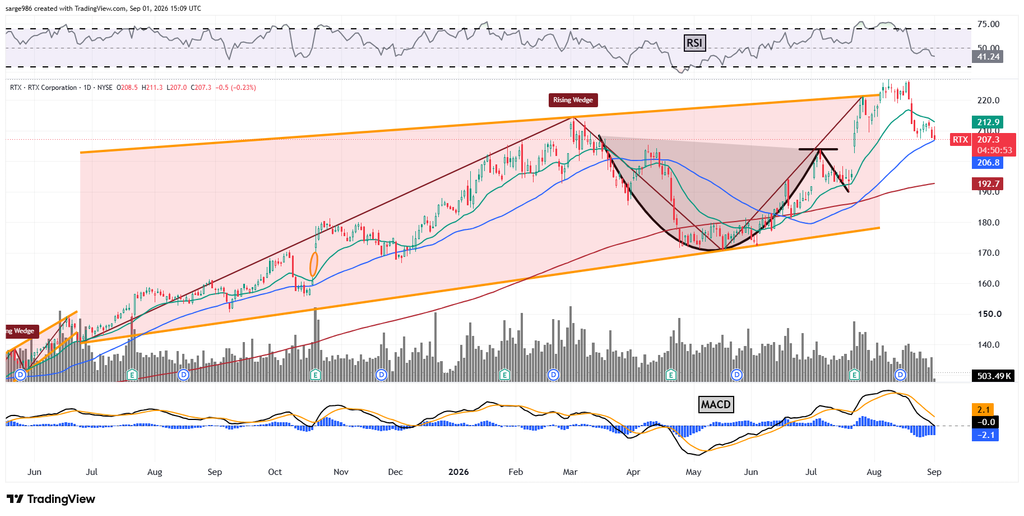
The two patterns that we discussed a month ago are still the dominant patterns on the chart. That said, RTX has tested support at the 50-day SMA (currently $207) for two consecutive days and so far has passed that test.
This is also above the $204 pivot created by the cup with handle, suggesting that professional managers are defending this name at that crucial spot despite overall market weakness. (LMT is also showing 50-day SMA support.) That is why I added to this long position on Tuesday morning. My target price remains $265 for now. That said, my next move on that target based on the highs of mid-August would likely go to $280 should the swing crowd get involved at the 21-day EMA.
At the time of publication, Guilfoyle was long LMT and RTX equity.