Investor ‘Fear’ Returns
Just one day after the largest percentage drop since April 2025, the Cboe Volatility Index (VIX), often called Wall Street’s “fear gauge,” is seeing the largest percentage gain since then (48% as of 12.15 pm ET). It’s also the largest increase since then in terms of points (7.8).
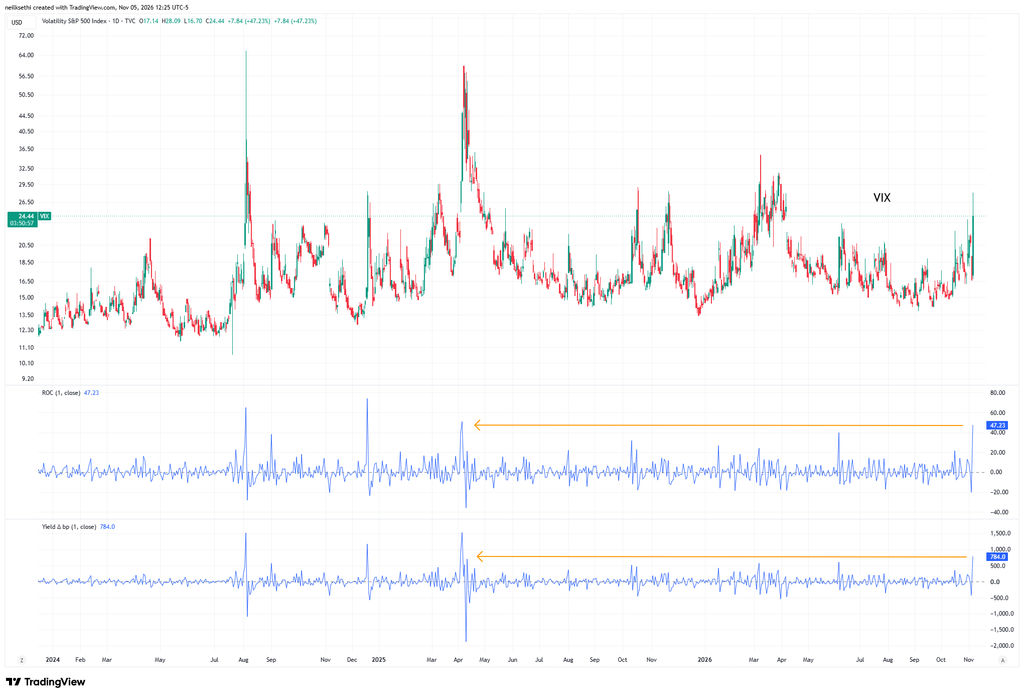
As I mentioned yesterday, “The VIX tracks how much volatility options traders expect in the S&P 500 over the next 30 days. A drop this sharp usually means investors are taking hedges off after a known risk has passed, not that the market has become safe. It puts the VIX back below its long-run average of about 19, which leaves room for it to rise if stocks lose ground again.”
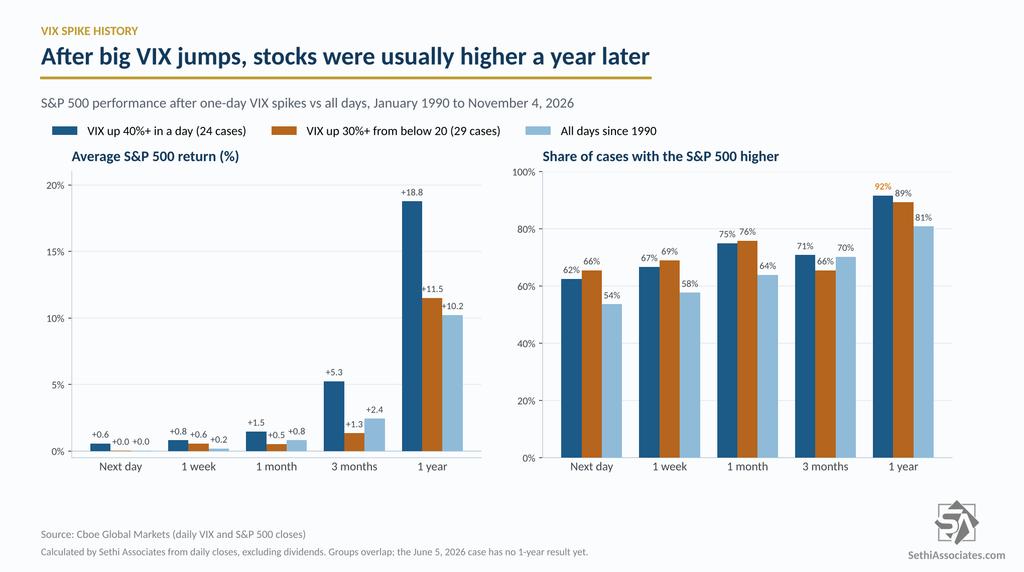
The good news is history suggests jumps like this tend to fade. Since 1990, the VIX has risen 40% or more in a single day 24 times, according to Cboe data. A month later, the S&P 500 was higher in 18 of those cases, and a year later it was up in 22 of 24, by an average of almost 19%, nearly double its typical annual gain. The VIX itself was lower a week later in 20 of the 24 cases.
The exceptions are worth noting, though. The worst outcomes came when the spike marked the start of a bigger shock, such as February 2020, when the S&P 500 was down 24% a month later as the pandemic took hold. And spikes from a calm starting point, like today’s, have had more muted follow-through over the next few months.
All figures use closing prices, so if today’s jump fades below 40% by the close, it falls outside the 24-case group. The 30%-from-below-20 numbers would still apply.
Conversation 0 Comments
One ongoing discussion across all days. Everyone can read; sign in to take part.
Your voice matters. Discussions are moderated for civility. Read our guidelines .
Log in to join the conversation