Stock Market Today

Market updates and conversation from TheStreet Pro team. Follow the latest and join the conversation below.

Stock Market Today: November 5, 2026

Newest first · All times Eastern · 4 updates

DATE:
By Neil Sethi

Democratic Sweep the Answer to China’s Stock Market Malaise?

While China’s stock rescue package got a shrug, as I posted on Tuesday (see China Reloads Its 2024 Stock Rescue Tools, but Markets Aren’t Buying It), the U.S. midterm results got a rally.

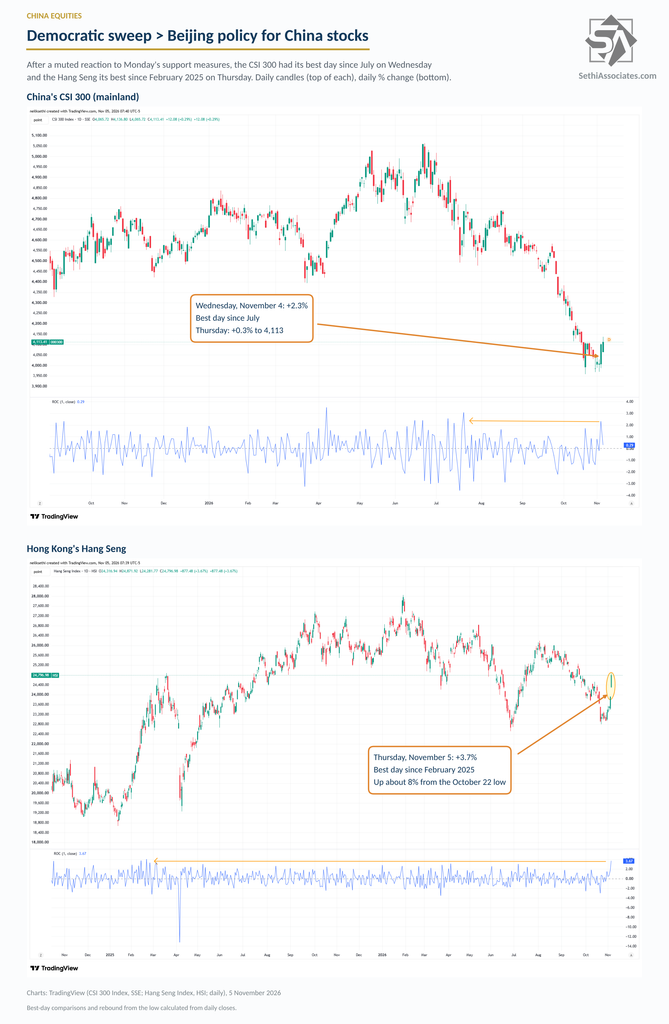
After Beijing rolled out its 2024-style support tools on Monday, the CSI 300 slipped 0.2% Tuesday and the tech-heavy Star 50 fell 3.8%. Then Democrats swept both chambers of Congress, and the CSI 300 jumped 2.3% Wednesday, its best day since July. It added 0.3% Thursday to 4,113, up 2.6% in two sessions.

Hong Kong followed with a bigger move Thursday:

  • The Hang Seng rose 3.7%, its best day since February 2025 (+4.0% on February 21, 2025, during the DeepSeek rally). It’s now up about 8% from its October 22 low.
  • The Hang Seng Tech rose 5.6%, the most since February 2025, per Bloomberg.
  • Alibaba and Tencent each rose more than 7%, and Meituan added 6.8%.
Positioning added fuel. Short selling was 32% of Hong Kong’s turnover on Tuesday, the highest in more than three years, according to Bloomberg. Lotus Asset Management’s Hao Hong calls the move “one of the biggest short squeezes in recent years.” The cost of hedging the Hang Seng Tech fell to its lowest since July, and options volume on the Tracker Fund hit a one-year high as bullish bets dominated.

Investors, according to Bloomberg, are reading the result as a risk to the U.S. AI hardware trade and rotating into value. Bloomberg notes the Hang Seng Tech traded at 13 times forward earnings last month, the lowest since 2024. Bloomberg Intelligence’s Marvin Chen sees three rotations at once. Money is moving out of Korea and Taiwan into China, into value after China was “stuck at trough valuations” while the rest of the world rallied, and away from “tech hardware and pure AI plays.”

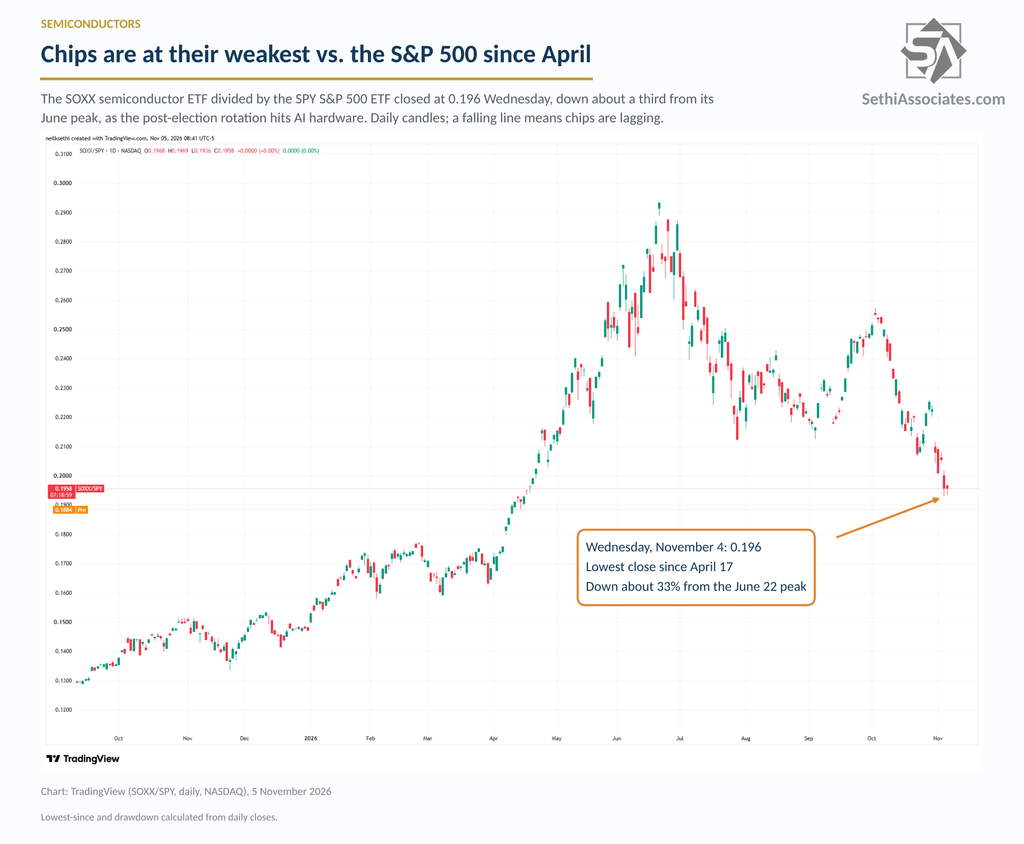
A similar rotation shows up in the U.S. Bespoke says 91.5% of consumer discretionary stocks are above their 50-day averages, the highest in at least a year, compared with 35.5% of tech stocks. And the Philadelphia Semiconductor Index (SOX) is at its lowest relative valuation to the S&P 500 since April.
To be fair to Beijing, Bloomberg also reported stepped-up national-team buying and buybacks Wednesday, so the policy floor is perhaps part of this.

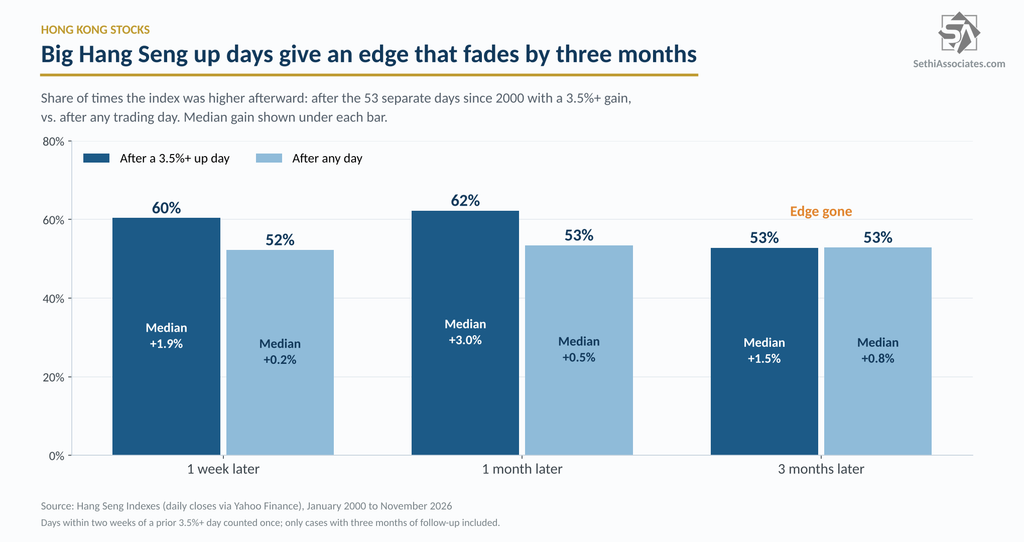
The good news: History says days like Thursday tend to carry over for a few weeks: since 2000, the Hang Seng has been higher a month after a 3.5%-plus day about 62% of the time, compared with 53% for any day.

The caveat: That edge is gone by three months, when it’s back to roughly even odds.
By Neil Sethi

Initial Jobless Claims Drop Back to Joint-Lowest Since 1969

  • Initial jobless claims for the week ending October 31st: 189,000 (estimate 196,000; previous 194,000; revised previous 195,000)
  • Continuing claims for the week ending October 24th: 1,718,000 (estimate 1,710,000; previous 1,701,000; revised previous 1,695,000).

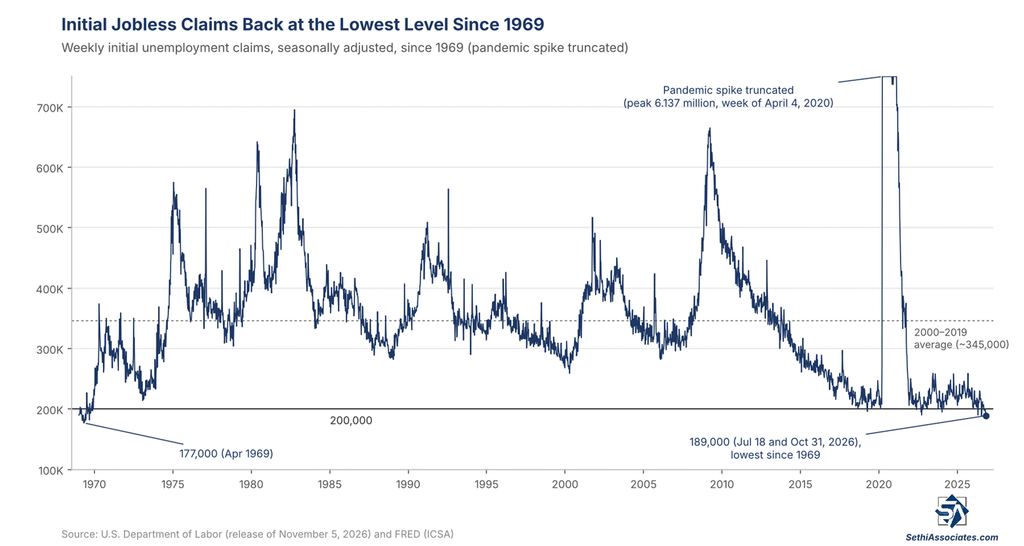
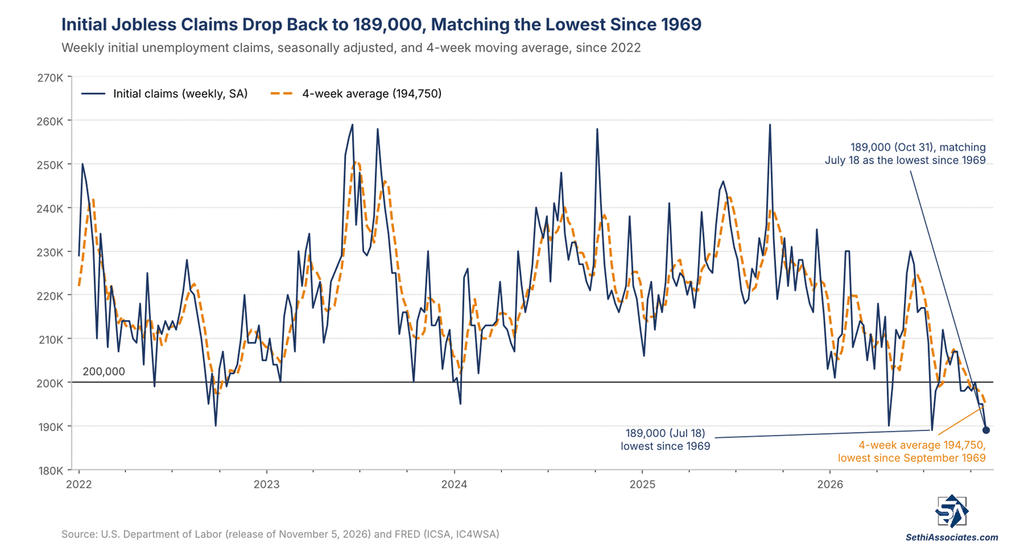
After bottoming at 189,000 in mid-July — the lowest reading since 1969 — initial jobless claims had barely budged, and in the week through October 31st fell 6,000, the most since September 12, right back to 189,000, matching that July 18 low (from an upwardly revised 195,000 the prior week). That makes it now the 18th week below 200,000 since 1969, and the third straight week under that mark (the four-week run from September 12 through October 3 was the longest since 1969), leaving claims at cycle lows at the bottom of the relatively narrow range that has held since November 2021.

The four-week average fell 2,250 to 194,750, the lowest since September 1969 (30,750 lower year-over-year).

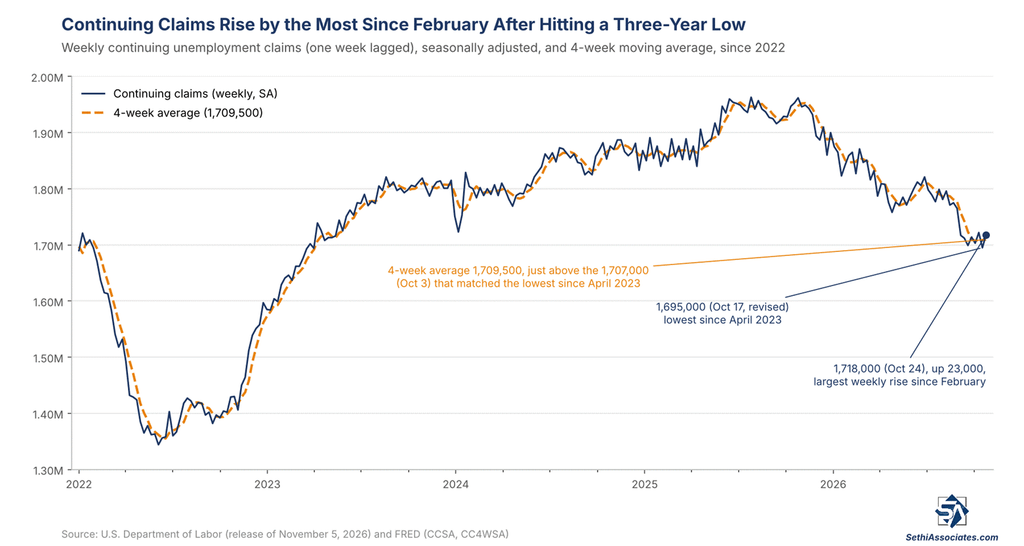
Continuing claims (seasonally adjusted) in the week through October 24th (one week lagged) rose 23,000, the largest weekly increase since February, to 1,718,000, but only after the prior week was revised down 6,000 to 1,695,000, the lowest since April 2023. That leaves them towards the bottom of the roughly 1.70 million to 2.0 million range that has held since mid-2023 — historically low, though not as low as initial claims.

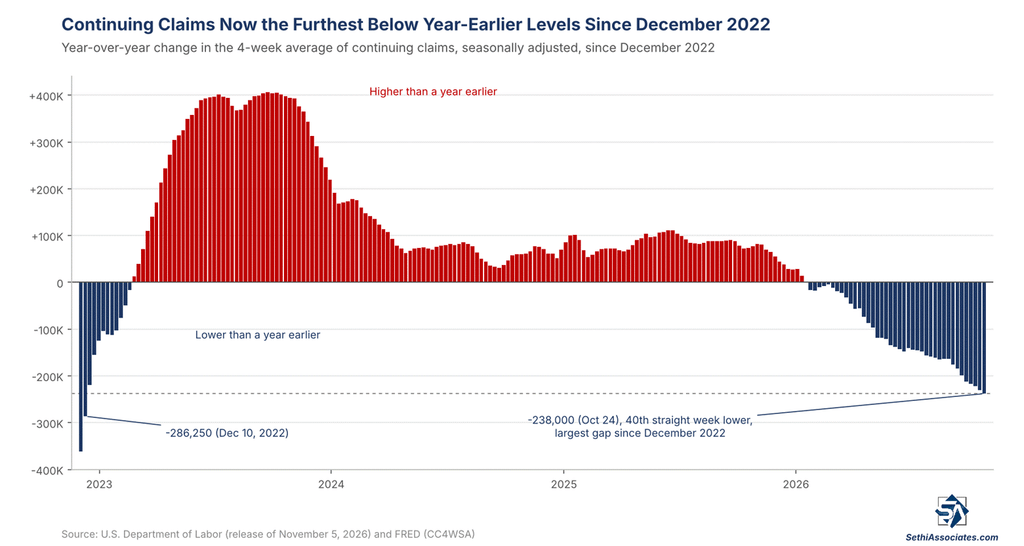
The four-week average of continuing claims rose 1,000 to 1,709,500 (after a 1,500 downward revision to the prior week), just above the 1,707,000 three weeks earlier that matched the lowest since April 2023, and remains lower year-over-year for a 40th straight week (down 238,000) — the largest such gap since December 2022.

The 20-year pre-pandemic average for initial claims is 345,000 and continuing claims roughly 2.9 million.

Source: U.S. Department of Labor

By Neil Sethi

Wednesday Rally Comes Too Late to Boost AAII Survey

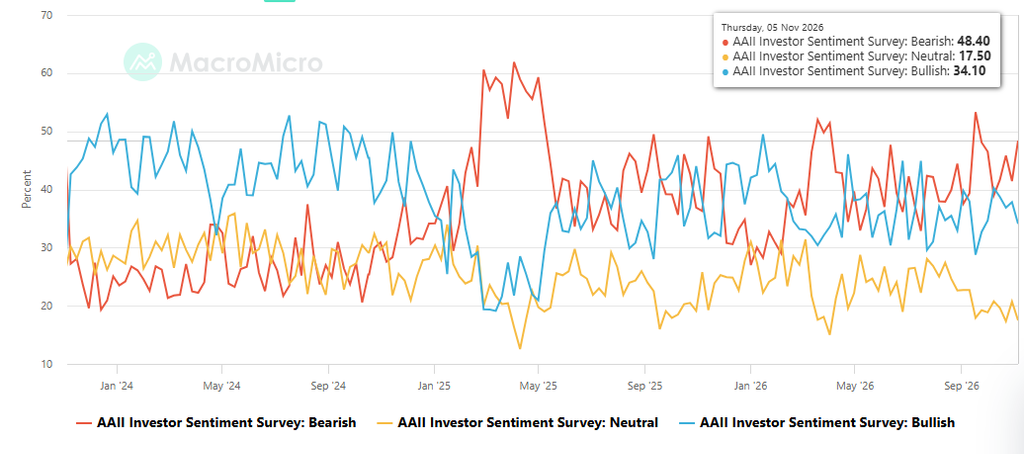
It seems the Wednesday rally came too late to save the American Association of Individual Investors’ (AAII) retail focused weekly investor survey, which edged more bearish:

AAII Bulls (those who see higher stock prices in six months, blue line) fell to 34.1%, the least in six weeks, from 37.8% the prior week (still though above the 28.8% seven weeks ago, which was the least since September 2025), and falling back below the long-term historical average of 37.5% after a week above.

Bulls also remained below the level of the Bears (who see lower stock prices in 6 months, red line), as the Bears rose to 48.4%, the most in seven weeks, from 41.4% the prior week (still though below the 53.3% seven weeks ago, the highest since May 2025). That leaves Bulls above Bears just twice in the last 16 weeks. Bears also remain above the long-term average of 31.0% for a 38th straight week (and they’ve only been below it 9 weeks since Dec 12, 2024).

The Neutral camp (yellow line) dropped to 17.5%, the least in two weeks, from 20.7% (just above the 17.3% two weeks ago, which was the least since early April). It remains under the long-run average of 31.5% and has been over that only twice since July 2024.

By Neil Sethi

A Lighter Thursday Schedule in the U.S.

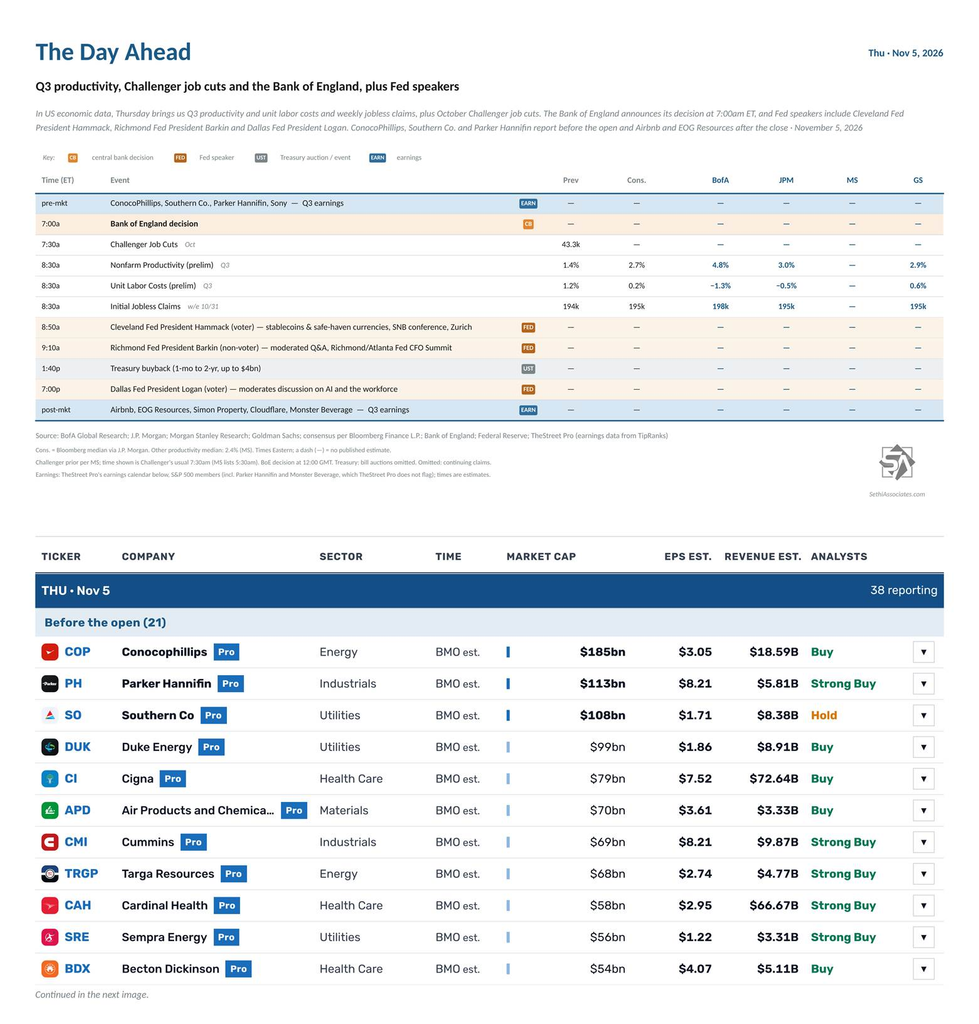
In U.S. economic data, Thursday brings us Q3 productivity and unit labor costs, plus October Challenger job cuts/hires. We’ll also get the weekly unemployment claims.

Cleveland Fed President Hammack (voter) speaks on stablecoins and safe-haven currencies in Zurich at 8:50am ET, Richmond Fed President Barkin (non-voter) participates in a moderated Q&A at 9:10am ET, and Dallas Fed President Logan (voter) moderates a discussion on AI and the workforce at 7pm ET.

The Bank of England announces its decision at 7am ET.

There are no non-Bill (>1yr in maturity) U.S. Treasury auctions, but Treasury holds a buyback of up to $4 billion of 1-month to 2-year securities at 1:40pm ET.

Also, a White House committee is scheduled to hold a closed hearing on allegations against Fed Governor Lisa Cook and whether there’s cause for her removal, per Bloomberg (via @C_Barraud).

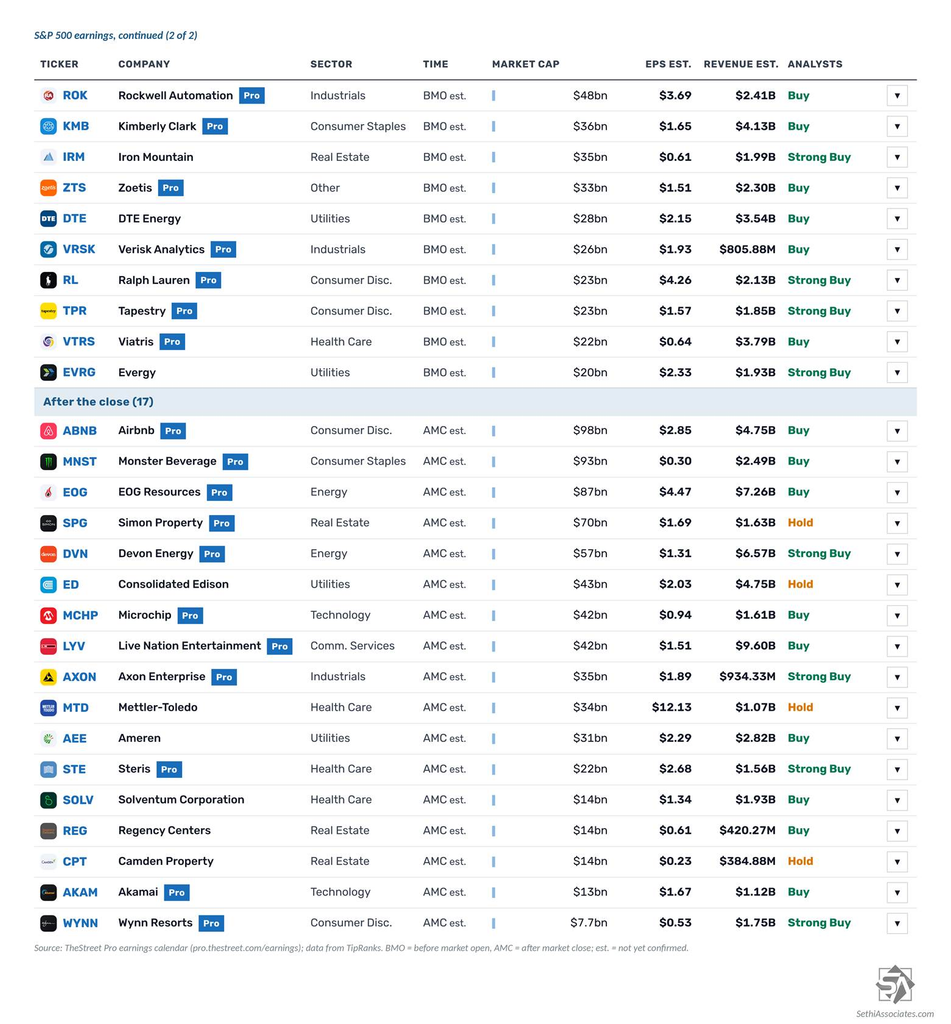
38 S&P 500 components report, three of them with market caps over $100bn:

Before the open: ConocoPhillips (COP), Parker Hannifin (PH), Southern Co. (SO), Duke Energy (DUK), Cigna (CI), Air Products (APD), Cummins (CMI), Targa Resources (TRGP), Cardinal Health (CAH), Sempra (SRE), Becton Dickinson (BDX), Rockwell Automation (ROK), Kimberly-Clark (KMB), Iron Mountain (IRM), Zoetis (ZTS), DTE Energy (DTE), Verisk Analytics (VRSK), Ralph Lauren (RL), Tapestry (TPR), Viatris (VTRS) and Evergy (EVRG)

After the close: Airbnb (ABNB), Monster Beverage (MNST), EOG Resources (EOG), Simon Property (SPG), Devon Energy (DVN), Consolidated Edison (ED), Microchip Technology (MCHP), Live Nation (LYV), Axon (AXON), Mettler-Toledo (MTD), Ameren (AEE), Steris (STE), Solventum (SOLV), Regency Centers (REG), Camden Property (CPT), Akamai (AKAM) and Wynn Resorts (WYNN)

Outside the S&P 500, Sony (SONY), National Grid (NGG) and ArcelorMittal (MT) report before the open, Cloudflare (NET) after the close, and Toyota (TM) at a time not yet announced.

Ex-U.S. highlights include U.K. October new car registrations and construction PMI, Japan September labor cash earnings, Germany September factory orders and October construction PMI, France September industrial production, Italy September retail sales, Eurozone September PPI and Sweden October CPI.

Besides the BoE, Norges Bank, Malaysia and Mexico announce rate decisions, ECB President Lagarde speaks, the ECB opens its annual money markets conference, Canada releases its 2026 federal budget and the China International Import Expo begins in Shanghai.

Conversation 0 Comments

One ongoing discussion across all days. Everyone can read; sign in to take part.

Your voice matters. Discussions are moderated for civility. Read our guidelines .

Log in to join the conversation

Loading comments...