Stock Market Today

Market updates and conversation from TheStreet Pro team. Follow the latest and join the conversation below.

Stock Market Today: November 13, 2026

Newest first · All times Eastern · 4 updates

DATE:
By Neil Sethi

BofA Now Sees Fed Hikes at Next Three Meetings

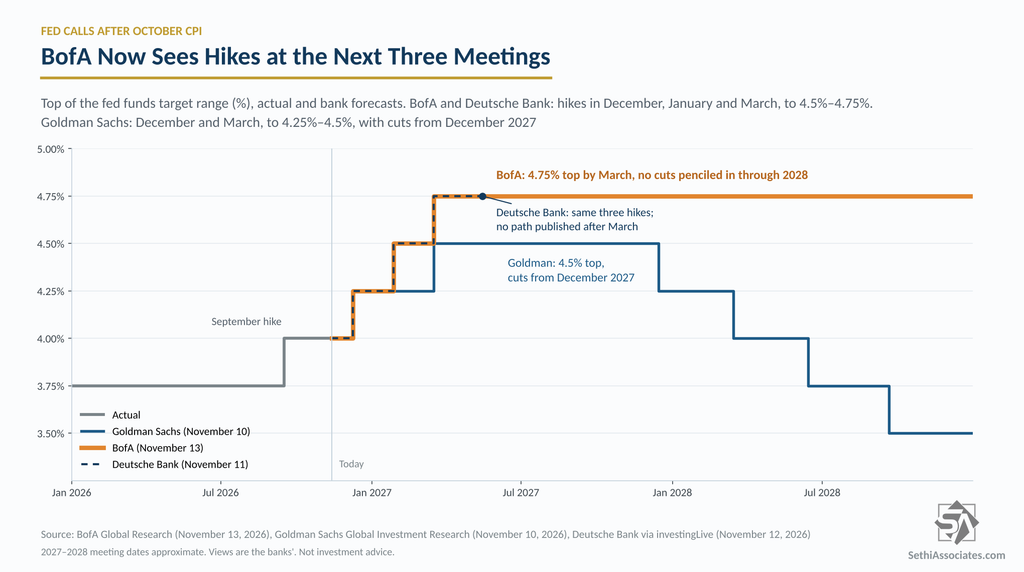
Two days after Goldman Sachs added a March hike to its Fed call, Bank of America went a step further this morning. Its economists now expect quarter-point hikes in December, January and March, for a peak of 4.5% to 4.75%, from 3.75% to 4% today. That’s one hike more than Goldman and the same path as Deutsche Bank. Unlike Goldman, BofA has no rate cuts penciled in for 2027 or 2028.
Why Add a Hike?

BofA’s old forecast had hikes in December and March. With December now looking like “a done deal,” BofA economist Aditya Bhave said the question was whether to pull the March hike into January or add another one. BofA chose to add one, because the October data, this week’s Fed speakers and the big move in market pricing “suggest that the entire distribution of outcomes has now moved to the right.”

BofA’s pacing is due to the fact they say the Fed “no longer has the luxury of hiking at a quarterly pace.” BofA noted Governor Christopher Waller said Tuesday that the Fed needs to take back at least the 75 basis points of “risk management” cuts it made last year, which BofA sees as the consensus on the committee. It thinks the Fed will end up taking back one of its 2024 cuts too. Cleveland Fed President Beth Hammack has also said she favors going “steadily in smaller increments” (more here) and Dallas Fed President Lorie Logan said “it may be possible to move more rapidly this winter” (more here), both of which fit a January move. BofA said markets were already pricing more than 45 basis points of hikes by the January meeting.

Risks Both Ways

BofA calls the risks to its new call balanced. On the downside, it describes “a reflexively dovish committee” that could push the last hike to April or June, or skip it. That could happen if the inflation or jobs data soften (the Fed gets four more months of data before March), a U.S.-Iran deal drives a lasting drop in oil prices, or stocks sell off sharply.

On the upside, a tighter labor market and a jump in wage growth could take rates above 5%. The start-of-year price increases in early 2027 also matter. BofA expects them to be somewhat smaller than this year, since AI-related input costs are still rising but diesel is well off its highs. Another year of big increases would put more hikes on the table.

Still a Quarter Point in December

Like Goldman, BofA doesn’t expect a half-point hike in December. It gave five reasons:

  • It would be a big jump from the current pace of hikes every other meeting, and with no more CPI reports before the December meeting and two before January, back-to-back quarter points can do the job.
  • Oil prices have fallen sharply.
  • A half point would make October’s pause “look very political.”
  • The doves can point to tame wage growth: unit labor costs fell outright in the third quarter and are up just 2.4% from a year ago.
  • A half point could cause market pricing to “become unanchored,” given Fed Chair Kevin Warsh’s unwillingness to guide markets.

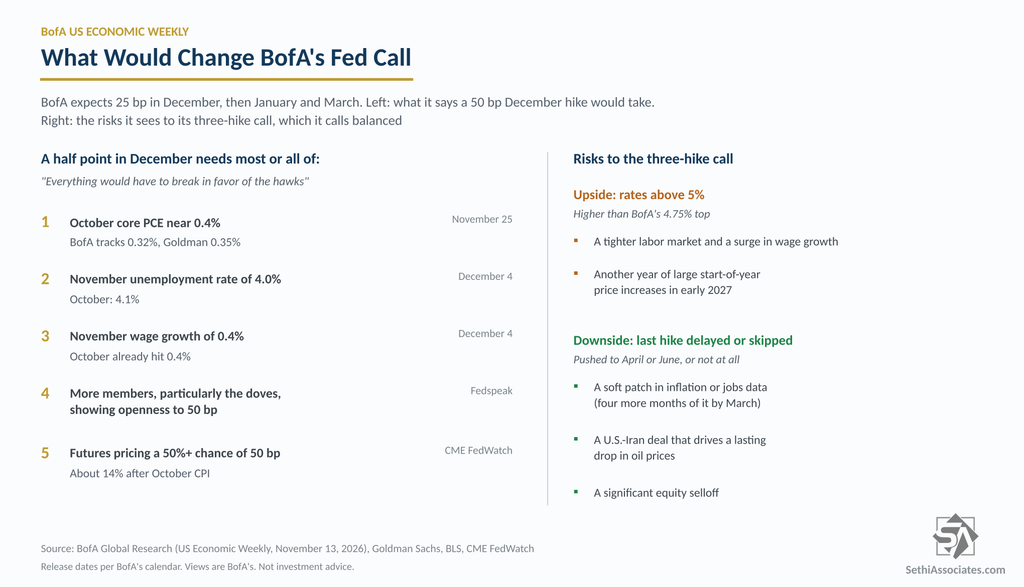
For a half-point hike to happen, BofA said “everything would have to break in favor of the hawks.” It lists five conditions:

  • October core PCE near 0.4%,
  • a 4.0% unemployment rate in November,
  • 0.4% wage growth in November,
  • signs more of the committee, particularly the doves, are open to the idea, and
  • futures pricing at least a 50% chance of a half point.

Wages already hit 0.4% in October (more here), but BofA tracks October core PCE at 0.32%. San Francisco Fed President Mary Daly and New York Fed President John Williams want more hikes but “over time” (more here), and futures put about a 14% chance on a half point after the CPI report (more here).
What to Watch

The October FOMC minutes come out Wednesday, and BofA expects them to show a deeper split over the October pause than the 10-2 vote suggested. October core PCE follows on November 25 and the November jobs report on December 4, ahead of the December 8–9 meeting. For investors, the debate has moved from whether the Fed hikes again to how many times and how fast.
By Neil Sethi

Investment Professionals’ Equity Exposure Falls to Eight-Week Low

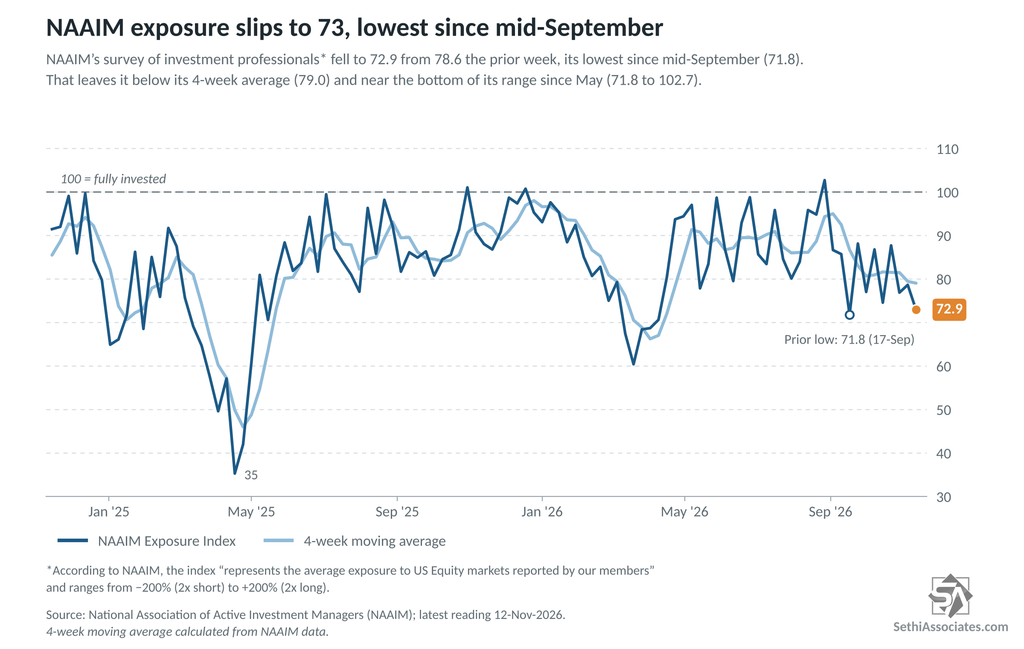
NAAIM’s survey of investment professionals* fell to 72.9 from 78.6 the prior week, its lowest since mid-September (71.8). That leaves it below its 4-week average (79.0) and near the bottom of its range since May (71.8 to 102.7). It also sits at the 37th percentile of its readings since 2016, meaning managers have trimmed exposure but are a long way from capitulating.

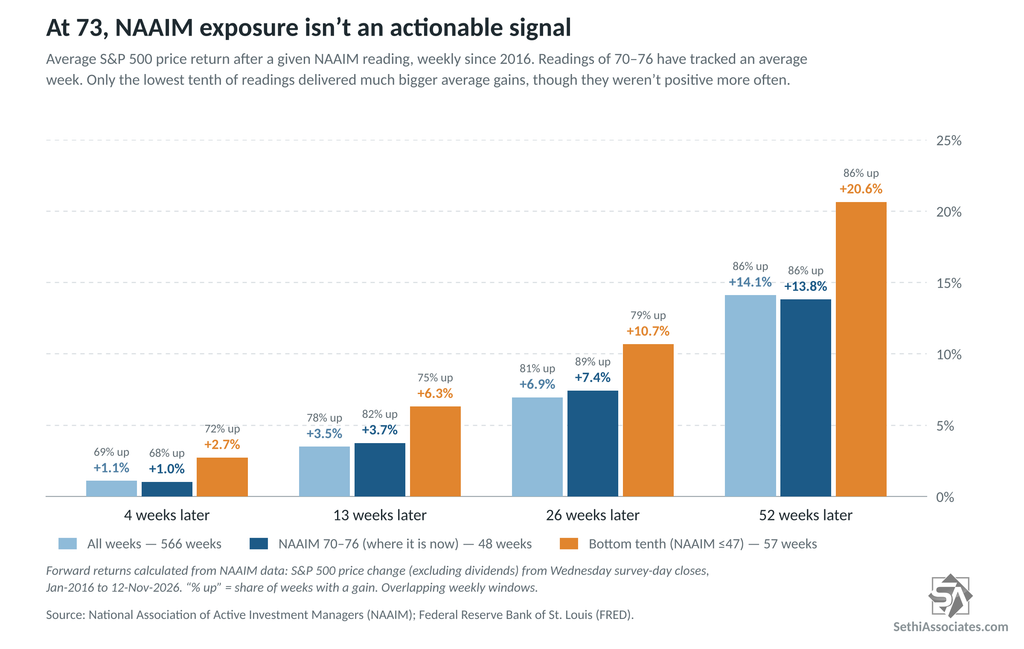
With NAAIM’s exposure index at its lowest in eight weeks, is it a buy signal? History says not at this level. Since 2016, weeks with the index between 70 and 76 have been followed by S&P 500 returns almost identical to an average week: +1.0% over the next four weeks (vs. +1.1% for all weeks), +3.7% over 13 weeks (vs. +3.5%) and +13.8% over a year (vs. +14.1%).

A meaningful difference only shows up at much lower readings. When the index has been in its bottom tenth (47 or below), the S&P 500 has averaged gains of 6.3% over the next 13 weeks and 20.6% over the next year, although those gains weren’t more frequent than usual, so the edge has come from the size of the rebounds rather than their reliability.

*The index according to NAAIM “represents the average exposure to US Equity markets reported by our members” and ranges from −200% (2x short) to +200% (2x long).

By Neil Sethi

Fed’s Daly and Williams Also See More Hikes, but ‘Over Time’

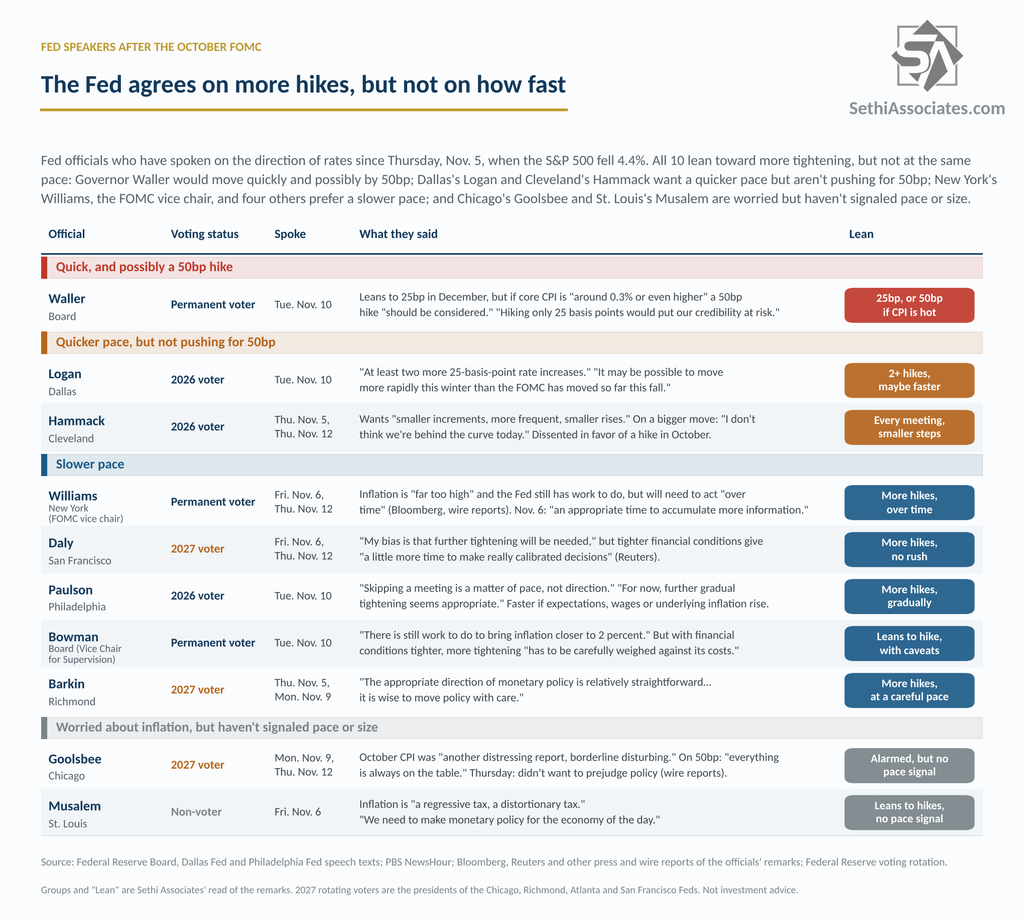
New York Fed President John Williams, the FOMC vice chair, and San Francisco Fed President Mary Daly (a 2027 voter), who has traditionally been in close alignment with the Fed’s old core of former Chair Jerome Powell, Vice Chair Philip Jefferson and Williams, both spoke Thursday. As a reminder, Williams has been one of the more dovish members, tipping the October hold ahead of time (saying there was “no need for urgency”) and later noting that he thought a December hike would be the last under his base case.

On the direction for rates, Williams agreed with the hawks, saying inflation is “far too high” and stubbornly persistent, and that the Fed still has work to do to get policy to the right place, according to Bloomberg and wire reports. He described the economy as resilient and getting stronger but not overheating. On pace, though, he remained more subdued, saying the Fed will need to act “over time,” and didn’t commit to a specific move in December.

On direction, Daly similarly said at the Stanford Institute for Economic Policy Research that “my bias is that further tightening will be needed,” according to Reuters, adding that price pressures are spreading into services, where inflation can be very sticky. “We have a labor market that’s stable, growth that’s good, but we definitely have an inflation problem right now,” she said.

On pace, Daly also was less aggressive than the hawks, saying rising bond yields “are most welcome,” and tighter financial conditions give the Fed “a little more time to make really calibrated decisions.” “That’s why I have said that my bias is to have additional tightening, but exactly how much and exactly when … we have many more pieces of data and information over many, many quarters,” she said. She also said “just because we have quite an inflation problem now, it doesn’t mean that we should completely ignore the possibilities of productivity growth or how that could be disinflationary.”

Overall, all 10 Fed officials who have spoken on the future direction of rates since last Thursday’s selloff lean toward more hikes. But of the seven December voters who have spoken, only Waller has opened the door to larger hikes. That said there remains a gap between the more dovish Williams, Daly, Bowman, Barkin, and Paulson, who seem to prefer a slower cadence, and the more hawkish Waller, Hammack and Logan, who are looking for a quicker pace.

By Neil Sethi

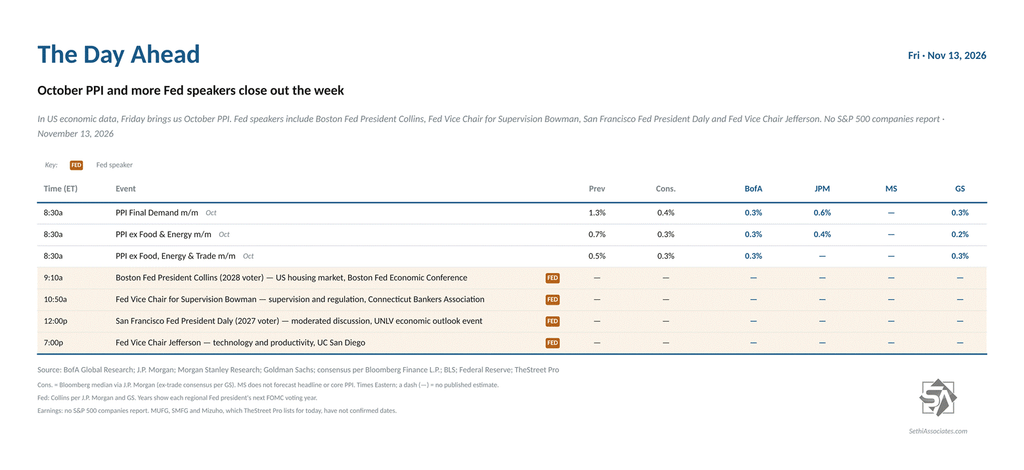
The Day Ahead — PPI and Four Fed Speakers

In US economic data, Friday brings us October PPI.

Fed speakers include Boston Fed President Collins (2028 voter) at 9:10am ET, Fed Vice Chair for Supervision Bowman at 10:50am, San Francisco Fed President Daly (2027 voter) at noon and Fed Vice Chair Jefferson at 7pm. Collins and Jefferson are the two we haven’t heard from this week, although Collins is less relevant since she isn’t a voter until 2028.

There are no coupon (>1 year in maturity) Treasury auctions.

No S&P 500 components report.

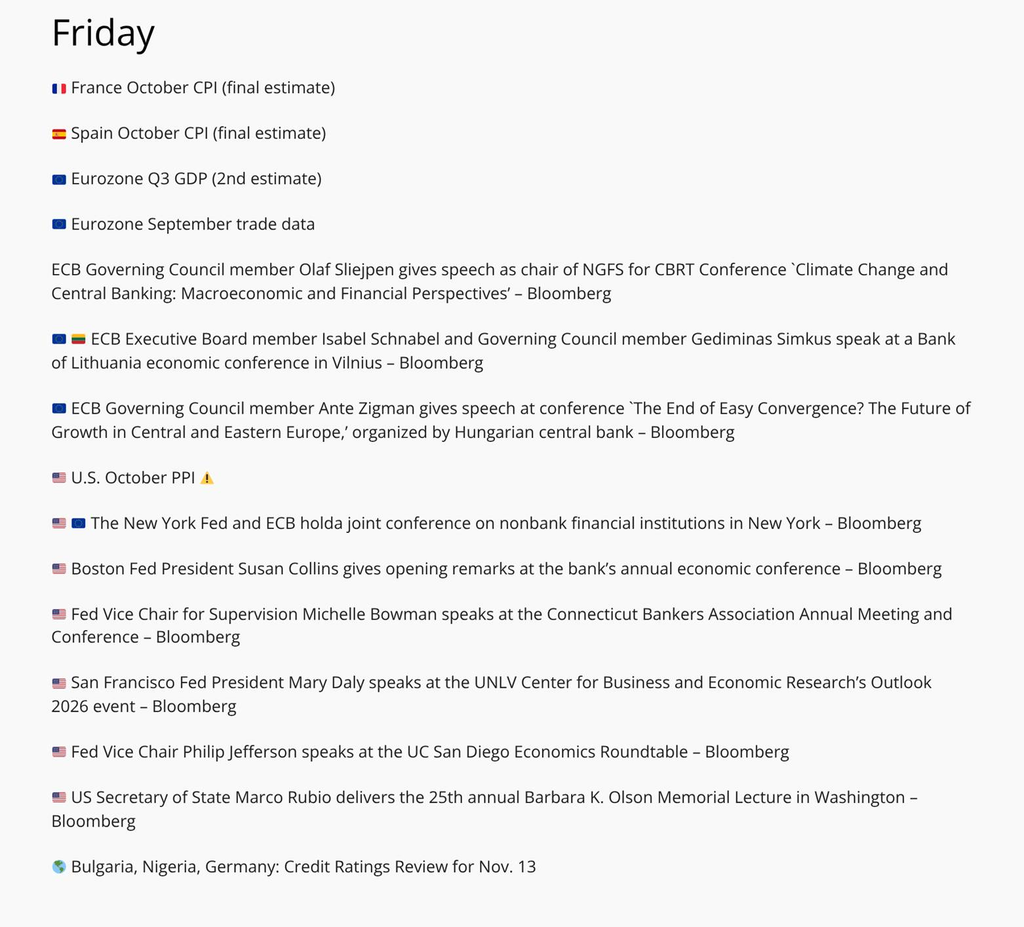
Ex-US highlights include the second estimate of eurozone third-quarter GDP, final October CPI in France and Spain, Poland’s October CPI and third-quarter GDP, and Brazil’s September retail sales. ECB Executive Board member Schnabel speaks, along with Governing Council members Simkus, Zigman and Sleijpen, and EU leaders hold an informal meeting. Germany’s credit rating is also up for review, and Richemont reports.

From Christophe Barraud’s international Week Ahead rundown:

Conversation 0 Comments

One ongoing discussion across all days. Everyone can read; sign in to take part.

Your voice matters. Discussions are moderated for civility. Read our guidelines .

Log in to join the conversation

Loading comments...