Goldman Now Calls for Two More Hikes, Pushes First Cut to December 2027
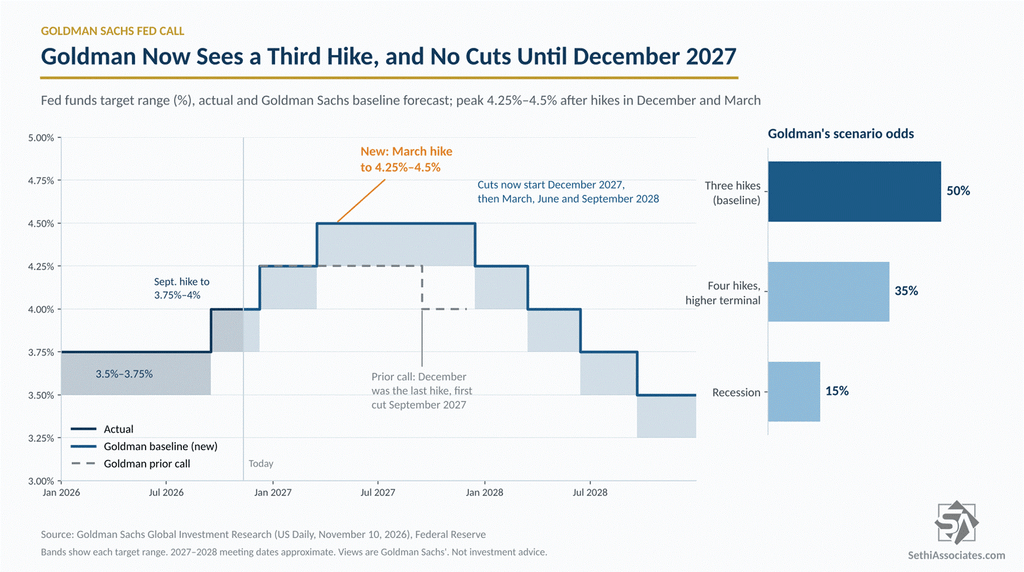
After Tuesday’s hot October CPI report, Goldman Sachs US Economics Team (Mericle) has dropped its call that December would be the Fed’s last rate hike, adding another quarter-point hike in March 2027 and pushing its first rate cut back a quarter to December 2027. That would take the Fed funds rate to a peak of 4.25% to 4.5%, from 3.75% to 4% today. Goldman is far from alone in the call, but it’s widely followed, so I thought it worth a quick post.
What Changed
Goldman still expects a quarter-point hike at the Fed’s December 8–9 meeting. Goldman left its estimate of where rates settle once cuts begin unchanged at 3.25% to 3.5%, but it now sees the path down starting later, with cuts in December 2027 and then March, June and September 2028.
The trigger was a third straight month of hotter-than-expected inflation. Core CPI rose 0.30% in October, and Goldman said the upside came from several categories, not just higher oil prices passing through (more on the report here). It estimates leftover seasonal distortions from last year’s government shutdown added about 0.05 percentage point, and that the data point to a 0.35% rise in October core PCE, the inflation gauge the Fed targets.
Why March, Not January
Goldman said the hike could come as early as January, since the Fed doesn’t have to stick to hiking every other meeting. But it expects softer November and December readings, with core PCE rising a bit less than 0.2% a month, before what it calls the “January effect”: companies raising prices at the start of the year while their costs are still elevated. A firm January report, out before the March meeting, would make the hike “the path of least resistance,” even if the energy shock looks over by then.
Goldman also expects most Fed officials to pencil in a third hike in December’s dot plot. That would require only two more officials raising their forecasts, so the December dots are the first test of the call.
A Quarter Point, Not a Half
Fed Governor Christopher Waller said in a speech Tuesday morning that if core CPI came in around 0.3% or higher, a half-point hike should be considered in December, and that hiking only a quarter point “would put our credibility at risk” (more here). Dallas Fed President Lorie Logan also backed at least two more quarter-point hikes, possibly at a quicker pace than the Fed has moved this fall. Goldman still sees a quarter point, betting most voters would hesitate to jump to 50. After the CPI report, futures put about a 14% chance on a half-point move.
As I mentioned, Goldman is far from alone. Deutsche Bank already expects hikes in December, January and March, and Bank of America is looking for December and March. Citi for now just sees one more quarter point in December but says the risk of another or a half-point increase has risen, per Reuters.
Notably, though, even with the extra hike, Goldman is less hawkish than the market. After Tuesday’s report, futures priced about 63 basis points of hikes through December 2027, about two and a half. Goldman’s baseline has two more hikes and then a cut that December.
The Other Side
Goldman also notes oil futures have fallen sharply since last week’s elections and thinks most of the energy shock’s pass-through to consumer prices is already behind us. It remains confident inflation will be meaningfully lower by the end of 2027 as the effects of tariffs, energy and AI-related price pressures fade.
Goldman puts 50% odds on its baseline, 35% on four hikes and a higher end point, and 15% on a recession.
What to Watch
The December 8–9 meeting will be key. Assuming a 25-basis-point hike, the dot plot will show where the Fed’s collective head is at as to the expected path next year. November CPI comes out December 10, the day after the decision (although the Fed will likely have the result). After that, the January inflation data, out in February, are what Goldman is counting on to deliver the March hike. For investors, the takeaway is that the first rate cut keeps getting pushed out, the same repricing behind Tuesday’s jump in the two-year Treasury yield.
Conversation 0 Comments
One ongoing discussion across all days. Everyone can read; sign in to take part.
Your voice matters. Discussions are moderated for civility. Read our guidelines .
Log in to join the conversation