Weekly Roundup: Maintaining Our Lead With a Telling Week Ahead
We exited one holding, and added to three others, upgrading one of them along the way.
You've reached your free article limit
You've read 0 of 1 free Pro articles.
Normally, we share some comprehensive comments in the Weekly Roundup, but coming off of Monday’s August Monthly Roundup, we’ll keep our comments on the shorter side this time around. What we will say is that after dissecting the week’s economic data, we head into the weekend with the market expecting the Fed to hike rates on September 16. Helping support that view, renewed hostilities between the U.S. and Iran intensified, oil prices closed the week higher as did AAA’s reading on gas prices.
Yet on Friday, President Trump threatened the Fed to lower interest rates or he’ll “STOP TRADING WITH COUNTRIES WITH WHICH WE HAVE A DEFICIT.”
On the one hand, that is a bit of a test on the Fed’s independence and credibility given recent inflation readings. For the almost 42% calling for the Fed to stand pat on September 16, it will take a meaningful drop in next week’s August CPI and PPI reports. Based on the August move in oil and gas prices as well as the Price findings in ISM’s August PMI data, the odds of such a drop are low. At the same time, the August Employment Report and the 162,000 jobs it showed being added in the month was far stronger than many expected and data leading up to the report suggested.
Now to see what those reports have to say, but we should not expect any chin wagging about what is revealed from any Fed members. The central bank heads into it pre-policy meeting blackout period on Saturday and won’t emerge until September 17.
For us, we will be focusing as much on management team comments at investor conferences like the Goldman Sachs Communacopia & Technology Conference, the Citi 2026 Global TMT Conference and the Wolfe Research TMT Conference. Among our holdings, we have Axon (AXON), Applied Materials (AMAT), Arista Networks (ANET), Google (GOOGL), Microsoft (MSFT) and others presenting at those events next week.
With just over three weeks to the close of the current quarter, what is said about end market demand, margin pressure and fresh pricing action, AI adoption and usage, capex spend, foreign exchange headwinds, tariff refunds and investment portfolio gains will be of keen interest. One aspect of that is to suss out how companies are performing relative to consensus expectations for the current quarter and the final one of the year.
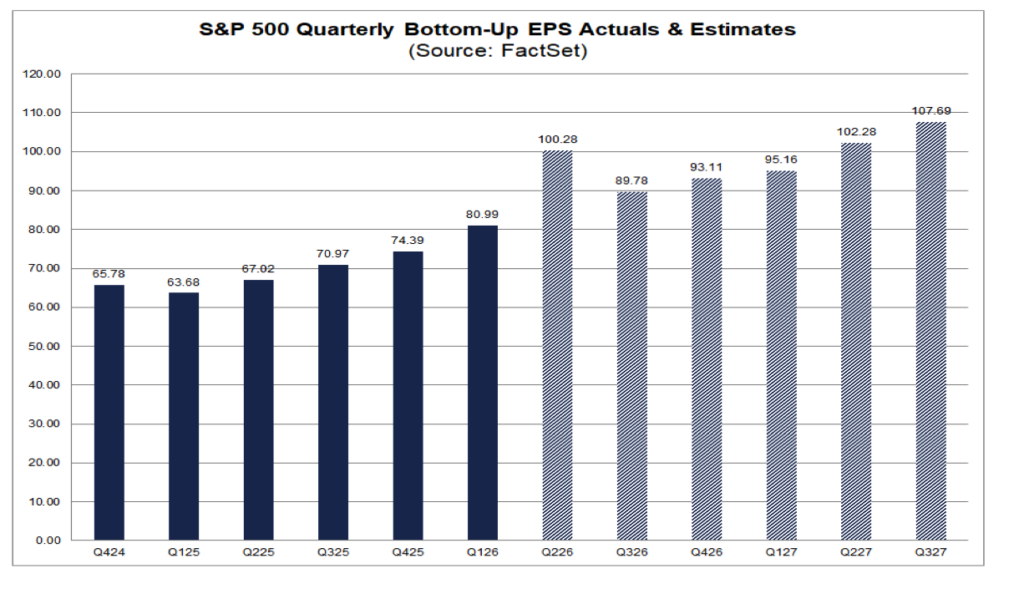
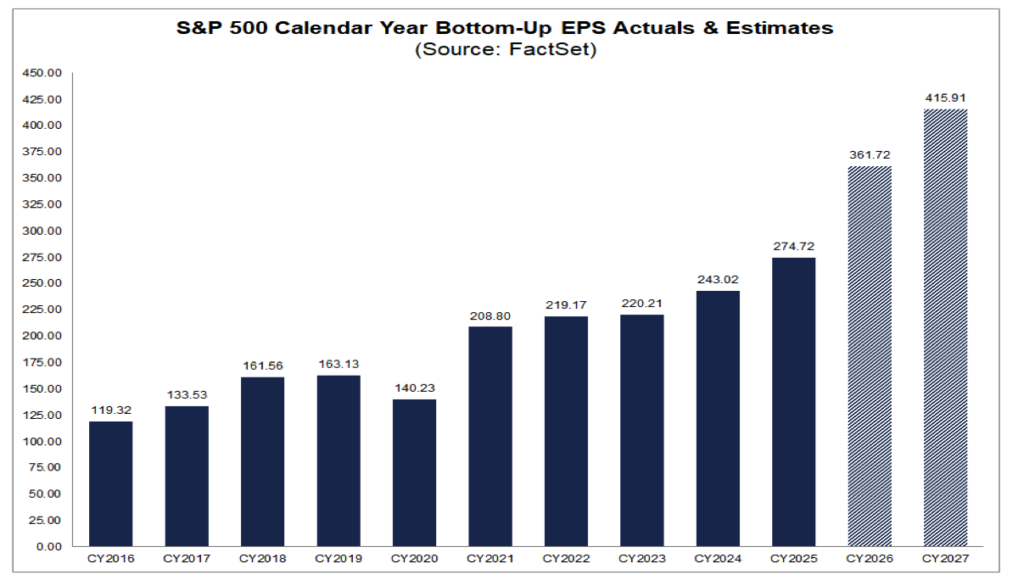
The other is larger in scale and speaks to the prospects for S&P 500 consensus EPS figures for H2 2026 and 2027. As we discussed in the August Monthly Roundup, expectations are sizable and the question we’ll be looking to answer is whether they are reasonable or ahead of themselves.
As the answer becomes clear, we’ll revisit the Portfolio’s positioning as needed, but we will continue to focus on companies benefitting from where capital from enterprises, consumers and governments is being spent. When tracking that spending, we’ll also be mindful of which companies are able to reap the benefits of accelerated depreciation under the “One Big Beautiful Bill” and how that can offset higher borrowing costs.
Enjoy your weekend, Saturday’s signals alert, and we’ll see you back here, bright and early on Tuesday morning. Have a wonderful holiday weekend!
Catching Up on the Portfolio This Week
The Portfolio lagged the market this week, but with a little over three weeks to go in the quarter, we remain in positive territory for the quarter, and ahead of the S&P 500 on a year-to-date basis. Helping on that front, the EPS All-Stars basket outpaced the S&P 500 this week. Other notable week to week gainers included Meta (META), Nvidia (NVDA), Marvell (MRVL), Apple (AAPL), Boeing (BA), Eaton (ETN), Morgan Stanley (MS) and Bank of America (BAC).
Despite the gains, the Portfolio’s overall performance was influenced by the week-to-week declines in Axon, Broadcom (AVGO) and Palantir (PLTR). Despite those near-term setbacks, we continue to see positive tailwinds for those holdings as well as the First Trust Nasdaq Cybersecurity ETF (CIBR) position.
On Tuesday, the growing likelihood that the Fed will deliver a September rate hike and the fall seen in mortgage purchase data in July and August led us to close out the Portfolio’s position in Builders FirstSource (BLDR). We took a small loss in the process, but we were able to put some of that capital to work in Boeing (BA) shares on Wednesday. We used the balance of that returned capital and some cash on hand Thursday to first add to the Portfolio’s position in heavy- and medium-duty truck company Paccar (PCAR), and later the same day, Applied Materials (AMAT).
Closing the week, the Portfolio’s cash position stood at 7.0% of its assets. Enough cushion for us to make some additional moves on the smaller side, but as we move through the month we will be looking for opportunities to increase cash ahead of the month-end reconstitution process for the EPS All-Stars basket. We are also interested in increasing our exposure to the Robo Global Robotics and Automation Index ETF (ROBO) and State Street Health Care Select Sector SPDR ETF (XLV), as well as a few select individual stock holdings. More to come on that front when we’re back from the holiday weekend.
Now, let’s turn and see what others on Wall Street had to say about the Portfolio’s holdings during this shortened but electric week for the market:
Monday: Barclays increased its Welltower (WELL) target by $5 to $259. Guggenheim trimmed its (TJX) target to $152 from $175, but reiterated its Buy rating. Deutsche Bank initiated coverage of Arista Networks with a Buy rating and $220 price target.
Tuesday: Wells Fargo boosted its Welltower price target to $266 from $237, while Morgan Stanley lifted its WELL target to $251 from $215. BofA increased it Microsoft target to $600 from $500. UBS added $20 to its Applied Materials target, resetting it at $695.
Wednesday: Scotiabank nudged its Welltower target to $251 from $244.
Thursday: Morgan Stanley lifted its Broadcom target to $505, while Macquarie reset its target at $490 and upgraded its rating to Outperform. BMO Capital increased its AVGO target to $575 from $455, while Evercore ISI took its to $578. Wells Fargo added $10 to its Amazon target, putting it at $338. Argus increased its Axon target to $600 from $460
Friday: Citi increased its AVGO target to $515 from $500 while Stifel boosted its Microsoft target to $530 from $450.
Key Global Economic Readings
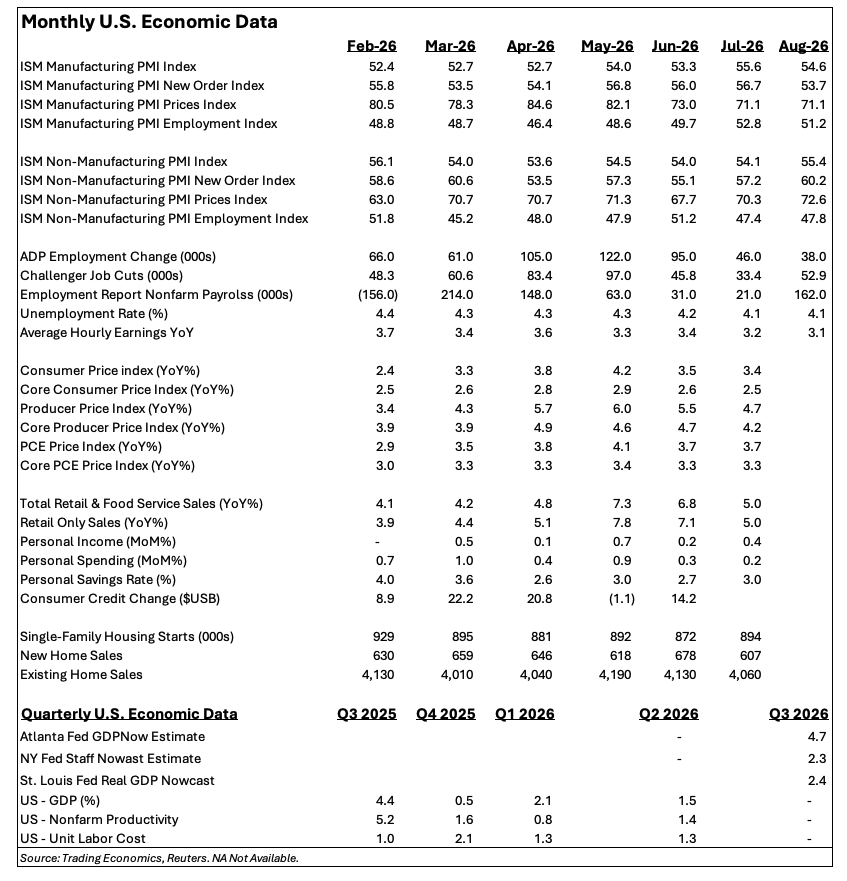
(Note: T is the most recent period, T-1 is the prior period’s reading, and T-2 is two periods back, the intent being to illustrate any trends.)
Chart of the Week: The Nasdaq Volatility Index
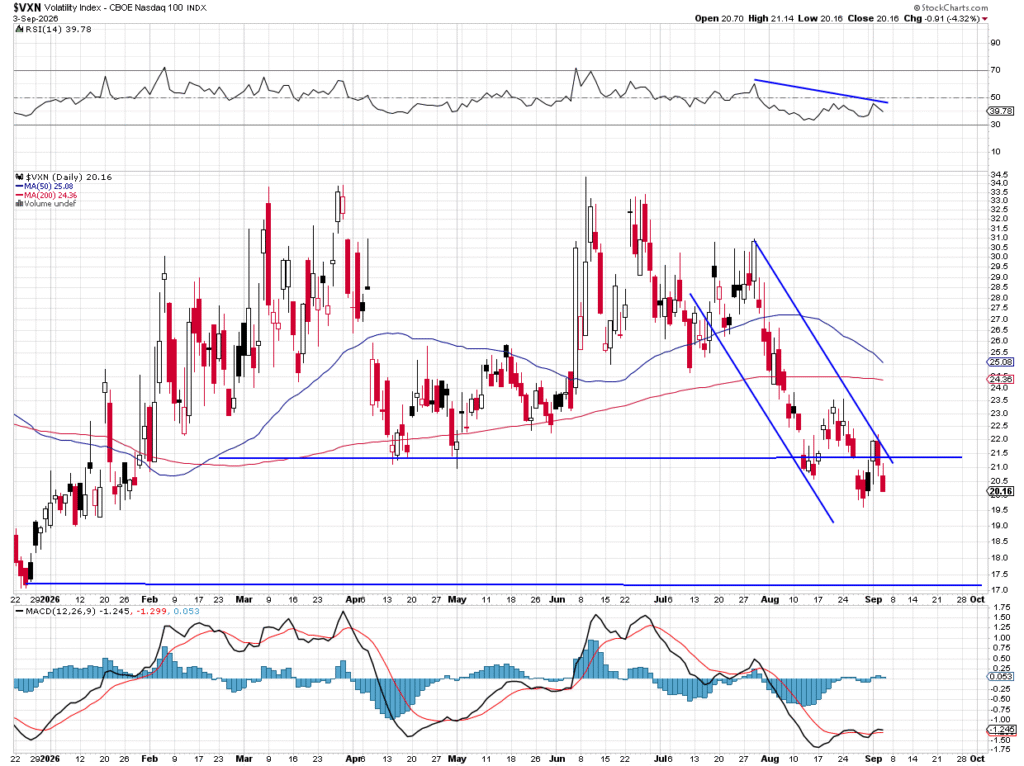
Market volatility (VIX) has reached its lowest levels of the year, but how about the Nasdaq 100? This instrument has been falling sharply since the index hit a speed bump in the summer. The Nasdaq volatility symbol is VXN, which measures the amount of volatility expect (implied) over the next few weeks. The current level is around 20%, which is the lowest we have seen since January of this year.
What exactly does a 20-level mean for the Nasdaq? Basically, 20 is a very low reading, and means there is very little worry or fear in the marketplace. That can cut in two directions of course, the first being more money can flow when traders/investors are not worried about a large move coming to the downside. On the other hand, the lack of worry creates a complacent attitude, the belief that down moves are not coming so why not put more capital at risk.
There is always something to worry about and the market should always be concerned and pricing in risk. It is these moments when there is a lack of sensibility and balance with investors/traders who only see an “all in” scenario that disaster can suddenly strike.
The chart of the VXN shows a downtrend, with lower highs and lower lows. The recent break of the $21 level was key to keep the momentum moving downward, the markets rallied in kind. Remember, markets generally move in opposite directions of the volatility indices. Could it go even lower? Sure, it can.
Since we are in September now there is the possibility that volatility will rise, the market lacks catalysts to move up and currently sits right near all-time highs. Earnings have been good, but the second quarter reporting is largely finished. With a positive return for markets in August maybe some profit-taking will happen, if the opportunity is there a volatility is low.
Other charts we shared with you this week were:
Monday, August 31: S&P 500 – Dangerous Complacency at the Wrong Time
Monday, August 31: Arista Networks (ANET) – Arista Networks Continues to Fight
Tuesday, September 1: Amazon (AMZN) – Amazon Flashes a Warning Sign
Wednesday, September 2: Boeing (BA) – Boeing Flies Low for Now, But That’s OK
Thursday, September 3: Apple (AAPL) – Looking at Apple as a New Chapter Begins
The Coming Week
As we break for the long weekend and next week’s compressed trading days, there will be a flurry of activity for us to work through. On the economic front, the reports that will captivate the market’s attention following the stronger-than-expected August Employment report that will put the Fed’s attention firmly on inflation are the ones for August CPI and PPI.
Based on the Price data contained in ISM’s Manufacturing and Service PMI reports for August this week, we are expecting the data to at best remain sticky. The more than 4% increase in the average price of oil in August compared to July adds to that thinking as did the move higher in gasoline prices. Should the CPI and PPI data come in hotter than expected, it would cement the likelihood of the Fed delivering a 25-basis point rate hike on September 16. Closing out the week, the CME FedWatch Tool puts the odds of such a move at 60%.
When we review next week’s inflation data, we’ll be sizing it up against the 3.1% year-over-year increase in average hourly earnings found in the August Employment Report. Should the inflation figures come in ahead of that wage gain figure, it would bring further support for our positions in TJX, Costco, and Amazon.
Here’s a closer look at the economic data coming at us next week:
U.S.
Tuesday, September 8
NFIB Small Business Optimism Index – (August) 6 AM ET
ADP Employment Change Report – (Weekly) 8:15 AM ET
Consumer Credit (July) – 3 PM ET
Wednesday, September 9
MBA Mortgage Applications Index – (Weekly) 7:00 AM ET
EIA Crude Oil Inventories – (Weekly) 10:30 AM ET
Thursday, September 10
Initial & Continuing Jobless Claims – (Weekly) 8:30 AM ET
Producer Price Index (August) – 8:30 AM ET
Existing Home Sales (August) – 10:00 AM ET
Wholesale Inventories (July) – 10:00 AM ET
EIA Natural Gas Inventories – (Weekly) 10:30 AM ET
Friday, September 11
Consumer Price Index – August (8:30 AM ET)
University of Michigan Consumer Sentiment Index, Prelim – (September) 2 PM ET
International
Monday, September 7
Eurozone: GDP Growth Rate, Employment Change (Q2 2026)
Tuesday, September 8
China: Imports/Exports (August)
Wednesday, September 9
China: Inflation Rate, Producer Price Index (August)
Thursday, September 10
Eurozone: European Central Bank Interest Rate Decision
Friday, September 11
U.K.: GDP, Industrial Production (July)
We have some quarterly earning stragglers next week, and among them we’ll be interested in what is said at Adobe (ADBE) about AI adoption and usage. From Kroger (KR), comments about food inflation and shifting consumer preferences to private label brands will be among the things we’ll be curious about.
Two other items for next week that will capture investor attention and ours as well are Apple’s (AAPL) Surprise and Shine event and the next step in Boeing’s union negotiations.
At Apple’s event, the company will unveil its latest iPhone hardware, including the anticipated foldable iPhone. The price tag for that new model is expected to be high, but we’ll be eyeing the price points for its new iPhone Pro models compared to ones on the shelves as well. We will also be looking to see how Apple integrates its revamped Apple Intelligence and Siri AI in the presentations. In our view, this offers the company a chance to wow the audience, and if it does so, that has the potential to ignite the long-awaited iPhone upgrade cycle.
With Boeing, because of the management team’s focus on lifting deliveries, revenue and cash flow, we suspect the company and the union will have a meeting of the minds. If that is the outcome reached, averting an early October strike, it would remove an overhang on the shares.
Here’s a closer look at the earnings reports coming at us next week:
Tuesday, September 8
Open: United Natural Foods (UNFI),
Close: Casey’s General Store (CASY), Mission Produce (AVO), ServiceTitan (TTAN).
Wednesday, September 9
Open: Chewy (CHWY), Sailpoint (SAIL), Signet Jewelers (SIG), Sunbelt Rentals (SUNB),
Close: AeroVironment (AVAV), American Eagle (AEO), Cooper (COO).
Thursday, September 10
Open: Macy’s (M), Shoe Station (SHOE),
Close: Adobe (ADBE).
Friday, September 11
Open: Kroger (KR).
Portfolio Investor Resource Guide
Economic Data: Here’s a List of Links to the Key Economic Data We Closely Watch
Investing Terminology: 16 Key Terms Club Members Should Know
10-Ks: Want to Know About a Stock? Read the Company’s Reports
10-Qs: Unlock the Numbers and Key Information Behind Your Stock With the 10-Q
Income Statement –Our Cheat Sheet to Understanding This Financial Document
Balance Sheet, Cash Flow Statements, and Dividends – How to Know If a Company Is Off-Kilter? Read Its Balance Sheet
Valuation Metrics – Everyone Wants a Value. Here’s How Investors Can Find
Thematic Investing 101 Webinar
Like the Benefits of ETFs? Let’s Talk About Models
The Portfolio Ratings System
1 – Buy Now (BN): Stocks that look compelling to buy right now.
2 – Stockpile (SP): Positions we would add to on pullbacks or a successful test of technical support levels.
3 – Holding Pattern (HP): Stocks we are holding as we wait for a fresh catalyst to make our next move.
4 – Sell (S): Positions we intend to exit.
More Pro Portfolio
- We’re Accumulating More Shares of This Oversold Holding
- We’re Tracking 23 New Signals Across Our Investing Themes
- August Monthly Roundup: Maintaining Our Lead Through the Ups and Downs
At the time of publication, TheStreet Pro Portfolio was long AXON, AMAT, ANET, GOOGL, MSFT, META, NVDA, MRVL, AAPL, BA, ETN, MS, BAC, AVGO, PLTR, CIBR, PCAR, ROBO, XLV, TJX, WELL and AMZN.