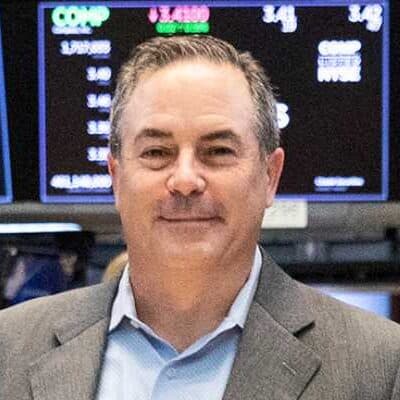
VIDEO: Rates vs AI Earnings Becomes Market’s Next Big Test
Waller’s rate-hike warning, PepsiCo’s outlook cut and TSMC’s 54% surge.
You've reached your free article limit
You've read 0 of 1 free Pro articles.
Earnings season kicks off next week, and the Fed is talking about more rate hikes. TipRanks’ Julie Gillespie sits down with Chris Versace to break down what it all means for your portfolio. Chris explains why Fed Governor Waller’s “hikes,” plural, matters, with the market now pricing in two to three by April.
They then walk through the two-speed market: PepsiCo (PEP) cutting its outlook as input costs climb, Costco (COST) winning wallet share as shoppers trade down, and Taiwan Semiconductor (TSM) posting 54% September revenue growth as the AI build-out rolls on. Versace also covers why tight chip capacity favors Applied Materials (AMAT), where he’s been buying the pullback (BA, AXON), and the one number he’s watching all earnings season.
More Pro Portfolio
- We’re Adding to This Holding After Averted Strike and Multiple Wins
- 26 Signals Across 9 Portfolio Themes
- September Monthly Roundup: 5 Focus Areas as Portfolio Keeps Its YTD Lead
Transcript
Julie Gillespie
Hey everyone, it’s Julie here with TipRanks, and I’m once again joined by Chris Versace from TheStreet Pro. We’re diving into some of the biggest headlines in the market this week. Chris, how are we doing today?
Chris Versace
Julie, I just got back from New York. I’m a little tired, and I’ve got to rest up. Earnings season really kicks off next week: banks, and then a whole slew of tech companies after that. But I think I’m up for the task.
Julie Gillespie
Perfect. Yeah, we’re going to have a lot to watch over the coming weeks with earnings season. But first, we’re going to dive into interest rates. Fed Governor Waller said this morning that more hikes are needed, though not necessarily immediately. How did you read that, and what do we expect for rate hikes in the coming months?
Chris Versace
Well, let me set the table for that, Julie. We’ve all seen the move higher in oil prices during September, and it’s getting a little bouncy here in October. But when we look at the underlying data in ISM’s September PMIs, we saw another leg up in the price components. And when we contrast that with what S&P found in its own September PMI, output prices are rising again. So it tells us that the inflation tailwinds are continuing to blow.
I think what Waller’s comments were saying is, A, no hike is likely in October. The market’s not expecting one, and I think we’ll want to revisit that potential after next week’s CPI and PPI data. But it’s the “s” — not “hike,” but “hikes” — that I think the market has to pay a little more attention to. We are well past the Fed’s 2% target, arguably creeping further past it. It’s going to take a little more than — what was it Warsh said — a dose of accommodation, or the removal of a dose, to really start clamping down on things.
But I’ll also say this: if you look at the market, it’s now calling for two, maybe three rate hikes by April. If you haven’t been paying attention to the CME FedWatch tool, Waller’s comment is probably new information for you. But if you’ve been watching that tool, I think you’ve been lobster potting it up with the idea that more hikes are increasingly likely.
The caveat here, Julie, is that if we see some resolution to what’s going on between the U.S. and Iran, and we see a sharp fall in oil prices, the market will have another opportunity to rethink the number of rate hikes as we get closer to the end of 2026, maybe into 2027, subject to timing. So for now, Waller’s saying: be warned.
Julie Gillespie
That is fair. Now, what does a hiking cycle mean for investors, and how should they position as we head into year-end?
Chris Versace
Well, to the extent rates are going higher, which is what we’ve seen, we’ve already seen some of the flow-through. Treasury yields are moving higher, and that raises the risk-free rate for investors. So we could see some capital come out of the markets, and that could pressure funding for IPOs, for example. That window is kind of closed, at least temporarily. We’re waiting to see what Anthropic does, maybe before Thanksgiving, if it elects to go forward with its IPO.
Then there are other interest-rate-sensitive areas. We’ve all seen mortgage rates climb to multiyear highs, and that’s going to weigh on the housing market. I think higher rates are also probably pulling a little interest out of REITs, because again, there’s a higher risk-free alternative.
So I think you just have to keep paying attention to where capital is being deployed: by companies — and boy, there’s a lot of data on that we could talk about this week — by consumers, where they’re continuing to spend, and I think we have something coming down the pike on that as well, and by other institutions. If you follow that rising demand profile, I think it’ll tell you where you want to be.
Julie Gillespie
Well, like I said, we’re going to touch on a couple of consumer stocks here. We did just hear from PepsiCo. You called them a bit of a litmus test for the other half of the S&P 500 that isn’t tech or tech-adjacent, and they did cut their outlook. So did they fail the test?
Chris Versace
I would say they are a barometer to watch for that other side of the S&P 500. And you set me up very well for this, as you always do, Julie. When we look at the market-cap-weighted S&P 500, 35% to 40% is tech, and roughly another 10% is tech-adjacent. So call it 45% to 50% tech or tech-adjacent.
When we think about the move higher in energy prices, transportation prices and other input prices, the question is how that’s going to affect earnings expectations and margins relative to what’s expected. And what’s expected is that the S&P 500 grows its EPS by 28% or 29% in the second half of the year, depending on the quarter. Smush it together and call it 27% plus. So some big numbers.
We do think tech and tech-adjacent will do well, given the spending I just mentioned. But these other areas are where some of the pressure could really come through, and PepsiCo just happens to be one of the first companies to report. And guess what? It has its own truck fleet, which means its comments on diesel prices will be important. It has a food business and a beverage business. What is it saying about input prices moving higher and the impact on margins?
And finally — and this is the real one I want to get to on the earnings call, which I haven’t listened to yet — what is it saying about its own pricing initiatives to preserve its margins? Because to the extent it does more pricing, that’s more inflation.
Julie Gillespie
Then we also had Costco, which just reported September net sales rising 13% to over $30 billion. That was one of its best months this year. So what was driving the acceleration?
Chris Versace
Well, again, tie it together. If the inflation tailwinds keep blowing, and potentially accelerating, the consumer is feeling that. We can trace it back to higher gas prices and the flow-through of transportation prices, diesel prices and the like. I also think consumers are seeing what’s unfolding on the geopolitical landscape, and they’re retrenching a little bit.
So where are they spending? They are continuing to spend, but Costco shows us that they’re trading down, looking for ways to stretch the disposable dollars they do have, including on gas, which is in that double-digit number you gave. But here’s the thing: when you look at a double stack for September 2026 — the reported numbers, and then what September 2025 did — it’s 5% on top of the numbers they put up this year. There’s no question Costco is continuing to win consumer wallet share, and I think that’s going to keep accelerating into the holiday shopping season, given how consumers are feeling.
Julie Gillespie
When we say Costco is winning wallet share, who is it taking it from? Who’s at risk?
Chris Versace
If you size up the retailers that just reported, arguably it’s just about everybody. Costco beat Walmart, it beat Target and the like. As I wrote in my comments this morning, this is not quite apples to apples. But when PepsiCo says its North American organic sales volumes fell, and then you trace Costco’s July, August and September numbers, it’s just another sign that Costco is where people want to shop, and it has the products people want.
Julie Gillespie
Perfect. Now we’re going to move over to the tech sector with TSMC. Its September revenue growth came in very strong. I think it grew a bit over 50%.
Chris Versace
Fifty-four. Fifty-four.
Julie Gillespie
There we go. Yeah, 54%. So huge growth there. Does that reinforce your view that we’re still in the early, early stages of the AI infrastructure buildout?
Chris Versace
Well, when you say “early, early,” that makes it sound like the first or second inning. I’m more of a third-inning guy, maybe fourth inning. So I’d say still relatively early.
We always like to track AI adoption and usage, and tracking that is going to get really interesting now, because we’re starting to see more agentic AI — Muse, for example, and OpenAI has Dots. That has the potential to take what was search-related AI, where you go to Claude or ChatGPT, do your thing and get your answer back, and turn it into enabling agents. That could really increase the amount of data being consumed and passed through the network and the data center. Depending on adoption, it could really drive massive usage.
So I think we’re still at a relatively early stage, and yes, I think TSMC’s numbers point to that. But I think they also back up a lot of the big forecasts we’ve had. Since we last talked, AMD came out and said it’s looking for more capacity. Marvell came out earlier this week and offered not only a very robust near-term outlook but robust multiyear guidance as well. And we can even dial that back to NVIDIA: I think Jensen Huang said its business would be up 70% next year and it’s still capacity constrained. All of that flows through to the manufacturing partners, including Taiwan Semiconductor. So I think the read-through, Julie, is: boy, what does TSMC say about capex when it reports next week? That’s what I’ll be watching.
Julie Gillespie
That’s going to be my next question. What do we want to hear from them on Oct. 15, when they release their full report?
Chris Versace
Well, obviously, the breakdown by end market. They have high-performance computing, which is where the AI data center sits. They have smartphones. Boy, wouldn’t it be interesting to hear what they have to say about that, the seasonal ramp and the outlook? Is there any read-through for Apple and the ramp of this new iPhone Duo? I think a lot of people will be trying to read the tea leaves on that.
But again, capital spending: what are they seeing there? That’s the read-through, at least for the portfolio’s position in Applied Materials. And I believe ASML reports right around the same time next week, so we’ll get a lot of nice back-to-back comments.
Julie Gillespie
Perfect. In your article this morning, you touched on chip capacity. You expect it to stay tight, and you specifically highlighted Applied Materials. What makes Applied Materials particularly interesting to you within the semiconductor ecosystem right now?
Chris Versace
To the extent chip capacity is tight — and it looks like it’s going to be that way well into 2028 — the chip manufacturers, Taiwan Semiconductor, Intel, Samsung and others, need more capacity. They have these big backlogs of business, and they can’t build it because they don’t have enough machines. Hmm. Who makes those machines? Applied Materials is certainly one of the key players there, and it’s one of the largest in the semicap industry. Am I biased because we own it in the portfolio? Arguably. But I’d strip the emotion out and say, look, we’re just going to follow the data, and I think that bodes extremely well for the company.
Julie Gillespie
We’re obviously seeing tremendous AI-related growth, but investors are also having to deal with interest-rate and inflation uncertainty. Which force do you think will end up mattering more for stocks over the next six months or so: earnings growth or the rate environment?
Chris Versace
I think the answer is both. If we look at how the market has behaved of late, it’s pretty apparent that tech and tech-adjacent have really been driving things. There are numerous articles about how it’s four, five, six, seven stocks that are really powering the S&P 500. If you follow the spending, that’s what you’re seeing, so that makes sense.
Those companies are going to have to keep putting up very good earnings, and things could get a little wobbly. With expectations so robust — “exuberant,” to quote a former Fed chairman — they could report great numbers on a year-over-year basis while the market’s whisper expectations are a little higher. We certainly dealt with that earlier this year. Could it happen again? It’s certainly possible.
Then there’s the other side, where not just interest rates but also higher input costs could weigh on margins and earnings. We’ve been in a bifurcated market, and I think we’re likely to remain in one. Having said that, if we look at some of the areas that have been hit hard — Boeing’s a great example, and Axon’s another — these are names we own in the portfolio. We’ve actually used the pullback to build up our positions in some of them, and I suspect we will again, because they’re solid businesses. Follow the capital. I think those companies might deliver a surprise relative to what the market expects, at least based on what the current stock prices are telling us.
Julie Gillespie
And to wrap it all up, what is one takeaway for investors as we head into another earnings season next week?
Chris Versace
It’s going to be violent. You’re going to want to compare, contrast and connect your dots. I’d say the figures to watch most are the consensus EPS expectations tallied by FactSet as we move through earnings season. FactSet reports them in its Earnings Insight report on Fridays, which is must reading, at least for me and several others I know. We’ll want to see whether the growth expectations for the back half of the year and for 2027 are ticking down or moving higher. That will be a telltale sign.
Julie Gillespie
Perfect. Well, as always, Chris, thank you so much for your time today.
Chris Versace
Happy to do it, Julie. I apologize for blathering on, but you ask the big questions.
Julie Gillespie
And I want the big answers. I appreciate you taking the time to explain them all and give your thoughts; it’s always very insightful. For all of our viewers, if you want to hear more of Chris’s thoughts, head over to TheStreet Pro and check out his articles there. And let us know in the comments below what you’ll be watching this earnings season. Thank you so much for watching.
At the time of publication, TheStreet Pro Portfolio was long AMAT, AXON, BA and COST.