Sometimes Bad Is Good, and Sometimes Bad Is Bad
Let’s sort through what those Friday jobs numbers mean for rate-hike chatter, what’s happening (or not happening) on the Strait, and why Trump is in a tough spot.
You've reached your free article limit
You've read 0 of 1 free Pro articles.

You Can’t always Get What You Want
No, you can’t always get what you want
You can’t always get what you want
You can’t always get what you want
But if you try sometime, you’ll find
You get what you need
– Richards, Jagger (The Rolling Stones), 1969
Friday was a day of beauty for financial markets. The marketplace got exactly what it needed, or maybe what it wanted. That “need” was a dreadful Bureau of Labor Statistics release for the U.S. July employment situation. For July, according to the BLS, the unemployment rate dropped from 4.2% to 4.1% and the underemployment rate held firm at 7.9%. Cool. Demand for labor must be quite robust, despite the advent and then advance of artificial intelligence. Right? Huzzah!
Not so fast, cowboy.
Going off of the household survey, participation dropped from 61.5% to 61.4%, as the civilian labor force shrunk by 264,000 people. The number of folks not in the labor force grew by 381,000. The number of employed persons contracted by 87,000. Not good. Moving on to the establishment survey, the nation apparently gave up 23,000 seasonally adjusted jobs in July. The revisions were nasty too. May dropped from job creation of 129,000 positions to just 63,000, while job creation for June dropped from 57,000 to 20,000. Hence that -23,000 non-farm payrolls print for July becomes a net -126,000 positions created relative to where we thought we were.
Why Was That Good for Stocks?
If you thought that such paltry job creation over the past three months brought the U.S. closer to an economic recession than maybe we thought, you’d be right. You’d also be right if you thought that maybe this report finally put to bed the foolish thoughts that some members of the FOMC had put out in the public square concerning the potential for a short-term interest-rate hike sometime soon.
I had been consistent on this. I had written and said across national financial media outlets that while some macroeconomic data-points were looking much better, labor markets were not strong enough to withstand an interest rate increase. This is obviously not something I enjoy being correct about, but it is now clear that unless these job creation numbers are somehow revised sharply higher, that even with higher energy prices, there is little chance for a rate hike soon.
Heck, every first-year economics student knows or should know that you can’t treat a supply shock by artificially restricting demand. That would be akin to treating a headache with a tourniquet and would be just plain stupid. I become more and more shocked as the years pass, by the level of underdeveloped economic thought produced by our central bankers. I mean you have to get your head out of your collective tails or just resign. It really is that simple. A Ph.D. in economics really has become worthless.
In the Meantime…
While it looks as if Iran may come to some kind of a deal with Oman, it does not look like the Strait of Hormuz will open safely to commercial maritime traffic any time soon. Iran is placing demands on the U.S. Though Iran has clearly taken a beating militarily, they are not defeated. On top of that, Iran appears to understand that time and domestic U.S. politics are close to being on their side if they can just not collapse for a little longer.
This leaves Pres. Trump in a very tough spot. What happens next, I can’t and don’t want to speculate. The spectrum of outcomes here ranges from the acceptable to the very, very awful. On top of that, it appears that Israeli Prime Minister Benjamin Netanyahu has rejected Pres. Trump’s plan to establish a permanent peace in Gaza. It’s hard to see how the U.S. president could have had a very good weekend.
The Week That Was…
Last week, the S&P 500 added a second consecutive winning week, that came after a two-week losing streak. Same for the Nasdaq Composite. The Nasdaq Composite closed Friday evening up 9.3% from its late July low. The S&P 500 is now up 6.1% over that same timeframe. Last week…
- The S&P 500 gained 0.62% on Friday and 3.58% for the week.
- The Nasdaq Composite added 1.3% on Friday and 5.19% for the week.
- The Nasdaq 100 tacked on 1.19% on Friday and 5.12% for the week.
- The Russell 2000 gained 1.1% on Friday and 3.52 % on the week.
- The S&P Small Cap 600 moved 0.76% ahead on Friday, gaining 2.41% for the week.
- The S&P Midcap 400 added 1.33% on Friday and 3.38% for the week.
- The Dow Transports tacked on 0.38% on Friday and 2.22% for the week.
- The Philly Semis gained a nice 2.56% on Friday and soared 9.24% for the week.
- The KBW Bank Index stacked on just 0.17% on Friday, gaining 1.59% for the week.
On Friday, nine of the 11 S&P sector SPDR ETFs closed out the session in the green. The Discretionaries (XLY) led for the day, while Energy (XLE) lagged. There was no clear outperformance across sector types, as the poor July employment data, though it may not have looked like it, slowed some cyclicals relative to some defensives.
For the week, eight of the 11 S&P sector SPDR ETFs finished the period in the green. Technology (XLK) easily led the way, and the semiconductors easily led tech. Arm Holdings (ARM) and Marvell Technology (MRVL) led the group. Again, Energy lagged. For the week, growth and cyclical type sectors outpaced the defensives.
Week Ahead
After yet another weekend pause in U.S. military operations inside Iran, the markets, or at least the algorithms that control the markets appear to be making an attempt to believe the headlines for now.
- The Geopolitical… Headline risk regarding the war in the Middle East will continue to have an oversized impact on financial markets. The tug of war now is over free passage through the Strait of Hormuz. The algorithms that control the point of sale in this modern era appear to trust the process a lot more than human traders probably would have.
- Macro…. This will be another huge macroeconomic week for economists, investors and traders. Major U.S. economic numbers set for release that will impact our marketplace this week would be July consumer price index on Wednesday, July producer price index on Thursday and July retail sales on Friday. Traders will also have to deal with July existing home sales (Tuesday), and the advance release of the University of Michigan Consumer Sentiment survey on Friday. On top of that, the U.S. Treasury Department will auction off $42 billion worth of new 10-Year Notes and $25 billion worth of new Thirty-Year Bonds on Wednesday and Thursday respectively.
- The Federal Reserve… Is it just me, or has new Fed Chair Kevin Warsh really reigned in the speaking members of the FOMC? I’m not just imagining this, right? It really seems like Fed officials have started taking on a lot less public speaking engagements since the new sheriff took over. That is a good thing as the endless posturing by what I believe are overeducated, but seriously under-qualified, individuals had reached epic proportions in recent years.
- Earnings…As we reach the later stages of the second quarter earnings reporting season, both the number of and quality of the names releasing results will start to dwindle this week. I know, we haven’t hit the retailers just yet. I get it, but this week will be light. Headline level names stepping up to the plate this week will include Simon Property Group (SPG) on Monday, CoreWeave (CRWV) on Tuesday, Cisco Systems (CSCO) on Wednesday and Applied Materials (AMAT) on Thursday. Other interesting releases could come from Rocket Lab (RKLB) on Monday, and Birkenstock (BIRK) on Thursday.
- In Addition….On Monday, Amazon (AMZN) will start charging fares for robo-taxi rides in Las Vegas. Then on Wednesday, Alphabet’s (GOOGL) Google will reveal its latest Pixel smartphones.
Charts
Readers will see that the S&P 500 finally broke out of our “Ascending Triangle” pattern of bullish continuation last week after we had all but given up on the pattern bearing fruit the week prior.
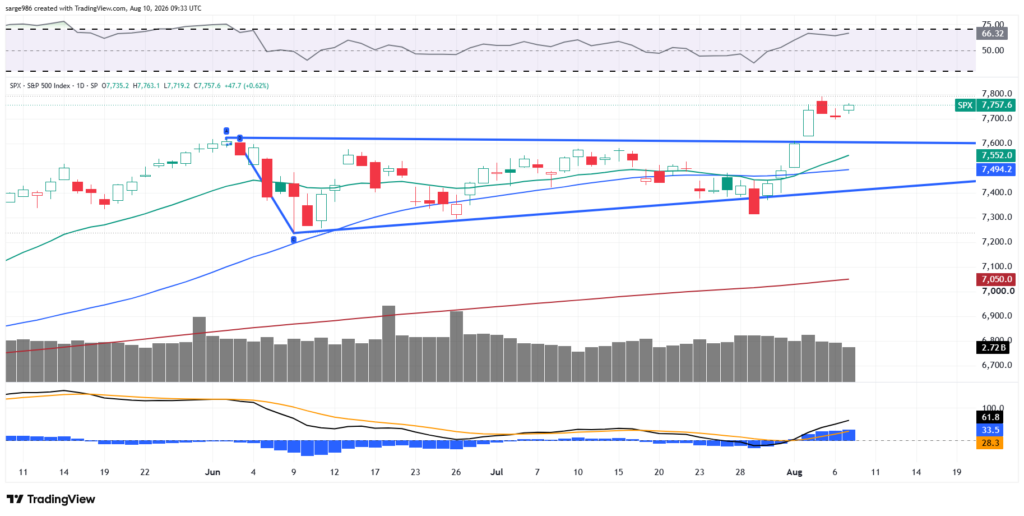
On Friday, the S&P 500 rallied broadly.
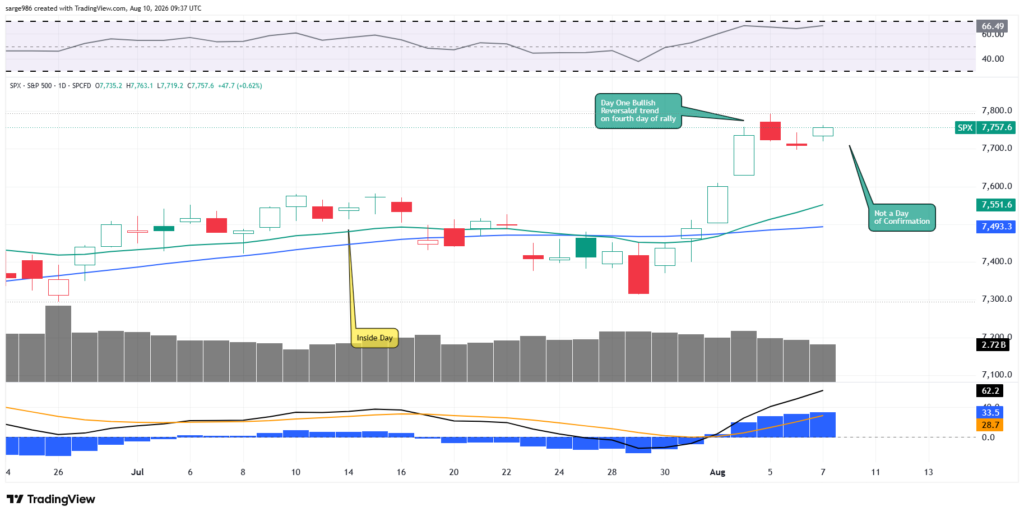
How meaningful was that rally? Well, my profits-losses liked it. That’s for sure. That said, On Tuesday, the S&P 500 finally generated enough trading volume to post a Day One Bullish reversal of trend on the fourth day of a rally. The next two days brought the necessary pause. Unfortunately, Friday, as great as it was, did not have the increase in underlying trading activity for a declaration of confirmation concerning the bullish trend.
That does not mean that we don’t have a rally. We’ll let the geopolitical risk crossed against macroeconomic performance / projected monetary policy and earnings figure that out. We just do not yet have technical confirmation.
Earnings
As of Aug. 7, according to FactSet, for the second quarter, Wall Street now sees blended (results and expectations) at an incredible year over year earnings growth rate for the S&P 500 of 50.4%, up sharply from 47.4% last week. Wall Street also sees revenue growth of 15.0%, up significantly from 14.1% one week ago. With 88% of S&P 500 companies having already reported for the season, 86% have beaten earnings expectations, while 76% have beaten revenue expectations.
For the full year of 2026, Wall Street now looks for earnings growth of 30.0%, up from 29.1% last week, and up from 14.7% about six weeks ago. This would come on revenue growth of 11.5%, up from 11.1% last week and up from 7.7% a month and a half ago. The outlook for the third quarter is also very positive. Third quarter S&P 500 earnings growth is now estimated at 27.4% year over year, flat from last week.
At the moment, the energy, communication services, consumer discretionaries and technology sectors are projected to have grown Q2 earnings by an absolutely jaw-dropping 147.0%, 117.0%, 91.6% and 70.4% respectively. Just one sector, health care (at -6.7%) is currently projected to have suffered a Q2 earnings contraction.
Valuation
Still using data provided by FactSet, the S&P 500 ended last week trading at 20 times twelve months’ forward-looking earnings, up from 19.6 times last week and down from 21.6 times a rough six weeks ago. This is back above the five-year average of 19.9 times for the index as well as being well above its ten-year average of 19 times. This is as much due to strong forward guidance as it is anything else and reflects a marketplace not really all that over-valued if these projections can be trusted.
The S&P 500 also ended last week trading at 28.2 times trailing twelve months’ earnings, up from 27.2 times just one week ago, and also above levels that the index reached more than two months back. This also stands well above the five-year (24.4 times) and ten-year (23.5 times) averages for the index.
Now four (down from five) of the eleven sectors are trading below their five-year average valuations. Six sectors, led by the Industrials (25.2 times) are trading at a premium to their five-year average valuation. One sector (Materials) is trading precisely in line with its five-year average. The four “undervalued” sectors according to their historical averages over five years are the Discretionaries, Technology, the Utilities and Communication Services.
Fed Funds Futures
Fed Funds futures trading in Chicago are currently pricing in a 56% probability for no change to be made to the current target range (3.5% to 3.75) for the Fed Funds Rate at the culmination of the next Federal Open Market Committee policy meeting on September 16th. That’s up huge from just a 37% likelihood a week ago at this time. There is now a 59% likelihood priced in a 25-basis point rate hike on October 28th.
There are no rate cuts fully priced in at any point in the future looking out towards year’s end 2027, though there is now a minority probability being priced in as early as July of 2027. There is now a second quarter-percentage point rate hike priced in (56% probability) for June of 2027.
Economics (All Times Eastern)
No major domestic macroeconomic data-points scheduled for release.
The Fed (All Times Eastern)
No public appearances scheduled.
Today’s Earnings Highlights (Consensus EPS Expectations)
Before the Open: MNDY (1.11)
After the Close: HIMS (-.05), RKLB (-.05), SPG (3.21)
At the time of publication, Guilfoyle was long RKLB, AMZN equity.