Market Looks Weak and There Is Risk to the Downside
A review of the ongoing technicals, oil questions and potential election results.
You've reached your free article limit
You've read 0 of 1 free Pro articles.

The question of “how much oil is getting out of the Middle East” has come up time and again. Often with the additional question of “if so much oil is getting out, why are prices still so high?”
We tried to address that in length last week, but let’s re-summarize as it is important. In a nutshell, why these reports are misleading:
- The reports don’t include Iranian oil, which, due to the boycott, has slowed to a trickle. That is probably between 1.5 million and 3 million barrels per day less.
- They don’t account for increased shipping time and shipping costs, helping elevate prices and slow delivery to refineries across the globe.
- It is difficult to measure how much is making it through the strait, with transponders off. What seems to happen is periodically a “convoy” makes it through, boosting flows, which are then dramatically reduced due to attacks and the time it takes for another group of ships to attempt it.
- Finally, and more importantly, diesel, LNG and fertilizer are not being exported at even half of the pre-war levels (by even optimistic estimates).
Technicals
Let’s just start with an updated version of last weekend’s (SOX) (semiconductor index) chart.
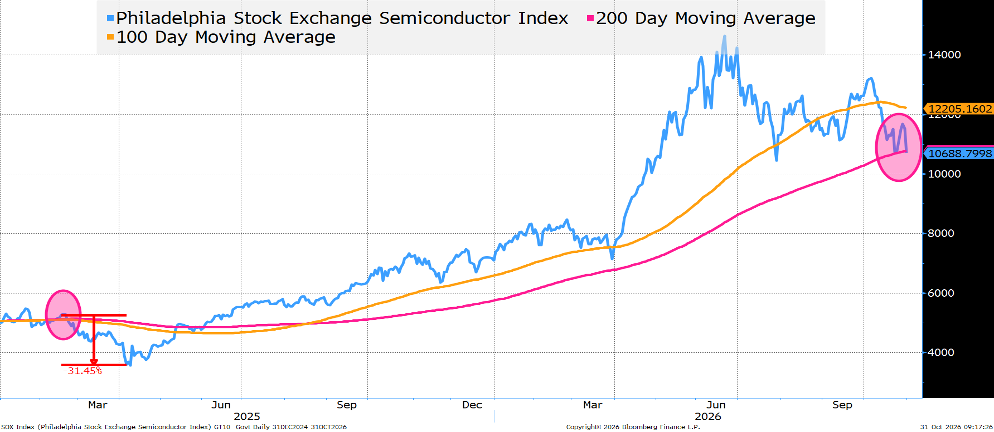
Markets initially bounced off of the 200-day moving average, but on Friday, they retested that level and failed. It is often the third retest that is the problem, so a bounce again is quite possible, but breaking the 200-DMA rarely is a good thing.
The Nasdaq 100 is solidly through its 100-DMA and is about 1.6% from testing its own 200-DMA. On Friday, the S&P 500 just broke its 100-DMA for the first time since November 2025. The 200-DMA is 3.5% away on the S&P 500, which should be support.
We are resorting to technicals more than usual because:
- The technicals are aligning with our views on risk and pricing quite well
- In a market that is whipsawing investors of all types on an almost daily basis, there is a tendency for risk managers to rely on technicals more than they would otherwise. That increased focus on technicals tends to make them work better than they otherwise do.
From what I see anecdotally and through some simple charts I like to use, the market is not exhibiting strength, and the risk is to further downside.
One positive is credit markets didn’t suffer as badly as stocks on Friday (spreads did not finish at their wides) and none of my indicators for “disorderly” selling pressure have triggered. I am watching those triggers as that is a risk that is still in play.
Mechanical
I remain concerned about the abundance of leveraged ETFs focused on the chip space (with (SOXL) being the largest). These amplify moves in both directions. While SOXL had some inflows on Friday, it would have had to sell about $8 billion of stocks into the close, without inflows. This added pressure makes it difficult to separate valuation from mechanically forced buying and selling.
With these indices all potentially exposed to some weak technicals, that makes me very cautious.
The chip sector is crucial for markets and for the economy. A degree of caution seems warranted at the moment, though we have all seen these markets turn on a dime.
Election
I will wait to see how Tuesday plays out. We have become accustomed to polls being inaccurate. Even betting markets failed in Brazil, which we avoided in an otherwise broad cross section of geopolitical risks and opportunities last Monday on CNBC. European stocks did outperform the U.S. last week, despite all the headlines.
I will be watching almost as closely (or more closely) how political leaders respond to the election results. That may be more telling for markets than the results themselves.
I do have a small concern that we could be in for more volatility from the elections than people are pricing in.
Bottom Line
The start of this week won’t be about bond yields. The Federal Reserve, I think, sent a message it will hike if necessary, but would only do so kicking and screaming. If anything, yields will respond to signs of economic growth or slowdown (driven primarily by the compute spend).
Credit outperformed stocks last week. While stocks finished at their lows in many cases, credit was not at the widest levels. This is very good. It is also good for equities that credit has been weak, but the weakness is targeted and the market is still trading in an orderly fashion. Credit not breaking (which remains a risk) provides strong support for stocks.
Tuesday and Wednesday will be interesting:
- Do the polls and prediction markets turn out correct? If so, that’s priced in. But I’m not sure they will turn out to be that accurate (yet again).
- Do politicians react to winning and losing the way we expect or will there be some wrenches thrown into the works, which markets won’t like?