Anatomy of a Meltdown
Let’s examine the responses to Alphabet’s and Amazon’s earnings and the other factors that led to last week’s ugliness. Also, a bright spot on the charts?
You've reached your free article limit
You've read 0 of 1 free Pro articles.

It started out well enough. A week ago, the action on Monday was indeed the beginning of a three-day winning streak for U.S. stocks. Anthropic had filed for its upcoming initial public offering and that sort of reignited for a few days, the AI trade. Then SK Hynix (SKHY) went to the tape with record single-quarter profits and the race to the upside was on. As readers well know, the euphoria was to be short-lived.
Quarterly earnings releases by high-profile tech giants, amid what is clearly a strong earnings season, would be the culprit. Not the midterm elections, which is something that I do believe is pressuring markets. Not the threat that the U.S. war in Iran will once again go hot after those elections though that is an issue. Earnings, which was something that we had seen as market-supportive.
Microsoft (MSFT) stepped to the plate early and posted a truly strong quarter. Microsoft actually beat expectations, as Azure showed impressive growth. On top of that, capital spending came in below consensus and free cash flow was a strength. If only they could all be Microsoft. Alphabet (GOOGL) reported alongside Microsoft and really spit the bit. Alphabet missed on both the top- and bottom-lines while posting negative free cash flow or what we in the industry call a “cash burn.”
Shares of Alphabet were punished severely. After a positive post-earnings start, Microsoft, though clearly “innocent”, was punished as well. The pain was just getting started. Amazon (AMZN) reported next. Perhaps nothing better describes the sour state of the U.S. consumer in late 2026 than Amazon’s retail and advertising businesses looking weak as the broader company missed expectations for both profits and revenue.
Shares of Amazon would join the high-tech/AI pity party. What was truly frightening for investors and traders was that Azure, Google Cloud and AWS had all performed very well. Yet, Alphabet and Amazon broadly underperformed. What if the broader, legacy businesses at these firms can no longer provide the cash flows to efficiently keep up the capex on the development of AI? Well, that is the very question that forced last week’s two-day beatdown. The worst was yet to come.
Lightning Strikes…
Then it happened. Intel (INTC) reported. The results were fine. Growth was strong. Guidance? Absolutely horrific. The company provided an outlook that went far beyond mere weakness. The data center? That story appears to be intact. The foundry? Growing and still losing money, but not the problem.
Nobody saw the now glaring weakness in PC demand coming, certainly not the C-Suite at Intel, which is a huge problem. This caused not just a monster selloff of Intel shares, but an awful rotation that popped the tech balloon. Intel caused a sell off that amounted to a 3.46% haircut for the Nasdaq 100 on Friday, a 4.89% beating for the S&P Tech sector SPDR ETF (XLK) and a 7.2% drubbing for the Philadelphia Semiconductor Index.
Other highly impacted names included SanDisk (SNDK), Qualcomm (QCOM), Advanced Micro Devices (AMD) and Marvell Technologies (MRVL). Those names all gave up at least 10% on Friday while Intel gave up 28.6%. For the record, I downgraded Intel to a “strong sell” on Friday, but cautioned that I intend to take my time trying to finesse my way out of what is now a negative performing long position dragging on my book.
This will be another heavy earnings week. I have two questions that have nothing to do with the election or the war.
One, Apple (AAPL) reports after the closing bell on Monday. Will the fact that Apple is seen as behind the other “Mag 7” names in the development of AI (and in AI-related spending) actually work in that stock’s favor?
Two, Advanced Micro Devices (AMD) reports after the closing bell on Tuesday. AMD, like Intel, has large exposure to the business and consumer market for personal computers. Intel CEO Li-Bu-Tan failed to warn investors and is being taken to task for that failure to lead. AMD CEO Lisa Su, who is broadly seen as an industry leader, has not warned either. Did she make the same mistake, or is AMD’s PC business not in the dire straits that Intel’s PC business appears to be in?
Catalysts for the Week Ahead…
- Earnings will remain front and center this week as the season rolls on. This (Monday) evening, we’ll hear from both Apple and Palantir Technologies (PLTR). Tuesday evening will bring us results from AMD and Amgen (AMGN). Over the final three days of the week, CVS Health (CVS), McDonald’s (MCD), Arm Holdings (ARM), Mckessoon (MCK), Qualcomm, Ralph Lauren (RL), Airbnb (ABNB) and Charter Communications (CHTR) among others will all go to the tape.
- Election Day is Tuesday. Recomposition of what party controls what house or perhaps the entire legislature, will influence sector performance. That said, I do believe that the coming post-election certainty, regardless of electoral outcome, will be a net positive for risk assets.
- That said, Pres. Trump has repeatedly claimed that U.S. forces could resume kinetic operations against the regime in Iran after the election. This would not likely be a market positive unless one is long crude oil, so this bears watching closely.
- On the macro side, this Friday is October “jobs day.” The Bureau Of Labor Statistics will release their consistently inaccurate estimates for monthly job creation, wage growth, participation and unemployment. Despite the fact that all of Wall Street knows that these estimates are little better than just having a blindfolded monkey throw darts at a dartboard, they do allow their trading algorithms to react. This is, in my humble opinion, so that momentum or price overshoot may force inefficiencies and those inefficiencies might create opportunity.
The Week That Was…
Equity markets had another rough week last week. Despite starting the week off with a three-day winning streak, equities were hit with a wicked rotation out of tech / AI stocks. The Nasdaq Composite posted its third consecutive losing week after having posted four straight winning weeks. The S&P 500 posted its third consecutive losing week and sixth in eight. This is how last week went for U.S. equities…
- The S&P 500 lost 1.82% on Friday and 0.57% for the week.
- The Nasdaq Composite gave up 2.86% on Friday and an even 2% for the week.
- The Nasdaq 100 gave back a nasty 3.46% on Friday and 1.98% for the week.
- The Russell 2000 surrendered 1.66% on Friday but gained 1.29% for the week.
- The S&P Small Cap 600 lost 1.22% on Friday but added 1.46% for the week.
- The S&P Midcap 400 slipped 1.22% on Friday but tacked on 1.26% for the week.
- The Dow Transports gained 0.47% on Friday and 1.43% for the week.
- The Philly Semis were roasted for a loss of 7.2% on Friday but lost just 0.84 on the week.
- The KBW Bank Index gave back 1.98% on Friday but added 0.87% for the week.
On Friday, surprisingly, six of the 11 S&P sector SPDR ETFs closed out the session in the green. The winners were led by energy (XLE), the itilities (XLU) and the staples (XLP). Technology (XLY) and communication services (XLC) led the losers and suffered quite badly.
For the week, nine of the eleven S&P sector SPDR ETFs finished the period in the green, which also might be considered to be somewhat surprising. Defensive sectors clearly outperform cyclicals while anything growth related was severely punished.
Earnings
As of Oct. 30, according to FactSet, for the third quarter, with 60% of the S&P 500 having reported, 82% of companies have beaten earnings expectations, while 70% have exceeded the consensus view for revenue generation. Wall Street now sees an estimated year over year blended (results & expectations) earnings growth rate for the S&P 500 of 30.2%, up from 29.1% two weeks back. Wall Street also sees revenue growth of 13.4% up from 12.6% at that time.
For the full year of 2026, Wall Street now looks for earnings growth of 32.9%, up from 32.8% two weeks ago. This would come on revenue growth of 13.1%, up from 12.7% at that time. The outlook for the fourth quarter is also very positive. Fourth quarter S&P 500 earnings growth is now estimated at 28.4% year over year, down from 28.6% two weeks ago. At the moment, the energy, and technology sectors are projected to have grown Q3 earnings by 146.4%, and 67.6% respectively.
Historically Undervalued
Still using data provided by FactSet, the S&P 500 ended last week trading at 18.7-times 12 months’ forward-looking earnings, down from 19.2-times a couple of weeks ago. This is below both the five-year average of 19.8-times for the index, and also the 10-year average of 19.1-times.
The S&P 500 also ended last week trading at 25.9-times trailing 12 months’ earnings, down from 26-times two weeks ago. This still stands well above both the five-year (24.4-times) and 10-year (23.6-times) averages for the index.
Currently, six of the 11 sectors are now trading below their five-year average valuations. Five sectors, led by the Industrials (22.8-times) are trading at a premium to their five-year average valuation. The six “undervalued” sectors according to their historical averages over five years are the discretionaries, technology, the utilities, the REITs, the materials, and communication services.
Fed Funds Futures
Fed Funds futures trading in Chicago are now pricing in a 72% probability for a hike of a quarter-percentage point to be made to the FOMC’s target range for the Fed Funds Rate on Dec. 9. Another quarter-point hike after that is now priced in (53% likelihood) for March 17 (with a new composition of voting-eligible committee members). There are no changes effectively priced in beyond March for as far as I can see.
Charts: Guess What I See on SOX?
Readers will note that on Friday, due to the increased trading volume and the visibly negative nature of the day’s trade, I have called a reconfirmation of the bullish change of trend that we had called on October 8th and had confirmed on Oct. 14. The S&P 500 quite decisively lost its 50-day simple moving average on Friday, meaning that some portfolio managers will start or already have started to reduce long side exposure to large or mega-cap tech.
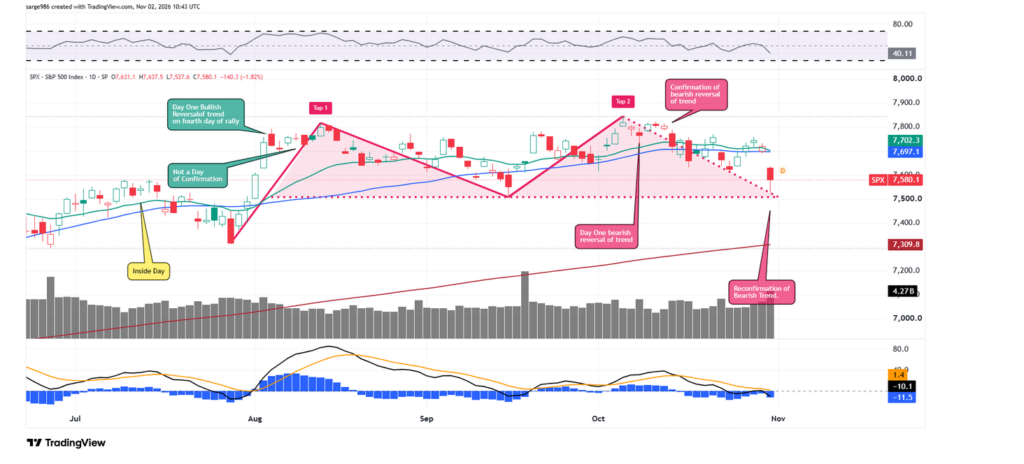
Relative Strength is showing some weakness while the daily MACD is starting to look more bearish. A rally on Monday would be nice, but the fact is that retaking that 50-day line is what is required for sustainable bullish activity to take root. Either that, or visible support at the 200-day SMA.
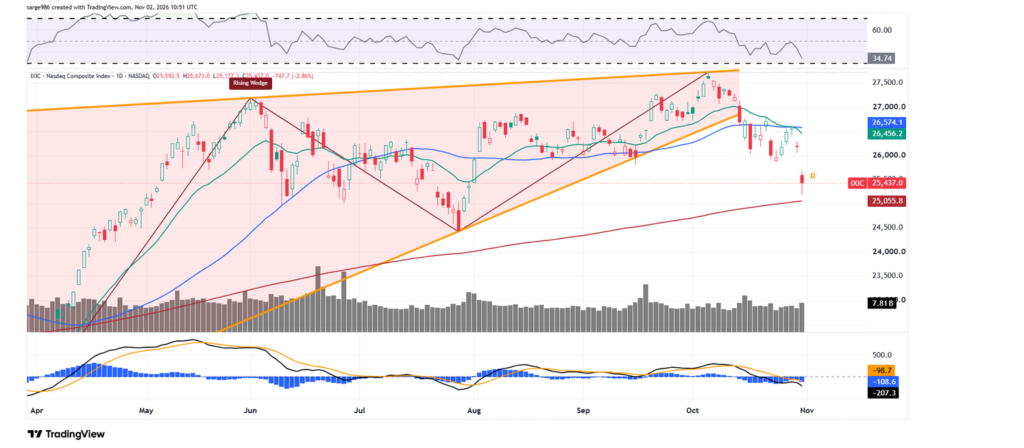
Let’s move on to the Nasdaq Composite. What I had once mistakenly described to you as a Large Pennant formation foretelling non-directional volatility, in hindsight, looks a lot more like a Rising Wedge pattern of bearish reversal. My apologies for the mis-identification. In my defense, I was stranded in Nevada at the time and working off of a laptop.
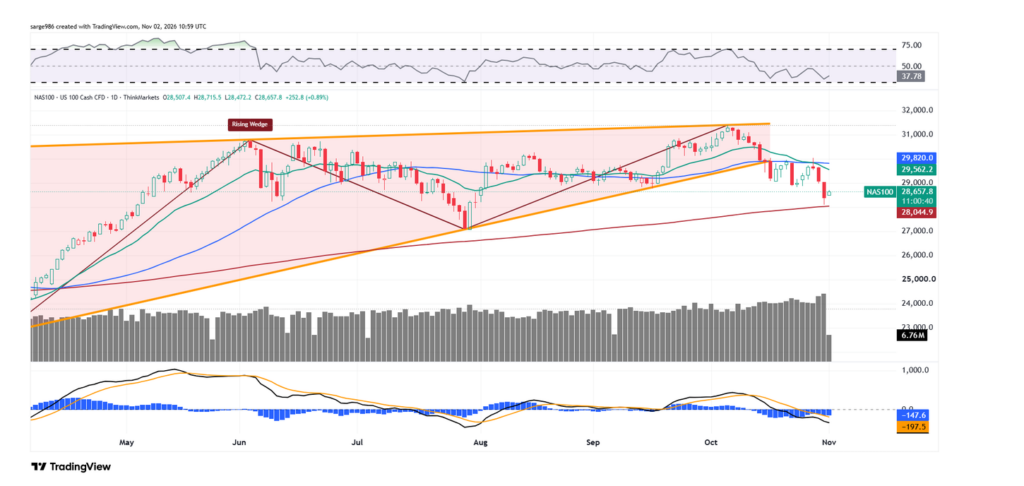
While Friday was distressing, Relative Strength is weak and the daily moving average convergence divergence looking bearish, this index does look like it may have found support at its 200-day simple moving average. No, that does not mean that an “all clear” bell has been rung, but it’s a whole lot better for the bulls than what we’ll see when and if that line fails to hold.
That support at the 200-day SMA is quite clear on this daily chart of the Nasdaq 100.That’s a spot of sunshine on a rainy day.
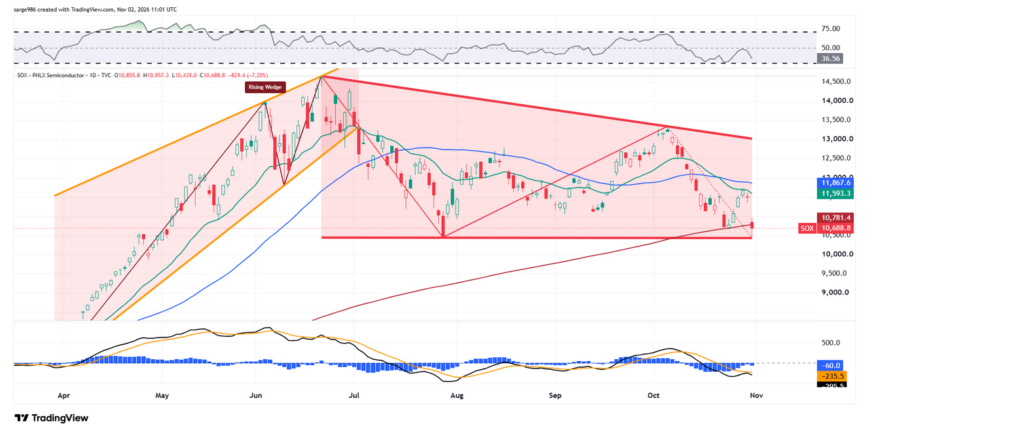
Now, the Philadelphia Semiconductor Index did actually pierce its 200-day SMA from the upside on Friday, but the level did not break. As we know, breaks only happen when contact is lost. Piercings are meaningless, technically. Very interestingly here, ahead of what we see above in the broader indexes, this industry-specific index is (I think) developing a Falling Wedge of (don’t say it) bullish reversal. Hey, I have to say what I see, even if I stand alone.
Economics (All Times Eastern)
09:45 – S&P Global Manufacturing PMI (Oct-F): Flashed 56.0.
09:45 – Chicago PMI (March): Expecting 62.2, Last 61.9.
10:00 – ISM Manufacturing Index (Oct): Expecting 54.7, Last 54.5.
10:00 – Construction Spending (Sep):
Expecting 0.4% m/m, Last 0.9% m/m.
The Fed (All Times Eastern)
11:15 – Speaker: Chicago Fed Pres. Austan Goolsbee.
Today’s Earnings Highlights (Consensus EPS Expectations)
After the Close: AAPL (1.98), ON (.88), PLTR (.41), ROKU (.55)
At the time of publication, Guilfoyle was long PLTR, MSFT, AMZN, INTC SNDK equity.