S&P Manufacturing PMI Eases from 52-Month High but Prices Rise the Most Since 2022
S&P October final manufacturing PMI revised down to 54.9 from the 56.0 flash, easing from September’s 52-month high, but hiring was the strongest in 5 1/2 years while selling prices rose the most since September 2022 and delivery delays were the worst since August 2022.
You've reached your free article limit
You've read 0 of 1 free Pro articles.
U.S. S&P Global Manufacturing PMI Oct F: 54.9 (est 56.0; flash 56.0, Sep 55.9)
Executive Summary
- The S&P final October manufacturing PMI fell -1.0 points to 54.9 from 55.9 in September, revised down from the 56.0 flash read, as growth eased from “September’s 52-month high.” The index still posted “above the critical 50.0 no-change mark for a fifteenth successive month” and “comfortably above trend.”
- Production slowed but rose for a 17th straight month and new orders grew at the slowest rate since March, but new export business “rose fractionally for the first time since June 2025.”
- Employment growth was revised lower but still the steepest in five-and-a-half years as backlogs rose for an 8th month at the steepest rate since April and supplier delivery times lengthened the most since August 2022.
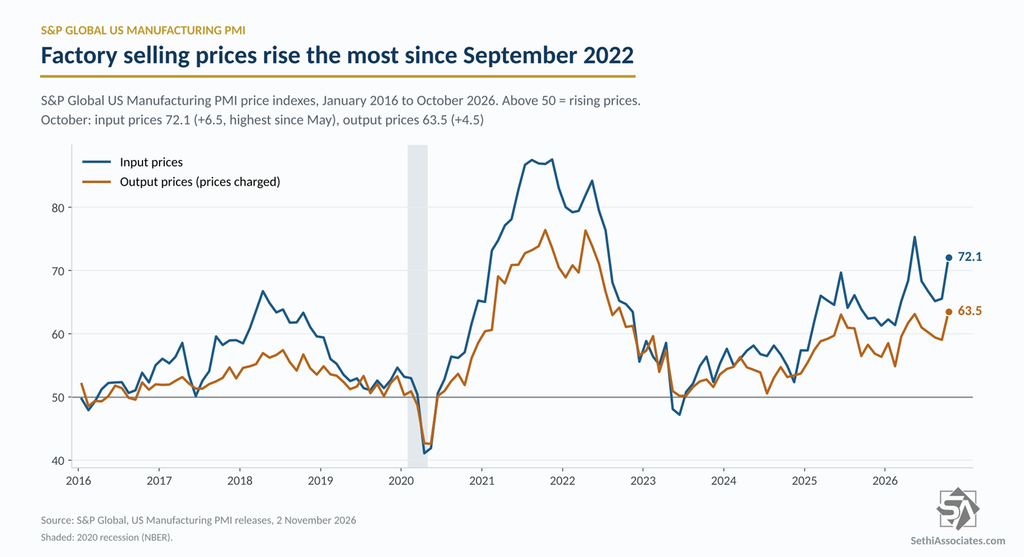
- Input cost inflation was the highest since May, and output prices rose at the fastest rate since September 2022.
- Per Williamson: “Such steep growth in factory gate prices will inevitably feed through to consumers in the coming months, keeping inflation well above the Fed’s target and adding to pressure on policymakers to raise interest rates further.”
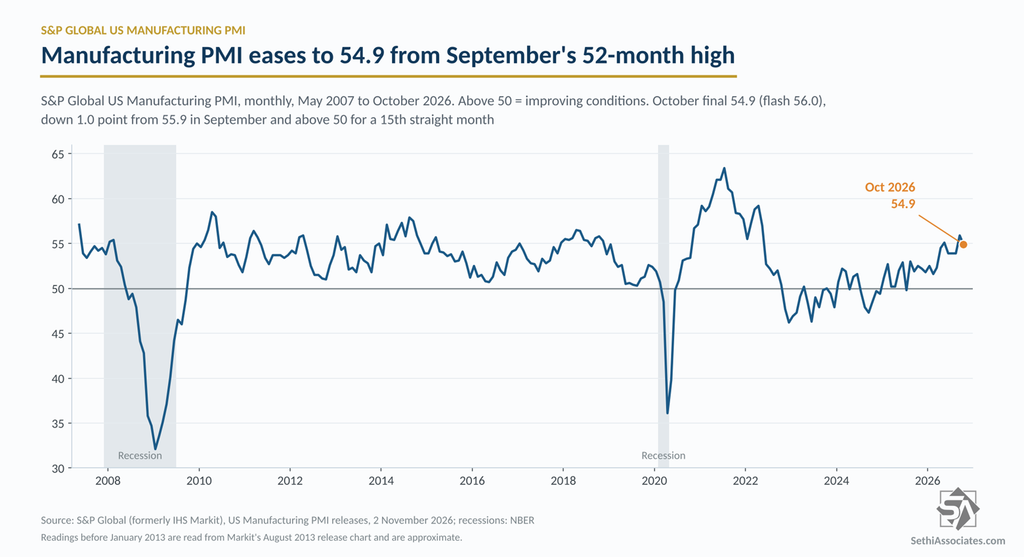
The S&P final October manufacturing PMI came in at 54.9, down -1.0pts from 55.9 in September and revised down from the 56.0 preliminary reading. The index still posted “above the critical 50.0 no-change mark for a fifteenth successive month,” with growth “again also comfortably above trend,” and the decline from “September’s 52-month high” pointing “to a slight softening of growth.”
Output and new orders both slowed, but hiring hit a five-and-a-half-year high and prices accelerated. S&P said “headwinds remained apparent,” “most notably related to input costs” and “supplier delivery times,” yet “firms retained sufficient confidence in the outlook to expand employment steeply.”
Looking more specifically at the components:
Production rose for a 17th successive month, though “like the PMI” at a slower rate, and was “closely associated with an upturn in new orders.”
New Orders increased at the slowest rate since March, but “growth was still solid and supported by generally stronger market demand and a stabilization of international sales (new export business rose fractionally for the first time since June 2025 although tariffs limited gains). There remained some reports of clients seeking to secure orders and lock in prices given widespread inflationary pressures.”
Backlogs rose for an 8th straight month at “the steepest since April’s near four-year peak,” as “delays in the delivery of certain inputs added to the pressure on plant capacity caused by rising new orders.”
Employment growth was the steepest in five-and-a-half years (although lower than the flash release which had factory jobs growth at the highest since March 2012), with manufacturers adding “to their staffing levels at a historically strong pace.”
Supply Chains/Purchasing/Inventories — delivery times lengthened the most since August 2022 “and at a historically elevated pace,” while purchasing rose for a 10th month and input inventories for a 7th — “Vendors were widely reported to be struggling to keep up with demand, especially for any products related to AI data center build outs, whilst simultaneously dealing with tariffs and the disruption caused to supply chains by the conflict in the Middle East…growth [in buying] again marked as firms sought to secure stock…Manufacturers also added to their input inventories, with modest growth.”
Input Prices rose at the fastest rate since May’s “near four-year high,” while Selling Prices rose the most since September 2022 — “Manufacturers widely reported that energy, fuel and transportation expenses had risen since September, and were key in driving up wider vendor prices. Tariffs also added to upward cost pressure, and metals like aluminum and steel were again reported to have risen in price. Faced with another atypical increase in input costs, many manufacturers saw little choice but to increase their own charges in October.”
Sentiment picked up from September “to a level broadly in line with its trend” — “Firms signaled positive business expansion plans and are hopeful of a pick-up in market demand despite some ongoing headwinds related to tariffs and broader global economic uncertainty.”
Comments from Chris Williamson, Chief Business Economist at S&P Global Market Intelligence, who notes the sector is sustaining “its best growth spell since early 2022” but warns rising factory gate prices add to pressure on the Fed to raise rates further:
“US factories continued to report strong expansion in October, sustaining the sector’s best growth spell since early 2022. The upturn is also generating jobs at a pace not seen for five-and-a-half years, during the surge in demand seen during the pandemic.
“However, growing pains are clearly evident, with factories struggling to meet strong demand, especially for AI-related goods and equipment, amid supply chain disruptions. Delivery delays, often linked to shipping and logistics issues, are more widespread than at any time since 2022.
“With demand often exceeding supply, producers have been increasingly able to pass higher costs on to customers, notably for energy-related inputs. October consequently saw another leg-up in terms of manufacturers’ selling price inflation to the steepest since September 2022. Such steep growth in factory gate prices will inevitably feed through to consumers in the coming months, keeping inflation well above the Fed’s target and adding to pressure on policymakers to raise interest rates further.“