ADP Hiring Beats as Job-Switchers’ Pay Growth Hits Fastest Pace Since 2024
ADP’s private payroll count comes in at 86,000 for a second month, while bonuses and overtime pushed job-changers’ earnings growth to its fastest since March 2024.
You've reached your free article limit
You've read 0 of 1 free Pro articles.

Executive Summary
- Private employers added 86,000 jobs in October, above the 75,000 Dow Jones estimate and matching a slightly downwardly revised September. It was the 16th straight monthly gain, and the three-month average rose to 69,000 from 55,000, its first increase since June.
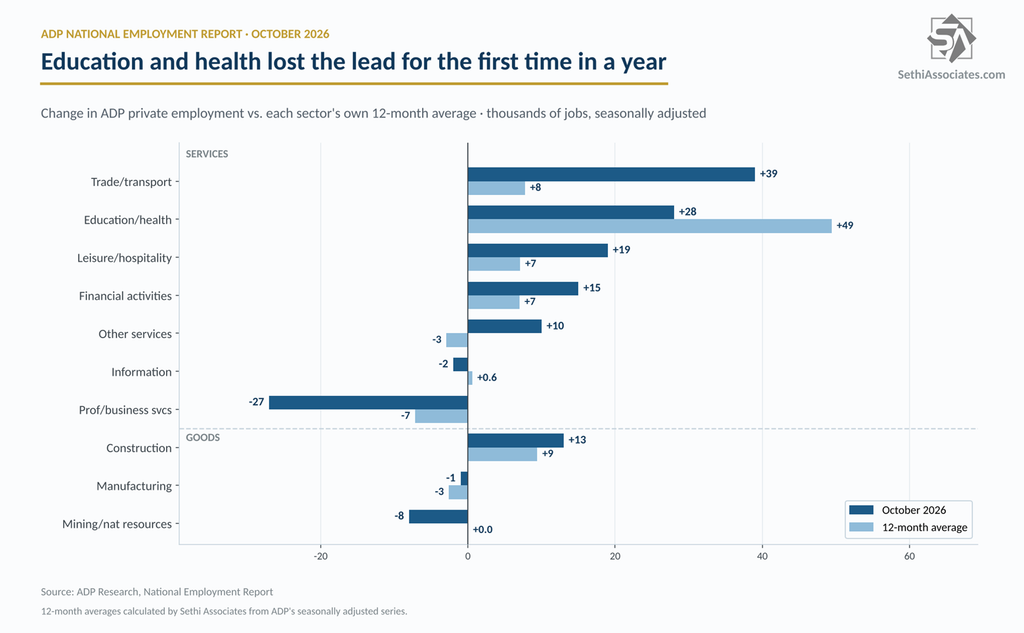
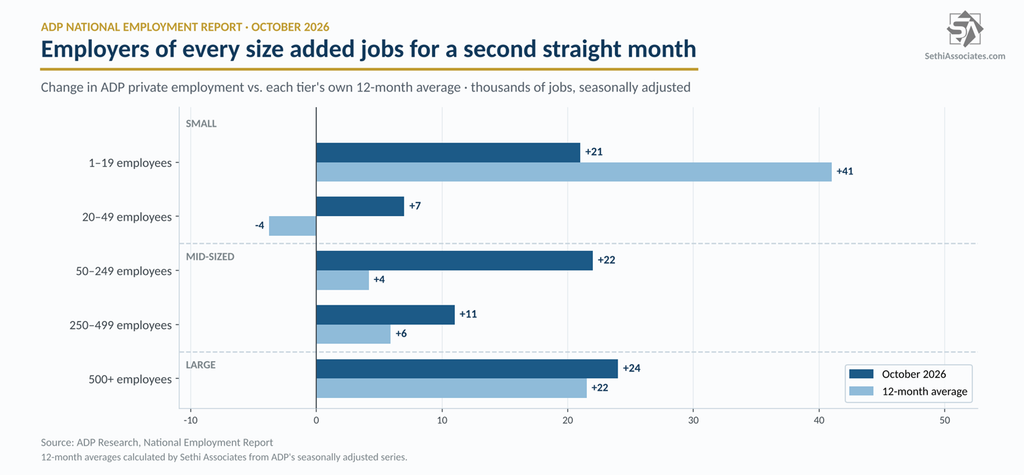
- Hiring was broad by firm size, with all five tiers adding jobs for a second month. Trade, transportation and utilities led at 39,000, ending education and health services’ 12-month run as the top sector. Professional and business services though lost 27,000, a third straight decline.
- Job-changers’ gross pay growth accelerated to 7.6% year-over-year, the fastest since March 2024, which ADP attributes to bonuses, overtime and more hours on top of higher base pay. Job-stayers held at 4.4% for an eighth month.
October ADP
Two straight months of 86,000 reversed the summer slowdown. Private payrolls rose 86,000 in October, according to ADP, after September was revised down from 90,000 to the same figure. That lifted the three-month average to 69,000 from 55,000, ending three straight months of declines from the June peak of 107,000.
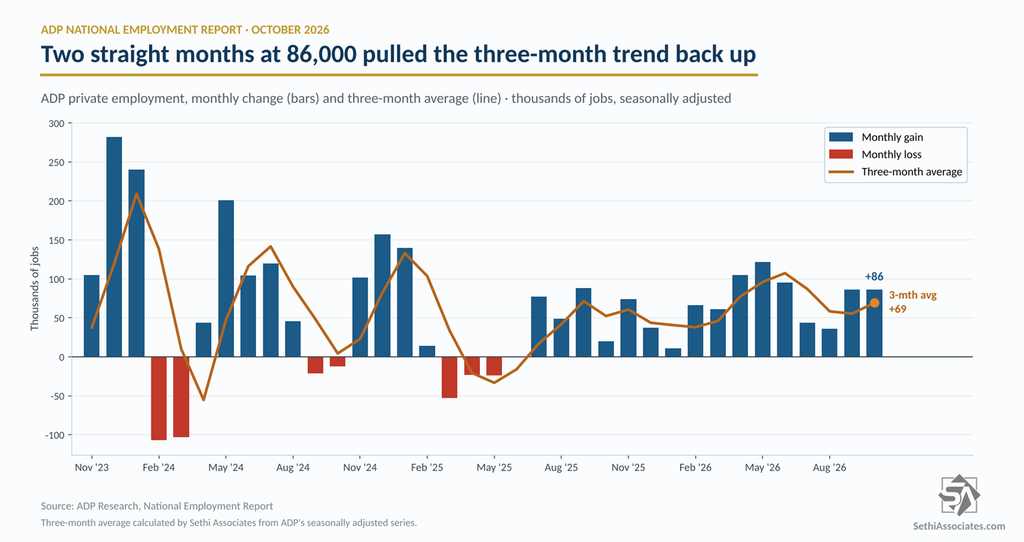
The bigger picture is that 2026 is running well ahead of last year. ADP’s private job growth totals 712,000 through October, an average of 71,000 a month, against 287,000 over the same 10 months of 2025. That squares with Fed Chair Kevin Warsh’s comment at the October 28 press conference that payroll growth is “noticeably above last year’s pace.”
Sectors
The leadership changed hands. Trade, transportation and utilities added 39,000, the most since January 2025 and roughly five times its 12-month average. Education and health services added 28,000, but that was the least since July 2025, ending a 12-month stretch as the biggest contributor. Leisure and hospitality added 19,000, and financial activities bounced back with 15,000, the best since December 2025, after a revised 20,000 loss in September.
The soft spot remains professional and business services, which lost 27,000, the worst since February and its third straight decline. It is now down 118,000 for the year, by far the weakest sector. Information lost 2,000.
Goods producers added just 4,000. Construction added 13,000 for a 10th straight gain, but manufacturing slipped 1,000 after a revised 16,000 gain in September, and natural resources and mining lost 8,000, its sixth straight decline and the most since October 2025.
Establishment Size
Every size tier added jobs for a second straight month, and the gains were unusually even. Firms with 500 or more employees added 24,000, firms with 50 to 249 added 22,000, and the smallest firms, with 1 to 19 employees, added 21,000. Firms with 250 to 499 added 11,000 and those with 20 to 49 added 7,000.
The smallest firms still account for the bulk of the past year’s hiring, 492,000 of the 823,000 total, but they have now run below their own 12-month average for five straight months.
Regions
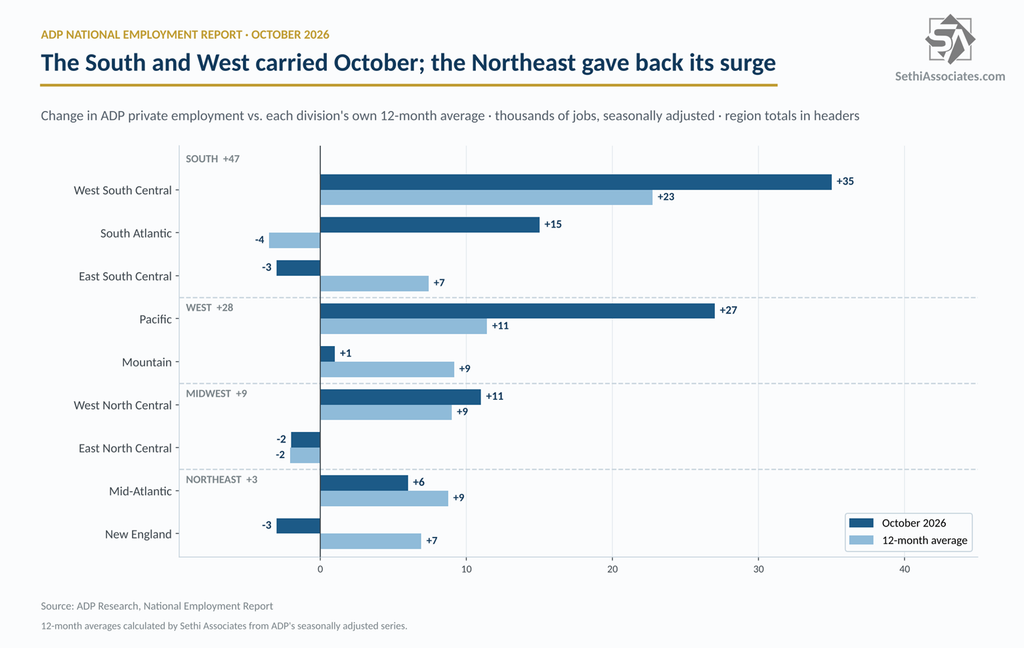
The South and West led regionally. The South added 47,000, the most since March, led by the West South Central’s 35,000. The West added 28,000 on a 27,000 gain in the Pacific division, its best since April. The Northeast, which led in September, added just 3,000, the least since March, as the Mid-Atlantic slowed to 6,000 from 51,000.
Pay Growth
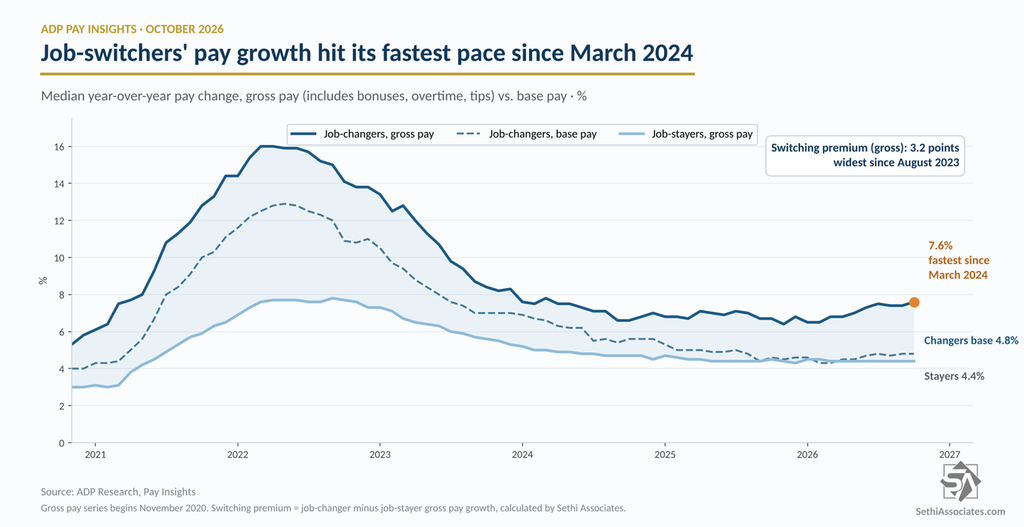
Job-changers’ gross pay growth jumped to 7.6%, the fastest since March 2024. That widened their premium over job-stayers, who held at 4.4% for an eighth straight month, to 3.2 percentage points, the widest since August 2023.
“Employers of all sizes were hiring last month, and our data suggests that job-changers were lured by a combination of bonuses, overtime, and more hours in addition to higher base pay,” said Nela Richardson, ADP’s chief economist.
Consistent with that, ADP’s base pay measure, which strips out those extras, shows a much smaller gain for job-changers, at 4.8%, and 3.0% for job-stayers. So the extra money for people switching jobs is coming mostly through bonuses and hours, not higher wage rates.
It fits with Tuesday’s JOLTS report, where quits, a gauge of workers’ confidence in finding another job, hit their highest since March 2025, as I covered in JOLTS Report Strong Across the Board.
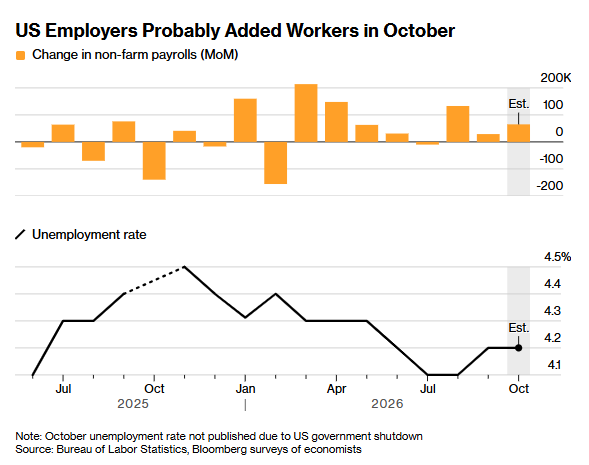
What to Watch
Friday’s government jobs report is the next test. Coming into the week, economists surveyed by Bloomberg expected it to show 65,000 jobs added in October after 29,000 in September (see The Week Ahead – Apple, Midterms and Jobs Test a Market on Edge). A print near ADP’s pace would back up Warsh’s view that the labor market is holding up while inflation “remains elevated.” The pay detail is worth watching too: if job-switchers’ bonus- and hours-driven gains start showing up in average hourly earnings, the Fed will have to pay attention.