S&P Services PMI Decelerates as Sentiment Slides
S&P’s final October services PMI was revised down to 56.1 from the 57.9 flash, easing from September’s high.
You've reached your free article limit
You've read 0 of 1 free Pro articles.

US S&P Global Services PMI Oct F: 56.1 (est 57.9; flash 57.9; Sep 58.8)
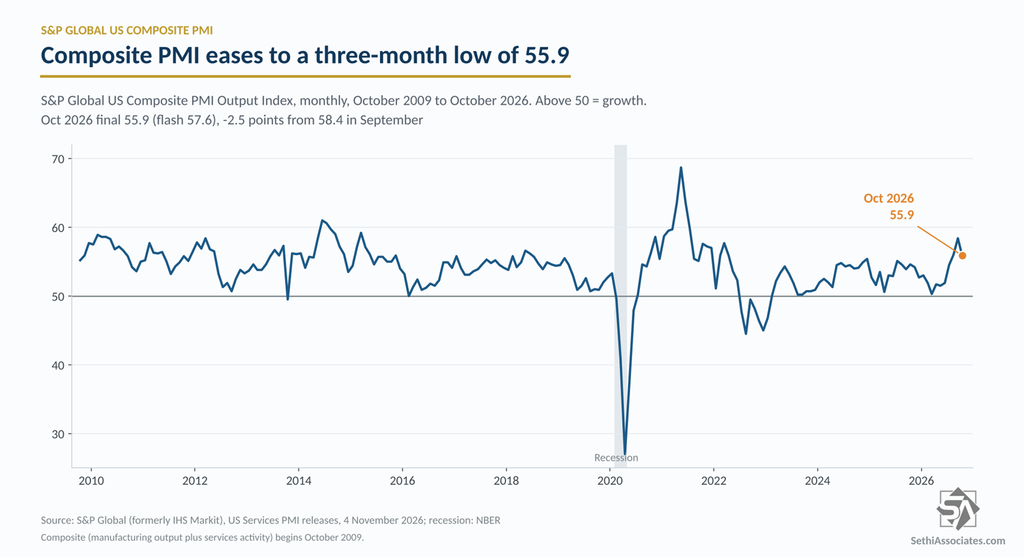
— Composite PMI: 55.9 (est 57.6; flash 57.6; Sep 58.4)
Executive Summary
- The S&P final October services PMI came in at 56.1, down -2.7pts from 58.8 in September and revised down from the 57.9 flash, but “comfortably above the survey average,” with output rising “for seven months in a row.”
- New business “rose sharply” and new export business grew for a third month at the best rate “since mid-2023.”
- Hiring rose for a fourth month, though at the slowest pace since July, while backlogs rose “to the greatest degree in four-and-a-half years.”
- Input cost inflation eased from September’s “near-four-year peak,” but selling prices rose the most since July, and sentiment fell to the lowest since May.
- The composite fell -2.5pts to 55.9 (revised down from the 57.6 flash), “the lowest in three months.” Per Williamson, the surveys are “indicative of GDP rising at an annualised rate of over 4%,” but “the good news on growth is tainted by yet another worrying intensification of inflationary pressures.”
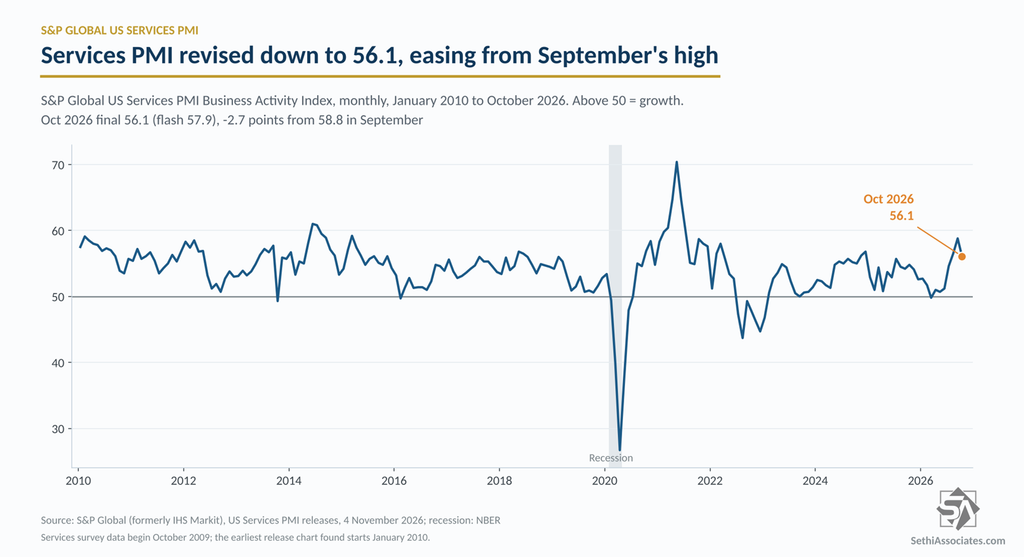
The S&P final October services PMI came in at 56.1, down -2.7pts from 58.8 in September and revised down from the 57.9 preliminary reading. Although “lower than September’s recent high,” the index “signaled a strong rate of growth that was comfortably above the survey average.”
The forward-looking details though softened. Per S&P, “growth rates for activity and new business were below September’s recent highs, reflecting elevated inflation and heightened uncertainty in the outlook.”
Looking more specifically at the components:
Output “has now risen for seven months in a row, and the latest expansion was again closely associated with a rise in incoming new business.”
New Orders “rose sharply” despite “reported headwinds of elevated inflation, high interest rates and associated market volatility,” with new export business up for a third month at the best rate since mid-2023 — “Demand was reported to be high, and pipelines of new work were positive with some success converting enquiries into hard contract wins.”
Employment rose for a fourth successive month, though at the slowest rate since July, down from “September’s 51-month peak” — “Companies were keen to expand employment to help support new business and as part of company expansion plans.”
Backlogs rose “to the greatest degree in four-and-a-half years” and “in each of the last 20 months,” as “present capacity was insufficient to keep on top of overall workloads.”
Input Prices eased from September’s “near-four-year peak,” but the rate of inflation was “higher than the average for 2026 so far,” while Output Prices rose the most since July — “Companies reported that operating expenses were being driven up by higher fuel prices, which raised prices for a wide range of other goods and services, especially food and associated transportation services.”
Sentiment fell to the lowest since May, “notably below its typical level” — “Inflation and its impact on client budgets, plus some uncertainty regarding the future path of federal government policies, weighed on service providers’ confidence in October.”
The S&P Composite Index (Services + Manufacturing) fell -2.5pts to 55.9 from 58.4, revised down from the 57.6 flash, “the lowest in three months” — “amid weaker gains in both manufacturing production and service sector activity…Private sector new business continued to rise sharply, underpinned by a strong contribution again from services, whilst jobs growth overall remained positive. Cost pressures remained elevated, despite softening since September. Output charges meanwhile rose to the greatest degree since August 2022.”
Comments from Chris Williamson, Chief Business Economist at S&P Global Market Intelligence, who notes the surveys point to GDP growth of over 4% annualized at the start of the fourth quarter, but warns of intensifying inflation and weaker forward-looking indicators:
“The October PMI surveys mark a strong start to the fourth quarter for the US economy, indicative of GDP rising at an annualised rate of over 4%. The star of the upturn remains the tech sector, but encouragingly solid supporting performances are also being seen in consumer-facing sectors and financial services.
“However, the good news on growth is tainted by yet another worrying intensification of inflationary pressures and some disappointing forward-looking indicators from the survey.
“Although current output growth remains strong, the pace of expansion has slowed from recent highs, linked to slower gains in order book inflows and reduced confidence about the economic outlook.
“Business optimism fell sharply across the vast services sector in October, reflecting worries relating to affordability, interest rates, and the uncertain political environment.
“Average prices charged for services meanwhile rose at one of the fastest rates seen over the past four years. Combined with a jump in goods prices tracked by the October manufacturing PMI survey, the overall signal is for inflation to rise further above the Fed’s target in the coming months.“