ISM Services Cools, But 12-Month Average Rises for 10th Straight Month
ISM’s services index eased to 54.5 in October, a 28th month of expansion, as all 10 indexes were in expansion, hiring grew for a second month and backlogs rose to the highest since July 2022, but ISM warned ‘more pricing pressure is on the way.’
You've reached your free article limit
You've read 0 of 1 free Pro articles.

- US ISM Services Index Oct: 54.5 (est 54.8; prev 54.9)
- Prices Paid: 73.0 (est 74.6; prev 74.0)
- New Orders: 55.9 (est 58.5; prev 59.8)
- Employment: 51.4 (est 50.0; prev 50.1)
Executive Summary
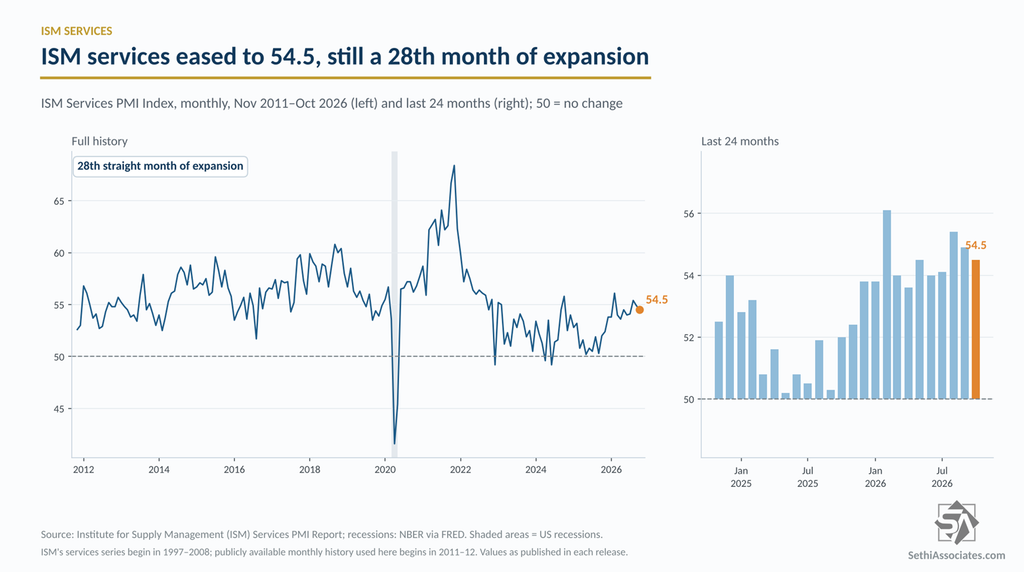
- The Institute for Supply Management (ISM) services index eased 0.4 point to 54.5, a 28th straight month of expansion, and the 12-month average rose for a 10th straight month.
- Business activity and new orders cooled further from August’s multiyear highs, but for a third straight month just Construction saw falling orders.
- For the first time since February, and only the second time since March 2021, all 10 of ISM’s services indexes were in expansion. Employment expanded for a second month, and backlogs hit the highest since July 2022.
- Still, Goldman Sachs called the composition of the report “mixed-to-weak,” with employment up but business activity and new orders down.
- Prices paid eased to 73.0 but have been above 70 in seven of the past eight months. Again this month no industry reported paying lower prices. ISM said many respondents haven’t yet passed higher fuel and tariff costs on to customers, signaling “more pricing pressure is on the way.”
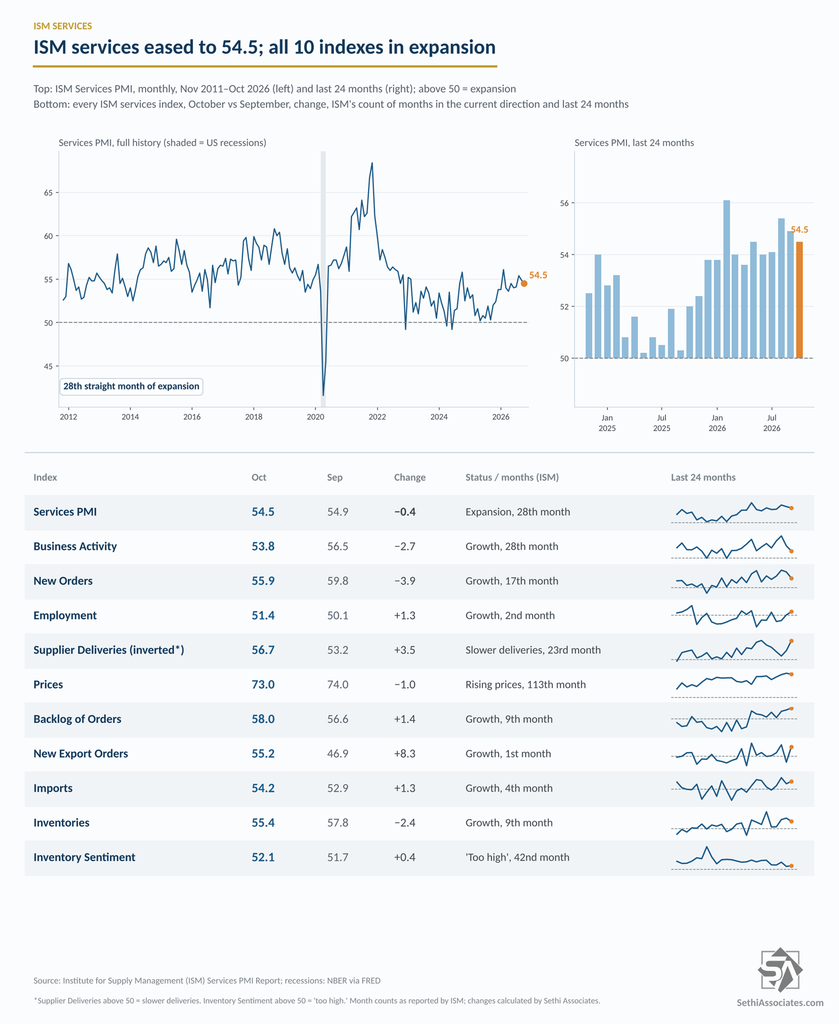
October ISM Services
The ISM services index fell 0.4 point to 54.5 in October, the lowest since July and below expectations of 54.8, but still the 28th consecutive month of expansion. It has now expanded in 65 of the last 68 months; the last contraction was in June 2024. The reading is 0.2 point above the 12-month average of 54.3. That average has now risen for 10 straight months and is up 2.6 points from 51.7 in December.
According to the report, the reading corresponds to 2.0% annualized growth in real gross domestic product (GDP), down from 2.1% in September, marking the 77th straight month of overall economic expansion.
S&P Global’s survey, which covers generally smaller and more domestically focused companies, also slowed. Its services index was revised down to 56.1 from the 57.9 flash, from 58.8 in September, though it remained “comfortably above the survey average.” S&P Global Chief Business Economist Chris Williamson said the surveys are “indicative of GDP rising at an annualised rate of over 4%,” but “the good news on growth is tainted by yet another worrying intensification of inflationary pressures and some disappointing forward-looking indicators.” Goldman’s breakdown though showed the S&P downward revision revision was broad, not just the headline: Goldman Sachs noted the final reading revised down new business, employment and both the input and output price measures
The Components
For the first time since February, and only the second time since March 2021, all 10 of ISM’s services indexes were in expansion. Still, Goldman Sachs called the composition of the report “mixed-to-weak,” with employment up but business activity and new orders down.
In that regard, all four components behind the headline remained in expansion, and employment and supplier deliveries both accelerated.
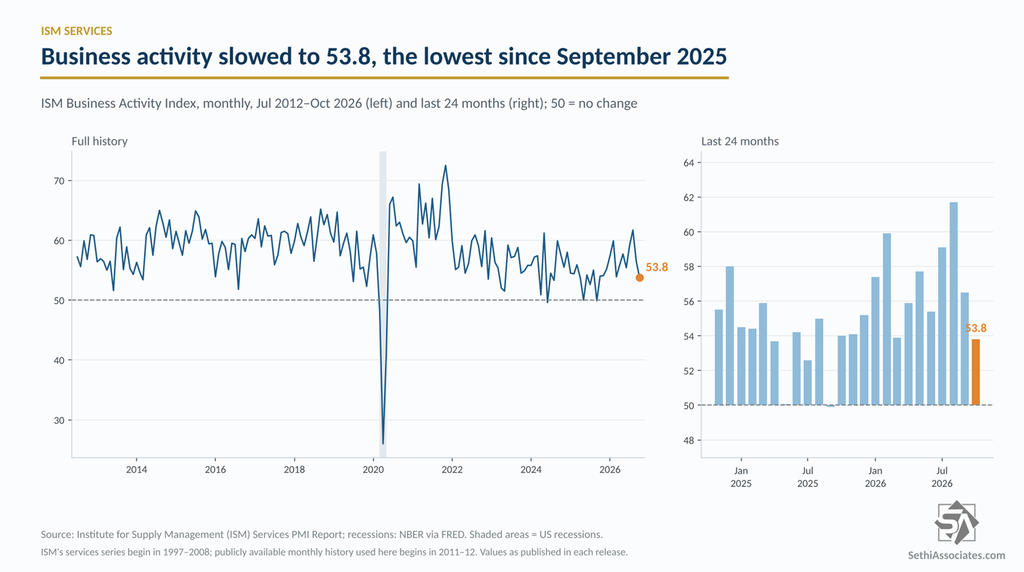
Business Activity though fell 2.7 points to 53.8, the lowest since September 2025, decelerating further from August’s 61.7, which was the highest since November 2022 (62.7). Still the index has now expanded for 28 straight months. It sits 2.9 points below its 12-month average of 56.7, which was unchanged. Thirteen industries reported growth (up from 12) and two reported declines (down from three).
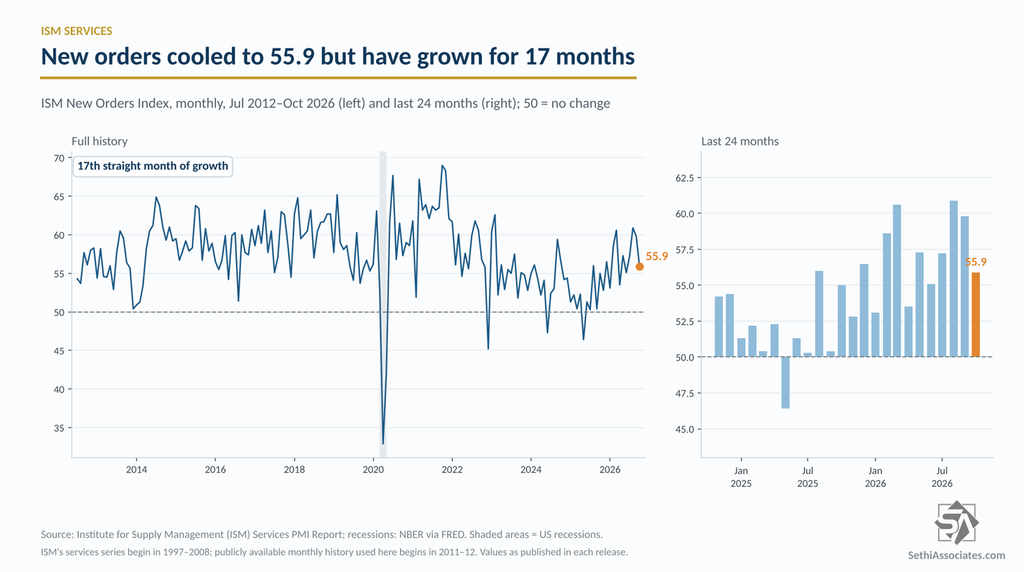
New Orders fell 3.9 points to 55.9, the lowest since June but a 17th consecutive month of expansion. That’s also down from August’s 60.9, the highest since February 2023 (61.0). Fifteen industries reported growth (up from 13). For the third month in a row, Construction was the only industry reporting a decline, with one respondent noting “excess speculative home inventory must sell before we can start new ones.” S&P Global, by contrast, said new business “rose sharply.”
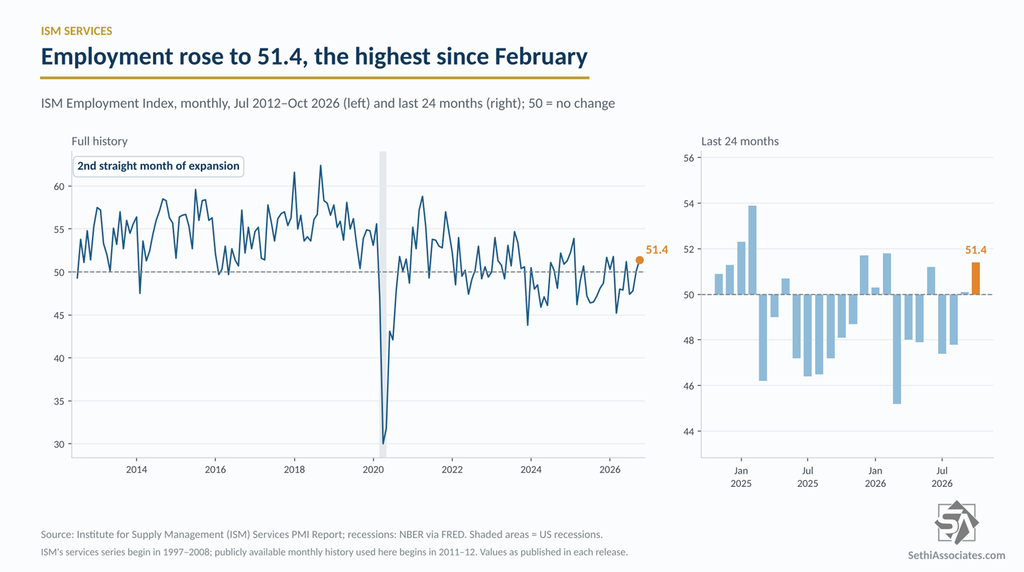
Employment rose 1.3 points to 51.4, the highest since February, expanding for a second straight month. It’s now 2.1 points above its 12-month average of 49.3. That follows a stretch in which the index was below 50 for 13 of the 18 months through August, including a drop to 45.2 in March, the lowest since December 2023.
Six industries reported higher employment (down from seven) and seven reported decreases (down from eight). The share of respondents reporting lower employment eased to 13.5% from 16.2%. Steve Miller, chair of ISM’s Services Business Survey Committee, said the second straight reading above 50 “may indicate help is on the way for slowing supplier deliveries and increasing order backlogs.” Respondent comments ranged from “increasing employment to support business growth and new contract awards” to “less people, more work equals frustration.”
S&P Global showed hiring rising for a fourth month, though at the slowest rate since July, down from “September’s 51-month peak.”
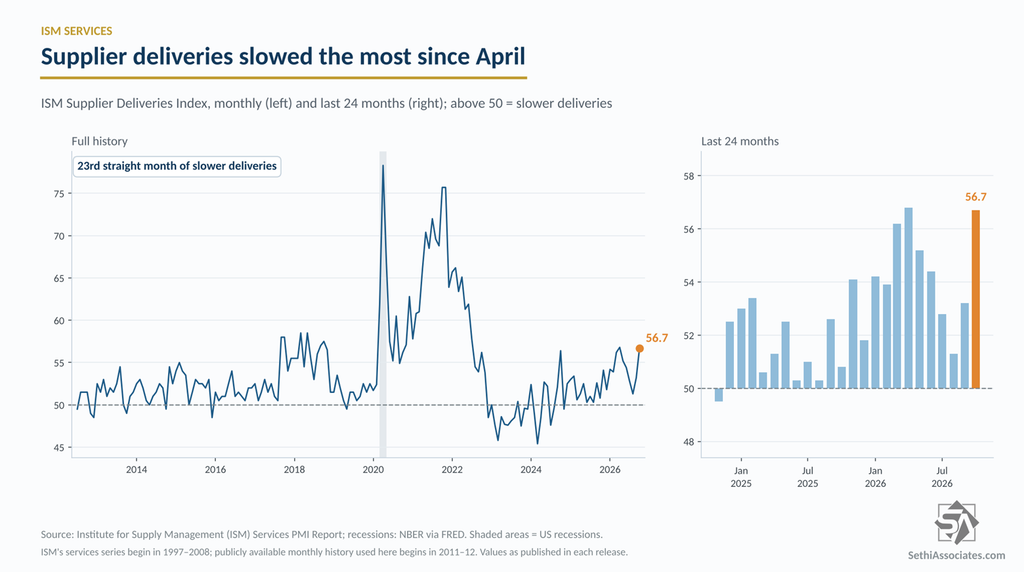
Supplier Deliveries rose 3.5 points to 56.7, the highest since April (56.8). A reading above 50 means deliveries are taking longer, and they have now slowed for 23 straight months. ISM said it’s the second-highest reading since July 2022, “exceeded only by April 2026,” and 2.5 points above its 12-month average of 54.2.
Fourteen industries reported slower deliveries (up from 11) and none reported faster (down from one). One respondent cited “repeated vessel and supplier schedule slips (some weeks to months late),” adding “longer lead times are forcing earlier ordering and more rescheduling.”
Prices
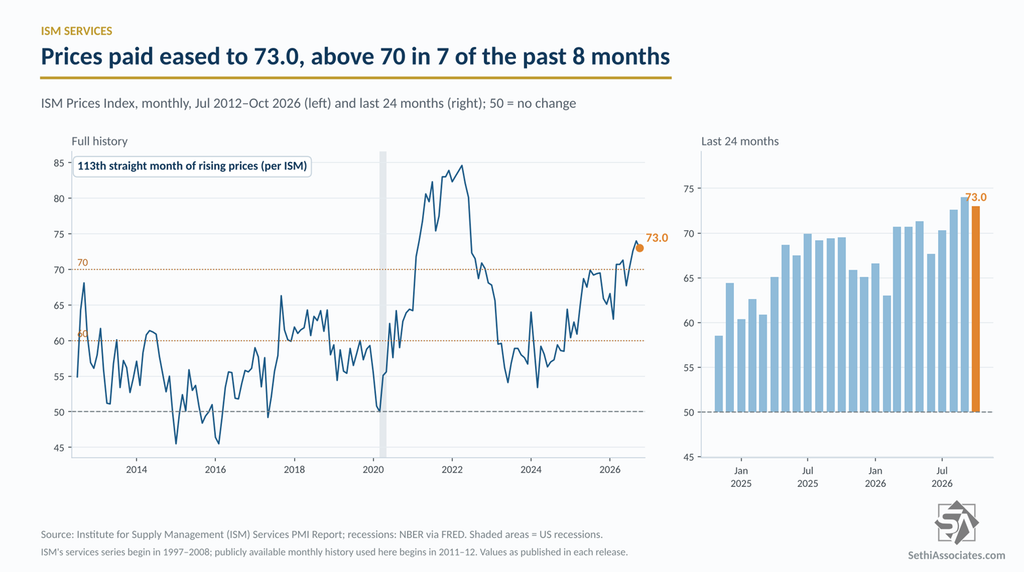
Prices paid eased 1.0 point to 73.0, after September’s 74.0 which was the highest since July 2022. That’s still the second-highest since mid-2022, according to Bloomberg, which noted the gauge had hit “a nearly one-year low in February, just before the Iran war sent fuel costs sharply higher.”
Prices have now risen for 113 consecutive months, and the index has been above 70 in seven of the past eight months and above 60 for 23 straight months. Its 12-month average rose 0.2 point to 69.2, the highest since April 2023. The share of respondents paying higher prices eased to 48.6% from 50.3%. Seventeen of 18 industries reported paying more (unchanged) and none paid less. No commodities were reported down in price, after lumber and pork products in September. Fuel was reported up in price for a ninth straight month and memory products for a 10th.
Miller said many respondents “are not yet seeing the full impact of these cost escalations or have not passed them through to customers. This indicates that more pricing pressure is on the way if oil and tariff cost impacts are not mitigated, even if they do not increase from current levels.”
S&P Global said input cost inflation eased from September’s “near-four-year peak” but remained “higher than the average for 2026 so far,” while selling prices rose the most since July. Firms cited “higher fuel prices, which raised prices for a wide range of other goods and services, especially food and associated transportation services.”
Other Indexes
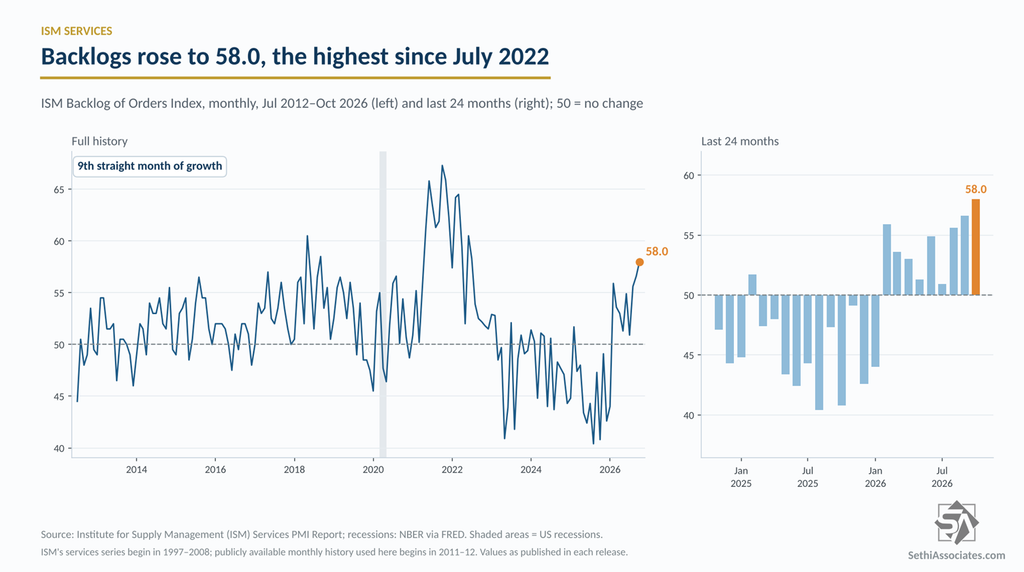
Backlogs rose 1.4 points to 58.0, the highest since July 2022 (58.3). Backlogs have now expanded for nine straight months, the longest run since a 26-month string that ended in February 2023. That’s after the index fell to 40.2 in August 2024, the lowest since 2009. Eleven industries reported growth (up from 10) and three reported declines (down from four). One respondent said “due to the need to hire additional staff to meet demand, we must backlog patients until a provider is available.”
S&P Global similarly showed backlogs rising “to the greatest degree in four-and-a-half years.”
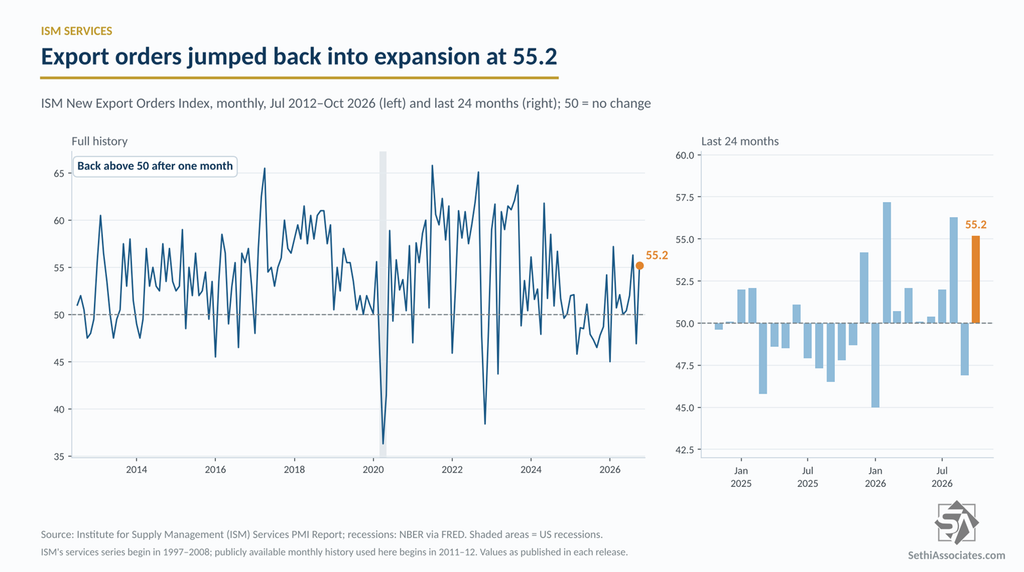
New Export Orders, reported by 60% of respondents, jumped 8.3 points to 55.2, back in expansion after one month below 50 and the highest since August. September’s 46.9 was the first reading below 50 since January’s 45.0, the lowest since March 2023. Six industries reported growth (up from three) and five reported declines (down from six). Comments ranged from “increased demand for subscriptions” to “new service centers offshored.” S&P Global also showed export business rising for a third month, at the best rate since mid-2023.
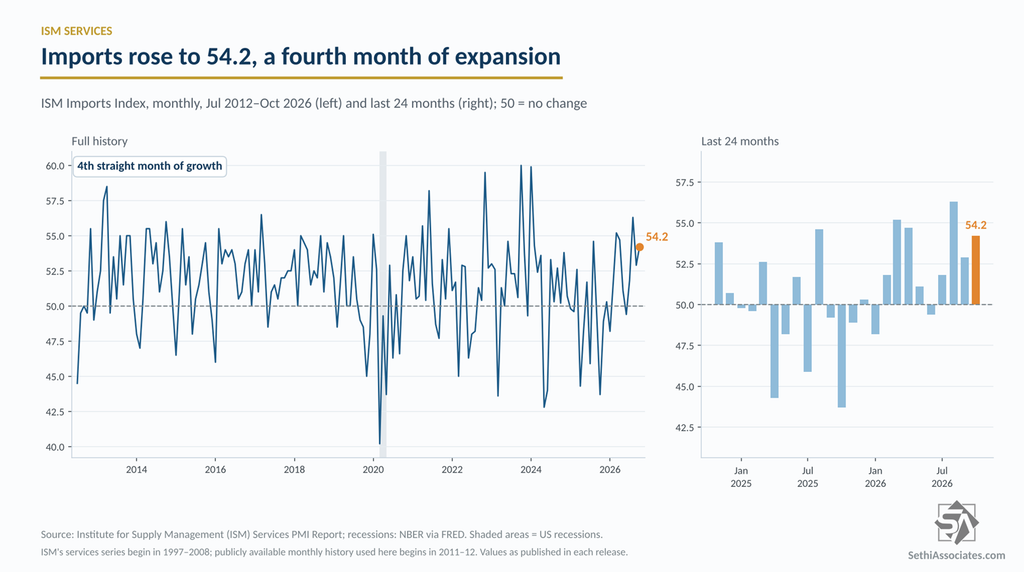
Imports, reported by 62% of respondents, rose 1.3 points to 54.2. Imports have now expanded for four straight months and in seven of the last eight. Eight industries reported higher imports (up from six) and two reported decreases (down from three). One respondent is “actively trying to source more products from U.S.-Mexico-Canada Agreement suppliers to mitigate the steep tariffs on food, apparel, and electronics from Asia.”
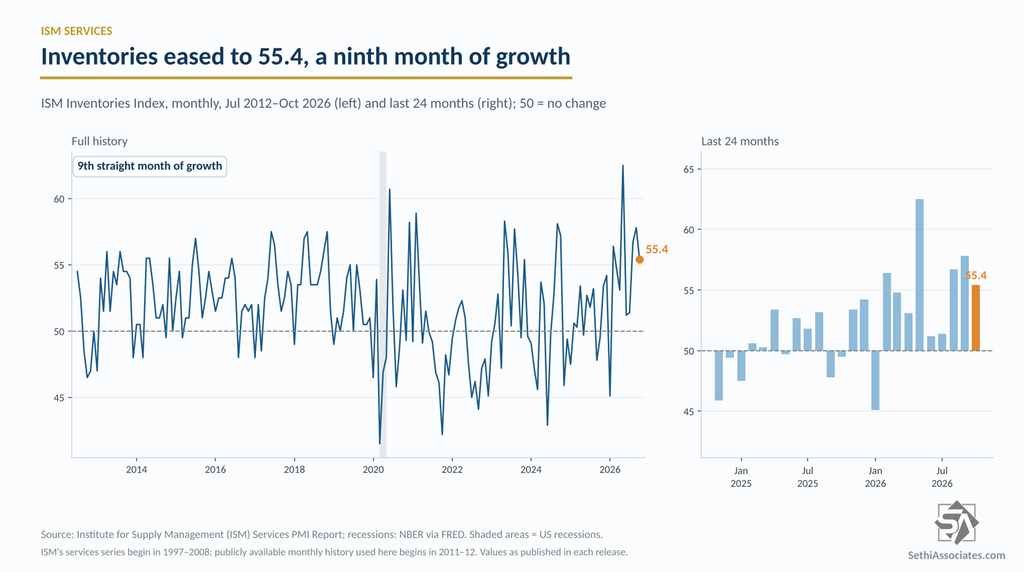
Inventories fell 2.4 points to 55.4, a ninth straight month of expansion. Ten industries reported increases (up from nine) and four reported decreases (up from two). One respondent made an “excess purchase to protect against price increases.”
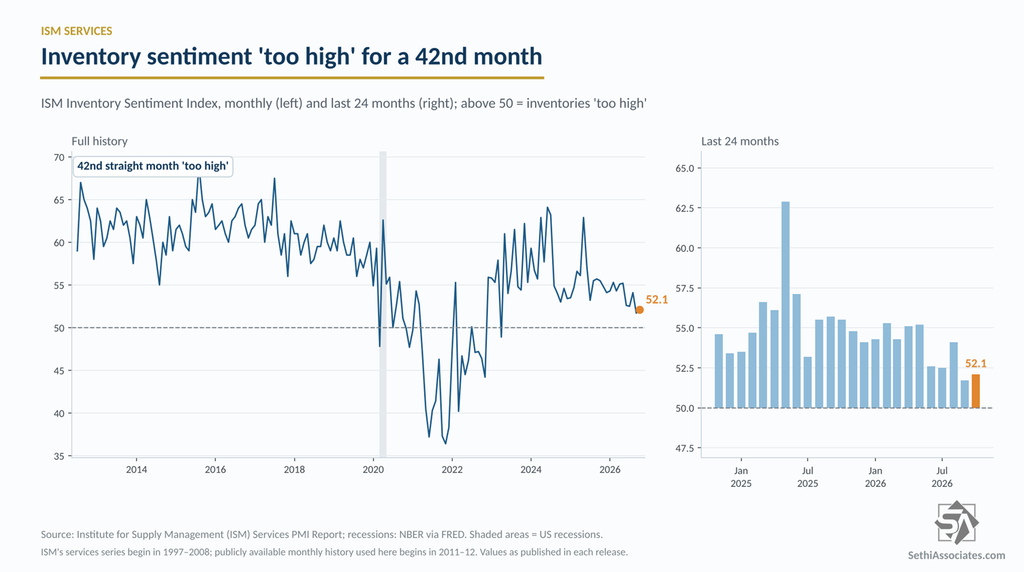
Inventory Sentiment rose 0.4 point to 52.1, up from September’s 51.7, the lowest this year. It has now been in “too high” territory for 42 consecutive months. Seven industries reported inventories as too high (down from nine).
Breadth
Fifteen of 18 industries reported growth, up from 13 in September but still below 17 in May. Growth was led by Transportation & Warehousing; Wholesale Trade; and Information.
Two industries contracted, down from four in September: Construction; and Health Care & Social Assistance.
The number of commodities in short supply fell to three from seven, “all related to computer technologies”: computers and related products, memory components (on the list for a 10th month) and wire and cable.
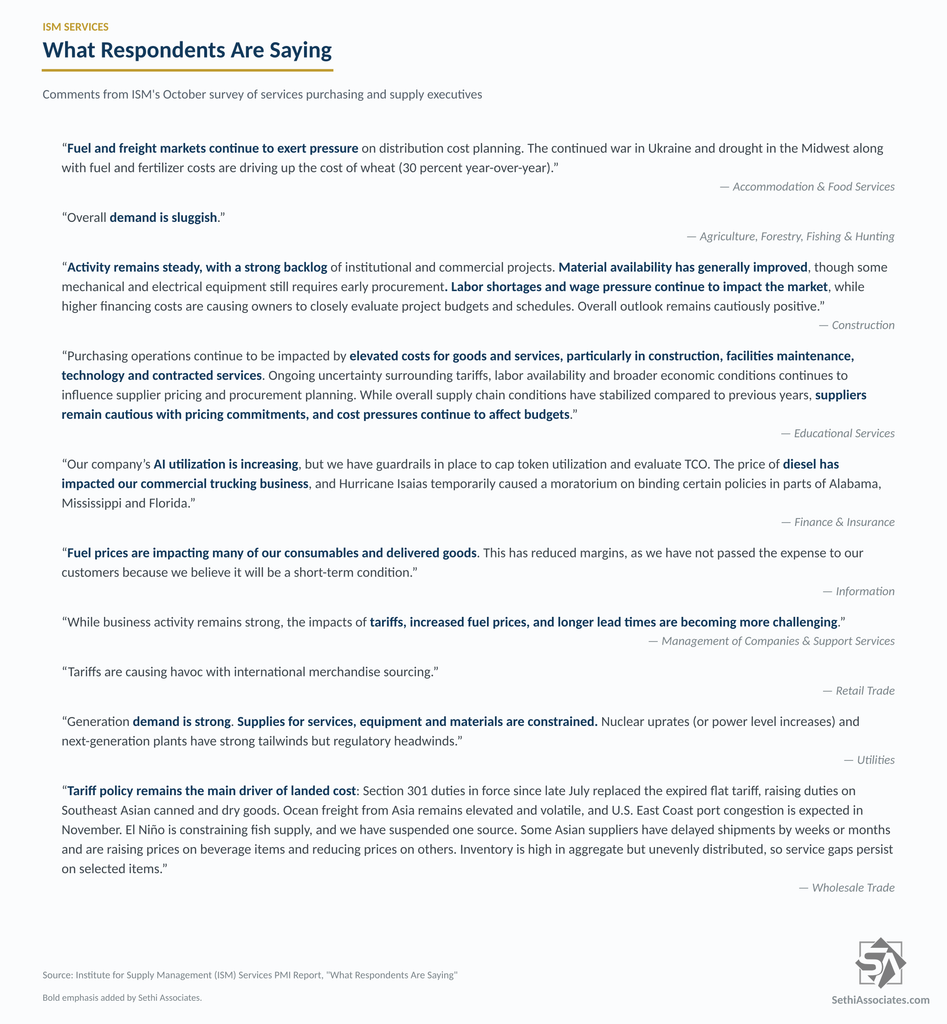
What Respondents Are Saying
Miller said “tariffs and fuel cost impacts continued to be the most-cited issues impacting respondents’ supply chains,” while “commentary on supply chain constraints increased significantly month over month.”
In line with that, eight of the 10 published comments cited higher costs, fuel or tariffs.
- Accommodation & Food Services said “fuel and freight markets continue to exert pressure on distribution cost planning,” with the war in Ukraine, Midwest drought and fuel and fertilizer costs “driving up the cost of wheat (30 percent year-over-year).”
- Information said “fuel prices are impacting many of our consumables and delivered goods,” which “has reduced margins, as we have not passed the expense to our customers because we believe it will be a short-term condition.”
- Finance & Insurance said “the price of diesel has impacted our commercial trucking business.”
- Educational Services cited “elevated costs for goods and services, particularly in construction, facilities maintenance, technology and contracted services,” adding that “suppliers remain cautious with pricing commitments, and cost pressures continue to affect budgets.”
- Construction said “labor shortages and wage pressure continue to impact the market, while higher financing costs are causing owners to closely evaluate project budgets and schedules.”
Tariffs and supply constraints, as Miller noted, were the other pressure points.
- Wholesale Trade said “tariff policy remains the main driver of landed cost,” with “ocean freight from Asia” still “elevated and volatile,” East Coast port congestion “expected in November,” and some Asian suppliers delaying shipments “by weeks or months.”
- Retail Trade said “tariffs are causing havoc with international merchandise sourcing.”
- Management of Companies & Support Services said “while business activity remains strong, the impacts of tariffs, increased fuel prices, and longer lead times are becoming more challenging.”
- Utilities said “supplies for services, equipment and materials are constrained.”
Demand mostly held up.
- Utilities said “generation demand is strong,” with nuclear uprates and next-generation plants having “strong tailwinds but regulatory headwinds.”
- Construction said “activity remains steady, with a strong backlog of institutional and commercial projects,” and “material availability has generally improved,” leaving its outlook “cautiously positive.”
- Finance & Insurance said its “AI utilization is increasing.”
- But Agriculture said “overall demand is sluggish.”
Analyst Takeaways
Bloomberg said “resilient consumer spending, a stable job market and strong business investment have supported demand for services throughout the year. But firms are also coping with mounting costs and delivery delays.”
S&P Global’s Williamson said “business optimism fell sharply across the vast services sector in October, reflecting worries relating to affordability, interest rates, and the uncertain political environment,” and that combined with goods prices, “the overall signal is for inflation to rise further above the Fed’s target in the coming months.” ZeroHedge noted that’s “reflected in rising rate-hike odds for December.”
Goldman: “This week’s ISM reports confirm the broader signal from the business surveys, which point to a healthy pace of economic activity but no sign of a surge to a far-above-trend pace. The price components in both ISM surveys eased slightly in October, but remain elevated relative to their levels before the start of the Iran war.”