Things I Did Today
Here are today’s things:
* New short — Apple (AAPL) at $345.04.
* Added to CURLF at $7.89 and VRNO at $5.06.
Position: Long CURLF (VS), VRNO (VS); Short AAPL (S)
BY Doug Kass · Oct 26, 2026, 12:55 PM EDT
 Doug KassDoug Kass
Here are today’s things:
* New short — Apple (AAPL) at $345.04.
* Added to CURLF at $7.89 and VRNO at $5.06.
Position: Long CURLF (VS), VRNO (VS); Short AAPL (S)
BY Doug Kass · Oct 26, 2026, 12:55 PM EDT
I added to Apple (AAPL) short at $345.35.
Position: Short AAPL (S)
BY Doug Kass · Oct 26, 2026, 12:44 PM EDT
No trades since the Apple (AAPL) short.
I plan to re-short the indices but giving Mr. Market a wide berth.
Position: Short AAPL (S)
BY Doug Kass · Oct 26, 2026, 12:33 PM EDT
Position: None.
BY Doug Kass · Oct 26, 2026, 11:35 AM EDT
I shorted Apple (AAPL) at $345.36.
Position: Short AAPL S
BY Doug Kass · Oct 26, 2026, 10:52 AM EDT
Positions: None.
BY Doug Kass · Oct 26, 2026, 10:46 AM EDT
* A really good regulatory summary by The Dales Report:
* Charlie Gasparino on Glass House and cananbis:
* President Trump on Medical Marijuana:
* A Non Partisan Approach to Descheduling Cannabis:
At the time of publication, Kass was long MSOS common VL calls VS GLAS S.
BY Doug Kass · Oct 26, 2026, 10:20 AM EDT
The following is from Peter Boockvar:
Very disappointing outcome with the Brazilian election and the shift away from its own socialistic experiment under Lula will not happen just yet. As we’re long a Brazilian stock ETF and some of its local currency bonds, it will not be a fun day with that.
With respect to the AI tech trade and the economic impact when sort of narrowing down the key aspects and questions to be watching/answering as we approach 2027, I put it into three buckets of focus:
1)Will the expected/hoped for amount of compute capacity get built and if not, what does that mean for the picks and shovels providers selling into the construction of the buildings and does it make those that do get built more valuable?
2)Both on the software/model side and with hardware, to what extent will the onslaught of Chinese competition erode the profits of its US competitors?
3)The history of technology typically leads to lower prices for hardware and services, and will the same eventually happen for GPU lease rates that financiers now want to turn into an asset class? Right now GPU lease rates have been rising but I question the sustainability of that over time.
Very much expected, but Meta is tapping the equity markets today for the first time since it priced its IPO in 2012. We know Google did the same earlier this year and highlights again the massive capital needs of this AI infrastructure build and the erosion of free cash flow needed to finance it.
With regards to the Fed meeting this week, I see no chance they will raise rates with the market pricing telling us the same. I do think though, the tremors in the AI trade over the past few weeks and the rising financing costs are now on the economic/market radar screen of Chair Warsh. To this, if the tremors turn more nasty in the coming few weeks/months, I don’t think they hike in December either but vice versa, if things calm, they likely will.
Gold has sold off hard the past two trading days but if there is one thing the price should like it is falling real interest rates and over the prior two trading days, the 5 yr real rate is down by 20 bps. I’m hoping gold holds this $4000 level again and the next thing I’m watching for is the soon to be released Q3 report from the World Gold Council to see the extent at which central banks are still buying.
I’m about to drown in earnings calls and here is what I got from the end of last week.
From Comfort Systems, a company being one of the data center picks and shovels because of its HVAC systems and whose stock fell 9% on Thursday and again on Friday because it’s an AI play and due to higher costs:
To a question of whether they are seeing any impact from data center moratoriums in some states in terms of changes to “project schedules” or “push-out in the pipeline in any of that states”, the CFO said “So, I would say and having talked to one of our biggest companies in the last day or two, the answer is generally no. I don’t know a project where one of these considerations has changed its trajectory. I think on a big, more macro level, I have a sense and I’ve talked with people who have given me this sense, this may push more of the work nationally into more sort of friendly jurisdictions.”
“So if you were a large hyperscaler and you were laying your bets on which states you wanted to do work in, where you place your bets, where you go do your work and make your commitments is going to be influenced by your perception of whether the Governor in that state wants people in that state to have jobs, right? I’m not saying it has no effect, but I don’t think at a micro level, we’ve seen any effect whatsoever.”
On costs, “material and equipment was about 2% higher than it had averaged in the first six months. The only other time we brought that up was during Covid because there was so much inflation in materials and equipment.”
From SLB, the oil service company we own stock in and that was up 7% Friday:
“It’s an exciting cycle for exploration. I think the combination of energy security as a heightened priority, as well as depleting reserves and the pressure of declining production are adding and fueling this investment in exploration.”
From American Express, down by 3.7% Friday but ended up closing flat on the week:
“Customer behavior looks very similar to what we’ve seen over the past year. Strong and consistent spend growth, especially in the T&E categories, balance growth in line with spend, high retention rates, and excellent credit performance.”
“Airline spending accelerated to 13%, while restaurants, our largest T&E category, saw spend growth of 9%. US consumer spending was up 9.4% this quarter, reflecting the continued strength in our premium customer base. While growth moderated slightly through Q2, it was in line with Q1, and continues to run above the levels we saw in 2024 and 2025.”
I’ll add, we know some of that T&E spend, particularly with airline, is partly price with airlines raising fares.
“Delinquency rate remained very low and stable…We feel very good about the quality of our credit performance and the stability we see in the portfolio.”
Rising marketing expenses was a focus of investors and the company explained the need for it. The CFO said “It’s been highly competitive. And our assumption is that it will remain highly competitive.”
From Tractor Supply, whose stock was flattish last week:
Comps grew just .4% but “We’re encouraged by the improving sales momentum and broader strength across our business.” They saw a .7% rise in average ticket but a .3% drop in transactions, though the latter was “cycling 2.7% growth last year, resulting in one of our strongest two year stacks of the past five years.” And “as we move into Q4, we expect continued momentum in sales trends, while recognizing that consumers remain cautious.”
More on their consumer, “Several broader trends continue to pressure the categories we serve. Elevated interest rates and reduced housing mobility are weighing on property improvements and larger projects. Pet ownership headwinds, particularly new pet acquisition, continue to affect demand in certain categories.”
“Across the farm economy, increases in commodity prices and operating costs are influencing purchasing decisions. Customers continue to spend, but remain cautious. In our most recent consumer work, more than 60% said they felt less comfortable making non-essential purchases than six months ago. Inflation, higher fuel costs, and broader uncertainty continued to weigh on household budgets and discretionary spending.”
Finally, “across our store base, rural locations returned to more positive comp growth and again outperformed the other population density groups.”
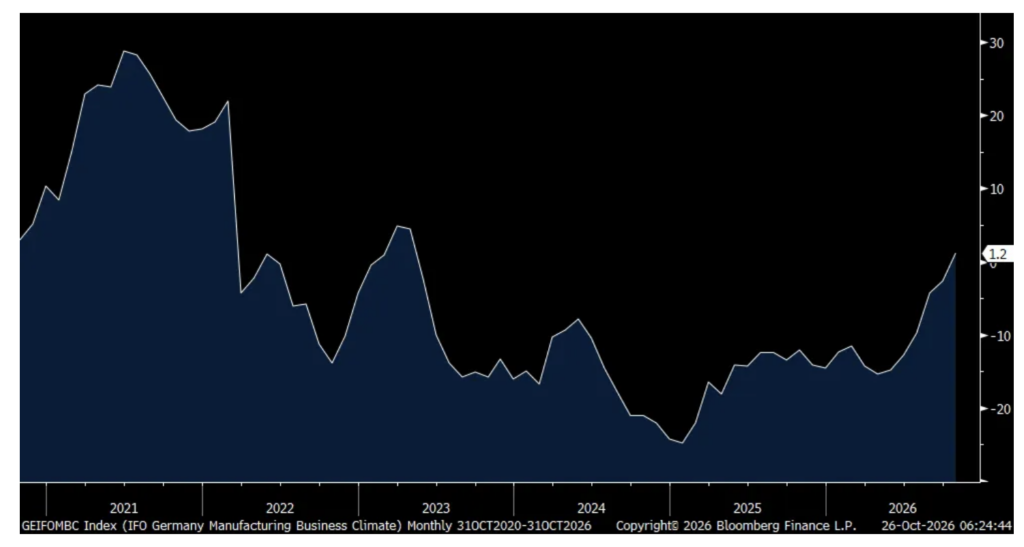
The one data point of note overseas was the October German IFO business confidence index which rose a touch to 90.2 from 89.9 but the components were mixed as all of the gain came from the Expectations line as the Current Assessment fell. The IFO said simply, “The economic recovery is continuing” and a key reason for this is the continued rebound in manufacturing with this component going positive for the first time since April 2023 “as incoming orders increased.” Services in contrast softened but “IT service providers performed particularly well.” Construction rose and trade was unchanged.
Bund yields are up slightly while the euro is flat and the DAX is up about .75%.
German IFO Manufacturing Component
BY Doug Kass · Oct 26, 2026, 10:00 AM EDT
Is it worth looking at Brazil (EWZ) – after this weekend’s schmeissing?
Is Brazil’s Market Crash An Overreaction?
Positions: None.
BY Doug Kass · Oct 26, 2026, 9:35 AM EDT
Anthropic token pricing still needs to halve to match OpenAI.
Anthropic has a non-differentiated product, so it seems inevitable. And OpenAI is still at a big premium to open source. Something tells me this all keeps going down, by a lot!
—
Strap in, the rest of the “More” is a long one.
Two parts.
First on compute prices, then on the coming depreciation bolus and its implications.
Nvidia (NVDA) and the tech bros are all in lock step with the talking points. Not too different from the political parties who distribute talking points to the media, which nods in bovine agreement, and just repeats them, without thinking, or even caring, due to whatever agenda they personally have. Now the talking point, out of desperation, is “the price of compute is going up.” Here is the latest propaganda, from Nvidia, and echoed by one of the VCs, and this is now all over the place:
This is terribly misleading. Spot is a tiny (and apparently manipulated) market, and the data itself spotty (pun intended) at best. There are anecdotal stories that Nvidia pressures their smaller partners to hold spot rates up (on the surface at least as discounting and other terms will not be captured by these charts if the data is even real to begin with). This may be done to present the notion that chips and equipment are somehow not depreciating assets, such that they can be used as collateral for financing deals. Anyone speculating on chips or lending against chips on the basis of incomplete and misleading spot compute price data deserves to lose their money.
Power is actually the binding constraint for compute. This is why the quoted price for compute, including for older parts, has gone up in theory. Power is the marginal constraint for the marginal market.
But underneath it all the chips and hardware are depreciating like they always do, which is rapidly. It should not be too hard to understand that the price of compute could go up due to power being a constraint, while the underlying hardware is still depreciating. Think of it this way, if the chips and equipment were removed, and sold on the open market, and needed to be placed elsewhere, what value would it have? The value of this stuff is independent of what the price of in place compute with power can be sold for.
But thinking would ruin another Hail Mary story, I guess. It is interesting that power is the marginal constraint, but nobody is talking about paying 100x PE for the local utility company.
Then, of course, nearly all of the revenue in the space is actually on LT contracts, so CoreWeave (CRWV) et al do not benefit from spot. The credit markets realize this at least. I think spot compute is generally sold by smaller marginal players.
But apparently, one of the big investors in the space does not realize that, or just dissembled, or both. Here is the big cheese at Blackstone (BX) echoing the spot compute price talking point:
Also, elevated spot pricing will not materially help the CoreWeave’s of the world to sign contracts for new business at higher prices, because big customers do not need CoreWeave to build capacity for them. If the price for compute was set at a level to yield more than a minor return, big players would just build it themselves. The only reason they use CoreWeave to begin with, is CoreWeave basically gives it away, as is evidenced by their lack of P&L and their balance sheet. This is why they report earnings before expenses, and sell their own stock like crazy.
If I remember correctly Blackstone was piling into real estate at the peak in 2008 and also telling us how wonderful the fundamentals were. Bailed out by the Fed, so history repeats. But something tells me this time around the Fed no longer has the dry powder it used to, and Fed Chair Warsh is less inclined to resort to the same money-printing shenanigans.
Spot compute will have to head the way of token prices, in my view. A significant portion of the demand side for spot compute also comes from the aforementioned VC startups that seemingly account for 70-80% of demand, many of whom will likely cease to exist, and before that happens, will have to meaningfully slow their burn rates.
There is excess stuff everywhere as well. There was the story that emerged last week with regard to Amazon (AMZN) sitting on racks of components and servers in warehouses, with no place to put them. And now this story about companies with so many excess GPUs, they sit idle half of the time:
At any rate, look who agrees with me about the power issue and the price of spot compute, as well as a glut of equipment and chips sitting idle which will be stranded. Chamath Palihapitiya, and Elon Musk of all people! Musk actually indirectly makes my point that the value of chips and equipment are independent of the price of compute quite clear when he talks about if anything is missing, the compute does not work. See the tweets to follow.
“This is a fuller list of the limitations of supercomputer buildout. If anything is missing, however seemingly trivial, the compute doesn’t work.”
I guess Musk is chiming in because he believes he has all the power lined up that he needs. Again, this is part of why is Amazon holding on to a bunch of chips and servers in warehouses. There has been massive forward buying of chips and equipment, that are sitting around doing nothing. This is what Musk is referring to as stranded capacity.
Anyway, spot compute is a tiny market and misleading. The real issue is power. The demand for spot compute is coming from garbage VC startups that won’t be around much longer either. Underneath it all, the chips and equipment are still depreciating rapidly like they always do. The intrinsic value of the chip has nothing to do with spot compute price. And spot compute price, if we even can get accurate data, will soon follow token prices for a variety of reasons. More supply is coming on line regardless, and the demand is coming from a lot of garbage companies that will not be around. End of day, the chips and equipment follow a normal depreciation curve, and using spot compute to suggest otherwise is B.S.
Then CoreWeave at al do not benefit from spot anyway, because their biz is on LT contract. The credit markets, at least, understand this.
Live by the sword, die by the sword with the spot compute charts, that are sketchy at best to begin with. We know where the price of spot compute is going to go next. And you never own these types of stocks when you almost know the 2bd derivative of this stuff is about to go the other way, and then the whole thing will head down. You buy when the data is close to bottoming, not topping.
At any rate, it seems like an ugly situation is on the come for a variety of reasons:
On a related note, below is another great chart and analysis on the amount of depreciation on the come for the big hyperscalers.
Think of all the profits needed to cover the coming increase in depreciation. The amount of depreciation expense that will hit by 2029 exceeds their current combined operating profits. But reality is you can already see this from looking at the balance sheets and cash flow statements. Meta (META) and Amazon are already cash flow negative. Nvidia earnings are not all they are cracked up to be either, as cash flow tells a different story due to all the money that keeps going out the door as they continue to function as the central bank of Nvidia and lender of last resort to keep buying their own revenue.
Per the chart, as usual the sell-side models at the individual company level are all B.S.
They do not flow enough depreciation into the P&L going forward.
They make up too much revenue on the come in the future.
Then they assume much too high of a margin on that revenue, especially given all the capacity coming on line, that will have to be sold.
It is all made-up crap.
Nobody can win now. There is too much capacity that has been put in place. Prices will have to be cut massively to sell the capacity. Think of the amount of revenue needed to absorb all of this. We are probably at multiples of world GDP at this point.
The whole earnings growth story that has been driving these companies, and equities overall (which is really just these companies), forget about it. With this much depreciation on the come, it is quite challenging for earnings to grow. Stagnant earnings, frankly, would be a good outcome relative to what might actually happen.
Post Script
Apollo’s Torsten Slok warns about the ROIC failure of AI:
And more…
Position: None
BY Doug Kass · Oct 26, 2026, 9:30 AM EDT
Source: TipRanks
BY Doug Kass · Oct 26, 2026, 9:15 AM EDT
BY Doug Kass · Oct 26, 2026, 9:00 AM EDT
BY Doug Kass · Oct 26, 2026, 8:50 AM EDT
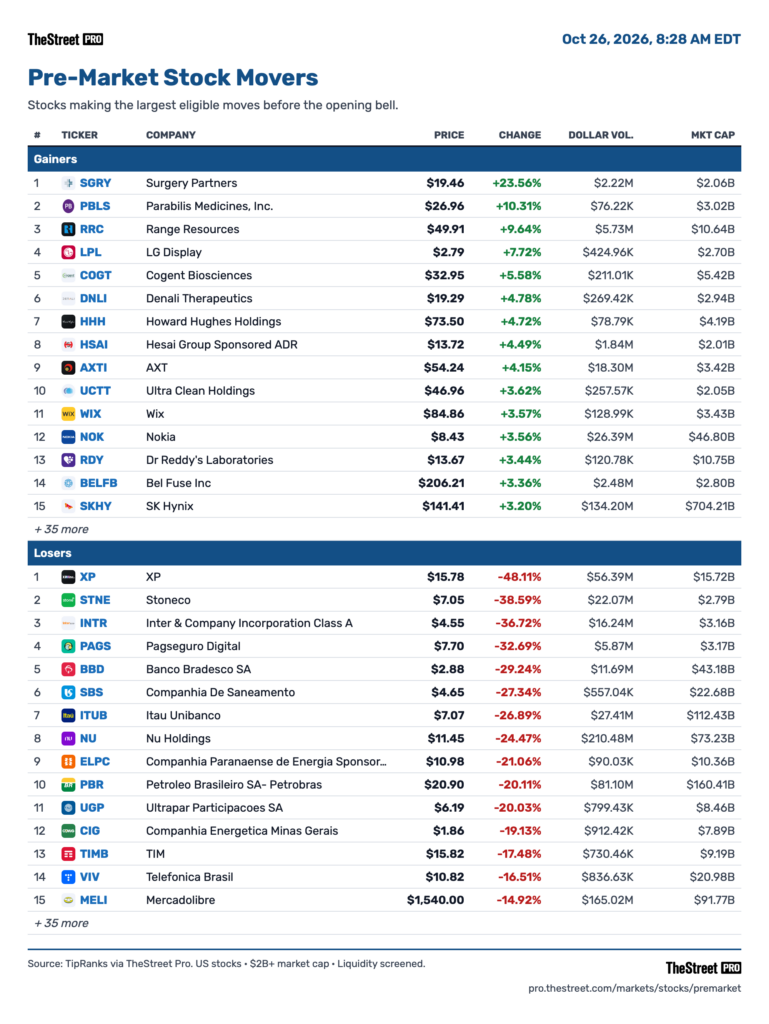
– XNCR +32% (Phase 1 XmAb819 kidney-cancer data showed a 45.5% confirmed response rate and 82% six-month PFS at the proposed Phase 3 dose)
– RENT +30% (no clear fresh catalyst identified; unusually heavy premarket volume extends Friday’s surge)
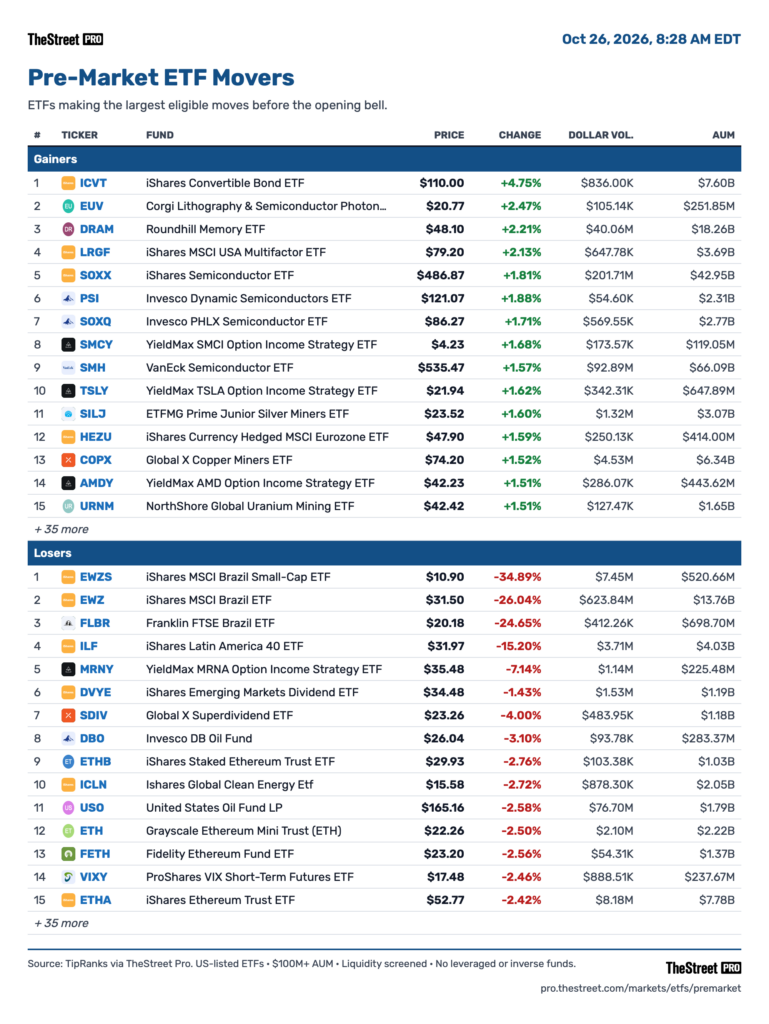
– SGRY +24% (report of late-stage talks for Bon Secours Mercy Health to acquire a controlling stake at about $20 a share)
– RRC +11% (EQT agreed to acquire it in a 0.987-share all-stock deal)
– MACI +10% (shareholders approved the Everli business combination)
– ROST +3.4% (UBS upgrades to Buy)
– AVBP +3.3% (initial Phase 1 ARR-217 data showed a 44.8% response rate in colorectal cancer at the selected dose)
– TSLA +2.3% (Barclays upgrades to Overweight, citing improving auto fundamentals, robotaxi momentum and potential SpaceX-combination upside)
– XP -48%, STNE -39%, PAGS -32%, BBD -30%, ITUB -26%, NU -26% (Brazil-linked financials plunge after leftist incumbent Lula won the presidential election over Flávio Bolsonaro)
– BAK -34%, PBR -19%, VALE -4.9% (Brazil commodity names fall on the election shock and policy-risk repricing)
– MRNA -8.1% (sell-the-news unwind continues after Phase 3 melanoma-vaccine data, with expectations elevated following the prior rally)
– EQT -6.8% (falls as the acquirer in the all-stock purchase of RRC)
– EFX -3.5% (RBC downgrades to Sector Perform on mortgage weakness concerns)
– NTAP 3.0% (Guggenheim initiates coverage at Neutral)
– CRWV -2.2%, IREN -2.0% (neoclouds fall after SpaceX closed a $40B debt raise to buy Nvidia GPUs, signaling a large captive AI-compute build)
BY Doug Kass · Oct 26, 2026, 8:38 AM EDT
I previously suggested not buying on last week’s EPS beat and increase in forward guidance at Meta (META) — based, in part, by my projection that the company would announce a large equity raise.
I should have shorted the stock at that time because the shares reversed violently that day and have continued their descent in recent trading sessions!
This morning Meta announced a massive equity offering to fund their AI ambitions:
The company launched public offerings of about $35 billion in common stock and convertible preferred stock. It also said it plans to launch a separate at-the-market share sale program of up to $60 billion after its new non-voting Class C shares begin trading, which is expected in the first quarter of 2027.
Meta launches plan for $95 billion stock offering to fund AI expansion
Position: None
BY Doug Kass · Oct 26, 2026, 8:14 AM EDT
I sent this email to Halftime’s Scott Wapner:
Scott
This email is intended to be of constructive criticism and not as an ad homenim attack.
“When the facts change, do you Slink?”
At the core of Stephanie Link’s bullish market view was tame credit spreads.
She no longer mentions because they have been rising.
Another foundational part of her bullish market view was rising S and P profits – well that one doesn’t hold up either as 1. EPS estimates have peaked, 2. the market is looking thru the numbers because of the disproportionate role of MU and NVDA and the other AI related companies (Non recurring profits from unrealized gains of investments, double and triple ordering (they are over earning) and 3. the market is declining in the face of past strong profits. (See analysis of S and P profits to S and P prices below).
Shouldn’t Slink be push backed and be confronted with the changing facts? Or should she be allowed to spew memorized sound bytes that are taken from the rear view mirror?
“Investment vision is always 20/20 when viewed in the rear view mirror.”
– Warren Buffett
Dougie
P.S. Please read my debunking of Stephanie Link’s fundamental view that S and P prices “always” correlate with rising S and P profits:
BY DOUG KASS · Aug 25, 2026, 9:35 AM EDT
The investment mosaic is far more complicated than suggested by hosts, investment strategists, panelists and guests in the business media.
Specifically, many distill the bullish argument to this: Since 2026 S&P EPS is expected to be about +20% (well above consensus expectations at the beginning of the year), the S&P price gains in 2026 should be about in line with that profit growth (or better). Candidly, that sort of distillation is the essence of “first-level thinking.”
First-level thinking is lazy, simplistic and superficial — it looks for simple formulas and easy answers. To paraphrase Howard Marks:
Most recent examples of when S&P EPS was better than expected and strong were in 2018 (+20.5% EPS growth, -6.6% decline in the S&P), 2006 (+16.7% EPS growth, +11.3% rise in the S&P), 2005 (+19.3% EPS growth, +8.8% rise in the S&P) and 2004 (+20.1% EPS growth, +4.2% rise in the S&P).
Going back, during the last 50 years — other 12-month periods with robust EPS growth and less-than-stellar to down S&P price include the years 1993, 1992, 1987, 1984, 1979 and others.
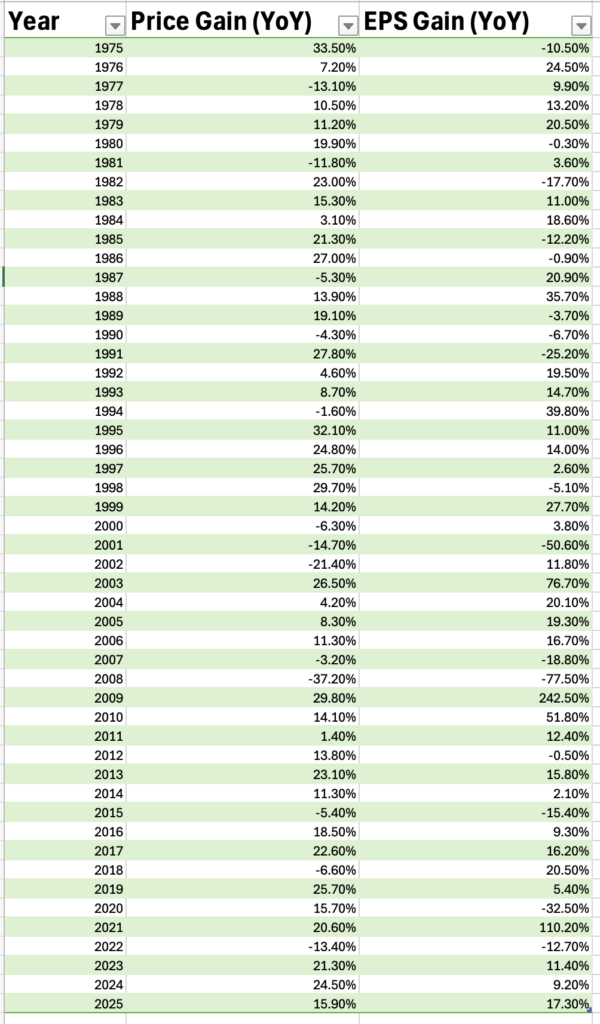
Furthermore, I would argue that the backdrop of 2026-2027 offers unique market challenges relative to prior periods since 1975 (“it’s different this time”):
* High and rising inflation and interest rates.
* A burgeoning deficit and U.S. debtload may be a permanent condition giving the general lack of discipline from both parties in Washington DC.
* Improvisational geopolitical and fiscal policies that present threats to political and economic stability.
* Both parties are moving to extremes — the Republican party more to the right and the Democratic party to the left. With a possible Democratic congressional majority win in November, anti-corporate policy (higher corporate taxes, etc.) may be in the offing.
* Traditional valuation metrics in the 98%-tile and two standard deviations above the average.
* The AI capital spending spree and gains from investments have inflated S&P profit reports — as noted in my “More Tales From Nvidia” series an earnings reckoning may lie in the not too distant future.
Looking at any one variable (e.g. S&P EPS growth) to forecast S&P price is fatuous, simplistic, lazy and is contradicted by past investment returns data.
Stated simply, the correlation between S&P EPS growth and S&P price gains is a crutch and is not a reliable indicator.
The investment mosaic is far more complex than many present in the business media.
Position: Short SPY (VS)
BY Doug Kass · Oct 26, 2026, 7:30 AM EDT
Position: None
BY Doug Kass · Oct 26, 2026, 7:05 AM EDT
Position: None
BY Doug Kass · Oct 26, 2026, 6:55 AM EDT
Position: None
BY Doug Kass · Oct 26, 2026, 6:42 AM EDT
Position: None
BY Doug Kass · Oct 26, 2026, 6:32 AM EDT
The S&P Short Range Oscillator slipped to modestly overbought at 0.48% vs. 1.43%.
I currently have no index positions on.
Position: None
BY Doug Kass · Oct 26, 2026, 5:46 AM EDT
Anthropic's lockup is insane What are we doing here

I have seen absurd capital structures before, but what Anthropic just disclosed in its S1 filing beats them all (by far)

The US junk bond market is under severe pressure: The effective yield on US CCC-rated and lower-rated high-yield corporate bonds is up to 18.0%, its highest level since the 2020 pandemic. This figure has surged +500 basis points over the last 6 months, marking its largest Show more

GPUs are aging like fine wine, with rental rates up across the board since January 1st Approximate change YTD: - H200: +160% - B200: +120% - RTX PRO 6000: +65% - H100: +35% Even the 6-year-old A100 rents for more than it did at the start of the year Charts of the Week: Show more

Historically, elevated consensus long-term earnings growth rates have been a contrarian indicator. Source: @BudaghyanArthur, BCA Research, “Charts That Matter: Zoom Out. Watch The Extremes” (July 2026)

BREAKING: Elon Musk has said: "As of the past few weeks, debt markets have almost entirely shut off access to money for any company that doesn’t have substantial revenue independent of AI data centers. That means the 200+ neoclouds are going to see guppy-level death andShow more
This is absolutely MIND-BLOWING: The 3x leveraged long semiconductor ETF, $SOXL, is down -51% from its October 6th peak. Meanwhile, the fund recorded +$3.13 billion in inflows this week, following +$6.14 billion the previous week, bringing the two-week total to +$9.27 billion
Donald Trump says medical marijuana has helped many people and argues that legalization must come with strict age limits and proper regulation. He also points to Florida as an example of how marijuana policy could be handled. Legalization needs rules, control, andShow more
Thoughts around AI 1) Given AI is the largest technology revolution in history at roughly 3.5% of GPD (larger than electrification, highways & internet combined); there is overinvestment due to the potential rewards for the eventual winners. 2) But much like during the InternetShow more
APOLLO: AI HAS DELIVERED “ZERO PAYOFF” OUTSIDE BIG TECH Apollo Chief Economist Torsten Slok warns that massive AI spending has yet to deliver measurable productivity gains across corporate America. Revenue per worker and profit margins are rising for the Magnificent Seven but Show more
The science of the bulls! Probably nothing;) @GaryMarcus @edzitron @JG_Nuke @MarkNeuman18 @davevermilion @LukeGromen @tomkeene

Griffin thinks GPUs are a commodity: "GPUs, like airlines, have a very low marginal cost to run... the moment you have overcapacity, pricing goes into freefall." Ken Griffin's bear case is supply passing demand in a business where the next unit costs almost nothing to serve, the
⏪ ICYMI — on Friday's TDR’s Trade to Black (presented by @FlowhubCo) 🎦 WATCH the full episode: youtube.com/watch?v=KjQyHX… ⚖️ ALJ Derek Julius rejected opponents’ bid to reopen the marijuana rescheduling hearing for more testimony and discovery. The record already has 2,500+ Show more


Judge Rejects Bid to Reopen the Rescheduling Hearing x.com/i/broadcasts/1…


I think we’re going to see a lot of stranded compute in partially complete data centers


I believe today we will break the Guinness world record of total number of Debt Managers around the world skipping a heartbeat


Renting Nvidia’s H100 costs 45% more than it did in December. It went on sale in 2022, and two newer generations have come out since. Yet, demand for compute is so far ahead of supply that older GPUs are getting more expensive.


And what binds power? • land • permits • grid access • transformers and switchgear • noise • clean air • supply chain • fuel security • casting machines • suitable large lathes for turning shafts • residential priority • community political power All the best
Blackstone's Jon Gray says neoclouds that can deliver compute get 50% more for it than a year ago, and old H100s lease near their original rates [ CoreWeave, a company that you work with... is seeing its yields on some of its debt go to 15%. ] "Well, it is creating a challenge. Show more

Demis Hassabis says Larry Page heard about DeepMind maybe through Elon Musk, and Jeff Dean saw all their secrets before the deal closed "Well, looking back on it now, of course, it seems very undervalued, which is actually even at the time we thought that." "It was actually
Talarico Wants To Partner With Trump On Legalizing Marijuana If He Wins Texas Senate Race: "I hope we can do that together and expunge the records of people who have been locked up for a crime that doesn't hurt anybody." marijuanamoment.net/talarico-wants…
Pretty much. As of the past few weeks, debt markets have almost entirely shut off access to money for any company that doesn’t have substantial revenue independent of AI data centers. SpaceX closed $40B of debt for GPUs, but we’re investment grade and have Starlink & launch Show more
Good data showing that NVIDIA AI infrastructure is a durable, investable asset that retains value. New applications and workloads keep landing on our fungible platform, increasing demand because of its productivity. Chart by @a16z


GPUs are aging like fine wine, with rental rates up across the board since January 1st Approximate change YTD: - H200: +160% - B200: +120% - RTX PRO 6000: +65% - H100: +35% Even the 6-year-old A100 rents for more than it did at the start of the year Charts of the Week: