Thinking of Buying Costco? Here’s Why I’d Keep It on a Short Leash
Let’s take a close look at this big-box retailer after it posted a solid earnings beat.
You've reached your free article limit
You've read 0 of 1 free Pro articles.
Big-box, club retail giant Costco (COST) last night reported fiscal fourth-quarter financial results, revealing unadjusted earnings per share of $6.75 on revenue of $95.723 billion. These top- and bottom-line results both easily beat Wall Street’s expectations while that sales print was good for year-over-year growth of 11.1%.
Results for same-store sales were impressive. Firm-wide, comp sales were up 9.4% year over year, or +6.7% adjusted for gasoline and constant currency. The expectation was for growth of about 6.3%. Broken out, comp sales in the U.S. were up 10.7% or an adjusted 7.2%. Wall Street was looking for growth of 6.9%. In Canada, comp sales were 5% or 4.6% adjusted. Elsewhere, comp sales were up 7% or 6.2% adjusted. Digital sales were up 19.5% or 19.8% adjusted.
During the call, CEO Ron Vachris said that for the fiscal year “business performed exceptionally well across all operating channels this year, including our warehouses, ancillary businesses and digital platforms. We delivered top line sales growth of over 10% and expanded our market share by deepening member loyalty and capturing a larger share of wallet. This success was anchored by our agile item-driven model. Our buyers stayed ahead of member trends, quickly adjusting our assortment to offer high-quality relevant products at the lowest prices. This strong performance was spread across a wide range of departments, including meat, bakery, major electronics, and health and beauty aids.”
Operations
While sales (and membership fee income) were growing 11.1% to $95.723 billion. Merchandise-related costs increased 11.3% to $83.531 billion, leaving a gross profit of $12.192 billion (+9.7%) as gross margin dropped from 11.1% to 11%. That was just a hair below expectations. Operating expenses grew 7.9% to $8.391 billion, leaving a unadjusted operating income of $3.801 billion (+13.8%) on an operating margin of 4.05%, up from 3.9%. This beat the consensus view.
After accounting for interest, other income and expenses, as well as for taxes, the firm’s unadjusted net income printed at $2.998 billion (+14.9%). This works out to $6.75 per fully diluted share, up from $5.87 for the year ago comparison. Paid membership, by the way, grew 3.8% to 84.1 million.
The Fundamentals
For the full fiscal year, Costco generated operating cash flow of $15.825 billion. Out of that number came capital spending of $6.435 billion, leaving free cash flow of $9.39 billion (+19.8%). Out of that number came cash dividend payments of $2.458 billion to shareholders and $848 million in stock repurchases.
Moving on to the balance sheet, Costco ended the quarter / fiscal year with a cash position of $21.301 billion and inventories of $19.324 billion. This puts current assets at $46.582 billion. Current liabilities landed at $43.952 billion, including $2.248 billion in short-term debt and $3.006 billion in deferred membership fees. Adjusted for those deferred revenues, the company’s current ratio stands at 1.14, which is not bad at all for a large retail chain like this.
Total assets amount to $89.045 billion. The company, admirably, claims no value for anything intangible. Total liabilities less equity comes to $53.242 billion, which includes longer-term debt of $3.914 billion. The company can pay off its entire debt load almost three and a half times over out of its cash position. This balance sheet is very healthy.
My Take
There’s a lot to like here. Same-store sales are growing like a weed. Membership is growing and membership fees are growing faster than are total members. Gross margin is slowing slightly, but operating margin is still moving in the right direction. Cash flows are growing nicely. The debt load is under control. The balance sheet is in excellent condition, which is special in this business.
The only truly tough thing to look at is the valuation, which is very likely for a reason. COST trades at 39-times forward looking earnings, which seems very expensive. That said, chief rival Walmart (WMT) trades at 37 times. Would you pay more for COST than for WMT? I think if I’m honest that I probably would and I like Walmart. Target (TGT) trades at just 15-times forward looking earnings and in my opinion, there’s a reason for that too.
The action in COST since this past spring fits very neatly inside of what we in the market call an “Inside Pitchfork” model which is flatter than would be an Andrews’ or Schiff Pitchfork. I rarely use it, but it appears to fit here. COST is trying to recapture its 21-day exponential moving average this morning after having traded lower. taking this line will show that the swing crowd may have switched sides after having not shown much interest since August.
Taking that line would put both the 50-day and 200-day simple moving averages in the field of vision of the professionals. Yes, I saw the price target cuts. Keep in mind that you and I, in 20 minutes, probably make more trades than many of those sell-side analysts ever will. Combined. You know what they say. Those who can, do. Those who can’t, work for a big firm. I found that to be true, not in every case, but certainly often enough. I never un-mute financial TV for anyone who has always worked for a large firm. Their opinions are very rarely actually “their” opinions.
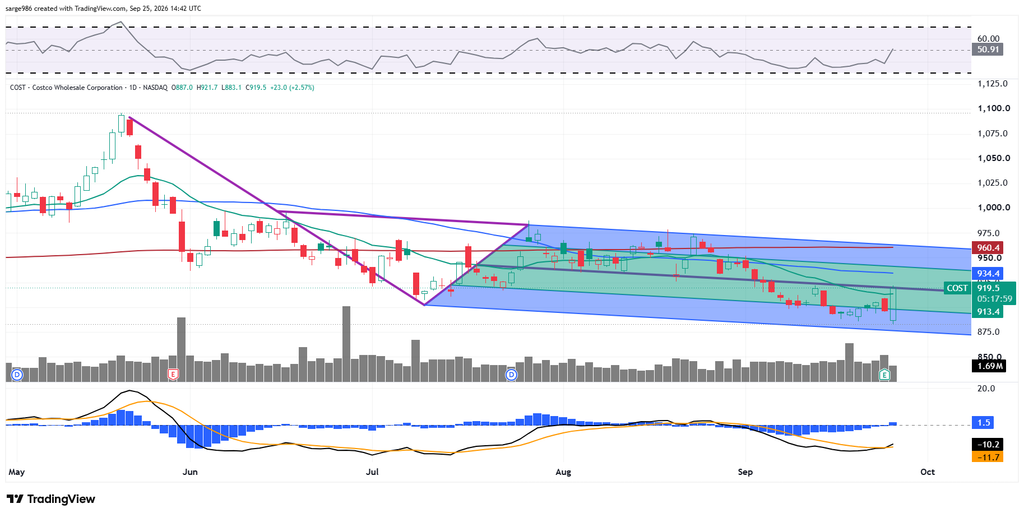
Moving on to the indicators, Relative Strength is finally showing some life. The daily moving average convergence divergence, below the chart, is showing some spunk as well. The histogram of the 9-day EMA is now above zero for the first time since late August. The 12-day EMA has also crossed above the 26-day EMA for the first time since then as well. These are both shot to medium-term bullish signals. I think COST can be bought here. If doing so, though… I would keep a short leash on it. I wouldn’t have much wiggle room built into my panic point.
At the time of publication, Guilfoyle had no position in any security mentioned.