Moderna Leads the Charge as Pharma ETF Hits All-Time High
Tempus AI and Merck are key contributors to Moderna’s success.
You've reached your free article limit
You've read 0 of 1 free Pro articles.

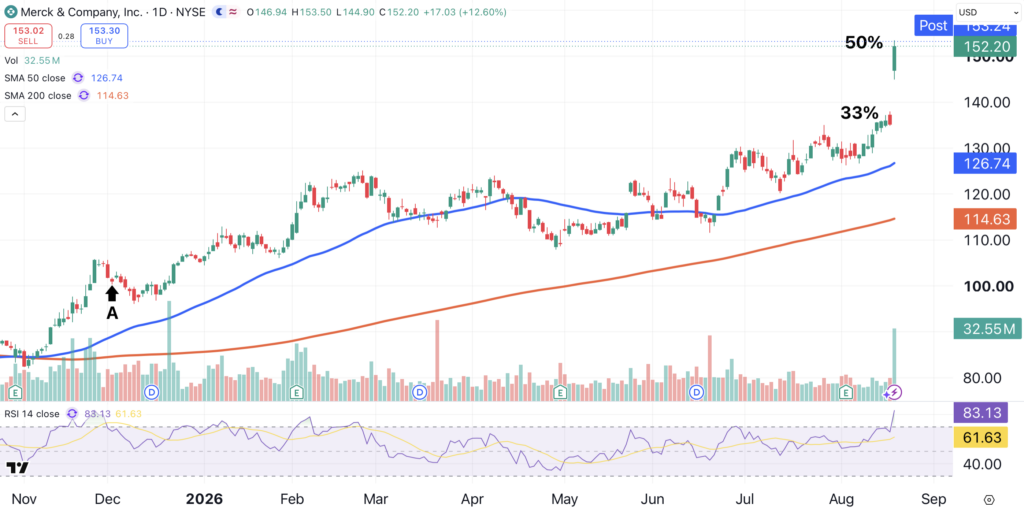
Moderna (MRNA) shot higher by 176% on Wednesday, after the company announced promising results on tests for a melanoma vaccine. The treatment combines a customized vaccine, based on the patient’s own tumors, with Merck’s (MRK) Keytruda immunotherapy medication.
I’m not chasing Moderna up here, but we did just add some Merck, which popped 12% on the news. Our initial position in Merck, from early December (point A) has now gained about 50%.
Place to Be
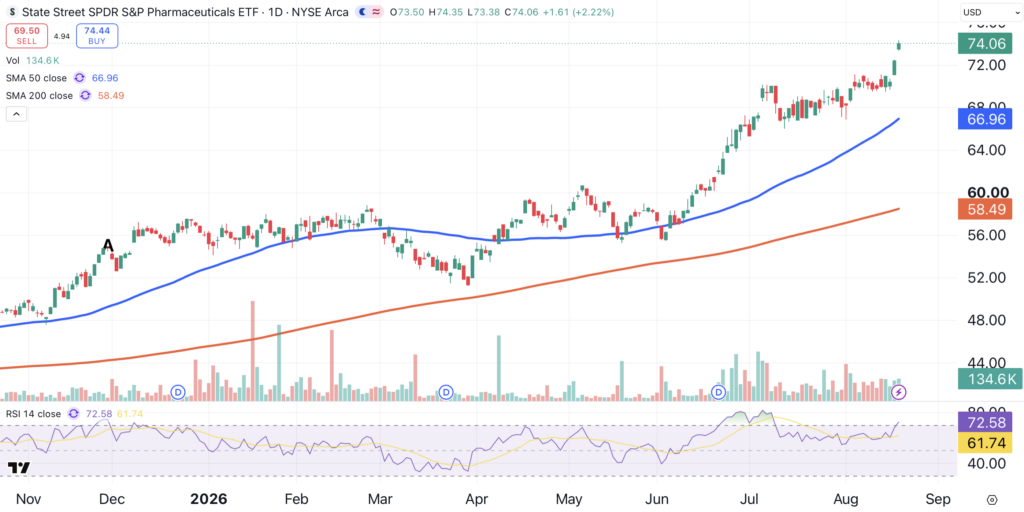
Is there any doubt that healthcare/pharma is the place to be right now? Merck, Johnson & Johnson (JNJ), Amgen (AMGN), Bristol-Myers (BMY), Teva Pharmaceuticals (TEVA), Eli Lilly (LLY) and Biogen (BIIB) all reached 52-week highs on Wednesday.
The State Street Pharmaceuticals SPDR (XHP), a bellwether for the sector, closed at an all-time high.
Tempus AI’s Moderna Connection
However, one of our names is noticeably absent from that list. Tempus AI did gain 24% on Wednesday, but the stock is still about 10% below our initial entry price.
However, things are looking up. Tempus AI recently acquired Personalis, a cancer genomics company, for $1.5 billion. Moderna uses a Personalis platform to analyze patient tumor tissue.
That’s why Tempus AI soared 24% higher on Wednesday, on its heaviest volume of the year.
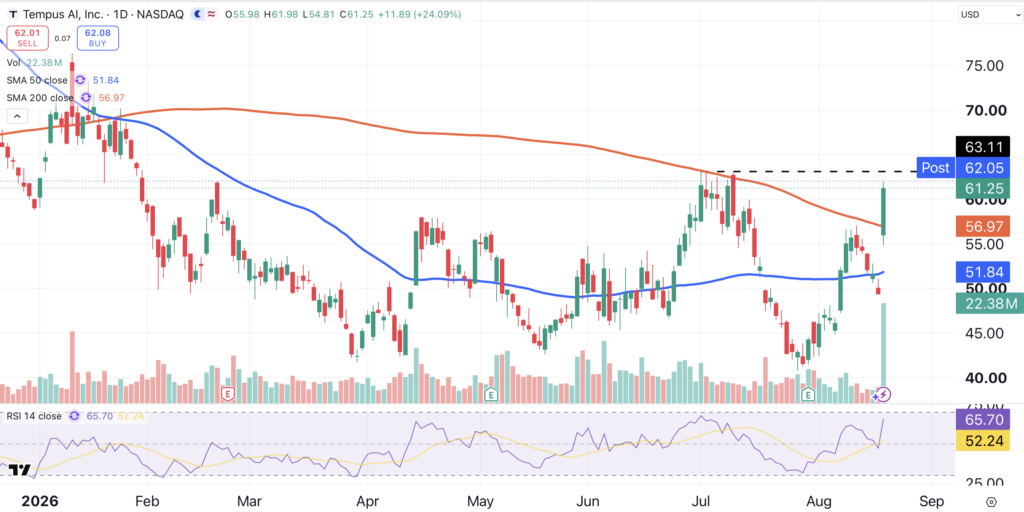
Will Tempus AI continue to rally? The stock needs a clean break above $63 (black dotted line) to reach a six-month high.
The stock is rapidly closing in on that figure, reaching $62 after Wednesday’s close. We’ll add to our Tempus AI position on a break above $63.
Desperate Measures?
Yields plunged on Wednesday, after the U.S. Treasury announced it would double the size of buybacks on its long-term instruments.
We’ve been warning readers about the alarming rise in yields, especially on 10-year notes and 30-year bonds. Treasury Secretary Bessent’s actions are designed to blunt this increase.
Bessent succeeded in knocking down the yield on the 30-year bond, which had reached its highest level since the financial crisis of 2008 (left chart). The long bond’s yield fell from 5.33% to 5.18%.
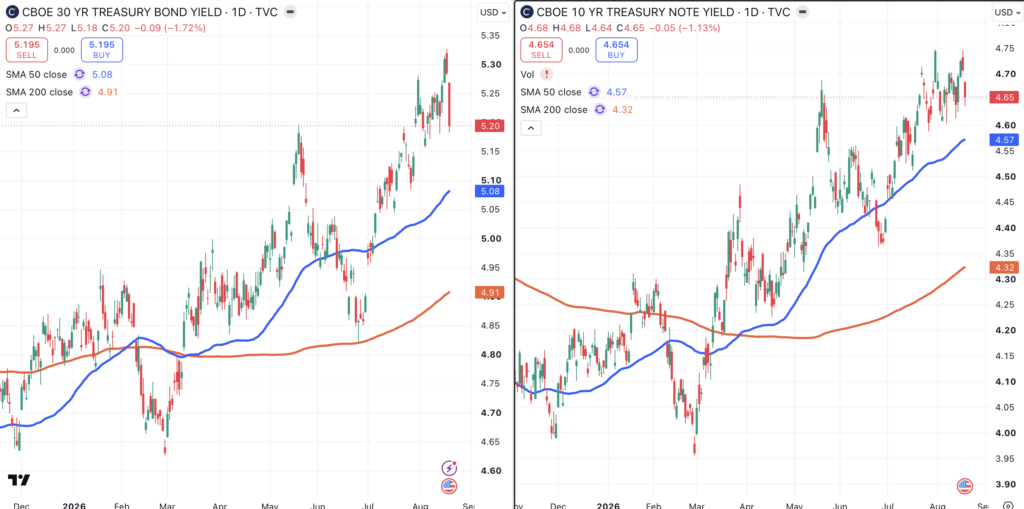
The yield on the 10-year note, which was nearing a 52-week high (right chart), declined from 4.75% to 4.65%.
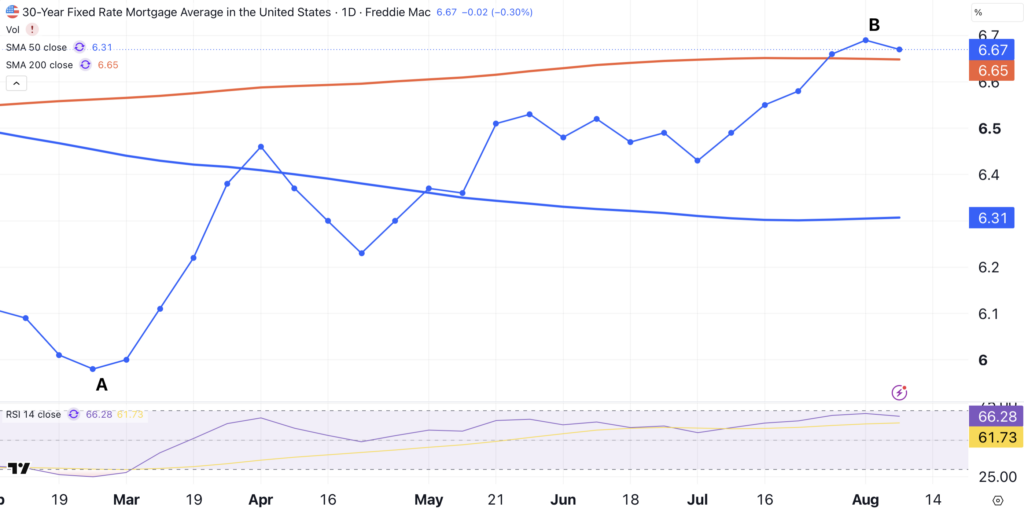
By lowering yields at the long end of the curve, Bessent is hoping to contain borrowing costs, which have been steadily rising. According to Freddie Mac, the average yield on a 30-year fixed rate mortgage has climbed from 6% in February (point A) to 6.69% earlier this week (point B).
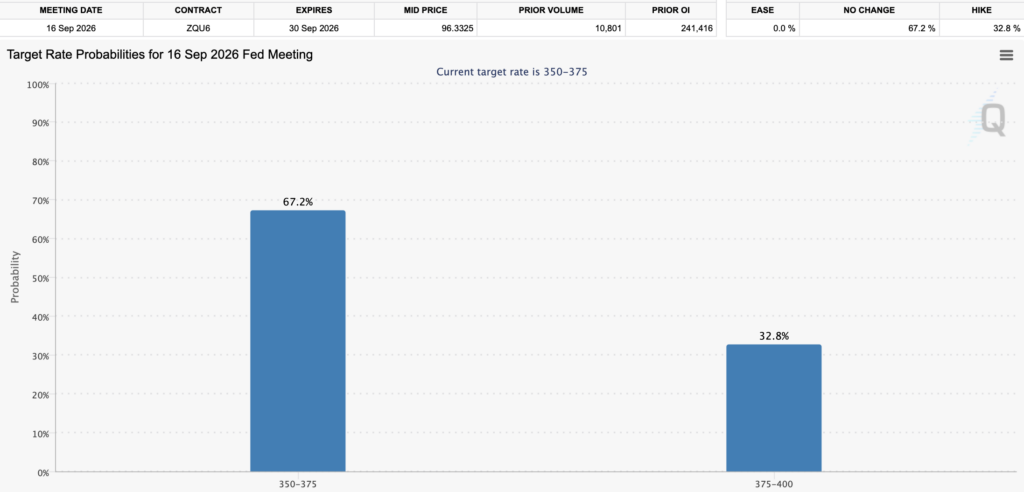
Meanwhile, the odds of a rate hike at the Fed’s September 16 meeting stand at about one in three. A recent series of weak data points (employment, factory orders, housing starts, pending home sales) have taken some pressure off of the central bank.
Bottom Line
While Bessent’s move may have succeeded in the short run, the jury is still out on whether he can keep a lid on yields in the long run.
Bonds have an inverse price/yield dynamic. By lowering bond yields, Bessent is also raising the price of those bonds. If investors sense that the rise in bond prices is temporary, they’ll likely sell into that strength, pushing prices back down. This would cause yields to bounce back quickly.
It’s one thing to knock yields down for a day, but quite another to hold them down for weeks, months or longer. Bulls will be rooting for Bessent, as stocks perform better in a low-yield environment.
At the time of publication, Ponsi was long MRK, JNJ and TEM.