GameStop Has an Infinite Money Glitch, But Is it a Buy Ahead of Earnings?
The infamous video game retailer keeps issuing new shares ahead of a highly anticipated report.
You've reached your free article limit
You've read 0 of 1 free Pro articles.
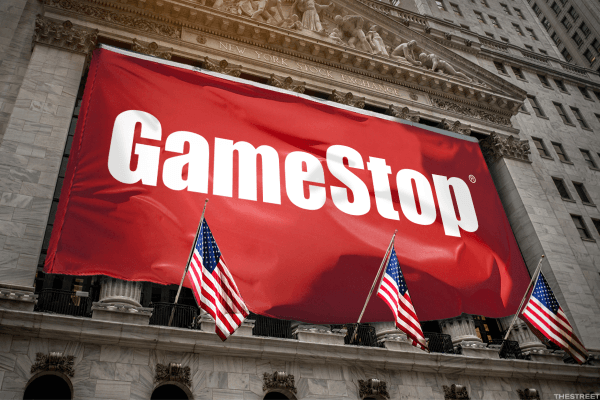
For the first time in a while, I’m getting questions about GameStop (GME). The stock has been creeping higher, just ahead of next week’s earnings announcement.
Shares of the gaming retailer have gained about 5% in the past week. GameStop’s next quarterly earnings announcement is scheduled for September 8.
Is GameStop about to make a real move, or are shareholders in for a disappointment? Let’s take a closer look.
GameStop Has Cash
Part of the bull case for GameStop centers around its cash and cash-equivalent position.
Six months ago, GameStop’s cash and cash equivalents stood at $9 billion, including marketable securities. Now the company has $5 billion in cash, and about $5 billion in shares of eBay.
Did GameStop obtain its cash position from its business operations? Not entirely.
Courtesy of Macrotrends, let’s take a peek at a 10-year timeline of GameStop revenues: trailing 12 months (top), quarterly (middle) and year-over-year quarterly growth (bottom).
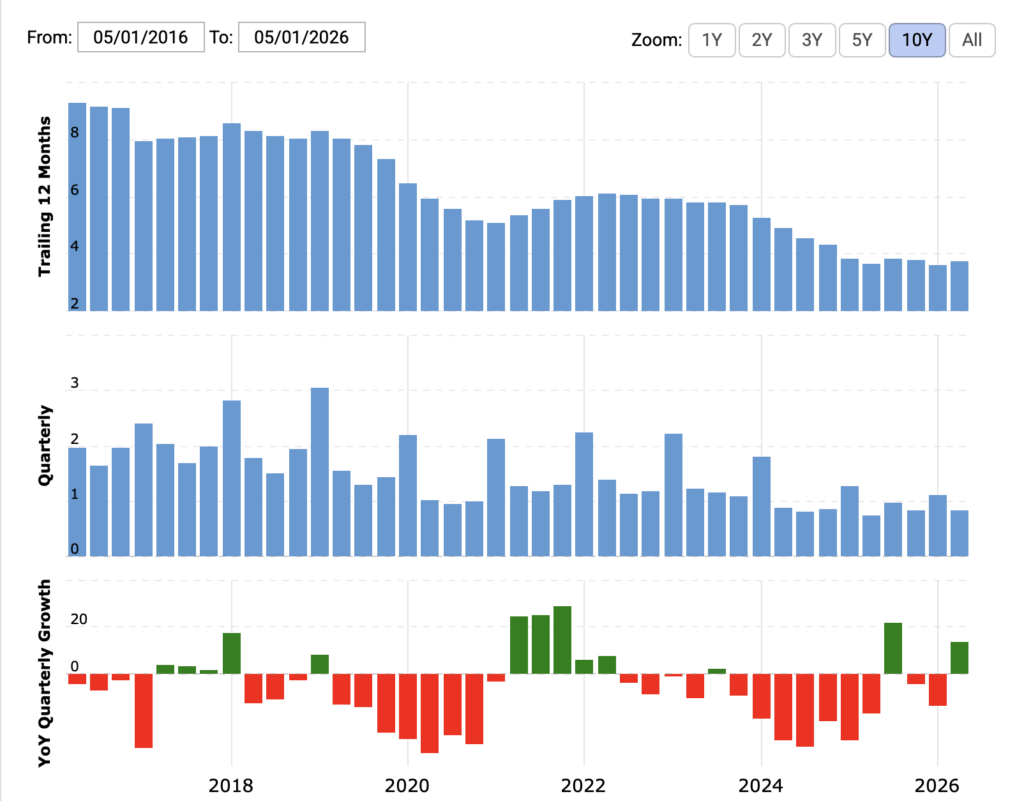
As you can see, the trajectory of GameStop’s revenue is less than appealing. It’s a shrinking brick-and-mortar retailer that once boasted 6,000 stores globally. That figure has been reduced to less than half.
How did shrinking GameStop become a cash-rich company? It seems that GameStop has discovered an infinite money glitch: keep issuing more shares.
Courtesy of Macrotrends, we see below GameStop’s quarterly shares outstanding (top image) and year-over-year quarterly growth in the number of outstanding shares.
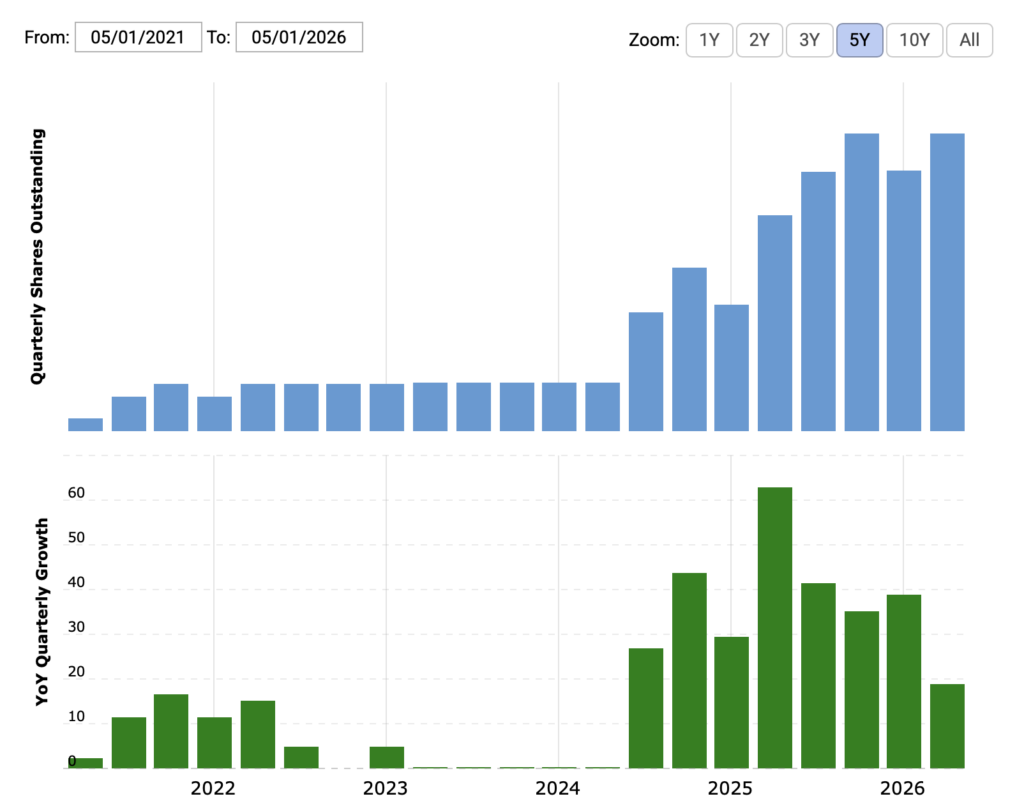
To be fair, GameStop recently capped the number of new shares it plans to issue. This is designed to avoid further shareholder dilution, although some would argue that it’s too little, too late.
The eBay Factor
What is GameStop doing with this capital? The Texas-based retail video game merchandiser is purchasing shares of eBay. In May, eBay rejected a $56 billion buyout proposal from GameStop.
GameStop now owns 43.4 million shares of eBay, or just under 10% of the company. If GameStop controlled more than 10% of eBay, it could be classified as a major stakeholder, triggering mandatory disclosures.
GameStop’s current investment in eBay is now worth $5 billion. Not including the eBay share purchases, the company maintains an additional $5 billion in cash and cash equivalents.
If eBay can attract interest from private equity investors, there is still a possibility the deal could go through.
Understanding eBay’s Perspective
When eBay rejected GameStop’s buyout, it described the offer as “neither credible nor attractive.” Moody’s declared that this merger would be a “credit-negative event”
Why would eBay, a profitable online-only marketplace, want to pair up with a shrinking brick-and-mortar retailer?
Understanding GameStop’s Perspective
Here’s why the deal makes sense to GameStop.
In the late ’90s, internet access provider America Online (AOL) was a very profitable company.
However, the writing was on the wall. Dial-up internet access was dying, and high-speed internet, delivered by telecom and cable providers, was about to take over.
Fortunately for AOL, the company was flush with cash. It used that capital to purchase Time Warner for $180 billion. It was an odd merger, since AOL was in a completely different line of business, but that didn’t matter.
AOL knew it was a sinking ship. It saw a lifeline, and grabbed hold of it.
That’s the situation that GameStop finds itself in today. It would rather be eBay than GameStop. I’m sure there are many other companies it would rather be, instead of the one it is right now.
Bottom Line
Maybe some exciting news will be released at the upcoming earnings report that will drive GameStop shares higher. If you make money on that announcement, more power to you.
Just don’t make the mistake of becoming a true believer.
Keep in mind, there are thousands of different companies you could own — well-run companies that don’t dilute their shares, or try to force a merger with a brand that has no interest. Companies that have expanding revenues, or have bullish technical momentum.
Companies that have a future. Companies that aren’t GameStop.
At the time of publication, Ponsi had no positions in any securities mentioned.