Apple Gets Hit by ‘100-Year Flood.’ But That’s Missing the Real Story.
Here’s why Apple’s selloff was overdone.
You've reached your free article limit
You've read 0 of 1 free Pro articles.
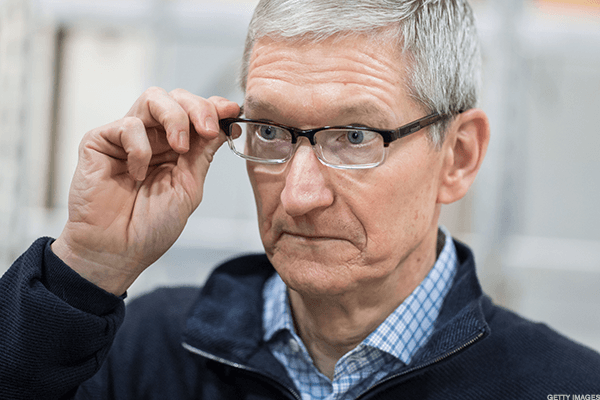
Thursday’s 6.12% decline from Apple (AAPL) was ugly. Apple is raising prices on its MacBooks and iPads, blaming higher memory and storage costs. CEO Tim Cook described the sharply higher prices for memory components as a “100-year flood.”
Technically, Apple took a hard blow on Thursday. The stock is now well below its 50-day moving average (blue), but still remains above its 200-day moving average (red).
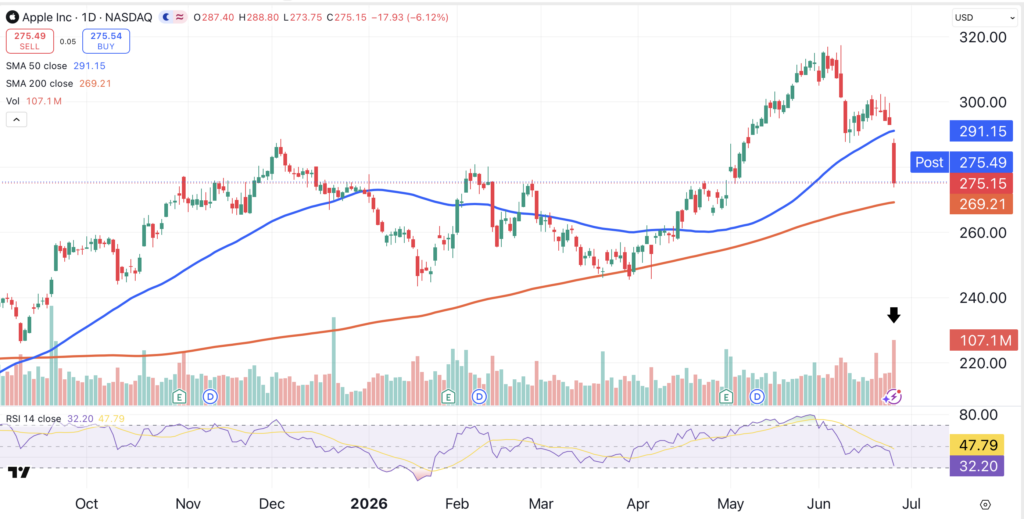
We could test that key indicator soon. That’s because Apple’s decline on Thursday occurred on the stock’s heaviest volume this year (arrow). This means institutional investors were likely among the heavy sellers.
It’s Not a Company-Specific Issue
However, this is not an Apple-specific problem. Sooner or later, Apple’s competitors will be forced into the same position. If Apple needs to charge more due to rising component prices, you can bet its competitors will be forced to do the same.
Taking this into consideration, perhaps the damage caused by the news was overdone. Numerous other companies are facing similar issues.
It’s Not Just Apple
Apple isn’t the only large-cap stock that is facing technical difficulties. On Thursday, Microsoft (MSFT) closed at a 52-week low.
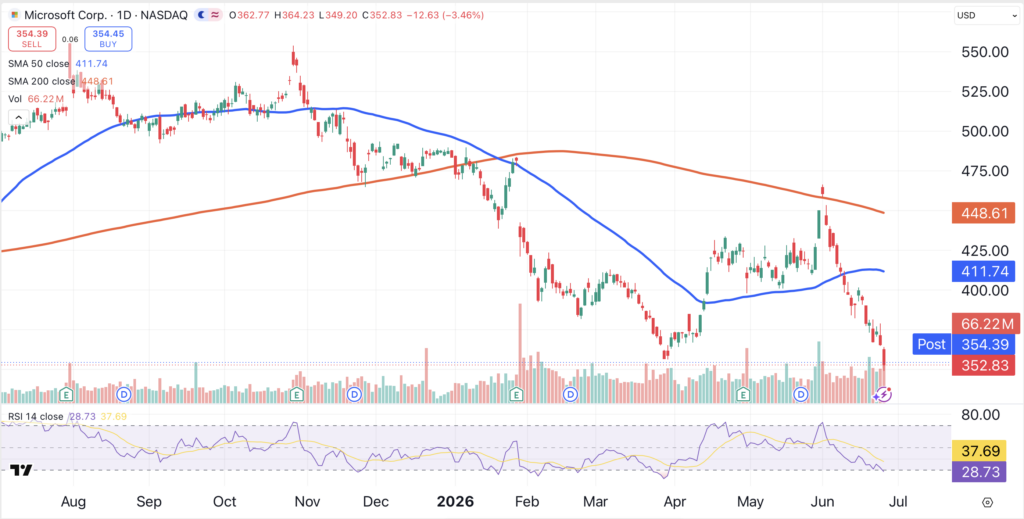
Effective August 1, Microsoft is raising its prices for Xbox hardware and certain Microsoft 365 subscriptions. Just as with Apple, Microsoft blamed higher component costs for the price increases.
Dell (DELL) and HP (HPQ) have also cited rising component costs as the reason behind recent price increases.
The problem isn’t contained in the U.S. Chinese handset makers Realme and Xiaomi also recently raised prices due to higher component costs.
Since Apple didn’t announce any price increases for the iPhone, sales could see a short-term bump as consumers attempt to upgrade before the inevitable price hike.
Real-Time Inflation
With Apple, we are seeing a real-time example of rampant inflation that has nothing to do with energy prices. If the Middle East conflict ended today, the prices of memory components would still be high and rising.
Is the U.S. falling behind the curve on inflation? The Bank of Japan raised its key interest rate by 25 basis points this week, and the European Central Bank did the same earlier this month. Both central banks indicated that more rate hikes could be on the way.
Bottom Line
It seems odd that Apple would be taken to the woodshed over the same issue that is plaguing virtually every maker of computers, smartphones, and tablets. Lacking any other news, it seems Thursday’s Apple selloff was overdone.
At the time of publication, Ponsi was long AAPL.