How to Bargain Hunt on Wall Street Without Shooting Yourself in the Foot
Simple discipline can help you avoid a lot of pain when you try to catch a falling knife.
You've reached your free article limit
You've read 0 of 1 free Pro articles.

There are two basic approaches to the stock market. The first is to buy high and sell higher by buying breakouts and riding momentum. The second is to buy low and sell higher by focusing on stocks that offer value and that the market has mispriced.
When the market is in a strong uptrend, buying high and selling higher works well. Riding momentum when conditions are favorable is usually the road to substantial gains. It’s my preferred method, because the gains tend to be big and fast, and it rewards astute stock selection.
When the market is struggling, sentiment is negative and stocks have been badly beaten up, bottom fishing can produce some great opportunities. Trying to catch a falling knife is risky, though. Done wrong, it can lead to substantial losses, and it has wiped out many traders who failed to manage the risk. In my experience, more investors suffer major losses from buying stocks in freefall than from anything else.
Why Bottom Fishing Burns So Many Traders
The biggest mistake investors make with bottom fishing is buying too big and too fast while trying too hard to predict the absolute low. They are convinced the stock they like is an exceptional value that the market is mispricing, and if they don’t hurry and buy into the teeth of the decline, they will miss the opportunity of a lifetime.
It’s understandable logic. It can feel like a great opportunity when a stock that was doing well suddenly collapses and goes straight down. Stocks are not like consumer goods, though. When a television goes on sale, it is the same television at a lower price. When a stock drops, there may be a valid reason for the lower price, and it is difficult to determine an accurate valuation, especially when market conditions are shifting.
The problem is that we can never be sure whether a stock is dropping because of a change in market conditions, mispriced fundamentals, a shift in business conditions, a weak economy or any number of other legitimate reasons. The market is often aware of problems before the news is widely known.
Semiconductors are a perfect example right now. As I wrote on Thursday, the chip stocks looked cheap on their price-to-earnings ratios, and they have steadily declined. Micron Technology (MU) has substantial growth but traded at about 5.5-times forward earnings in late October. Those low multiples convinced many folks they were buying bargains, while the market was warning that the earnings estimates might be too high and the low P/E was a trap.
Don’t Try to Buy the Low
The key to effective bottom fishing is to avoid the game of trying to buy the absolute low. The only way to buy the exact low is to buy into the teeth of a decline and hope for an immediate reversal. Traders love the idea of being the genius who nails the exact turning point. They like to believe it is a skill great traders possess, but the truth is that it is pure luck. There is no reliable method for predicting the exact bottom of a stock in freefall.
Traders can sometimes catch an oversold bounce after panic and a sharp drop, but not with great precision. That can still produce some good short-term trades, but if the goal is a position trade that may last weeks or months, there is a better approach.
If you want a lower-risk entry point, buy only after a low has formed and the stock has bounced. The recent low then becomes an obvious support level. If the stock rolls over again, your risk is defined. You exit, wait for conditions to develop and try again.
This approach means you will never buy the exact bottom, but it greatly reduces risk. You give up the first part of the move in exchange for knowing exactly where you are wrong. That is a good trade-off, because the cost of being wrong while catching a falling knife is far greater than the cost of being a little late.
The SMH Example
The VanEck Semiconductor ETF (SMH) shows how this works. It peaked near $635 in early October and closed around $455 on Thursday, a drop of more than 28% in a month. Many bottom fishers have suffered substantial losses buying the chip stocks during that slide.
What happens when we apply one simple rule: Buy only on a day with a positive close, and set the stop at the prior low?
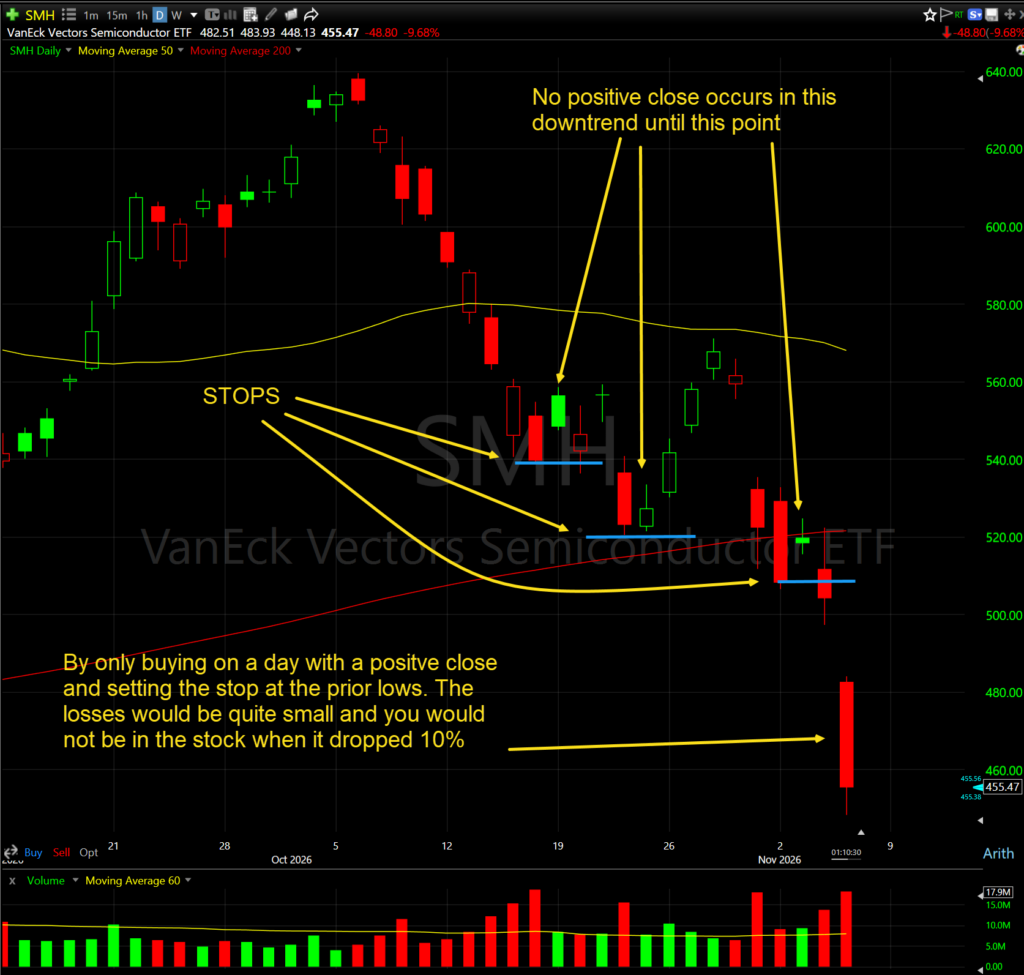
In this downtrend, the SMH didn’t post a positive close until Oct. 19, near $558. A buyer there would have set a stop at the prior low, around $541. The SMH broke that level a few days later, for a loss of about 3%.
The next positive close came on Oct. 23, around $535, with a stop near $521. This trade worked for a while. The SMH bounced to about $565 by late October, and a trader who took a quick profit came out ahead. A trader who held was stopped out when the chips broke down again on Nov. 2, for another small loss.
The third positive close came on Nov. 3, around $519, with a stop near $509. Wednesday’s post-election selling took it out for a loss of about 2%.
Then came Thursday, when the SMH dropped nearly 10% on its heaviest volume of the entire decline. A trader following the rule wasn’t in it.
Add it up. The disciplined trader took three small losses totaling about 7.5%, or came out ahead by flipping the late-October bounce. Someone who bought the first positive close and held is down about 18%. Someone who bought into the decline near $600 because the chips looked cheap is down roughly 24%, and needs a gain of nearly a third just to get back to even.
The stock kept hitting new lows, and the method still protected capital. It doesn’t make you right. It keeps you from being badly wrong.
The Rules
- Wait for strength. A positive close, or better yet, a higher-low, tells you buyers are showing up. A falling price alone tells you nothing.
- Define the risk before you buy. The stop goes just below the most recent low. If you can’t identify that level, you don’t have a trade.
- Start small. Your first entry is a test. Add only if the stock confirms by holding its low and making progress.
- Expect to try more than once. Getting stopped out isn’t failure. It’s the cost of finding the bottom. Re-entering after a stop is part of the process.
- Watch the volume. Thursday’s heavy volume on the SMH could be the start of a capitulation that eventually forms a durable low. It could also be the start of the next leg down. The bounce that follows will tell you which.
- Respect the fundamentals. If the decline is about deteriorating earnings, the bottom will take longer to form than the chart suggests.
What I’m Watching
The current market is creating some exceptional bottom-fishing opportunities, but there is no way to know how long the selling pressure will last. The semiconductors are now well below their 200-day moving average, and Nvidia (NVDA) reports on Nov. 17. That report will tell us a lot about whether the estimates behind those cheap-looking P/Es are holding up.
If you want to try to buy some bargains, stay patient, wait for strength and set your stops at the prior lows. If it doesn’t work, keep trying until it does. Eventually, market conditions will change, or you will be forced to recognize that you picked the wrong stock. Either way, small losses keep you in the game long enough to find out.
At the time of publication, DePorre had no position in any security mentioned.