Stock Market Today

Market updates and conversation from TheStreet Pro team. Follow the latest and join the conversation below.

Stock Market Today: October 23, 2026

Newest first · All times Eastern · 7 updates

DATE:
By Jason Meshnick, CMT

Quick Comparo on Consumer Sent vs. SP500

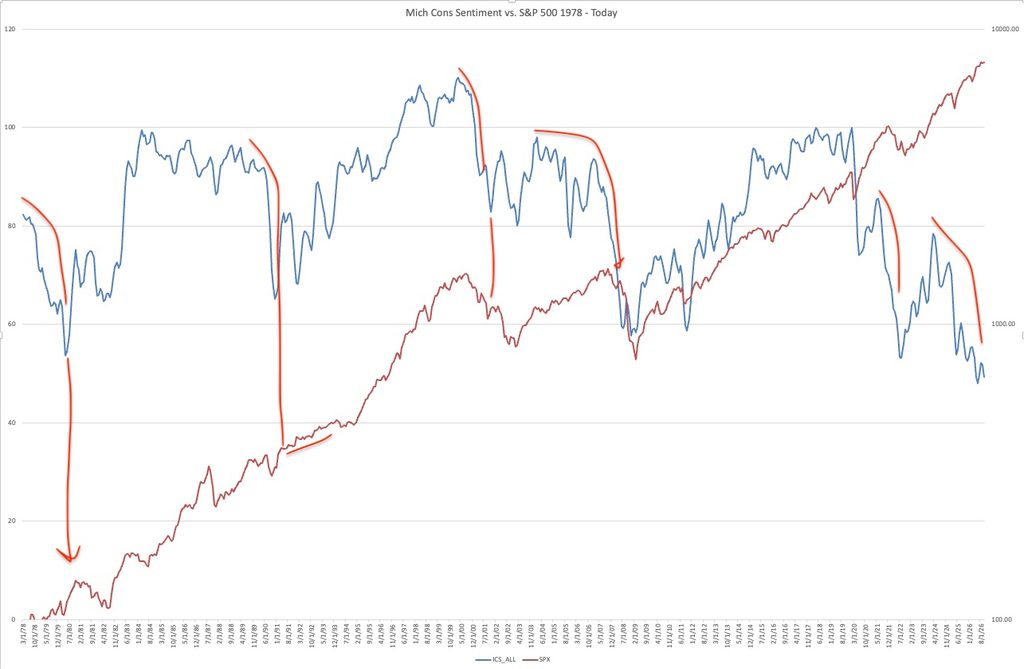
Neil’s note earlier on Michigan Consumer Sentiment dropping to lows (although beating expectations) got me thinking about research I did back in my Fear & Greed days. Back then, I noticed that lows in Consumer Sentiment happened around lows in the S&P 500.

Here’s the thing. It’s not a timing tool. And you might even say that Consumer Sentiment leads stocks. So, where are we now?

The red line is the S&P 500 and the blue is Mich Consumer Sentiment. What I see is a relationship between the two and according to my stats, Sentiment explains 40% of the movement in the S&P 500. Now, this is a simplistic analysis, but it has some merit.

Basically, consumers lose faith in the economy, and then stocks fall. Consumers have no faith in the economy right now, and haven’t for years! (This isn’t a political statement.) I probably should have used RSP for this analysis instead of S&P 500, but it doesn’t go back as far.

So, the stock market may continue to go up, but risk is only increasing.

Trend is your friend, except at the ends, where it bends.
Screenshot

Data from: https://data.sca.isr.umich.edu/ and https://shillerdata.com/
By Jason Meshnick, CMT

Scarcity of Capital or Scarcity of Demand Willing to Pay?

In today’s Market Recon, Tech’s Capital Problem, Sarge shared the following quote from Nvidia’s (NVDA) Jensen Huang:

“If you look at the fundamentals, the demand for the neoclouds is off the charts.” Huang paused and then he added, “What is missing in the middle is the working capital to fuel that growth… because there’s just so much demand across so many sectors of AI, there’s a scarcity of capital.”

Then he said: “The demand of the capital is much greater than the availability of the capital.”

This got me thinking. Yeah, I understand that early-stage ideas need capital to grow. But a business needs customers that are willing to pay a fair market price for the thing they’re buying.

In the case of AI, the demand is there, but paying customers are not. Or, at least, customers willing to pay what the product is believed to be worth.

Yes, these companies are growing fast. But when will people be willing to pay what the services are “worth”?

When the demand comes from investors and not customers, is that the sign of a healthy product? Or has AI gotten ahead of itself?

There are lots of good businesses that would make the world a better place that failed for a lack of “capital.” Or was it a lack of paying customers?

I’m not saying AI will fail. On the contrary. It will succeed because the people with the money will make sure that we can’t live a modern life without it. I guess that’s when we’ll all start paying a fair market value for it.

By Neil Sethi

Why Has Tech Been So Volatile?

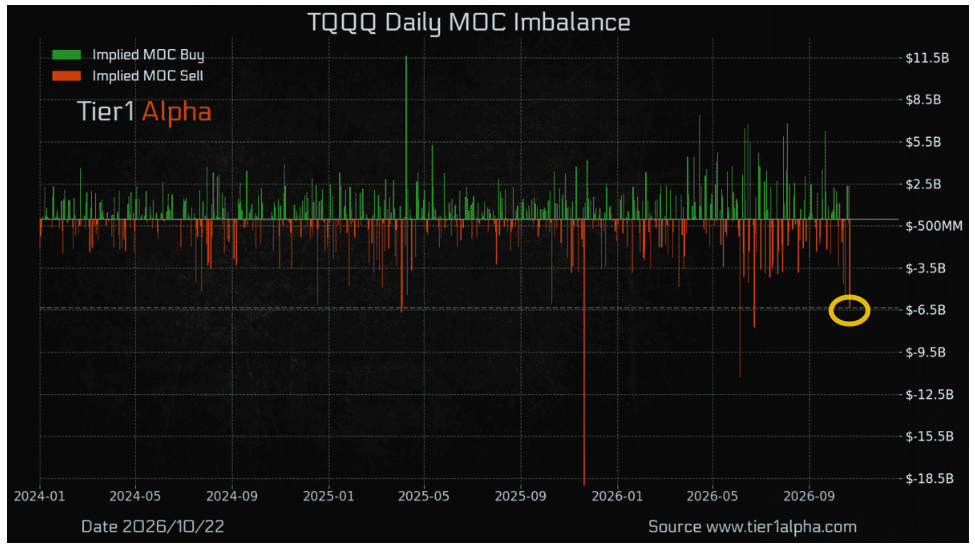
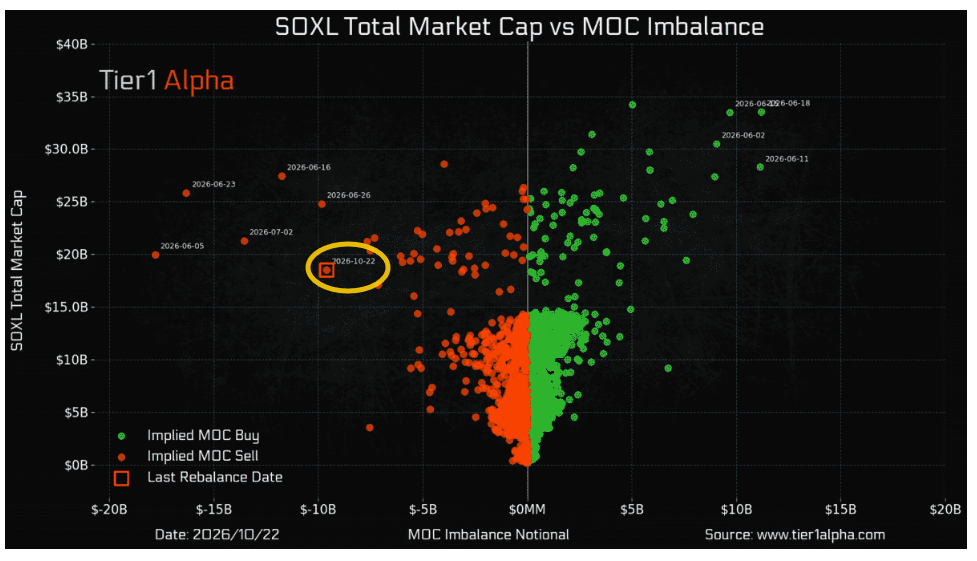
If you’re searching for an explanation for why Tech, particularly semiconductors, has been so volatile, you can in part blame the overall negative gamma* regime in the market as Tier1Alpha indicated earlier this week.

But semis have an added pseudo-negative-gamma source in the huge amount of assets in leveraged ETFs tied to the space, which must rebalance near the close by buying or selling in the direction of each day’s move.

As Tier1Alpha notes: “we suspect these funds were the largest non-discretionary agents in the market yesterday.” The two biggest are the Direxion Daily Semiconductor Bull 3X ETF (SOXL) and the ProShares UltraPro QQQ (TQQQ) [‘the largest levered fund in the industry by market cap’], which together hold about $60 billion in assets.”

They estimate SOXL’s 20% decline forced a $9.5 billion market-on-close (MOC) sell imbalance, while TQQQ “contributed another $6.5 billion in MOC selling.”

*Gamma plays an important, if nebulous, role in market volatility. Positive gamma means options market makers buy and sell against price moves, which dampens volatility. Negative gamma means the reverse: market makers trade with the move, accelerating rallies and selloffs and adding to volatility.

By Neil Sethi

France Puts the ECB in a Bind

Not easy these days to be an ECB policymaker.

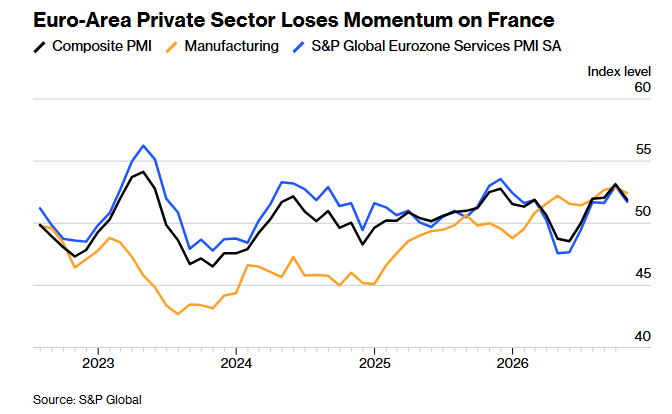
The euro area flash PMIs showed that while the “eurozone economy starts the fourth quarter with businesses reporting further robust growth… consistent with GDP growing at a 0.3% quarterly cadence,” according to S&P, France was a key outlier.

While growth cooled modestly across the region S&P said “French private sector output moved back into contraction in October, following a first rise in 10 months during September,” with business confidence “the lowest since 2012 if the pandemic is excluded.”

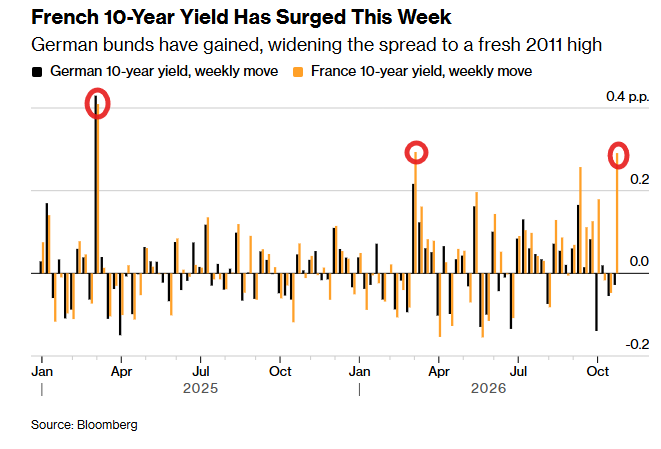
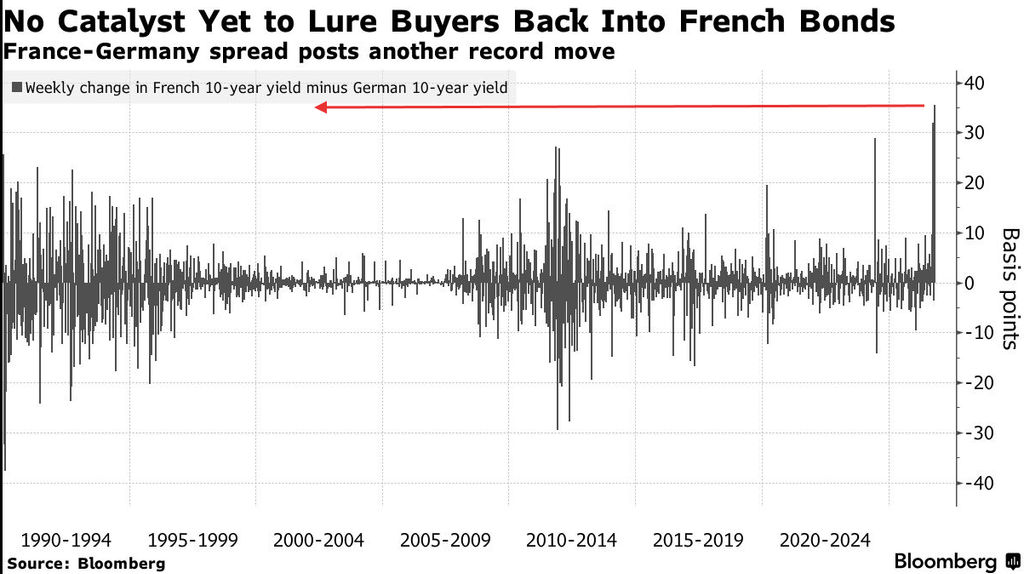
Slowing growth only adds fuel to budget concerns in France, putting further pressure on French bonds. Rather than pulling back this week along with other developed-market yields, French yields instead surged the joint-most since March 2025, according to Bloomberg.

Pushing the spread between French 10-year debt and the German equivalent up 32 basis points so far this week, the most in records going back to 1990, according to data compiled by Bloomberg. “The yield gap now stands around 1.7 percentage points, more than double the level from May.”

This puts the ECB in an increasingly tricky spot, weighing turmoil in the French bond market against inflationary pressures that, according to S&P, are far from extinguished:

“Key to the broader slowdown is the further escalation of inflationary pressures seen during the month. Input costs are rising sharply again, the rate of increase surging in manufacturing on the back of higher energy prices, causing firms to push selling prices higher in order to protect margins.”

So policymakers are in an uncomfortable spot heading into next week’s meeting. A hold is widely expected, but markets are still pricing further hikes to fight inflation, just as France’s economy stalls and its bond market comes under strain.

By Neil Sethi

Slower AI Buildout = Fewer Rate Hikes?

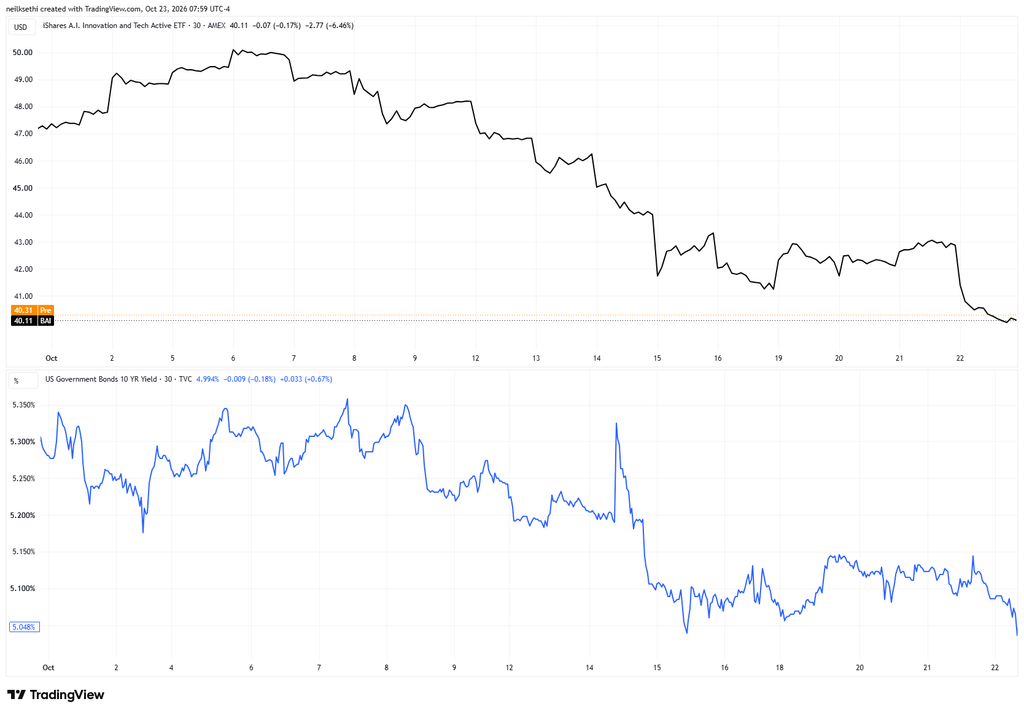
In addition to the negative correlation between AI stocks and yields this month (below chart is Philadelphia Semiconductor Index (SOX) and 10-year yields)…

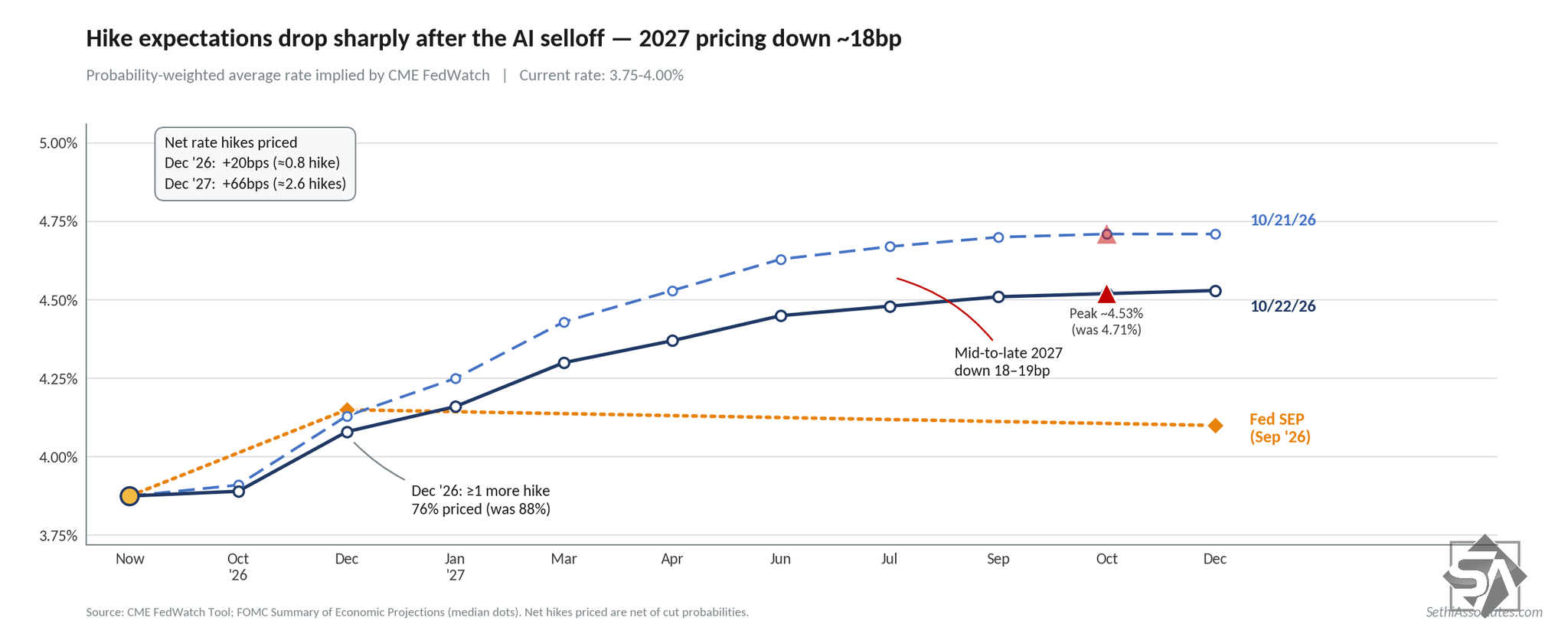
… we’ve seen weakness in the AI trade weigh on Fed rate hike expectations, on the idea that a softer AI complex means slower growth through both the buildout and equity channels, and so less need for hikes.

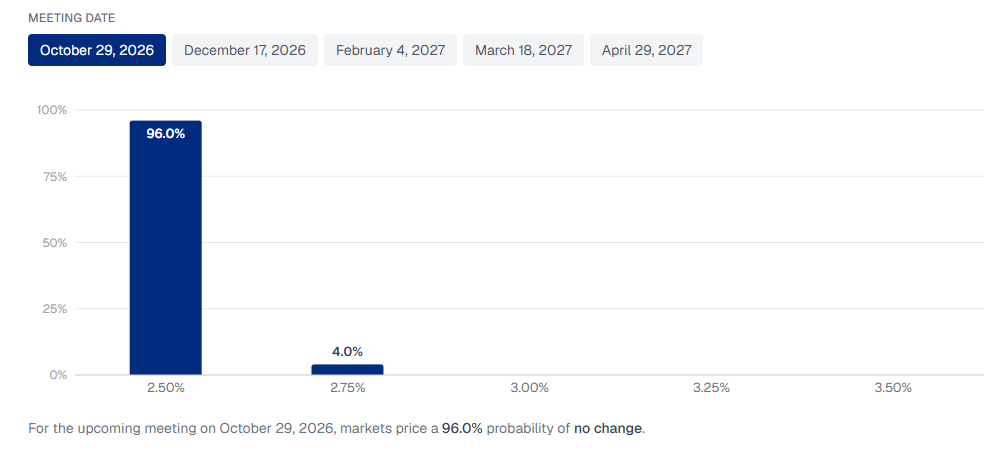
As noted in last night’s update, October is now a 93% chance of a hold, and December is less sure of a hike at 76% (from 88%). 2027 expectations dropped as well with now just 66 basis points of total hikes priced through December next year, down from 83 basis points Wednesday.

By Neil Sethi

Credit Spreads Are Widening

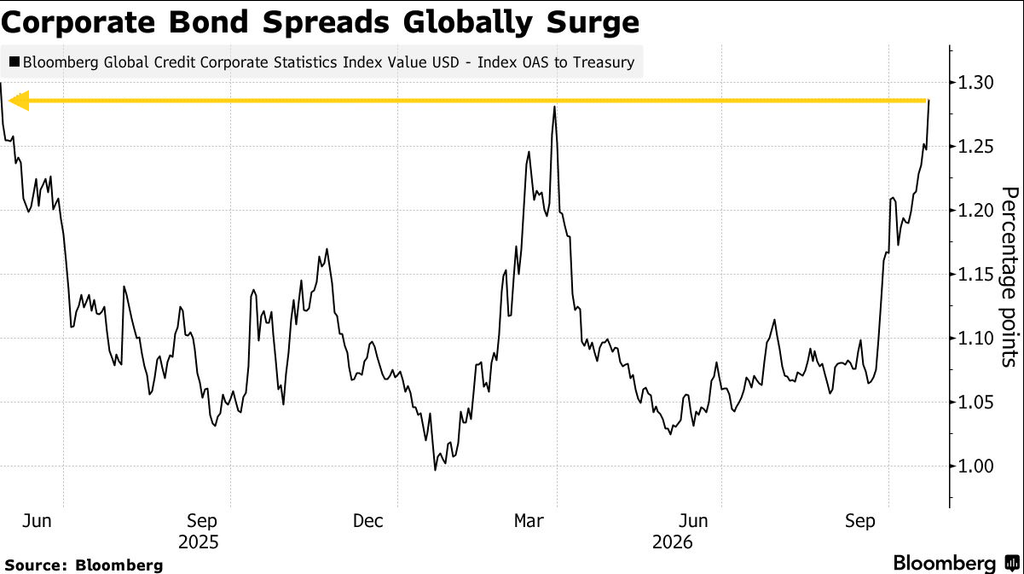
Bloomberg’s Global Corporate Credit Index (measure of aggregate bond spreads) have jumped to 129 basis points, the widest over the risk free rate since May 2025 (when they were recovering from the liberation day spike).

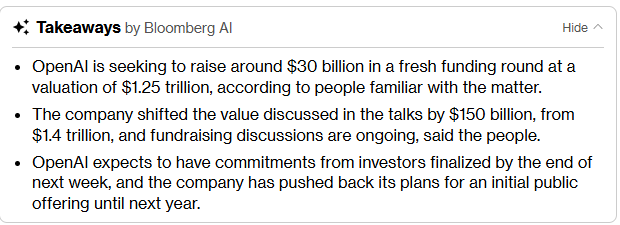
Perhaps not unrelated, Bloomberg is reporting that OpenAI’s valuation in its latest funding round is being trimmed to $1.25 trillion from $1.40 trillion.

Still that represents a nearly 50% increase from the $852 billion in its March funding round.

By Neil Sethi

TGIF – Friday’s Calendar

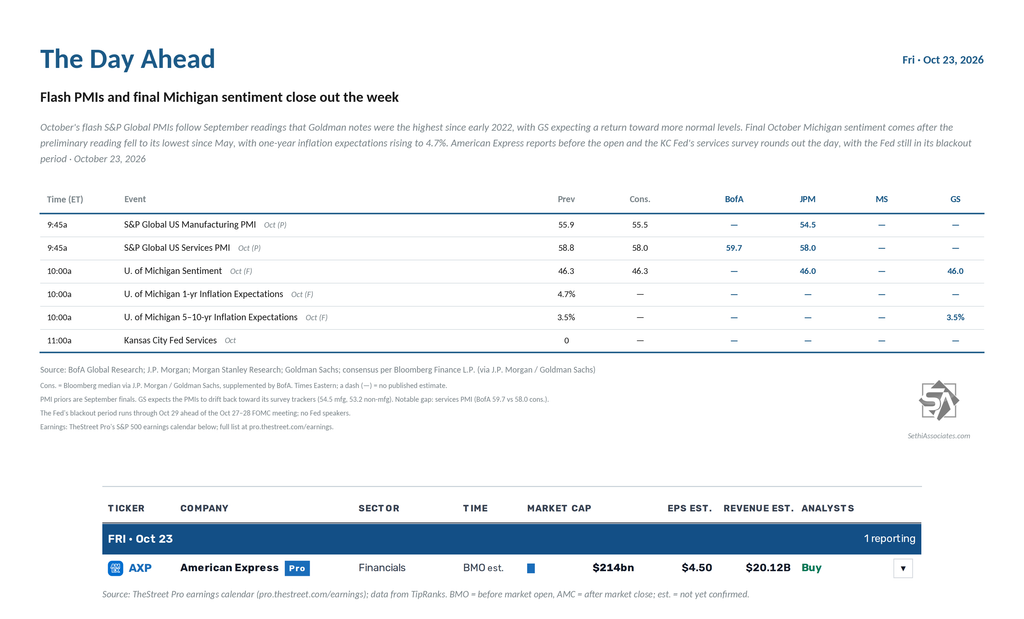
US economic data closes out the week with October’s flash S&P Global PMIs, final University of Michigan consumer sentiment and the Kansas City Fed’s services survey.

The Fed remains in its blackout period ahead of next week’s October 27–28 FOMC meeting.

No non-Bill (>1yr in maturity) US Treasury auctions.

Q3 earnings season continues with one S&P 500 component, American Express ($AXP).

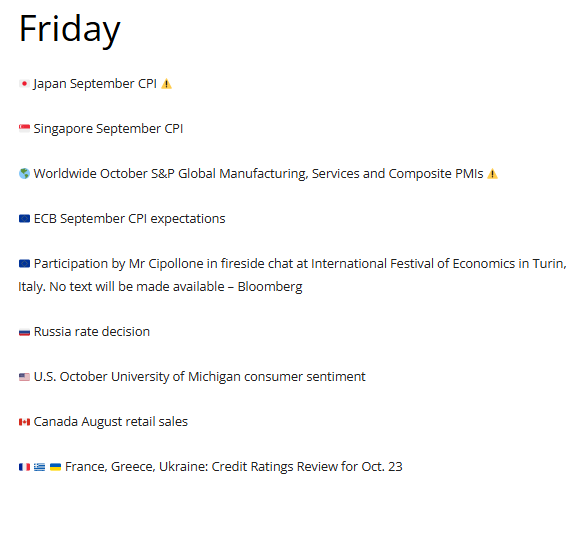
Ex-US highlights are global flash PMIs, ECB consumer expectations survey, UK October GfK consumer confidence, September retail sales, Japan September national CPI, and Canada August retail sales.

From Christophe Barraud’s international Week Ahead rundown:

Conversation 0 Comments

One ongoing discussion across all days. Everyone can read; sign in to take part.

Your voice matters. Discussions are moderated for civility. Read our guidelines .

Log in to join the conversation

Loading comments...