Tech’s Capital Problem
As more and more funds are raised for the AI buidout, is there a scarcity of capital?
You've reached your free article limit
You've read 0 of 1 free Pro articles.

Enter Sandman
… Sleep with one eye open
Gripping your pillow tight
… Exit light
Enter night
Take my hand
We’re off to never-never land
-Hetfield, Ulrich, Hammett (Metallica), 1991
Carnage
The wrecking ball hit hard. The tech-heavy Nasdaq Composite gave up 2.6% for the day on Thursday. The tech-heavier Nasdaq 100 lost 2.9%. In fact, these indexes suffered their worst regular session since early June. The S&P 500? Down a gnarly 1.21% as the closing bell rang aloud. The culprit? A report at the New York Times claiming that the U.S. and Israeli militaries had developed detailed plans for renewed strikes against Iran after the American midterm elections.
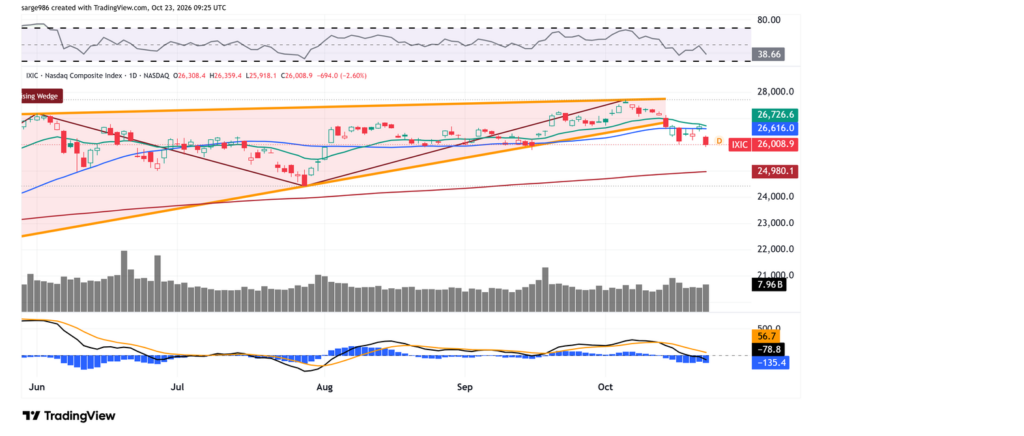
Readers will note the technical damage done Thursday. This damage was severe. The Nasdaq Composite opened well below its 50-day simple moving average on Thursday and never made contact with that line. The index would have to rally 2.33% or 607 points on Friday to regain that line going into the weekend.
Prices for crude oil ran higher in response and haven’t really stopped. Front-month WTI traded close to $101 per barrel overnight as Brent traded above $114. Investors flocked into U.S. Treasury debt securities in search of safe haven. The benchmark U.S. 10-year Note paid just 4.952% at day’s end as that yield dropped an incredible 19.3 basis points, posting its largest single day-move since March 10, 2023.
To put this kind of a move in yields in context, Joy Wiltermuth pointed out at MarketWatch that there have only been 15 trading days in the past decade where the 10-year U.S. Treasury yield had moved as much as 19 basis-points in either direction. She points out that this period covers both the pandemic, and the 2023 regional-banking crisis. In fact, buyers surged into Treasuries with such a level of aggression on Thursday that I felt the move was just as much squeeze driven as news driven.
Was That Really the Reason…
Behind such carnage? Of course not. There has been talk up and down Wall Street and elsewhere for weeks that the current U.S. administration had lost patience with Iran. That talk has suggested that this administration was simply waiting to get the midterm elections out of the way. This kind of news, while dour, should not have shocked investors. Not even those “professionals” more reliant upon high-speed, keyword reading algorithms designed to force momentum overshoot.
The truth is that Thursday’s equity market selloff wasn’t all that broad. This was a tech sector, AI trade, Mag 7 beatdown. Pure and simple. If the catalyst had truly been war jitters, the S&P Small Cap 600 would not have rallied 0.65% for the session. That rally came by virtue of the rally in Treasuries that forced yields (borrowing costs) lower. The Dow Transports rallied sharply as well, gaining 1.87% on Thursday. The Dow Industrials may not be all that relevant in the modern era, but the transports sure are.
As a matter of fact, the S&P 500 Equal Weight Index rallied to the tune of 0.77% on Thursday and has been in rally mode for all of October. Take a look at this:
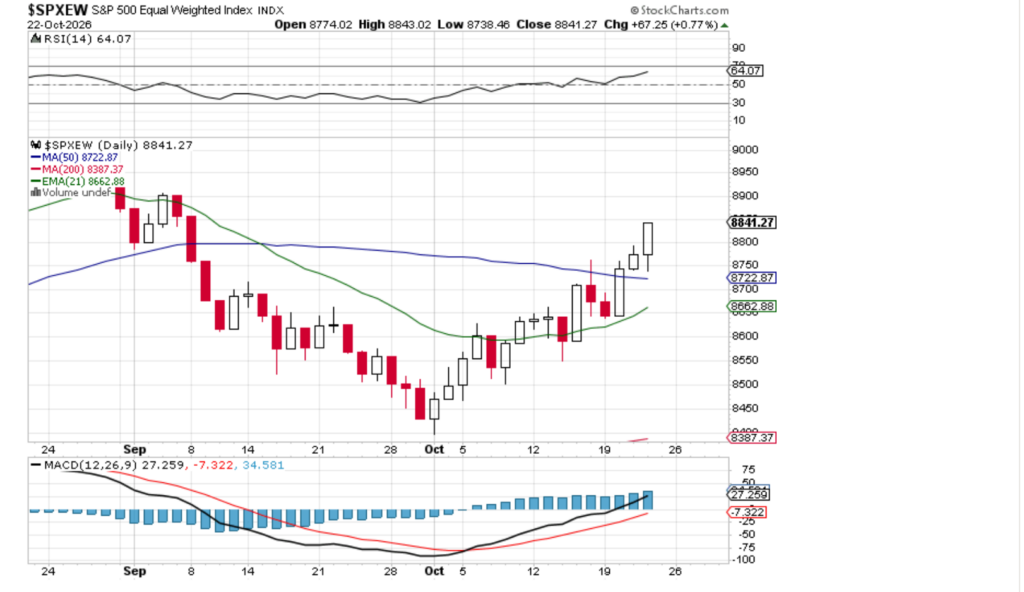
The equal weight S&P 500 lost contact with it’s 50-day simple moving average too, to the upside. Take a look at this comparison. The equal weight S&P 500 badly underperformed the weighted S&P 500 in September and has now made all of that ground up in October. This chart is truly incredible…
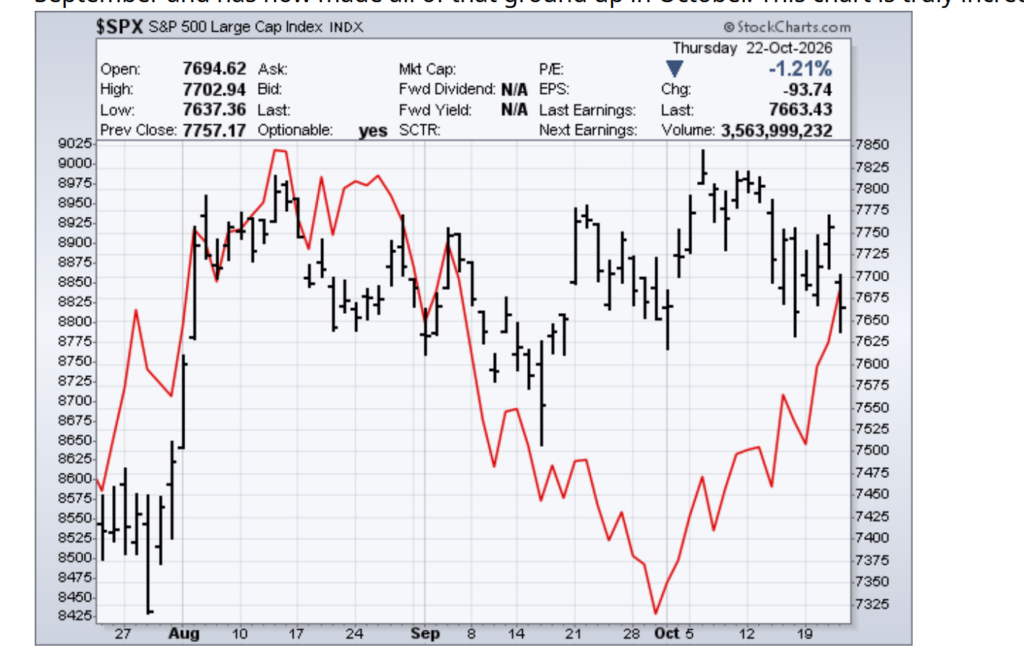
So, what has really been behind such a bifurcation in market performance? Let’s talk about it, shall we?
A Scarcity of Capital?
Despite all of this capex spending? On Thursday morning, Nvidia (NVDA) CEO Jensen Huang appeared on CNBC. During the interview, Huang said, “If you look at the fundamentals, the demand for the neoclouds is off the charts.” Huang paused and then he added, “What is missing in the middle is the working capital to fuel that growth… because there’s just so much demand across so many sectors of AI, there’s a scarcity of capital.”
Then he said: “The demand of the capital is much greater than the availability of the capital.”
Investors started thinking.
Broadcom (AVGO) CEO Hock Tan spoke a few days ago from Singapore. He said it just as plainly, “There is more demand for compute infrastructure than we can supply,” adding “(What) I think might be the biggest constraint is capital.”
Tan was not alone. Intel (INTC) CEO Lip-Bu Tan echoed those concerns, pointing to the rising cost of capital and questions over whether companies investing so heavily in AI will ever be able to generate sufficient returns. He stated, “If there’s any challenge in the front, it’s capital and the cost of capital, and then the other part is in the longer run, people want to see the ROI.”
Later on Thursday, a regulatory filing by Meta Platforms (META) noted that recent significant capital raises made by peers such as Alphabet (GOOGL) and SpaceX (SPCX), alongside anticipated fundraising efforts to be made by Anthropic and OpenAI, have created an increasingly difficult fundraising environment.
As a result, Meta would move proactively to raise funds before competitors could absorb the suddenly concerning available capital. Meta disclosed an updated figure on its future spending commitments as well, which had risen to roughly $825 billion from less than $700 billion as recently as July. This news clearly rattled tech / AI focused investors.
As I Ebb’d with the Ocean of Life
O baffled, balk’d, bent to the very earth,
Oppress’d with myself that I have dared to open my mouth,
Aware now that amid all that blab whose echoes recoil upon me I have not once had the
least idea who or what I am,
But that before all my arrogant poems the real Me stands yet untouch’d, untold,
altogether unreach’d,
Withdrawn far, mocking me with mock-congratulatory signs and bows,
With peals of distant ironical laughter at every word I have written,
Pointing in silence to these songs, and then to the sand beneath.
– Walt Whitman, 1860
Breadth
Thursday really was not all that bad. Depending on who you ask. Depending on how one is positioned. Six of the 11 S&P sector SPDR ETFs closed out the session in the green. Five of those funds gained more than 1% on the day. Of course, more defensive sectors, led by the staples (XLP) and the utilities (XLU) were your top performers. Of course, it got ugly for growth type sectors. Technology (XLK) and Communication Services (XLC) led the losers.
Interestingly, winners beat losers at the NYSE by a rough four-to-three margin as NYSE-listed advancing volume took a 51.9% share of the pie. But losers beat winners by about four to three at the Nasdaq. Advancing volume took a 43.2% share of composite Nasdaq-listed activity. Bifurcation? Oh yeah. Trading volume exploded higher on a day over day basis across the listings of both exchanges. Good times? Depends on perspective
Rawhide
Keep rollin’, rollin’, rollin’,
Though the streams are swollen,
Keep them doggies rollin’, rawhide.
Through rain and wind and weather,
Hell bent for leather,
Wishin’ my gal was by my side.
All the things I’m missin’,
Good vittles, love, and kissin’,
Are waiting at the end of my ride.
– Washington, Tiomkin (performed by Frankie Laine), 1958
Economics (All Times Eastern)
09:45 – S&P Global Manufacturing PMI (Oct-Flash): Expecting 55.3, Last 55.9.
09:45 – S&P Global Services PMI (Oct-Flash):
Expecting 57.9, Last 58.8.
10:00 – U of M Consumer Sentiment (Oct-F): Flashed 46.3.
10:00 – U of M One-Year Inflation Expectations (Oct-F): Flashed 4.7%.
10:00 – U of M Five-Year Inflation Expectations (Oct-F): Flashed 3.5%.
1:00 p.m. – Baker Hughes Total Rig Count (Weekly): Last 603.
1:00 – Baker Hughes Oil Rig Count (Weekly): Last 459.
The Fed (All Times Eastern)
Fed Blackout Period.
Today’s Earnings Highlights (Consensus EPS Expectations)
Before the Open: AXP (4.49), SLB (.61)
At the time of publication, Guilfoyle was long NVDA, INTC equity.