Consumer Sentiment Revised Up but Still Second Worst Ever as Inflation Fears Climb
Final October University of Michigan read improved but remained at a five-month low. Buying conditions for durables hit a record low and inflation expectations rose to the highest since May with the report warning against them becoming ‘entrenched.’
You've reached your free article limit
You've read 0 of 1 free Pro articles.
October University of Michigan Sentiment: 48.0 (estimate 46.3; preliminary 46.3; September 48.1)
- Current Conditions: 46.7 (preliminary 44.7; September 50.9)
- Expectations: 48.8 (preliminary 47.3; September 46.3)
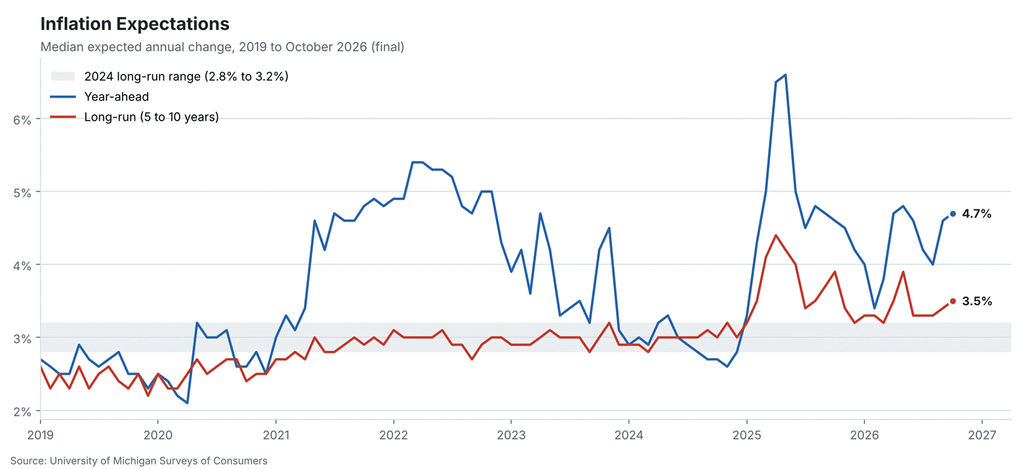
- 1-Year Inflation: 4.7% (preliminary 4.7%; September 4.6%)
- 5-10 Year Inflation: 3.5% (preliminary 3.5%; September 3.4%)
Executive Summary
- The final read of University of Michigan consumer sentiment for October was revised up to 48.0 from the preliminary 46.3, and above the 46.3 consensus, still though the second-lowest reading on record.
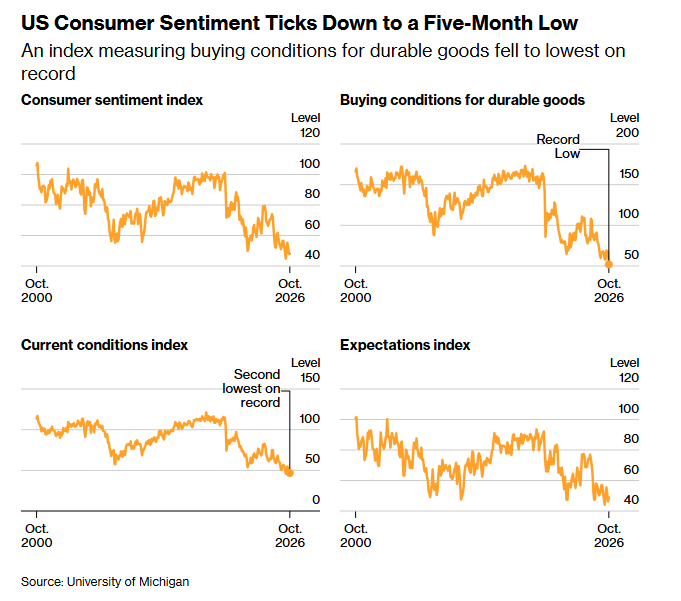
- Current conditions were revised up from a record low of 44.7 in the preliminary report to 46.7, still down 8.3% from September, a decline “driven entirely by buying conditions for durables, which plunged 18%” to a record low, per Bloomberg. Expectations rose 5.4% to 48.8, the highest since August.
- “Purchasing power continues to dominate consumer views of the economy.” Sentiment is 10% below a year ago and 15% below February, just prior to the Iran conflict.
- Year-ahead inflation expectations rose to 4.7% and long-run expectations to 3.5%, both up for a second straight month to the highest since May. A special report released with the survey warned of “risks that elevated inflation expectations could become entrenched,” something that may catch the ear of Fed officials.
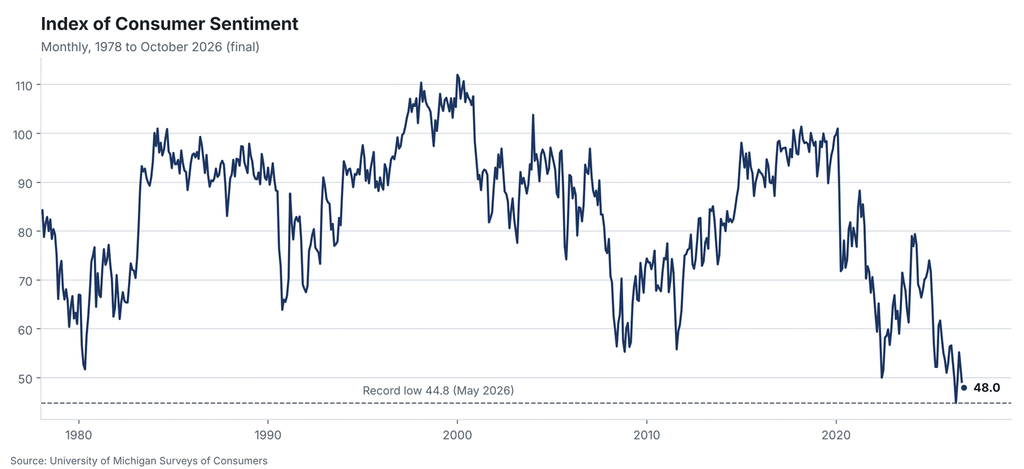
The final read of University of Michigan consumer sentiment for October came in at 48.0, revised up from 46.3 in the preliminary and well above the 46.3 consensus (JPMorgan and Goldman Sachs had both forecast 46.0), topping all estimates in a Bloomberg survey of economists. Per Surveys of Consumers Director Joanne Hsu, via the University of Michigan release, sentiment “held steady this month, registering a scant one-tenth of an index point below September” (48.1). It is still the lowest since May and the second-lowest reading on record, now 3.2 points above the all-time low set in May (44.8). The survey period ran September 22 to October 19.
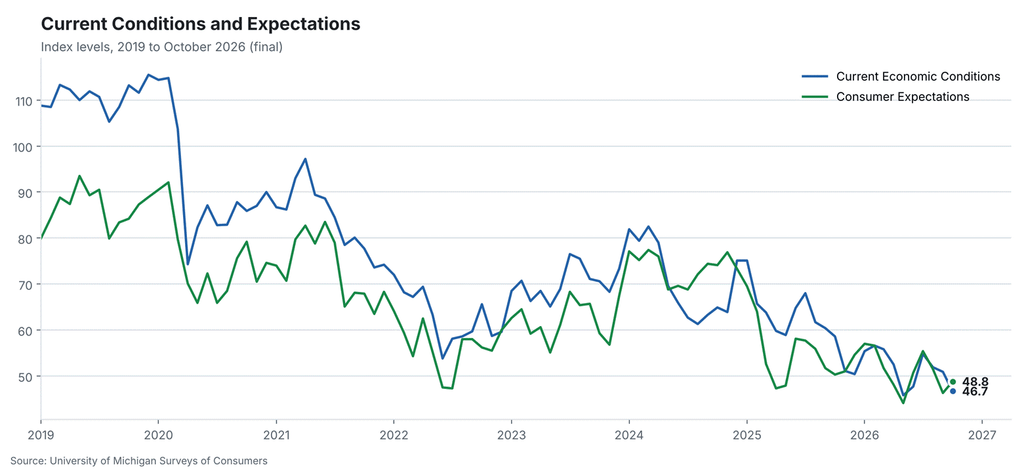
The upward revision came in both components. Current conditions (blue line) were revised up to 46.7 from 44.7 in the preliminary, which had been the lowest on record. The final reading is down 8.3% from 50.9 in September and is the second-lowest on record behind May (45.8). Expectations (green line) were revised up to 48.8 from 47.3, up 5.4% from September’s 46.3 and the highest since August, still though very weak historically.
Independents Again Offset Gains Elsewhere
Hsu: “Increases in sentiment among Republicans and Democrats were balanced by declines among independents. While year-ahead business conditions improved about 14%, they stand 16% less than last October’s read.” Per Bloomberg, sentiment among independents fell for a third straight month. Hsu added that “consumers of all political persuasions agree that inflation is overwhelmingly the greater risk to the economy in the year ahead than unemployment.”
Hsu: “Purchasing power continues to dominate consumer views of the economy. Sentiment is now 10% below a year ago and 15% less than February, just prior to the Iran conflict.”
Durables Buying Conditions Drive Current Conditions Drop
Hsu: “This month’s decline in the Current Conditions subindex was driven entirely by buying conditions for durables, which plunged 18% on the basis of higher interest rates and rising concerns about the affordability of such purchases.” Per Bloomberg, the gauge fell to a record low, and nearly 70% of consumers expect interest rates to rise in the year ahead, the highest in more than three years.
Inflation Expectations Rise for a Second Month
On inflation, per Hsu: “Year-ahead inflation expectations [blue line] ticked up from 4.6% last month to 4.7% this month. The current reading substantially exceeds the 3.4% seen in February before the Iran conflict began, along with all 2024 readings.” That remains below the 6.6% peak in May 2025. Per Bloomberg, consumer prices rose in September at the fastest pace in five months.
Long-run five-to-10-year expectations (red line) “also stepped up from 3.4% in September to 3.5%, notably higher than their 2024 range of 2.8% to 3.2%,” and above the sub-2.8% readings in 2019 and 2020; the peak was 4.4% in April 2025. Per Hsu, “inflation expectations over both time horizons increased for the second straight month to their highest readings since May.”
Special Report: Risks of Entrenchment
The University of Michigan also published a special report by Hsu on long-run inflation expectations. It opens: “After five years of above-target inflation, both short- and long-term inflation expectations have ticked up in recent months, exposing risks that elevated inflation expectations could become entrenched.” The report notes that “the 2024 softening failed to return inflation expectations to its pre-pandemic, pre-inflationary range; current readings are even higher still,” and that “the fact that inflation expectations are currently picking up suggests that consumers do not expect meaningful disinflation for the foreseeable future.”
The risk of inflation expectations becoming entrenched is a reason many of the more hawkish Fed members are pushing for further rate increases per the minutes from the September FOMC.
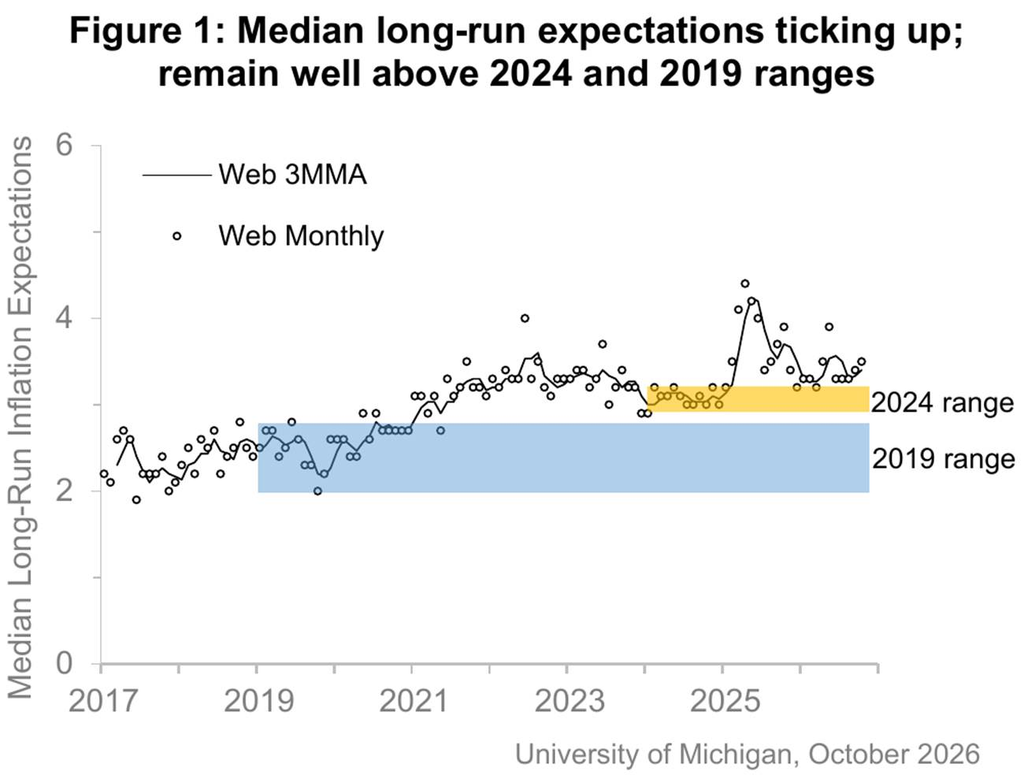
University of Michigan special report, October 23, 2026
Hsu draws a comparison to the 1960s to 1980s, when “with each successive inflationary episode, the trough in expectations was higher than the one prior; each successive escalation in inflation expectations began from a higher base than the episode prior and surged to a higher peak.” She argues the more appropriate analogue for the post-pandemic period is “the initial bout in the late 1960s,” but that “the present situation in 2026 is very different; the 2022 episode has been followed by two major, successive policy shocks that consumers broadly perceive as inflationary.”
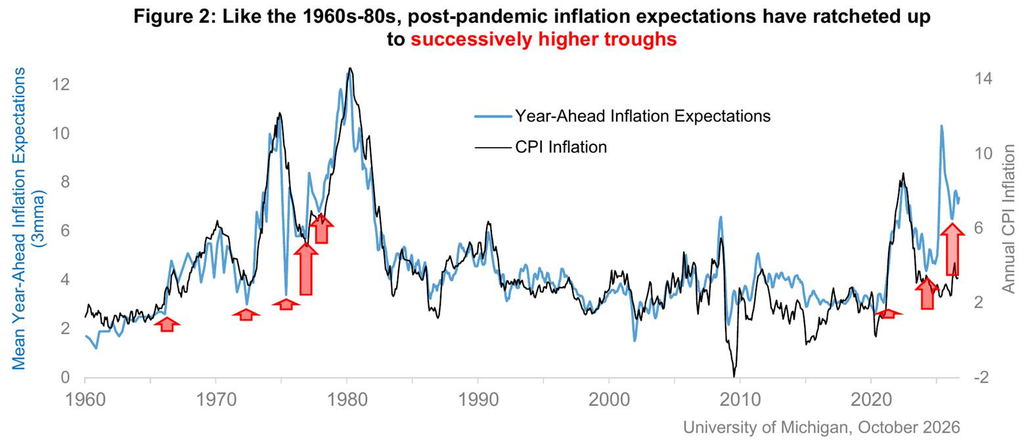
University of Michigan special report, October 23, 2026
The report ties that back to spending: “The fact that aggregate consumer spending has been relatively resilient despite negative views of the economy provides another reason for caution. If part of consumption currently reflects precautionary spending to avoid future price hikes, disinflation may be even more difficult to achieve.”