Flash PMI Holds Near 5-Year High But Prices Jump the Most Since 2022
October flash composite PMI eased to 57.6 on services deceleration but stayed close to September’s five-year high, with new orders at a 4.5-year high.
You've reached your free article limit
You've read 0 of 1 free Pro articles.

US S&P Global Composite PMI: 57.6 (est 57.6; prev 58.4)
— Manufacturing PMI Oct P: 56.0 (est 55.5; prev 55.9)
— Services PMI: 57.9 (est 58.0; prev 58.8)
Executive Summary
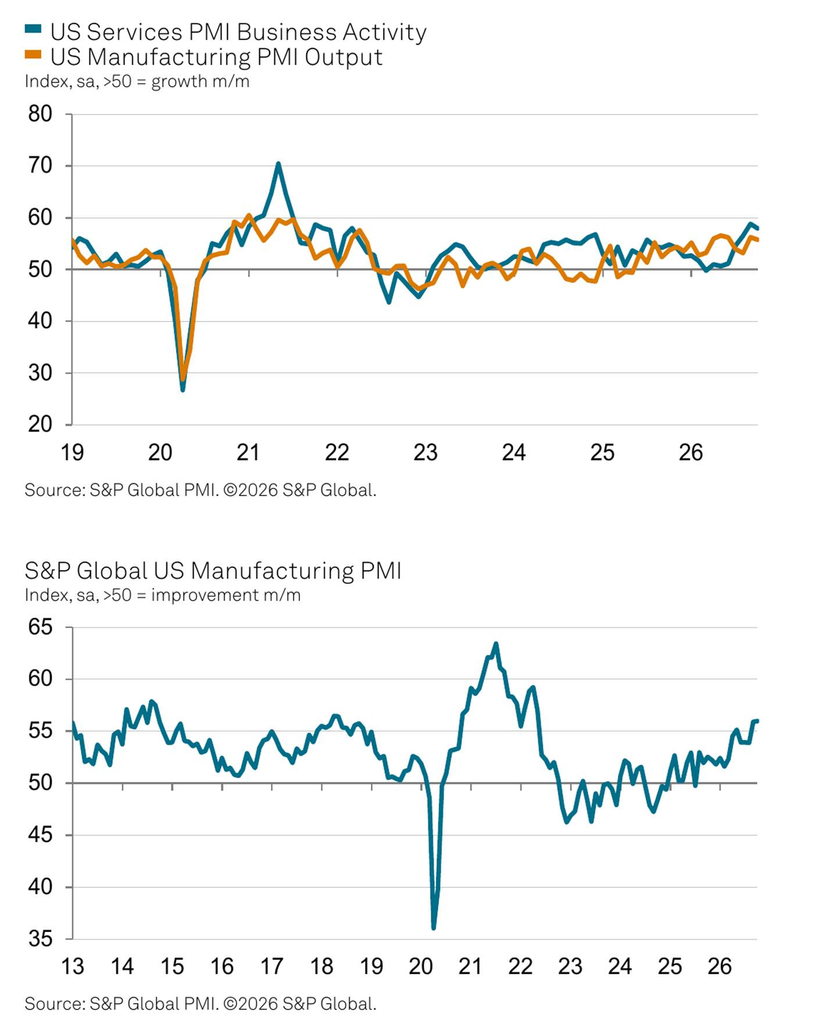
- The October US flash Composite PMI Output Index eased -0.8pts to 57.6, a 2-month low, but still signaled “the second-sharpest increase in activity since March 2022.” The easing was driven by the services sector, which slipped -0.9pts to 57.9, but manufacturing output (used in the composite) also slipped -0.4pts to 55.8, though “in both cases the rates of expansion were among the highest seen over the past five years.” The manufacturing PMI meanwhile ticked up to 56.0, a 53-month high.
- New orders rose to the highest in over four-and-a-half years, and export sales gained “traction, registering the strongest gain since May 2022,” as goods export orders “rose for the first time since June of last year.”
- Hiring was the fastest since June 2022 barring only September, with manufacturing payrolls up the most since March 2012, as backlogs rose the most since May 2022.
- But selling prices rose at the sharpest rate since August 2022 across both goods and services, with input costs the fastest since November 2022 excluding September and supplier delivery times lengthening the most since July 2022.
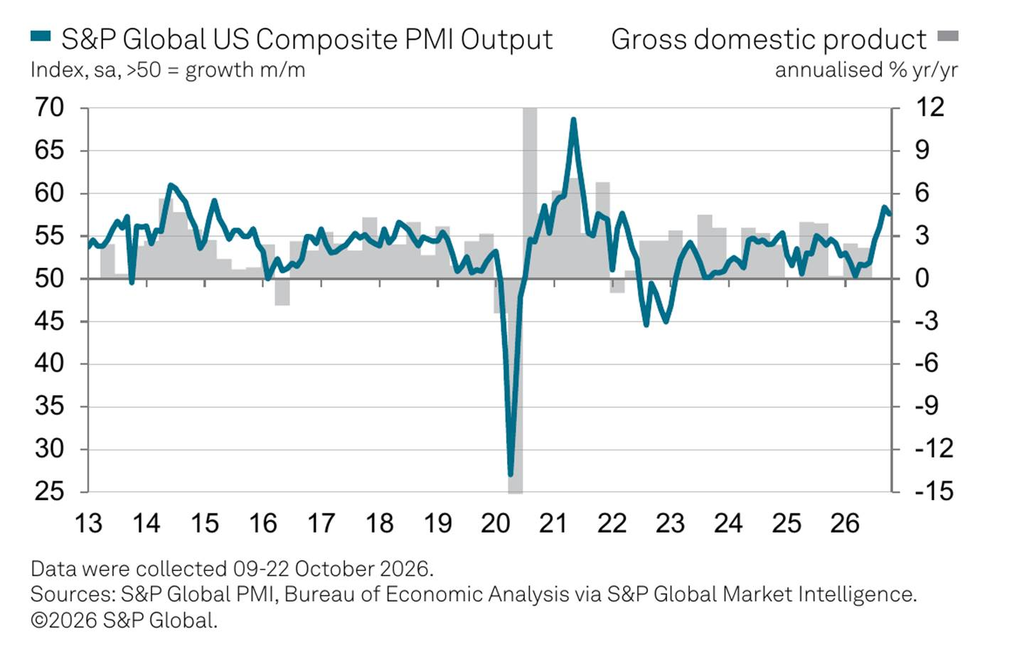
- Per S&P: “The output readings from the survey are consistent with GDP growing at a 5% annualized rate after a 4% expansion was signalled for the third quarter…. If the reopening of the economy after COVID is excluded, recent months have seen the best growth spell for US businesses since early 2015.”
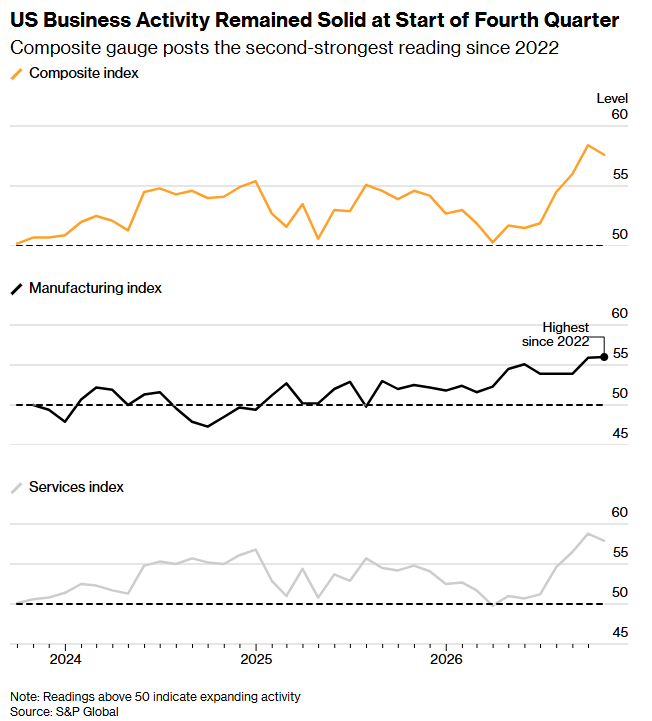
The October US flash Composite PMI Output Index eased -0.8pts to 57.6 from 58.4 in September, a 2-month low but “firmly in strong growth territory” and signaling “the second-sharpest increase in activity since March 2022.” It is the 45th month of expansion.
The easing was driven by the services sector, which slipped -0.9pts to 57.9, but manufacturing output (used in the composite) also slipped -0.4pts to 55.8. S&P noted, though, that “in both cases the rates of expansion were among the highest seen over the past five years.” The manufacturing PMI edged up +0.1pts to 56.0, a 53-month high and “the strongest improvement in operating conditions since May 2022.”
Looking at the components:
Output slowed in both sectors but, alongside new orders, “remained elevated to register sustained strong expansions.”
New Orders rose to the highest in over four-and-a-half years, though the sectors diverged opposite to the headline PMIs — “a weakened rate of increase in manufacturing new orders contrasted with an improved rate of growth of services new business to the strongest since March 2022,” with the upturn “again principally a reflection of rising domestic demand, boosted partly by precautionary stock building.”
Sentiment cooled from September but was “still the second highest seen this year,” again diverging by sector, this time the other way — “A paring-back of optimism in the services economy was countered, however, by a marked improvement in sentiment in the manufacturing sector…factory confidence has more or less returned to its long-run average. In contrast, service providers’ sentiment remained well below its trend level amid worries over the cost-of-living, higher borrowing costs and political uncertainty.”
Exports turned up in both sectors, with export sales gaining “traction, registering the strongest gain since May 2022” — “Export orders for goods rose for the first time since June of last year, accompanied by the largest rise in services exports since July 2023.”
Backlogs rose the most since May 2022, accumulating “at stronger rates in both manufacturing and services.”
Employment rose at the fastest rate since June 2022 “barring only the jump in payrolls reported in September,” as rising backlogs “again encouraged firms to take on more staff” — “Both service sector and manufacturing payrolls increased, the latter notably at the fastest rate since March 2012, while the service sector jobs gain was below that seen in September but still the third largest for over four years.”
Supply Chains saw delivery times lengthen the most since July 2022 “amid material shortages, low stock levels, overloaded suppliers, labour shortages, rising back orders and shipping or import delays,” while manufacturers’ “input inventories rose at the fastest rate for four months.”
Selling Prices rose at the sharpest rate since August 2022, with the upturn “broad-based” — “while services inflation edged up to the steepest since August 2022, manufacturers’ selling prices rose at a pace not seen since July 2022, with the rate of inflation accelerating markedly.”
Input Prices rose at the fastest pace since November 2022 “excluding only the rise seen in September,” with the surge “most prominent in manufacturing” — “Respondents commonly cited oil-based inputs, energy, fuel and freight rates as having pushed costs higher, but various other raw materials including steel, aluminum and copper were also up in price, often due to tariffs or shortages…Service providers also widely noted higher wage rates and increased utility and insurance costs.”
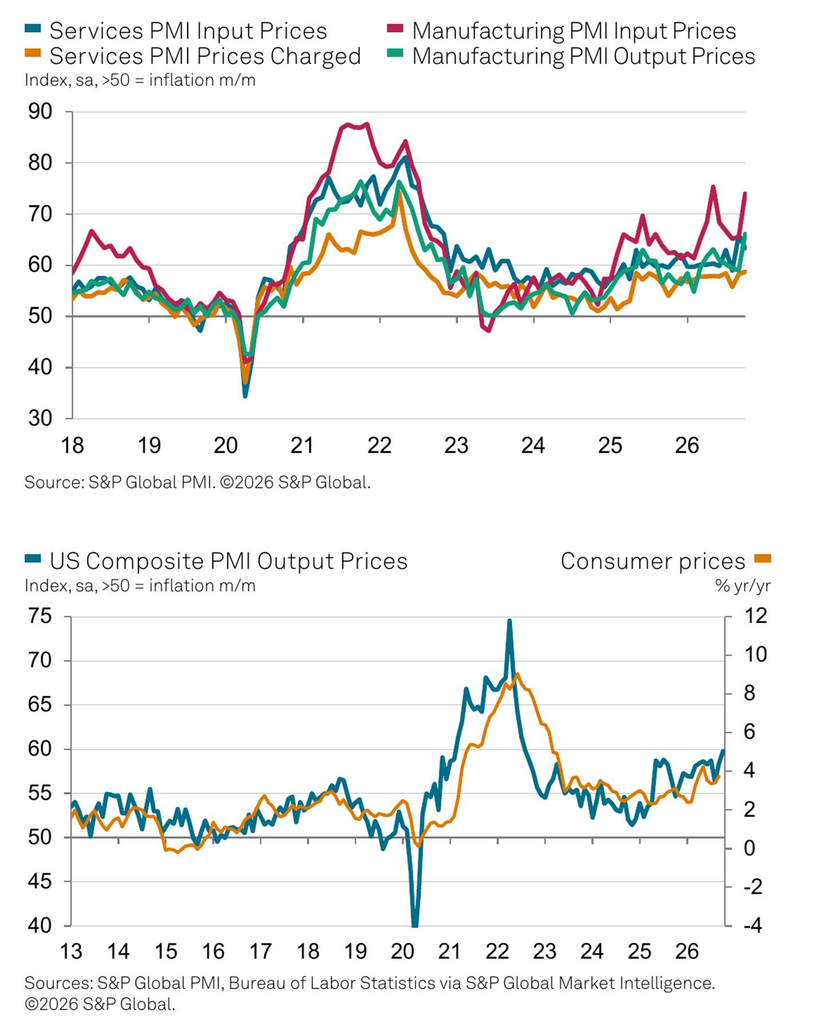
Comments from Chris Williamson, Chief Business Economist at S&P Global Market Intelligence, who notes the survey is consistent with GDP growing at a 5% annualized rate at the start of the fourth quarter after 4% in the third, but warns selling prices point to consumer price inflation rising further above the Fed’s target:
“October’s flash PMI data indicate that the US economy continues to boom at the start of the fourth quarter. The output readings from the survey are consistent with GDP growing at a 5% annualized rate after a 4% expansion was signalled for the third quarter. Especially healthy corporate earnings and profits are also indicated, and hiring has surged as companies seek to boost capacity to fulfil stronger customer demand.
“If the reopening of the economy after COVID is excluded, recent months have seen the best growth spell for US businesses since early 2015.
“However, cost pressures remain a key concern, notably as the renewed surge in oil prices reverberates through to impact a wide variety of goods and services. Supply chain bottlenecks have meanwhile intensified, and order book backlogs are growing, making it easier for companies to pass higher costs on to customers. The result is the sharpest increase in selling prices for over four years to a pace that indicates consumer price inflation is likely to rise further above the Fed’s target in the coming months.”